sensor NISSAN PICK-UP 2001 Owner's Guide
[x] Cancel search | Manufacturer: NISSAN, Model Year: 2001, Model line: PICK-UP, Model: NISSAN PICK-UP 2001Pages: 1306, PDF Size: 31.7 MB
Page 50 of 1306

Mixture Ratio Feedback Control (Closed loop control)NEEC0014S04
SEC303D
The mixture ratio feedback system provides the best air-fuel mixture ratio for driveability and emission con-
trol. The three way catalyst can then better reduce CO, HC and NOx emissions. This system uses a heated
oxygen sensor 1 in the exhaust manifold to monitor if the engine operation is rich or lean. The ECM adjusts
the injection pulse width according to the sensor voltage signal. For more information about the heated oxy-
gen sensor 1, refer to EC-3213. This maintains the mixture ratio within the range of stoichiometric (ideal air-
fuel mixture).
This stage is referred to as the closed loop control condition.
Heated oxygen sensor 2 is located downstream of the three way catalyst. Even if the switching characteris-
tics of the heated oxygen sensor 1 shift, the air-fuel ratio is controlled to stoichiometric by the signal from the
heated oxygen sensor 2.
Open Loop ControlNEEC0014S05The open loop system condition refers to when the ECM detects any of the following conditions. Feedback
control stops in order to maintain stabilized fuel combustion.
+Deceleration and acceleration
+High-load, high-speed operation
+Malfunction of heated oxygen sensor 1 or its circuit
+Insufficient activation of heated oxygen sensor 1 at low engine coolant temperature
+High engine coolant temperature
+During warm-up
+When starting the engine
Mixture Ratio Self-learning ControlNEEC0014S06The mixture ratio feedback control system monitors the mixture ratio signal transmitted from the heated oxy-
gen sensor 1. This feedback signal is then sent to the ECM. The ECM controls the basic mixture ratio as close
to the theoretical mixture ratio as possible. However, the basic mixture ratio is not necessarily controlled as
originally designed. Both manufacturing differences (i.e., mass air flow sensor hot film) and characteristic
changes during operation (i.e., injector clogging) directly affect mixture ratio.
Accordingly, the difference between the basic and theoretical mixture ratios is monitored in this system. This
is then computed in terms of ªinjection pulse durationº to automatically compensate for the difference between
the two ratios.
ªFuel trimº refers to the feedback compensation value compared against the basic injection duration. Fuel trim
includes short term fuel trim and long term fuel trim.
ªShort term fuel trimº is the short-term fuel compensation used to maintain the mixture ratio at its theoretical
value. The signal from the heated oxygen sensor 1 indicates whether the mixture ratio is RICH or LEAN com-
pared to the theoretical value. The signal then triggers a reduction in fuel volume if the mixture ratio is rich,
and an increase in fuel volume if it is lean.
ªLong term fuel trimº is overall fuel compensation carried out long-term to compensate for continual deviation
of the short term fuel trim from the central value. Such deviation will occur due to individual engine differences,
wear over time and changes in the usage environment.
ENGINE AND EMISSION BASIC CONTROL SYSTEM
DESCRIPTION
KA24DE (EURO OBD)
Multiport Fuel Injection (MFI) System
EC-3025
Page 51 of 1306
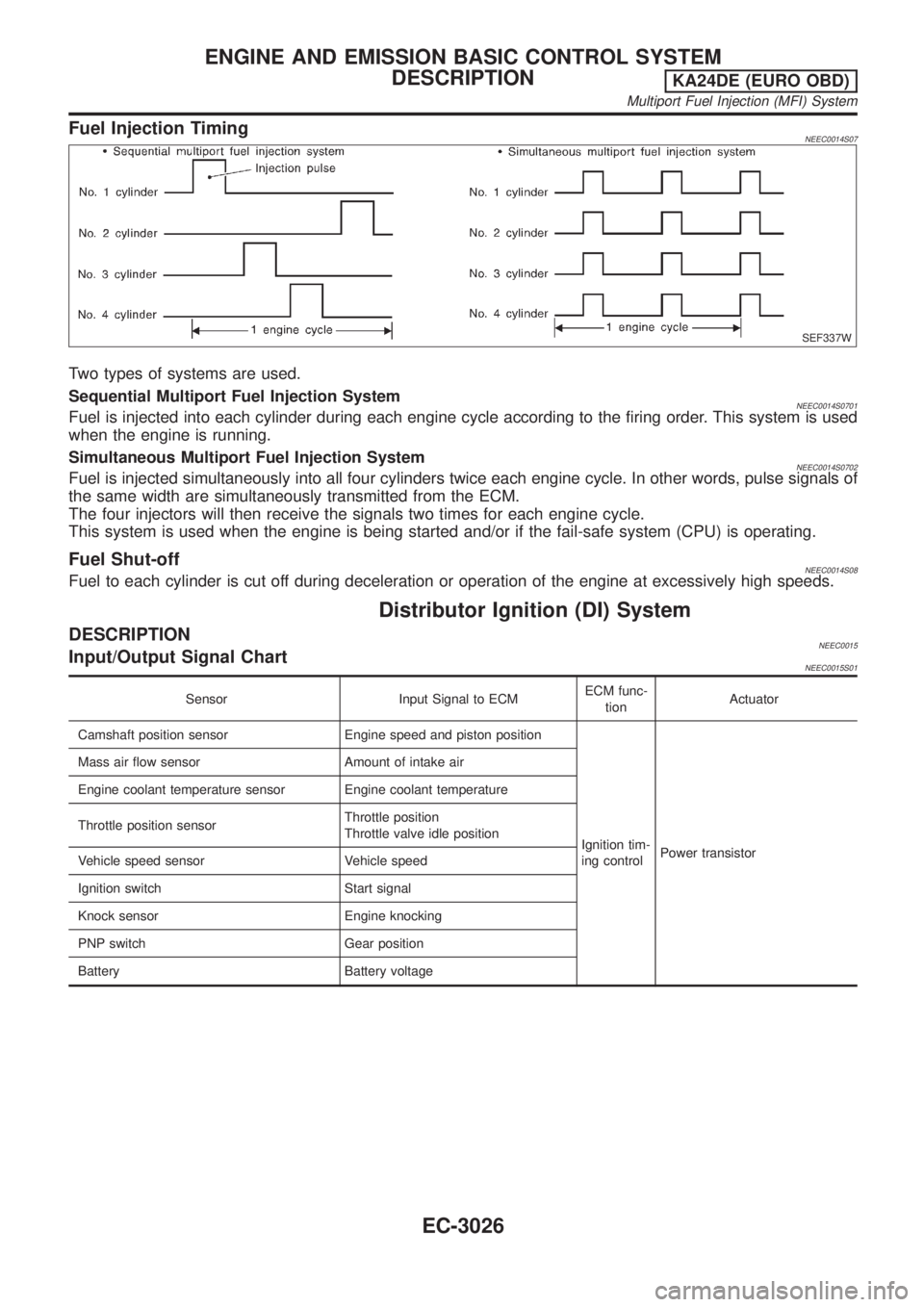
Fuel Injection TimingNEEC0014S07
SEF337W
Two types of systems are used.
Sequential Multiport Fuel Injection System
NEEC0014S0701Fuel is injected into each cylinder during each engine cycle according to the firing order. This system is used
when the engine is running.
Simultaneous Multiport Fuel Injection System
NEEC0014S0702Fuel is injected simultaneously into all four cylinders twice each engine cycle. In other words, pulse signals of
the same width are simultaneously transmitted from the ECM.
The four injectors will then receive the signals two times for each engine cycle.
This system is used when the engine is being started and/or if the fail-safe system (CPU) is operating.
Fuel Shut-offNEEC0014S08Fuel to each cylinder is cut off during deceleration or operation of the engine at excessively high speeds.
Distributor Ignition (DI) System
DESCRIPTIONNEEC0015Input/Output Signal ChartNEEC0015S01
Sensor Input Signal to ECMECM func-
tionActuator
Camshaft position sensor Engine speed and piston position
Ignition tim-
ing controlPower transistor Mass air flow sensor Amount of intake air
Engine coolant temperature sensor Engine coolant temperature
Throttle position sensorThrottle position
Throttle valve idle position
Vehicle speed sensor Vehicle speed
Ignition switch Start signal
Knock sensor Engine knocking
PNP switch Gear position
Battery Battery voltage
ENGINE AND EMISSION BASIC CONTROL SYSTEM
DESCRIPTION
KA24DE (EURO OBD)
Multiport Fuel Injection (MFI) System
EC-3026
Page 52 of 1306
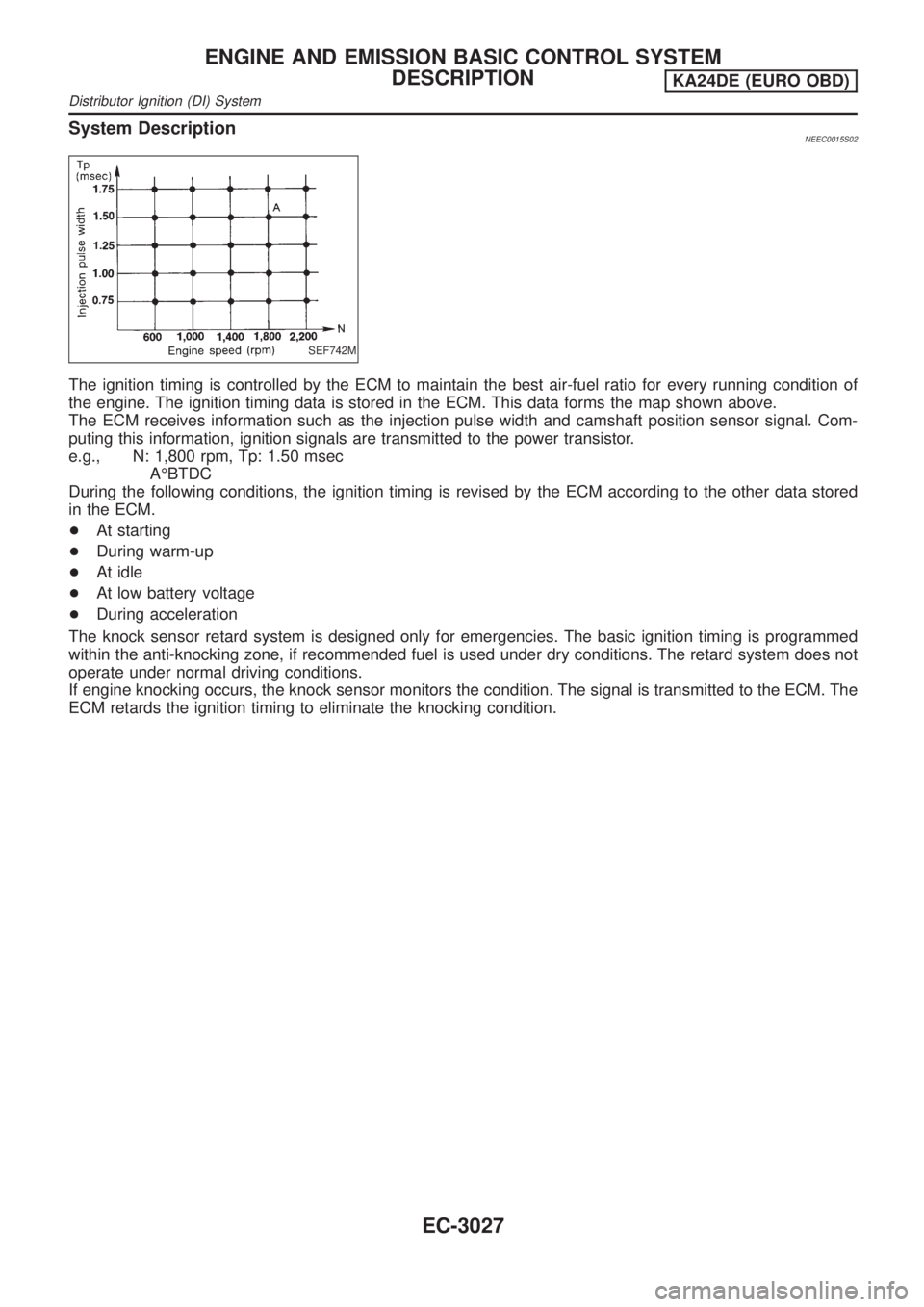
System DescriptionNEEC0015S02
SEF742M
The ignition timing is controlled by the ECM to maintain the best air-fuel ratio for every running condition of
the engine. The ignition timing data is stored in the ECM. This data forms the map shown above.
The ECM receives information such as the injection pulse width and camshaft position sensor signal. Com-
puting this information, ignition signals are transmitted to the power transistor.
e.g., N: 1,800 rpm, Tp: 1.50 msec
AÉBTDC
During the following conditions, the ignition timing is revised by the ECM according to the other data stored
in the ECM.
+At starting
+During warm-up
+At idle
+At low battery voltage
+During acceleration
The knock sensor retard system is designed only for emergencies. The basic ignition timing is programmed
within the anti-knocking zone, if recommended fuel is used under dry conditions. The retard system does not
operate under normal driving conditions.
If engine knocking occurs, the knock sensor monitors the condition. The signal is transmitted to the ECM. The
ECM retards the ignition timing to eliminate the knocking condition.
ENGINE AND EMISSION BASIC CONTROL SYSTEM
DESCRIPTION
KA24DE (EURO OBD)
Distributor Ignition (DI) System
EC-3027
Page 53 of 1306
Air Conditioning Cut Control
DESCRIPTION=NEEC0016Input/Output Signal ChartNEEC0016S01
Sensor Input Signal to ECMECM func-
tionActuator
Air conditioner switch Air conditioner ªONº signal
Air condi-
tioner cut
controlAir conditioner relay Throttle position sensor Throttle valve opening angle
Camshaft position sensor Engine speed
Engine coolant temperature sensor Engine coolant temperature
Ignition switch Start signal
Vehicle speed sensor Vehicle speed
Power steering oil pressure switch Power steering operation
System DescriptionNEEC0016S02This system improves engine operation when the air conditioner is used.
Under the following conditions, the air conditioner is turned off.
+When the accelerator pedal is fully depressed.
+When cranking the engine.
+When the engine coolant temperature becomes excessively high.
+When operating power steering and air conditioner during low engine speed or when fully releasing accel-
erator pedal.
+When engine speed is excessively low.
Fuel Cut Control (at no load & high engine
speed)
DESCRIPTIONNEEC0017Input/Output Signal ChartNEEC0017S01
Sensor Input Signal to ECMECM func-
tionActuator
Vehicle speed sensor Vehicle speed
Fuel cut
controlInjectors PNP switch Neutral position
Throttle position sensor Throttle position
Camshaft position sensor Engine speed
If the engine speed is above 3,000 rpm with no load, (for example, in Neutral and engine speed over 3,000
rpm) fuel will be cut off after some time. The exact time when the fuel is cut off varies based on engine speed.
Fuel cut will operate until the engine speed reaches 1,500 rpm, then fuel cut is cancelled.
NOTE:
This function is different from deceleration control listed under ªMultiport Fuel Injection (MFI) Systemº,
EC-3024.
ENGINE AND EMISSION BASIC CONTROL SYSTEM
DESCRIPTION
KA24DE (EURO OBD)
Air Conditioning Cut Control
EC-3028
Page 62 of 1306
INSPECTION PROCEDURE=NEEC0028S02
1 INSPECTION START
1. Visually check the following:
+Air cleaner clogging
+Hoses and duct for leaks
+Electrical connectors
+Gasket (intake manifold, cylinder head, exhaust system)
+Throttle valve and throttle position sensor operation
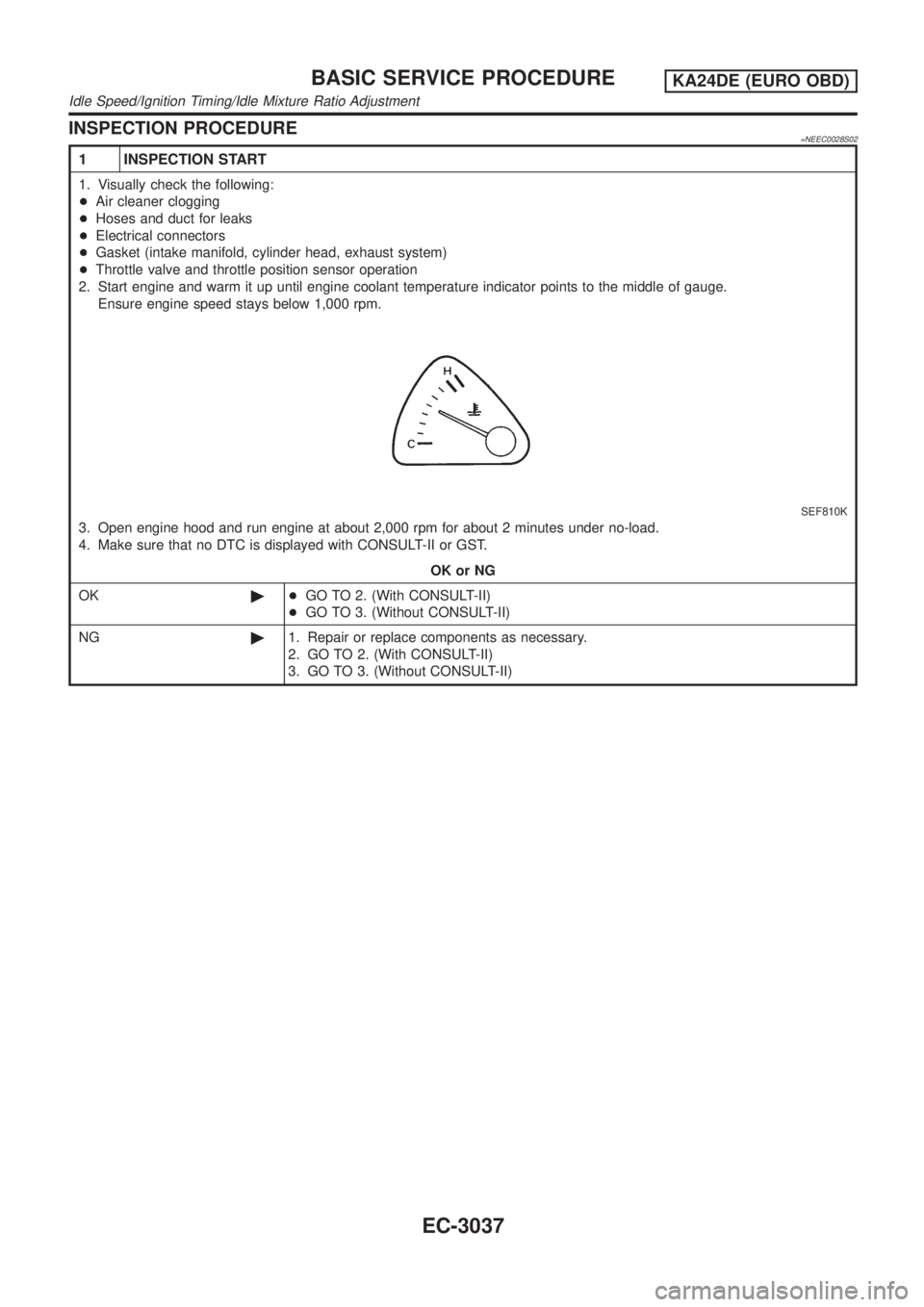
2. Start engine and warm it up until engine coolant temperature indicator points to the middle of gauge.
Ensure engine speed stays below 1,000 rpm.
SEF810K
3. Open engine hood and run engine at about 2,000 rpm for about 2 minutes under no-load.
4. Make sure that no DTC is displayed with CONSULT-II or GST.
OK or NG
OK©+GO TO 2. (With CONSULT-II)
+GO TO 3. (Without CONSULT-II)
NG©1. Repair or replace components as necessary.
2. GO TO 2. (With CONSULT-II)
3. GO TO 3. (Without CONSULT-II)
BASIC SERVICE PROCEDUREKA24DE (EURO OBD)
Idle Speed/Ignition Timing/Idle Mixture Ratio Adjustment
EC-3037
Page 64 of 1306
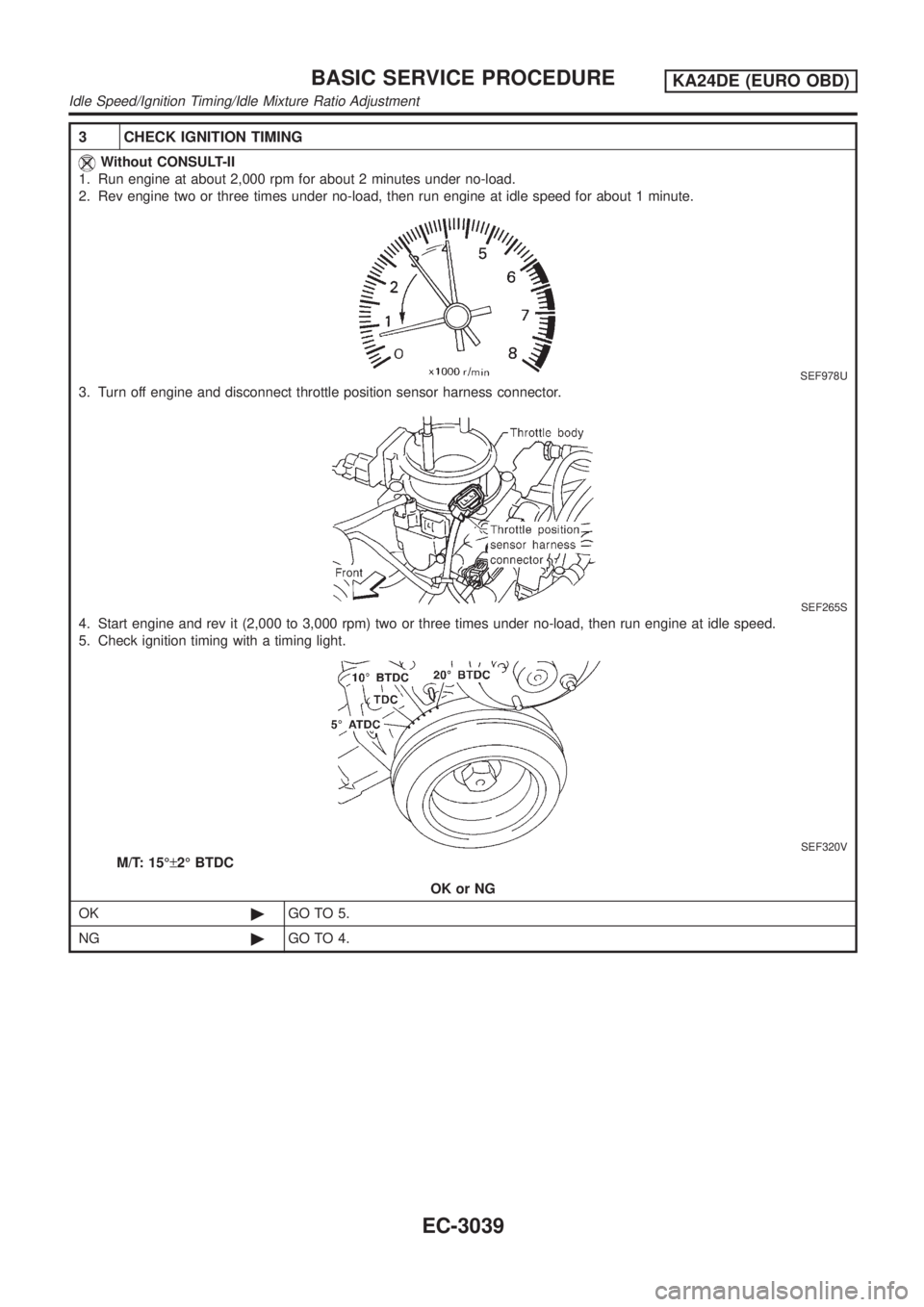
3 CHECK IGNITION TIMING
Without CONSULT-II
1. Run engine at about 2,000 rpm for about 2 minutes under no-load.
2. Rev engine two or three times under no-load, then run engine at idle speed for about 1 minute.
SEF978U
3. Turn off engine and disconnect throttle position sensor harness connector.
SEF265S
4. Start engine and rev it (2,000 to 3,000 rpm) two or three times under no-load, then run engine at idle speed.
5. Check ignition timing with a timing light.
SEF320V
M/T: 15ɱ2É BTDC
OK or NG
OK©GO TO 5.
NG©GO TO 4.
BASIC SERVICE PROCEDUREKA24DE (EURO OBD)
Idle Speed/Ignition Timing/Idle Mixture Ratio Adjustment
EC-3039
Page 65 of 1306
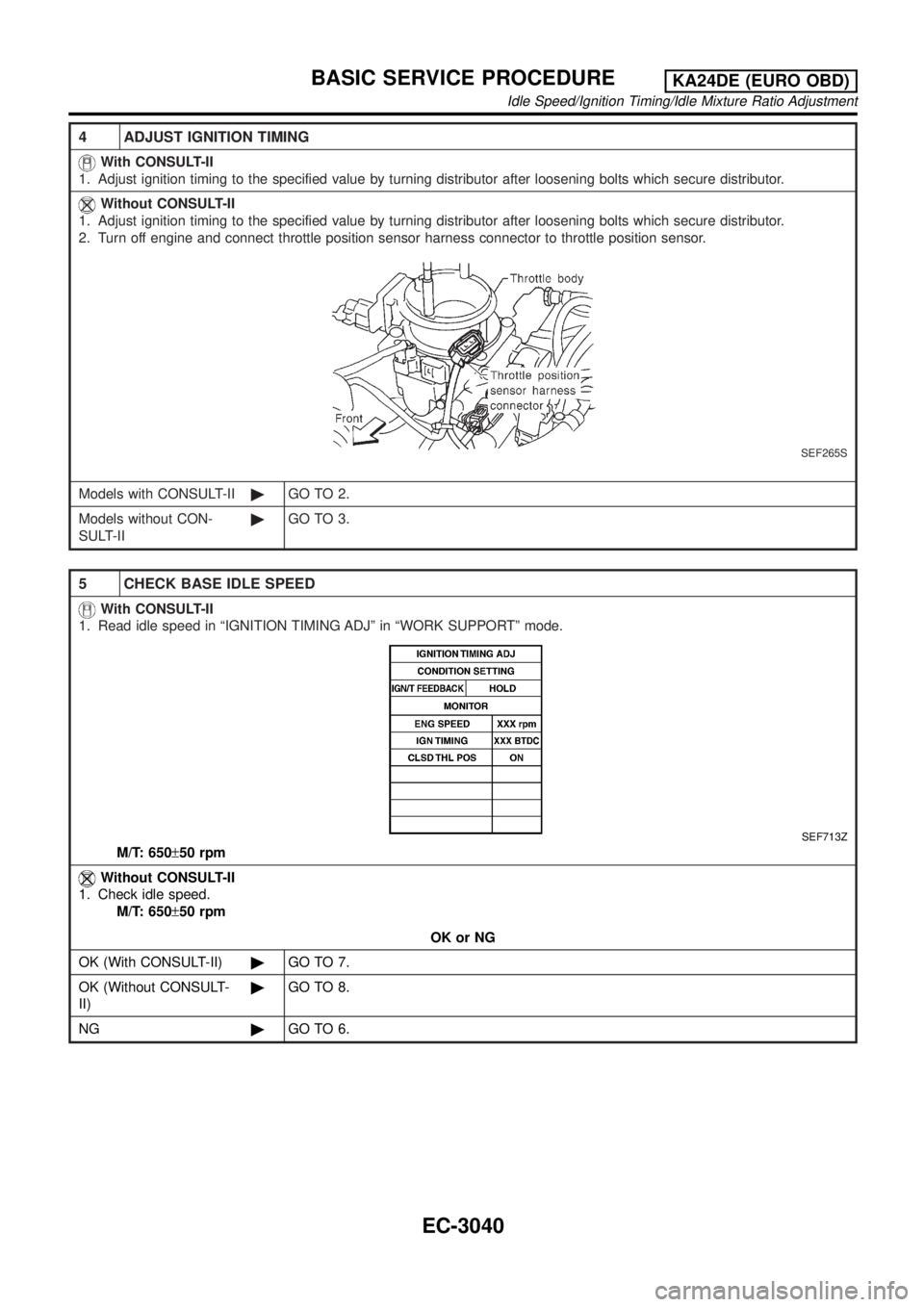
4 ADJUST IGNITION TIMING
With CONSULT-II
1. Adjust ignition timing to the specified value by turning distributor after loosening bolts which secure distributor.
Without CONSULT-II
1. Adjust ignition timing to the specified value by turning distributor after loosening bolts which secure distributor.
2. Turn off engine and connect throttle position sensor harness connector to throttle position sensor.
SEF265S
Models with CONSULT-II©GO TO 2.
Models without CON-
SULT-II©GO TO 3.
5 CHECK BASE IDLE SPEED
With CONSULT-II
1. Read idle speed in ªIGNITION TIMING ADJº in ªWORK SUPPORTº mode.
SEF713Z
M/T: 650±50 rpm
Without CONSULT-II
1. Check idle speed.
M/T: 650±50 rpm
OK or NG
OK (With CONSULT-II)©GO TO 7.
OK (Without CONSULT-
II)©GO TO 8.
NG©GO TO 6.
BASIC SERVICE PROCEDUREKA24DE (EURO OBD)
Idle Speed/Ignition Timing/Idle Mixture Ratio Adjustment
EC-3040
Page 67 of 1306
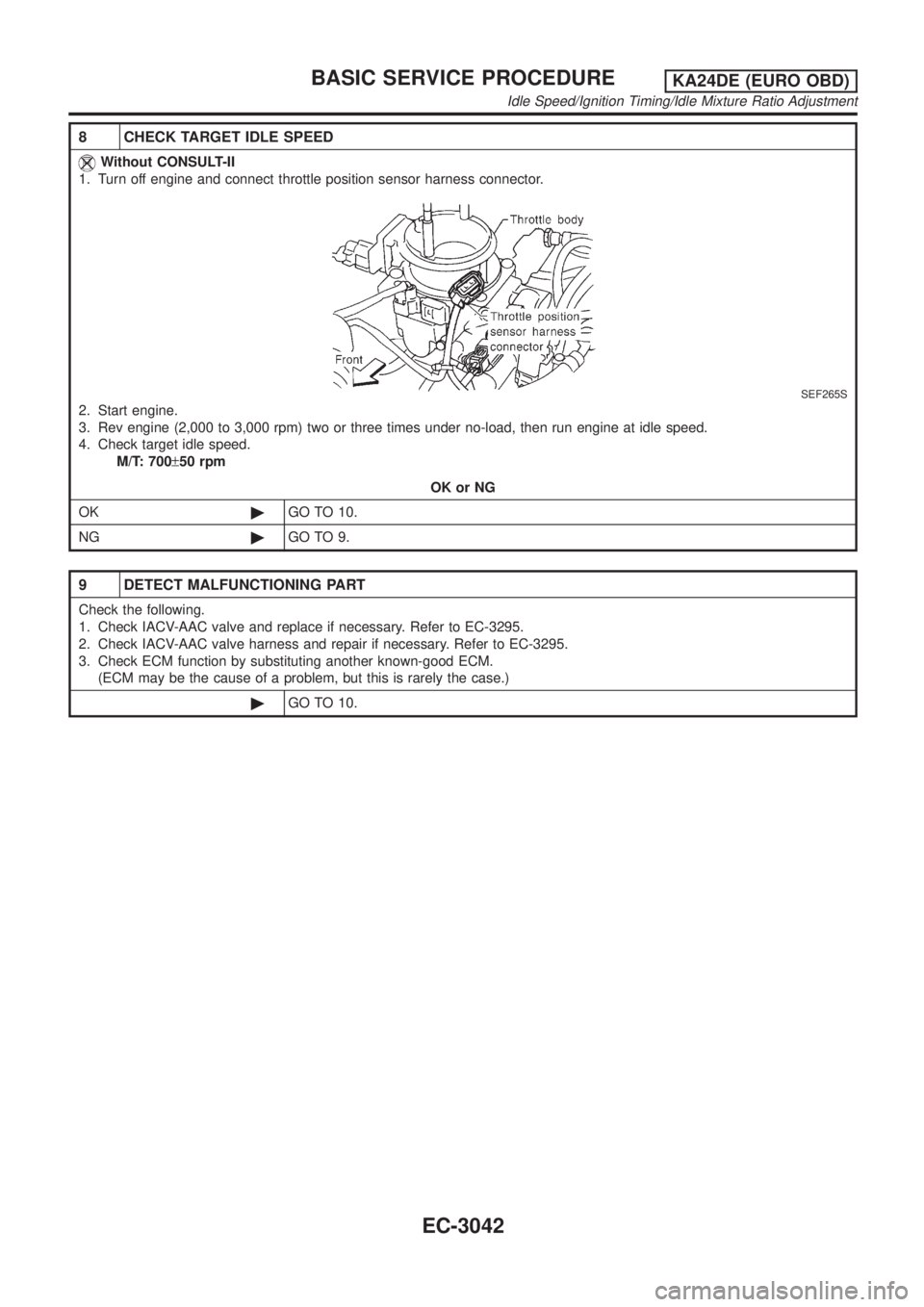
8 CHECK TARGET IDLE SPEED
Without CONSULT-II
1. Turn off engine and connect throttle position sensor harness connector.
SEF265S
2. Start engine.
3. Rev engine (2,000 to 3,000 rpm) two or three times under no-load, then run engine at idle speed.
4. Check target idle speed.
M/T: 700±50 rpm
OK or NG
OK©GO TO 10.
NG©GO TO 9.
9 DETECT MALFUNCTIONING PART
Check the following.
1. Check IACV-AAC valve and replace if necessary. Refer to EC-3295.
2. Check IACV-AAC valve harness and repair if necessary. Refer to EC-3295.
3. Check ECM function by substituting another known-good ECM.
(ECM may be the cause of a problem, but this is rarely the case.)
©GO TO 10.
BASIC SERVICE PROCEDUREKA24DE (EURO OBD)
Idle Speed/Ignition Timing/Idle Mixture Ratio Adjustment
EC-3042
Page 68 of 1306
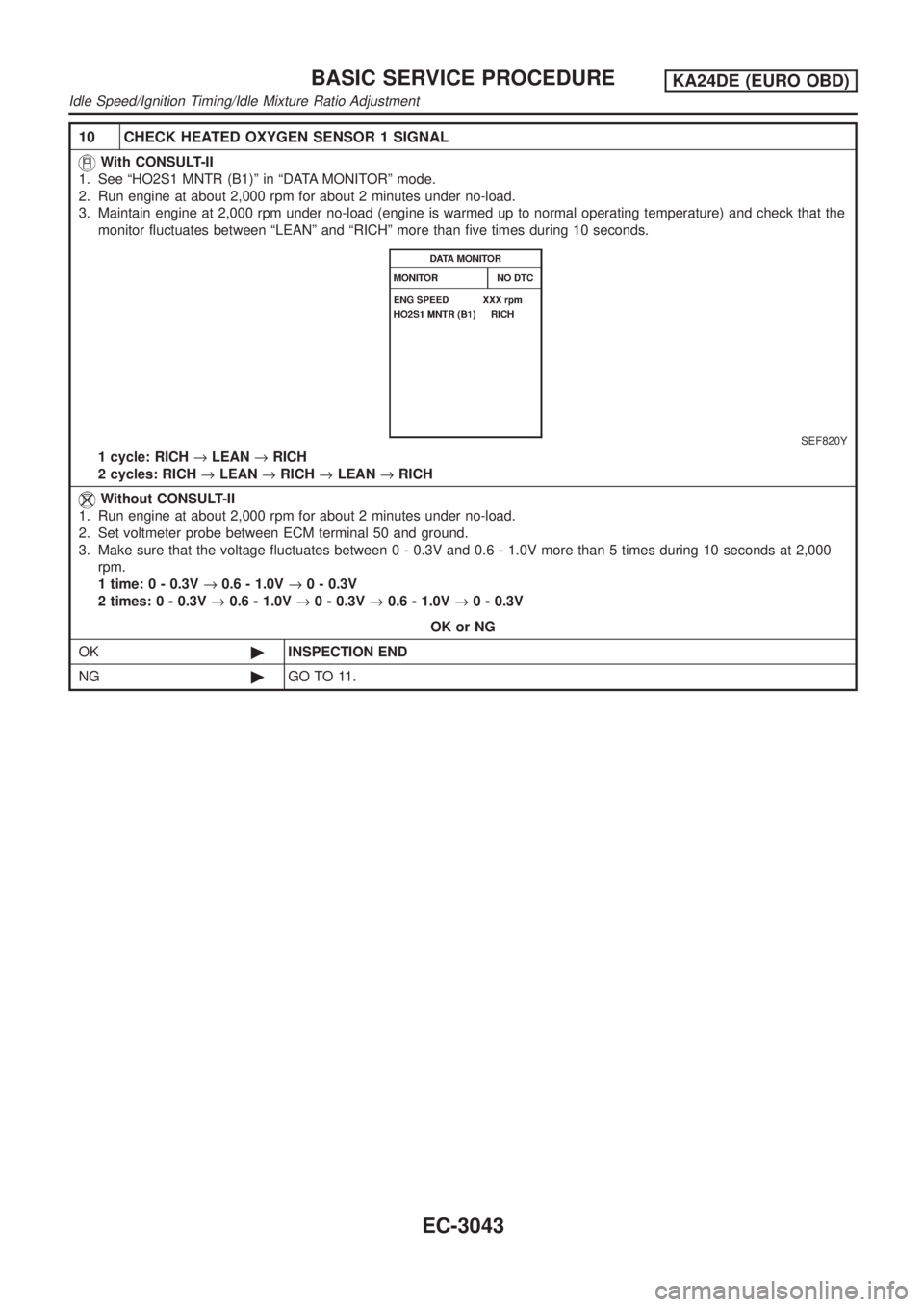
10 CHECK HEATED OXYGEN SENSOR 1 SIGNAL
With CONSULT-II
1. See ªHO2S1 MNTR (B1)º in ªDATA MONITORº mode.
2. Run engine at about 2,000 rpm for about 2 minutes under no-load.
3. Maintain engine at 2,000 rpm under no-load (engine is warmed up to normal operating temperature) and check that the
monitor fluctuates between ªLEANº and ªRICHº more than five times during 10 seconds.
SEF820Y
1 cycle: RICH®LEAN®RICH
2 cycles: RICH®LEAN®RICH®LEAN®RICH
Without CONSULT-II
1. Run engine at about 2,000 rpm for about 2 minutes under no-load.
2. Set voltmeter probe between ECM terminal 50 and ground.
3. Make sure that the voltage fluctuates between 0 - 0.3V and 0.6 - 1.0V more than 5 times during 10 seconds at 2,000
rpm.
1 time: 0 - 0.3V®0.6 - 1.0V®0 - 0.3V
2 times: 0 - 0.3V®0.6 - 1.0V®0 - 0.3V®0.6 - 1.0V®0 - 0.3V
OK or NG
OK©INSPECTION END
NG©GO TO 11.
BASIC SERVICE PROCEDUREKA24DE (EURO OBD)
Idle Speed/Ignition Timing/Idle Mixture Ratio Adjustment
EC-3043
Page 69 of 1306

11 CHECK HEATED OXYGEN SENSOR 1 HARNESS
1. Turn off engine and disconnect battery ground cable.
2. Disconnect ECM harness connector.
3. Disconnect heated oxygen sensor 1 harness connector.
4. Then connect harness connector terminal for heated oxygen sensor 1 to ground with a jumper wire.
SEC299D
5. Check for continuity between terminal 50 of ECM harness connector and body ground.
SEF250P
Continuity exists...OK
Continuity does not exist...NG
OK or NG
OK©1. Connect ECM harness connector to ECM.
2. Connect battery ground cable.
3. GO TO 13.
NG©1. Repair or replace harness.
2. GO TO 12.
BASIC SERVICE PROCEDUREKA24DE (EURO OBD)
Idle Speed/Ignition Timing/Idle Mixture Ratio Adjustment
EC-3044