fuel cap NISSAN PULSAR 1987 User Guide
[x] Cancel search | Manufacturer: NISSAN, Model Year: 1987, Model line: PULSAR, Model: NISSAN PULSAR 1987Pages: 238, PDF Size: 28.91 MB
Page 92 of 238
92 Fuel and Engine Management
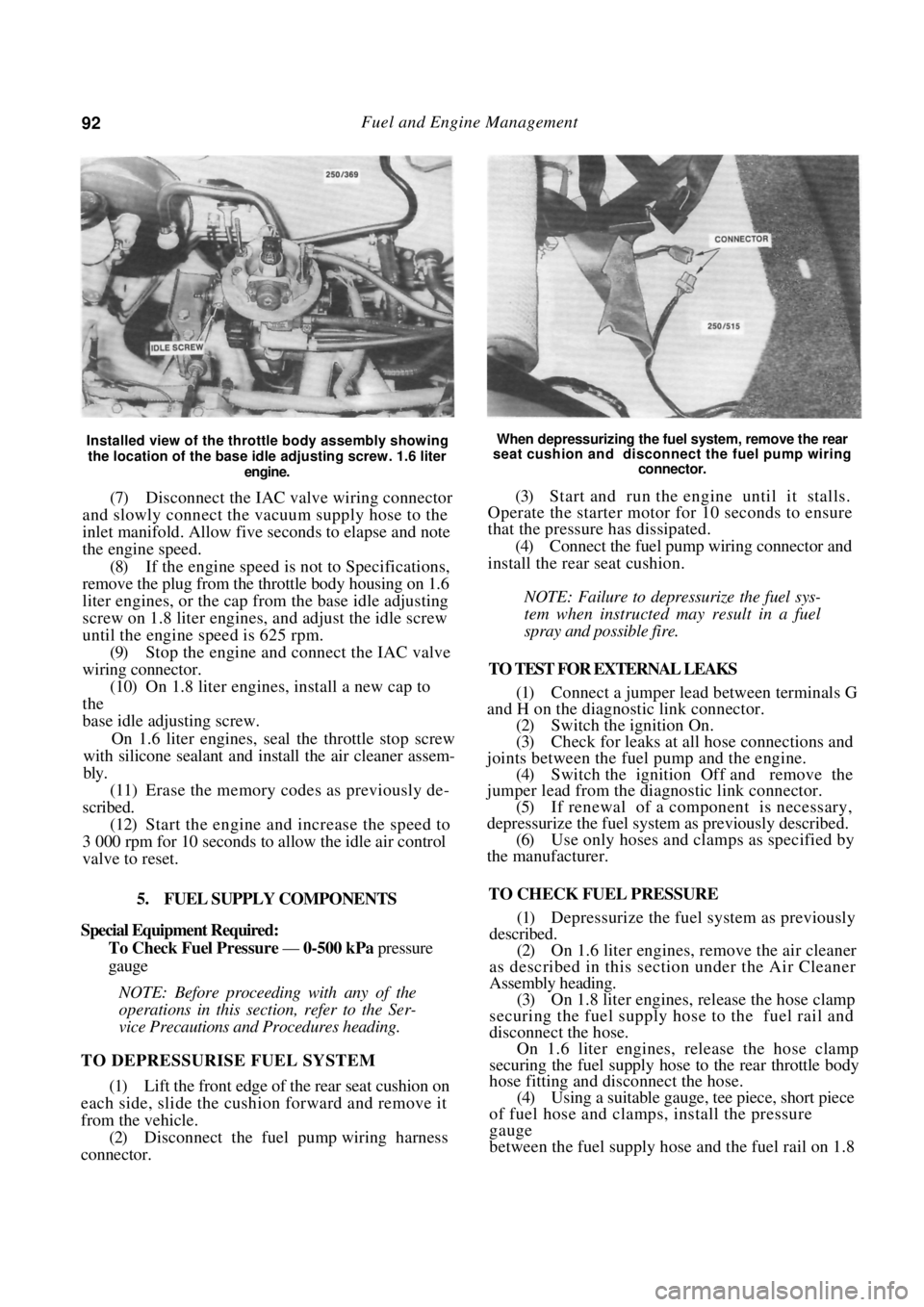
Installed view of the throttle body assembly showing
the location of the base idle adjusting screw. 1.6 liter
engine.
(7) Disconnect the IAC valve wiring connector
and slowly connect the vacuum supply hose to the
inlet manifold. Allow five seconds to elapse and note
the engine speed.
(8) If the engine speed is not to Specifications,
remove the plug from the throttle body housing on 1.6
liter engines, or the cap from the base idle adjusting
screw on 1.8 liter engines, and adjust the idle screw
until the engine speed is 625 rpm. (9) Stop the engine and connect the IAC valve
wiring connector. (10) On 1.8 liter engines, install a new cap to
the
base idle adjusting screw.
On 1.6 liter engines, seal the throttle stop screw
with silicone sealant and install the air cleaner assem-
bly.
(11) Erase the memory codes as previously de-
scribed.
(12) Start the engine and increase the speed to
3 000 rpm for 10 seconds to allow the idle air control
valve to reset.
5. FUEL SUPPLY COMPONENTS
Special Equipment Required:
To Check Fuel Pressure — 0-500 kPa pressure
gauge
NOTE: Before proceeding with any of the
operations in this section, refer to the Ser-
vice Precautions and Procedures heading.
TO DEPRESSURISE FUEL SYSTEM
(1) Lift the front edge of the rear seat cushion on
each side, slide the cushion forward and remove it
from the vehicle. (2) Disconnect the fuel pump wiring harness
connector.
When depressurizing the fuel system, remove the rear
seat cushion and disconnect the fuel pump wiring
connector.
(3) Start and run the engine until it stalls.
Operate the starter motor for 10 seconds to ensure
that the pressure has dissipated.
(4) Connect the fuel pump wiring connector and
install the rear seat cushion.
NOTE: Failure to depressurize the fuel sys-
tem when instructed may result in a fuel
spray and possible fire.
TO TEST FOR EXTERNAL LEAKS
(1) Connect a jumper lead between terminals G
and H on the diagnostic link connector.
(2) Switch the ignition On.
(3) Check for leaks at all hose connections and
joints between the fuel pump and the engine. (4) Switch the ignition Off and remove the
jumper lead from the diagnostic link connector.
(5) If renewal of a component is necessary,
depressurize the fuel system as previously described. (6) Use only hoses and clamps as specified by
the manufacturer.
TO CHECK FUEL PRESSURE
(1) Depressurize the fuel system as previously
described. (2) On 1.6 liter engines, remove the air cleaner
as described in this section under the Air Cleaner
Assembly heading. (3) On 1.8 liter engines, release the hose clamp
securing the fuel supply hos e to the fuel rail and
disconnect the hose. On 1.6 liter engines, release the hose clamp
securing the fuel supply hose to the rear throttle body
hose fitting and disconnect the hose.
(4) Using a suitable gauge, tee piece, short piece
of fuel hose and clamps, install the pressure
gauge
between the fuel supply ho se and the fuel rail on 1.8
Page 104 of 238
104 Fuel and Engine Management
(3) Gently pull the outer throttle cable until the
inner cable remains taut without moving the throttle
linkage. (4) Install the snap ring into the groove
posi-
tioned second from the insulator.
(5) Depress the throttle pedal and check that the
throttle valve opens fully and returns to the idle
position when the pedal is released. (6) On 1.6 liter engines, install the air
cleaner
assembly.
7. ELECTRONIC COMPONENTS
NOTE: Before proceeding with any of the
operations in this section, refer to the Ser-
vice Precautions and Procedures heading.
TO CHECK IGNITION SYSTEM
(1) Perform the test procedure described in the
Roadside Trouble Shooting section. Repair or renew
components as necessary. (2) Perform the self diagnosis test procedure as
previously described and rectify any faults. If there is
no spark, proceed as follows. (3) Disconnect the 4 pin wiring connector from
the distributor and check for spark at a spark plug
high tension lead using the test spark plug. If there is a spark, renew the pickup coil in the
distributor.
If there is no spark, proceed as follows.
(4) Connect the coil high tension lead to the test
spark plug and check for spark.
If there is a spark, check the distributor cap and
rotor for cracks and moisture. Repair or renew as
necessary.
If there is no spark, proceed as follows.
(5) Disconnect the 2 pin wiring connector from
the distributor. (6) With the ignition switched On. measure the
voltage at terminals A and B on the distributor 2 pin
wiring connector. If the voltage at terminal B only is under 10 volts,
check the wiring harness for continuity between
terminal B on the distributor 2 pin wiring connector
and terminal 2 on the black ignition coil wiring
connector. Repair or renew the wiring harness as
necessary. If no fault is found, renew the ignition coll.
If the voltages at both terminals is under 10 volts,
check the wiring harness between terminal A on the
distributor 2 pin wiring connector and terminal 1 on
the black ignition coil wiring connector for continuity.
Also check the fuel pump fuse and the wiring harness
between the ignition switch and the ignition coil.
Repair or renew the wiring harness as necessary.
If the voltage at both terminals is 10 volts or
more, proceed as follows.
(7) Connect the 2 pin wiring connector to the
distributor. (8) With the ignition switched On, measure the
voltage at the tachometer signal wire.
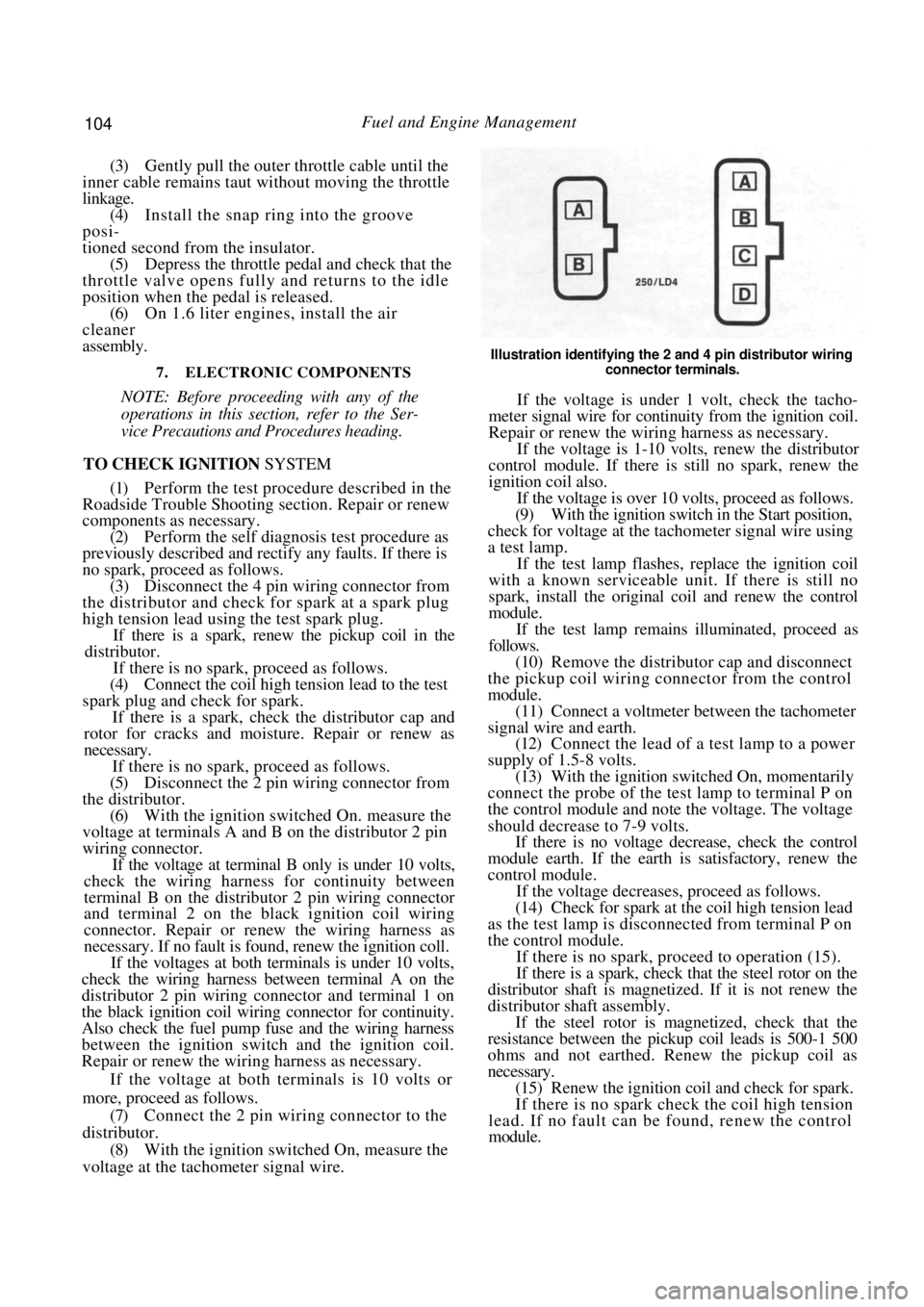
Illustration identifying the 2 and 4 pin distributor wiring
connector terminals.
If the voltage is under 1 volt, check the tacho-
meter signal wire for continuity from the ignition coil.
Repair or renew the wiring harness as necessary.
If the voltage is 1-10 volts, renew the distributor
control module. If there is still no spark, renew the
ignition coil also.
If the voltage is over 10 volts, proceed as follows.
(9) With the ignition switch in the Start position,
check for voltage at the tachometer signal wire using
a test lamp.
If the test lamp flashes, replace the ignition coil
with a known serviceable un it. If there is still no
spark, install the original coil and renew the control
module.
If the test lamp remains illuminated, proceed as
follows.
(10) Remove the distributor cap and disconnect
the pickup coil wiring co nnector from the control
module. (11) Connect a voltmeter between the tachometer
signal wire and earth. (12) Connect the lead of a test lamp to a power
supply of 1.5-8 volts. (13) With the ignition switched On, momentarily
connect the probe of the test lamp to terminal P on
the control module and note the voltage. The voltage
should decrease to 7-9 volts. If there is no voltage decrease, check the control
module earth. If the earth is satisfactory, renew the
control module.
If the voltage decreases , proceed as follows.
(14) Check for spark at the coil high tension lead
as the test lamp is disconnected from terminal P on
the control module.
If there is no spark, proceed to operation (15).
If there is a spark, check that the steel rotor on the
distributor shaft is magnetized. If it is not renew the
distributor shaft assembly.
If the steel rotor is magnetized, check that the
resistance between the pickup coil leads is 500-1 500
ohms and not earthed. Renew the pickup coil as
necessary.
(15) Renew the ignition coil and check for spark.
If there is no spark check the coil high tension
lead. If no fault can be found, renew the control
module.
Page 105 of 238
Fuel and Engine Management 105
DISTRIBUTOR
To Remove and Install
(1) Disconnect the negative battery terminal.
(2) Disconnect the distribu tor wiring connec-
tors.
(3) Disconnect the high tension leads from the
spark plugs. (4) Remove the distributor cap retaining screws
and remove the cap and high tension leads from the
vehicle. (5) Turn the engine in the normal direction of
rotation until the mark on the crankshaft pulley aligns
with the timing pointer and the rotor is pointing
towards the No. 1 spark pl ug lead terminal on the
distributor cap. (6) Mark the distributor body to camshaft hous-
ing relationship to aid in setting the ignition timing on
installation.
(7) Remove the distributor retaining nuts and
withdraw the distributor from the camshaft housing.
Installation is a reversal of the removal procedure
with attention to the following points:
(1) Ensure that the engine has not been rotated
while the distributor has been removed. If the engine
has been rotated, align the timing marks and ensure
that No. 1 piston is on the compression stroke.
(2) Check and renew the distributor base O ring
if the sealing quality is suspect. (3) Install the distributor to the camshaft
hous-
ing, aligning the coupling with the slot in the camshaft
and ensuring that the rotor does not move in relation
to the distributor body. Align the marks made on
removal. (4) Install and securely tighten the distributor
retaining nuts. (5) Install the distributor cap and tighten
the
retaining screws.
(6) Connect the distributor wiring connector.
(7) Connect the negative battery terminal and
check the ignition timing as previously described in
this section.
To Dismantle and Assemble
With the distributor removed from the engine and
the distributor cap removed, dismantle the distributor
as follows:
(1) Disconnect the pickup coil wiring connector
from the control module. (2) Measure the resistance between the terminals
on the pickup coil wiring connector and the distribu-
tor body. The r esistance should be infinity.
(3) Measure the resistance between the terminals
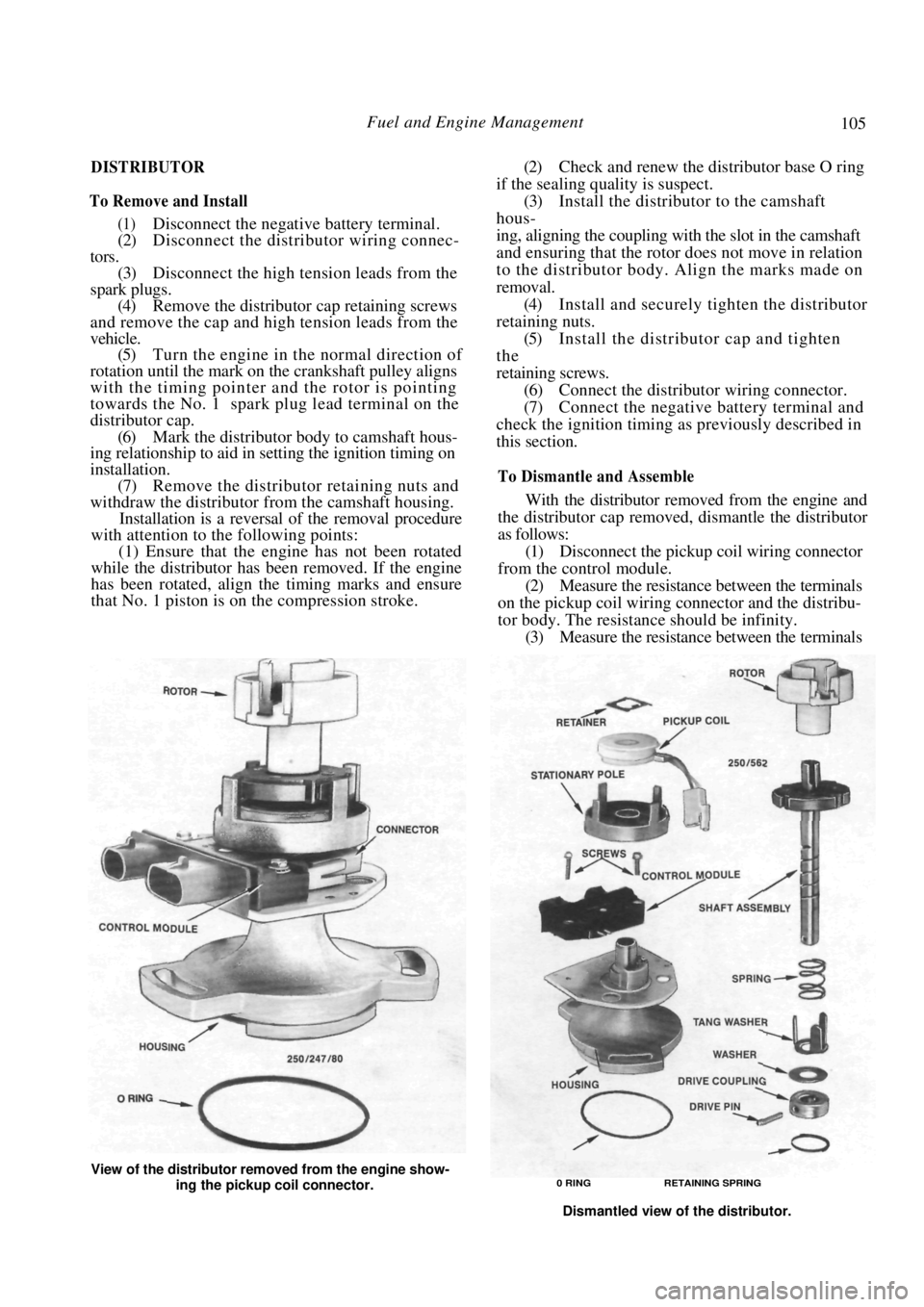
View of the distributor removed from the engine show-
ing the pickup coil connector. 0 RING RETAINING SPRING
Dismantled view of the distributor.
Page 117 of 238
117
EMISSION CONTROL
INTRODUCTION
To reduce the output level of the three primary
automotive emissions, carbon monoxide (CO), hydro-
carbons (HC) and oxides of nitrogen (NOx), and thus
comply with legislation on the maintenance of clean
air, several different emissi on control systems are used
in the Pulsar range of vehicles covered by this manual.
The systems will be discussed under the headings
( 1 ) Crankcase Ventilation System, (2) Evaporative
Control System, (3) Air Preheat System — 1.6 Liter
Engine and (4) Exhaust Control System.
1. CRANKCASE VENTILATION SYSTEM
DESCRIPTION
The crankcase ventilation system is of the closed
type and is designed to prevent crankcase vapors
being emitted into the atmosphere. Crankcase
vapors are caused by gases escaping past the piston
rings into the crankcase during the combustion pro-
cess.
The crankcase vapors are collected in the cam-
shaft housing from the cra nkcase via the various oil
drain passages and the pipe from the side of the
crankcase.
The crankcase vapors are then drawn into the
engine via a branched hose connected to the camshaft
housing oil baffle and the throttle body (1.8 liter
engines) or inlet manifold (1.6 liter engines).
At idle speed, vapors are drawn through the
small branch of the hose and into the engine.
As the engine speed increases, vapors are also
drawn into the engine via the main hose.
TO SERVICE THE SYSTEM
(1) At intervals of 40 000 km, disconnect the
small engine ventilation hose from the throttle body
or inlet manifold and check that the metering orifice
is not blocked.
If necessary, clean the orifice using compressed air
and solvent.
(2) Disconnect all the engine ventilation hoses
and check for blocking, collapsing and deterioration.
Renew the hoses as necessary.
2. EVAPORATIVE CONTROL SYSTEM
Special Equipment Required:
To Test Purge Valve — Hand vacuum pump
DESCRIPTION
The evaporative control system reduces the
amount of hydrocarbons emitted to the atmosphere
through fuel evaporation.
The vehicles covered by this manual use an
absorption regeneration system to reduce vapor loss.
The system utilizes a canister of activated charcoal to
trap and hold the fuel vapors until they can be fed
into the induction system for burning in the combus-
tion chambers.
The basic components of the evaporative control
system are a fuel tank with a sealed filler cap, a
charcoal canister with a pur ge control valve, a fuel
check valve and pipes a nd hoses to connect the
various components.
NOTE: The fuel tank filler cap is not vented
to the atmosphere but is equipped with a one
way relief valve to prevent a vacuum form-
ing in the fuel tank.
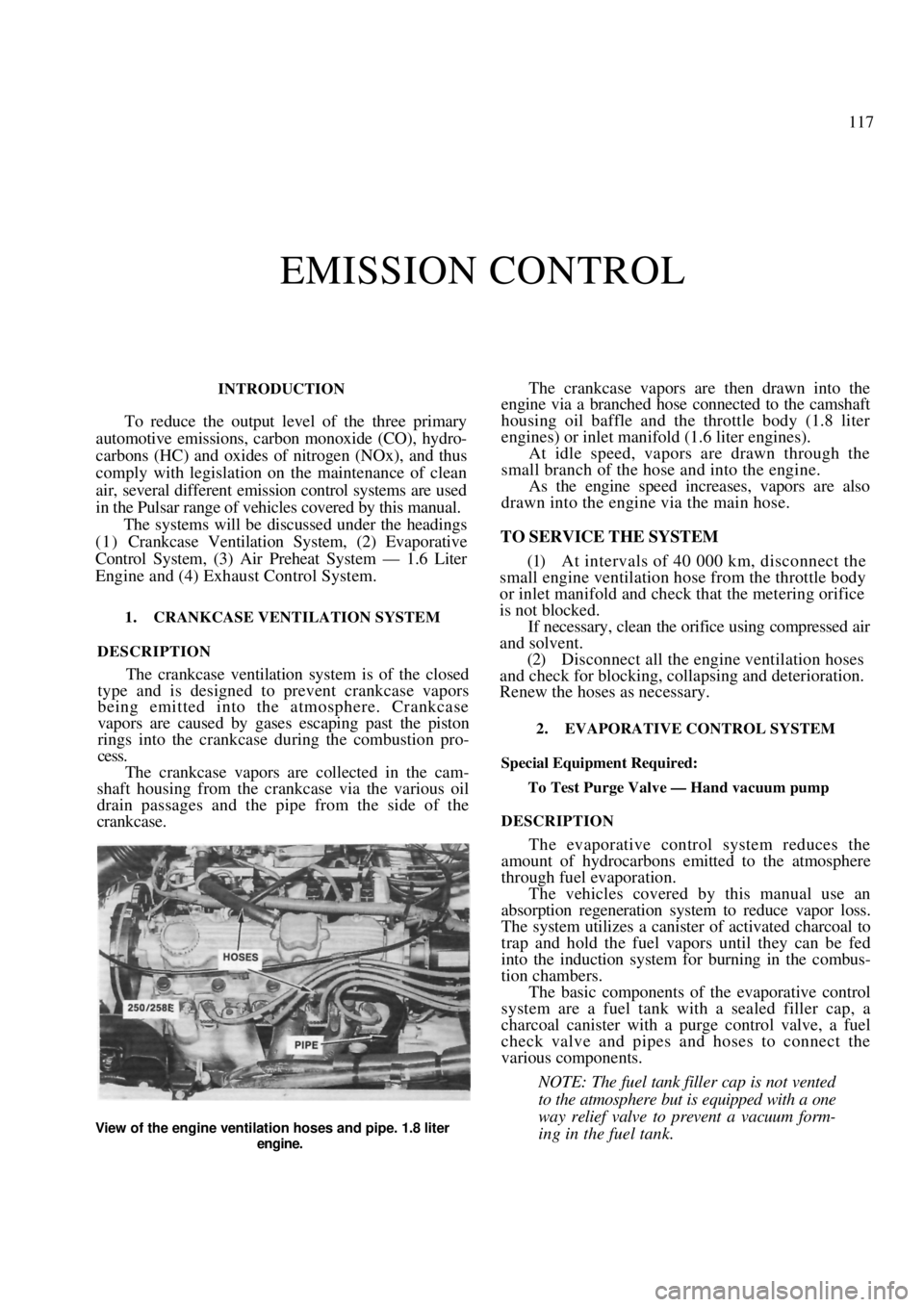
View of the engine ventilation hoses and pipe. 1.8 liter
engine.
Page 118 of 238

118 Emission Control
Installed view of the charcoal canister.
When the engine is at rest, fuel vapor through
evaporation gradually fills the air space in the fuel
tank. The sealed filler cap pr events the escape of this
vapor and pressure builds up within the system,
forcing the vapor to flow into the charcoal canister
which is located in the engine compartment beneath
the windscreen wiper motor.
The fuel check valve prevents liquid fuel entering
the charcoal canister when the fuel tank is full or the
vehicle is parked on a steep incline. When the engine
is running, the vapor is drawn via a hose from the
charcoal canister to the throttle body and burnt in the
combustion chambers.
TO RENEW CHARCOAL CANISTER
(1) Suitably mark and disconnect the hoses from
the canister. (2) Release the retaining spring and remove the
canister from the engine compartment. Installation is a reversal of the removal procedure.
TO RENEW FUEL CHECK VALVE
(1) Disconnect the negative battery terminal.
(2) Raise the rear of the vehicle and support it
on chassis stands. Remove the left hand rear wheel. (3) Drain the fuel from the fuel tank using a
hand pump or a suitable siphon. Do not siphon fuel
using the mouth.
(4) Remove the hoses from the check valve.
(5) Squeeze the retaining clip and remove the
check valve from the mounting bracket. Installation is a reversal of the removal procedure.
TO SERVICE THE SYSTEM
(1) Inspect the vacuum lines and connectors for
signs of leakage, cracks and deterioration and renew
as necessary. (2) Remove the fuel tank cap and check that a
slight resistance is felt, when vacuum is applied to the
one-way relief valve in the centre of the cap. Renew the fuel tank cap if no resistance is felt or
if the valve is blocked.
(3) Inspect the fuel tank cap seal for deteriora-
tion. Renew as necessary.
Installed view of the fuel check valve as seen with the
left hand rear wheel removed.
Check the fuel filler cap seal for damage.
23Q/LDZ GAUGE
Line drawing showing a hand vacuum pump.
Page 140 of 238
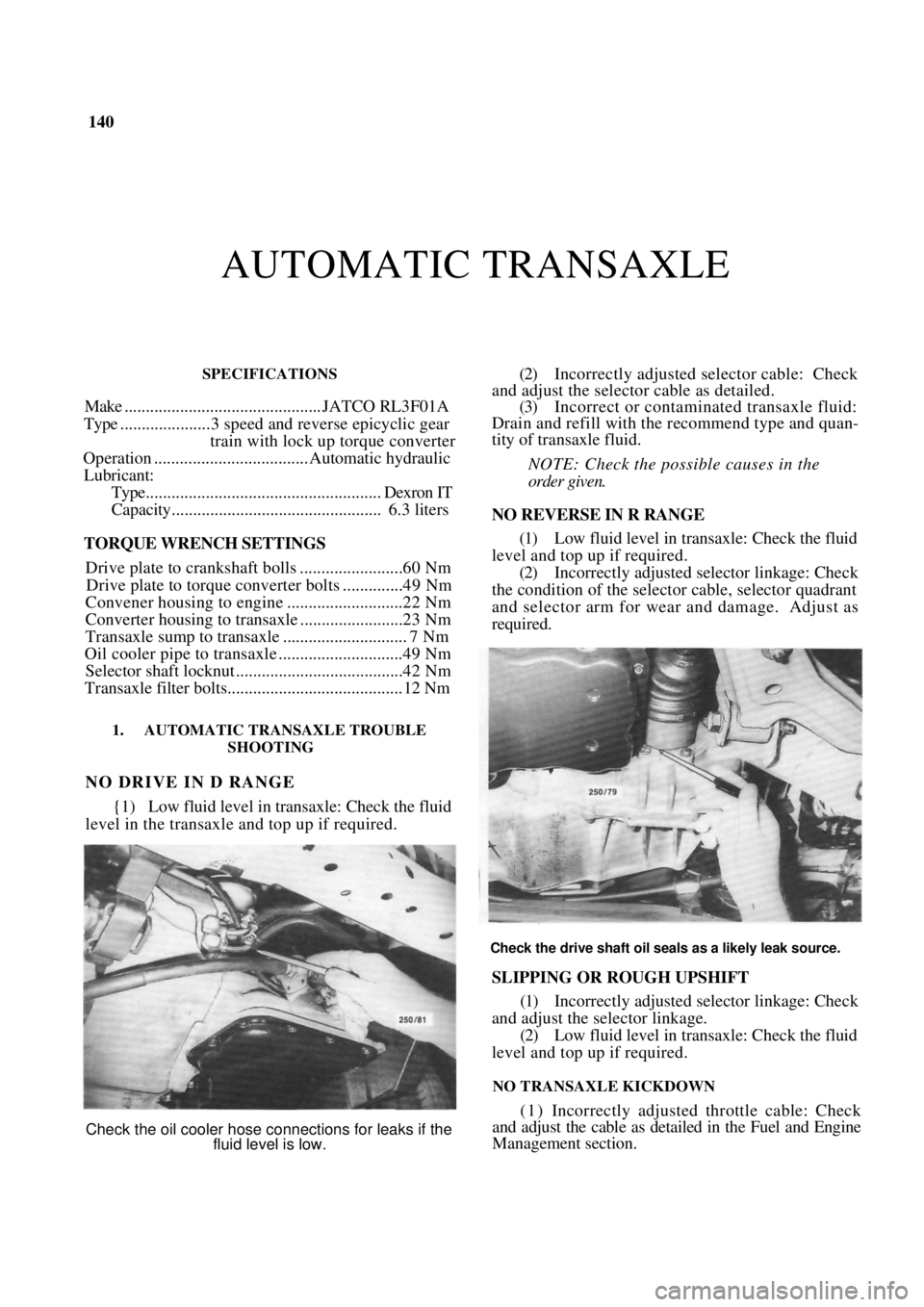
140
AUTOMATIC TRANSAXLE
SPECIFICATIONS
Make .............................................. JATCO RL3F01A
Type .....................3 speed and reverse epicyclic gear
train with lock up torque converter
Operation .................................... Automatic hydraulic
Lubricant:
Type....................................................... Dexron IT
Capacity................................................. 6.3 liters
TORQUE WRENCH SETTINGS
Drive plate to crankshaft bolls ........................60 Nm
Drive plate to torque converter bolts ..............49 Nm
Convener housing to engine ...........................22 Nm
Converter housing to transaxle ........................23 Nm
Transaxle sump to transaxle ............................. 7 Nm
Oil cooler pipe to transaxle .............................49 Nm
Selector shaft locknut .......................................42 Nm
Transaxle filter bolts.........................................12 Nm
1. AUTOMATIC TRANSAXLE TROUBLE SHOOTING
NO DRIVE IN D RANGE
{1) Low fluid level in transaxle: Check the fluid
level in the transaxle and top up if required.
(2) Incorrectly adjusted selector cable: Check
and adjust the selector cable as detailed. (3) Incorrect or contaminated transaxle fluid:
Drain and refill with the recommend type and quan-
tity of transaxle fluid.
NOTE: Check the possible causes in the
order given.
NO REVERSE IN R RANGE
(1) Low fluid level in transaxle: Check the fluid
level and top up if required. (2) Incorrectly adjusted selector linkage: Check
the condition of the selector cable, selector quadrant
and selector arm for wear and damage. Adjust as
required.
Check the drive shaft oil seals as a likely leak source.
SLIPPING OR ROUGH UPSHIFT
(1) Incorrectly adjusted selector linkage: Check
and adjust the selector linkage. (2) Low fluid level in transaxle: Check the fluid
level and top up if required.
NO TRANSAXLE KICKDOWN
(1) Incorrectly adjusted throttle cable: Check
and adjust the cable as detailed in the Fuel and Engine
Management section.
Check the oil cooler hose connections for leaks if the
fluid level is low.
Page 190 of 238

190
ELECTRICAL SYSTEM
CAUTION: To prevent severe electrical shock extreme care must be taken when
working on or near the electronic ignition system as dangerous high tension voltages
are produced in both the primary and secondary circuits. See the text fo\
r
precautionary notes.
SPECIFICATIONS
BATTERY
Type ..................................................12 volt lead acid
Polarity to earth .................................... Negative ( - )
Specific gravity:
Fully charged ................................... A bove 1.250
Fully discharged ................................Below 1.130
ALTERNATOR
Make .................................................Bosch or Hitachi
Maximum output .......................................... 70 amps
Polarity to earth .................................... Negative ( - )
Stator windings ......................................... Star wound
Regulator type ................................................ Integral
Brush length minimum:
Bosch ........................................................ 5.0 mm
Hitachi ............................. 6.0 mm or limit mark
STARTER MOTOR
Make .................................................Hitach i or Bosch
Type ............................ 4 pole 4 brush reduction gear
Operation control.................................. Solenoid and
overrunning clutch
Undercut of commutator (maximum):
Hitachi ...................................................... 0.8 mm
Brush length (minimum):
Bosch ........................................................ 8.0 mm
Hitachi ........................................................11 mm
Brush spring tension;
Hitachi ............................................... 15.7-19.6 N
Hitachi:
Drive pinion stopper clearance ........ 0.3-1.5 mm
Selective fit adjuster plates ........ 0.5 and 0.8 mm
IGNITION SYSTEM
The ignition system is an integral part of the
engine management system. The Specifications, testing
and overhaul procedures are fully covered in the Fuel
and Engine Management section.
TORQUE WRENCH SETTINGS
Alternator pulley retaining nut:
Bosch ......................................................... 50 Nm
Hitachi ....................................................... 59 Nm
1. BATTERY AND CHARGING SYSTEM
TROUBLE SHOOTING
BATTERY UNDERCHARGED
3. Loose or broken drive belt: Adjust or renew
the drive belt. 4. Faulty alternator regulator; Renew the regu-
lator unit.
5. Faulty battery: Install a new battery of
the
recommended type and capacity. 6. Faulty alternator: Overhaul or renew the
alternator. 7. Fault in the charging circuit wiring: Check
and repair or renew the wiring harness. 8. Faulty connections in the charging circuit:
Check and repair the connections. 9. Fusible link blown; Rectify the fault and
renew as necessary.
NOTE: Check the state of charge (specific
gravity) of the battery- as described under
the
Battery heading in this section. If the battery
is undercharged, check the possible causes in
the order given.
BATTERY OVERCHARGED
• Faulty alternator regulator unit:
Renew the
regulator unit.
• Faulty alternator: Overhaul or
renew the
alternator. • Faulty charging circuit wiring or
connec-
tions: Check and renew or repair the faulty
compo-
nents.
NOTE: An overcharged battery is indicated
by continual loss of water through boiling.