tires NISSAN PULSAR 1987 User Guide
[x] Cancel search | Manufacturer: NISSAN, Model Year: 1987, Model line: PULSAR, Model: NISSAN PULSAR 1987Pages: 238, PDF Size: 28.91 MB
Page 150 of 238
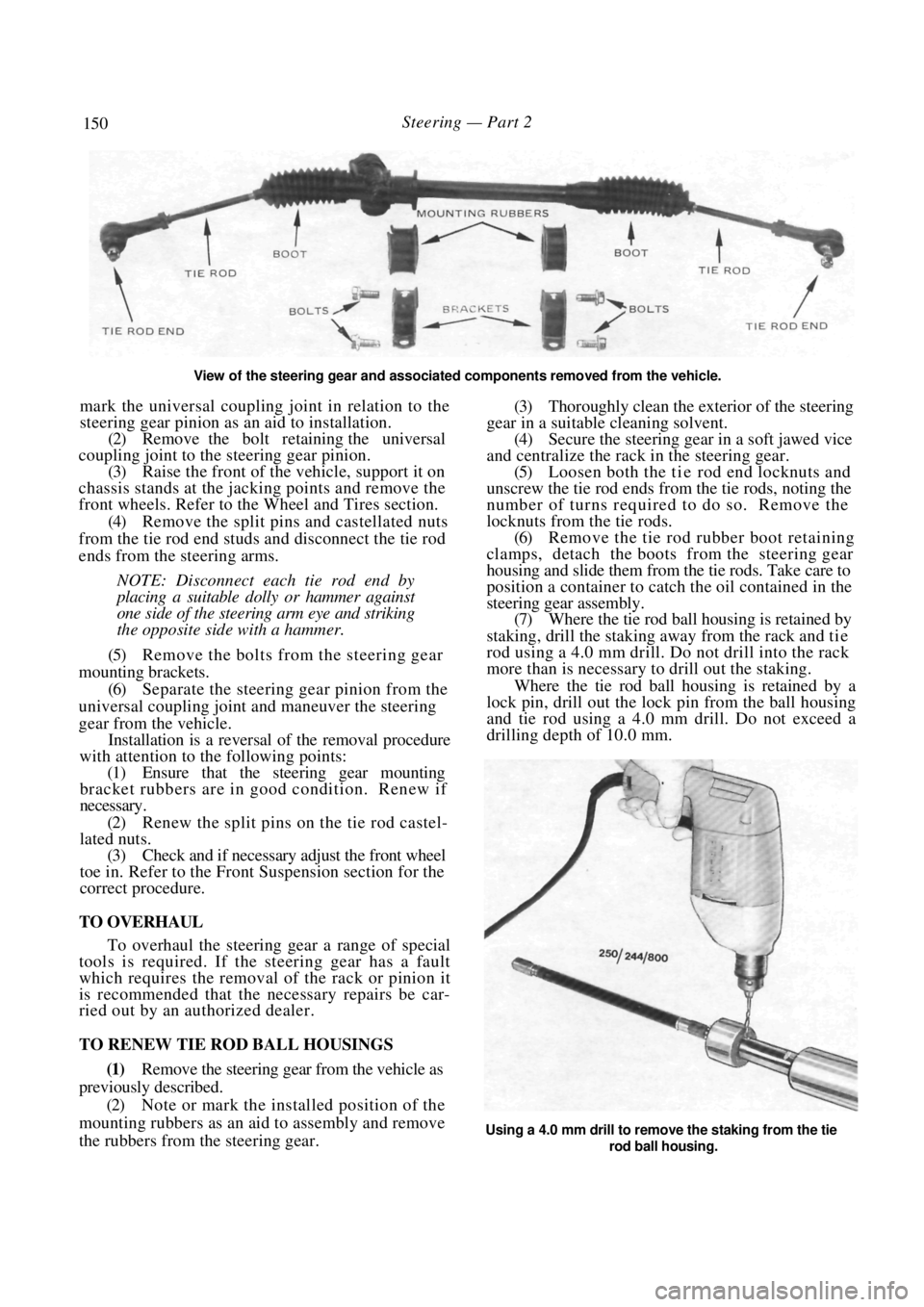
150 Steering — Part 2
View of the steering gear and associated components removed from the vehicle.
mark the universal coupling joint in relation to the
steering gear pinion as an aid to installation.
(2) Remove the bolt retaining the universal
coupling joint to the steering gear pinion. (3) Raise the front of the vehicle, support it on
chassis stands at the jack ing points and remove the
front wheels. Refer to the Wheel and Tires section.
(4) Remove the split pins and castellated nuts
from the tie rod end studs and disconnect the tie rod
ends from the steering arms.
NOTE: Disconnect each tie rod end by
placing a suitable dolly or hammer against
one side of the steer ing arm eye and striking
the opposite side with a hammer.
(5) Remove the bolts from the steering gear
mounting brackets. (6) Separate the steering gear pinion from the
universal coupling joint and maneuver the steering
gear from the vehicle. Installation is a reversal of the removal procedure
with attention to the following points:
(1) Ensure that the steering gear mounting
bracket rubbers are in good condition. Renew if
necessary.
(2) Renew the split pins on the tie rod castel-
lated nuts.
(3) Check and if necessary adjust the front wheel
toe in. Refer to the Front Suspension section for the
correct procedure.
TO OVERHAUL
To overhaul the steering gear a range of special
tools is required. If the steering gear has a fault
which requires the removal of the rack or pinion it
is recommended that the necessary repairs be car-
ried out by an authorized dealer.
TO RENEW TIE ROD BALL HOUSINGS
(1) Remove the steering gear from the vehicle as
previously described.
(2) Note or mark the installed position of the
mounting rubbers as an aid to assembly and remove
the rubbers from the steering gear.
(3) Thoroughly clean the exterior of the steering
gear in a suitable cleaning solvent.
(4) Secure the steering gear in a soft jawed vice
and centralize the rack in the steering gear. (5) Loosen both the ti e rod end locknuts and
unscrew the tie rod ends from the tie rods, noting the
number of turns required to do so. Remove the
locknuts from the tie rods. (6) Remove the tie rod rubber boot retaining
clamps, detach the boot s from the steering gear
housing and slide them from the tie rods. Take care to
position a container to catch the oil contained in the
steering gear assembly. (7) Where the tie rod ball housing is retained by
staking, drill the staking away from the rack and t i e
rod using a 4.0 mm drill. Do not drill into the rack
more than is necessary to drill out the staking.
Where the tie rod ball housing is retained by a
lock pin, drill out the lock pin from the ball housing
and tie rod using a 4.0 mm drill. Do not exceed a
drilling depth of 10.0 mm.
Using a 4.0 mm drill to remove the staking from the tie
rod ball housing.
Page 156 of 238

156
FRONT SUSPENSION
SPECIFICATIONS
Type.................. Independent MacPherson strut with
coil springs and control arms
Shock absorber .................. Hydraulic, non-repairable
Hub bearing end float (maximum) ............. 0.05 mm
Ball joint axial play (maximum) ....................0.7 mm
Ball joint turning torque (used)...............0.5-4.9 Nm
Wheel alignment:
Toe in ..................................................... 0-2 mm
Camber ........................................- 0 ° 1 0 ' ± 4 5 '
Caster ..............................................1 ° 1 0 ' ± 4 5 '
King pin inclination..................... 1 3 ° 5 5 ' ± 4 5 '
TORQUE WRENCH SETTINGS
Hub bearing nut..................................... 196-235 Nm
Suspension unit to steering knuckle nut ...... 118 Nm
Suspension unit to body nuts ......................... 29 Nm
Piston rod nut .................................................. 72 Nm
Brake caliper to steering knuckle bolts ........... 52 Nm
Ball joint to steering knuckle bolt ................... 86 Nm
Control arm bracket bolts ............................... 98 Nm
Control arm pivot bolt ................................ 118 Nm
Stabiliser bar link nuts..................................... 44 Nm
Stabiliser bar bracket bolts .............................. 21 Nm
1. FRONT SUSPENSION TROUBLE
SHOOTING
FRONT END NOISE
(1) Loose upper suspension mounting or piston
rod: Tighten the mounting or piston rod nuts. (2) Loose or worn suspension unit lower ball
joint: Tighten or renew the lower ball joint.
(3) Noise in the suspension unit: Renew the
faulty suspension unit, preferably in pairs.
(4) Worn or loose steering gear: Overhaul the
steering gear assembly. (5) Worn front hub bearings: Renew the hub
bearings:
(6) Loose or defective stab ilizer bar, control arm
or mountings: Check, tighten or renew the mounting
rubbers.
Check the ball joints for wear and deterioration.
(7) Worn stabilizer bar link ball joints: Renew
the stabilizer bar links.
(8) Drive shafts worn or insufficiently lubri-
cated: Check the lubricant and the dust boots and
renew as necessary. (9) Drive shaft splines in the hub or the
differential worn or dama ged: Check and renew as
necessary.
NOTE: To check the front suspension com-
ponents for wear, raise the front of the
vehicle, support it on chassis stands and
allow both front wheel to hang free. With an
assistant pushing and pulling the front
wheels in and out at the top and then at the
bottom, check for excessive looseness at the
front hub bearings and lower control arm
inner pivot bushes. Noise or vibration in the
front end can also be caused by excessive
tire or wheel unbalance. Drive shaft joint
noise is usually more pronounced when
moving slowly with the steering on full lock.
POOR OR ERRATIC ROAD HOLDING
ABILITY
(1) Low or uneven tire pressures: Inflate the
tires to the recommended pressures.
(2) Defective suspension unit: Renew the faulty
unit, preferably in pairs.
Page 163 of 238
Front Suspension 163
(2) Ensure that the stabilizer bar links are in
good condition. Renew if necessary.
(3) When installing the stabilizer bar ensure that
the links are installed perpendicular to the control arm
with the ball joint socket face parallel to the end of the
stabilizer bar. (4) Ensure that the brackets are installed with
the flat portion facing towards the front of the vehicle.
Tighten the retaining bolts securely.
7. SUSPENSION AND STEERING ANGLES
ADJUSTMENT
NOTE: Extensive knowledge and special-
ised equipment are required to measure and
correct the suspension and steering angles
with the exception of the front wheel toe in.
Therefore, as it is not a viable proposition
for the average person to carry out a com-
plete wheel alignment, the vehicle should be
taken to a wheel alignment specialist.
Prior to carrying out a wheel alignment, a thor-
ough inspection of the steering linkage, front hub
bearings, ball joints and suspension units should be
carried out. Faulty components should be renewed or
repaired as necessary.
The tread of the front ti res should be examined
for excessive or uneven wear as certain conditions of
tire wear are indicative of damaged or worn compo-
nents in the suspension, stee ring linkage and/or wheels
and bearings. Refer to the heading Tire Wear Trouble
Shooting in the Wheels and Tires section. If the tires
are found to be defective, renew them with serviceable
lyres.
TO CHECK AND ADJUST TOE IN/OUT
NOTE: The vehicle s hould be unladen ex-
cept for the normal amount of fuel and with
the tires inflated to the correct pressures.
(1) With the vehicle on a level floor, raise the
front of the vehicle and s upport it on chassis stands.
(2) Spin each front wheel in turn and using a
piece of chalk, mark a line around the periphery of
each tire as near to the centre as possible. (3) Lower the vehicle to the ground and bounce
the front several times to stabilize the suspension. (4) Set the wheels in the straight ahead position.
(5) Mark the centre chalk line on both tires at a
point approximately 200 mm above the floor and
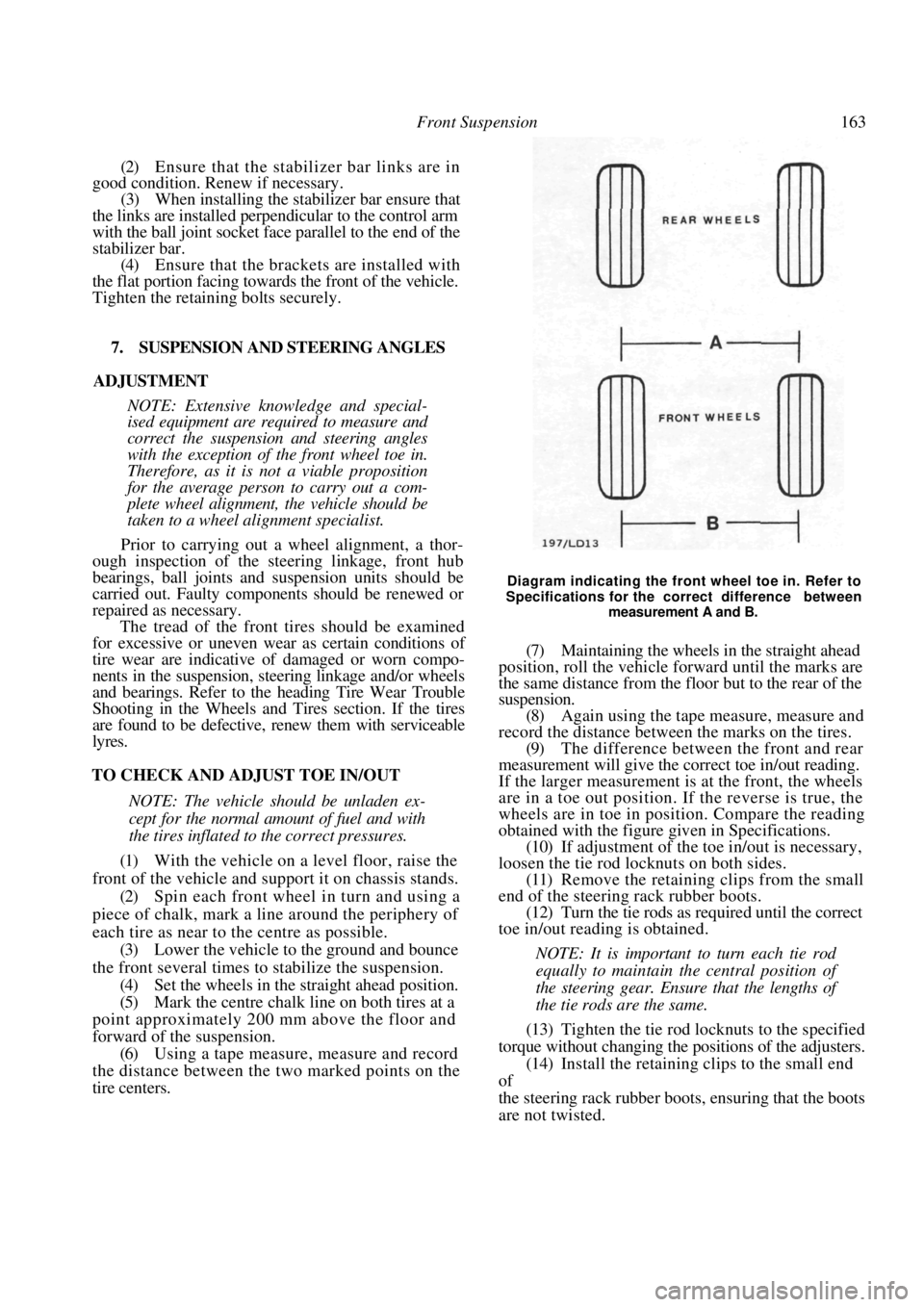
forward of the suspension. (6) Using a tape measure, measure and record
the distance between the two marked points on the
tire centers.
Diagram indicating the front wheel toe in. Refer to
Specifications for the correct difference between
measurement A and B.
(7) Maintaining the wheels in the straight ahead
position, roll the vehicle forward until the marks are
the same distance from the floor but to the rear of the
suspension. (8) Again using the tape measure, measure and
record the distance between the marks on the tires.
(9) The difference between the front and rear
measurement will give the correct toe in/out reading.
If the larger measurement is at the front, the wheels
are in a toe out position. If the reverse is true, the
wheels are in toe in position. Compare the reading
obtained with the figure given in Specifications.
(10) If adjustment of the to e in/out is necessary,
loosen the tie rod locknuts on both sides. (11) Remove the retaining clips from the small
end of the steering rack rubber boots. (12) Turn the tie rods as required until the correct
toe in/out reading is obtained.
NOTE: It is important to turn each tie rod
equally to maintain the central position of
the steering gear. Ensure that the lengths of
the tie rods are the same.
(13) Tighten the tie rod locknuts to the specified
torque without changing the positions of the adjusters.
(14) Install the retaining clips to the small end
of
the steering rack rubber boots, ensuring that the boots
are not twisted.
Page 167 of 238

Rear Suspension 167
NOTE: When a wheel bearing has been
removed from the hub it must be renewed.
(5) Press the new bearing into the hub, ensuring
that pressure is not exerted on the inner race of the
bearing and that the bearin g seal is not damaged. Do
not apply grease or oil to the mating surfaces of the
bearing and the hub.
NOTE: When installing the new bearing,
the press load must not exceed 3 tonnes.
(6) Inspect the snap ring for wear or cracks and
renew as necessary. Install the snap ring into the hub
ensuring that it is secur ely located in the groove.
(7) Apply multi-purpose grease to the bearing
sealing lip and install the hub as previously described.
4. SUSPENSION UNIT
Special Equipment Required:
To Dismantle — Spring compressor
TO REMOVE AND DISMANTLE
(1) On hatchback models, remove the rear par-
cel shelf and lower the rear seat backrests. Remove the
parcel shelf side panel re taining screws and remove
the relevant side panel.
(2) On sedan models, prise out the parcel shelf
retaining buttons using a suitable instrument and
withdraw the parcel shelf from the vehicle. If the rear
radio speakers are installed, remove the speaker grille
retaining screws and separate the speaker grilles from
the speakers prior to withdrawing the parcel shelf
from the vehicle. (3) Raise the rear of the vehicle and support it
on chassis stands as describe d in the Wheels and Tires
section. Remove the rear wheel from the vehicle.
View of the suspension unit with the spring compres-
sors installed.
(4) Remove the clip securing the brake hose to
the suspension unit and disengage the hose from the
suspension unit. (5) Support the weight of the knuckle assembly
and remove the bolts and nuts securing the suspension
unit to the knuckle assembly.
(6) Remove the nuts securing the suspension
unit to the body panel and maneuver the suspension
unit from the vehicle. (7) Thoroughly clean the suspension unit and
secure it in a soft jawed vice.
(8) Remove the dust cap from the upper mount-
ing and while holding the end of the piston rod with
an adjustable spanner, loosen the upper mounting
retaining nut. Do not re move the retaining nut.
(9) Using a suitable spring compressor, com-
press the coil spring and remove the upper mounting
retaining nut and washer. (10) Remove the upper mounting, insulator and
spring seat from th e suspension unit.
(11) Withdraw the upper insulator, coil spring,
lower insulator and dust cover from the suspension
unit. (12) Check the coil spring for cracks, deformation
and damage. Compare the free length with a new coil
spring and renew as necessary.
Location of the suspension unit retaining nuts. Hatch-
back model.
Page 169 of 238
Rear Suspension 169
5. CONTROL ARM
Special Equipment Required:
To Renew Control Arm Bush — Press and suitable
removal tool
TO REMOVE AND INSTAL
(1) Raise the rear of the vehicle and support it
on chassis stands as describe d in the Wheels and Tires
section.
(2) Suitably mark the front and rear control
arms to ensure installation to the original locations.
NOTE: The front and rear control arms are
identical in appearance, however, on models
manufactured prior to March 1988 the
compound of the rubber bushes differ.
(3) Remove the nut and bolt securing the control
arms to the knuckle assembly.
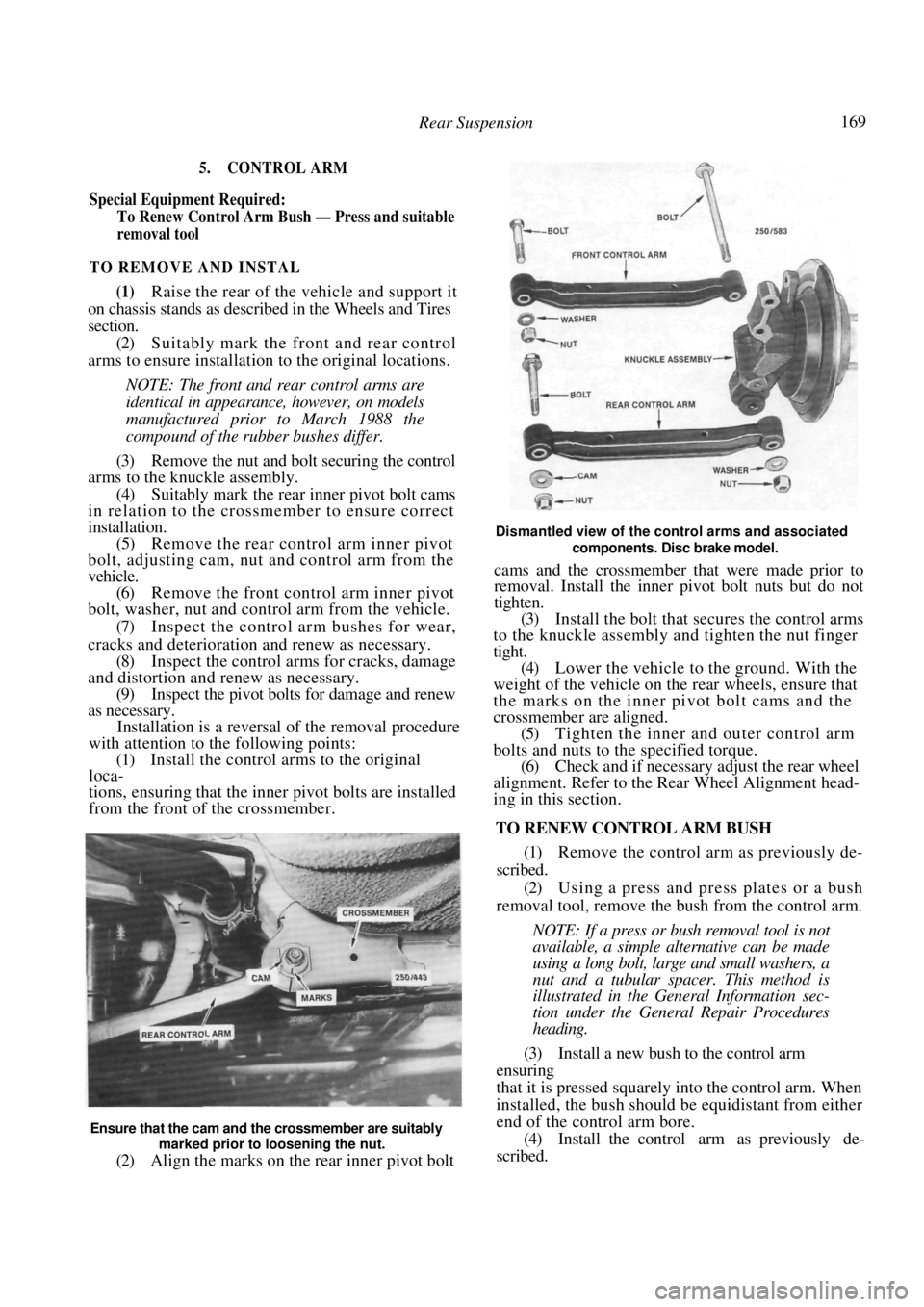
(4) Suitably mark the rear inner pivot bolt cams
in relation to the crossmember to ensure correct
installation.
(5) Remove the rear control arm inner pivot
bolt, adjusting cam, nut and control arm from the
vehicle. (6) Remove the front control arm inner pivot
bolt, washer, nut and control arm from the vehicle.
(7) Inspect the control arm bushes for wear,
cracks and deterioration and renew as necessary. (8) Inspect the control arms for cracks, damage
and distortion and renew as necessary.
(9) Inspect the pivot bolts for damage and renew
as necessary. Installation is a reversal of the removal procedure
with attention to the following points:
(1) Install the control arms to the original
loca-
tions, ensuring that the inner pivot bolts are installed
from the front of the crossmember.
(2) Align the marks on the rear inner pivot bolt
Dismantled view of the control arms and associated
components. Disc brake model.
cams and the crossmember that were made prior to
removal. Install the inner pivot bolt nuts but do not
tighten.
(3) Install the bolt that secures the control arms
to the knuckle assembly and tighten the nut finger
tight. (4) Lower the vehicle to the ground. With the
weight of the vehicle on th e rear wheels, ensure that
the marks on the inner pivot bolt cams and the
crossmember are aligned. (5) Tighten the inner and outer control arm
bolts and nuts to the specified torque. (6) Check and if necessary adjust the rear wheel
alignment. Refer to the Re ar Wheel Alignment head-
ing in this section.
TO RENEW CONTROL ARM BUSH
(1) Remove the control arm as previously de-
scribed. (2) Using a press and press plates or a bush
removal tool, remove the bush from the control arm.
NOTE: If a press or bush removal tool is not
available, a simple alternative can be made
using a long bolt, large and small washers, a
nut and a tubular spacer. This method is
illustrated in the General Information sec-
tion under the General Repair Procedures
heading.
(3) Install a new bush to the control arm
ensuring
that it is pressed squarely into the control arm. When
installed, the bush should be equidistant from either
end of the control arm bore. (4) Install the control arm as previously de-
scribed.
Ensure that the cam and the crossmember are suitably
marked prior to loosening the nut.
Page 170 of 238
170 Rear Suspension
6. KNUCKLE ASSEMBLY
TO REMOVE AND INSTAL
(1) Remove the rear hub as previously de-
scribed.
(2) On drum brake models, disconnect the brake
pipe from the wheel cylinder and plug the cylinder
and brake pipe apertures to prevent the loss of brake
fluid and the entry of dirt. (3) Remove the backing plate retaining bolts and
remove the backing plate from the knuckle assembly. (4) Remove the nut and bolt securing the control
arms to the knuckle assembly. (5) Remove the bolts and nuts securing the
suspension unit to the knuckle assembly. (6) Remove the nut, washers and bush securing
the stabilizer bar to the knuckle assembly, rotate the
knuckle assembly and remove it from the stabilizer
bar. (7) Carefully clean the knuckle assembly. Do not
immerse the rubber bush in solvent as damage will
occur.
(8) Check the knuckle assembly for wear, cracks
and damage. Installation is a reversal of the removal procedure
with attention to the following points:
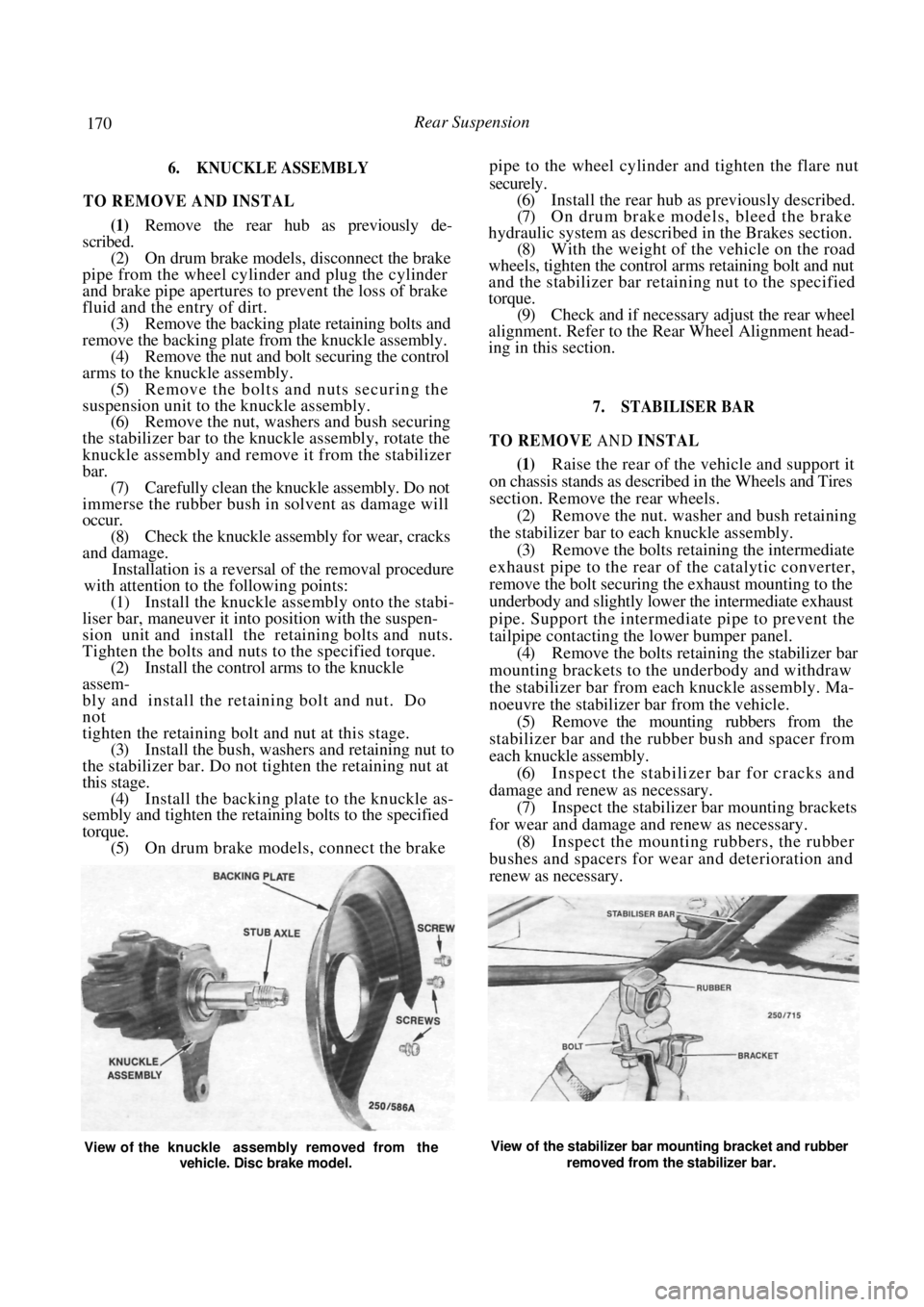
(1) Install the knuckle assembly onto the stabi-
liser bar, maneuver it into position with the suspen-
sion unit and install the retaining bolts and nuts.
Tighten the bolts and nuts to the specified torque.
(2) Install the control arms to the knuckle
assem-
bly and install the retaining bolt and nut. Do
not
tighten the retaining bolt and nut at this stage. (3) Install the bush, washers and retaining nut to
the stabilizer bar. Do not tighten the retaining nut at
this stage. (4) Install the backing plate to the knuckle as-
sembly and tighten the retaining bolts to the specified
torque.
(5) On drum brake models, connect the brake
pipe to the wheel cylinder and tighten the flare nut
securely.
(6) Install the rear hub as previously described.
(7) On drum brake models, bleed the brake
hydraulic system as described in the Brakes section.
(8) With the weight of the vehicle on the road
wheels, tighten the control arms retaining bolt and nut
and the stabilizer bar retaining nut to the specified
torque. (9) Check and if necessary adjust the rear wheel
alignment. Refer to the Re ar Wheel Alignment head-
ing in this section.
7. STABILISER BAR
TO REMOVE AND INSTAL
(1) Raise the rear of the vehicle and support it
on chassis stands as describe d in the Wheels and Tires
section. Remove the rear wheels.
(2) Remove the nut. washer and bush retaining
the stabilizer bar to each knuckle assembly. (3) Remove the bolts retain ing the intermediate
exhaust pipe to the rear of the catalytic converter,
remove the bolt securing the exhaust mounting to the
underbody and slightly lower the intermediate exhaust
pipe. Support the intermediate pipe to prevent the
tailpipe contacting the lower bumper panel. (4) Remove the bolts retaining the stabilizer bar
mounting brackets to the underbody and withdraw
the stabilizer ba r from each knuckle assembly. Ma-
noeuvre the stabilizer bar from the vehicle.
(5) Remove the mounting rubbers from the
stabilizer bar and the rubber bush and spacer from
each knuckle assembly. (6) Inspect the stabilizer bar for cracks and
damage and renew as necessary. (7) Inspect the stabilizer bar mounting brackets
for wear and damage and renew as necessary. (8) Inspect the mounting rubbers, the rubber
bushes and spacers for wear and deterioration and
renew as necessary.
View of the knuckle assembly removed from the
vehicle. Disc brake model. View of the stabilizer bar mounting bracket and rubber
removed from the stabilizer bar.
Page 171 of 238
Rear Suspension 171
Installation is a reversal of the removal procedure
with attention to the following points:
(1) When installing the stabilizer bar to the
knuckle assembly bushes, ensu re that the thicker bush
is installed to the front of the knuckle assembly. Install
the rear bush, washers and nut but do not tighten at
this stage. (2) Install the stabil izer bar mounting
brackets,
ensuring that the end with the large bevel is facing the
front of the vehicle. Tighte n the retaining bolts to the
specified torque. (3) Using a new gasket, install the intermediate
exhaust pipe to the catalytic converter, ensuring that
the earth wire terminal is installed, and tighten the
bolts securely. Install the exhaust mounting
retaining
bolt. (4) Install the rear wheels and lower the
vehicle
to the ground. With the wei ght of the vehicle on the
road wheels, tighten the stabilizer bar retaining nuts to
the specified torque.
8. REAR WHEEL ALIGNMENT
Specialized equipment is required to measure the
rear wheel alignment. It is therefore recommended
that the vehicle be referred to a specialist suspension
workshop or an authorized dealer for measurement
and adjustment. The suspension components should
be inspected and renewed as necessary prior to having
the wheel alignment checked. If any suspension com-
ponents are renewed, the re ar wheel toe out may be
temporarily adjusted as described below.
TO INSPECT
Examine the tread of the tires. Excessive or
uneven wear will indicate misalignment or damaged
or worn components. Refer to the Tire Wear Trouble
Shooting Chart in the Wheels and Tires section for
possible causes and renew the faulty components.
Badly worn tires should be renewed prior to
having the wheel alignment checked.
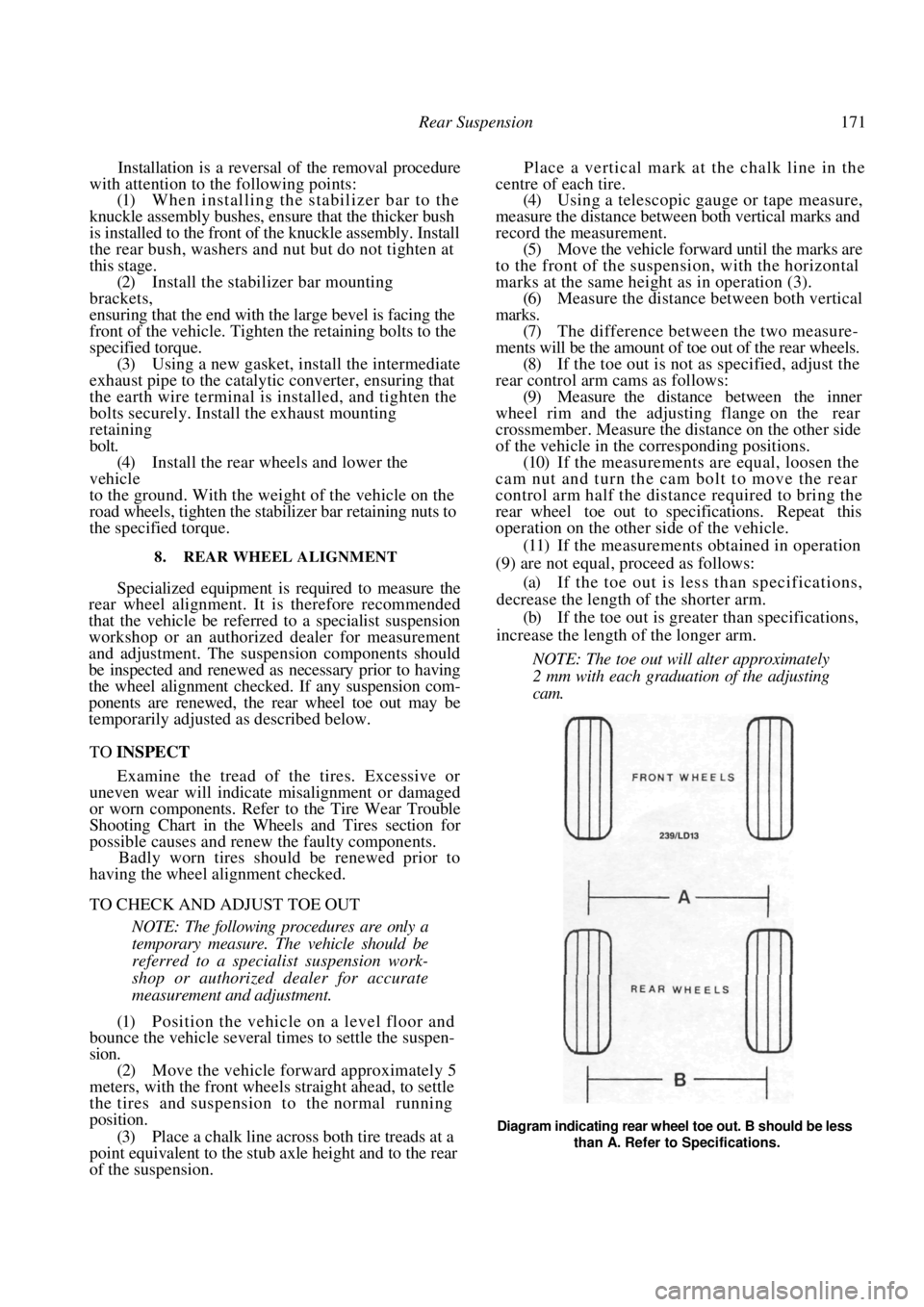
TO CHECK AND ADJUST TOE OUT
NOTE: The following procedures are only a
temporary measure. Th e vehicle should be
referred to a specialis t suspension work-
shop or authorized dealer for accurate
measurement and adjustment.
(1) Position the vehicle on a level floor and
bounce the vehicle several tim es to settle the suspen-
sion. (2) Move the vehicle forward approximately 5
meters, with the front wheels straight ahead, to settle
the tires and suspension to the normal running
position.
(3) Place a chalk line across both tire treads at a
point equivalent to the stub axle height and to the rear
of the suspension. Place a vertical mark at the chalk line in the
centre of each tire.
(4) Using a telescopic gauge or tape measure,
measure the distance between both vertical marks and
record the measurement. (5) Move the vehicle forward until the marks are
to the front of the suspen sion, with the horizontal
marks at the same height as in operation (3). (6) Measure the distance between both vertical
marks. (7) The difference between the two measure-
ments will be the amount of toe out of the rear wheels. (8) If the toe out is not as specified, adjust the
rear control arm cams as follows: (9) Measure the distance between the inner
wheel rim and the adjusting flange on the rear
crossmember. Measure the distance on the other side
of the vehicle in the corresponding positions. (10) If the measurements are equal, loosen the
cam nut and turn the cam bolt to move the rear
control arm half the distance required to bring the
rear wheel toe out to specifications. Repeat this
operation on the other side of the vehicle.
(11) If the measurements obtained in operation
(9) are not equal, proceed as follows:
(a) If the toe out is less than specifications,
decrease the length of the shorter arm.
(b) If the toe out is greater than specifications,
increase the length of the longer arm.
NOTE: The toe out will alter approximately
2 mm with each graduation of the adjusting
cam.
Diagram indicating rear wheel toe out. B should be less than A. Refer to Specifications.
Page 210 of 238
210 Electrical System
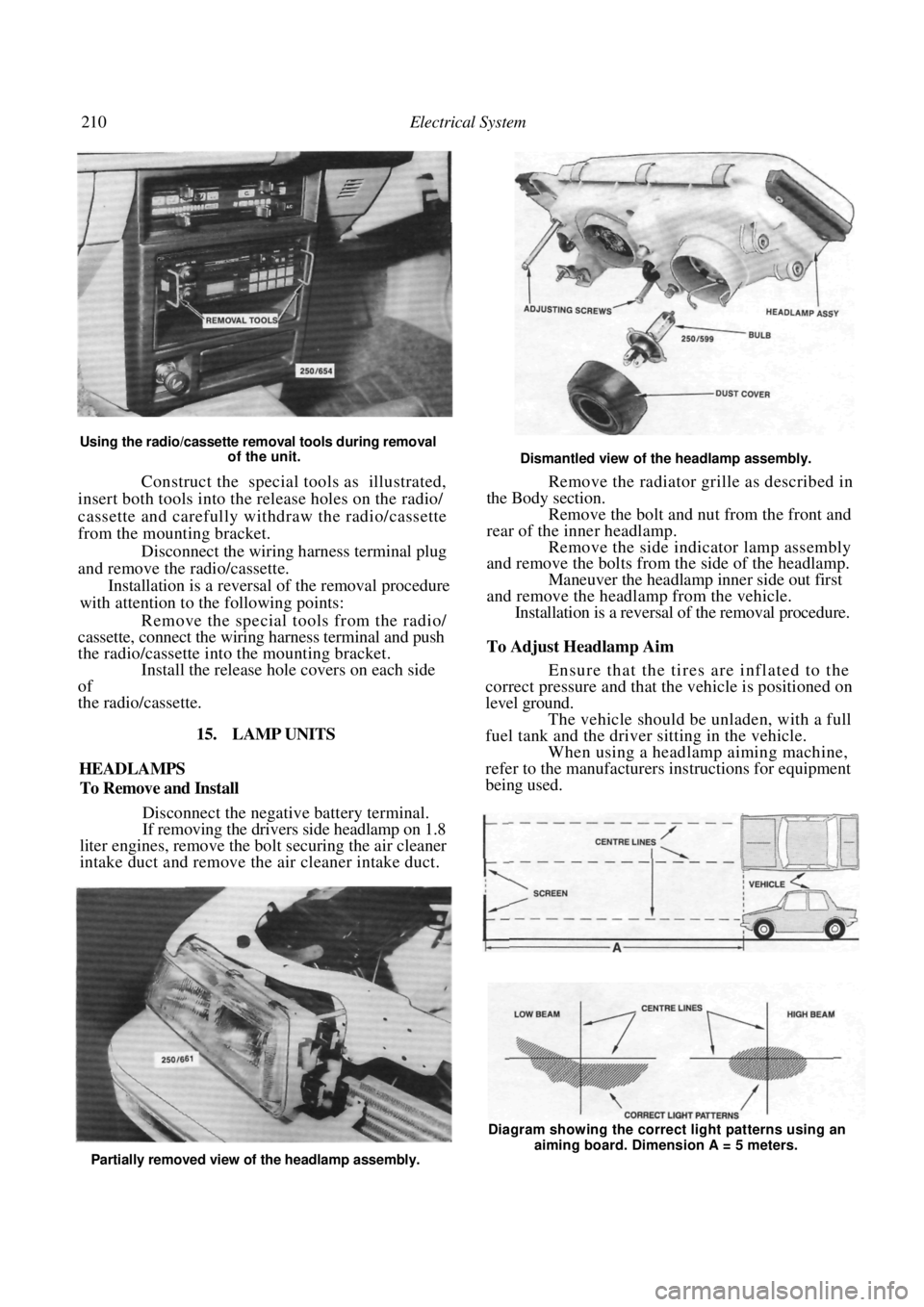
Using the radio/cassette removal tools during removal of the unit.
Construct the special tools as illustrated,
insert both tools into the release holes on the radio/
cassette and carefully withdraw the radio/cassette
from the mounting bracket.
Disconnect the wiring harness terminal plug
and remove the radio/cassette.
Installation is a reversal of the removal procedure
with attention to the following points:
Remove the special tools from the radio/
cassette, connect the wiring harness terminal and push
the radio/cassette into the mounting bracket. Install the release hole covers on each side
of
the radio/cassette.
15. LAMP UNITS
HEADLAMPS
To Remove and Install
Disconnect the negative battery terminal.
If removing the drivers side headlamp on 1.8
liter engines, remove the bo lt securing the air cleaner
intake duct and remove the air cleaner intake duct.
Dismantled view of the headlamp assembly.
Remove the radiator grille as described in
the Body section. Remove the bolt and nut from the front and
rear of the inner headlamp. Remove the side indicator lamp assembly
and remove the bolts from the side of the headlamp.
Maneuver the headlamp inner side out first
and remove the headlamp from the vehicle. Installation is a reversal of the removal procedure.
To Adjust Headlamp Aim
Ensure that the tires are inflated to the
correct pressure and that the vehicle is positioned on
level ground.
The vehicle should be unladen, with a full
fuel tank and the driver sitting in the vehicle. When using a headlamp aiming machine,
refer to the manufacturers instructions for equipment
being used.
Partially removed view of the headlamp assembly. Diagram showing the correct light patterns using an
aiming board. Dimension A = 5 meters.