fuel pump NISSAN PULSAR 1987 Owner's Manual
[x] Cancel search | Manufacturer: NISSAN, Model Year: 1987, Model line: PULSAR, Model: NISSAN PULSAR 1987Pages: 238, PDF Size: 28.91 MB
Page 97 of 238
Fuel and Engine Management 97
circuitry do not immerse it in cleaning
solvent as this may result in irreparable
damage.
Installation is a reversal of the removal procedure
with attention to the following points:
(1) Lubricate the new O ring seals with auto-
matic transmission fluid prior to installing them to the
injector. If removed, ensure that the lower filter screen
is installed. (2) Firmly push the injector into the throttle
body assembly until it is fully seated, ensuring that the
injector connection terminals face towards the rear of
the vehicle.
(3) Apply Loctite 262 to the injector retaining
plate screw and tighten securely.
(4) Start the engine and check for fuel leaks as
previously described.
(5) Install the air cleaner and tighten the retain-
ing nuts securely.
FUEL METER ASSEMBLY - 1.6 LITRE
ENGINE
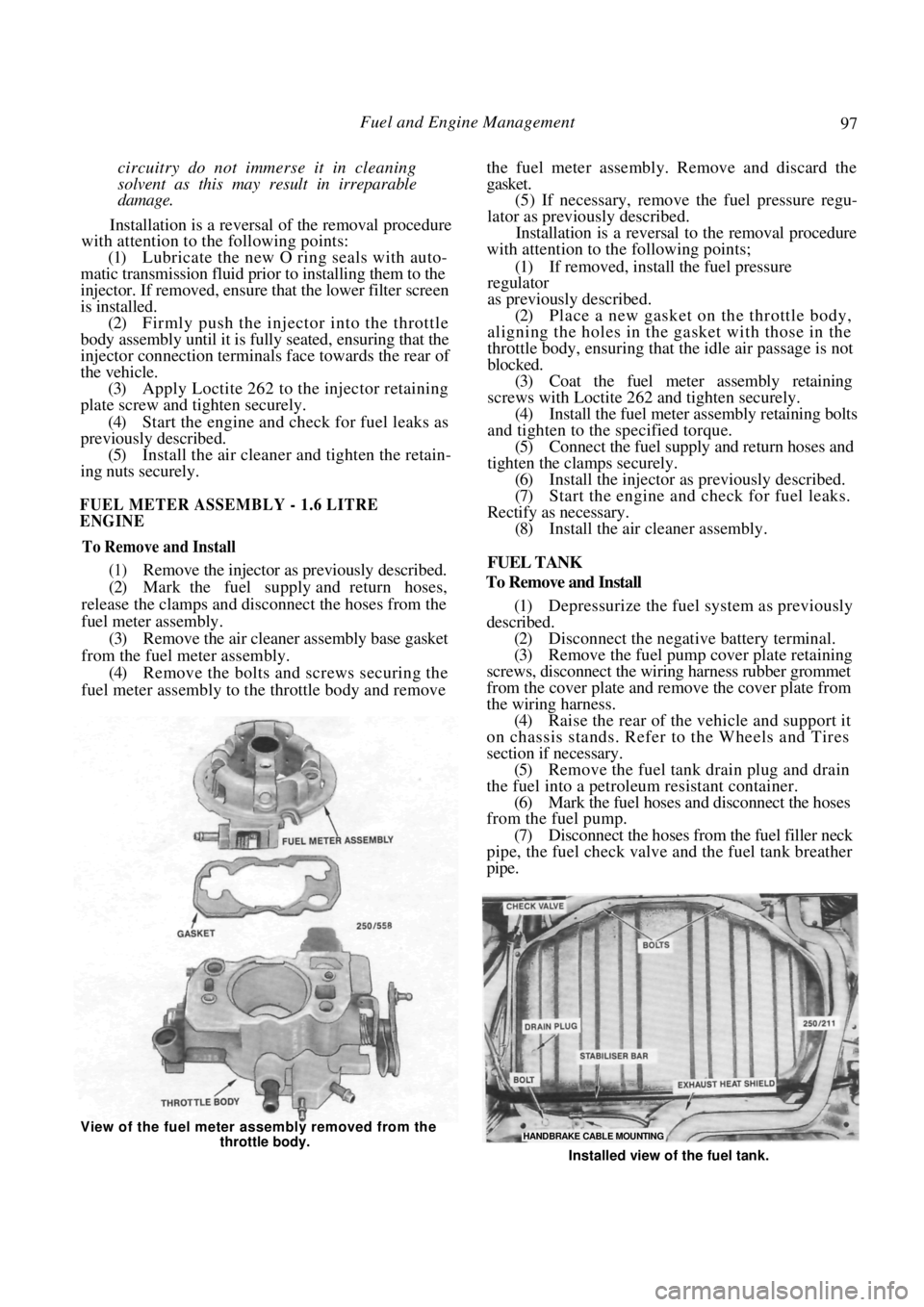
To Remove and Install
(1) Remove the injector as previously described.
(2) Mark the fuel supp ly and return hoses,
release the clamps and disconnect the hoses from the
fuel meter assembly.
(3) Remove the air cleaner assembly base gasket
from the fuel meter assembly. (4) Remove the bolts and screws securing the
fuel meter assembly to the throttle body and remove the fuel meter assembly. Remove and discard the
gasket.
(5) If necessary, remove the fuel pressure regu-
lator as previously described.
Installation is a reversal to the removal procedure
with attention to the following points;
(1) If removed, install the fuel pressure
regulator
as previously described.
(2) Place a new gasket on the throttle body,
aligning the holes in the gasket with those in the
throttle body, ensuring that the idle air passage is not
blocked. (3) Coat the fuel meter assembly retaining
screws with Loctite 26 2 and tighten securely.
(4) Install the fuel meter assembly retaining bolts
and tighten to the specified torque.
(5) Connect the fuel supply and return hoses and
tighten the clamps securely. (6) Install the injector as previously described.
(7) Start the engine and check for fuel leaks.
Rectify as necessary. (8) Install the air cleaner assembly.
FUEL TANK
To Remove and Install
(1) Depressurize the fuel system as previously
described.
(2) Disconnect the negative battery terminal.
(3) Remove the fuel pump cover plate retaining
screws, disconnect the wi ring harness rubber grommet
from the cover plate and remove the cover plate from
the wiring harness. (4) Raise the rear of the vehicle and support it
on chassis stands. Refer to the Wheels and Tires
section if necessary. (5) Remove the fuel tank drain plug and drain
the fuel into a petroleum resistant container. (6) Mark the fuel hoses and disconnect the hoses
from the fuel pump.
(7) Disconnect the hoses from the fuel filler neck
pipe, the fuel check valve and the fuel tank breather
pipe.
View of the fuel meter assembly removed from the
throttle body. HANDBRAKE CABLE MOUNTING
Installed view of the fuel tank.
Page 98 of 238
Fuel and Engine Management
(8) Remove the bolts retaining the intermediate
exhaust pipe to the rear of the catalytic converter,
remove the bolt securing the exhaust mounting to the
underbody and slightly lower the intermediate exhaust
pipe. Support the intermediate pipe to prevent the
tailpipe fouling the lower bumper panel.
(9) Remove the bolts retaining the stabilizer bar
mounting brackets to the underbody and allow the
stabilizer bar to drop.
(10) Remove the bolts retaining the exhaust heat
shield to the underbody, located at the front of the
fuel tank. (11) Remove the handbrake cable mounting
bracket retaining nuts and remove the mounting
brackets from the mounting studs. (12) Remove the fuel tank retaining bolts and
maneuver the fuel tank from the vehicle. Installation is a reversal of the removal procedure
with attention to the following points:
(1) When installing the fuel tank, ensure that the
fuel pump wiring harness is directed through the
aperture in the floor. (2) Install the stabilizer bar mounting
bracket
bolts and tighten to the specified torque. Refer to the
Rear Suspension section.
(3) Using a new gasket, install the intermediate
exhaust pipe to the catalyti c converter ensuring that
the earth wire terminal is installed and tighten the
bolts securely. (4) Connect the fuel filler neck hose, the fuel
check valve hose and the breat her hose ensuring that
they are secured firmly. (5) Tighten the fuel tank drain plug to the
specified torque. (6) Connect the fuel hoses to the fuel pump,
using the marks made during removal to ensure
correct installation. (7) Install the fuel pump wiring harness and the
rubber grommet to the fuel pump cover plate. Install
the cover plate and tighten the retaining bolts se-
curely.
(8) Connect the fuel pump wiring connector
securely. (9) Check for fuel leaks as previously described.
6. AIR FLOW COMPONENTS
NOTE: Before proceeding with any of the
operations in this section, refer to the Ser-
vice Precautions and Procedures heading.
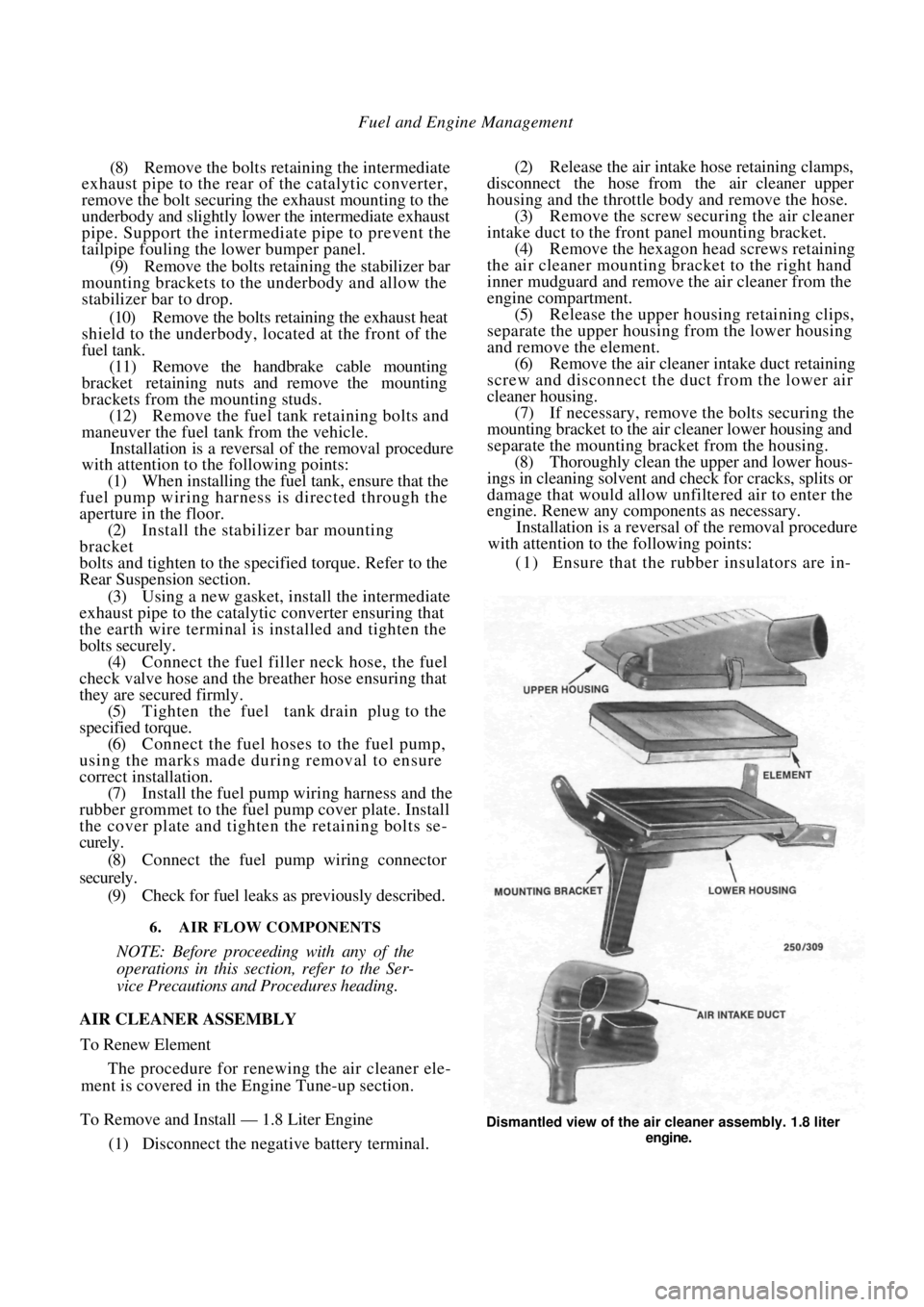
AIR CLEANER ASSEMBLY
To Renew Element
The procedure for renewing the air cleaner ele-
ment is covered in the Engine Tune-up section.
To Remove and Install — 1.8 Liter Engine
(1) Disconnect the negative battery terminal.
(2) Release the air intake hose retaining clamps,
disconnect the hose from the air cleaner upper
housing and the throttle body and remove the hose. (3) Remove the screw securing the air cleaner
intake duct to the front panel mounting bracket. (4) Remove the hexagon head screws retaining
the air cleaner mounting bracket to the right hand
inner mudguard and remove the air cleaner from the
engine compartment. (5) Release the upper housing retaining clips,
separate the upper housing from the lower housing
and remove the element. (6) Remove the air cleaner intake duct retaining
screw and disconnect the duct from the lower air
cleaner housing. (7) If necessary, remove the bolts securing the
mounting bracket to the ai r cleaner lower housing and
separate the mounting bracket from the housing. (8) Thoroughly clean the upper and lower hous-
ings in cleaning solvent and check for cracks, splits or
damage that would allow unfiltered air to enter the
engine. Renew any components as necessary.
Installation is a reversal of the removal procedure
with attention to the following points:
(1) Ensure that the r ubber insulators are in-
Dismantled view of the ai r cleaner assembly. 1.8 liter
engine.
Page 103 of 238
Fuel and Engine Management 103
(10) Remove the jumper lead from the MAP
sensor wiring connector and measure the voltage
across terminals A and C on the MAP sensor wiring
connector.
If the voltage is below 4 volts, proceed to opera-
tion (12).
If the voltage is 4-6 volts, proceed as follows.
(11) With the ignition switched Off, disconnect
the wiring connectors from the control unit and check
the wiring harness for contin uity and shorts between
MAP sensor wiring connector terminal B and control
unit wiring connector terminal C11. Check the wiring
connectors for faults. Repair or renew the wiring
harness as necessary.
If no fault is found, renew the control unit and
retest for fault codes.
(12) Disconnect the wiring connector from the
throttle position sensor. (13) Measure the voltage across terminals A and
C on the MAP sensor wiring connector.
If the voltage is 4-6 volts, renew the throttle
position sensor as describe d later in this section.
If the voltage is below 4 volts, proceed as follows.
(14) With the ignition switched Off, disconnect
the wiring connectors from the control unit and check
the wiring harness for contin uity and shorts between
the MAP sensor wiring connector terminal C and
control unit wiring connector terminal C14. Check the
wiring connectors. Repair or renew the wiring harness
as necessary.
If no fault is found, renew the control unit and
retest for fault codes.
(15) Test the MAP sensor as follows:
(a) With the ignition switched On and the MAP
sensor wiring connector connected, measure the volt-
age across terminals A an d B by backprobing the
MAP sensor wiring connector. The voltage should be
as follows:
ALTITUDE VOLTAGE
Below 305 m .......................................... 3.8-5.5 volts
305-610 m ............................................. 3.6-5.3 volts
610-914 m ............................................. 3.5-5.1 volts
914-1 219 m .......................................... 3.3-5.0 volts
1 219-1 524 m ...................................... 3.2-4.8 volts
1 524-1 829 m ...................................... 3.0-4.6 volts
1 829-2 133 m ...................................... 2.9-4.5 volts
2 133-2 438 m ....................................... 2.8-4.3 volts
2 438-2 743 m ...................................... 2.6-4.2 volts
2 743-3 048 m ...................................... 2.5-4.0 volts
If the voltage is not as specified, renew the MAP
sensor.
(b) If the voltage is as specified, apply a 34 kPa
vacuum to the MAP sensor using a vacuum pump.
The voltage should be 1.2-2.3 volts lower than that
measured in operation (a).
If the voltage is not as specified, renew the MAP
sensor.
If no fault is found, check the vacuum supply hose
for restriction, leakage or correct installation.
To Remove and Install
(1) Disconnect the negative battery terminal.
(2) Disconnect the MAP sensor wiring connec-
tor and the vacuum hose. (3) Remove the retaining sc rews and remove the
MAP sensor from the vehicle.
Installation is a reversal of the removal procedure
with attention to the following points:
(1) If a new MAP sensor is to be installed ensure
that the colored insert inside the connector cavity
matches the color of the wiring connector.
(2) Ensure that the wiri ng connector and the
vacuum hose are connected securely.
THROTTLE CABLE
To Remove and Install
(1) On 1.6 liter engines, remove the air cleaner
assembly as previously described.
(2) Slide the outer throttle cable from the
mounting bracket, rotate the throttle linkage and
disconnect the inner throttle cable from the throttle
linkage. (3) Disconnect the throttle cable from the retain-
ing clamps in the engine compartment. (4) Disconnect the plastic re tainer from the top
of the throttle pedal and disengage the inner throttle
cable from the pedal. (5) Remove the bolts securing the throttle cable
to the bulkhead and withdraw the throttle cable. Installation is a reversal of the removal procedure.
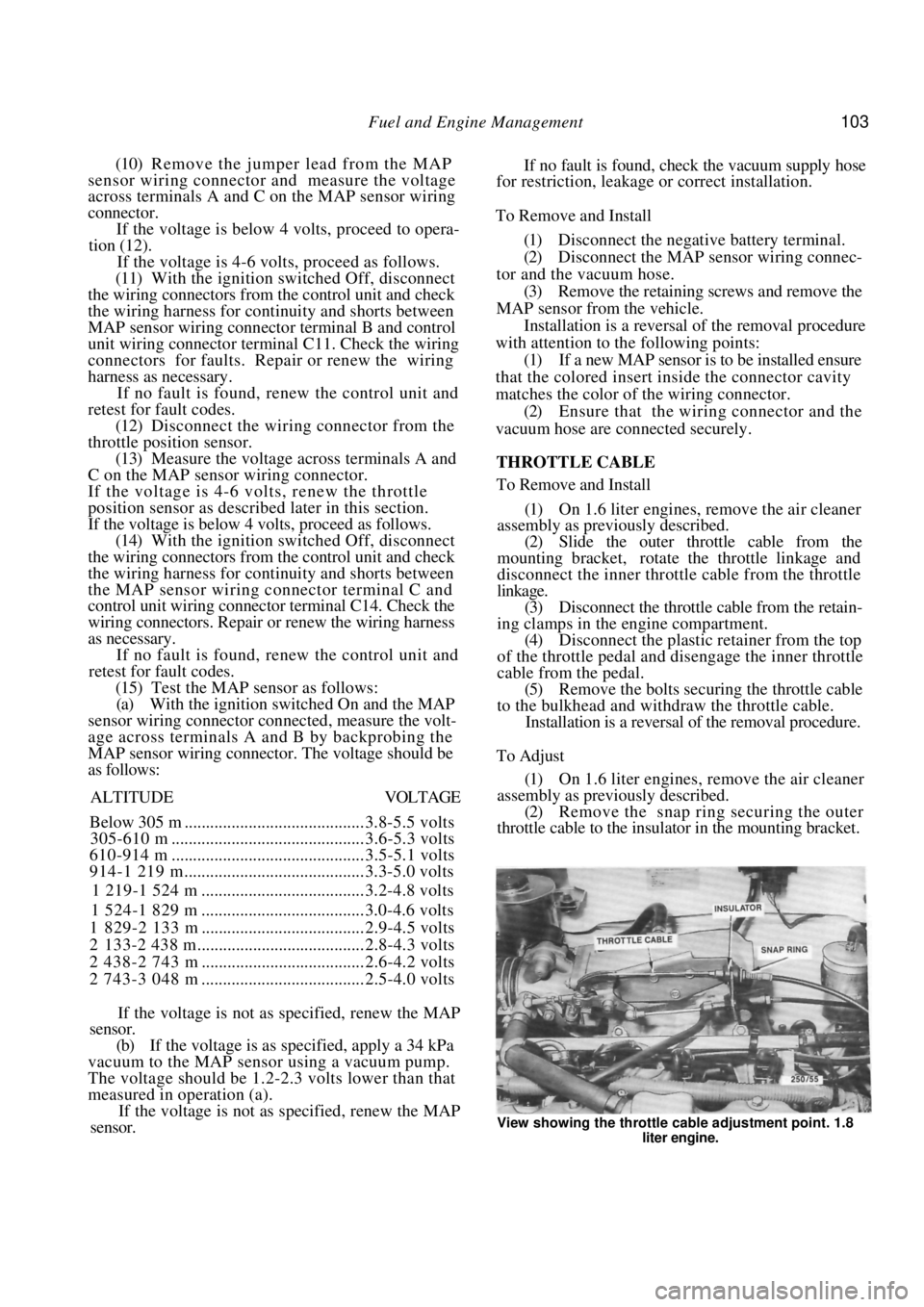
To Adjust
(1) On 1.6 liter engines, remove the air cleaner
assembly as previously described.
(2) Remove the snap ring securing the outer
throttle cable to the insulator in the mounting bracket.
View showing the throttle cable adjustment point. 1.8
liter engine.
Page 104 of 238
104 Fuel and Engine Management
(3) Gently pull the outer throttle cable until the
inner cable remains taut without moving the throttle
linkage. (4) Install the snap ring into the groove
posi-
tioned second from the insulator.
(5) Depress the throttle pedal and check that the
throttle valve opens fully and returns to the idle
position when the pedal is released. (6) On 1.6 liter engines, install the air
cleaner
assembly.
7. ELECTRONIC COMPONENTS
NOTE: Before proceeding with any of the
operations in this section, refer to the Ser-
vice Precautions and Procedures heading.
TO CHECK IGNITION SYSTEM
(1) Perform the test procedure described in the
Roadside Trouble Shooting section. Repair or renew
components as necessary. (2) Perform the self diagnosis test procedure as
previously described and rectify any faults. If there is
no spark, proceed as follows. (3) Disconnect the 4 pin wiring connector from
the distributor and check for spark at a spark plug
high tension lead using the test spark plug. If there is a spark, renew the pickup coil in the
distributor.
If there is no spark, proceed as follows.
(4) Connect the coil high tension lead to the test
spark plug and check for spark.
If there is a spark, check the distributor cap and
rotor for cracks and moisture. Repair or renew as
necessary.
If there is no spark, proceed as follows.
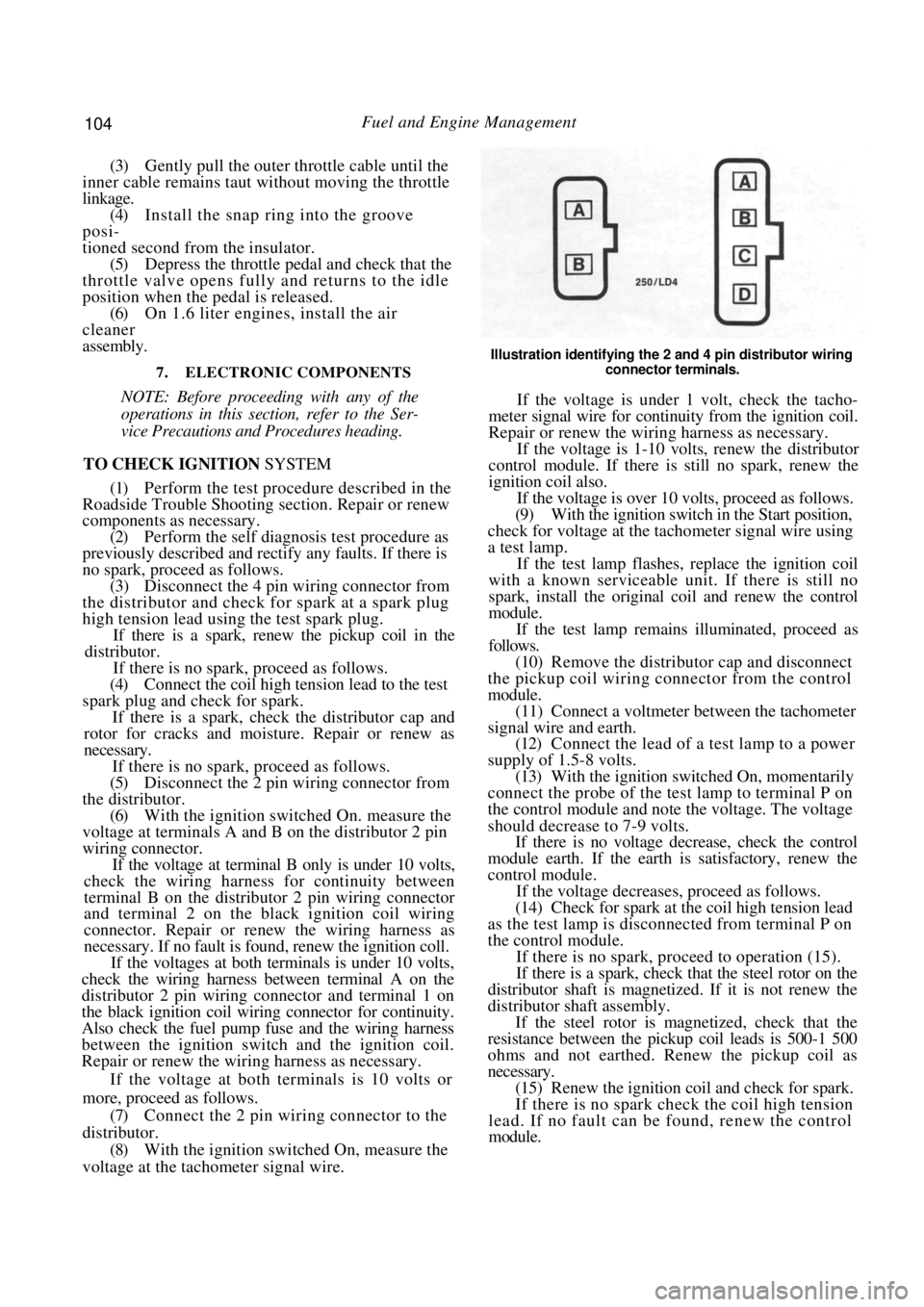
(5) Disconnect the 2 pin wiring connector from
the distributor. (6) With the ignition switched On. measure the
voltage at terminals A and B on the distributor 2 pin
wiring connector. If the voltage at terminal B only is under 10 volts,
check the wiring harness for continuity between
terminal B on the distributor 2 pin wiring connector
and terminal 2 on the black ignition coil wiring
connector. Repair or renew the wiring harness as
necessary. If no fault is found, renew the ignition coll.
If the voltages at both terminals is under 10 volts,
check the wiring harness between terminal A on the
distributor 2 pin wiring connector and terminal 1 on
the black ignition coil wiring connector for continuity.
Also check the fuel pump fuse and the wiring harness
between the ignition switch and the ignition coil.
Repair or renew the wiring harness as necessary.
If the voltage at both terminals is 10 volts or
more, proceed as follows.
(7) Connect the 2 pin wiring connector to the
distributor. (8) With the ignition switched On, measure the
voltage at the tachometer signal wire.
Illustration identifying the 2 and 4 pin distributor wiring
connector terminals.
If the voltage is under 1 volt, check the tacho-
meter signal wire for continuity from the ignition coil.
Repair or renew the wiring harness as necessary.
If the voltage is 1-10 volts, renew the distributor
control module. If there is still no spark, renew the
ignition coil also.
If the voltage is over 10 volts, proceed as follows.
(9) With the ignition switch in the Start position,
check for voltage at the tachometer signal wire using
a test lamp.
If the test lamp flashes, replace the ignition coil
with a known serviceable un it. If there is still no
spark, install the original coil and renew the control
module.
If the test lamp remains illuminated, proceed as
follows.
(10) Remove the distributor cap and disconnect
the pickup coil wiring co nnector from the control
module. (11) Connect a voltmeter between the tachometer
signal wire and earth. (12) Connect the lead of a test lamp to a power
supply of 1.5-8 volts. (13) With the ignition switched On, momentarily
connect the probe of the test lamp to terminal P on
the control module and note the voltage. The voltage
should decrease to 7-9 volts. If there is no voltage decrease, check the control
module earth. If the earth is satisfactory, renew the
control module.
If the voltage decreases , proceed as follows.
(14) Check for spark at the coil high tension lead
as the test lamp is disconnected from terminal P on
the control module.
If there is no spark, proceed to operation (15).
If there is a spark, check that the steel rotor on the
distributor shaft is magnetized. If it is not renew the
distributor shaft assembly.
If the steel rotor is magnetized, check that the
resistance between the pickup coil leads is 500-1 500
ohms and not earthed. Renew the pickup coil as
necessary.
(15) Renew the ignition coil and check for spark.
If there is no spark check the coil high tension
lead. If no fault can be found, renew the control
module.
Page 108 of 238
108 Fuel and Engine Management
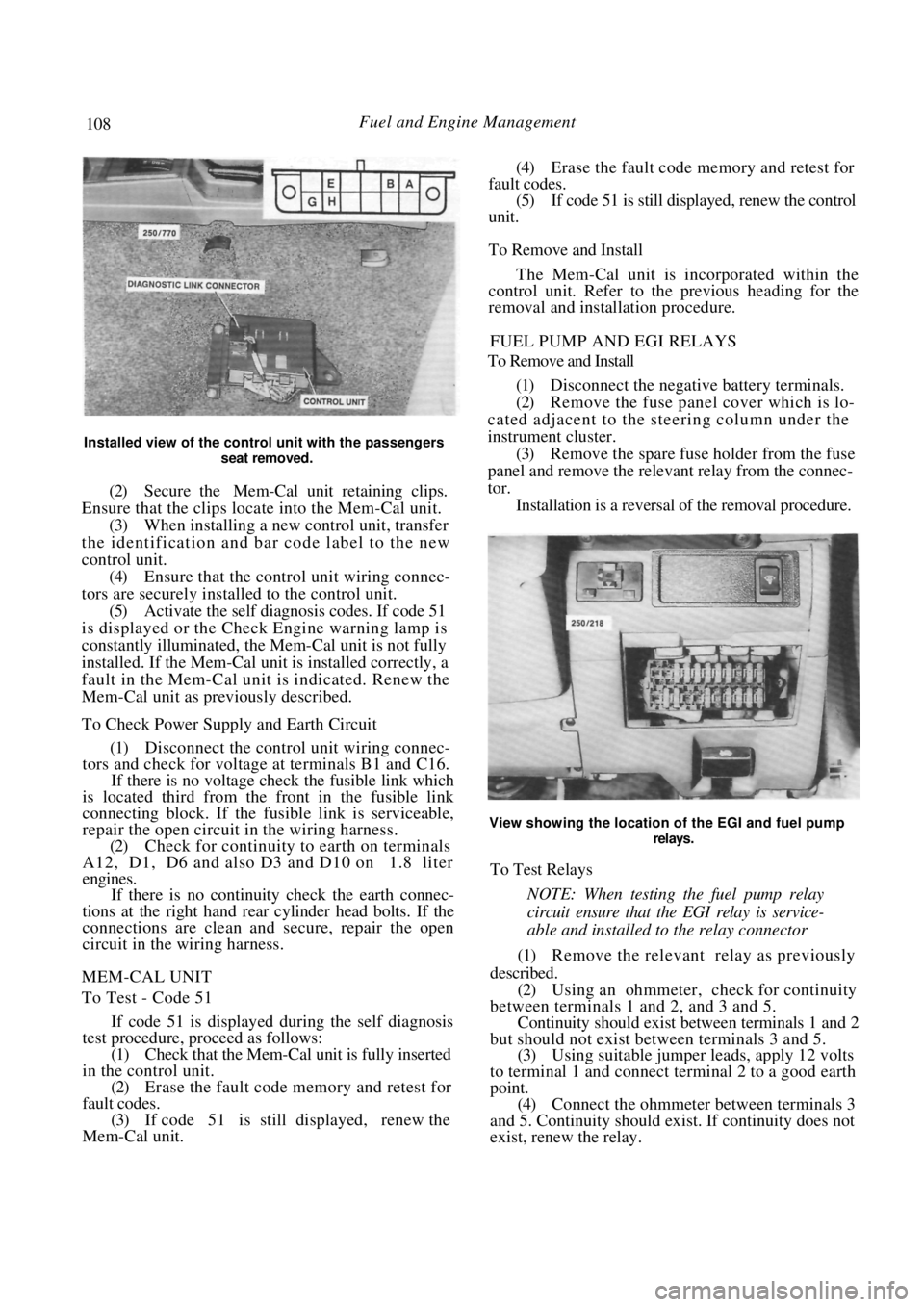
Installed view of the control unit with the passengers seat removed.
(2) Secure the Mem-Cal unit retaining clips.
Ensure that the clips locate into the Mem-Cal unit. (3) When installing a new control unit, transfer
the identification and bar code label to the new
control unit. (4) Ensure that the control unit wiring connec-
tors are securely installed to the control unit. (5) Activate the self diagnosis codes. If code 51
is displayed or the Check Engine warning lamp is
constantly illuminated, the Mem-Cal unit is not fully
installed. If the Mem-Cal uni t is installed correctly, a
fault in the Mem-Cal unit is indicated. Renew the
Mem-Cal unit as previously described.
To Check Power Supply and Earth Circuit
(1) Disconnect the control unit wiring connec-
tors and check for voltage at terminals B1 and C16.
If there is no voltage check the fusible link which
is located third from the front in the fusible link
connecting block. If the fu sible link is serviceable,
repair the open circuit in the wiring harness.
(2) Check for continuity to earth on terminals
A12, D1, D6 and also D3 and D10 on 1.8 liter
engines.
If there is no continuity check the earth connec-
tions at the right hand rear cylinder head bolts. If the
connections are clean and secure, repair the open
circuit in the wiring harness.
MEM-CAL UNIT
To Test - Code 51
If code 51 is displayed during the self diagnosis
test procedure, pr oceed as follows:
(1) Check that the Mem-Cal unit is fully inserted
in the control unit. (2) Erase the fault code memory and retest for
fault codes. (3) If code 51 is still displayed, renew the
Mem-Cal unit.
(4) Erase the fault code memory and retest for
fault codes. (5) If code 51 is still displayed, renew the control
unit.
To Remove and Install
The Mem-Cal unit is incorporated within the
control unit. Refer to the previous heading for the
removal and installation procedure.
FUEL PUMP AND EGI RELAYS
To Remove and Install
(1) Disconnect the negative battery terminals.
(2) Remove the fuse panel cover which is lo-
cated adjacent to the steering column under the
instrument cluster. (3) Remove the spare fuse holder from the fuse
panel and remove the releva nt relay from the connec-
tor. Installation is a reversal of the removal procedure.
View showing the location of the EGI and fuel pump
relays.
To Test Relays
NOTE: When testing the fuel pump relay
circuit ensure that th e EGI relay is service-
able and installed to the relay connector
(1) Remove the relevant relay as previously
described. (2) Using an ohmmeter, check for continuity
between terminals 1 and 2, and 3 and 5. Continuity should exist be tween terminals 1 and 2
but should not exist between terminals 3 and 5.
(3) Using suitable jumper leads, apply 12 volts
to terminal 1 and connect terminal 2 to a good earth
point. (4) Connect the ohmmeter between terminals 3
and 5. Continuity should exist. If continuity does not
exist, renew the relay.
Page 109 of 238
Fuel and Engine Management 109
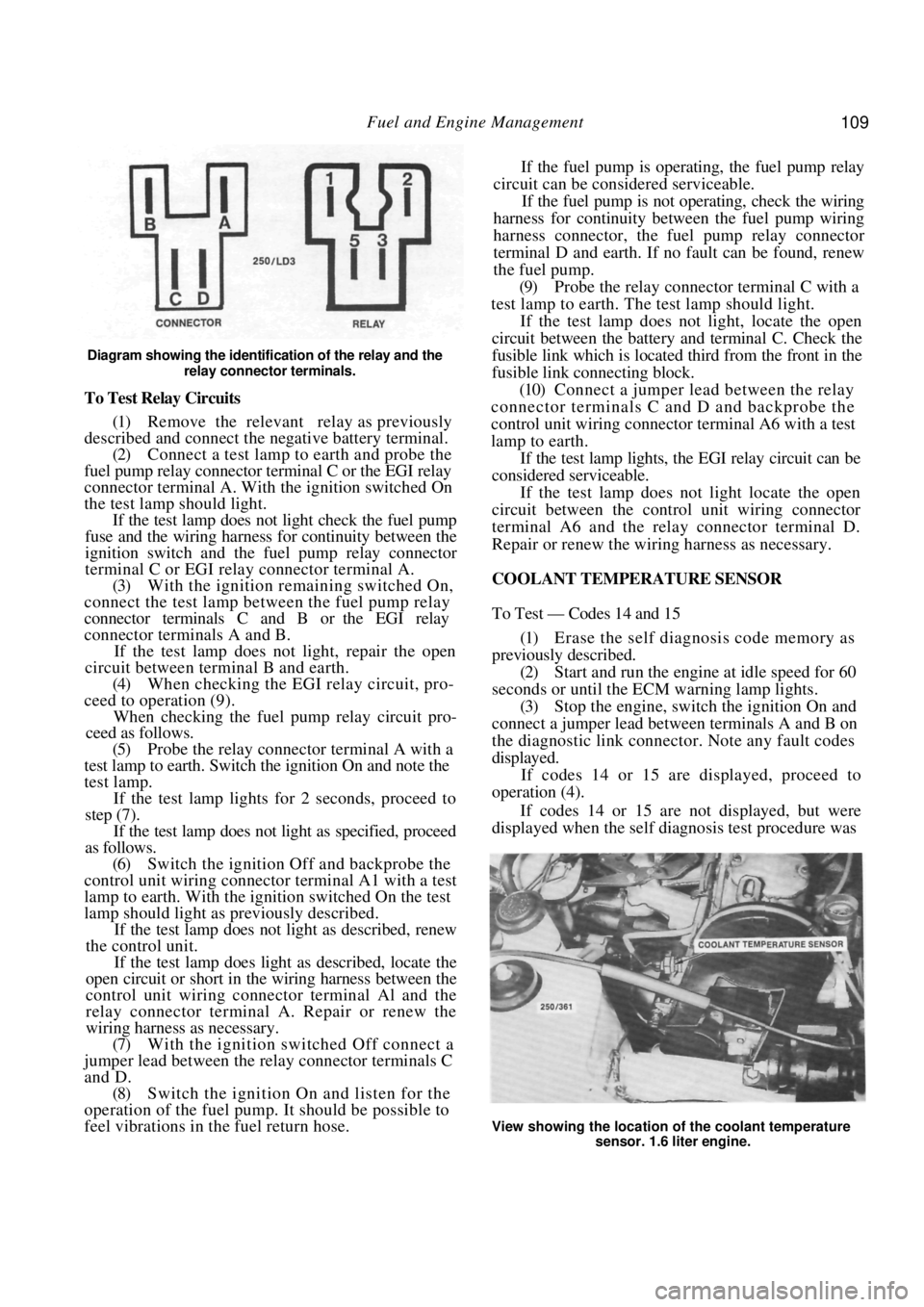
Diagram showing the identification of the relay and the relay connector terminals.
To Test Relay Circuits
(1) Remove the relevant relay as previously
described and connect the ne gative battery terminal.
(2) Connect a test lamp to earth and probe the
fuel pump relay connector terminal C or the EGI relay
connector terminal A. With the ignition switched On
the test lamp should light. If the test lamp does not light check the fuel pump
fuse and the wiring harness for continuity between the
ignition switch and the fuel pump relay connector
terminal C or EGI rela y connector terminal A.
(3) With the ignition remaining switched On,
connect the test lamp between the fuel pump relay
connector terminals C and B or the EGI relay
connector terminals A and B.
If the test lamp does not light, repair the open
circuit between terminal B and earth.
(4) When checking the EGI relay circuit, pro-
ceed to operation (9).
When checking the fuel pu mp relay circuit pro-
ceed as follows.
(5) Probe the relay connector terminal A with a
test lamp to earth. Switch the ignition On and note the
test lamp.
If the test lamp lights for 2 seconds, proceed to
step (7).
If the test lamp does not light as specified, proceed
as follows.
(6) Switch the ignition Off and backprobe the
control unit wiring connector terminal A1 with a test
lamp to earth. With the ignition switched On the test
lamp should light as previously described.
If the test lamp does not light as described, renew
the control unit.
If the test lamp does light as described, locate the
open circuit or short in the wiring harness between the
control unit wiring connector terminal Al and the
relay connector terminal A. Repair or renew the
wiring harness as necessary.
(7) With the ignition switched Off connect a
jumper lead between the relay connector terminals C
and D. (8) Switch the ignition On and listen for the
operation of the fuel pump. It should be possible to
feel vibrations in the fuel return hose. If the fuel pump is operating, the fuel pump relay
circuit can be considered serviceable.
If the fuel pump is not operating, check the wiring
harness for continuity between the fuel pump wiring
harness connector, the fuel pump relay connector
terminal D and earth. If no fault can be found, renew
the fuel pump.
(9) Probe the relay connector terminal C with a
test lamp to earth. The test lamp should light.
If the test lamp does not light, locate the open
circuit between the battery and terminal C. Check the
fusible link which is located third from the front in the
fusible link connecting block.
(10) Connect a jumper lead between the relay
connector terminals C and D and backprobe the
control unit wiring connector terminal A6 with a test
lamp to earth.
If the test lamp lights, the EGI relay circuit can be
considered serviceable.
If the test lamp does not light locate the open
circuit between the contro l unit wiring connector
terminal A6 and the relay connector terminal D.
Repair or renew the wiring harness as necessary.
COOLANT TEMPERATURE SENSOR
To Test — Codes 14 and 15
(1) Erase the self diagnosis code memory as
previously described. (2) Start and run the engine at idle speed for 60
seconds or until the ECM warning lamp lights.
(3) Stop the engine, switch the ignition On and
connect a jumper lead between terminals A and B on
the diagnostic link connect or. Note any fault codes
displayed. If codes 14 or 15 are displayed, proceed to
operation (4).
If codes 14 or 15 are not displayed, but were
displayed when the self diagnosis test procedure was
View showing the location of the coolant temperature
sensor. 1.6 liter engine.
Page 114 of 238

114 Fuel and Engine Management
(6) Check the vehicle for the following:
(a) Low fuel pressure.
(b) Contaminated fuel.
(c) Vacuum leaks at the inlet manifold, engine
vacuum hoses and engine ventilation hoses. (d) Exhaust manifold leaks before the oxygen
sensor. (e) Correct MAP sensor operation.
(f) Blocked oxygen sensor metal vent cover eg.
plugged with mud etc. (g) Fuel injectors) partially blocked. Refer to a
fuel injection specialis t or a Nissan dealer.
If the above items have been checked and no
faults have been found, a faulty oxygen sensor is
indicated. Renew the oxygen sensor, run the engine
and ensure that no fault codes are set.
To Test — Code 45
(1) Run the engine until normal operating tem-
perature is attained. (2) With the ignition switched Off, connect a
jumper lead between terminals B and A on the
diagnostic link connector. (3) Start and run the engine at approximately
1 600-1 800 rpm for 2 minutes and note the ECM
warning lamp. If the ECM warning lamp is on more than off or
flashes at the rate of twice per second, proceed to the
following operation.
If the ECM warning lamp flashes evenly at the
rate of once per second an intermittent fault is
indicated. Proceed as follows:
(a) Check for faulty wiri ng connections. Check
that all wiring connectors are clean and secure. (b) Check that all earth wires are secure.
(4) Switch the engine Off and disconnect the
oxygen sensor wiring connector. (5) Using a jumper lead, connect the oxygen
sensor wiring connector to a suitable engine earth. (6) Start and run the engine at 1 600-1 800 rpm
and note the ECM warning lamp.
If the ECM warning lamp extinguishes for at least
30 seconds, proceed to operation (7).
If the ECM warning lamp flashes on more than off
or flashes at the rate of twice per second, switch the
engine Off and disconnect the control unit wiring
connectors. Using an ohmmeter, check that there is no
resistance between the co ntrol unit wiring connector
terminal D6 and earth. Repair or renew the wiring as
necessary.
If no fault can be found in the wiring harness,
renew the control unit.
NOTE: The wiring harness for terminal D6
earths through the righ t hand rear cylinder
head bolt.
(7) Check the vehicl e for the following:
(a) High fuel pressure.
(b) Leaking injector(s).
(c) Faulty ignition wiring.
(d) Charcoal canister purge system blocked or
restricted.
(e) Faulty coolant temper ature sensor circuit.
(f) Faulty MAT sensor circuit (1.8 liter engine).
(g) MAP sensor operation.
(h) Throttle position sensor operation.
If the above items have been checked and no
faults have been found, a faulty oxygen sensor is
indicated.
Renew the oxygen sensor, run the engine and
ensure that no fault codes are set.
To Remove and Install
(1) If the engine is cold, run the engine for
approximately two minutes to allow easy oxygen
sensor removal. (2) Disconnect the negative battery terminal and
the oxygen sensor connector.
View of the oxygen sensor removed from the exhaust
manifold.
(3) Remove the exhaust manifold heat shield
retaining bolts and remove the heat shield from the
engine.
(4) Remove the oxygen sensor with a short ring
spanner using care not to damage the sensor wire. Installation is a reversal of the removal procedure
with attention to the following points:
(1) When installing a sensor that has previously
been removed, coat the sen sor threads with anti-seize
compound. Nissan recommend a mixture of liquid
graphite and glass beads. (2) Install the sensor and tighten to the specified
torque. (3) Connect the electrical connector ensuring
that the wiring is secured away from the exhaust. (4) Install the heat shield and tighten the retain-
ing bolts securely. On 1.6 liter engines, ensure that the hot air inlet
tube is located correctly be tween the heat shield and
the air cleaner housing.
(5) Start the engine and check for leaks.
VEHICLE SPEED SENSOR
To Test - Code 24
(1) Check the fuel pump and meter fuses. If the
fuses are serviceable, proceed to operation (5). If a
fuse is blown, rectify the cause and renew the fuse.
Page 115 of 238

Fuel and Engine Management 115
Erase the fault codes and retest for fault codes as
follows:
(2) Start and run the engine until normal oper-
ating temperature is attained. (3) Drive the vehicle at a speed of at least 80
km/h and, with the throttle closed, allow the vehicle to
decelerate until the engine speed is below 1 500 rpm.
NOTE: After rectifying any fault it will be
necessary to retest for fault codes. To test for
Code 24 the vehicle must be driven as
previously described.
(4) Switch the engine Off and connect a jumper
lead between terminals A and B on the diagnostic link
connector. Switch the ignition On and note the fault
codes. If code 24 is displayed proceed as follows. (5) Check the operation of the speedometer and
the instrument cluster warning lamps. If the speed-
ometer only is not functioning, proceed to operation
(13).
If the speedometer and the instrument cluster
warning lamps are not functioning, a fault in the
instrument cluster wiring harness is indicated. Refer
the fault to an auto electrical workshop or a Nissan
dealer.
If the speedometer is functioning, proceed as
follows:
(6) Raise the front of the vehicle and support it
on chassis stands. (7) Place the transaxle in Neutral and switch the
ignition On. (8) With the aid of assistants, slowly spin the
front wheels by hand while backprobing the control
unit wiring connector terminal A10 with a digital
voltmeter to earth. The voltage should alternate from under 1 volt to
over 10 volts.
If the voltmeter readi ng is not as specified,
proceed to operation (9).
If the voltmeter reading is as specified, the vehicle
speed sensor is operating satisfactorily, indicating an
intermittent fault was the cause of the fault code.
Proceed as follows:
(a) Check for faulty wiri ng connections. Check
that all wiring connectors are clean and secure. (b) Check that all earth c onnections are secure.
(9) Remove the instrument cluster as described
in the Electrical System section. (10) With the ignition switched On, backprobe
the control unit wiring connector terminal A10 with a
voltmeter to earth. The voltage should be over 10
volts. If the voltage is less than specified, check the
wiring harness for shorts to earth between the black
and yellow wire terminal on the instrument cluster
wiring connector and the control unit connector
terminal A10. Repair or renew the wiring harness as
necessary. If no fault can be found, renew the control
unit.
(11) With the ignition switched On, backprobe
the black and yellow wire terminal on the instrument
cluster wiring connector with a voltmeter to earth.
The voltage should be over 10 volts.
If the voltage is less than specified, locate the open
circuit between the instrument cluster black and
yellow wire terminal and the control unit wiring
connector terminal A10. Repair or renew the wiring
harness as necessary.
(12) With a test lamp connected to 12 volts,
backprobe the black wire terminals on the instrument
cluster wiring connectors. The test lamp should light.
If the test lamp does not light locate the open
circuit between the black wire terminals and earth.
Repair or renew the wiring harness as necessary.
If the test lamp does light, renew the signal
divider circuit board which is located in the instru-
ment cluster.
(13) With the ignition switched On and the
engine not running, disconnect the vehicle speed
sensor wiring connector from the harness connector.
(14) With a test lamp connected to earth, probe
the yellow wire terminal on the harness wiring con-
nector. The test lamp should light. If the test lamp does not light, locate the open
circuit between the yellow wi re terminal and the Fuel
Pump fuse. Repair or renew the wiring harness as
necessary.
(15) With a test lamp connected to 12 volts,
probe the black wire terminal on the harness wiring
connector. The test lamp should light.
If the test lamp does not light, locate the open
circuit between the black wire terminal and earth.
Repair or renew the wiring harness as necessary.
(16) Using a voltmeter measure the voltage at the
red wire terminal on the harness wiring connector.
If the voltage is 5-9 volts proceed to operation
(19).
If the voltage is over 9 vol ts proceed to operation
(18).
Installed view of the vehicle speed sensor.
Page 117 of 238
117
EMISSION CONTROL
INTRODUCTION
To reduce the output level of the three primary
automotive emissions, carbon monoxide (CO), hydro-
carbons (HC) and oxides of nitrogen (NOx), and thus
comply with legislation on the maintenance of clean
air, several different emissi on control systems are used
in the Pulsar range of vehicles covered by this manual.
The systems will be discussed under the headings
( 1 ) Crankcase Ventilation System, (2) Evaporative
Control System, (3) Air Preheat System — 1.6 Liter
Engine and (4) Exhaust Control System.
1. CRANKCASE VENTILATION SYSTEM
DESCRIPTION
The crankcase ventilation system is of the closed
type and is designed to prevent crankcase vapors
being emitted into the atmosphere. Crankcase
vapors are caused by gases escaping past the piston
rings into the crankcase during the combustion pro-
cess.
The crankcase vapors are collected in the cam-
shaft housing from the cra nkcase via the various oil
drain passages and the pipe from the side of the
crankcase.
The crankcase vapors are then drawn into the
engine via a branched hose connected to the camshaft
housing oil baffle and the throttle body (1.8 liter
engines) or inlet manifold (1.6 liter engines).
At idle speed, vapors are drawn through the
small branch of the hose and into the engine.
As the engine speed increases, vapors are also
drawn into the engine via the main hose.
TO SERVICE THE SYSTEM
(1) At intervals of 40 000 km, disconnect the
small engine ventilation hose from the throttle body
or inlet manifold and check that the metering orifice
is not blocked.
If necessary, clean the orifice using compressed air
and solvent.
(2) Disconnect all the engine ventilation hoses
and check for blocking, collapsing and deterioration.
Renew the hoses as necessary.
2. EVAPORATIVE CONTROL SYSTEM
Special Equipment Required:
To Test Purge Valve — Hand vacuum pump
DESCRIPTION
The evaporative control system reduces the
amount of hydrocarbons emitted to the atmosphere
through fuel evaporation.
The vehicles covered by this manual use an
absorption regeneration system to reduce vapor loss.
The system utilizes a canister of activated charcoal to
trap and hold the fuel vapors until they can be fed
into the induction system for burning in the combus-
tion chambers.
The basic components of the evaporative control
system are a fuel tank with a sealed filler cap, a
charcoal canister with a pur ge control valve, a fuel
check valve and pipes a nd hoses to connect the
various components.
NOTE: The fuel tank filler cap is not vented
to the atmosphere but is equipped with a one
way relief valve to prevent a vacuum form-
ing in the fuel tank.
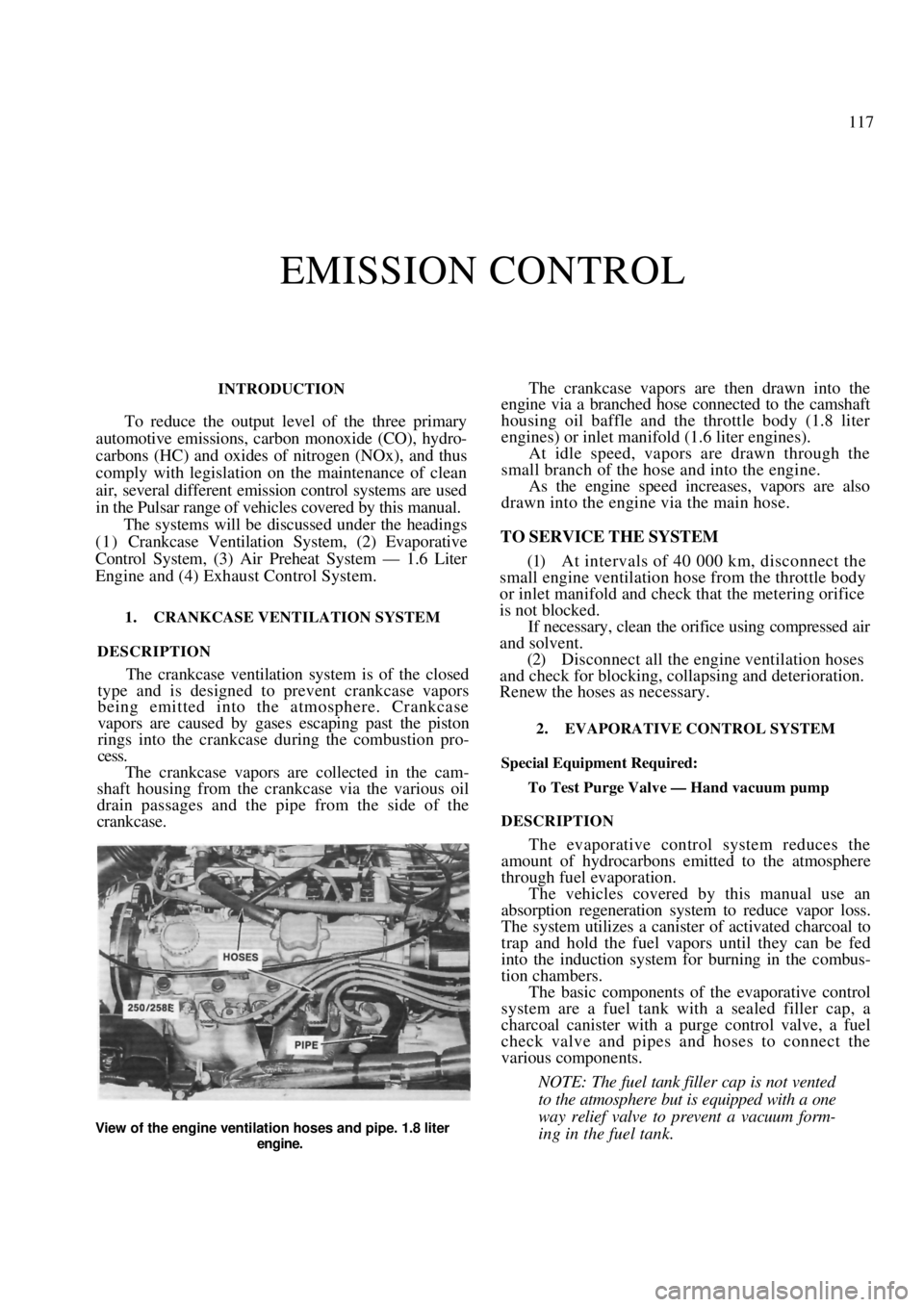
View of the engine ventilation hoses and pipe. 1.8 liter
engine.
Page 118 of 238

118 Emission Control
Installed view of the charcoal canister.
When the engine is at rest, fuel vapor through
evaporation gradually fills the air space in the fuel
tank. The sealed filler cap pr events the escape of this
vapor and pressure builds up within the system,
forcing the vapor to flow into the charcoal canister
which is located in the engine compartment beneath
the windscreen wiper motor.
The fuel check valve prevents liquid fuel entering
the charcoal canister when the fuel tank is full or the
vehicle is parked on a steep incline. When the engine
is running, the vapor is drawn via a hose from the
charcoal canister to the throttle body and burnt in the
combustion chambers.
TO RENEW CHARCOAL CANISTER
(1) Suitably mark and disconnect the hoses from
the canister. (2) Release the retaining spring and remove the
canister from the engine compartment. Installation is a reversal of the removal procedure.
TO RENEW FUEL CHECK VALVE
(1) Disconnect the negative battery terminal.
(2) Raise the rear of the vehicle and support it
on chassis stands. Remove the left hand rear wheel. (3) Drain the fuel from the fuel tank using a
hand pump or a suitable siphon. Do not siphon fuel
using the mouth.
(4) Remove the hoses from the check valve.
(5) Squeeze the retaining clip and remove the
check valve from the mounting bracket. Installation is a reversal of the removal procedure.
TO SERVICE THE SYSTEM
(1) Inspect the vacuum lines and connectors for
signs of leakage, cracks and deterioration and renew
as necessary. (2) Remove the fuel tank cap and check that a
slight resistance is felt, when vacuum is applied to the
one-way relief valve in the centre of the cap. Renew the fuel tank cap if no resistance is felt or
if the valve is blocked.
(3) Inspect the fuel tank cap seal for deteriora-
tion. Renew as necessary.
Installed view of the fuel check valve as seen with the
left hand rear wheel removed.
Check the fuel filler cap seal for damage.
23Q/LDZ GAUGE
Line drawing showing a hand vacuum pump.