fuel pump NISSAN PULSAR 1987 Owner's Guide
[x] Cancel search | Manufacturer: NISSAN, Model Year: 1987, Model line: PULSAR, Model: NISSAN PULSAR 1987Pages: 238, PDF Size: 28.91 MB
Page 119 of 238

Emission Control 119
(4) Remove the charcoal canister as previously
described under the heading To Renew Charcoal
Canister. (5) Shake the canister, there should no audible
carbon movement. If there is, renew the canister. (6) Check the purge valve by applying 20-35
kPa of vacuum with a hand pump to the control port. Using a piece of hose, blow through the purge
hose connection. If this is not possible, renew the
canister.
Remove the vacuum source and blow air through
the purge hose connection. If this is possible, renew
the canister.
(7) Apply 20-35 kPa air pressure into the fuel
tank connector. Air should flow freely from all the
other connectors.
If poor air flow through the drain tube exists,
block off the fuel tank tube and blow compressed air
at approximately 300 kPa through the purge port.
Check the air flow and if st ill poor, renew the canister.
(8) Apply 20-35 kPa air pressure to any one of
the canister ports except th e purge valve control port
and with the other ports blocked, ensure that there are
no leaks from the canister. If leaks exist, renew the
canister. (9) Remove the fuel check valve as previously
described under the heading To Renew Fuel Check
Valve. (10) Blow through the check valve from the side
that is connected to the fu el tank hose. Considerable
resistance should be felt with only a small amount of
air passing through the valve. If no resistance is felt or
if the valve is blocked renew the fuel check valve.
(11) Blow air through the fuel check valve from
the opposite end. There should be a smooth flow of air
through the valve. If the valve is blocked, renew the
fuel check valve.
3. AIR PREHEAT SYSTEM — 1.6 LITRE
ENGINE
DESCRIPTION
To reduce emissions and improve drivability
when the engine is cold, hot air is drawn into the air
cleaner from a heat shield which partially surrounds
the exhaust manifold.
When the ambient temperature is below 30°C, the
thermal vacuum valve, which is located inside the air
cleaner housing, allows vacuum to operate a servo
actuated flap in the air cleaner intake duct. When the
flap closes, hot air is dr awn from the exhaust heat
shield, through the hot air inlet tube into the air
cleaner intake duct.
When the ambient temperature is above 30°C,
the flap in the air cleaner intake duct opens allowing
cool air to enter the air cleaner.
View of the air preheat system components. 1.6 liter
engine.
TO CHECK OPERATION
(1) When the engine is cold, use a mirror to
check that the passage from the hot air inlet tube is
closed by the flap.
(2) Start and run the engi ne at approximately
1 200 rpm. The hot air inlet passage should now be
open, allowing hot air from the exhaust heat shield to
be drawn into the air cleaner. (3) Allow the engine to idle for fifteen minutes
and inspect the position of th e air cleaner intake flap.
The flap should now be in the open position allowing
cool air to be drawn into the air cleaner and shutting
oft' air from the exhaust manifold heat shield.
TO CHECK COMPONENTS
(1) Disconnect the vacuum hose from the servo
unit and connect a vacuum pump to the unit.
When the vacuum is applied to the servo unit, the
flap in the air cleaner intake duct should close.
When the vacuum is removed, the flap should
open.
View of the air cleaner raised showing the engine
ventilation hose and the thermal vacuum valve supply
hose connection. 1.6 liter engine.
Page 216 of 238
216 Electrical System
NOTE: While checking the operation of the
fusible link, loosely connect the battery-
terminal only, to safeguard against damage
to the wiring harness.
(5) If the circuit is still inoperative or the fusible
link burns out again, refer the problem to an auto-
motive electrician.
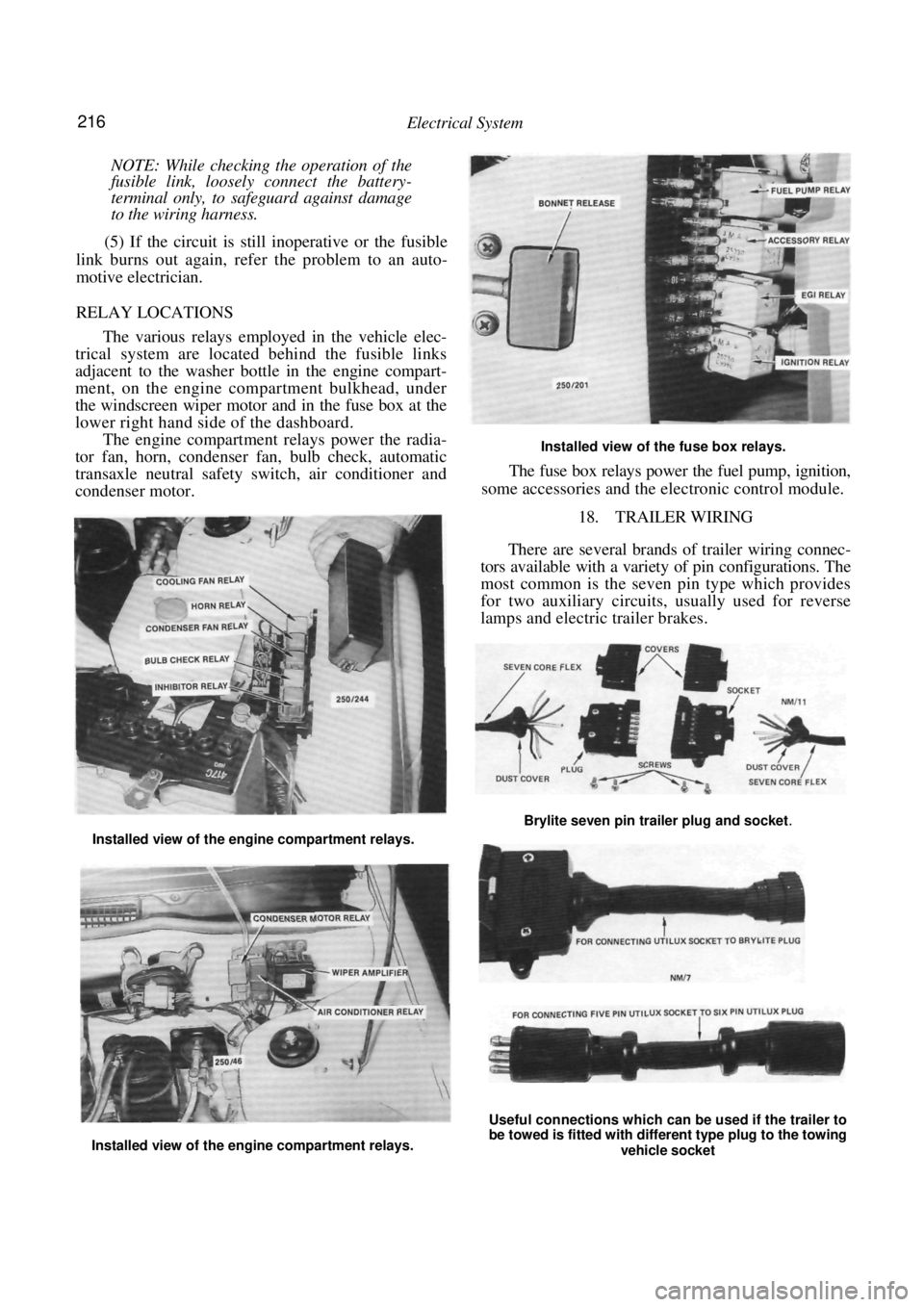
RELAY LOCATIONS
The various relays employed in the vehicle elec-
trical system are located behind the fusible links
adjacent to the washer bottle in the engine compart-
ment, on the engine compartment bulkhead, under
the windscreen wiper motor and in the fuse box at the
lower right hand side of the dashboard.
The engine compartment relays power the radia-
tor fan, horn, condenser fan, bulb check, automatic
transaxle neutral safety switch, air conditioner and
condenser motor.
Installed view of the fuse box relays.
The fuse box relays power the fuel pump, ignition,
some accessories and the el ectronic control module.
18. TRAILER WIRING
There are several brands of trailer wiring connec-
tors available with a variet y of pin configurations. The
most common is the seven pin type which provides
for two auxiliary circuits, usually used for reverse
lamps and electric trailer brakes.
Installed view of the engine compartment relays.
Installed view of the engine compartment relays.
Useful connections which can be used if the trailer to
be towed is fitted with different type plug to the towing
vehicle socket
Brylite seven pin trailer plug and socket.
Page 219 of 238
Electrical System 219
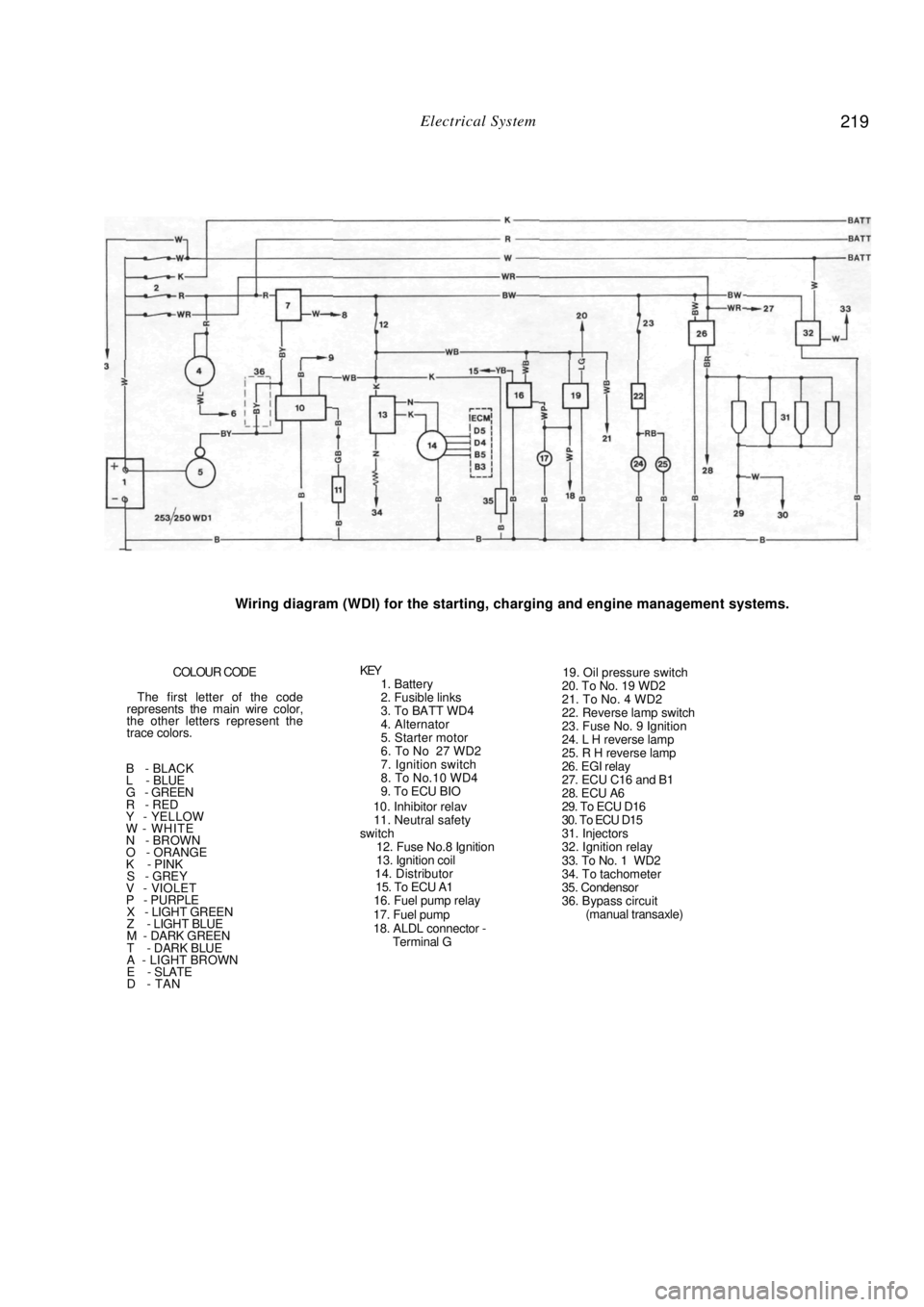
Wiring diagram (WDI) for the starting, charging and engine management systems.
COLOUR CODE
The first letter of the code
represents the main wire color,
the other letters represent the
trace colors.
B - BLACK
L - BLUE
G - GREEN
R - RED
Y - YELLOW
W - WHITE
N - BROWN
O - ORANGE
K - PINK
S - GREY V - VIOLET
P - PURPLE X - LIGHT GREEN
Z - LIGHT BLUE
M - DARK GREEN
T - DARK BLUE
A - LIGHT BROWN
E - SLATE
D - TAN
KEY 1. Battery
2. Fusible links
3. To BATT WD4
4. Alternator
5. Starter motor
6. To No 27 WD2
7. Ignition switch
8. To No.10 WD4
9. To ECU BIO
10. Inhibitor relav
11. Neutral safety
switch
12. Fuse No.8 Ignition
13. Ignition coil
14. Distributor
15. To ECU A1
16. Fuel pump relay
17. Fuel pump
18. ALDL connector - Terminal G
19. Oil pressure switch
20. To No. 19 WD2
21. To No. 4 WD2
22. Reverse lamp switch
23. Fuse No. 9 Ignition
24. L H reverse lamp
25. R H reverse lamp
26. EGI relay
27. ECU C16 and B1
28. ECU A6
29. To ECU D16
30. To ECU D15
31. Injectors
32. Ignition relay
33. To No. 1 WD2
34. To tachometer
35. Condensor
36. Bypass circuit (manual transaxle)