steering wheel NISSAN PULSAR 1987 Owner's Manual
[x] Cancel search | Manufacturer: NISSAN, Model Year: 1987, Model line: PULSAR, Model: NISSAN PULSAR 1987Pages: 238, PDF Size: 28.91 MB
Page 158 of 238

158 Front Suspension
Installed view of the front suspension. When using a floor jack locate the head of the jack on the crossmember.
(2) Remove the cap, split pin, castellated re-
tainer and with the aid of an assistant applying the
brakes, loosen and remove the hub nut.
(3) Remove the split pin and the castellated nut
retaining the tie rod end to the steering knuckle. (4) Disconnect the tie rod end from the steering
knuckle using a suitable puller. Alternatively place a
suitable dolly or hammer against one side of the
steering knuckle eye and strike the opposite side with
a hammer.
(5) Remove the brake caliper anchor plate bolts,
withdraw the caliper from the disc and support it with
a piece of wire inside the inner mudguard. Ensure that
the brake hose is not twisted.
(6) Withdraw the brake disc from the hub.
(7) Loosely install the hub nut and tap on the nut
with a soft faced hammer to separate the drive shaft
from the hub. (8) Place a mark on the suspension unit to
steering knuckle cam head bolt to ensure correct wheel
alignment on assembly. (9) Remove the steering knuckle to suspension
unit nuts and bolts. (10) Remove the split pin and the castellated nut
retaining the lower ball joint stud to the steering
knuckle. (11) Disconnect the ball joint stud from the steering knuckle using a suitable puller or alternatively
place a suitable dolly or hammer against one side of
the steering knuckle eye and strike the opposite side
with a hammer.
(12)
Withdraw the steering knuckle from the
vehicle taking care not to drop the drive shaft or
damage its boot. (13) Clean and check the steering knuckle for
wear, cracks and damage. (14) If necessary, dismantle the hub and check
the bearing assembly using the dismantling procedure
described later in this section. Installation is a reversal of the removal procedure
with attention to the following points:
(1) Install the steering knuckle and hub assembly
over the drive shaft and loosely install the ball joint
stud nut and the suspension unit to knuckle bolts and
nuts.
(2) Ensure that the suspension unit to steering
knuckle cam head bolt mark s are aligned and tighten
the retaining nuts to the specified torque.
NOTE: If the cam head bolt is not installed
in its original position, a wheel alignment
should be performed.
(3) Tighten the ball joint to steering knuckle stud
bolt to the specified torque.
Page 159 of 238

Front Suspension 159
(4) Install the tie rod end to the steering knuckle
and tighten the castellated nut securely. Install a
new
split pin.
(5) Install the brake disc to the hub.
(6) Install the brake caliper to the steering
knuckle and tighten the retaining bolts to the specified
torque. (7) Install the hub nut and washer to the
drive
shaft and with the aid of an assistant applying the
brakes, tighten the hub nut to the specified torque. (8) Install the hub nut retainer and a new
split
pin to the drive shaft. (9) Check the hub end float as described later in
this section. (10) Install the fron t wheel and lower the vehicle
to the ground.
TO DISMANTLE
NOTE: The front wheel bearing assembly is
non-serviceable. If the wheel bearing is dis-
mantled for any reason it should be re-
newed.
(1) Remove the steering knuckle from the vehi-
cle as previously described. (2) Hold the steering knuckle assembly in a vice
with soft jaw guards. (3) Using a hammer and a suitable pipe or tube
that pushes on the inside of the hub, drive out the
wheel hub and outside inner race from the steering
knuckle assembly. (4) Using snap ring pliers, remove the snap ring
that retains the outer bearing race from the wheel side
of the steering knuckle. (5) Using a suitable press and press plates,
support the steering knuckle with the outside face
downwards. To aid in dismantling, position the inside
inner race in the bearing and press the assembly from
the steering knuckle. Discard the bearing assembly. (6) Using a bearing puller and a press, remove
the inner race from the hub assembly. If the inner race cannot be removed from the hub
in this manner, it may be necessary to grind the race
using an angle grinder and split the race using a cold
chisel.
(7) Thoroughly clean and dry the steering
knuckle and hub in a suitable solvent. (8) Inspect all the components for wear, damage
and cracks and renew if necessary.
TO ASSEMBLE
Assembly is a reversal of the dismantling proce-
dure with attention to the following points:
(1) Apply grease to the oil seal lips of the new
bearing assembly.
NOTE: Ensure that (he inside of the outer
race of the bearing is precoated with wheel
bearing grease. If necessary, pack the outer
race of the wheel bearing with wheel bearing
grease after it is installed to the steering
knuckle.
(2) Using the press and press plates, support the
steering knuckle with the outside face uppermost.
Using a suitable diameter steel tube that contacts on
the outer race only, press the outer race full into the
steering knuckle.
(3) Install the snap ring to the groove in the
steering knuckle.
(4) Install the inner races to the steering
knuckle
and support the inner race on the press using a
suitable tube or mandrel. (5) Using the press and a suitable tube press the
hub assembly into the steerin g knuckle. When using
the press ensure that the pressing force does not
exceed 29 kN. (6) With the press exerting a force of 44.1 kN
rotate the steering knuckle from side to side several
turns to ensure that the wh eel bearings are operating
smoothly.
(7) Install the steering knuckle to the vehicle
as
previously described.
TO CHECK HUB END FLOAT
(1) Raise the front of the vehicle and support it
on chassis stands. Remove the front wheel.
(2) Mount the dial gauge on the steering knuckle
so that the dial gauge plunger is against the wheel hub.
(3) Zero the dial gauge and attempt to move the
hub in and out. Total hub e nd float should not exceed
0.05 mm. (4) Renew the wheel bearing as previously de-
scribed if necessary.
4. SUSPENSION UNIT
Special Equipment Required:
To Dismantle — Spring compressor
TO REMOVE AND DISMANTLE
(1) Raise the front of the vehicle and support it
on chassis stands. Remove the front wheels.
Dismantled view of the steering knuckle and hub
components.
Page 161 of 238
Front Suspension 161
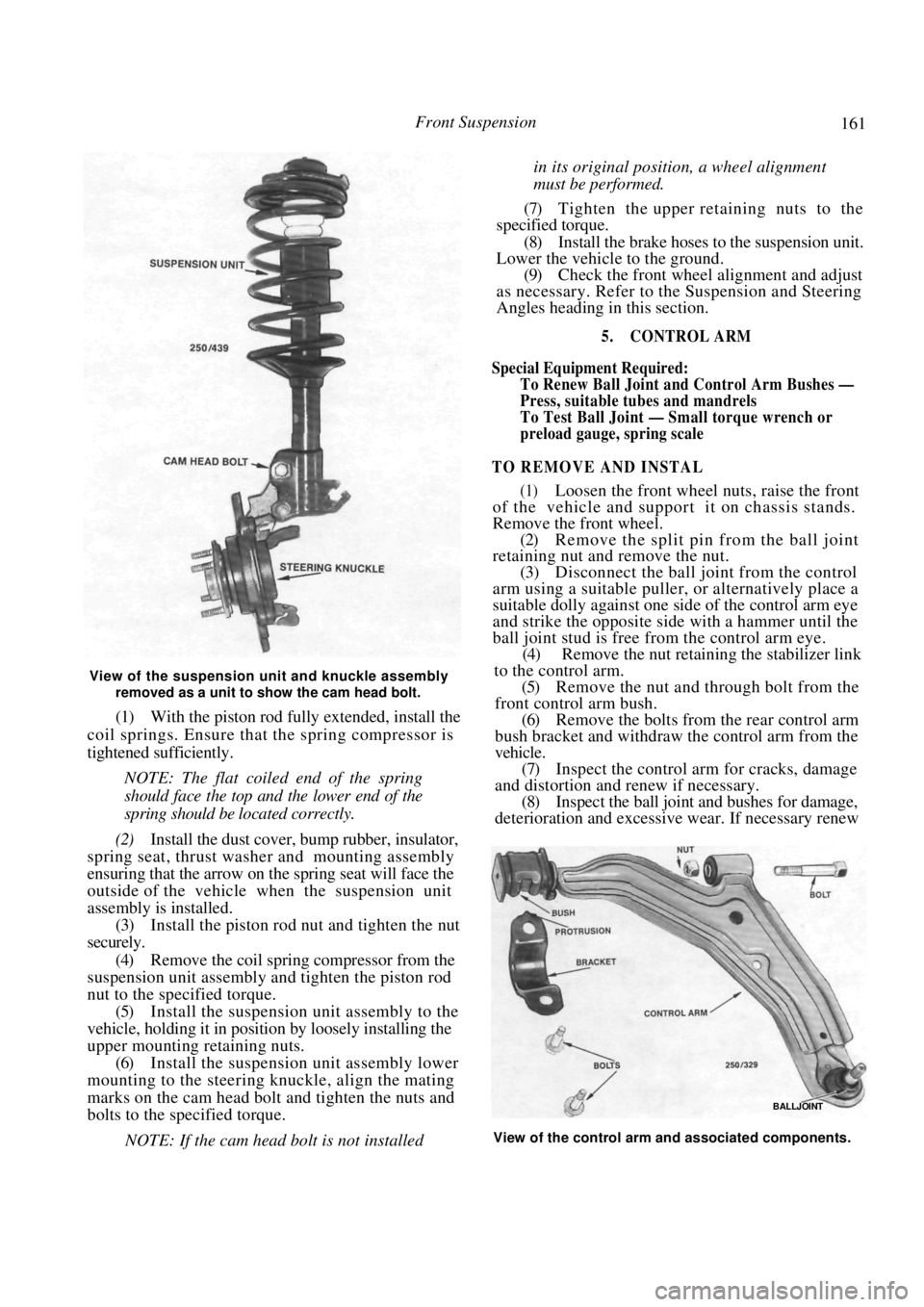
View of the suspension unit and knuckle assembly removed as a unit to show the cam head bolt.
(1) With the piston rod fully extended, install the
coil springs. Ensure that the spring compressor is
tightened sufficiently.
NOTE: The flat coiled end of the spring
should face the top and the lower end of the
spring should be located correctly.
(2) Install the dust cover, bump rubber, insulator,
spring seat, thrust washer and mounting assembly
ensuring that the arrow on the spring seat will face the
outside of the vehicle when the suspension unit
assembly is installed.
(3) Install the piston rod nut and tighten the nut
securely.
(4) Remove the coil spring compressor from the
suspension unit assembly and tighten the piston rod
nut to the specified torque. (5) Install the suspension unit assembly to the
vehicle, holding it in position by loosely installing the
upper mounting retaining nuts. (6) Install the suspension unit assembly lower
mounting to the steering knuckle, align the mating
marks on the cam head bolt and tighten the nuts and
bolts to the specified torque.
NOTE: If the cam head bolt is not installed
in its original position, a wheel alignment
must be performed.
(7) Tighten the upper retaining nuts to the
specified torque.
(8) Install the brake hoses to the suspension unit.
Lower the vehicle to the ground.
(9) Check the front wheel alignment and adjust
as necessary. Refer to the Suspension and Steering
Angles heading in this section.
5. CONTROL ARM
Special Equipment Required:
To Renew Ball Joint and Control Arm Bushes —
Press, suitable t ubes and mandrels
To Test Ball Joint — Small torque wrench or
preload gauge, spring scale
TO REMOVE AND INSTAL
(1) Loosen the front wheel nuts, raise the front
of the vehicle and support it on chassis stands.
Remove the front wheel.
(2) Remove the split pin from the ball joint
retaining nut and remove the nut.
(3) Disconnect the ball joint from the control
arm using a suitable puller, or alternatively place a
suitable dolly against one si de of the control arm eye
and strike the opposite side with a hammer until the
ball joint stud is free from the control arm eye. (4) Remove the nut retaining the stabilizer link
to the control arm.
(5) Remove the nut and through bolt from the
front control arm bush. (6) Remove the bolts from the rear control arm
bush bracket and withdraw the control arm from the
vehicle. (7) Inspect the control arm for cracks, damage
and distortion and renew if necessary. (8) Inspect the ball joint and bushes for damage,
deterioration and excessive wear. If necessary renew
BALLJOINT
View of the control arm and associated components.
Page 163 of 238
Front Suspension 163
(2) Ensure that the stabilizer bar links are in
good condition. Renew if necessary.
(3) When installing the stabilizer bar ensure that
the links are installed perpendicular to the control arm
with the ball joint socket face parallel to the end of the
stabilizer bar. (4) Ensure that the brackets are installed with
the flat portion facing towards the front of the vehicle.
Tighten the retaining bolts securely.
7. SUSPENSION AND STEERING ANGLES
ADJUSTMENT
NOTE: Extensive knowledge and special-
ised equipment are required to measure and
correct the suspension and steering angles
with the exception of the front wheel toe in.
Therefore, as it is not a viable proposition
for the average person to carry out a com-
plete wheel alignment, the vehicle should be
taken to a wheel alignment specialist.
Prior to carrying out a wheel alignment, a thor-
ough inspection of the steering linkage, front hub
bearings, ball joints and suspension units should be
carried out. Faulty components should be renewed or
repaired as necessary.
The tread of the front ti res should be examined
for excessive or uneven wear as certain conditions of
tire wear are indicative of damaged or worn compo-
nents in the suspension, stee ring linkage and/or wheels
and bearings. Refer to the heading Tire Wear Trouble
Shooting in the Wheels and Tires section. If the tires
are found to be defective, renew them with serviceable
lyres.
TO CHECK AND ADJUST TOE IN/OUT
NOTE: The vehicle s hould be unladen ex-
cept for the normal amount of fuel and with
the tires inflated to the correct pressures.
(1) With the vehicle on a level floor, raise the
front of the vehicle and s upport it on chassis stands.
(2) Spin each front wheel in turn and using a
piece of chalk, mark a line around the periphery of
each tire as near to the centre as possible. (3) Lower the vehicle to the ground and bounce
the front several times to stabilize the suspension. (4) Set the wheels in the straight ahead position.
(5) Mark the centre chalk line on both tires at a
point approximately 200 mm above the floor and
forward of the suspension. (6) Using a tape measure, measure and record
the distance between the two marked points on the
tire centers.
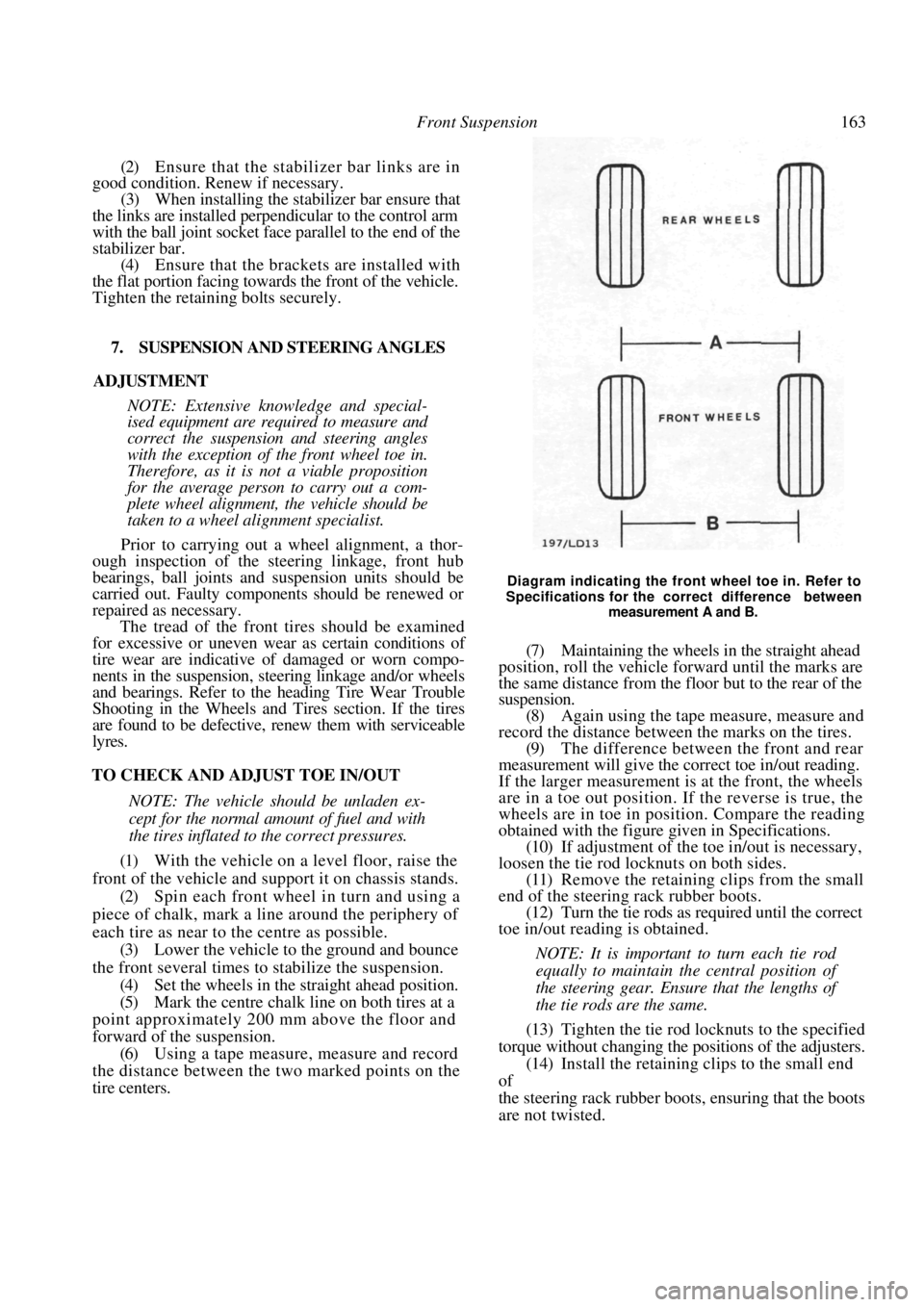
Diagram indicating the front wheel toe in. Refer to
Specifications for the correct difference between
measurement A and B.
(7) Maintaining the wheels in the straight ahead
position, roll the vehicle forward until the marks are
the same distance from the floor but to the rear of the
suspension. (8) Again using the tape measure, measure and
record the distance between the marks on the tires.
(9) The difference between the front and rear
measurement will give the correct toe in/out reading.
If the larger measurement is at the front, the wheels
are in a toe out position. If the reverse is true, the
wheels are in toe in position. Compare the reading
obtained with the figure given in Specifications.
(10) If adjustment of the to e in/out is necessary,
loosen the tie rod locknuts on both sides. (11) Remove the retaining clips from the small
end of the steering rack rubber boots. (12) Turn the tie rods as required until the correct
toe in/out reading is obtained.
NOTE: It is important to turn each tie rod
equally to maintain the central position of
the steering gear. Ensure that the lengths of
the tie rods are the same.
(13) Tighten the tie rod locknuts to the specified
torque without changing the positions of the adjusters.
(14) Install the retaining clips to the small end
of
the steering rack rubber boots, ensuring that the boots
are not twisted.
Page 175 of 238
Brakes 175
A pressure proportioning valve is incorporated in
each circuit to prevent premature locking of the rear
wheels during severe braking.
The four wheel hydraulically operated brakes
utilize disc brakes on each front wheel and disc brakes
or leading and trailing drum brake shoes on each rear
wheel.
The front disc brakes comprise a disc attached to
the hub assembly and a caliper bolted to the steering
knuckle.
The rear disc brakes comprise a disc and hub
assembly attached to the rear stub axle and a caliper
and anchor plate bolted to the backing plate.
The front and rear calipers are of the sliding type.
As pad wear takes place, the caliper piston is allowed
to slide outwards through the seal to take up a new
position in the caliper bore. Elastic deformation of the
seal takes place when the brakes are applied, which
returns the piston slightly when the brakes are re-
leased. Thus a constant clearance is maintained
between the pads and the disc when the brakes are in
the off position.
The disc brakes do not require periodical adjust-
ment in service to compensate for pad wear as they
are self adjusting.
The leading and trailing shoe drum brakes on the
rear wheels use a double ended wheel cylinder to
operate both brake shoes at the top. The lower end of
each brake shoe abuts a fixed anchor point. The brake
shoes are automatically adju sted when the brakes are
operated.
The handbrake operates the rear brakes via a
cable arrangement.
3. MASTER CYLINDER
Special Equipment Required:
To Install New Seals — Suitable machined drift
TO REMOVE
(1) Depress the brake pedal several times to
deplete the vacuum from the system.
(2) Raise the bonnet and install covers to
both
the front mudguards. Cover the areas of paintwork
beneath the master cylinder with absorbent cloth.
(3) Disconnect the wiring from the pressure
sensing switch. (4) Disconnect the brake pipes from the master
cylinder and plug the outlets and pipes to prevent the
loss of fluid and the ingress of dirt.
(5) Remove the nuts retaining the master cylin-
der to the brake servo unit and remove the master
cylinder from the vehicle.
TO DISMANTLE
(1) Remove the master cylinder as previously
described. (2) Remove the reservoir cap and diaphragm,
drain and discard the brake fluid from the reservoir. (3) Carefully remove the reservoir from the
master cylinder by pulling it from the reservoir
retainers by hand. Remove and discard the retainers
from the master cylinder. (4) Using internal snap ring pliers, remove the
snap ring from the primary reservoir port. (5) Remove the fast fill valve assembly and the
O ring from the port. Remove and discard the valve
washer from the fast fill valve.
(6) Remove the proportioning valve plugs and
the O rings. Discard the O rings. Withdraw the springs
and valve plungers from the master cylinder. Remove
and discard the seals from the valve plungers. (7) Remove the pressure sensing switch and
lever assembly from the master cylinder. {8) Remove the cylinder end plug from the
master cylinder. Remove and discard the O ring from
the plug.
(9) Carefully tap the front of the master cylinder
vertically on a block of wo od and remove the pressure
differential pistons from the master cylinder. Remove
and discard the O rings from the pistons. (10) Push the primary piston forward in the
cylinder with a blunt rod and while holding the
pressure, remove the stop pin from the master cylin-
der.
(11) The primary piston may now be withdrawn
from the cylinder bore. The secondary piston, retainer
and spring can also be withdrawn by carefully tapping
the master cylinder on a block of wood. (12) Prise the legs of the seal retainer upwards
and remove it from the primary piston. Remove the
seal and guide. Discard the seal and retainer.
NOTE: The secondary piston must no! be
dismantled by removing the screw. This
assembly has a factory p reset length and the
screw must not be altered in service.
(13) Remove the main seal and the guide from
the front of the secondary piston. Stretch the rear seal
from the groove and remove it from the piston. Take
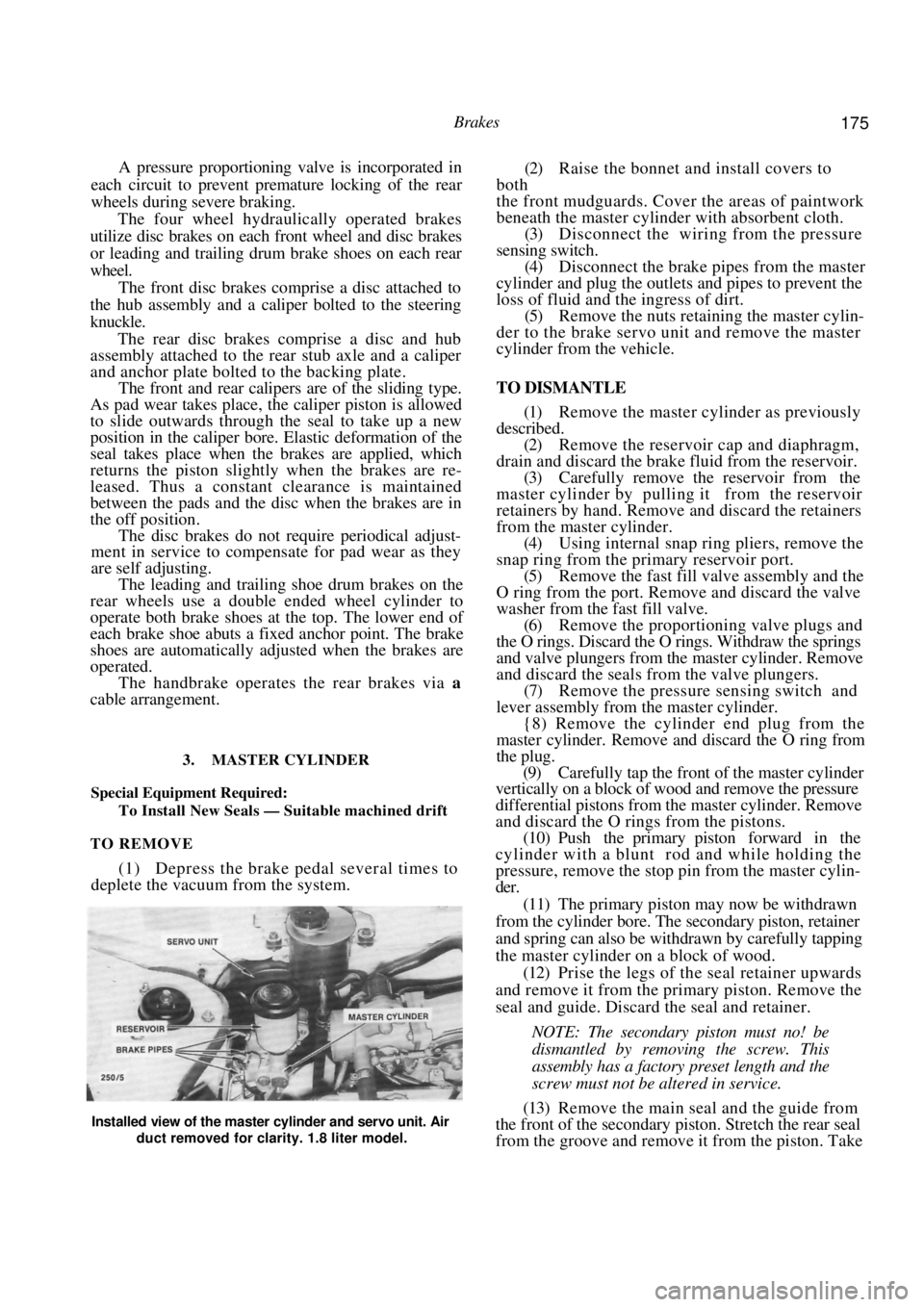
Installed view of the master cylinder and servo unit. Air
duct removed for clarity. 1.8 liter model.
Page 178 of 238
178 Brakes
Let the vehicle stand for 1-2 minutes, press the
brake pedal two or three times and check its opera-
tion.
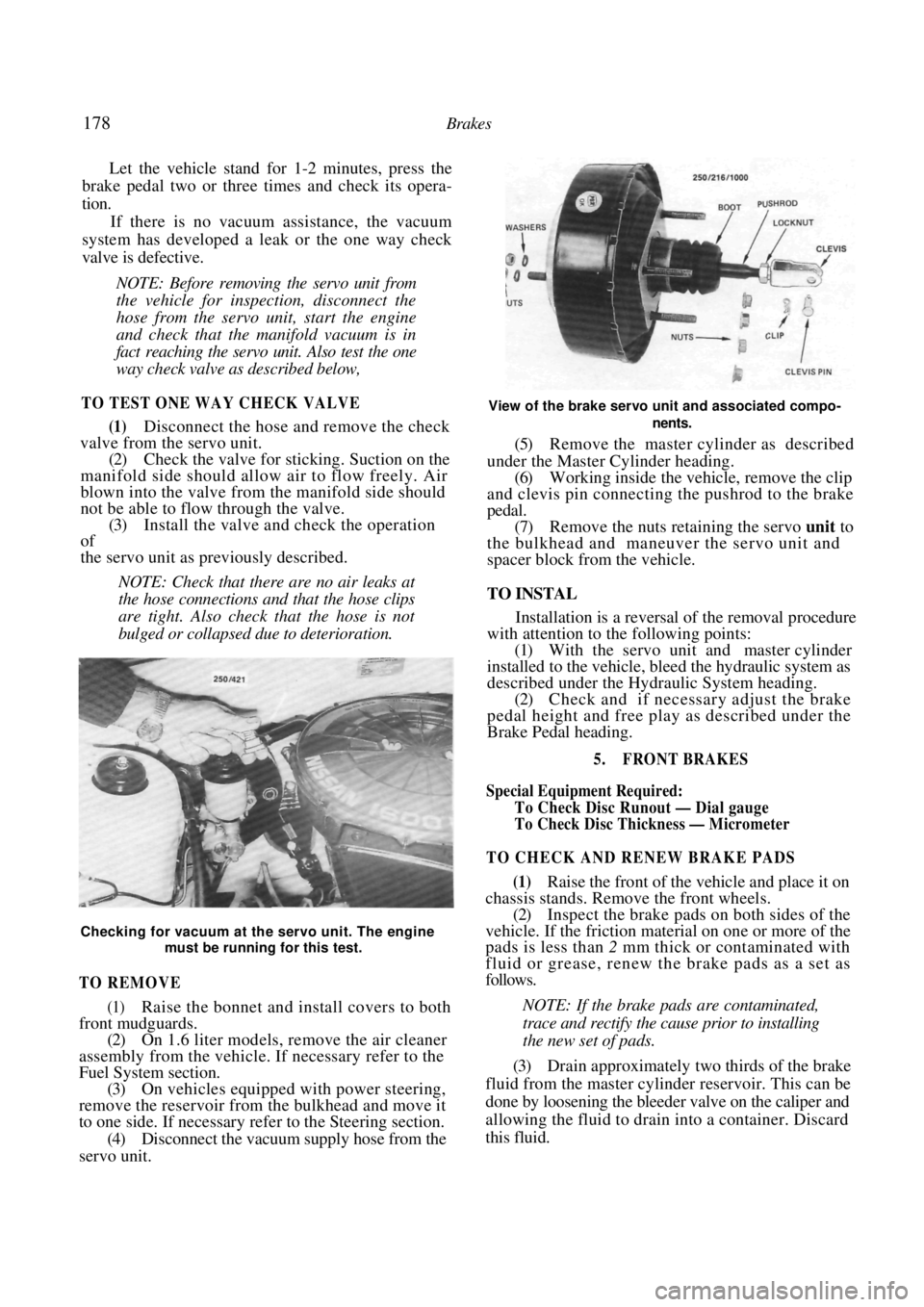
If there is no vacuum assistance, the vacuum
system has developed a leak or the one way check
valve is defective.
NOTE: Before removing the servo unit from
the vehicle for inspection, disconnect the
hose from the servo unit, start the engine
and check that the manifold vacuum is in
fact reaching the servo unit. Also test the one
way check valve as described below,
TO TEST ONE WAY CHECK VALVE
(1) Disconnect the hose and remove the check
valve from the servo unit.
(2) Check the valve for sticking. Suction on the
manifold side should allo w air to flow freely. Air
blown into the valve from the manifold side should
not be able to flow through the valve. (3) Install the valve and check the operation
of
the servo unit as previously described.
NOTE: Check that there are no air leaks at
the hose connections and that the hose clips
are tight. Also check that the hose is not
bulged or collapsed due to deterioration.
Checking for vacuum at the servo unit. The engine
must be running for this test.
TO REMOVE
(1) Raise the bonnet and install covers to both
front mudguards.
(2) On 1.6 liter models, remove the air cleaner
assembly from the vehicle. If necessary refer to the
Fuel System section.
(3) On vehicles equipped with power steering,
remove the reservoir from the bulkhead and move it
to one side. If necessary refer to the Steering section.
(4) Disconnect the vacuum supply hose from the
servo unit.
View of the brake servo unit and associated compo-
nents.
(5) Remove the master cylinder as described
under the Master Cylinder heading. (6) Working inside the vehicle, remove the clip
and clevis pin connecting the pushrod to the brake
pedal. (7) Remove the nuts retaining the servo unit to
the bulkhead and maneuver the servo unit and
spacer block from the vehicle.
TO INSTAL
Installation is a reversal of the removal procedure
with attention to the following points:
(1) With the servo unit and master cylinder
installed to the vehicle, bleed the hydraulic system as
described under the Hydr aulic System heading.
(2) Check and if necessary adjust the brake
pedal height and free play as described under the
Brake Pedal heading.
5. FRONT BRAKES
Special Equipment Required:
To Check Disc Runout — Dial gauge
To Check Disc Thickness — Micrometer
TO CHECK AND RENEW BRAKE PADS
(1) Raise the front of the vehicle and place it on
chassis stands. Remove the front wheels.
(2) Inspect the brake pads on both sides of the
vehicle. If the friction material on one or more of the
pads is less than 2 mm thick or contaminated with
fluid or grease, renew the brake pads as a set as
follows.
NOTE: If the brake pads are contaminated,
trace and rectify the cause prior to installing
the new set of pads.
(3) Drain approximately two thirds of the brake
fluid from the master cylinde r reservoir. This can be
done by loosening the bleeder valve on the caliper and
allowing the fluid to drai n into a container. Discard
this fluid.
Page 179 of 238
Brakes 179
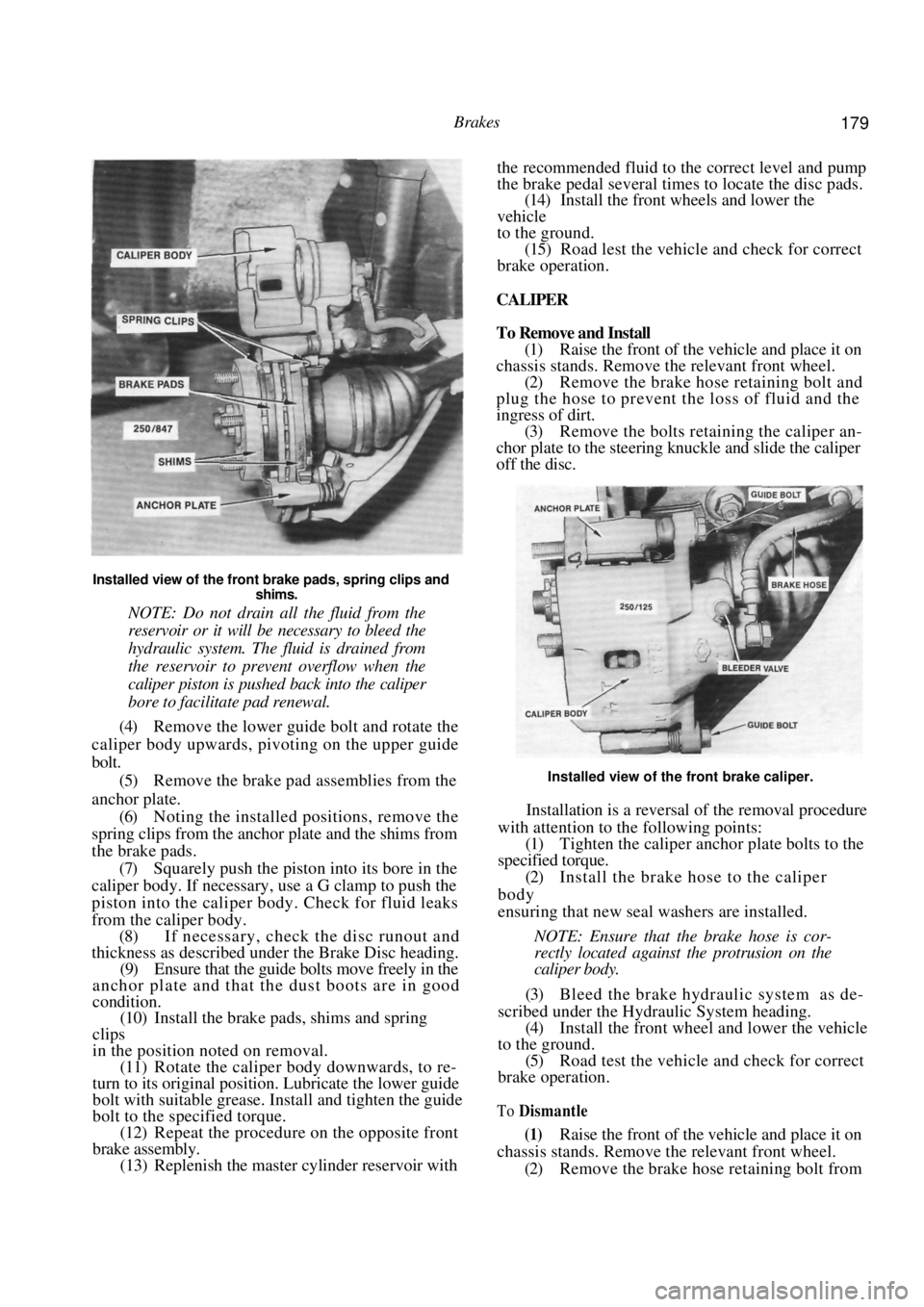
Installed view of the front brake pads, spring clips and shims.
NOTE: Do not drain all the fluid from the
reservoir or it will be necessary to bleed the
hydraulic system. The fluid is drained from
the reservoir to prevent overflow when the
caliper piston is pushed back into the caliper
bore to facilitate pad renewal.
(4) Remove the lower guide bolt and rotate the
caliper body upwards, pivoting on the upper guide
bolt.
(5) Remove the brake pad assemblies from the
anchor plate. (6) Noting the installed positions, remove the
spring clips from the anchor plate and the shims from
the brake pads.
(7) Squarely push the piston into its bore in the
caliper body. If necessary, us e a G clamp to push the
piston into the caliper b ody. Check for fluid leaks
from the calip er body.
(8) If necessary, check the disc runout and
thickness as described under the Brake Disc heading.
(9) Ensure that the guide bolts move freely in the
anchor plate and that the dust boots are in good
condition. (10) Install the brake pads, shims and spring
clips
in the position noted on removal. (11) Rotate the caliper body downwards, to re-
turn to its original position. Lubricate the lower guide
bolt with suitable grease. In stall and tighten the guide
bolt to the specified torque. (12) Repeat the procedure on the opposite front
brake assembly. (13) Replenish the master cylinder reservoir with the recommended fluid to the correct level and pump
the brake pedal several times to locate the disc pads.
(14)
Install the front wheels and lower the
vehicle
to the ground. (15) Road lest the vehicle and check for correct
brake operation.
CALIPER
To Remove and Install
(1) Raise the front of the vehicle and place it on
chassis stands. Remove the relevant front wheel. (2) Remove the brake hose retaining bolt and
plug the hose to prevent the loss of fluid and the
ingress of dirt. (3) Remove the bolts retaining the caliper an-
chor plate to the steering knuckle and slide the caliper
off the disc.
Installed view of the front brake caliper.
Installation is a reversal of the removal procedure
with attention to the following points:
(1) Tighten the caliper anch or plate bolts to the
specified torque.
(2) Install the brake hose to the caliper
body
ensuring that new seal washers are installed.
NOTE: Ensure that the brake hose is cor-
rectly located against the protrusion on the
caliper body.
(3) Bleed the brake hydraulic system as de-
scribed under the Hydraulic System heading. (4) Install the fron t wheel and lower the vehicle
to the ground. (5) Road test the vehicle and check for correct
brake operation.
To Dismantle
(1) Raise the front of the vehicle and place it on
chassis stands. Remove the relevant front wheel.
(2) Remove the brake hose retaining bolt from
Page 181 of 238

Brakes 181
chor plate to the steering knuckle and slide the caliper
off the brake disc. Suspend the caliper clear of the
work area using wire or cord.
(3) Suitably mark the location of the disc in
relation to the hub.
(4) Slide the disc off the hub. If the disc is
difficult to remove, install two M8 x 1.25 mm bolts in
the disc and by alternatively tightening the bolts,
remove the disc.
Do not use a hammer to remove the disc.
Installation is a reversal of the removal procedure
ensuring that the mating face s of the disc and hub are
clean and free from burrs and that the marks made on
removal are aligned.
To Inspect
(1) Inspect the machined faces of the disc for
scores, cracks, wear and signs of overheating. (2) Using a micrometer, measure the thickness
of the disc at several positi ons around the face of the
disc. Renew the disc if the minimum thickness is
below Specifications.
Inspect the brake discs for scoring and wear.
(3) If the disc thickness is satisfactory but the
disc is scored, machine equal amounts from the
machined face on each side of the disc, to restore the
serviceability of the disc.
NOTE: Disc machining is best entrusted to
a reliable brake specialist who can advise on
disc serviceability.
6. REAR DISC BRAKES
Special Equipment Required:
To Check Disc Runout — Dial gauge
To Check Disc Thickness — Micrometer
TO CHECK AND RENEW BRAKE PADS
( 1 ) Raise the rear of the vehicle and place it on
chassis stands. Remove the rear wheels.
Renew the rear brake pads if the friction material is less
than 2 mm thick.
(2) Inspect the brake pads on both sides of the
vehicle. If the friction material on one or more of the
pads is less than 2 mm thick or contaminated with
fluid or grease, renew the brake pad as a set as follows.
NOTE: If the brake pads are contaminated
trace and rectify the cause prior to installing
the new set of pads.
(3) Drain approximately two thirds of the brake
fluid from the master cylinder reservoir. This can be
done by loosening the bleeder valve on the caliper and
allowing the fluid to drai n into a container. Discard
this fluid.
NOTE: Do not drain all the fluid from the
reservoir otherwise it will be necessary to
bleed the hydraulic system. The fluid is
drained from the reservoir to prevent over-
flow when the caliper piston is pushed back
into the caliper bore to facilitate pad re-
newal.
(4) Remove the guide bolts and lift the caliper
body clear of the disc.
NOTE: Do not allow the caliper to hang on
the brake hose.
(5) Noting the installed positions, remove the
brake pads, shims and spring clips from the anchor
plate.
(6) Using a pair of long nosed pliers with the
nose located in the recesses of the piston, rotate the
piston clockwise to retract it into the cylinder body.
Align the recesses between the brake pad retaining
lugs on the caliper body. Refer to the illustration. (7) If necessary, check the disc runout and
thickness as described under the Brake Disc heading.
(8) Ensure that the guide bolts move freely in the
caliper body and that the dust boots are in good
condition.
Page 206 of 238
206 Electrical System
Install the armature and yoke to the drive end
bracket rotating the drive to align the reduction gears.
Do not use force.
Install the retaining through bolts to the
commutator end bracket and lighten the through bolts
and armature end cover retaining screws securely. Install the solenoid to the drive end bracket,
install the retaining screws and tighten them securely.
Install the brush connector strap and
install
the retaining nut and washer and tighten securely.
9 . IGNITION SYSTEM
The testing and repair procedures for the ignition
system are fully covered in the Fuel and Engine
Management section.
10. STEERING WHEEL
The removal and installation procedures for the
steering wheel and horn pad are fully covered in the
Steering section.
11. SWITCHES AND CONTROLS
IGNITION SWITCH
To Remove and Install
Disconnect the negative battery terminal.
Remove the retaining screws from the steer-
ing column cover. Unclip and separate the upper and lower
steering column covers and remove the upper cover. Release the column adjusting lever and re-
move the lower cover by guiding the column adjusting
lever through the hole in the upper end of the cover.
Disconnect the ignition switch wiring at the
switch. Remove the retaining screw and withdraw
the ignition switch fr om the lock assembly.
Installation is a reversal of the removal procedure.
COMBINATION SWITCH
The combination switch is mounted at the top of
the steering column and incorporates two switches.
The parking lamp, headlamp, headlamp flasher, head-
lamp dipper and turn signal lamps are operated by a
lever on the right hand side. A lever on the left hand
side operates the windscreen washer and wiper switch.
These switches can be re newed without removing
the combination switch.
To Remove and Install Switches
Remove the retaining screws from the steer-
ing column cover.
Unclip and separate the upper and lower
steering column covers and remove the upper cover.
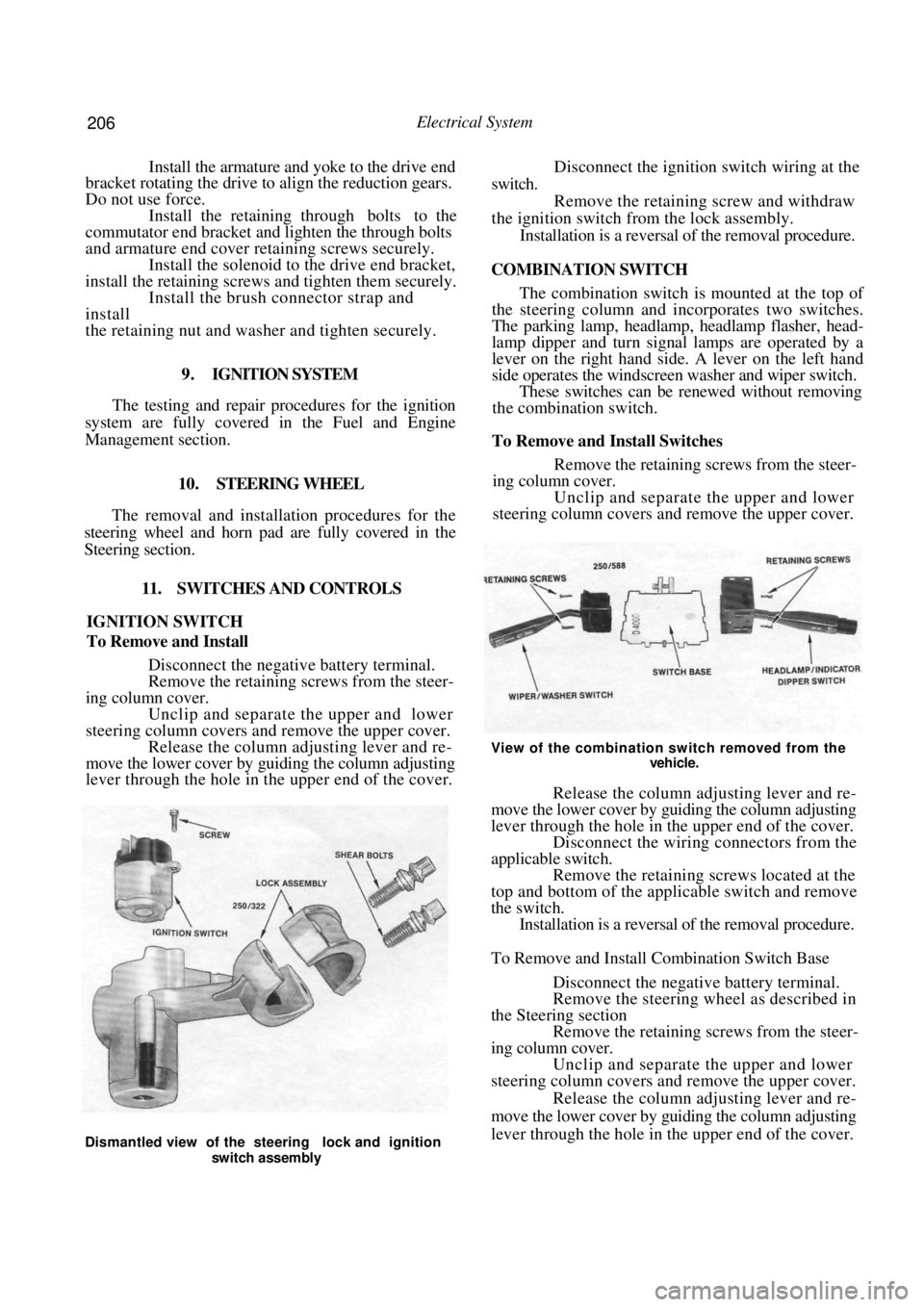
View of the combination switch removed from the
vehicle.
Release the column adjusting lever and re-
move the lower cover by guiding the column adjusting
lever through the hole in the upper end of the cover. Disconnect the wiring connectors from the
applicable switch. Remove the retaining screws located at the
top and bottom of the applicable switch and remove
the switch. Installation is a reversal of the removal procedure.
To Remove and Install Combination Switch Base
Disconnect the negative battery terminal.
Remove the steering wheel as described in
the Steering section Remove the retaining screws from the steer-
ing column cover. Unclip and separate the upper and lower
steering column covers and remove the upper cover.
Release the column adjusting lever and re-
move the lower cover by guiding the column adjusting
lever through the hole in the upper end of the cover.
Dismantled view of the steering lock and ignition
switch assembly
Page 235 of 238

Body 235
lever and remove the screws underneath. Withdraw
the rear console.
On manual transaxle models, unscrew the
gear lever knob and prise out the gear lever rubber
boot. On automatic transaxle models, prise out the
panel around the selector lever and maneuver the
panel over the lever. Remove the screws retaining the front of the
console to the floor panel and withdraw the console
from the vehicle. Installation is a reversal of the removal procedure.
9, DASHBOARD
TO REMOVE AND INSTAL
Disconnect the negative battery terminal.
Remove the centre console as previously
described in this section. Remove the steering wheel as described in
the Steering section. Remove the upper and lower steering col-
umn shrouds and remove the combination switch.
Refer to the Electrical System section if necessary. Remove the retaining screws and withdraw
the lower trim panel from underneath the steering
column. Remove the screws from underneath the
bonnet lock handle and slide the bonnet lock handle
downwards out of the dashboard. Remove the screws retaining the centre fas-
cia panel, two upper and two lower, withdraw the
fascia panel slightly and disconnect the wiring to the
cigarette lighter.
Dismantled view of the centre console assembly. Au-
tomatic transaxle model.
Remove the radio/cassette bracket retaining
screws. Disconnect the aerial and the wiring and
withdraw the radio/cassette from the centre bracket. Remove the heater control knobs and re-
move the heater fascia panel screws. Carefully remove
the heater fascia panel leaving the heater controls in
place.
Loosen the bolt retaining the large wiring
connector at the lower right hand side of the dash-
board. As the bolt is loosened it will force the
connector apart. Using a screwdriver, carefully prise out the
demister ducts from th e top of the dashboard.
Using a suitable socket, remove the bolts
from underneath the demister ducts. Remove the bolts from the outer lower edges
and the lower part of th e centre bracket assembly.
NOTE: Refer to the illustration for the
location of the dashboard retaining bolts.
(14) With the aid of an assistant lift the dash-
board straight up at the door pillar brackets. Tilt the
View of the dashboard removed from the vehicle. The arrows indicate the location of the retaining bolts.