torque NISSAN PULSAR 1987 Service Manual
[x] Cancel search | Manufacturer: NISSAN, Model Year: 1987, Model line: PULSAR, Model: NISSAN PULSAR 1987Pages: 238, PDF Size: 28.91 MB
Page 134 of 238

134 Manual Transaxle and Drive Shafts
(32) Install and tighten the retaining bolts to
the specified torque.
(33) Repeat operation (29). The total turning
torque should be 5.9-13.7 Nm if new bearings have
been installed or slightly l ess if the original bearings
have been installed. If the turning torque is no t as specified, adjust the
mainshaft turning torque as follows:
(a) Remove the transaxle case rear cover, O ring,
spacer and adjusting shim from the transaxle case.
(b) Ensure that the mainsh aft rear bearing outer
race is fully seated on the bearing cone. (c) Using micrometer depth gauge, measure the
distance from the transaxle case to the bearing outer
race and note the reading. (d) Referring to the following table, select the
appropriate shim, according to the reading noted in
operation (c), required to correct the mainshaft turn-
ing torque.
READING SHIM
2.35-2.40 mm............................................... 0.10 mm
2.40-2.45 mm............................................... 0.15 mm
2.45-2.50 mm...............................................0.20 mm
2.50-2.55 mm...............................................0.25 mm
2.55-2.60 mm...............................................0.30 mm
2.60-2.65 mm............................................... 0.35 mm
2.65-2.70 mm............................................... 0.40 mm
2.70-2.75 mm............................................... 0.45 mm
2.75-2.80 mm............................................... 0.50 mm
2.80-2.85 mm............................................... 0.55 mm
2.85-2.90 mm............................................... 0.60 mm
2.90-2.95 mm............................................... 0.65 mm
2.95-3.00 mm............................................... 0.70 mm
3.00-3.05 mm............................................... 0.75 mm
3.05-3.10 mm............................................... 0.80 mm
3.10-3.15 mm............................................... 0.85 mm
3.15-3.20 mm............................................... 0.90 mm
3.20-3.25 mm............................................... 0.95 mm
3.25-3.30 mm...............................................1.00 mm.
(e) Install the spacer, shim, O ring and rear
cover to the transaxle case. Tighten the retaining
bolts securely.
(34) Measure the total turning torque as previ-
ously described. (35) Install the striking interlock and striking lever
to the clutch housing. (36) Install the striking ro d to the clutch housing
sliding the rod through the lever and interlock. Take
care that the end of the rod does not damage the seal. (37) Install a new retaining pin to the striking rod
using a pin punch. (38) Install the reverse and fifth gear check
assembly to the clutch housing. Tighten the retaining
screws securely. (39) Install the balls, spring and reverse check
plug to the clutch housing ensuring that the smaller
diameter ball enters the hole in the body of the
reverse and fifth gear check assembly body. Apply locking com-
pound and tighten the reverse check plug securely.
(40) Using a bar clamped to the end of the
striking rod, check that a force of 4.9-7.4 Nm is
required to overcome the spring loading of the reverse
and fifth gear check assembly. If necessary, renew the
springs to achieve this correct spring loading.
NOTE: Ensure that the reverse check plug is
coated with locking compound when finally
installed.
(41) Install the shift check ball, spring and plug to
the clutch housing. Ensure that the ball is centrally
located in the plug.
(42) If removed, install the oil reservoir to the
clutch housing.
(43) Install the input shaft assembly and the
reverse idler gear to the clutch housing taking care not
to damage the seal.
(44) Apply locking compound to the bearing
retainer bolts and tighten the bolts to the specified
torque.
(45) Install the spacer to the reverse idler shaft.
(46) Install the differential assembly to the clutch
housing.
(47) Install the mainshaft to the clutch housing
ensuring that the resin oil ch annel is located centrally
in the end of the mainshaft. (48) Install the shift cap to the slot in the first/
second shift fork and install the shift fork and control
bracket to the clutch housing. Use grease to hold the
shift cap in the shift fork slot. Ensure that the reverse
idler shift fork is correctly located over the gear.
(49) Apply locking compound to the threads of
the control bracket retaining bolts and tighten the
bolts to the specified torque. (50) Install the shift cap in the slot in the third/
fourth shift fork and install the fork to the transaxle
assembly. Use grease to hold the shift cap in the shift
fork slot. (51) Install the fifth gear shift fork to the transaxle
ensuring that the shift fork slot engages the control
finger.
(52) Install the fork shaft an d spring to the clutch
housing sliding the shaft through the shift forks. Use
grease to hold the spring in the end of the shaft. (53) Apply a continuous bead of sealant to the
mating face of the clutch housing so that the bead is
located inside the row of bolt holes.
NOTE: Sealant is available from Nissan
spare parts using the part number KP
610-00250.
(54) Install the transaxle case to the clutch hous-
ing. Install and tighten the retaining bolts to the
specified torque. (55) Select each gear in turn and check that the
transaxle turns freely in each gear. Ensure that it is not
Page 135 of 238
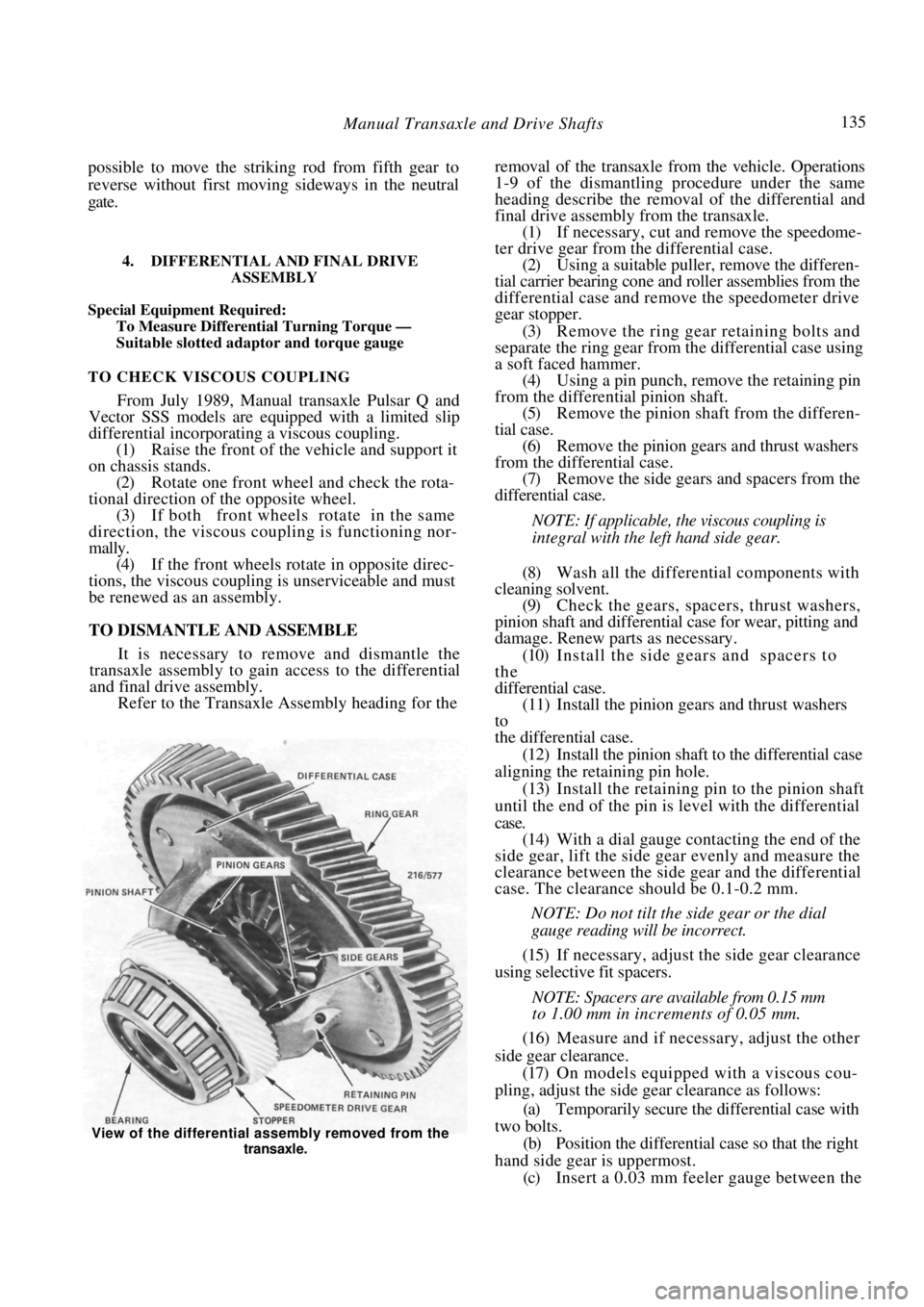
Manual Transaxle and Drive Shafts 135
possible to move the striking rod from fifth gear to
reverse without first moving sideways in the neutral
gate.
4. DIFFERENTIAL AND FINAL DRIVE ASSEMBLY
Special Equipment Required:
To Measure Differential Turning Torque —
Suitable slotted adaptor and torque gauge
TO CHECK VISCOUS COUPLING
From July 1989, Manual transaxle Pulsar Q and
Vector SSS models are equipped with a limited slip
differential incorporating a viscous coupling.
(1) Raise the front of the vehicle and support it
on chassis stands. (2) Rotate one front wheel and check the rota-
tional direction of the opposite wheel. (3) If both front wheels rotate in the same
direction, the viscous coupling is functioning nor-
mally. (4) If the front wheels rota te in opposite direc-
tions, the viscous coupling is unserviceable and must
be renewed as an assembly.
TO DISMANTLE AND ASSEMBLE
It is necessary to remove and dismantle the
transaxle assembly to gain access to the differential
and final drive assembly.
Refer to the Transaxle Assembly heading for the
removal of the transaxle from the vehicle. Operations
1-9 of the dismantling procedure under the same
heading describe the removal of the differential and
final drive assembly from the transaxle.
(1) If necessary, cut and remove the speedome-
ter drive gear from the differential case. (2) Using a suitable puller, remove the differen-
tial carrier bearing cone and roller assemblies from the
differential case and remove the speedometer drive
gear stopper.
(3) Remove the ring gear retaining bolts and
separate the ring gear from the differential case using
a soft faced hammer.
(4) Using a pin punch, remove the retaining pin
from the differential pinion shaft.
(5) Remove the pinion shaft from the differen-
tial case. (6) Remove the pinion gears and thrust washers
from the differential case. (7) Remove the side gears and spacers from the
differential case.
NOTE: If applicable, the viscous coupling is
integral with the left hand side gear.
(8) Wash all the differential components with
cleaning solvent. (9) Check the gears, spacer s, thrust washers,
pinion shaft and differential case for wear, pitting and
damage. Renew parts as necessary.
(10) Install the side gears and spacers to
the
differential case.
(11) Install the pinion gear s and thrust washers
to
the differential case.
(12) Install the pinion shaft to the differential case
aligning the retaining pin hole. (13) Install the retaining pin to the pinion shaft
until the end of the pin is level with the differential
case. (14) With a dial gauge contacting the end of the
side gear, lift the side gear evenly and measure the
clearance between the side gear and the differential
case. The clearance should be 0.1-0.2 mm.
NOTE: Do not tilt the side gear or the dial
gauge reading will be incorrect.
(15) If necessary, adjust the side gear clearance
using selective fit spacers.
NOTE: Spacers are available from 0.15 mm
to 1.00 mm in increments of 0.05 mm.
(16) Measure and if necessary, adjust the other
side gear clearance. (17) On models equipped with a viscous cou-
pling, adjust the side gear clearance as follows:
(a) Temporarily secure the differential case with
two bolts. (b) Position the differential case so that the right
hand side gear is uppermost. (c) Insert a 0.03 mm feeler gauge between the
View of the differential ass embly removed from the
transaxle.
Page 136 of 238

136 Manual Transaxle and Drive Shafts
right hand side gear and the adjacent spacer in an area
where there is no oil groove in the differential case.
(d) Insert another 0.03 mm feeler gauge diago-
nally opposite the first feeler gauge to avoid tilting the
side gear.
(e) Insert a splined adaptor into the right hand
side gear and attempt to rotate the gear by hand.
(f) If the gear cannot be rotated, change the
thickness of the left hand side gear spacer, repeating
the test until the gear can be rotated.
NOTE: Spacers are available in thicknesses
from 0.8 mm to 1.5 mm in increments of
0.1 mm.
(g) Remove the 0.03 mm feel er gauges and insert
0.09 mm feeler gauges to the same position. The gear
should lock.
(h) The spacer selection is correct when the right
hand side gear can be rotated with 0.03 mm feeler
gauges inserted but locks when 0.09 mm feeler gauges
are inserted.
(18) Install the ring gear to the differential case
with the chamfered edge of the ring gear inwards. (19) Install and tighten the retaining bolts in
a
diagonal sequence to the specified torque.
(20) Install a new speedometer drive gear to
the
differential case. Install the stopper adjacent to the
drive gear.
(21) Install the differentia] carrier bearing
cones
and roller assemblies to the differential case.
(22) Remove the adjusting shim from behind the
carrier bearing outer race in the transaxle case and
replace the outer race in the transaxle case.
(23) Install the differential assembly to the clutch
housing. (24) Install the transaxle case to the clutch housing
and tighten the retaining bolts to the specified torque.
(25) Mount a dial gauge to the clutch housing so
that the contact point is resting on the differential
case. (26) Insert a bar through the opposite side gear
and, contacting the pinion shaft, raise and lower the
differential case and measure the end float in the
carrier bearings. (27) Using the following table, select a shim to
correspond to the relevant end float.
END FLOAT SHIM THICKNESS
0.30-0.34 mm....................................................0.64 mm
0.34-0.38 mm................................................... 0.68 mm
0.38-0.42 mm................................................... 0.72 mm
0.42-0.46 mm................................................... 0.76 mm
0.46-0.50 mm................................................... 0.80 mm
0.50-0.54 mm................................................... 0.84 mm
0.54-0.58 mm................................................... 0.88 mm
0.58-0.62 mm................................................... 0.92 mm
0.62-0.66 mm................................................... 0.96 mm
0.66-0.70 mm................................................... 1.00 mm
0.70-0.74 mm................................................... 1.04 mm
0.74-0.78 mm ................................................... 1.08 mm
0.78-0.82 mm ................................................... 1.12 mm
0.82-0.86 mm ................................................... 1.16 mm
0.86-0.90 mm ................................................... 1.20 mm
0.90-0.94 mm ................................................... 1.24 mm
0.94-0.98 mm ................................................... 1.28 mm
0.98-1.02 mm ................................................... 1.32 mm
1.02-1.06 mm ................................................... 1.36 mm
1.06-1.10 mm ................................................... 1.40 mm
1.10-1.14 mm ................................................... 1.44 mm
1.14-1.18 mm ................................................... 1.48 mm
1.18-1.22 mm ................................................... 1.52 mm
1.22-1.26 mm ................................................... 1.56 mm
1.26-1.30 mm ................................................... 1.60 mm
1.30-1.34 mm ................................................... 1.64 mm
1.34-1.38 mm ................................................... 1.68 mm
1.38-1.42 mm ................................................... 1.72 mm
1.42-1.46 mm ................................................... 1.76 mm
The thickest shim available is 0.88 mm. Multiple
shims are required above this thickness.
(28) Install the shim behind the carrier
bearing
outer race in the transaxle case and assemble the unit
once more. (29) Using a suitable slotted adaptor engage the
pinion shaft and using a to rque gauge, measure the
differential turning torque. The turning torque when new carrier bearings
have been installed should be 3.9-7.8 Nm or slightly
lower if the original carrier bearings have been
replaced.
(30) Assemble the transaxle and measure the total
turning torque of the diff erential assembly and the
mainshaft. The total turning torque should be 5.9 to
13.7 Nm with new bearings or slightly lower if the
original bearings have been replaced.
5. GEAR LEVER ASSEMBLY
TO DISMANTLE AND ASSEMBLE
(1) Remove the gear lever knob and remove the
centre console as described in the Body section. If not
previously removed, remove the rubber boot sur-
rounding the gear lever. (2) Raise the front of the vehicle and support it
on chassis stands. Remove the catalytic converter and
heat shield as described in the Engine section.
(3) Remove the bolt and disconnect the control
rod from the bottom of the gear lever, noting the
position of the return spring and bracket.
(4) Remove the nuts retaining the gear lever
socket to the support rod. (5) Working inside the vehicle, lift the gear lever
out of the floor bracket. (6) Separate the lower rubber boot, socket,
spring seat, spring, upper ball seat and lower ball seat
from the gear lever, noting the location of each
component to aid assembly.
Page 140 of 238
140
AUTOMATIC TRANSAXLE
SPECIFICATIONS
Make .............................................. JATCO RL3F01A
Type .....................3 speed and reverse epicyclic gear
train with lock up torque converter
Operation .................................... Automatic hydraulic
Lubricant:
Type....................................................... Dexron IT
Capacity................................................. 6.3 liters
TORQUE WRENCH SETTINGS
Drive plate to crankshaft bolls ........................60 Nm
Drive plate to torque converter bolts ..............49 Nm
Convener housing to engine ...........................22 Nm
Converter housing to transaxle ........................23 Nm
Transaxle sump to transaxle ............................. 7 Nm
Oil cooler pipe to transaxle .............................49 Nm
Selector shaft locknut .......................................42 Nm
Transaxle filter bolts.........................................12 Nm
1. AUTOMATIC TRANSAXLE TROUBLE SHOOTING
NO DRIVE IN D RANGE
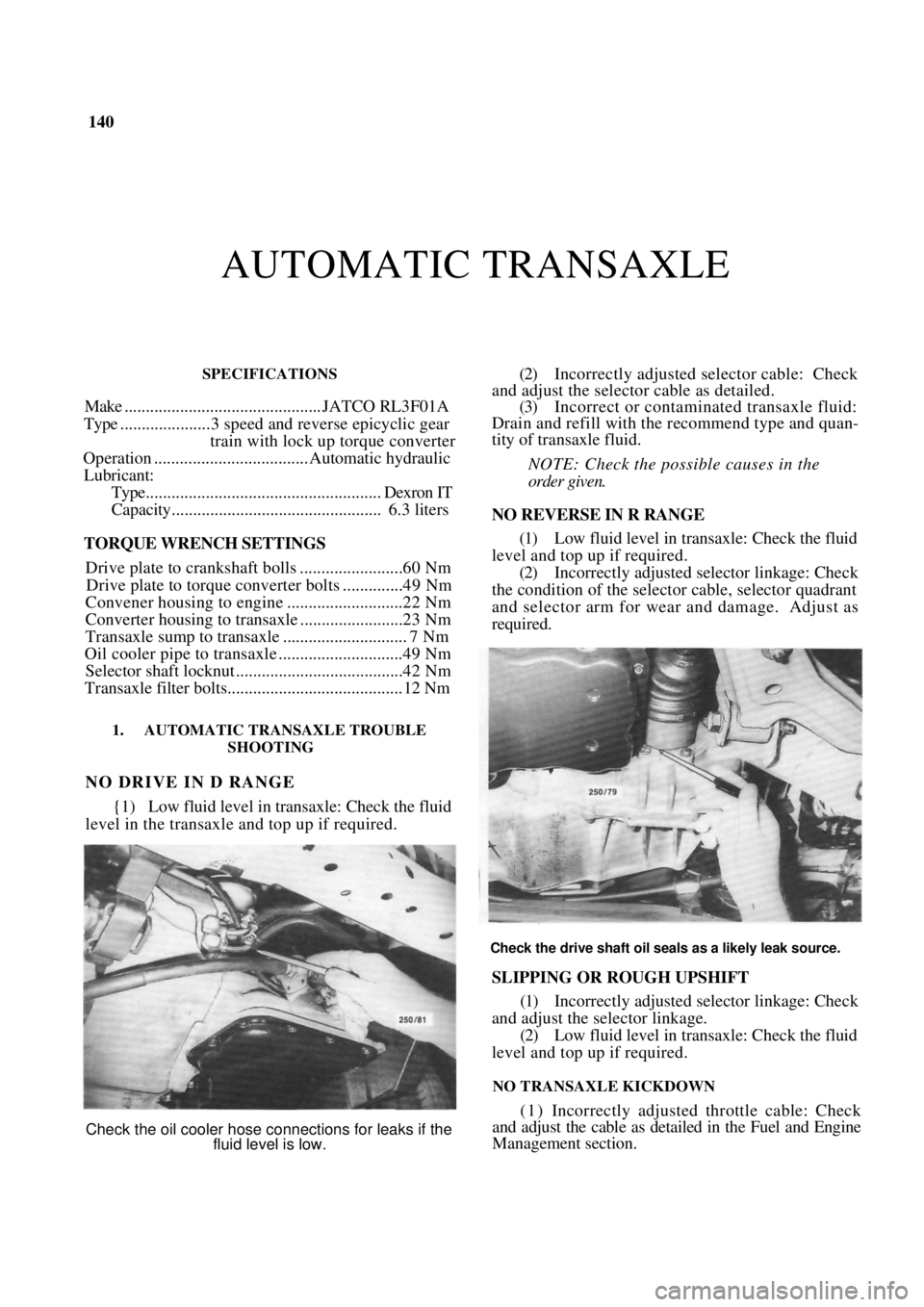
{1) Low fluid level in transaxle: Check the fluid
level in the transaxle and top up if required.
(2) Incorrectly adjusted selector cable: Check
and adjust the selector cable as detailed. (3) Incorrect or contaminated transaxle fluid:
Drain and refill with the recommend type and quan-
tity of transaxle fluid.
NOTE: Check the possible causes in the
order given.
NO REVERSE IN R RANGE
(1) Low fluid level in transaxle: Check the fluid
level and top up if required. (2) Incorrectly adjusted selector linkage: Check
the condition of the selector cable, selector quadrant
and selector arm for wear and damage. Adjust as
required.
Check the drive shaft oil seals as a likely leak source.
SLIPPING OR ROUGH UPSHIFT
(1) Incorrectly adjusted selector linkage: Check
and adjust the selector linkage. (2) Low fluid level in transaxle: Check the fluid
level and top up if required.
NO TRANSAXLE KICKDOWN
(1) Incorrectly adjusted throttle cable: Check
and adjust the cable as detailed in the Fuel and Engine
Management section.
Check the oil cooler hose connections for leaks if the
fluid level is low.
Page 141 of 238
Automatic Transaxle 141
(2) Incorrectly adjusted kickdown cable: Check
and adjust or renew the kickdown cable as required.
NOTE: Check and adjust the throttle cable
before adjusting the kickdown cable.
ENGINE WILL NOT START IN P OR N
RANGE OR WILL START IN ANY RANGE
(1) Neutral safety switch faulty: Adjust or renew
the neutral safety switch. (2) Incorrectly adjusted selector cable: Check
and adjust the selector cable as detailed.
2. DESCRIPTION
The automatic transaxle combines a fluid coup-
ling or torque converter with a fully automatic three
speed epicyclic gear system.
The transaxle provides th ree forward ratios and
one reverse. The hydraulic system consists of a single
pump and valv e arrangement.
The final drive or differential and the transaxle
use a common lubricant. The transaxle oil pan and
final drive drain plug will have to be removed to drain
the transaxle completely. Topping up or refilling is
done through the dipstick tube.
The gear selector lever is floor mounted and
connected to the transaxle by an adjustable cable. The
selector quadrant adjacent to the base of the lever is
marked P, R, N, D, 2, 1.
It is necessary for the selector lever to be in P or
N before the engine can be started. When testing or
tuning the engine, the handbrake must be firmly
applied and the selector lever placed in the P position,
otherwise the vehicle could move forward or back-
wards as the engine speed is increased.
For long distance towing the vehicle should be
towed with the front end raised.
It is not possible to start the engine by either
towing or pushing the vehicle.
The transaxle can be removed from the vehicle
without engine removal.
NOTE: As extensive knowledge and equip-
ment is required to overhaul the automatic
transaxle assembly, it is therefore not a
worthwhile repair proposition for the aver-
age person. However if the transaxle must
be overhauled by a specialist or be replaced
with a reconditioned unit, the removal and
installation procedure is fully described at
the end of this section.
3. TRANSAXLE FLUID
Only use the recommended transaxle fluid speci-
fied by the manufacturer when topping up or changing
the fluid in the system.
TO CHECK AND TOP UP
NOTE: The fluid level should be checked
after approximately 5 minutes driving on
the road when the engine has achieved its
normal operating temperature of approxi-
mately 65 deg C.
(1) Place the vehicle on a level floor and open
the engine bonnet.
NOTE: When working on the automatic
transaxle cleanliness is very important. Do
not reuse transaxle fluid and do not allow
foreign matter to enter the filler opening.
(2) Clean around the top of the dipstick to
ensure that no dirt or foreign matter can enter the
dipstick tube.
(3) Place the selector in the P position and
firmly apply the handbrake. (4) Move the selector thro ugh each gear return-
ing it to the P position.
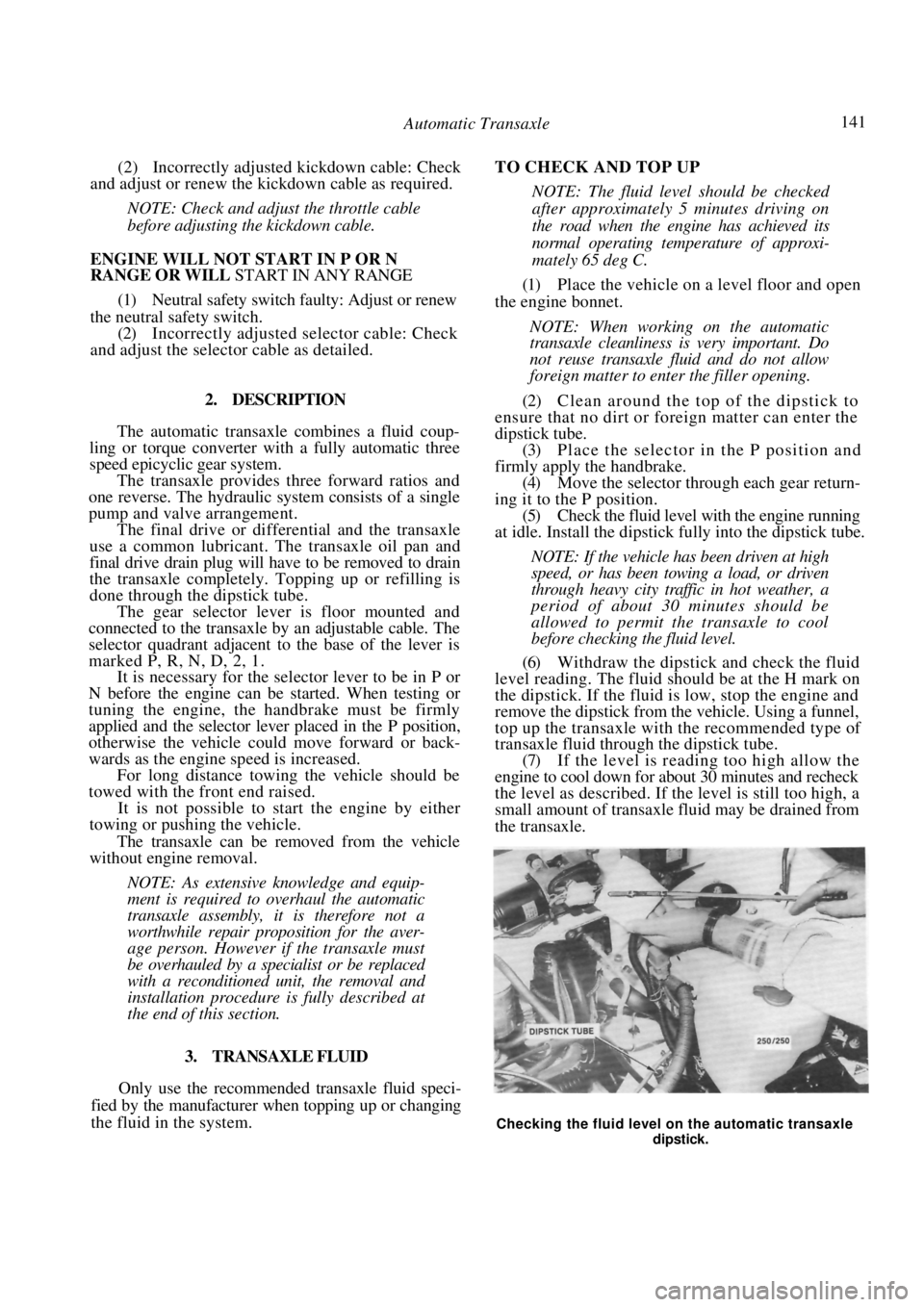
(5) Check the fluid level with the engine running
at idle. Install the dipstick fully into the dipstick tube.
NOTE: If the vehicle has been driven at high
speed, or has been towing a load, or driven
through heavy city traffic in hot weather, a
period of about 30 minutes should be
allowed to permit the transaxle to cool
before checking the fluid level.
(6) Withdraw the dipstick and check the fluid
level reading. The fluid should be at the H mark on
the dipstick. If the fluid is low, stop the engine and
remove the dipstick from the vehicle. Using a funnel,
top up the transaxle with the recommended type of
transaxle fluid through the dipstick tube. (7) If the level is reading too high allow the
engine to cool down for about 30 minutes and recheck
the level as described. If the level is still too high, a
small amount of transaxle fluid may be drained from
the transaxle.
Checking the fluid level on the automatic transaxle
dipstick.
Page 142 of 238
142 Automatic Transaxle
(8) Install the dipstick and start the engine and
recheck the fluid level.
NOTE; Do not overfill the transaxle or
foaming and unsatisfactory operation of the
transaxle will result.
TO DRAIN AND REFILL
This is not a normal maintenance and lubrication
procedure. It is only necessary to drain the complete
system, including the torq ue converter and the oil
cooler, when the transaxle assembly is removed for
overhaul or the renewal of transaxle components such
as bearings, clutches or as semblies. When this condi-
tion arises, the torque converter and the cooler should
be cleaned and flushed to remove any dirt or sludge.
After transaxle overhaul, install approximately 6
liters of new transaxle fluid, and top up as previously
described.
4. BRAKE BAND
Band adjustment is not a normal maintenance
procedure.
The adjustment entails removal of the valve body
and for this reason the vehicle should be taken to an
authorized dealer.
5. KICKDOWN CABLE
TO ADJUST
(1) On models with a 1.6 liter engine, remove
the air cleaner assembly. (2) With the aid of an assistant, ensure that the
throttle valve is fully open when the throttle pedal is
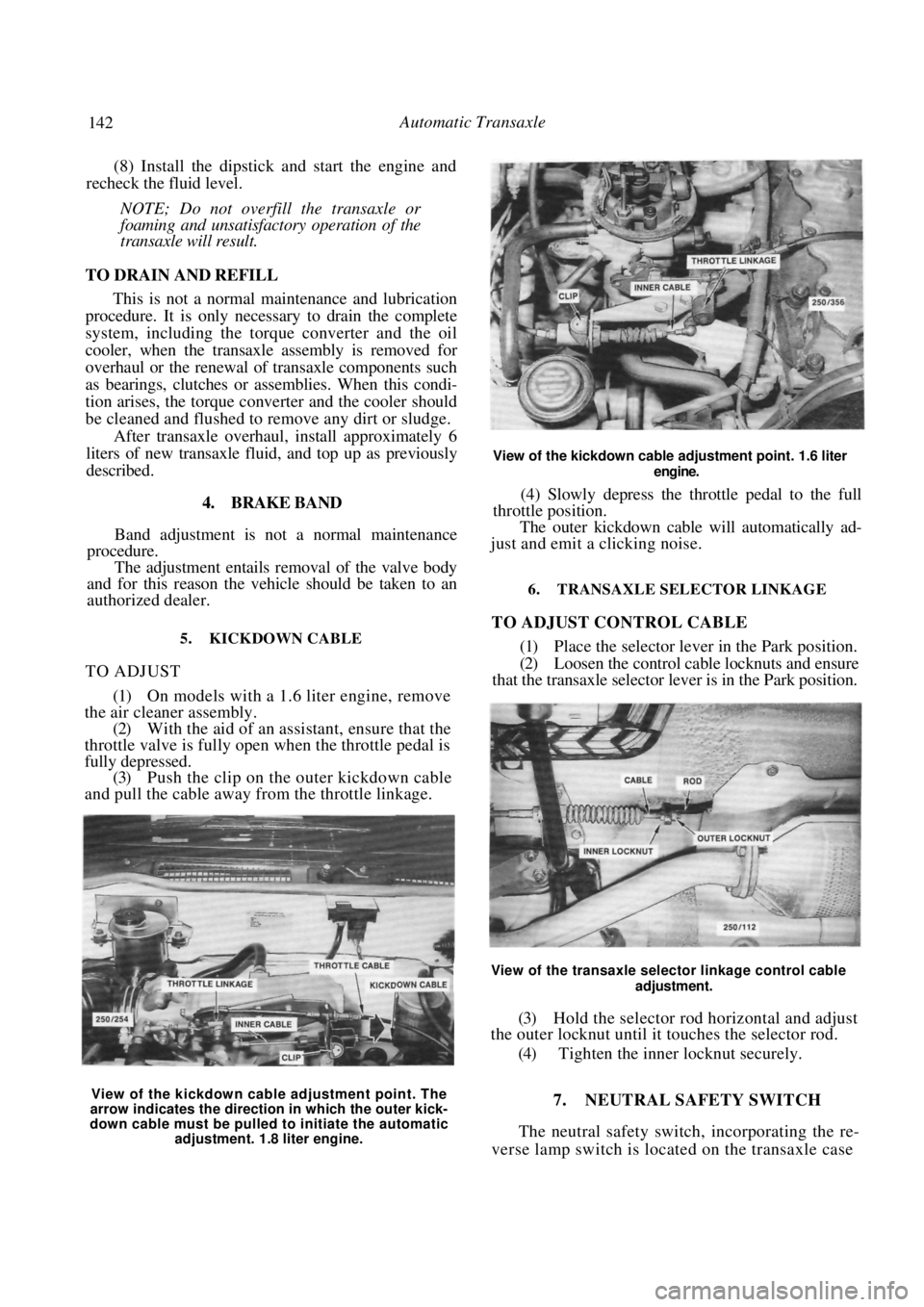
fully depressed. (3) Push the clip on the outer kickdown cable
and pull the cable away from the throttle linkage.
View of the kickdown cable adjustment point. 1.6 liter
engine.
(4) Slowly depress the throttle pedal to the full
throttle position.
The outer kickdown cable will automatically ad-
just and emit a clicking noise.
6. TRANSAXLE SELECTOR LINKAGE
TO ADJUST CONTROL CABLE
(1) Place the selector lever in the Park position.
(2) Loosen the control cable locknuts and ensure
that the transaxle selector lever is in the Park position.
View of the transaxle selector linkage control cable
adjustment.
(3) Hold the selector rod horizontal and adjust
the outer locknut until it touches the selector rod.
(4) Tighten the inner locknut securely.
7. NEUTRAL SAFETY SWITCH
The neutral safety switch, incorporating the re-
verse lamp switch is located on the transaxle case
View of the kickdown cable adjustment point. The
arrow indicates the direction in which the outer kick-
down cable must be pulled to initiate the automatic adjustment. 1.8 liter engine.
Page 144 of 238
144 Automatic Transaxle
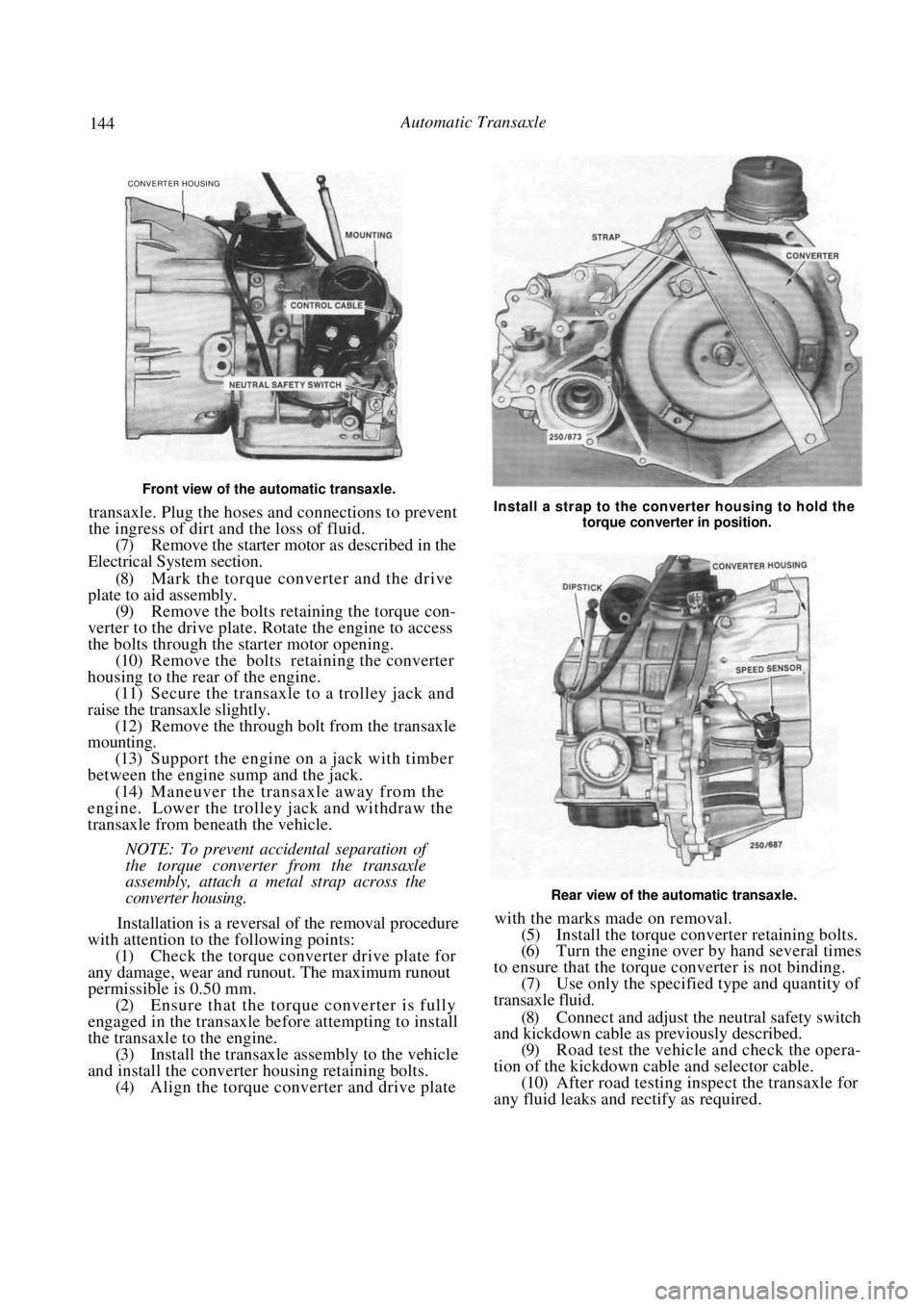
Front view of the automatic transaxle.
transaxle. Plug the hoses and connections to prevent
the ingress of dirt and the loss of fluid.
(7) Remove the starter motor as described in the
Electrical System section.
(8) Mark the torque converter and the drive
plate to aid assembly.
(9) Remove the bolts retaining the torque con-
verter to the drive plate. Rotate the engine to access
the bolts through the starter motor opening. (10) Remove the bolts retaining the converter
housing to the rear of the engine. (11) Secure the transaxle to a trolley jack and
raise the transaxle slightly. (12) Remove the through bolt from the transaxle
mounting.
(13) Support the engine on a jack with timber
between the engine sump and the jack. (14) Maneuver the transaxle away from the
engine. Lower the trolley jack and withdraw the
transaxle from beneath the vehicle.
NOTE: To prevent accidental separation of
the torque converter from the transaxle
assembly, attach a metal strap across the
converter housing.
Installation is a reversal of the removal procedure
with attention to the following points:
(1) Check the torque converter drive plate for
any damage, wear and runout. The maximum runout
permissible is 0.50 mm.
(2) Ensure that the torque converter is fully
engaged in the transaxle be fore attempting to install
the transaxle to the engine. (3) Install the transaxle assembly to the vehicle
and install the converter housing retaining bolts. (4) Align the torque converter and drive plate
Install a strap to the converter housing to hold the
torque converter in position.
Rear view of the automatic transaxle.
with the marks made on removal.
(5) Install the torque converter retaining bolts.
(6) Turn the engine over by hand several times
to ensure that the torque converter is not binding. (7) Use only the specified type and quantity of
transaxle fluid.
(8) Connect and adjust the neutral safety switch
and kickdown cable as previously described.
(9) Road test the vehicle and check the opera-
tion of the kickdown cable and selector cable. (10) After road testing inspect the transaxle for
any fluid leaks and rectify as required.
CONVERTER HOUSING
Page 147 of 238
147
PART 2. MANUAL STEERING
SPECIFICATIONS
Steering gear type ............................ Rack and pinion
Steering column type ...................... Energy absorbing
collapsible and tilt adjustable
Steering wheel free play
(maximum ) ...................................................... 35 mm
Linkage........................... Direct from rack ends to t i e
rods and steering knuckles
Turns lock to lock ................................................. 3.6
Steering column length .................. 534.7-537.3 mm
Steering gear lubricant.............. Castrol EPL 1 grease
TORQUE WRENCH SETTINGS
Steering wheel retaining nut ............................ 39 Nm
Steering gear to bulkhead
mounting bolts .............................................. 108 Nm
Tie rod to steering knuckle nut...................... 98 Nm
Tie rod to tie rod end locknut ....................... 98 Nm
Tie rod ball housing to rack............................ 88 Nm
Steering column to mounting
bracket bolt ...................................................... 14 Nm
Steering column universal
coupling joint pinch bolts ............................... 29 Nm
2. STEERING WHEEL
Special Equipment Required:
To Remove Steering Wheel - Steering wheel
puller
TO REMOVE AND INSTAL
(1) Disconnect the negative battery terminal.
(2) Using a small screwdriver, carefully prise the
centre ornament from the steering wheel.
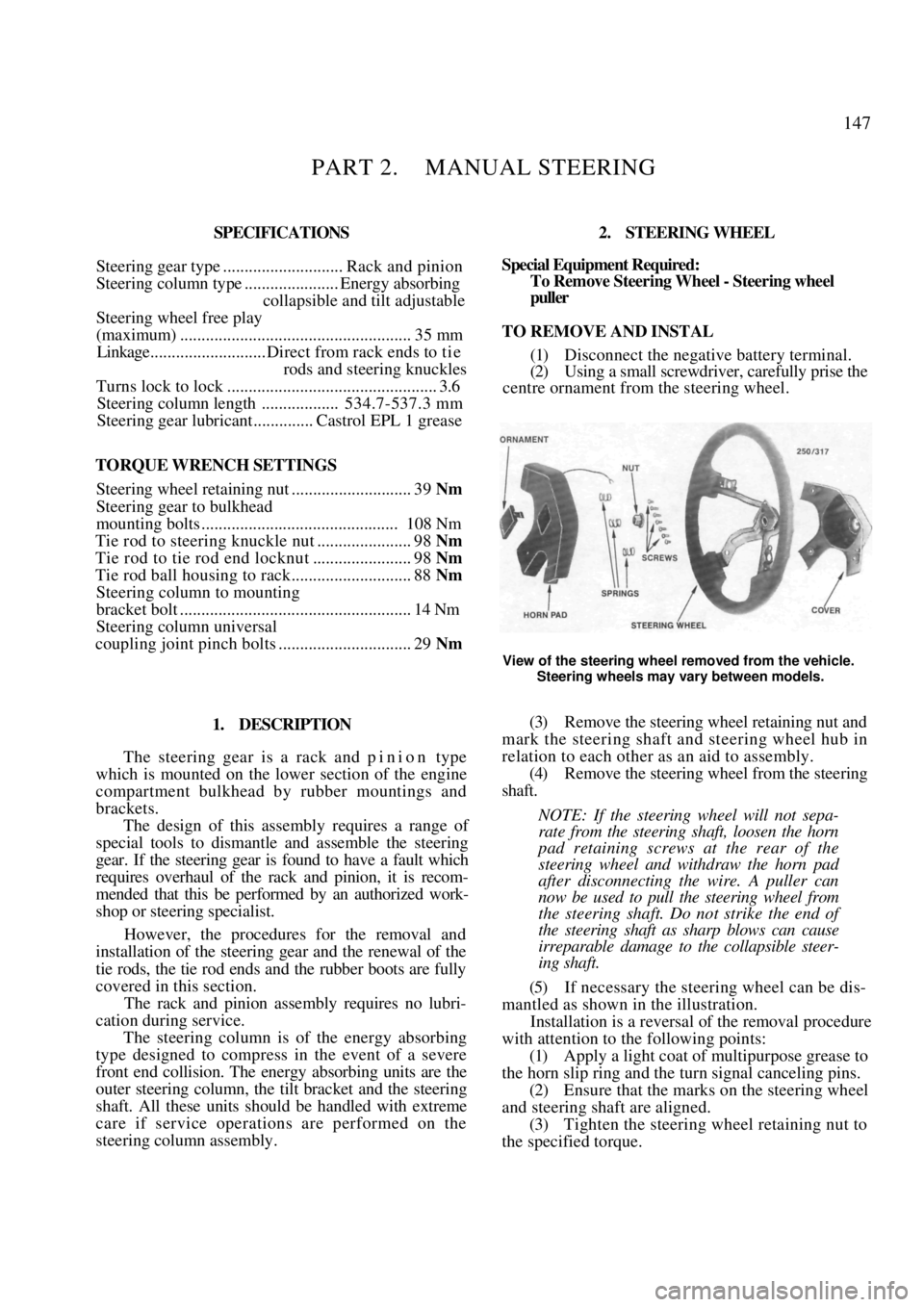
View of the steering wheel removed from the vehicle.
Steering wheels may vary between models.
1. DESCRIPTION
The steering gear is a rack and p i n i o n type
which is mounted on the lower section of the engine
compartment bulkhead by rubber mountings and
brackets.
The design of this assembly requires a range of
special tools to dismantle and assemble the steering
gear. If the steering gear is found to have a fault which
requires overhaul of the rack and pinion, it is recom-
mended that this be performed by an authorized work-
shop or steering specialist.
However, the procedures for the removal and
installation of the steering gear and the renewal of the
tie rods, the tie rod ends and the rubber boots are fully
covered in this section.
The rack and pinion assembly requires no lubri-
cation during service.
The steering column is of the energy absorbing
type designed to compress in the event of a severe
front end collision. The energy absorbing units are the
outer steering column, the tilt bracket and the steering
shaft. All these units shoul d be handled with extreme
care if service operations are performed on the
steering column assembly.
(3) Remove the steering wh eel retaining nut and
mark the steering shaft and steering wheel hub in
relation to each other as an aid to assembly.
(4) Remove the steering wheel from the steering
shaft.
NOTE: If the steering wheel will not sepa-
rate from the steering shaft, loosen the horn
pad retaining screws at the rear of the
steering wheel and withdraw the horn pad
after disconnecting the wire. A puller can
now be used to pull the steering wheel from
the steering shaft. Do not strike the end of
the steering shaft as sharp blows can cause
irreparable damage to the collapsible steer-
ing shaft.
(5) If necessary the steering wheel can be dis-
mantled as shown in the illustration.
Installation is a reversal of the removal procedure
with attention to the following points:
(1) Apply a light coat of multipurpose grease to
the horn slip ring and the turn signal canceling pins.
(2) Ensure that the marks on the steering wheel
and steering shaf t are aligned.
(3) Tighten the steering wheel retaining nut to
the specified torque.
Page 151 of 238

Steering — Part 2 151
(8) Slide the rack out of the housing slightly so
that an adjustable spanner can be used to hold the
rack. (9) Using a Stillsons wrench, unscrew the ball
housings in turn using care not to allow the rack to
rotate. Keep all the tie rod parts in order. (10) Inspect the rack boots for cracks and deteri-
oration and renew as necessary. (11) Inspect the tie rod ends for wear and damage
and renew as necessary.
Dismantled view of the tie rod ball housing and the tie
rod end assemblies removed from the steering gear.
Assembly is a reversal of the dismantling proce-
dure with attention to the following points:
(1) Using large Stillsons and a large adjustable
spanner, install the tie rod and ball housing
assemblies
to the rack. Tighten the ball housings to the specified
torque.
NOTE: To avoid damage to the rack or
pinion the adjustable spanner must be
firmly tightened over the rack teeth and the
rack must not be allowed to rotate when
installing the ball housings.
(2) Measure a point 9 mm in from the rear face
of the ball housing of the rack and at 90 deg to the
rack teeth. Centre punch this point.
(3) At this point drill a 4 mm hole, 10 mm deep
through the rack and into the ball housing thread.
(4) Place a locking pin above the hole and drive
it into position.
(5) Lubricate the rack, rack teeth and t i e rod
boot groove with suitable EPL 1 grease. (6) Install the rack boots and secure with the
clamps. Renew the clamps if necessary. (7) Install the tie rod end locknuts and then the
tie rod ends, ensuring that they are screwed on the
same number of turns as was necessary to remove
them.
(8) Tighten the locknuts to the specified torque.
(9) Install the mounting rubbers and brackets
to
the steering gear as noted on removal. (10) Install the steering gear assembly to
the
vehicle as previously described. (11) Check and if necessary adjust the front wheel toe in as described in the Front Suspension section
under the appropriate heading.
TO RENEW TIE ROD END
(1)
Raise the front of the vehicle and support it
on chassis stands. (2) Remove the relevant front wheel.
(3) Loosen the tie rod end locknut and remove
the tie rod end castellated nut. Disconnect the tie rod
from the steering arm by plac ing a suitable dolly or
hammer against one side of the steering arm eye and
striking the opposite side with a hammer. (4) Unscrew the tie rod end from the tie rod,
noting the number of turns necessary to remove it.
(5) Screw the new tie rod end onto the t i e rod
the same number of turn s noted during removal.
(6) Connect the t i e rod to the steering arm and
install the castellated nut. Tighten the nut to the
specified torque and secure it with a new split pin.
(7) Install the front wheel and lower the vehicle
to the ground. (8) Check and if necessary, adjust the front
wheel toe in as described in the Front Suspension
section. Ensure that the rubber boots are not distorted
or twisted on the tie rod when the adjustment is
completed.
TO RENEW RUBBER BOOT
(1) Raise the front of the vehicle and support it
on chassis stands. (2) Remove the relevant t i e rod end as previ-
ously described. (3) Release the clamps securi ng the boot to the
tie rod and steering gear housing. (4) Unscrew and remove the locknut from the
tie rod. (5) Remove the rubber boot together with the
outer retaining clamp from the t i e rod. (6) Sparingly lubricate th e tie rod boot groove
with EPL 1 grease, install the new boot to the t i e
rod
and push it onto the steering gear rack housing. Install
and secure the inner and outer retaining clamps.
(7) Install the tie rod end locknut and screw
the
tie rod end onto the tie ro d the same number of turns
noted during removal. (8) Connect the tie rod to the steering arm and
install the castellated nut. Tighten the nut to the
specified torque and secure it with a new split pin. (9) Install the wheel and lower the vehicle to the
ground. (10) Check and if necessary, adjust the front
wheel toe in as described in the Front Suspension
section. Ensure that the rubber boots are not distorted
or twisted when the adjustment is completed.
Page 152 of 238

152
PART 3. POWER STEERING
SPECIFICATIONS
Steering gear type ................Rack and pinion with
integral power cylinder
Steering column type .................... Energy absorbing
collapsible and lilt adjustable
Steering wheel free play ................................. 35 mm
Number of turns lock to lock:
TRW ...............................................................2.82
PR24SA ........................................................... 2.7
Linkage.....................................Direct from rack ends
to ti e rods and steering knuckles
Power steering pump
maximum pr essure.................................... 6 865 kPa
Lubricant ...................................................... Dexron II
TORQUE WRENCH SETTINGS
Steering gear to bulkhead mounting bolts... 108 Nm
Tie rod to steering knuckle nut ...................... 98 Nm
Tie rod to tie rod end locknut....................... 98 Nm
Tie rod ball housing to rack............................ 88 Nm
Power steering pump pulley nut ..................... 68 Nm
1. DESCRIPTION
The vehicles covered by this manual are equipped
with either a TRW power steering system or a
Japanese PR24SA power steering system.
Both types are similar in construction and appear-
ance.
The power steering is a rack and pinion type
which is mounted on the lower section of the engine
compartment bulkhead by rubber mountings and
brackets.
Hydraulic pressure is supplied to the power
steering gear by a pump driven by a drive belt from
the engine.
The power steering pump has a separate fluid
reservoir located on the righ t side of the bulkhead.
No lubrication of the steering gear or steering
pump is required in service and in the event of the
loss of power assistance, the steering will continue to
operate but will require a greatly increased effort.
However, as the steering gear and pump are lubricated
by the power steering fluid, the cause of the loss of
power steering or fluid loss must be determined and
repaired promptly to prevent damage to the steering
pump and to a lesser extent, the steering gear.
The t i e rod ends and rubb er boots can be renewed
without removing the steering gear from the vehicle.
To renew the integral t i e rod and tie rod ball housings,
the steering gear must be removed.
As specialist knowledge and equipment are re-
quired to overhaul the power steering gear and the
hydraulic pump, it is recommended that these op-
erations be carried out by an authorized dealer.
However, procedures for the removal and installa-
tion of the steering gear and pump are fully de-
scribed in this section.
The steering column is of the energy absorbing
type and is designed to collapse in the event of a
severe front end collision. The energy absorbing com-
ponents are the column tu bes, steering shaft and tilt
bracket breakaway capsules. All these components
should be handled with extr eme care if service opera-
tions are to be carried out on the steering column
assembly.
2. IN CAR ADJUSTMENTS, CHECKS AND
MINOR REPAIRS
If the power steering system becomes partially or
fully inoperative it is most important that the follow-
ing preliminary inspection and testing procedure be
performed prior to undertaking any trouble shooting
or repair operations.
PUMP DRIVE BELT
Inspect the pump drive belt for breakage, glazing
or wear. If any of these characteristics are evident,
renew the belt using only a genuine replacement.
If the belt is loose but still serviceable, adjust it
using the procedure outlined in the Engine Tune-up
section.
NOTE: In most cases a loose drive belt can
be heard squealing when a load is placed on
the pump as the steering wheel is turned or
as the engine speed is increased.
Checking the power steering pump drive belt for
deterioration.