fuel NISSAN PULSAR 1987 Repair Manual
[x] Cancel search | Manufacturer: NISSAN, Model Year: 1987, Model line: PULSAR, Model: NISSAN PULSAR 1987Pages: 238, PDF Size: 28.91 MB
Page 116 of 238

116 Fuel and Engine Management
Rear view of the instrument cluster showing the flexible printed circuit.
If the voltage is under 5 volts proceed as follows.
(17) Check the wiring harness for continuity or
shorts to earth between th e red wire terminal on the
speed sensor harness connector and the green and
black wire terminal on th e instrument cluster wiring
connector.
If no fault can be found check the instrument
cluster printed circuit for continuity or shorts. If no
fault can be found, renew the speedometer and the
signal divider circuit board.
(18) Remove the instrument cluster as described
in the Electrical System se ction and repeat operation
(16).
If the voltage is under 1 volt, check the flexible
printed circuit on the rear of the instrument cluster for
continuity or shorts and re new as necessary. If no fault
can be found, renew the speedometer and the signal
divider circuit board.
(19) Connect the harness connector to the vehicle
speed sensor wiring connector. (20) Raise the front of the vehicle and support it on chassis stands. Place the transaxle in Neutral.
(21) With the aid of assistants, slowly spin the
front wheels by hand while backprobing the brown
wire terminal on the vehicle speed sensor wiring
connector with a voltmeter to earth.
The voltage should alternate between approxi-
mately 1 and 7 volts.
If the voltage is as specif ied, check the flexible
printed circuit on the rear of the instrument cluster for
continuity or shorts. If no fault can be found, renew
the speedometer and the signal divider circuit board.
If the voltage is not as specified, proceed as
follows.
(22) Disconnect the vehicle speed sensor wiring
connector and unscrew the sensor from the speedom-
eter drive housing. (23) Rotate both front wheels in the same direc-
tion and check that the speedometer drive shaft is
turning and does not slip. If the drive shaft does not operate as described,
renew the drive assembly as described in the Manual
or Automatic Transaxle section.
If the drive shaft operates satisfactorily, renew the
vehicle speed sensor.
To Remove and Install
(1) Disconnect the negative battery terminal.
(2) Disconnect the vehicle speed sensor wiring
connector. (3) Unscrew the vehicle speed sensor from the
speedometer drive housing.
Installation is a reversal of the removal procedure
with attention to the following points:
(1) Align the cut-out in the speedometer drive
shaft with the notch in the vehicle speed sensor shaft.
(2) Tighten the vehicle speed sensor securely.
Page 117 of 238
117
EMISSION CONTROL
INTRODUCTION
To reduce the output level of the three primary
automotive emissions, carbon monoxide (CO), hydro-
carbons (HC) and oxides of nitrogen (NOx), and thus
comply with legislation on the maintenance of clean
air, several different emissi on control systems are used
in the Pulsar range of vehicles covered by this manual.
The systems will be discussed under the headings
( 1 ) Crankcase Ventilation System, (2) Evaporative
Control System, (3) Air Preheat System — 1.6 Liter
Engine and (4) Exhaust Control System.
1. CRANKCASE VENTILATION SYSTEM
DESCRIPTION
The crankcase ventilation system is of the closed
type and is designed to prevent crankcase vapors
being emitted into the atmosphere. Crankcase
vapors are caused by gases escaping past the piston
rings into the crankcase during the combustion pro-
cess.
The crankcase vapors are collected in the cam-
shaft housing from the cra nkcase via the various oil
drain passages and the pipe from the side of the
crankcase.
The crankcase vapors are then drawn into the
engine via a branched hose connected to the camshaft
housing oil baffle and the throttle body (1.8 liter
engines) or inlet manifold (1.6 liter engines).
At idle speed, vapors are drawn through the
small branch of the hose and into the engine.
As the engine speed increases, vapors are also
drawn into the engine via the main hose.
TO SERVICE THE SYSTEM
(1) At intervals of 40 000 km, disconnect the
small engine ventilation hose from the throttle body
or inlet manifold and check that the metering orifice
is not blocked.
If necessary, clean the orifice using compressed air
and solvent.
(2) Disconnect all the engine ventilation hoses
and check for blocking, collapsing and deterioration.
Renew the hoses as necessary.
2. EVAPORATIVE CONTROL SYSTEM
Special Equipment Required:
To Test Purge Valve — Hand vacuum pump
DESCRIPTION
The evaporative control system reduces the
amount of hydrocarbons emitted to the atmosphere
through fuel evaporation.
The vehicles covered by this manual use an
absorption regeneration system to reduce vapor loss.
The system utilizes a canister of activated charcoal to
trap and hold the fuel vapors until they can be fed
into the induction system for burning in the combus-
tion chambers.
The basic components of the evaporative control
system are a fuel tank with a sealed filler cap, a
charcoal canister with a pur ge control valve, a fuel
check valve and pipes a nd hoses to connect the
various components.
NOTE: The fuel tank filler cap is not vented
to the atmosphere but is equipped with a one
way relief valve to prevent a vacuum form-
ing in the fuel tank.
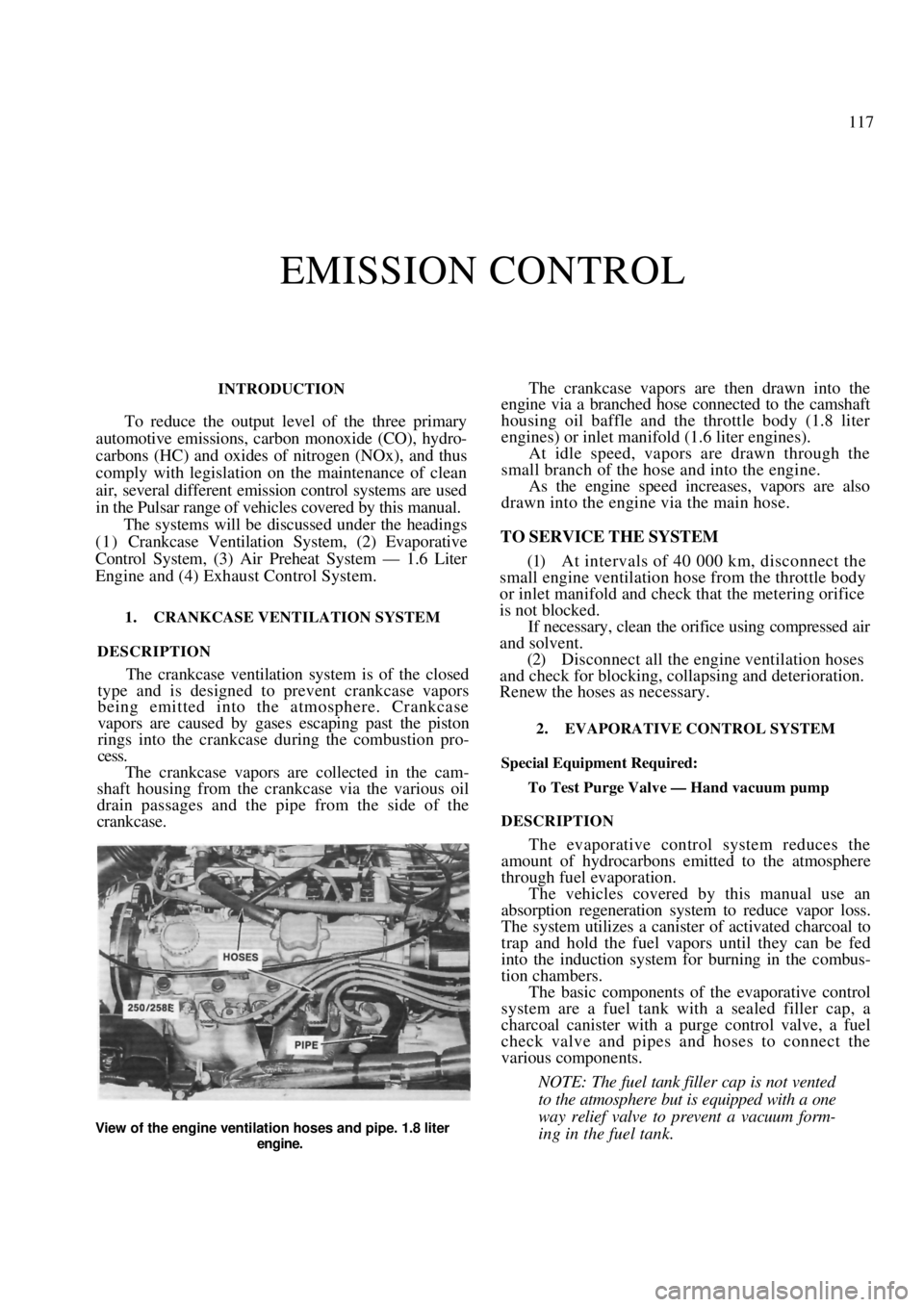
View of the engine ventilation hoses and pipe. 1.8 liter
engine.
Page 118 of 238

118 Emission Control
Installed view of the charcoal canister.
When the engine is at rest, fuel vapor through
evaporation gradually fills the air space in the fuel
tank. The sealed filler cap pr events the escape of this
vapor and pressure builds up within the system,
forcing the vapor to flow into the charcoal canister
which is located in the engine compartment beneath
the windscreen wiper motor.
The fuel check valve prevents liquid fuel entering
the charcoal canister when the fuel tank is full or the
vehicle is parked on a steep incline. When the engine
is running, the vapor is drawn via a hose from the
charcoal canister to the throttle body and burnt in the
combustion chambers.
TO RENEW CHARCOAL CANISTER
(1) Suitably mark and disconnect the hoses from
the canister. (2) Release the retaining spring and remove the
canister from the engine compartment. Installation is a reversal of the removal procedure.
TO RENEW FUEL CHECK VALVE
(1) Disconnect the negative battery terminal.
(2) Raise the rear of the vehicle and support it
on chassis stands. Remove the left hand rear wheel. (3) Drain the fuel from the fuel tank using a
hand pump or a suitable siphon. Do not siphon fuel
using the mouth.
(4) Remove the hoses from the check valve.
(5) Squeeze the retaining clip and remove the
check valve from the mounting bracket. Installation is a reversal of the removal procedure.
TO SERVICE THE SYSTEM
(1) Inspect the vacuum lines and connectors for
signs of leakage, cracks and deterioration and renew
as necessary. (2) Remove the fuel tank cap and check that a
slight resistance is felt, when vacuum is applied to the
one-way relief valve in the centre of the cap. Renew the fuel tank cap if no resistance is felt or
if the valve is blocked.
(3) Inspect the fuel tank cap seal for deteriora-
tion. Renew as necessary.
Installed view of the fuel check valve as seen with the
left hand rear wheel removed.
Check the fuel filler cap seal for damage.
23Q/LDZ GAUGE
Line drawing showing a hand vacuum pump.
Page 119 of 238

Emission Control 119
(4) Remove the charcoal canister as previously
described under the heading To Renew Charcoal
Canister. (5) Shake the canister, there should no audible
carbon movement. If there is, renew the canister. (6) Check the purge valve by applying 20-35
kPa of vacuum with a hand pump to the control port. Using a piece of hose, blow through the purge
hose connection. If this is not possible, renew the
canister.
Remove the vacuum source and blow air through
the purge hose connection. If this is possible, renew
the canister.
(7) Apply 20-35 kPa air pressure into the fuel
tank connector. Air should flow freely from all the
other connectors.
If poor air flow through the drain tube exists,
block off the fuel tank tube and blow compressed air
at approximately 300 kPa through the purge port.
Check the air flow and if st ill poor, renew the canister.
(8) Apply 20-35 kPa air pressure to any one of
the canister ports except th e purge valve control port
and with the other ports blocked, ensure that there are
no leaks from the canister. If leaks exist, renew the
canister. (9) Remove the fuel check valve as previously
described under the heading To Renew Fuel Check
Valve. (10) Blow through the check valve from the side
that is connected to the fu el tank hose. Considerable
resistance should be felt with only a small amount of
air passing through the valve. If no resistance is felt or
if the valve is blocked renew the fuel check valve.
(11) Blow air through the fuel check valve from
the opposite end. There should be a smooth flow of air
through the valve. If the valve is blocked, renew the
fuel check valve.
3. AIR PREHEAT SYSTEM — 1.6 LITRE
ENGINE
DESCRIPTION
To reduce emissions and improve drivability
when the engine is cold, hot air is drawn into the air
cleaner from a heat shield which partially surrounds
the exhaust manifold.
When the ambient temperature is below 30°C, the
thermal vacuum valve, which is located inside the air
cleaner housing, allows vacuum to operate a servo
actuated flap in the air cleaner intake duct. When the
flap closes, hot air is dr awn from the exhaust heat
shield, through the hot air inlet tube into the air
cleaner intake duct.
When the ambient temperature is above 30°C,
the flap in the air cleaner intake duct opens allowing
cool air to enter the air cleaner.
View of the air preheat system components. 1.6 liter
engine.
TO CHECK OPERATION
(1) When the engine is cold, use a mirror to
check that the passage from the hot air inlet tube is
closed by the flap.
(2) Start and run the engi ne at approximately
1 200 rpm. The hot air inlet passage should now be
open, allowing hot air from the exhaust heat shield to
be drawn into the air cleaner. (3) Allow the engine to idle for fifteen minutes
and inspect the position of th e air cleaner intake flap.
The flap should now be in the open position allowing
cool air to be drawn into the air cleaner and shutting
oft' air from the exhaust manifold heat shield.
TO CHECK COMPONENTS
(1) Disconnect the vacuum hose from the servo
unit and connect a vacuum pump to the unit.
When the vacuum is applied to the servo unit, the
flap in the air cleaner intake duct should close.
When the vacuum is removed, the flap should
open.
View of the air cleaner raised showing the engine
ventilation hose and the thermal vacuum valve supply
hose connection. 1.6 liter engine.
Page 120 of 238

120 Emission Control
If the flap does not operate as described, renew
the air cleaner housing.
(2) Disconnect the vacuum hose from the servo
unit and connect it to a vacuum gauge.
(3) Start and run the engine at approximately
1 200 rpm. If the engine is cold there should be
vacuum. (4) As the engine temperature increases the
vacuum should decrease to zero. If the vacuum gauge does not read as described,
check that the vacuum supply hose is connected to the
thermal vacuum valve and the throttle body.
If no fault is found, renew the thermal vacuum
valve.
4. EXHAUST CONTROL SYSTEM
DESCRIPTION
The exhaust system is the greatest source of
pollutant emission from the internal combustion
engine.
On the Pulsar range of vehicles covered by this
manual, the exhaust control system consists of a
catalytic converter and the engine management sys-
tem. The engine management system constantly mon-
itors the exhaust gases via an oxygen sensor located in
the exhaust system. Fuel injection is then adjusted
accordingly to give the minimum amount of exhaust
emissions. Refer to the Fuel and Engine Management
section for further information.
CATALYTIC CONVERTER
The catalytic converter, which is located in the
exhaust system, converts hydrocarbons, oxides of
nitrogen and carbon monoxide present in the exhaust
gases into carbon dioxide, nitrogen, water and heat.
The catalytic converter does not require periodic
maintenance or replacement under normal circum-
stances. However, it can be damaged or poisoned by
excessively high exhaust gas temperatures, raw fuel
and the use of leaded fuel.
Installed view of the catalytic converter.
To prevent the use of leaded fuel, a small diam-
eter fuel filler neck with a spring loaded trap door is
used.
To prevent damage to the catalytic converter, the
following precautions sh ould be observed.
(1) Do not operate the vehicle on leaded fuel.
(2) Do not push or tow start the vehicle.
(3) Do not allow the engine to idle for prolonged
periods. (4) Do not operate the vehicle if the engine is
misfiring.
(5) Avoid running the vehicle out of fuel.
(6) Ensure that the engine oil is formulated to
contain low phosphorous levels.
To Inspect Catalytic Converter
(1) Inspect the converter for dents and damage.
If the converter is damaged, it should be renewed. (2) Inspect the converter heat shield for damage
and ensure that it is positioned correctly. Renew the
converter heat shield if necessary.
To Remove and Install
To remove and install the catalytic converter,
refer
to the Exhaust System heading in the Engine section.
Page 140 of 238
140
AUTOMATIC TRANSAXLE
SPECIFICATIONS
Make .............................................. JATCO RL3F01A
Type .....................3 speed and reverse epicyclic gear
train with lock up torque converter
Operation .................................... Automatic hydraulic
Lubricant:
Type....................................................... Dexron IT
Capacity................................................. 6.3 liters
TORQUE WRENCH SETTINGS
Drive plate to crankshaft bolls ........................60 Nm
Drive plate to torque converter bolts ..............49 Nm
Convener housing to engine ...........................22 Nm
Converter housing to transaxle ........................23 Nm
Transaxle sump to transaxle ............................. 7 Nm
Oil cooler pipe to transaxle .............................49 Nm
Selector shaft locknut .......................................42 Nm
Transaxle filter bolts.........................................12 Nm
1. AUTOMATIC TRANSAXLE TROUBLE SHOOTING
NO DRIVE IN D RANGE
{1) Low fluid level in transaxle: Check the fluid
level in the transaxle and top up if required.
(2) Incorrectly adjusted selector cable: Check
and adjust the selector cable as detailed. (3) Incorrect or contaminated transaxle fluid:
Drain and refill with the recommend type and quan-
tity of transaxle fluid.
NOTE: Check the possible causes in the
order given.
NO REVERSE IN R RANGE
(1) Low fluid level in transaxle: Check the fluid
level and top up if required. (2) Incorrectly adjusted selector linkage: Check
the condition of the selector cable, selector quadrant
and selector arm for wear and damage. Adjust as
required.
Check the drive shaft oil seals as a likely leak source.
SLIPPING OR ROUGH UPSHIFT
(1) Incorrectly adjusted selector linkage: Check
and adjust the selector linkage. (2) Low fluid level in transaxle: Check the fluid
level and top up if required.
NO TRANSAXLE KICKDOWN
(1) Incorrectly adjusted throttle cable: Check
and adjust the cable as detailed in the Fuel and Engine
Management section.
Check the oil cooler hose connections for leaks if the
fluid level is low.
Page 162 of 238

162 Front Suspension
the ball joint or bushes as described later in this
section.
Installation is a reversal of the removal procedure
with attention to the following points:
(1) When installing the control arm bush
bracket, ensure that the protrusion on the bracket is
towards the inside of the vehicle.
(2) Do not fully tighten the control arm bush
bolts and through bolt nut until the curb weight of the
vehicle is on the suspension.
NOTE: Curb weight is with the vehicle
unladen except for a full tank of fuel and
normal amounts of oil and water and with
the spare lyre, jack and hand tools in their
normal positions.
(3) Tighten the ball joint nut to the specified
torque and retain with a new split pin.
TO CHECK AND RENEW BALL JOINT
(1) Remove the control arm from the vehicle as
previously described.
(2) Install the ball joint nut and turn the ball
joint at least ten revolutions to ensure that the ball
joint is correctly seated. (3) Using a spring scale with the hook placed
over the split pin hole, check the ball joint swinging
torque. A new ball joint should measure 15.7-80.4 N
and a used ball joint should measure 7.8-80.4 N.
Renew the ball joint if necessary. (4) Using a small torque wrench or preload
gauge, measure the force requi red to rotate the ball
joint. A new ball joint should measure between
1.0-4.9 Nm and a used ball joint should measure
between 0.5-4.9 Nm. Renew the ball joint if neces-
sary.
(5) To renew the ball joint, remove the snap ring
from the stud end of the ball joint using snap ring
pliers. (6) Support the control arm in a press, ball joint
stud uppermost, with a suitable tube that is large
enough for the ball joint to pass through. (7) Press the ball joint out from the control arm.
(8) Press a new ball joint into the control arm
using a suitable tube that pushes on the outer circum-
ference of the joint only.
(9) Install the snap ring and install the
control
arm to the vehicle as previously described.
TO RENEW CONTROL ARM BUSHES
(1) Remove the control arm from the vehicle as
previously described. Mark the position of the rear
control arm bush. (2) To remove the rear control arm bush use a
bearing puller and a press. When installing the bush
use a suitable tube that pushes on the inner edge of the
bush only. NOTE: Ensure that the bush is installed
with the flat portion in its original location.
(3)
To remove the front control arm bush use a
suitable tube that pushes on the outer circumference
of the bush and a split tu be supporting the control
arm. (4) After the bush has been pressed out approx-
imately half way, cut the protruding part of the bush
using a hacksaw. Cutting the bush in this way will
allow removal.
(5) Support the control arm and push the new
bush in from the outside using a suitable tube that
pushes on the outer circumference only. (6) Install the control ar m to the vehicle as
previously described.
6. STABILISER BAR
TO REMOVE AND INSTAL
(1) Raise the front of the vehicle and support it
on chassis stands.
(2) Remove the bolts at the flexible joint retain-
ing the front engine pipe to the exhaust pipe located
below the stabilizer bar. (3) Remove the bolt from the exhaust pipe
mounting below the stabilizer bar. Disconnect the
exhaust pipe at the flexible joint and allow the front of
the pipe to hang down. (4) Remove the stabilizer bar bracket retaining
bolts and remove the stabilizer bar brackets from the
vehicle. (5) Remove the stabilizer bar lower link nuts
from each control arm. When removing the lower nuts
it may be necessary to hold the upper nuts with a
spanner.
(6) Maneuver the stabilizer bar from the
vehicle.
Installation is a reversal of the removal procedure
with attention to the following points:
(1) Ensure that the stabilizer bar mounting rub-
bers are in a serviceable condition and secure in the
mounting brackets.
Dismantled view of one end of the stabilizer bar.
Page 163 of 238
Front Suspension 163
(2) Ensure that the stabilizer bar links are in
good condition. Renew if necessary.
(3) When installing the stabilizer bar ensure that
the links are installed perpendicular to the control arm
with the ball joint socket face parallel to the end of the
stabilizer bar. (4) Ensure that the brackets are installed with
the flat portion facing towards the front of the vehicle.
Tighten the retaining bolts securely.
7. SUSPENSION AND STEERING ANGLES
ADJUSTMENT
NOTE: Extensive knowledge and special-
ised equipment are required to measure and
correct the suspension and steering angles
with the exception of the front wheel toe in.
Therefore, as it is not a viable proposition
for the average person to carry out a com-
plete wheel alignment, the vehicle should be
taken to a wheel alignment specialist.
Prior to carrying out a wheel alignment, a thor-
ough inspection of the steering linkage, front hub
bearings, ball joints and suspension units should be
carried out. Faulty components should be renewed or
repaired as necessary.
The tread of the front ti res should be examined
for excessive or uneven wear as certain conditions of
tire wear are indicative of damaged or worn compo-
nents in the suspension, stee ring linkage and/or wheels
and bearings. Refer to the heading Tire Wear Trouble
Shooting in the Wheels and Tires section. If the tires
are found to be defective, renew them with serviceable
lyres.
TO CHECK AND ADJUST TOE IN/OUT
NOTE: The vehicle s hould be unladen ex-
cept for the normal amount of fuel and with
the tires inflated to the correct pressures.
(1) With the vehicle on a level floor, raise the
front of the vehicle and s upport it on chassis stands.
(2) Spin each front wheel in turn and using a
piece of chalk, mark a line around the periphery of
each tire as near to the centre as possible. (3) Lower the vehicle to the ground and bounce
the front several times to stabilize the suspension. (4) Set the wheels in the straight ahead position.
(5) Mark the centre chalk line on both tires at a
point approximately 200 mm above the floor and
forward of the suspension. (6) Using a tape measure, measure and record
the distance between the two marked points on the
tire centers.
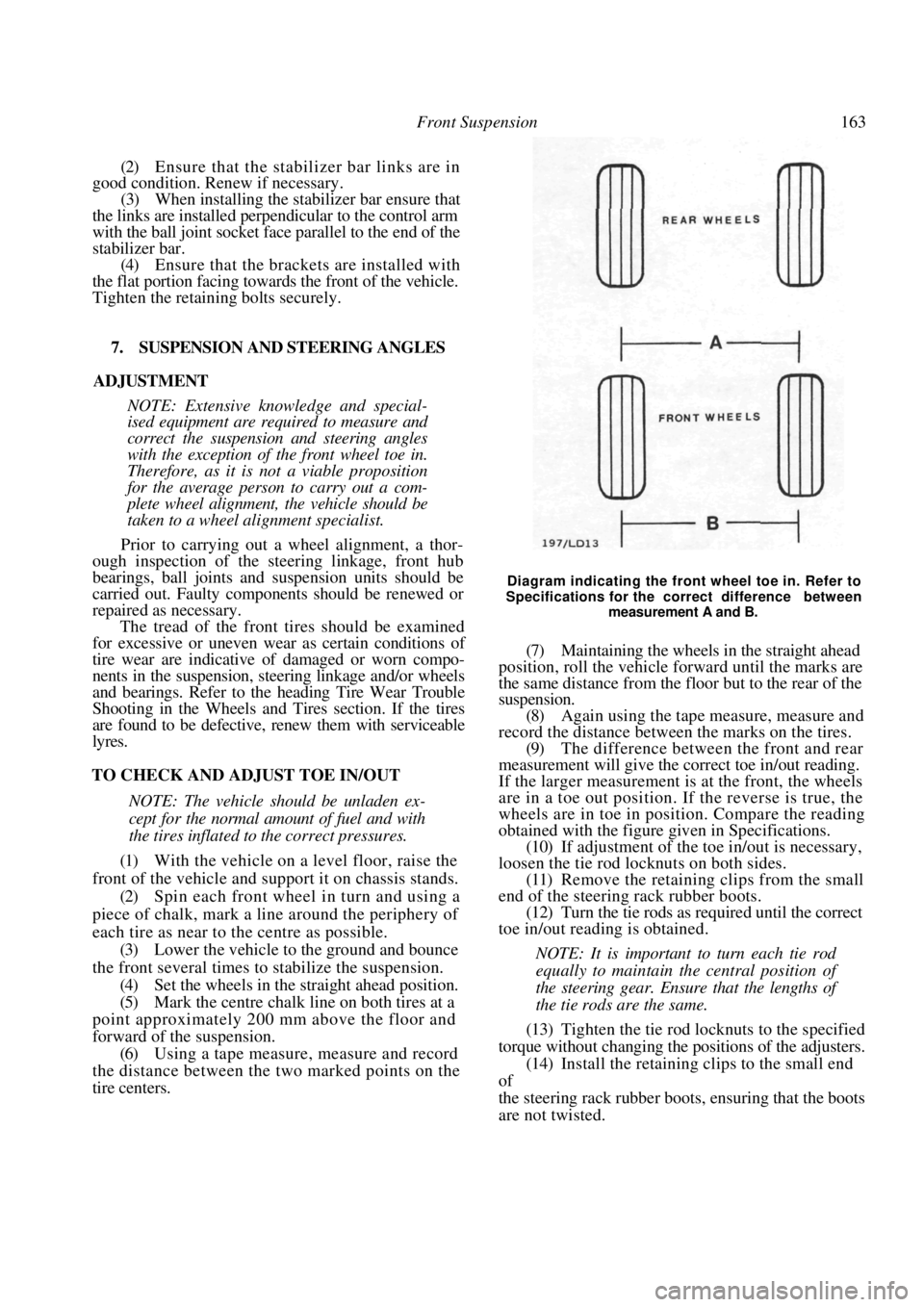
Diagram indicating the front wheel toe in. Refer to
Specifications for the correct difference between
measurement A and B.
(7) Maintaining the wheels in the straight ahead
position, roll the vehicle forward until the marks are
the same distance from the floor but to the rear of the
suspension. (8) Again using the tape measure, measure and
record the distance between the marks on the tires.
(9) The difference between the front and rear
measurement will give the correct toe in/out reading.
If the larger measurement is at the front, the wheels
are in a toe out position. If the reverse is true, the
wheels are in toe in position. Compare the reading
obtained with the figure given in Specifications.
(10) If adjustment of the to e in/out is necessary,
loosen the tie rod locknuts on both sides. (11) Remove the retaining clips from the small
end of the steering rack rubber boots. (12) Turn the tie rods as required until the correct
toe in/out reading is obtained.
NOTE: It is important to turn each tie rod
equally to maintain the central position of
the steering gear. Ensure that the lengths of
the tie rods are the same.
(13) Tighten the tie rod locknuts to the specified
torque without changing the positions of the adjusters.
(14) Install the retaining clips to the small end
of
the steering rack rubber boots, ensuring that the boots
are not twisted.
Page 178 of 238
178 Brakes
Let the vehicle stand for 1-2 minutes, press the
brake pedal two or three times and check its opera-
tion.
If there is no vacuum assistance, the vacuum
system has developed a leak or the one way check
valve is defective.
NOTE: Before removing the servo unit from
the vehicle for inspection, disconnect the
hose from the servo unit, start the engine
and check that the manifold vacuum is in
fact reaching the servo unit. Also test the one
way check valve as described below,
TO TEST ONE WAY CHECK VALVE
(1) Disconnect the hose and remove the check
valve from the servo unit.
(2) Check the valve for sticking. Suction on the
manifold side should allo w air to flow freely. Air
blown into the valve from the manifold side should
not be able to flow through the valve. (3) Install the valve and check the operation
of
the servo unit as previously described.
NOTE: Check that there are no air leaks at
the hose connections and that the hose clips
are tight. Also check that the hose is not
bulged or collapsed due to deterioration.
Checking for vacuum at the servo unit. The engine
must be running for this test.
TO REMOVE
(1) Raise the bonnet and install covers to both
front mudguards.
(2) On 1.6 liter models, remove the air cleaner
assembly from the vehicle. If necessary refer to the
Fuel System section.
(3) On vehicles equipped with power steering,
remove the reservoir from the bulkhead and move it
to one side. If necessary refer to the Steering section.
(4) Disconnect the vacuum supply hose from the
servo unit.
View of the brake servo unit and associated compo-
nents.
(5) Remove the master cylinder as described
under the Master Cylinder heading. (6) Working inside the vehicle, remove the clip
and clevis pin connecting the pushrod to the brake
pedal. (7) Remove the nuts retaining the servo unit to
the bulkhead and maneuver the servo unit and
spacer block from the vehicle.
TO INSTAL
Installation is a reversal of the removal procedure
with attention to the following points:
(1) With the servo unit and master cylinder
installed to the vehicle, bleed the hydraulic system as
described under the Hydr aulic System heading.
(2) Check and if necessary adjust the brake
pedal height and free play as described under the
Brake Pedal heading.
5. FRONT BRAKES
Special Equipment Required:
To Check Disc Runout — Dial gauge
To Check Disc Thickness — Micrometer
TO CHECK AND RENEW BRAKE PADS
(1) Raise the front of the vehicle and place it on
chassis stands. Remove the front wheels.
(2) Inspect the brake pads on both sides of the
vehicle. If the friction material on one or more of the
pads is less than 2 mm thick or contaminated with
fluid or grease, renew the brake pads as a set as
follows.
NOTE: If the brake pads are contaminated,
trace and rectify the cause prior to installing
the new set of pads.
(3) Drain approximately two thirds of the brake
fluid from the master cylinde r reservoir. This can be
done by loosening the bleeder valve on the caliper and
allowing the fluid to drai n into a container. Discard
this fluid.
Page 190 of 238

190
ELECTRICAL SYSTEM
CAUTION: To prevent severe electrical shock extreme care must be taken when
working on or near the electronic ignition system as dangerous high tension voltages
are produced in both the primary and secondary circuits. See the text fo\
r
precautionary notes.
SPECIFICATIONS
BATTERY
Type ..................................................12 volt lead acid
Polarity to earth .................................... Negative ( - )
Specific gravity:
Fully charged ................................... A bove 1.250
Fully discharged ................................Below 1.130
ALTERNATOR
Make .................................................Bosch or Hitachi
Maximum output .......................................... 70 amps
Polarity to earth .................................... Negative ( - )
Stator windings ......................................... Star wound
Regulator type ................................................ Integral
Brush length minimum:
Bosch ........................................................ 5.0 mm
Hitachi ............................. 6.0 mm or limit mark
STARTER MOTOR
Make .................................................Hitach i or Bosch
Type ............................ 4 pole 4 brush reduction gear
Operation control.................................. Solenoid and
overrunning clutch
Undercut of commutator (maximum):
Hitachi ...................................................... 0.8 mm
Brush length (minimum):
Bosch ........................................................ 8.0 mm
Hitachi ........................................................11 mm
Brush spring tension;
Hitachi ............................................... 15.7-19.6 N
Hitachi:
Drive pinion stopper clearance ........ 0.3-1.5 mm
Selective fit adjuster plates ........ 0.5 and 0.8 mm
IGNITION SYSTEM
The ignition system is an integral part of the
engine management system. The Specifications, testing
and overhaul procedures are fully covered in the Fuel
and Engine Management section.
TORQUE WRENCH SETTINGS
Alternator pulley retaining nut:
Bosch ......................................................... 50 Nm
Hitachi ....................................................... 59 Nm
1. BATTERY AND CHARGING SYSTEM
TROUBLE SHOOTING
BATTERY UNDERCHARGED
3. Loose or broken drive belt: Adjust or renew
the drive belt. 4. Faulty alternator regulator; Renew the regu-
lator unit.
5. Faulty battery: Install a new battery of
the
recommended type and capacity. 6. Faulty alternator: Overhaul or renew the
alternator. 7. Fault in the charging circuit wiring: Check
and repair or renew the wiring harness. 8. Faulty connections in the charging circuit:
Check and repair the connections. 9. Fusible link blown; Rectify the fault and
renew as necessary.
NOTE: Check the state of charge (specific
gravity) of the battery- as described under
the
Battery heading in this section. If the battery
is undercharged, check the possible causes in
the order given.
BATTERY OVERCHARGED
• Faulty alternator regulator unit:
Renew the
regulator unit.
• Faulty alternator: Overhaul or
renew the
alternator. • Faulty charging circuit wiring or
connec-
tions: Check and renew or repair the faulty
compo-
nents.
NOTE: An overcharged battery is indicated
by continual loss of water through boiling.