fuel NISSAN PULSAR 1987 Owner's Manual
[x] Cancel search | Manufacturer: NISSAN, Model Year: 1987, Model line: PULSAR, Model: NISSAN PULSAR 1987Pages: 238, PDF Size: 28.91 MB
Page 66 of 238
66 Engine
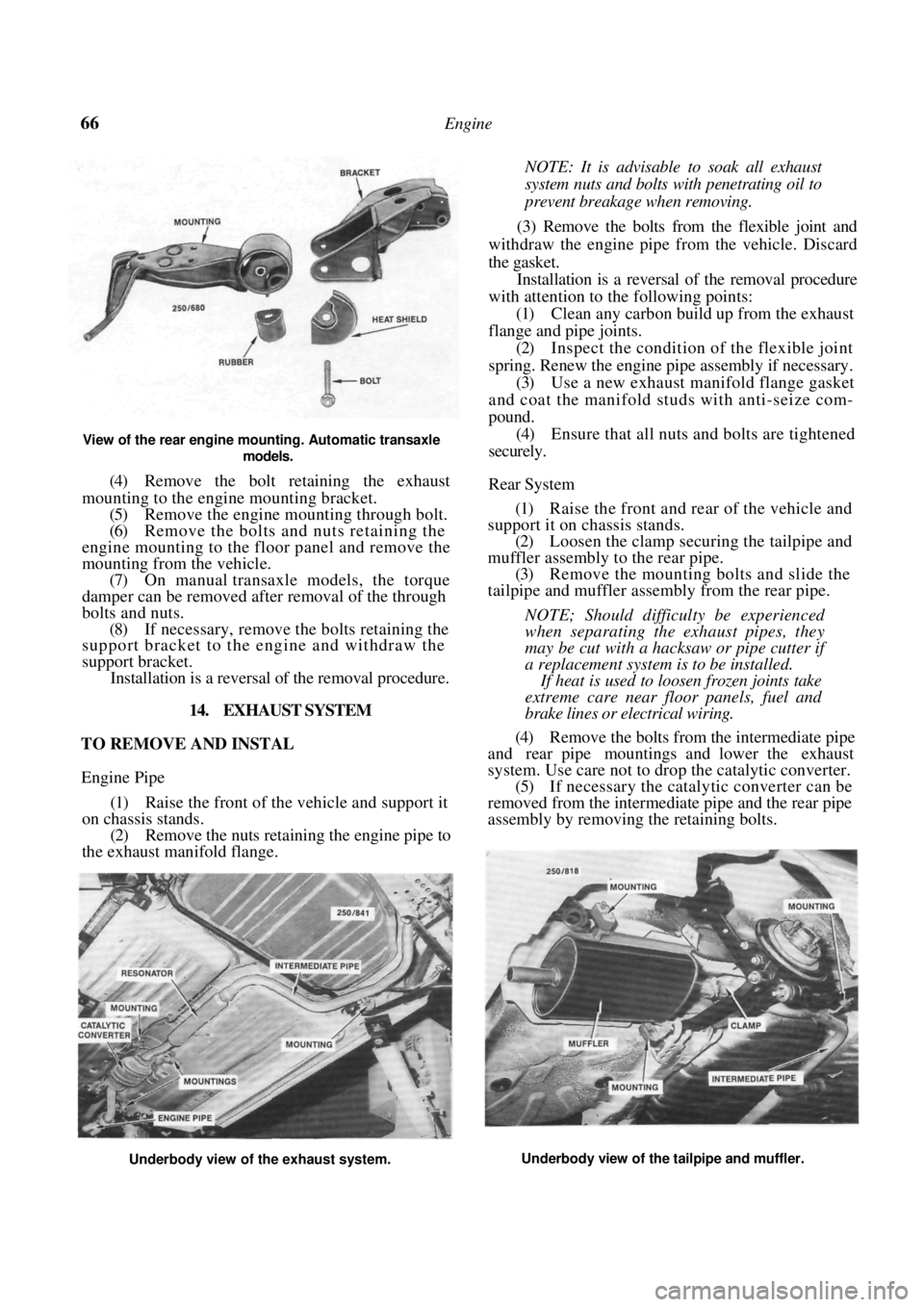
View of the rear engine mounting. Automatic transaxle models.
(4) Remove the bolt retaining the exhaust
mounting to the engine mounting bracket. (5) Remove the engine mounting through bolt.
(6) Remove the bolts and nuts retaining the
engine mounting to the floor panel and remove the
mounting from the vehicle.
(7) On manual transaxle models, the torque
damper can be removed after removal of the through
bolts and nuts. (8) If necessary, remove the bolts retaining the
support bracket to the engine and withdraw the
support bracket.
Installation is a reversal of the removal procedure.
14. EXHAUST SYSTEM
TO REMOVE AND INSTAL
Engine Pipe
(1) Raise the front of the vehicle and support it
on chassis stands. (2) Remove the nuts retaining the engine pipe to
the exhaust manifold flange.
NOTE: It is advisable to soak all exhaust
system nuts and bolts wi th penetrating oil to
prevent breakage when removing.
(3) Remove the bolts from the flexible joint and
withdraw the engine pipe from the vehicle. Discard
the gasket.
Installation is a reversal of the removal procedure
with attention to the following points:
(1) Clean any carbon build up from the exhaust
flange and pipe joints. (2) Inspect the condition of the flexible joint
spring. Renew the engine pipe assembly if necessary. (3) Use a new exhaust manifold flange gasket
and coat the manifold studs with anti-seize com-
pound. (4) Ensure that all nuts and bolts are tightened
securely.
Rear System
(1) Raise the front and rear of the vehicle and
support it on chassis stands. (2) Loosen the clamp securing the tailpipe and
muffler assembly to the rear pipe. (3) Remove the mounting bolts and slide the
tailpipe and muffler assembly from the rear pipe.
NOTE; Should difficulty be experienced
when separating the exhaust pipes, they
may be cut with a hacksaw or pipe cutter if
a replacement system is to be installed.
If heat is used to loosen frozen joints take
extreme care near floor panels, fuel and
brake lines or electrical wiring.
(4) Remove the bolts from the intermediate pipe
and rear pipe mountings and lower the exhaust
system. Use care not to drop the catalytic converter.
(5) If necessary the cataly tic converter can be
removed from the intermediate pipe and the rear pipe
assembly by removing the retaining bolts.
Underbody view of the exhaust system. Underbody view of the tailpipe and muffler.
Page 69 of 238
Cooling and Heating Systems 69
the cylinder head or cylinder block and renew the
cylinder head gasket.
(2) Crack in the cylinder head or cylinder block:
Repair or renew as necessary.
NOTE; Check the engine for internal leak-
age by withdrawing the dipstick and inspect-
ing for emulsified oil. Run the engine and
check for excessive steam at the exhaust
pipe which would indi cate coolant leakage
into the combustion chamber.
COOLANT LOSS BY OVERFLOW
(1) Overfull system: Drain the excess coolant
from the system.
(2) Faulty radiator cap: Renew the faulty cap.
(3) Blocked radiator core tubes: Clean or renew
the radiator core.
(4) Faulty thermostat: Renew the thermostat.
(5) Coolant foaming due to poor quality anti-
freeze or corrosion inhibitor: Drain the system and
renew the coolant and additive.
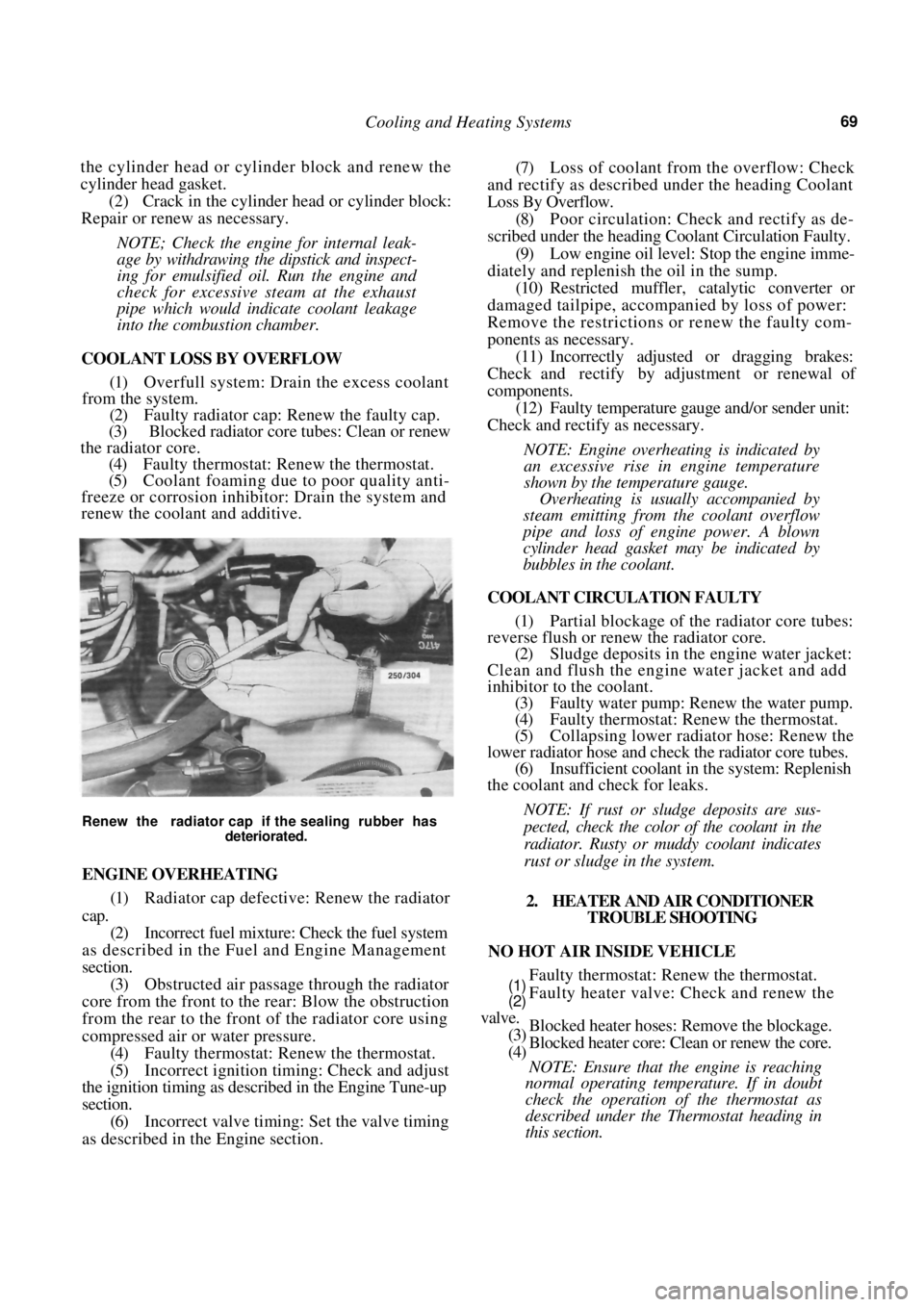
Renew the radiator cap if the sealing rubber has
deteriorated.
ENGINE OVERHEATING
(1) Radiator cap defective: Renew the radiator
cap.
(2) Incorrect fuel mixture: Check the fuel system
as described in the Fuel and Engine Management
section. (3) Obstructed air passage through the radiator
core from the front to the rear: Blow the obstruction
from the rear to the front of the radiator core using
compressed air or water pressure. (4) Faulty thermostat: Renew the thermostat.
(5) Incorrect ignition timing: Check and adjust
the ignition timing as described in the Engine Tune-up
section. (6) Incorrect valve timing: Set the valve timing
as described in th e Engine section.
(7) Loss of coolant from the overflow: Check
and rectify as described under the heading Coolant
Loss By Overflow.
(8) Poor circulation: Check and rectify as de-
scribed under the heading Coolant Circulation Faulty.
(9) Low engine oil level: Stop the engine imme-
diately and replenish the oil in the sump. (10) Restricted muffler, catalytic converter or
damaged tailpipe, accompanied by loss of power:
Remove the restrictions or renew the faulty com-
ponents as necessary.
(11) Incorrectly adjusted or dragging brakes:
Check and rectify by adjustment or renewal of
components. (12) Faulty temperature gauge and/or sender unit:
Check and rectify as necessary.
NOTE: Engine overheating is indicated by
an excessive rise in engine temperature
shown by the temperature gauge.
Overheating is usually accompanied by
steam emitting from the coolant overflow
pipe and loss of engine power. A blown
cylinder head gasket may be indicated by
bubbles in the coolant.
COOLANT CIRCULATION FAULTY
(1) Partial blockage of the radiator core tubes:
reverse flush or renew the radiator core.
(2) Sludge deposits in the engine water jacket:
Clean and flush the engine water jacket and add
inhibitor to the coolant. (3) Faulty water pump: Renew the water pump.
(4) Faulty thermostat: Renew the thermostat.
(5) Collapsing lower radiator hose: Renew the
lower radiator hose and check the radiator core tubes. (6) Insufficient coolant in the system: Replenish
the coolant and check for leaks.
NOTE: If rust or sludge deposits are sus-
pected, check the color of the coolant in the
radiator. Rusty or muddy coolant indicates
rust or sludge in the system.
2. HEATER AND AIR CONDITIONER TROUBLE SHOOTING
NO HOT AIR INSIDE VEHICLE
Faulty thermostat: Renew the thermostat.
Faulty heater valve: Check and renew the
Blocked heater hoses: Remove the blockage.
Blocked heater core: Clean or renew the core.
NOTE: Ensure that the engine is reaching
normal operating temperature. If in doubt
check the operation of the thermostat as
described under the Thermostat heading in
this section.
(1)
(2)
valve.
(3)
(4)
Page 70 of 238
70 Cooling and Heating Systems
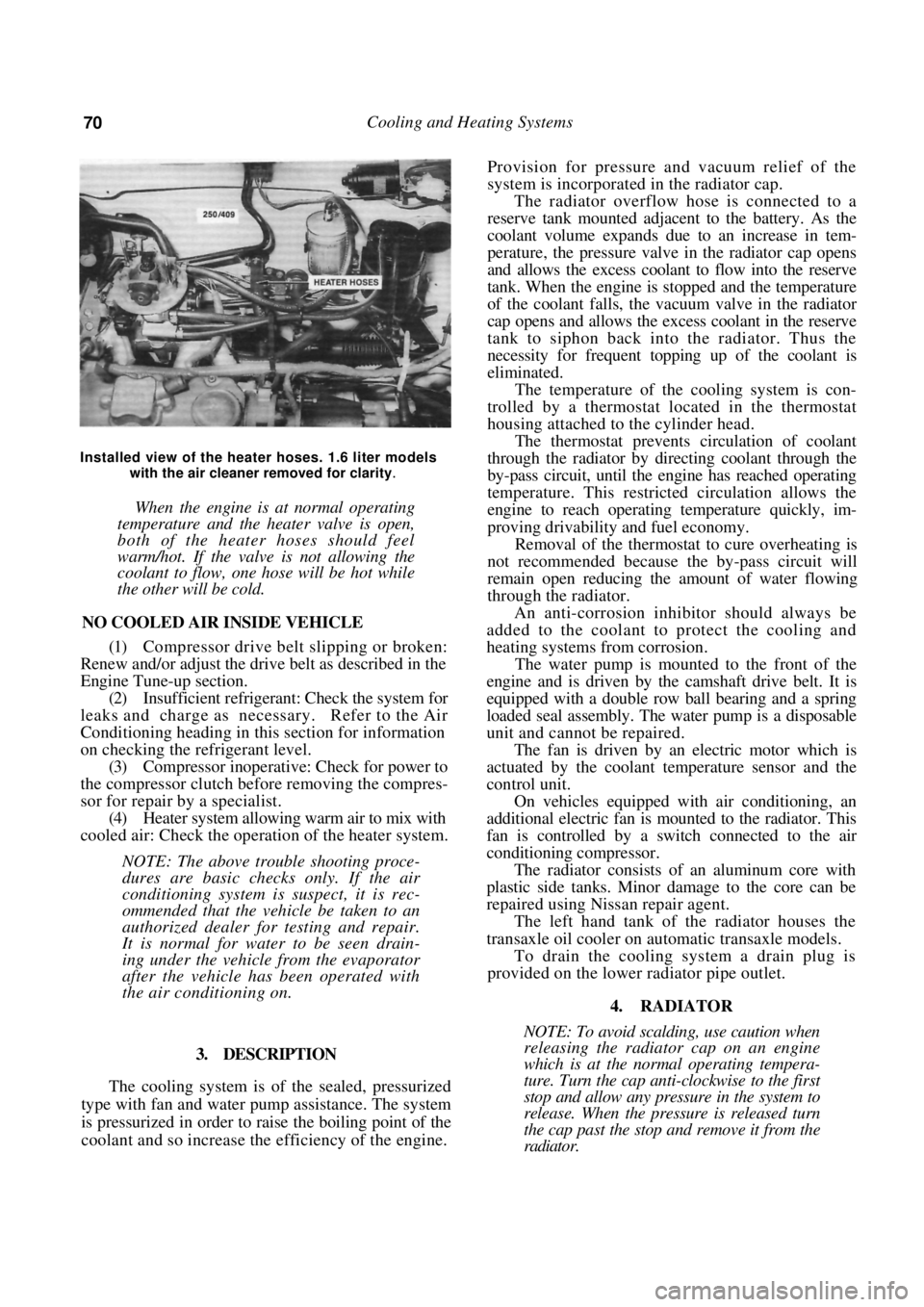
Installed view of the heater hoses. 1.6 liter models with the air cleaner removed for clarity
.
When the engine is at normal operating
temperature and the heater valve is open,
both of the heater hoses should feel
warm/hot. If the valve is not allowing the
coolant to flow, one hose will be hot while
the other will be cold.
NO COOLED AIR INSIDE VEHICLE
(1) Compressor drive belt slipping or broken:
Renew and/or adjust the drive belt as described in the
Engine Tune-up section.
(2) Insufficient refrigerant: Check the system for
leaks and charge as necessary. Refer to the Air
Conditioning heading in th is section for information
on checking the refrigerant level. (3) Compressor inoperative: Check for power to
the compressor clutch before removing the compres-
sor for repair by a specialist. (4) Heater system allowing warm air to mix with
cooled air: Check the operation of the heater system.
NOTE: The above trouble shooting proce-
dures are basic checks only. If the air
conditioning system is suspect, it is rec-
ommended that the vehicle be taken to an
authorized dealer for testing and repair.
It is normal for water to be seen drain-
ing under the vehicle from the evaporator
after the vehicle has been operated with
the air conditioning on.
3. DESCRIPTION
The cooling system is of the sealed, pressurized
type with fan and water pump assistance. The system
is pressurized in order to raise the boiling point of the
coolant and so increase the efficiency of the engine.
Provision for pressure a nd vacuum relief of the
system is incorporated in the radiator cap.
The radiator overflow hose is connected to a
reserve tank mounted adjacent to the battery. As the
coolant volume expands due to an increase in tem-
perature, the pressure valve in the radiator cap opens
and allows the excess coolant to flow into the reserve
tank. When the engine is stopped and the temperature
of the coolant falls, the vacuum valve in the radiator
cap opens and allows the excess coolant in the reserve
tank to siphon back into the radiator. Thus the
necessity for frequent topping up of the coolant is
eliminated.
The temperature of the cooling system is con-
trolled by a thermostat located in the thermostat
housing attached to the cylinder head.
The thermostat prevents circulation of coolant
through the radiator by directing coolant through the
by-pass circuit, until the engine has reached operating
temperature. This restricted circulation allows the
engine to reach operating temperature quickly, im-
proving drivability and fuel economy.
Removal of the thermostat to cure overheating is
not recommended because th e by-pass circuit will
remain open reducing the amount of water flowing
through the radiator.
An anti-corrosion inhibitor should always be
added to the coolant to protect the cooling and
heating systems from corrosion.
The water pump is mounted to the front of the
engine and is driven by the camshaft drive belt. It is
equipped with a double row ball bearing and a spring
loaded seal assembly. The water pump is a disposable
unit and cannot be repaired.
The fan is driven by an electric motor which is
actuated by the coolant temperature sensor and the
control unit.
On vehicles equipped with air conditioning, an
additional electric fan is m ounted to the radiator. This
fan is controlled by a sw itch connected to the air
conditioning compressor.
The radiator consists of an aluminum core with
plastic side tanks. Minor damage to the core can be
repaired using Nissan repair agent.
The left hand tank of the radiator houses the
transaxle oil cooler on automatic transaxle models.
To drain the cooling system a drain plug is
provided on the lower radiator pipe outlet.
4. RADIATOR
NOTE: To avoid scalding, use caution when
releasing the radiator cap on an engine
which is at the normal operating tempera-
ture. Turn the cap anti-clockwise to the first
stop and allow any pressure in the system to
release. When the pressure is released turn
the cap past the stop and remove it from the
radiator.
Page 74 of 238
74 Cooling and Heating Systems
NOTE: Refer to the Fuel and Engine Man-
agement section for the correct procedure for
backprobing the control unit.
(3) In operation (1) if the cooling fan is station-
ary proceed as follows:
(a) Connect a jumper lead between the terminals
A and B of the diagnostic link connector. (b) if the fan runs, the fan circuit is satisfactory.
If the engine is overheating check the coolant temper-
ature sensor as described in the Fuel and Engine
Management section under the appropriate codes. (c) If the fan does not run, check the fuse (6) and
the fusible link (4) show n on the illustration.
(d) Backprobe terminal C1 at the electronic
control unit using an LED t est lamp connected to the
positive battery terminal. If no circuit exists, renew
the electronic control unit. (e) If the fuse and fusible links are serviceable,
ensure that power is available at the white and pink
wires from the fuse and fusible link of the cooling fan
relay. Repair any faults in the wiring to that point if
necessary. (f) Switch the ignition Off. disconnect the
cooling fan wiring connector at the radiator and
connect power to the fan. Renew the fan if it does not
run.
(4) On air conditioned models, remove the
jumper lead from the ALDL connector if still in-
stalled, start the engine and allow it to idle. Switch the
air conditioning on and ensu re that the cooling fan
runs.
If the cooling fan is opera ting as described above
but cooling system problems still exist, refer to the
Trouble Shooting heading at the start of this section.
TO REMOVE AND INSTAL COOLING FAN
(1) Disconnect the negative battery terminal.
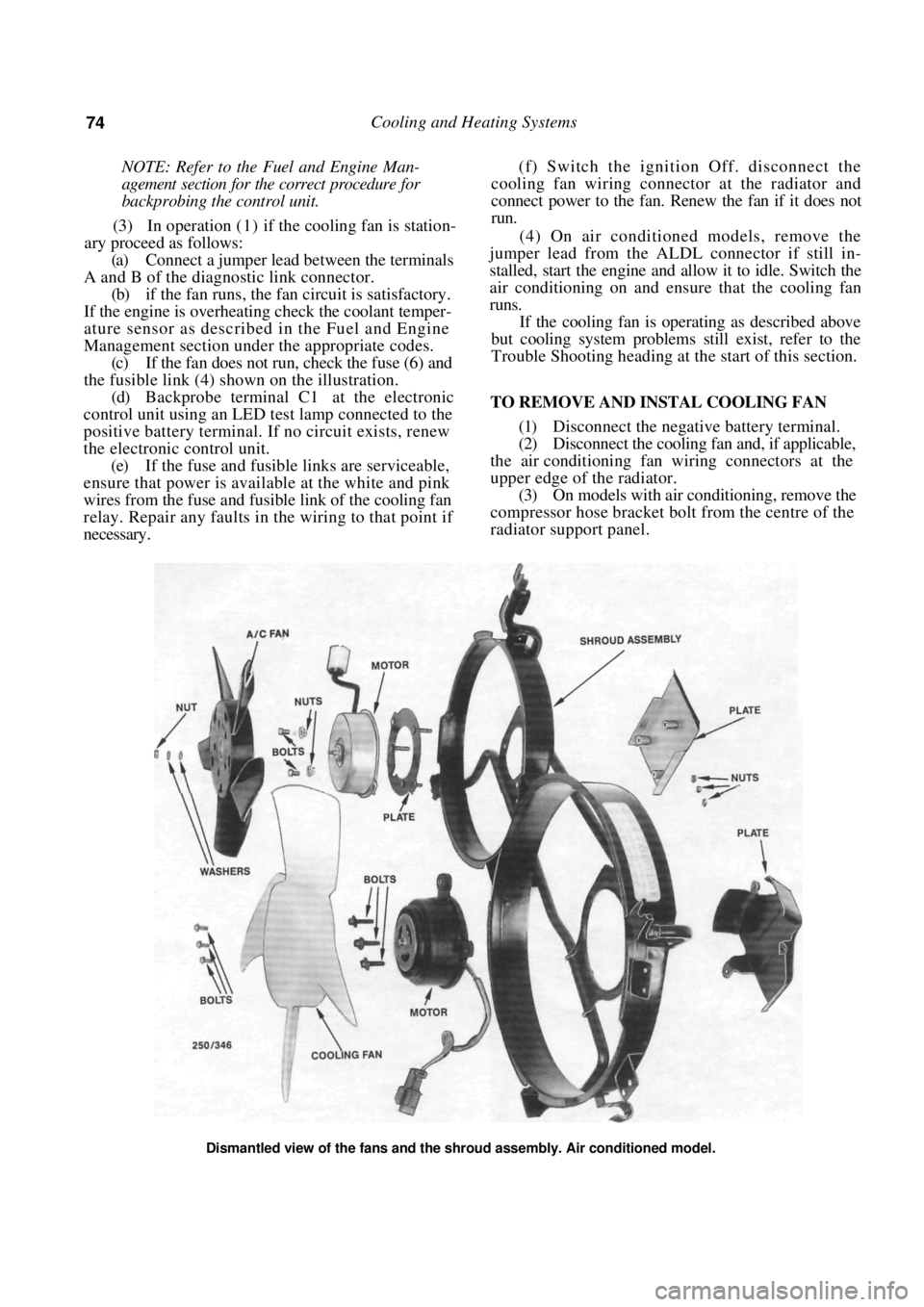
(2) Disconnect the cooling fa n and, if applicable,
the air conditioning fan wiring connectors at the
upper edge of the radiator. (3) On models with air conditioning, remove the
compressor hose bracket bolt from the centre of the
radiator support panel.
Dismantled view of the fans and the shroud assembly. Air conditioned model.
Page 75 of 238

Cooling and Heating Systems 75
(4) Remove the bolts retaining the fan shroud
assembly to the radiator and carefully move the
shroud assembly upwards and towards the engine to
release it from the lower mountings.
NOTE: On models with air conditioning, it
will be necessary to hold the air conditioning
compressor hoses toward s the engine to
allow clearance for removal of the shroud
assembly.
(5) If necessary, remove the fan from the fan
motor by removing the retaining bolts or on some
models the nut and washers.
(6) If necessary, remove the fan motor from the
shroud assembly by removing the retaining bolts or
nuts. Installation is a reversal of the removal procedure
with attention to the following points:
(1) Ensure all the fan motor and fan retaining
nuts and bolts are tightened securely. (2) Ensure that all the rubber mountings are in
good condition. Installation is a reversal of the removal procedure
with attention to the following points:
(1) Ensure that all sealing surfaces are clean.
(2) Renew the O ring on installation.
(3) Tighten the thermostat cover retaining bolts
securely.
(4) Fill the cooling system as previously de-
scribed ensuring that the heater control lever is in the
maximum heat position. Check for coolant leaks.
TO CHECK
NOTE: A visual examination of the thermo-
stat will often determine its serviceability
and make further testing unnecessary. For
instance, a thermostat with its valve fully-
open when removed from a cold engine is
obviously faulty and should be renewed.
Remove the thermostat from the thermostat
6. THERMOSTAT
Special Equipment Required:
To Check — Thermometer
TO REMOVE AND INSTAL
(1) Drain the cooling system as previously de-
scribed under the Radiator heading.
(2) On 1.6 liter models, remove the air cleaner
assembly. Refer to the Fuel and Engine Management
section if necessary. (3) Disconnect the top radiator hose from the
thermostat cover.
(4) Remove the bolts retaining the thermostat
cover to the thermostat housing. (5) Remove the thermostat cover, thermostat
and O ring from the thermostat housing.
NOTE: The thermostat and cover are ser-
viced as a unit and cannot be renewed
separately.
View of the thermostat removed from the vehicle and dismantled for testing. Line drawing showing the correct method to test the
thermostat.
(4) Progressively heat the mixture noting the
temperature reading on the thermometer as the ther-
mostat valve commences to open and when it is fully
open.
See the Specifications for opening and fully open
temperatures.
A thermostat which is not opening or is not open
at the specified temperatures should be renewed.
Page 76 of 238

Cooling and Heating Systems
7. THERMOSTAT HOUSING
Special Equipment Required:
To Adjust Camshaft Drive Belt — Adjusting tool
TO REMOVE AND INSTAL
(1) Disconnect the negative battery terminal.
(2) On 1.6 liter models, remove the air cleaner
assembly from the engine. Refer to the Fuel and
Engine Management section if necessary. (3) Drain the cooling system as previously de-
scribed. (4) Remove the camshaft drive belt as described
in the Engine section under the heading Camshaft
Drive Belt. (5) Remove the bolts retaining the camshaft
drive belt rear cover to the cylinder block and remove
the rear cover.
\ COOLANT TEMPERATURE SENSOR TEMPERATURE SENDER SWITCH
View of the thermostat housing and
components.
(6) Disconnect the top radi ator hose, the heater
hose and the inlet manifold heater hose from the
thermostat housing.
(7) Disconnect the wire from the temperature
sender switch and the coolant temperature sensor. (8) Remove the bolts retaining the thermostat
housing to the cylinder head and remove the thermo-
stat housing and the O ring from the cylinder head. Installation is a reversal of the removal procedure
with attention to the following points:
(1) Ensure that all mounting faces are clean.
(2) Renew the O ring on installation.
NOTE; Ensure that the O ring is not
twisted. Do not use sealant.
(3) Tighten the thermostat housing retaining
bolts to the specified torque. (4) Adjust the camshaft drive belt tension as
described in the Engine section under the heading
Camshaft Drive Belt. (5) Fill the cooling system as previously de-
scribed and check for coolant leaks. 8. WATER PUMP
Special Equipment Required:
To Adjust Camshaft Drive Belt — Adjusting tool
TO REMOVE AND INSTAL
NOTE: The water pump is non-repairable
and if faulty must be renewed as a complete
assembly.
(1)
Drain the cooling system as previously de-
scribed.
(2) Remove the camshaft drive belt as described
in the Engine section under the heading Camshaft
Drive Belt. (3) Remove the water pump retaining bolts and
remove the water pump and the O ring from the
engine. Installation is a reversal of the removal procedure
with attention to the following points:
View of the water pump and components removed
from the vehicle.
(1) Ensure that all mounting faces are clean.
(2) Use a new O ring and smear it with a liberal
amount of silicone grease.
(3) Install the water pump to the engine but
do
not tighten the retaining bolts until the camshaft drive
belt has been installed and tensioned correctly as
described in the Engine section under the heading
Camshaft Drive Belt.
(4) Fill the cooling system as previously de-
scribed in this section and check for coolant leaks.
9. WELCH PLUGS
To facilitate the casting of the cylinder block and
cylinder head passages and water jackets, a number of
openings had to be ma de at manufacture.
Page 82 of 238

82
FUEL AND ENGINE MANAGEMENT
CAUTION: To prevent severe electrical shock, extreme care must be taken when
working on or near the electronic ignition system as dangerous high tension voltages
are produced in both the primary and secondary circuits. See the text fo\
r
precautionary notes.
SPECIFICATIONS
FUEL INJECTION
Type:
1.6 liter engine .................................. Single point
1.8 liter engine................................... Multi point
FUEL PUMP
Type ................................................................ Electric
Pressure at idle:
1.6 liter engine ..................................... 62-90 kPa
1.8 liter engine ................................ 190-230 kPa
FUEL FILTER
Type ................................................ Inline, disposable
AIR FILTER
Type ................................... Disposable paper element
DISTRIBUTOR
Make ........................................................ Delco Remy
Advance contro l .......................................... Electronic
Rotation of rotor .................................. Anti-clockwise
Firing order....................................................1 -3-4-2
ADJUSTMENTS
Base idle speed ..................................... 550-650 rpm
Ignition timing.......................................... 10° BTDC
TORQUE WRENCH SETTINGS
Throttle body nuts.......................................... 10 Nm
*Throttle body bolts ........................................ 12 Nm
*Fuel hose fittings............................................ 35 Nm
Fuel rail bolts ....................................................8 Nm
Fuel tank drain plug ........................................ 24 Nm
Coolant temperature sensor ............................ 12 Nm
Oxygen sensor .................................................. 40 Nm
MAT sensor..................................................... 14 Nm
*1.6 liter engine
l . 8 liter engine
1. FUEL AND ENGINE MANAGEMENT
TROUBLE SHOOTING
NOTE: The following Trouble Shooting pro-
cedures are basic checks only. If these pro-
cedures fail to locate the fault, refer to the
System Diagnosis and Adjustments heading
for more thorough testing.
Prior to performing any of the following
operations, refer to the Service Precautions
and Procedures heading.
ENGINE WILL NOT START OR HARD TO
START
(1) Water in the fuel: Dr ain the fuel from the
system and renew the fuel filter.
(2) Fault in the power supply: Check the battery,
fusible links and fuses. Check for clean, secure con-
nections, particularly the earth connections. Check the
EG1 and fuel pump relays.
NOTE: If the fuel pump relay fails, power
will be supplied to the fuel pump via the oil
pressure switch. When starting the engine,
Check that the MAP sensor hose is not blocked or split
and ensure that all electrical connections are clean and
secure.
Page 83 of 238

Fuel and Engine Management 83
the fuel pump will not operate until the oil
pressure is sufficient to extinguish the oil
pressure warning lamp. Therefore it will be
necessary to operate the starter motor for a
longer period than usual to start the engine.
(3) Faulty EFI component wiring connections:
Check that all component wiring connections are
clean and secure.
(4) Manifold absolute pressure (MAP) sensor
vacuum hose blocked or disconnected: Clear or recon-
nect the vacuum hose. (5) Fault in the ignition system: Check the
primary and secondary ignition circuits.
(6) Engine flooded: Fully depress the throttle
pedal until the engine starts. Check the coolant
temperature sensor. Check th e injector(s) for leakage.
ENGINE STARTS THEN STALLS
(1) Water in the fuel: Dr ain the fuel from the
system and renew the fuel filter.
(2) Air leakage at the inlet manifold: Check all
joints and hoses for air leaks. (3) Faulty EFI wiring connections: Check that
all component wiring connections are clean and
secure.
(4) Ignition timing incorrectly set: Check and
adjust the timing. (5) MAP sensor faulty or supply hose discon-
nected or blocked: Check the vacuum supply hose.
Check the operation of the MAP sensor.
ENGINE MISFIRES
(1) Faulty, dirty or incorrectly adjusted spark
plugs: Renew or clean and adjust the spark plugs.
(2) Condensation in the distributor cap: Dry and
examine the cap for cracks. (3) Faulty high tension leads: Check and renew
the high tension leads.
Testing the fuel system pressure using a pressure
gauge.
(4) Faulty ignition coil: Check and renew the
ignition coil.
(5) Fuel blockage: Check for blockage in the fuel
filter, lines and injector(s). (6) Low fuel pressure: Check the fuel pump and
fuel pressure regulator. (7) Water in the fuel: Dr ain the fuel from the
system and renew the fuel filter. (8) Loose fuel supply wiring connectors: Check
all connectors for tightness. (9) Faulty fuel injector: Check the connections
and test the condition of the fuel injectors.
ENGINE LACKS POWER
(1) Ignition timing incorrectly set: Check and
adjust the timing.
(2) Water in the fuel: Dr ain the fuel from the
system and renew the fuel filter.
(3) Incorrectly adjusted throttle cable: Adjust the
throttle cable.
Check the distributor cap for cracks or tracking be- tween the terminals. The air filter element should be renewed at 40 000 km
intervals. 1.8 liter engine.
Page 84 of 238
Fuel and Engine Management
(4) MAP sensor faulty or supply hose discon-
nected or blocked: Check the vacuum supply hose.
Check the operation of the MAP sensor.
EXCESSIVE FUEL CONSUMPTION
(1) Blocked air cleaner element: Check the ele-
ment and clean or renew as necessary.
(2) Incorrect fuel pressure: Check the fuel pump
and fuel pressure regulator. (3) Faulty coolant temperature sensor: Check
the connections and operation.
(4) Leaks in the fuel supply system: Check the
connections and components for leakage. (5) Leaking fuel injector(s): Clean or renew the
faulty injector(s). (6) Engine operating temperature too low:
Check the thermostat and electric cooling fan as
described in the Cooling an d Heating Systems section.
2. DESCRIPTION
The engine management system on the range of
vehicles covered by this manual controls the opera-
tion of the ignition system and the fuel system.
The central component of the engine management
system is the electronic control unit (ECU). The con-
trol unit is a micro-computer which controls the igni-
tion timing and the amount of fuel injected according
to signals received from various sensors. As changes
are detected in engine load and speed, coolant tem-
perature, barometric pressure, air temperature (1.8
liter engine), throttle position and vehicle speed, the
control unit alters the ignition timing and the fuel
injection amount to achieve optimum engine effi-
ciency.
The control unit incorporates a self diagnosis
mode which stores and displays codes relating to
certain system malfunctions. Whenever power is sup-
plied to the control unit, the control unit performs a
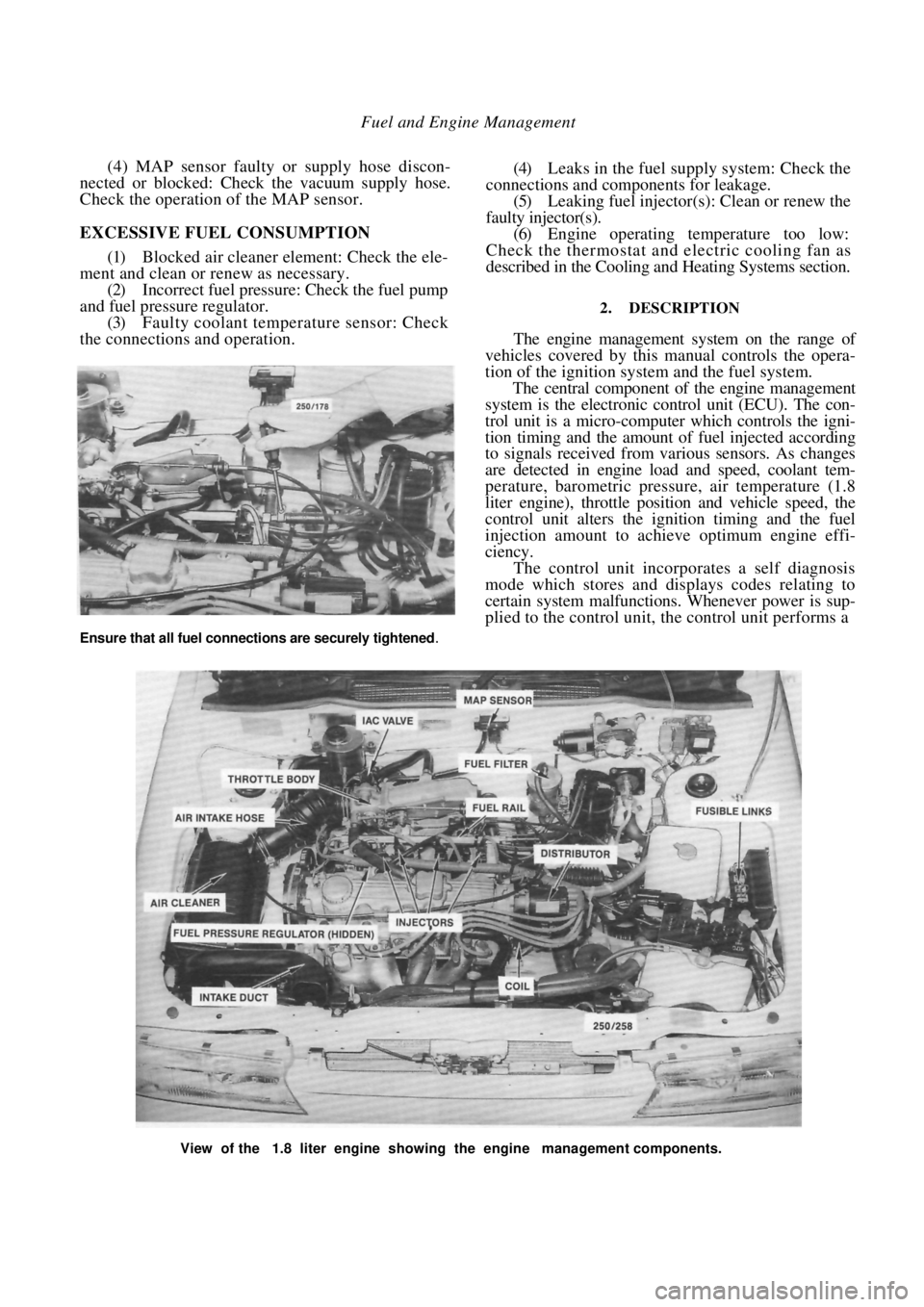
View of the 1.8 liter engine showing the engine management components.
Ensure that all fuel connections are securely tightened.
Page 85 of 238

Fuel and Engine Management 85
View of the 1.6 liter engine showing the engine management components. Air cleaner removed for clarity.
series of tests on various components in the system
and records the results, If a fault is discovered, the
ECM warning lamp on the instrument cluster will
illuminate while the engine is running. When the self
diagnosis mode is activated, the ECM warning lamp
will flash codes indicating the area in which the fault
has occurred.
This function is very useful in locating system
faults, particularly intermittent problems. However,
the self diagnosis mode does not provide comprehen-
sive testing of the EFI system, and therefore should
always be used in conjunction with the other test
procedures described later in this section in order to
accurately locate system faults.
The high energy electronic ignition system con-
sists of a distributor and an ignition coil.
The distributor has two functions. The first is to
produce and distribute secondary high tension voltage
to the spark plugs.
The second function is to provide the control unit
with information on engine speed and crankshaft
position.
The ignition timing is constantly adjusted by the
control unit to suit varying engine and vehicle oper-
ating conditions.
In the fuel injection system, a metered amount of
fuel is sprayed into the air stream. The air/fuel
mixture then enters the combustion chamber via the
inlet valves.
On 1.6 liter engines, the fuel is injected by a single
injector, located above the throttle valve within the
throttle body assembly. The injector fires twice per
engine revolution under most operating conditions.
On 1.8 liter engines, four injectors are used. The
fuel is distributed to the injectors via the fuel rail. All
injectors fire simultaneous ly once per engine revolu-
tion under most operating conditions.
Under conditions of high load the control unit
may signal the injector(s) to fire more often. However,
if the engine speed exceeds 6 700 rpm the control unit
will cease firing the injectors until the engine speed is
below 6 200 rpm.
Fuel is supplied under pressu re by an electric fuel
pump mounted in the fuel tank and the pressure is
regulated by a pressure regulator.
On 1.6 liter engines, the regulator consists of a
spring tensioned diaphragm which is mounted to the
side of the throttle body assembly. The fuel pressure is
regulated by the tension of the spring against the
diaphragm, opening and closing the fuel return port.
On 1.8 liter engines, the pressure regulator is
mounted adjacent to the fuel rail and consists of a
diaphragm with fuel pressu re acting on one side and
spring tension and manifold vacuum acting on the