ACC NISSAN QASHQAI 2012 User Guide
[x] Cancel search | Manufacturer: NISSAN, Model Year: 2012, Model line: QASHQAI, Model: NISSAN QASHQAI 2012Pages: 297, PDF Size: 4.09 MB
Page 34 of 297
Downloaded from www.Manualslib.com manuals search engine forces in another type of collision are similar to those
of a higher severity side impact. They are designed
to inflate on the side where the vehicle is impacted.
They may not inflate in certain side collisions. Ve-
hicle damage (or lack of it) is not always an indica-
tion of proper supplemental side air bag operation.
When the supplemental side air bag and curtain air
bag inflate, a fairly loud noise may be heard, fol-
lowed by a release of smoke. This smoke is not
harmful and does not indicate a fire. However, care
should be taken not to inhale it, as it may cause irri-
tation and choking. Occupants with a history of
breathing difficulties, such as asthma, should get
fresh air promptly.
Supplemental side air bags, along with the use of
seat belts, help to cushion the impact force on the
chest of the front occupants. Curtain air bags help
to cushion the impact force to the head of occu-
pants in the front and rear outer seating positions.
They can help save lives and reduce serious inju-
ries. However, an inflating side air bag and curtain
air bag may cause abrasions or other injuries.
Supplemental side air bags and curtain air bags do
not provide restraint to the lower body.
The seat belts should be correctly worn and the
driver and passenger seated upright, and as far as
is practical, away from the side air bag. Rear seat
passengers should be seated as far away as practi-
cal from the door finishers and side roof rails. The
side air bags and curtain air bags inflate quickly in
order to help protect the front occupants. Because
of this, the force of the side air bag and curtain air
bag inflating can increase the risk of injury if theoccupant is too close to, or is against, these air bag
modules during inflation. The side air bag and cur-
tain air bag will deflate quickly after the collision is
over.
WARNING
Directly after inflation, several air bag system
components will be hot. Do not touch them;
you may severely burn yourself.
No unauthorised changes should be made to
any components or wiring of the air bag sys-
tem. This is to prevent accidental inflation of
the air bag or damage to the air bag system.
Tampering with the air bag system may result
in serious personal injury. Tampering includes
making changes to the steering wheel and
the instrument panel assembly by placing ma-
terial over the steering pad and above the
dashboard, or by installing additional trim ma-
terial around the air bag system.
Do not attach any objects to the steering
wheel pad or to the instrument panel. Objects
attached to the steering wheel pad and in-
strument panel may become dangerous pro-
jectiles and cause injury if the air bag inflates.
Work on and around the air bag system should
be done by a NISSAN dealer or qualified work-
shop. Installation of electrical equipment
should be done by a NISSAN dealer or quali-
fied workshop. The yellow SRS wiring har-
nesses* should not be modified or discon-
nected. Unauthorised electrical test equip-
ment and probing devices should not be used
on the air bag system.
* SRS wiring harnesses are covered with yellow insulation either just before the harness con-
nectors or on the complete harness, for easy
identification.
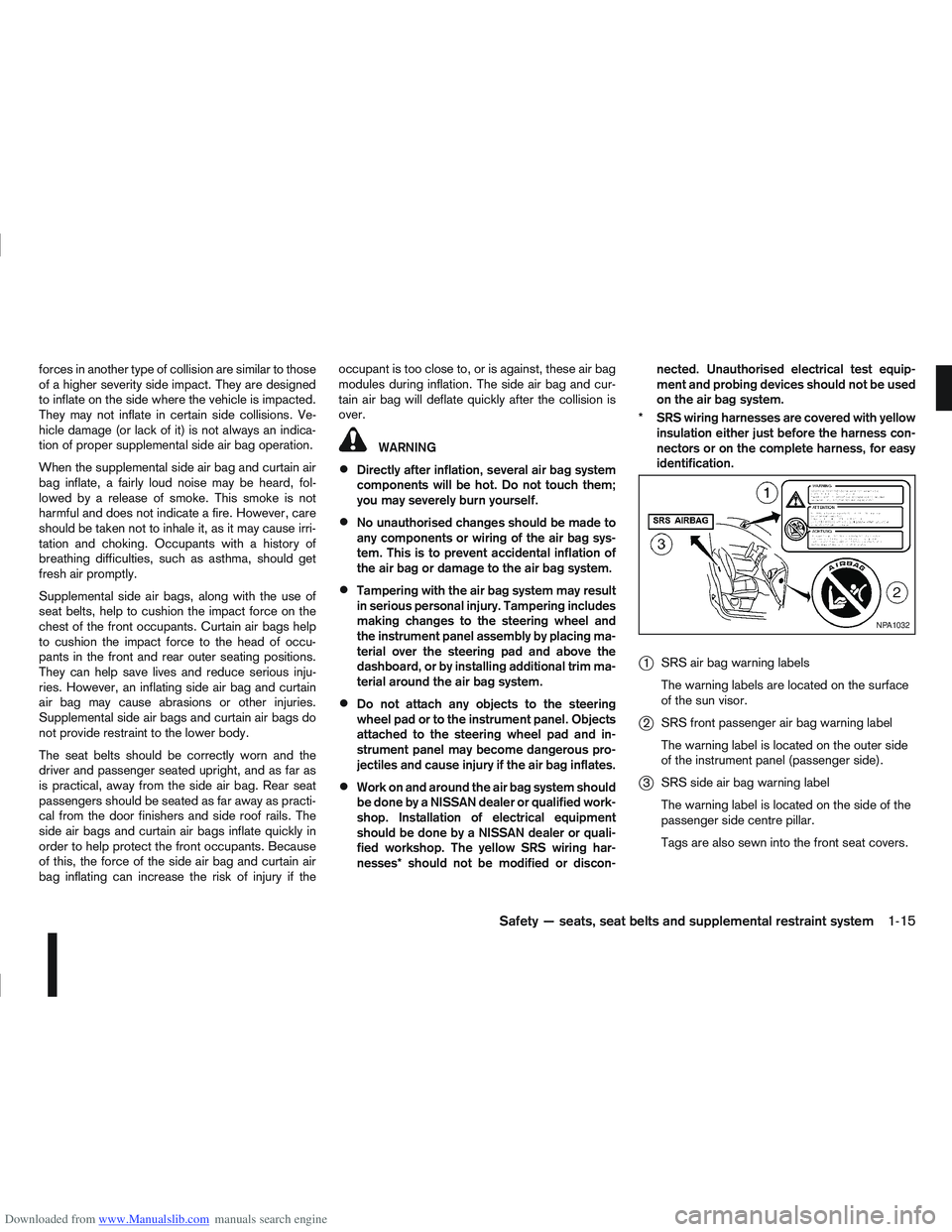
j1 SRS air bag warning labels
The warning labels are located on the surface
of the sun visor.
j2SRS front passenger air bag warning label
The warning label is located on the outer side
of the instrument panel (passenger side).
j3SRS side air bag warning label
The warning label is located on the side of the
passenger side centre pillar.
Tags are also sewn into the front seat covers.
NPA1032
Safety — seats, seat belts and supplemental restraint system1-15
Page 35 of 297
Downloaded from www.Manualslib.com manuals search engine AIR BAG WARNING LABELS
Warning labels about the air bag system are placed
in the vehicle. Warning labels are for your safety and
the safety of your passengers; do not remove them.
Child restraint on front passenger seat
NISSAN recommends that infants or small children
be seated in a child restraint system on the rear seat
if available. According to accident statistics, chil-
dren are safer when properly restrained in the rear
seat rather than in the front seat.
Front passenger air bag:
Your vehicle is equipped with a front passenger air
bag, you will find an air bag warning label attached
to the passenger side of the instrument panel as
shown in the previous illustration.
This label warns:
“Extreme Hazard! Do not use a rearward facing
child restraint on a seat protected by an air bag
in front of it!”
This label warns NOT to fit a rearward facing child
restraint on the front passenger seat without first
deactivating the front passenger air bag.
For instructions on deactivating the front passenger
air bag see “Front passenger air bag deactivation
system” later in this section.
When installing child restraints in your vehicle, al-
ways carefully observe the manufacturer’s instruc-
tions.For more details on the installation of child restraints,
see also “Child restraints” later in this section.
Side air bags:
Your vehicle is equipped with side air bags. You will
find a side air bag warning label attached to the
vehicle’s interior as shown in the previous illustra-
tion.
This label warns you not to let infants or small chil-
dren sit on the front passenger seat as the air bag
may cause serious injury in case of deployment dur-
ing a collision.
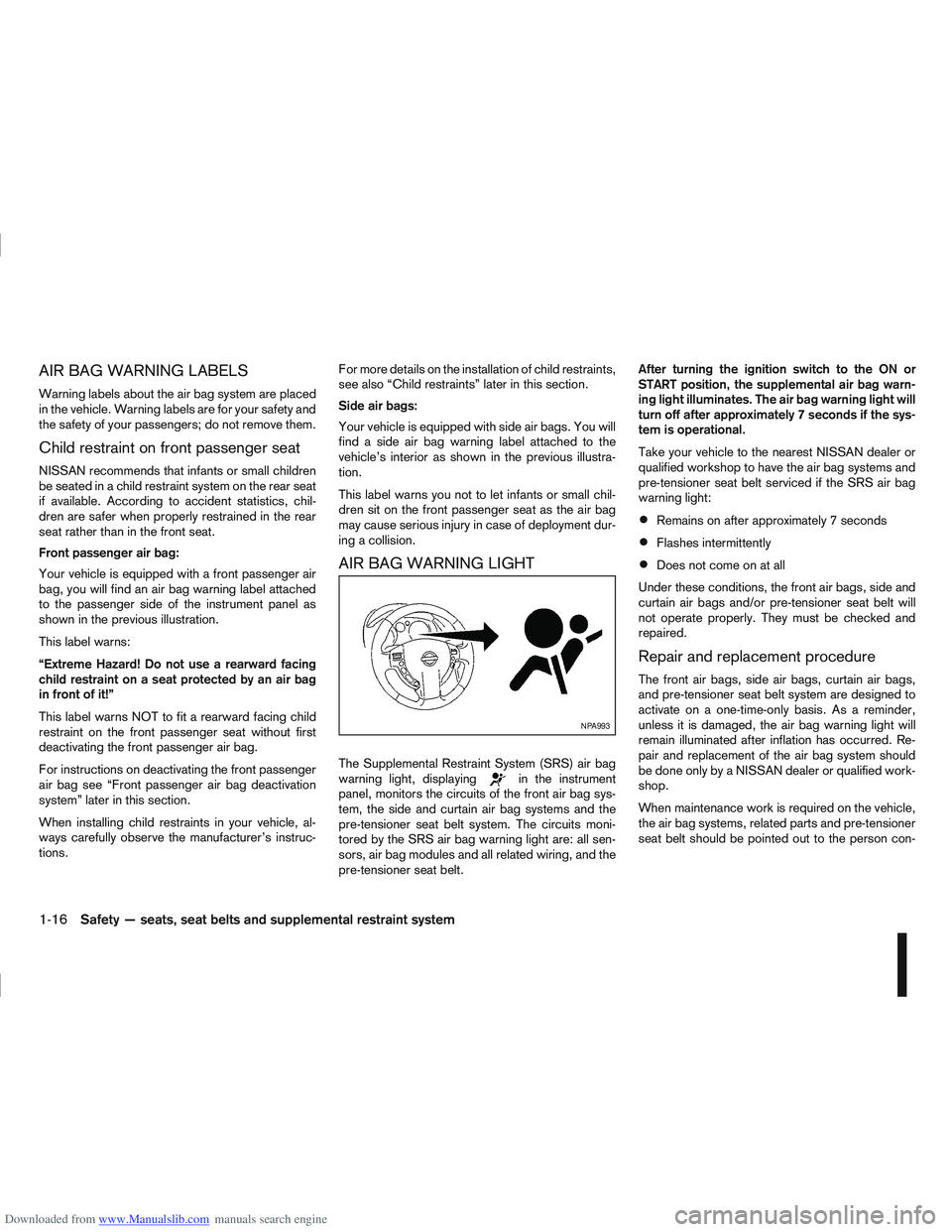
AIR BAG WARNING LIGHT
The Supplemental Restraint System (SRS) air bag
warning light, displayingin the instrument
panel, monitors the circuits of the front air bag sys-
tem, the side and curtain air bag systems and the
pre-tensioner seat belt system. The circuits moni-
tored by the SRS air bag warning light are: all sen-
sors, air bag modules and all related wiring, and the
pre-tensioner seat belt. After turning the ignition switch to the ON or
START position, the supplemental air bag warn-
ing light illuminates. The air bag warning light will
turn off after approximately 7 seconds if the sys-
tem is operational.
Take your vehicle to the nearest NISSAN dealer or
qualified workshop to have the air bag systems and
pre-tensioner seat belt serviced if the SRS air bag
warning light:
Remains on after approximately 7 seconds
Flashes intermittently
Does not come on at all
Under these conditions, the front air bags, side and
curtain air bags and/or pre-tensioner seat belt will
not operate properly. They must be checked and
repaired.
Repair and replacement procedure
The front air bags, side air bags, curtain air bags,
and pre-tensioner seat belt system are designed to
activate on a one-time-only basis. As a reminder,
unless it is damaged, the air bag warning light will
remain illuminated after inflation has occurred. Re-
pair and replacement of the air bag system should
be done only by a NISSAN dealer or qualified work-
shop.
When maintenance work is required on the vehicle,
the air bag systems, related parts and pre-tensioner
seat belt should be pointed out to the person con-
NPA993
1-16Safety — seats, seat belts and supplemental restraint system
Page 37 of 297
Downloaded from www.Manualslib.com manuals search engine cal key (Intelligent Key models)” later in this sec-
tion) in the front passenger air bag switch on the
side of the dashboard, press then turn the key to
the OFF position.
3. Turn the ignition switch to the ON position and make sure the front passenger air bag indicator
light
remains illuminated.
The
indicator light remains continuously illumi-
nated to warn you of front passenger air bag status.
See “Child restraints” later in this section for child
seat appropriate fitting.
Activating the front passenger air bag
You should reactivate the front passenger air bag
system as soon as the child restraint is not in use on
the front passenger seat to ensure protection of the
front passenger seat occupant in the event of an
impact.
To reactivate the front passenger air bag system:
1. With the ignition switch in the LOCK position and the engine off, open the front passenger
door.
2. Insert the ignition key/emergency key (Intelligent Key equipped models) in the front passenger air
bag switch and turn the key to the ON position.
3. Turn the ignition switch to the ON position and make sure the front passenger air bag indicator
light
illuminates for a few seconds and then
turns off.
WARNING
If any of the following conditions occur after the
ignition switch has been turned to the ON posi-
tion, the front passenger air bag system needs
servicing and your vehicle must be taken to the
nearest NISSAN dealer or qualified workshop.
The front passenger air bag indicator light
comes on and remains illuminated after ap-
proximately 7 seconds while the front pas-
senger air bag switch is ON.
The front passenger air bag indicator light
does not come on at all while the front pas-
senger air bag switch is ON.
Unless checked and repaired, the front passenger
air bag system may not function properly.
PRECAUTIONS ON CHILD
RESTRAINT USAGE
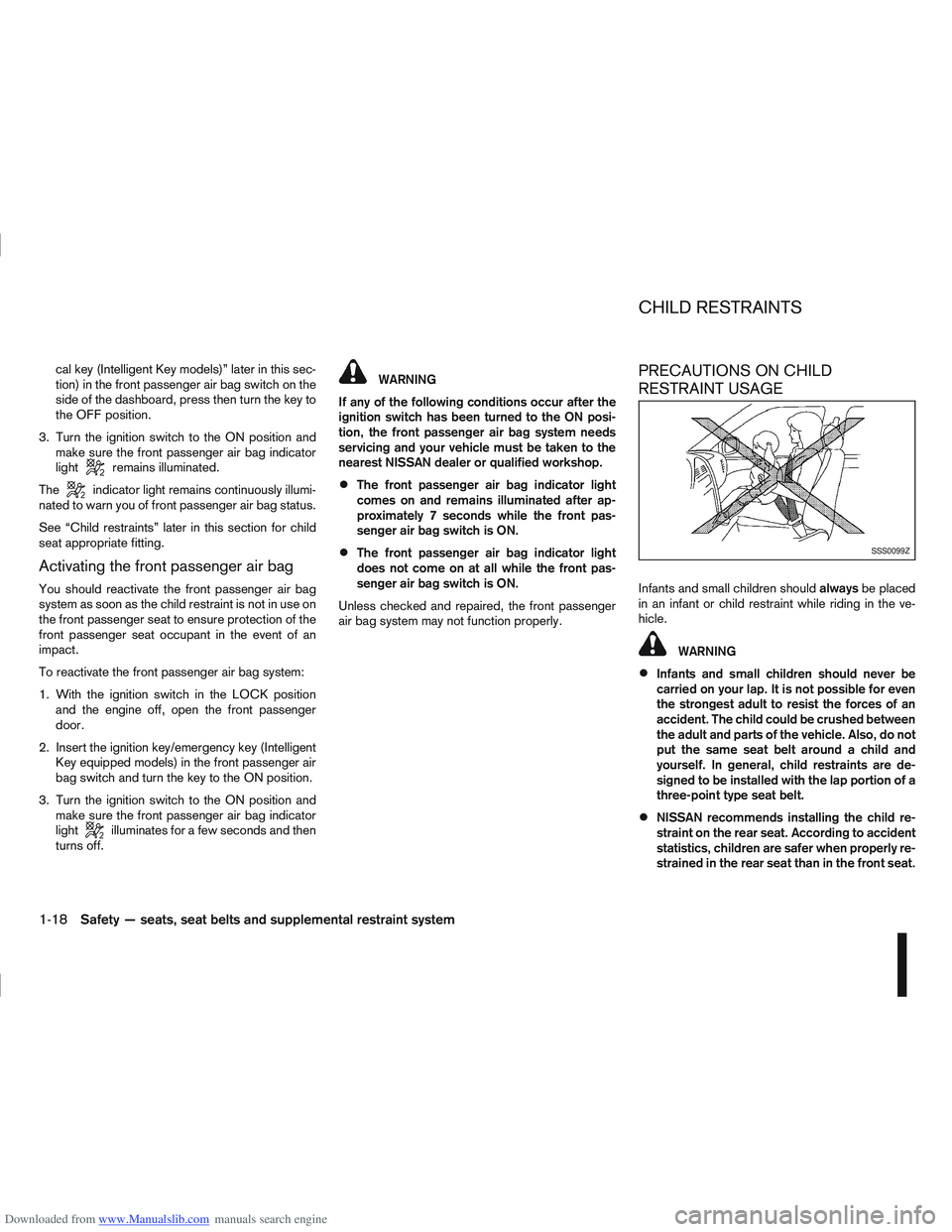
Infants and small children should alwaysbe placed
in an infant or child restraint while riding in the ve-
hicle.
WARNING
Infants and small children should never be
carried on your lap. It is not possible for even
the strongest adult to resist the forces of an
accident. The child could be crushed between
the adult and parts of the vehicle. Also, do not
put the same seat belt around a child and
yourself. In general, child restraints are de-
signed to be installed with the lap portion of a
three-point type seat belt.
NISSAN recommends installing the child re-
straint on the rear seat. According to accident
statistics, children are safer when properly re-
strained in the rear seat than in the front seat.
SSS0099Z
CHILD RESTRAINTS
1-18Safety — seats, seat belts and supplemental restraint system
Page 38 of 297
Downloaded from www.Manualslib.com manuals search engine An improperly installed child restraint could
lead to serious injury in an accident.
Child restraints specially designed for infants and
small children are offered by several manufacturers.
When selecting any child restraint, keep the follow-
ing points in mind:
Choose a child restraint that complies with the
latest European safety standard, ECE Regula-
tion 44.04.
Place your child in the child restraint and check
the various adjustments to be sure that the child
restraint is suitable for your child. Always follow
all of the recommended procedures.
Check the child restraint in your vehicle to be
sure it is compatible with the vehicle’s seat belt
system.
Refer to the tables further on in this section for a
list of the recommended fitment positions and
the approved child restraint for your vehicle.
WARNING
Never install a rear facing child restraint in the
front seat without first deactivating the front
passenger air bag.
Adjustable seatbacks should be positioned to
fit the child seat; however, the seatback
should be as upright as possible.
Follow all of the child restraint manufacturer’s
instructions for installation and use.
Choose a child restraint appropriate to the
child and the vehicle. It may not be possible
to properly install some types of child restraint
in your vehicle.
Improper use of a child restraint can increase
injuries to the infant or child and other occu-
pants in the vehicle.
When your child restraint is not in use, keep it
secured with a seat belt to prevent it from
being thrown forwards in case of a sudden
stop or accident.
Remember that a child restraint left in a closed
vehicle can become very hot. Check the seat-
ing surface and buckles before placing your
child in the child restraint.
After attaching a child restraint, test the seat
before you place the child in it. Check that it
does not tilt too far from side to side. Try to
tug it forwards and check whether the belt
holds it in place. If the restraint is not secure,
tighten the belt as necessary, or put the re-
straint in another seat and test it again.
If the child restraint is not anchored properly,
the risk of a child being injured in a collision
or sudden stop greatly increases.
The front passenger seat should be
positioned to fit the child seat appropriately.
See “Installation of a child restraint system on
the front passenger seat” later in this section.
For a front facing child restraint installed on a
three-point type lap/shoulder belt, make sure the shoulder belt does not go in front of the
child’s face or neck. If it does, put the shoul-
der belt behind the child restraint.
If the child restraint is equipped with a locking
clip, ensure that the clip is securely fastened
to the vehicle seat belt. If the locking clip is
not used, injuries could result from the child
restraint tipping over during normal vehicle
braking or cornering.
Safety — seats, seat belts and supplemental restraint system1-19
Page 41 of 297
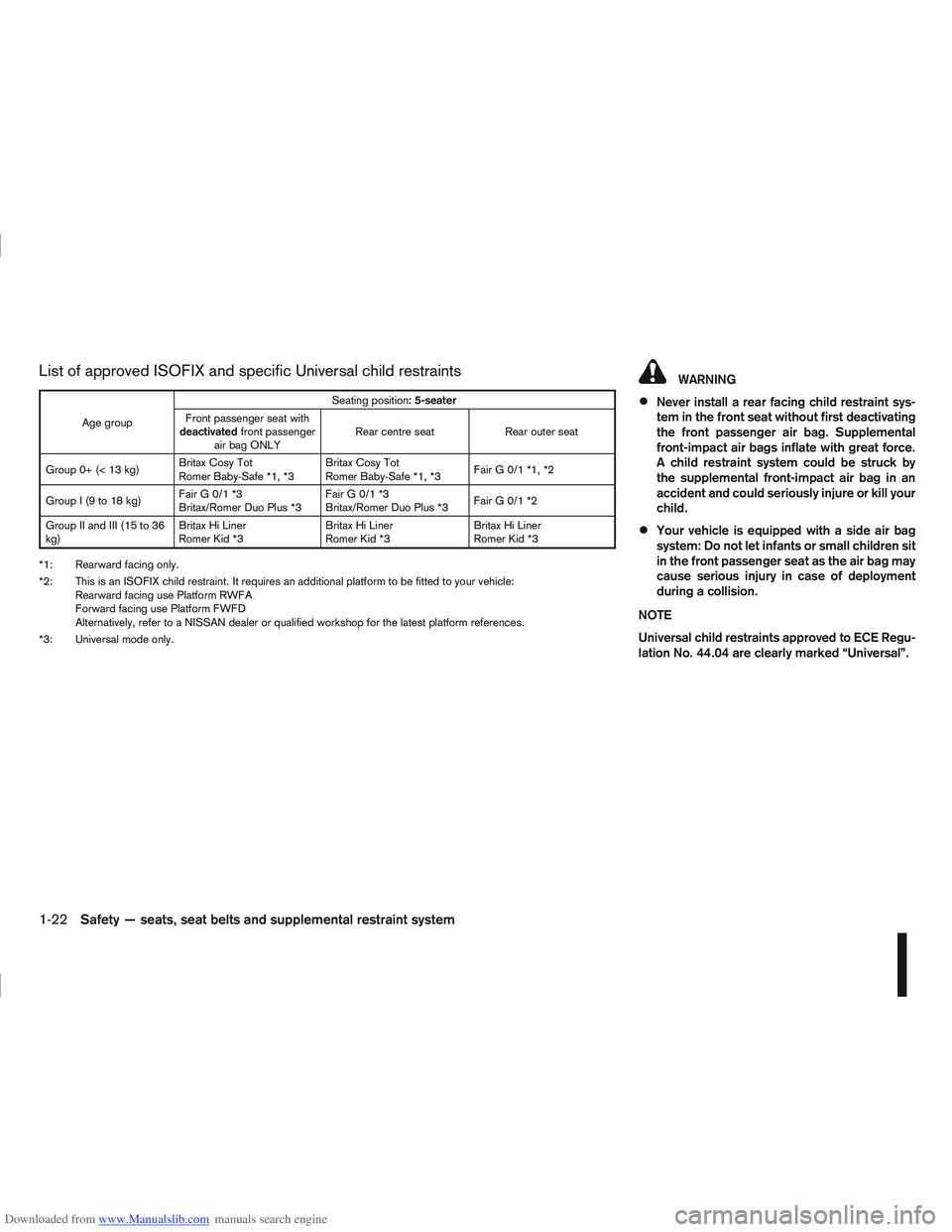
Downloaded from www.Manualslib.com manuals search engine List of approved ISOFIX and specific Universal child restraintsWARNING
Never install a rear facing child restraint sys-
tem in the front seat without first deactivating
the front passenger air bag. Supplemental
front-impact air bags inflate with great force.
A child restraint system could be struck by
the supplemental front-impact air bag in an
accident and could seriously injure or kill your
child.
Your vehicle is equipped with a side air bag
system: Do not let infants or small children sit
in the front passenger seat as the air bag may
cause serious injury in case of deployment
during a collision.
NOTE
Universal child restraints approved to ECE Regu-
lation No. 44.04 are clearly marked “Universal”.
Age group Seating position
: 5-seater
Front passenger seat with
deactivated front passenger
air bag ONLY Rear centre seat
Rear outer seat
Group 0+ (< 13 kg) Britax Cosy Tot
Romer Baby-Safe *1, *3 Britax Cosy Tot
Romer Baby-Safe *1, *3
Fair G 0/1 *1, *2
Group I (9 to 18 kg) Fair G 0/1 *3
Britax/Romer Duo Plus *3 Fair G 0/1 *3
Britax/Romer Duo Plus *3
Fair G 0/1 *2
Group II and III (15 to 36
kg) Britax Hi Liner
Romer Kid *3 Britax Hi Liner
Romer Kid *3 Britax Hi Liner
Romer Kid *3
*1: Rearward facing only.
*2: This is an ISOFIX child restraint. It requires an additional platform to be fitted to your vehicle: Rearward facing use Platform RWFA
Forward facing use Platform FWFD
Alternatively, refer to a NISSAN dealer or qualified workshop for the latest platform references.
*3: Universal mode only.
1-22Safety — seats, seat belts and supplemental restraint system
Page 42 of 297
Downloaded from www.Manualslib.com manuals search engine INSTALLATION OF A CHILD
RESTRAINT SYSTEM ON THE FRONT
PASSENGER SEAT
WARNING
Never install a rear facing child restraint sys-
tem in the front seat without first deactivating
the front passenger air bag. Supplemental
front-impact air bags inflate with great force.
A child restraint system could be struck by
the supplemental front-impact air bag in an
accident and could seriously injure or kill your
child.
NISSAN recommends that infants or small
children be seated in a child restraint system
in the rear seat. According to accident statis-
tics, children are safer when properly
restrained in the rear seat than in the front
seat.
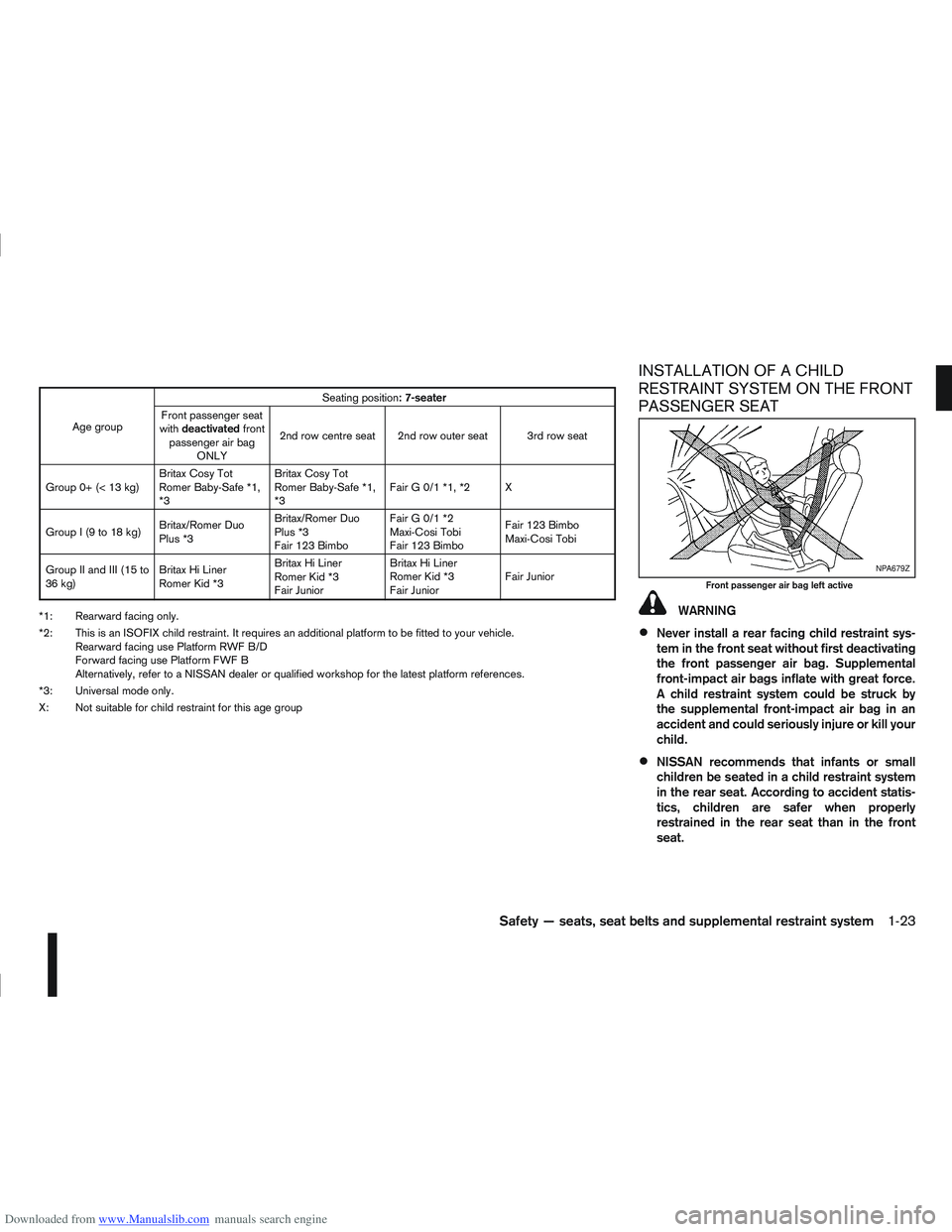
Age groupSeating position
: 7-seater
Front passenger seat
with deactivated front
passenger air bag ONLY 2nd row centre seat 2nd row outer seat 3rd row seat
Group 0+ (< 13 kg) Britax Cosy Tot
Romer Baby-Safe *1,
*3 Britax Cosy Tot
Romer Baby-Safe *1,
*3
Fair G 0/1 *1, *2 X
Group I (9 to 18 kg) Britax/Romer Duo
Plus *3 Britax/Romer Duo
Plus *3
Fair 123 BimboFair G 0/1 *2
Maxi-Cosi Tobi
Fair 123 Bimbo
Fair 123 Bimbo
Maxi-Cosi Tobi
Group II and III (15 to
36 kg) Britax Hi Liner
Romer Kid *3 Britax Hi Liner
Romer Kid *3
Fair JuniorBritax Hi Liner
Romer Kid *3
Fair Junior
Fair Junior
*1: Rearward facing only.
*2: This is an ISOFIX child restraint. It requires an additional platform to be fitted to your vehicle. Rearward facing use Platform RWF B/D
Forward facing use Platform FWF B
Alternatively, refer to a NISSAN dealer or qualified workshop for the latest platform references.
*3: Universal mode only.
X: Not suitable for child restraint for this age group
NPA679Z
Front passenger air bag left active
Safety — seats, seat belts and supplemental restraint system1-23
Page 43 of 297
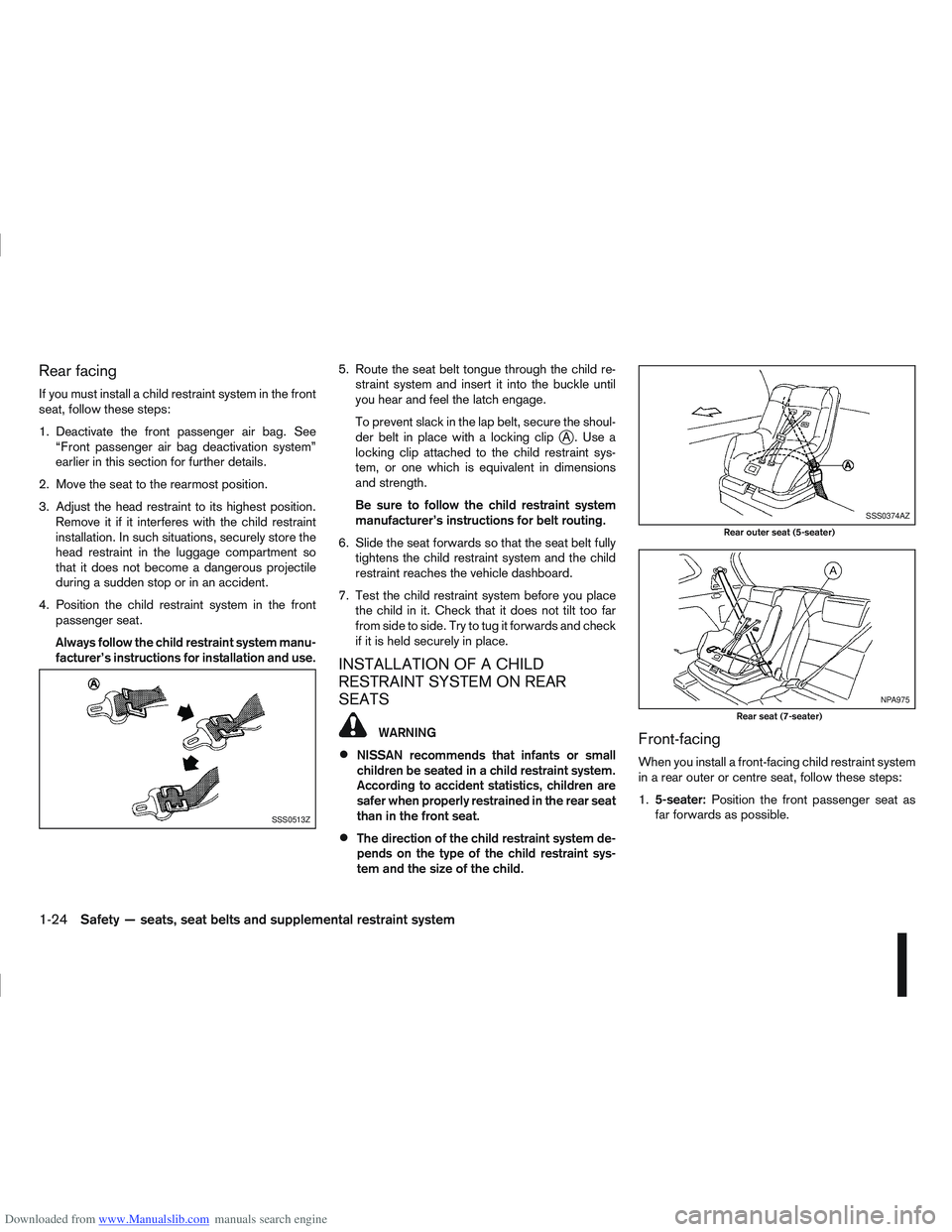
Downloaded from www.Manualslib.com manuals search engine Rear facing
If you must install a child restraint system in the front
seat, follow these steps:
1. Deactivate the front passenger air bag. See“Front passenger air bag deactivation system”
earlier in this section for further details.
2. Move the seat to the rearmost position.
3. Adjust the head restraint to its highest position. Remove it if it interferes with the child restraint
installation. In such situations, securely store the
head restraint in the luggage compartment so
that it does not become a dangerous projectile
during a sudden stop or in an accident.
4. Position the child restraint system in the front passenger seat.
Always follow the child restraint system manu-
facturer’s instructions for installation and use. 5. Route the seat belt tongue through the child re-
straint system and insert it into the buckle until
you hear and feel the latch engage.
To prevent slack in the lap belt, secure the shoul-
der belt in place with a locking clip
jA. Use a
locking clip attached to the child restraint sys-
tem, or one which is equivalent in dimensions
and strength.
Be sure to follow the child restraint system
manufacturer’s instructions for belt routing.
6. Slide the seat forwards so that the seat belt fully tightens the child restraint system and the child
restraint reaches the vehicle dashboard.
7. Test the child restraint system before you place the child in it. Check that it does not tilt too far
from side to side. Try to tug it forwards and check
if it is held securely in place.
INSTALLATION OF A CHILD
RESTRAINT SYSTEM ON REAR
SEATS
WARNING
NISSAN recommends that infants or small
children be seated in a child restraint system.
According to accident statistics, children are
safer when properly restrained in the rear seat
than in the front seat.
The direction of the child restraint system de-
pends on the type of the child restraint sys-
tem and the size of the child.
Front-facing
When you install a front-facing child restraint system
in a rear outer or centre seat, follow these steps:
1.5-seater: Position the front passenger seat as
far forwards as possible.
SSS0513Z
SSS0374AZ
Rear outer seat (5-seater)
NPA975
Rear seat (7-seater)
1-24Safety — seats, seat belts and supplemental restraint system
Page 45 of 297
Downloaded from www.Manualslib.com manuals search engine sary to secure the shoulder belt in place with a
locking clipjA . Use a locking clip attached to
the child restraint system, or one which is equiva-
lent in dimensions and strength.
Be sure to follow the child restraint system
manufacturer’s instructions for belt routing.
4. Test the child restraint system before you place the child in it. Check that it does not tilt too far
from side to side. Try to tug it forwards and check
if it is held securely in place.
5. Check to make sure that the child restraint sys- tem is properly secured prior to each use.
ISOFIX SYSTEM (where fitted)
WARNING
Attach ISOFIX compatible child restraint sys-
tems only at the locations shown. If a child
restraint is not secured properly, your child
could be seriously injured or killed in an acci-
dent.
The rear seat is equipped with 2 ISOFIX com-
patible child restraint systems, on both outer
seats ONLY. Do not secure a child restraint in
the rear centre seating position using the child
restraint lower anchors. The child restraint will
not be secured properly.
The ISOFIX system anchors are designed to
withstand only those loads imposed by cor-
rectly fitted child restraints. Under no circum-
stances are they to be used for adult seat
belts or harnesses.
Some child restraints include two rigid or webbing-
mounted attachments that can be connected to two
anchors located at certain seating positions in your
vehicle. This system is known as the ISOFIX or
ISOFIX compatible system. With this system, you
do not have to use a vehicle seat belt to secure the
child restraint. Your vehicle is equipped with special
anchor points that are used with ISOFIX system
compatible child restraints on the rear seat. Check
your child restraint for a label stating that it is com-
patible with the ISOFIX system. This information
may also be in the child restraint owner’s manual. If
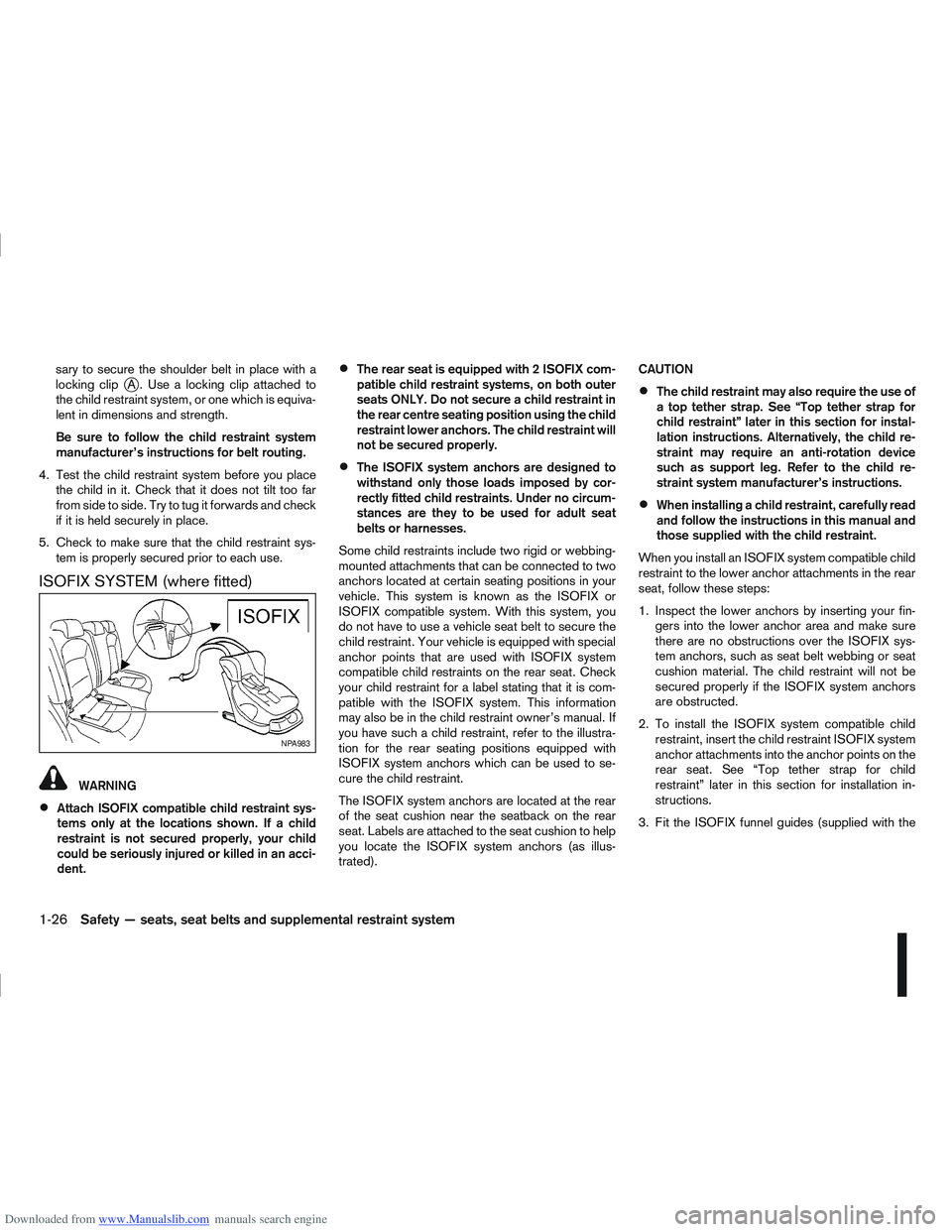
you have such a child restraint, refer to the illustra-
tion for the rear seating positions equipped with
ISOFIX system anchors which can be used to se-
cure the child restraint.
The ISOFIX system anchors are located at the rear
of the seat cushion near the seatback on the rear
seat. Labels are attached to the seat cushion to help
you locate the ISOFIX system anchors (as illus-
trated). CAUTION
The child restraint may also require the use of
a top tether strap. See “Top tether strap for
child restraint” later in this section for instal-
lation instructions. Alternatively, the child re-
straint may require an anti-rotation device
such as support leg. Refer to the child re-
straint system manufacturer’s instructions.
When installing a child restraint, carefully read
and follow the instructions in this manual and
those supplied with the child restraint.
When you install an ISOFIX system compatible child
restraint to the lower anchor attachments in the rear
seat, follow these steps:
1. Inspect the lower anchors by inserting your fin- gers into the lower anchor area and make sure
there are no obstructions over the ISOFIX sys-
tem anchors, such as seat belt webbing or seat
cushion material. The child restraint will not be
secured properly if the ISOFIX system anchors
are obstructed.
2. To install the ISOFIX system compatible child restraint, insert the child restraint ISOFIX system
anchor attachments into the anchor points on the
rear seat. See “Top tether strap for child
restraint” later in this section for installation in-
structions.
3. Fit the ISOFIX funnel guides (supplied with the
NPA983
1-26Safety — seats, seat belts and supplemental restraint system
Page 46 of 297
Downloaded from www.Manualslib.com manuals search engine ISOFIX child seat – where fitted) to the vehicle
ISOFIX brackets located in slots on the slope of
the rear outer seat cushions (refer to the ISOFIX
label for appropriate locations).
4. After attaching the child restraint and before plac- ing the child in it, use force to check that it does
not tilt too far from side to side and tug it forward
to make sure that the child restraint is securely
held in place. Make sure that both ISOFIX an-
chorages have latched correctly.
5. Make sure that the child restraint is properly se- cured prior to each use.
NOTE
For forward facing ISOFIX child restraint posi-
tion on the rear seat, slide the front seat as far
forwards as possible.
For rearward facing ISOFIX child restraint po-
sition on the rear seat, slide the front seat
backwards until it touches the edge of the
child restraint.
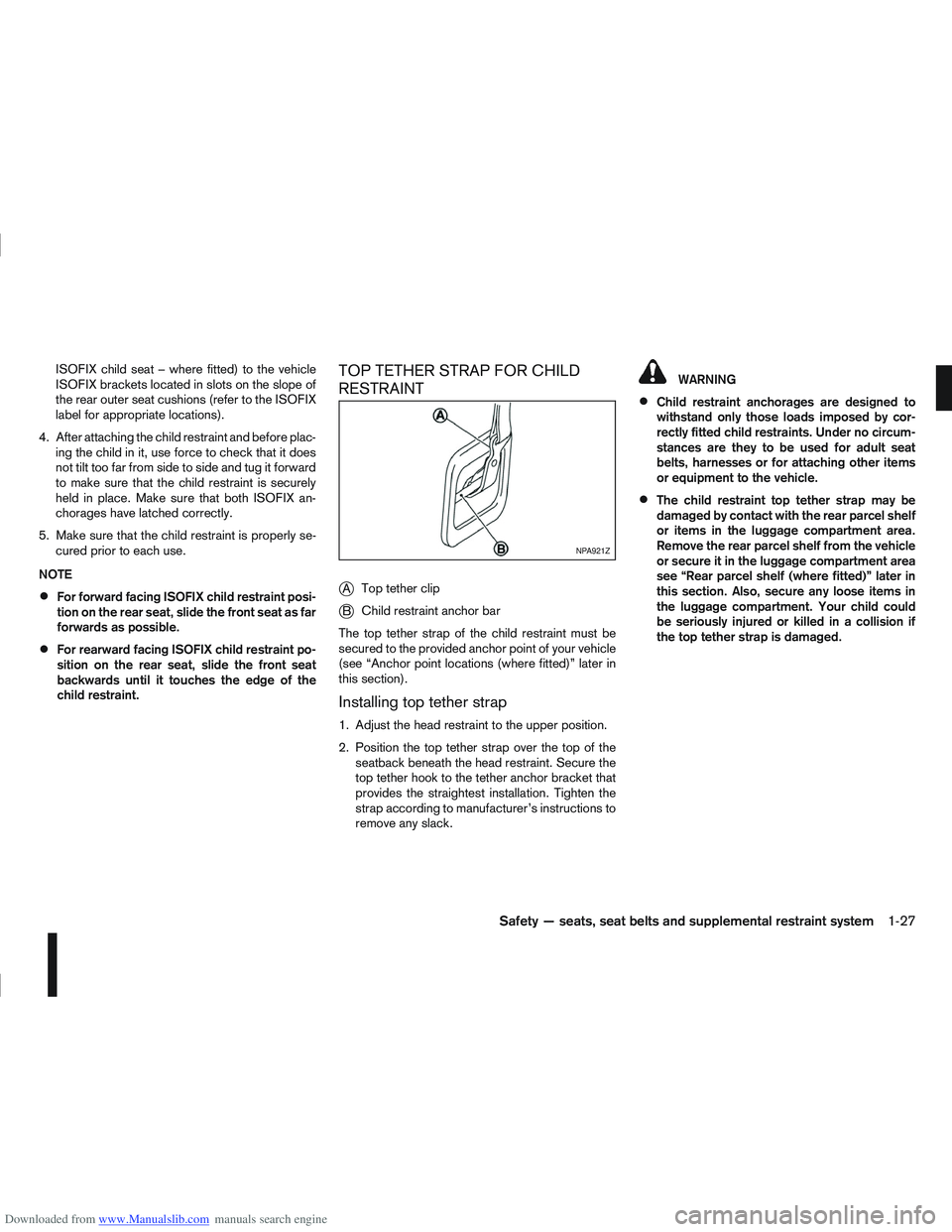
TOP TETHER STRAP FOR CHILD
RESTRAINT
j
A Top tether clip
jB Child restraint anchor bar
The top tether strap of the child restraint must be
secured to the provided anchor point of your vehicle
(see “Anchor point locations (where fitted)” later in
this section).
Installing top tether strap
1. Adjust the head restraint to the upper position.
2. Position the top tether strap over the top of the seatback beneath the head restraint. Secure the
top tether hook to the tether anchor bracket that
provides the straightest installation. Tighten the
strap according to manufacturer’s instructions to
remove any slack.
WARNING
Child restraint anchorages are designed to
withstand only those loads imposed by cor-
rectly fitted child restraints. Under no circum-
stances are they to be used for adult seat
belts, harnesses or for attaching other items
or equipment to the vehicle.
The child restraint top tether strap may be
damaged by contact with the rear parcel shelf
or items in the luggage compartment area.
Remove the rear parcel shelf from the vehicle
or secure it in the luggage compartment area
see “Rear parcel shelf (where fitted)” later in
this section. Also, secure any loose items in
the luggage compartment. Your child could
be seriously injured or killed in a collision if
the top tether strap is damaged.
NPA921Z
Safety — seats, seat belts and supplemental restraint system1-27
Page 51 of 297
Downloaded from www.Manualslib.com manuals search engine NOTE
For an overview see “Instrument and control
layout” in the “0. Illustrated table of contents”
section and see “Meters and gauges” in the “0. Il-
lustrated table of contents” section.
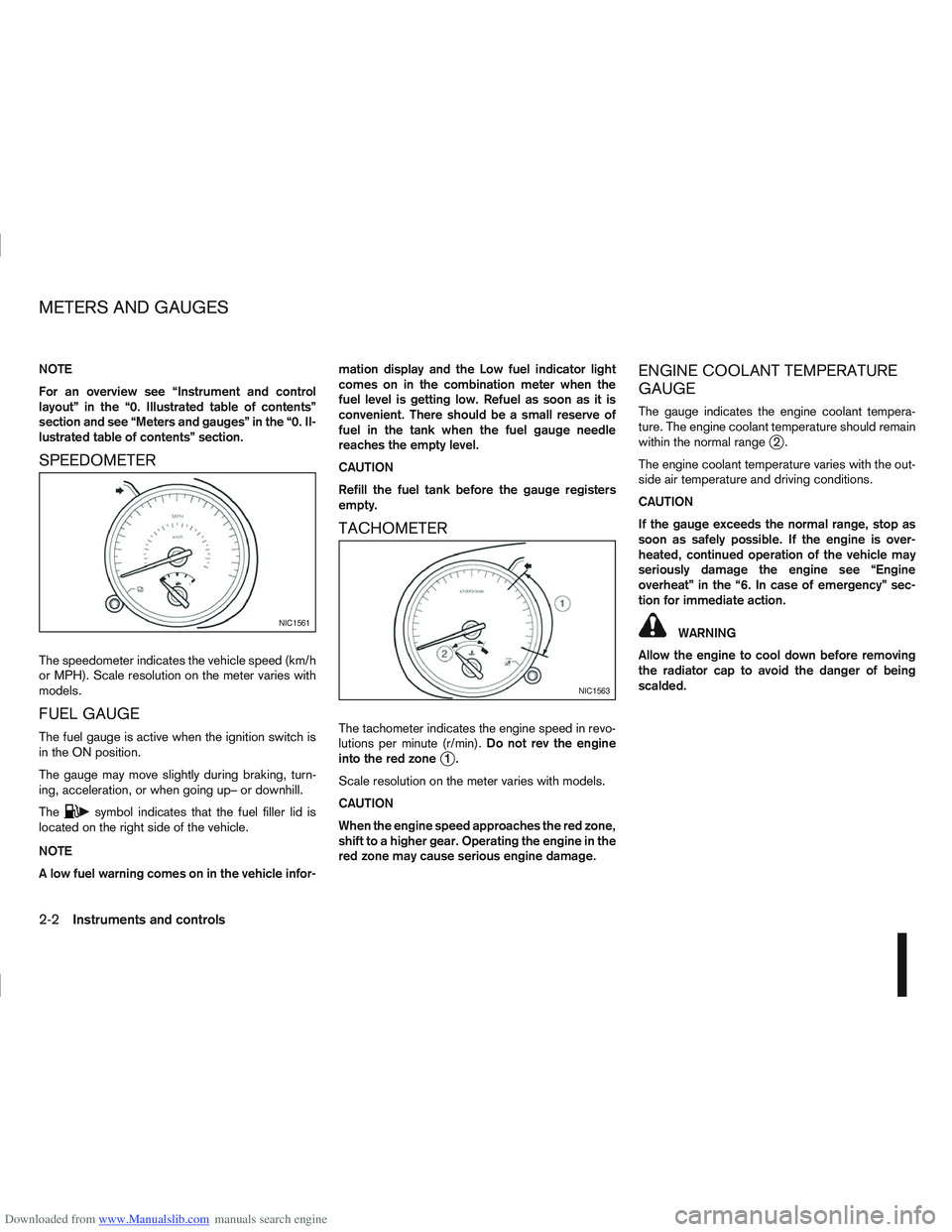
SPEEDOMETER
The speedometer indicates the vehicle speed (km/h
or MPH). Scale resolution on the meter varies with
models.
FUEL GAUGE
The fuel gauge is active when the ignition switch is
in the ON position.
The gauge may move slightly during braking, turn-
ing, acceleration, or when going up– or downhill.
The
csymbol indicates that the fuel filler lid is
located on the right side of the vehicle.
NOTE
A low fuel warning comes on in the vehicle infor- mation display and the Low fuel indicator light
comes on in the combination meter when the
fuel level is getting low. Refuel as soon as it is
convenient. There should be a small reserve of
fuel in the tank when the fuel gauge needle
reaches the empty level.
CAUTION
Refill the fuel tank before the gauge registers
empty.
TACHOMETER
The tachometer indicates the engine speed in revo-
lutions per minute (r/min).
Do not rev the engine
into the red zone
j1.
Scale resolution on the meter varies with models.
CAUTION
When the engine speed approaches the red zone,
shift to a higher gear. Operating the engine in the
red zone may cause serious engine damage.
ENGINE COOLANT TEMPERATURE
GAUGE
The gauge indicates the engine coolant tempera-
ture. The engine coolant temperature should remain
within the normal range
j2.
The engine coolant temperature varies with the out-
side air temperature and driving conditions.
CAUTION
If the gauge exceeds the normal range, stop as
soon as safely possible. If the engine is over-
heated, continued operation of the vehicle may
seriously damage the engine see “Engine
overheat” in the “6. In case of emergency” sec-
tion for immediate action.
WARNING
Allow the engine to cool down before removing
the radiator cap to avoid the danger of being
scalded.NIC1561
NIC1563
METERS AND GAUGES
2-2Instruments and controls