pressure NISSAN QASHQAI 2012 Owner's Manual
[x] Cancel search | Manufacturer: NISSAN, Model Year: 2012, Model line: QASHQAI, Model: NISSAN QASHQAI 2012Pages: 297, PDF Size: 4.09 MB
Page 237 of 297
Downloaded from www.Manualslib.com manuals search engine WARNING
Never remove the engine coolant reservoir
cap when the engine is hot. Serious burns
could be caused by high pressure fluid es-
caping from the engine coolant reservoir. Wait
until the engine and radiator have cooled
down.
Engine coolant is poisonous and should be
stored carefully in marked containers out of
the reach of children.
The engine cooling system is filled at the factory
with a high-quality, year-round and extended life en-
gine coolant. The high quality engine coolant con-
tains the specific solutions effective for the anti-cor-
rosion and the anti-freeze function. Therefore, addi-
tional cooling system additives are not necessary.
CAUTION
When adding or replacing engine coolant, be
sure to use Genuine NISSAN engine coolant
or equivalent.
The use of other types of engine coolant may
damage the engine cooling system.
The engine coolant reservoir tank is equipped
with a pressure cap, use a Genuine NISSAN
cap or its equivalent when replacement is re-
quired.
CHECKING ENGINE COOLANT
LEVEL
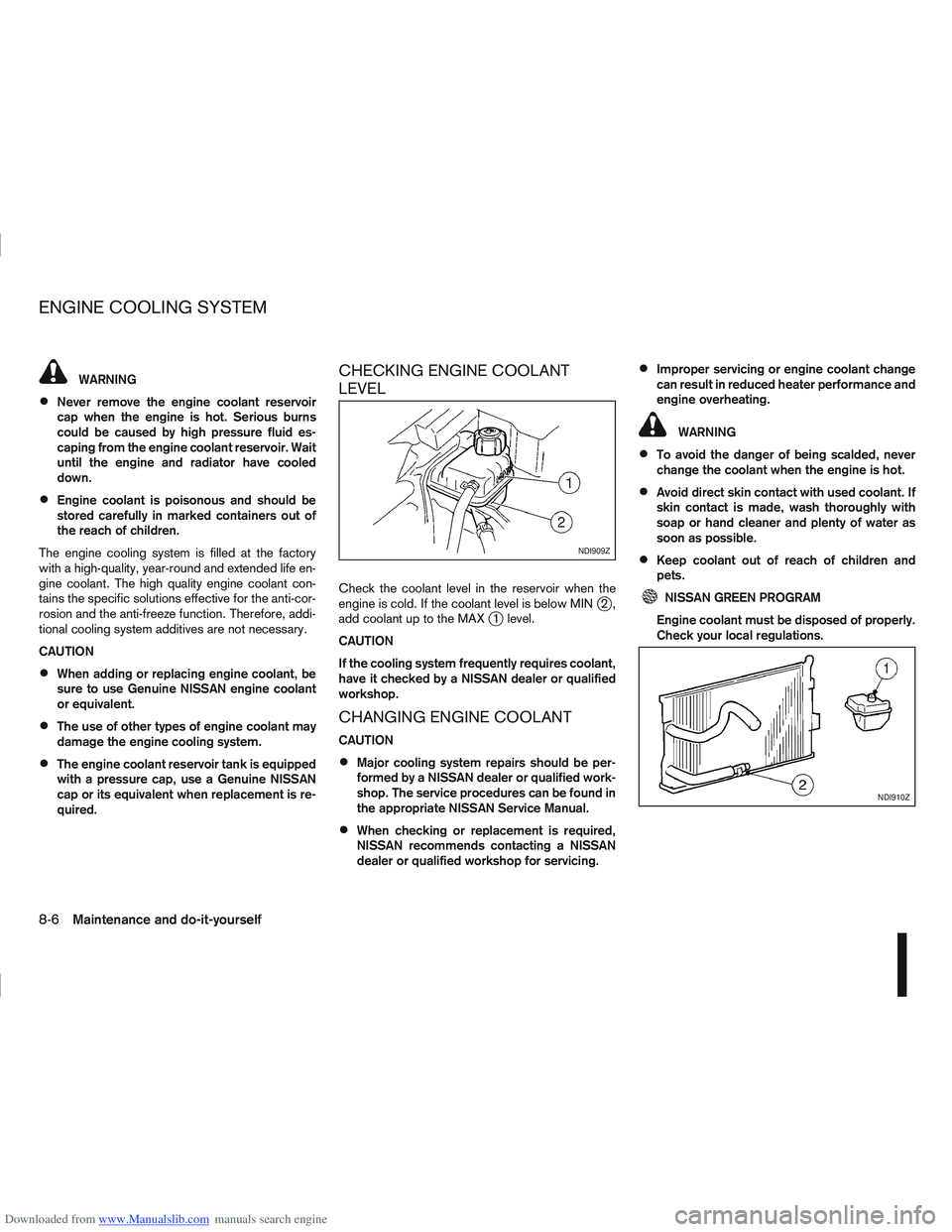
Check the coolant level in the reservoir when the
engine is cold. If the coolant level is below MINj2,
add coolant up to the MAXj1 level.
CAUTION
If the cooling system frequently requires coolant,
have it checked by a NISSAN dealer or qualified
workshop.
CHANGING ENGINE COOLANT
CAUTION
Major cooling system repairs should be per-
formed by a NISSAN dealer or qualified work-
shop. The service procedures can be found in
the appropriate NISSAN Service Manual.
When checking or replacement is required,
NISSAN recommends contacting a NISSAN
dealer or qualified workshop for servicing.
Improper servicing or engine coolant change
can result in reduced heater performance and
engine overheating.
WARNING
To avoid the danger of being scalded, never
change the coolant when the engine is hot.
Avoid direct skin contact with used coolant. If
skin contact is made, wash thoroughly with
soap or hand cleaner and plenty of water as
soon as possible.
Keep coolant out of reach of children and
pets.
NISSAN GREEN PROGRAM
Engine coolant must be disposed of properly.
Check your local regulations.
NDI909Z
NDI910Z
ENGINE COOLING SYSTEM
8-6Maintenance and do-it-yourself
Page 245 of 297
Downloaded from www.Manualslib.com manuals search engine BLEEDING THE FUEL SYSTEM
Except for models with R9M diesel engine:
Bleed the air out of the fuel system after refilling
an empty fuel tank by the following procedure:
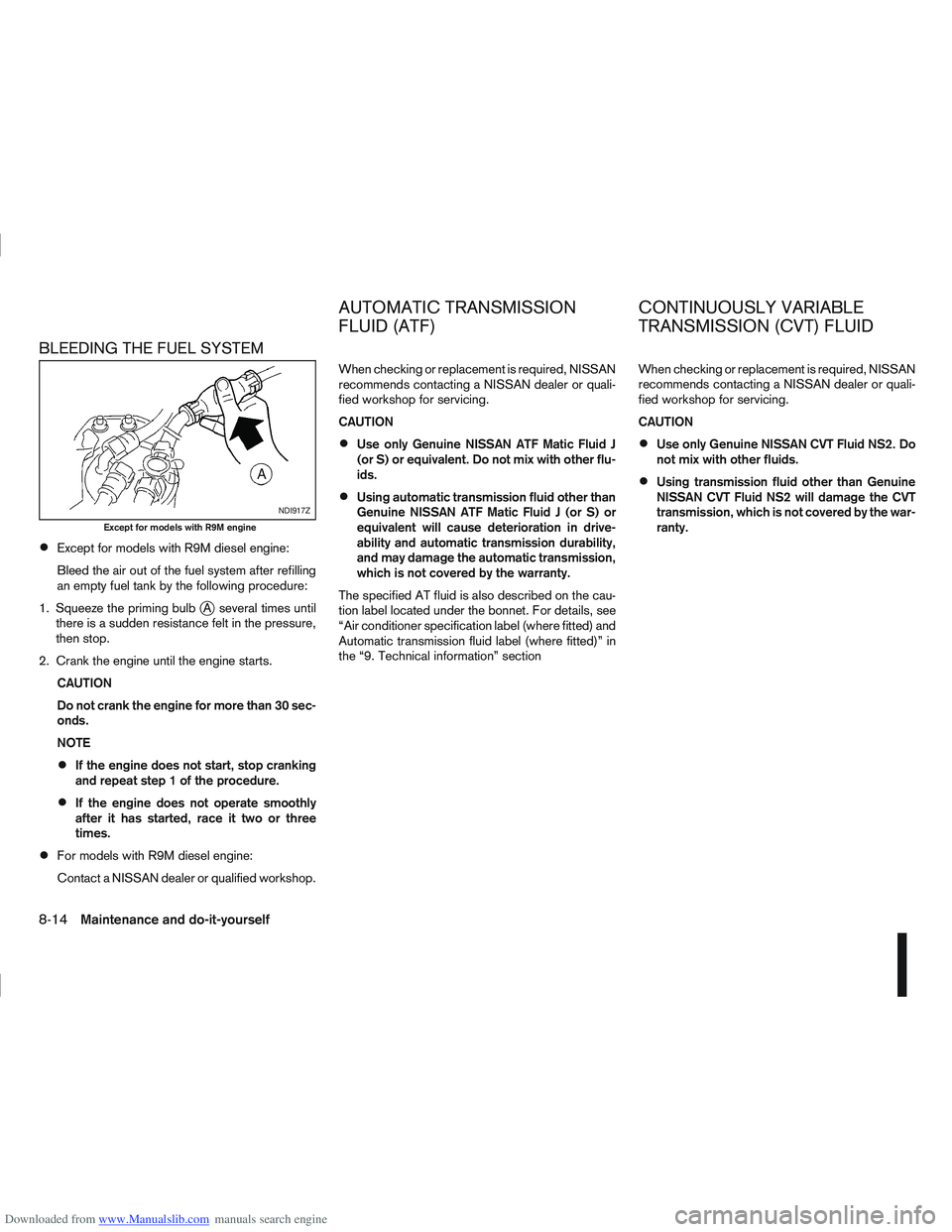
1. Squeeze the priming bulb
jA several times until
there is a sudden resistance felt in the pressure,
then stop.
2. Crank the engine until the engine starts. CAUTION
Do not crank the engine for more than 30 sec-
onds.
NOTE
If the engine does not start, stop cranking
and repeat step 1 of the procedure.
If the engine does not operate smoothly
after it has started, race it two or three
times.
For models with R9M diesel engine:
Contact a NISSAN dealer or qualified workshop. When checking or replacement is required, NISSAN
recommends contacting a NISSAN dealer or quali-
fied workshop for servicing.
CAUTION
Use only Genuine NISSAN ATF Matic Fluid J
(or S) or equivalent. Do not mix with other flu-
ids.
Using automatic transmission fluid other than
Genuine NISSAN ATF Matic Fluid J (or S) or
equivalent will cause deterioration in drive-
ability and automatic transmission durability,
and may damage the automatic transmission,
which is not covered by the warranty.
The specified AT fluid is also described on the cau-
tion label located under the bonnet. For details, see
“Air conditioner specification label (where fitted) and
Automatic transmission fluid label (where fitted)” in
the “9. Technical information” section When checking or replacement is required, NISSAN
recommends contacting a NISSAN dealer or quali-
fied workshop for servicing.
CAUTION
Use only Genuine NISSAN CVT Fluid NS2. Do
not mix with other fluids.
Using transmission fluid other than Genuine
NISSAN CVT Fluid NS2 will damage the CVT
transmission, which is not covered by the war-
ranty.
NDI917Z
Except for models with R9M engine
AUTOMATIC TRANSMISSION
FLUID (ATF)
CONTINUOUSLY VARIABLE
TRANSMISSION (CVT) FLUID
8-14Maintenance and do-it-yourself
Page 253 of 297
Downloaded from www.Manualslib.com manuals search engine Be careful when working on the engine with-
out the air cleaner filter.
VISCOUS PAPER TYPE
The filter elementjA should not be cleaned and
reused.
Replace it according to the maintenance schedule
shown in the separately provided Warranty Informa-
tion & Maintenance Booklet. When replacing the fil-
ter, wipe the inside of the air cleaner housing and
the cover with a damp cloth.
DRY PAPER TYPE (where fitted)
Check the filter elementjA to see if it is dirty. If it is
dirty, shake the element to remove dust.
Clean or replace it according to the maintenance
schedule shown in the separately provided War-
ranty Information & Maintenance Booklet. When
cleaning or replacing the filter, wipe the inside of the
air cleaner housing and the cover with a damp cloth.
CLEANING
If the windscreen or back door window is not clear
after using the window washer or if a wiper blade
chatters when running, wax or other material may be
on the blade or windscreen.
Clean the outside of the windscreen or back door
window with a washer solution or a mild detergent.
The windscreen or back door window is clean if
beads do not form when rinsing with clear water.
Clean the blade by wiping it with a cloth soaked in a
washer solution or a mild detergent. Then rinse the
blade with clear water. If the windscreen or back
door window is still not clear after cleaning the
blades and using the wiper, replace the blades.
CAUTION
After wiper blade replacement, return the
wiper arm to its original position. Otherwise it
may be damaged when the bonnet is opened.
Make sure the wiper blade contacts the glass.
Otherwise, the arm may be damaged from
wind pressure.
Do not open the bonnet when the front wiper
is in the servicing position other wise it can
damage the paint surface of the bonnet.
FRONT WINDOW WIPER
REPLACEMENT
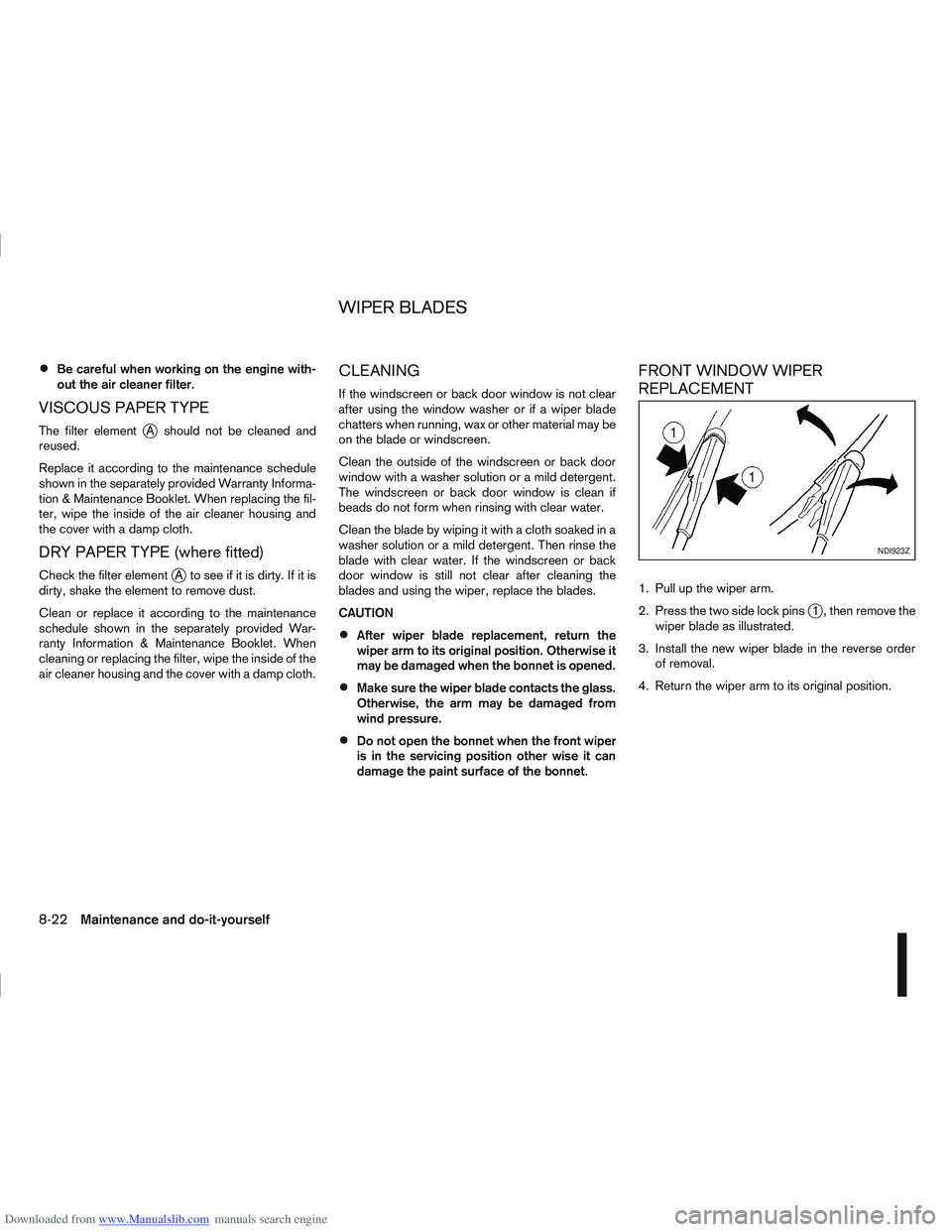
1. Pull up the wiper arm.
2. Press the two side lock pins
j1 , then remove the
wiper blade as illustrated.
3. Install the new wiper blade in the reverse order of removal.
4. Return the wiper arm to its original position.
NDI923Z
WIPER BLADES
8-22Maintenance and do-it-yourself
Page 256 of 297
Downloaded from www.Manualslib.com manuals search engine HEADLIGHTS
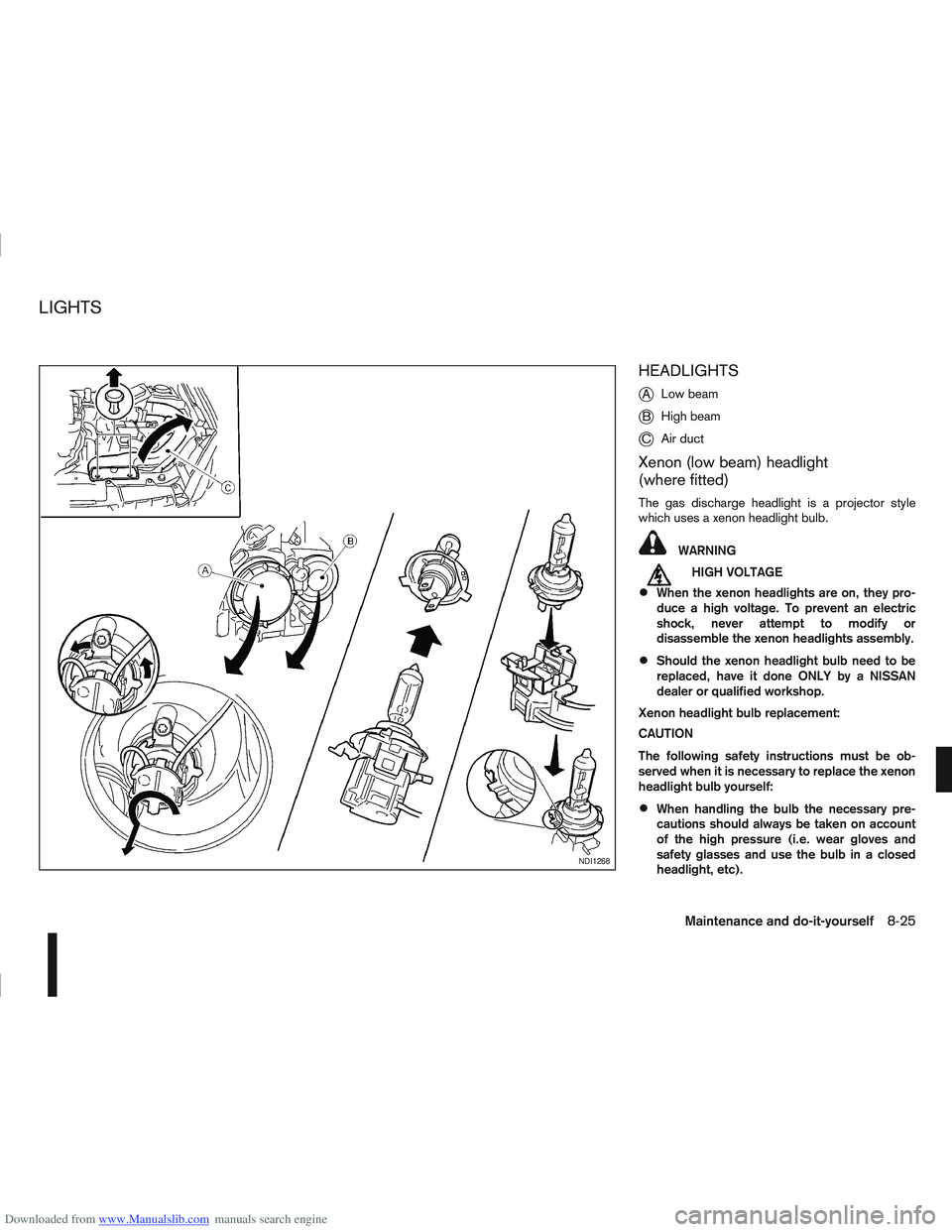
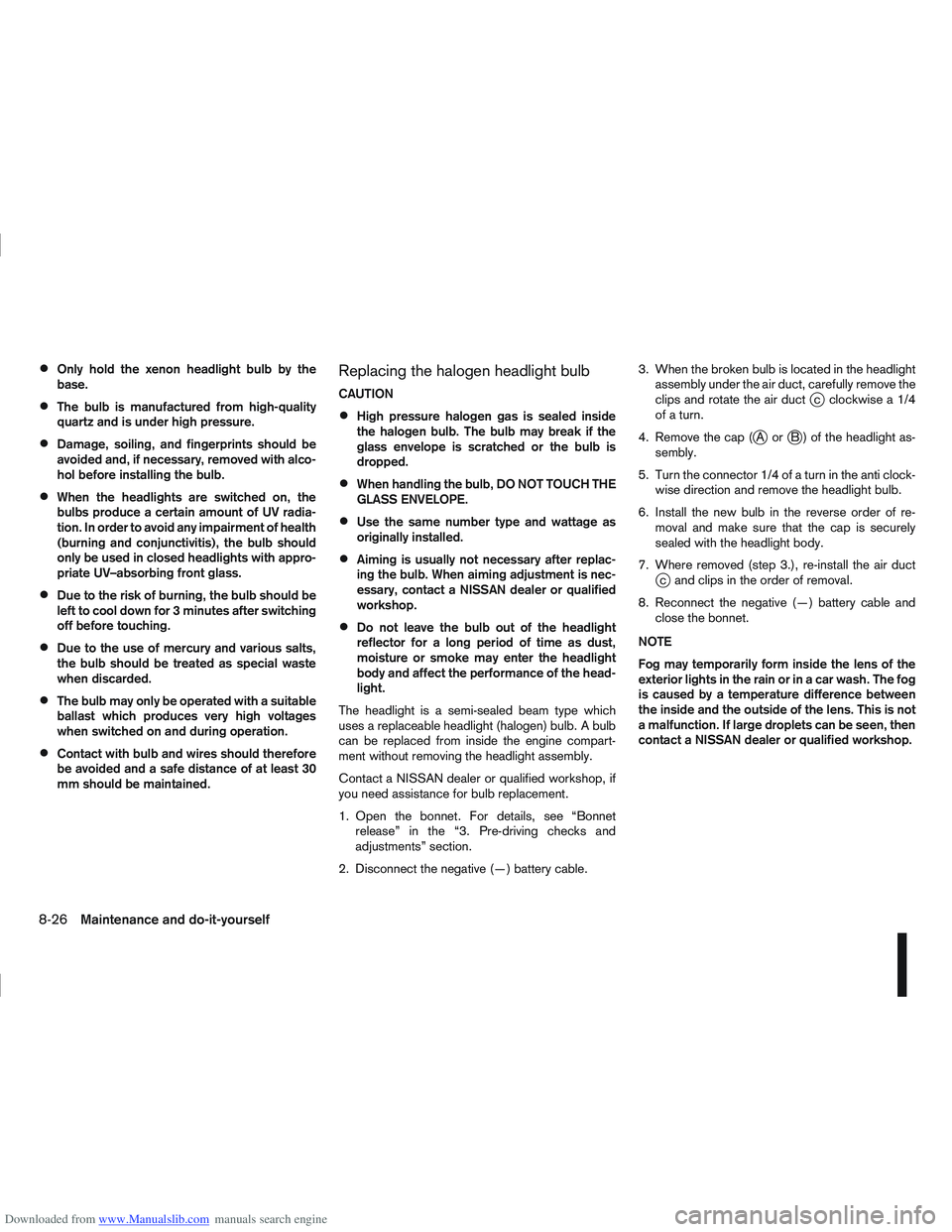
j
ALow beam
jB High beam
jC Air duct
Xenon (low beam) headlight
(where fitted)
The gas discharge headlight is a projector style
which uses a xenon headlight bulb.
WARNING
mHIGH VOLTAGE
When the xenon headlights are on, they pro-
duce a high voltage. To prevent an electric
shock, never attempt to modify or
disassemble the xenon headlights assembly.
Should the xenon headlight bulb need to be
replaced, have it done ONLY by a NISSAN
dealer or qualified workshop.
Xenon headlight bulb replacement:
CAUTION
The following safety instructions must be ob-
served when it is necessary to replace the xenon
headlight bulb yourself:
When handling the bulb the necessary pre-
cautions should always be taken on account
of the high pressure (i.e. wear gloves and
safety glasses and use the bulb in a closed
headlight, etc).
NDI1268
LIGHTS
Maintenance and do-it-yourself8-25
Page 257 of 297
Downloaded from www.Manualslib.com manuals search engine Only hold the xenon headlight bulb by the
base.
The bulb is manufactured from high-quality
quartz and is under high pressure.
Damage, soiling, and fingerprints should be
avoided and, if necessary, removed with alco-
hol before installing the bulb.
When the headlights are switched on, the
bulbs produce a certain amount of UV radia-
tion. In order to avoid any impairment of health
(burning and conjunctivitis), the bulb should
only be used in closed headlights with appro-
priate UV–absorbing front glass.
Due to the risk of burning, the bulb should be
left to cool down for 3 minutes after switching
off before touching.
Due to the use of mercury and various salts,
the bulb should be treated as special waste
when discarded.
The bulb may only be operated with a suitable
ballast which produces very high voltages
when switched on and during operation.
Contact with bulb and wires should therefore
be avoided and a safe distance of at least 30
mm should be maintained.
Replacing the halogen headlight bulb
CAUTION
High pressure halogen gas is sealed inside
the halogen bulb. The bulb may break if the
glass envelope is scratched or the bulb is
dropped.
When handling the bulb, DO NOT TOUCH THE
GLASS ENVELOPE.
Use the same number type and wattage as
originally installed.
Aiming is usually not necessary after replac-
ing the bulb. When aiming adjustment is nec-
essary, contact a NISSAN dealer or qualified
workshop.
Do not leave the bulb out of the headlight
reflector for a long period of time as dust,
moisture or smoke may enter the headlight
body and affect the performance of the head-
light.
The headlight is a semi-sealed beam type which
uses a replaceable headlight (halogen) bulb. A bulb
can be replaced from inside the engine compart-
ment without removing the headlight assembly.
Contact a NISSAN dealer or qualified workshop, if
you need assistance for bulb replacement.
1. Open the bonnet. For details, see “Bonnet release” in the “3. Pre-driving checks and
adjustments” section.
2. Disconnect the negative (—) battery cable. 3. When the broken bulb is located in the headlight
assembly under the air duct, carefully remove the
clips and rotate the air duct
jc clockwise a 1/4
of a turn.
4. Remove the cap (
jAorjB ) of the headlight as-
sembly.
5. Turn the connector 1/4 of a turn in the anti clock- wise direction and remove the headlight bulb.
6. Install the new bulb in the reverse order of re- moval and make sure that the cap is securely
sealed with the headlight body.
7. Where removed (step 3.), re-install the air duct
jc and clips in the order of removal.
8. Reconnect the negative (—) battery cable and close the bonnet.
NOTE
Fog may temporarily form inside the lens of the
exterior lights in the rain or in a car wash. The fog
is caused by a temperature difference between
the inside and the outside of the lens. This is not
a malfunction. If large droplets can be seen, then
contact a NISSAN dealer or qualified workshop.
8-26Maintenance and do-it-yourself
Page 262 of 297
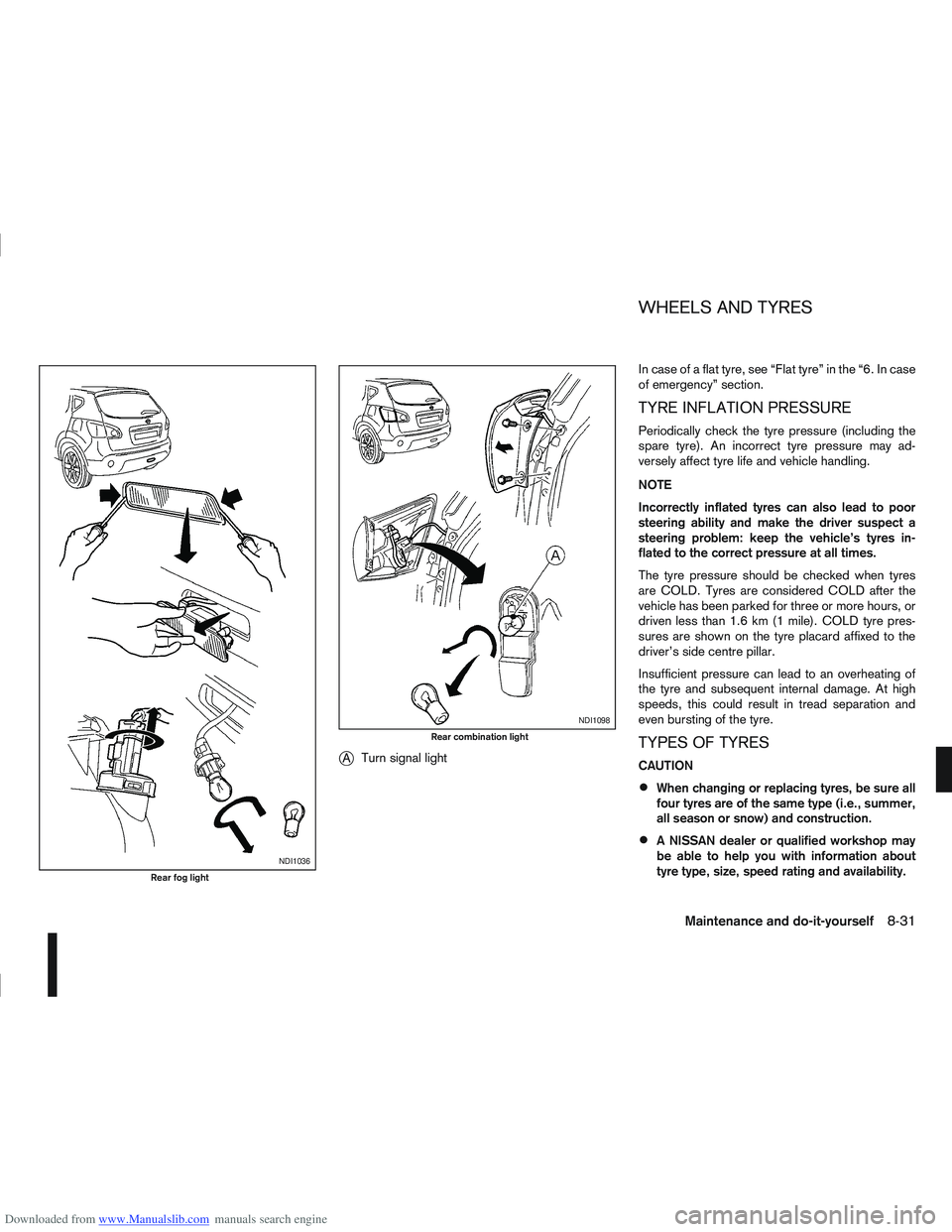
Downloaded from www.Manualslib.com manuals search engine jATurn signal light In case of a flat tyre, see “Flat tyre” in the “6. In case
of emergency” section.
TYRE INFLATION PRESSURE
Periodically check the tyre pressure (including the
spare tyre). An incorrect tyre pressure may ad-
versely affect tyre life and vehicle handling.
NOTE
Incorrectly inflated tyres can also lead to poor
steering ability and make the driver suspect a
steering problem: keep the vehicle’s tyres in-
flated to the correct pressure at all times.
The tyre pressure should be checked when tyres
are COLD. Tyres are considered COLD after the
vehicle has been parked for three or more hours, or
driven less than 1.6 km (1 mile). COLD tyre pres-
sures are shown on the tyre placard affixed to the
driver’s side centre pillar.
Insufficient pressure can lead to an overheating of
the tyre and subsequent internal damage. At high
speeds, this could result in tread separation and
even bursting of the tyre.
TYPES OF TYRES
CAUTION
When changing or replacing tyres, be sure all
four tyres are of the same type (i.e., summer,
all season or snow) and construction.
A NISSAN dealer or qualified workshop may
be able to help you with information about
tyre type, size, speed rating and availability.
NDI1036
Rear fog light
NDI1098
Rear combination light
WHEELS AND TYRES
Maintenance and do-it-yourself8-31
Page 274 of 297
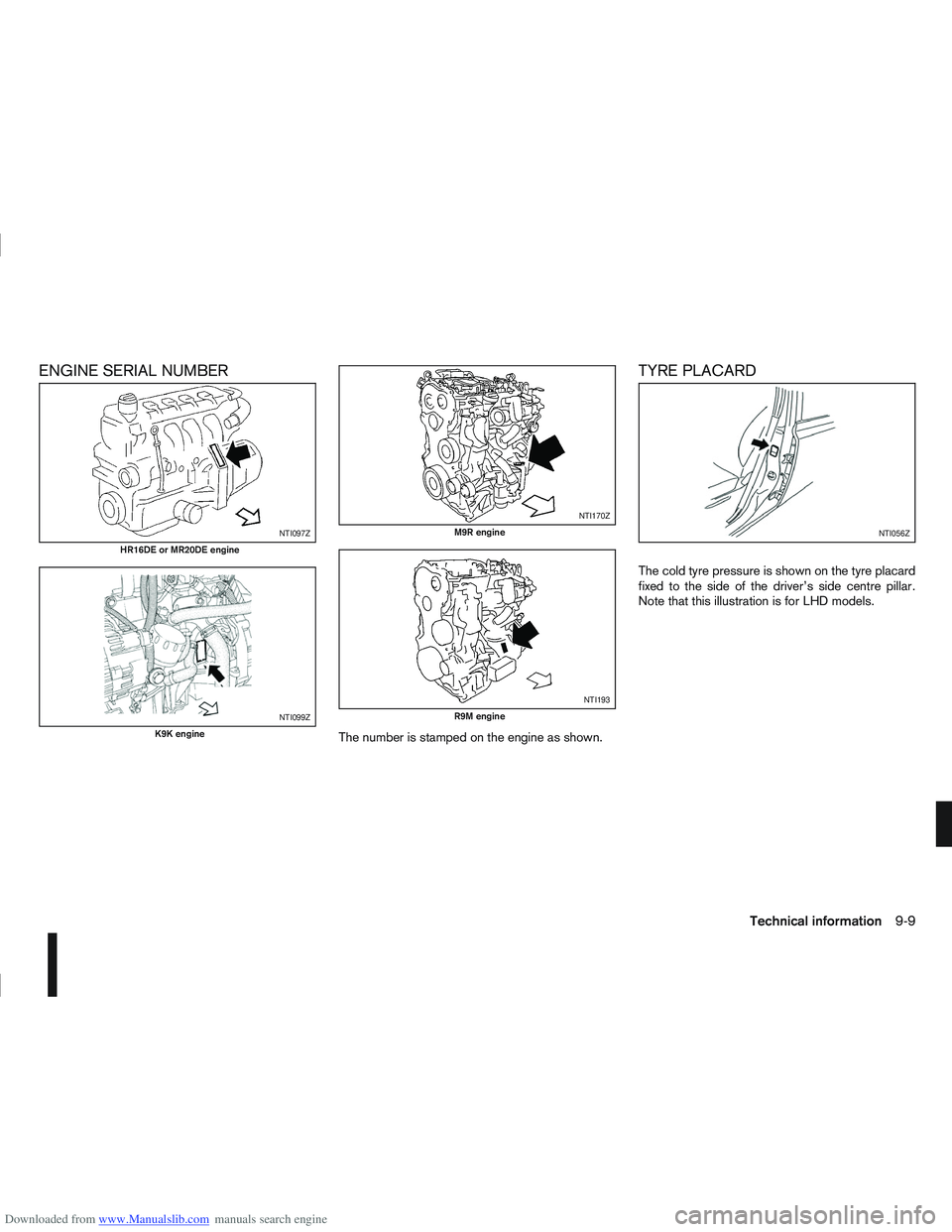
Downloaded from www.Manualslib.com manuals search engine ENGINE SERIAL NUMBER
The number is stamped on the engine as shown.
TYRE PLACARD
The cold tyre pressure is shown on the tyre placard
fixed to the side of the driver’s side centre pillar.
Note that this illustration is for LHD models.
NTI097Z
HR16DE or MR20DE engine
NTI099Z
K9K engine
NTI170Z
M9R engine
NTI193
R9M engine
NTI056Z
Technical information9-9
Page 290 of 297
Downloaded from www.Manualslib.com manuals search engine – Driving with automatic transmission ...................... 5-14, 5-17
– Driving with continuously variable transmission (Models withmanual shift) .................................................................. 5-14
– Driving with continuously variable transmission (Models without manual shift) .................................................................. 5-17
– Driving with manual transmission ................................... 5-12
– Manual transmission (ignition knob) ................................. 5-8
– Manual transmission (ignition switch) ............................... 5-6
Travelling or transferring your registration to another country .. 9-8
Trip computer ...................................................................... 2-16
Turbocharger system (Diesel engine models) ......................... 5-5
Turn signal switch ............................................................... 2-26
Twin trip odometer .............................................................. 2-16
Tyre
– Changing tyres and wheels ........................................... 8-33
– Emergency tyre puncture repair kit ......................... 6-7, 8-34
– Flat tyre ........................................................................\
... 6-2
– Repairing flat tyre ............................................................ 6-7
– Spare tyre ..................................................................... 8-33
– Temporary-use spare tyre ................................................ 6-2
– Types of tyres ................................................................ 8-31
– Tyre age ........................................................................\
8-33
– Tyre equipment .............................................................. 5-43
– Tyre inflation pressure ................................................... 8-31
– Tyre placard .................................................................... 9-9
– Tyre pressure (Trailer) ................................................... 5-36
– Tyre rotation .................................................................. 8-32
– Tyre wear and damage .................................................. 8-33
– Wheels and tyres ................................................... 8-31, 9-7
U
Ultrasonic sensor
– Alarm sensor ................................................................. 3-13
– Parking sensor .............................................................. 5-24
USB Memory operation ....................................................... 4-37 Using Intelligent Key system .................................................. 3-7
V
Vehicle identification .............................................................. 9-8
– Vehicle identification number (VIN) (chassis number) ....... 9-8
– Vehicle identification plate ................................................ 9-8
Vehicle information display .................................................. 2-11
Vehicle security .......................................................... 3-13, 5-38
– Alarm system ................................................................. 3-13
Vents ........................................................................\
.......... 4-12W
Warning/indicator lights and audible reminders ...................... 2-3
Warnings and alerts (Vehicle information display) ................ 2-12
Washing ........................................................................\
....... 7-2
Waxing ........................................................................\
.......... 7-2
Wheel
– Blocking the wheels ........................................................ 6-3
– Care of wheels ................................................................ 7-3
– Changing tyres and wheels ........................................... 8-33
– Getting the tools and spare wheel .................................... 6-3
– Installing the wheel .......................................................... 6-6
– Removing the wheel ........................................................ 6-4
– Removing the wheel cover ............................................... 6-4
– Stowing the wheel and tools ............................................ 6-6
– Wheel balance .............................................................. 8-33
– Wheel lock key code ....................................................... 6-7
– Wheel lock nuts ....................................................... 6-4, 6-7
– Wheels and tyres ................................................... 8-31, 9-7
Wheel lock nuts .................................................................... 6-7
Windows
– Power window — Driver’s side (Reinitialisationprocedure) .................................................................... 2-35
Index10-9
Page 292 of 297
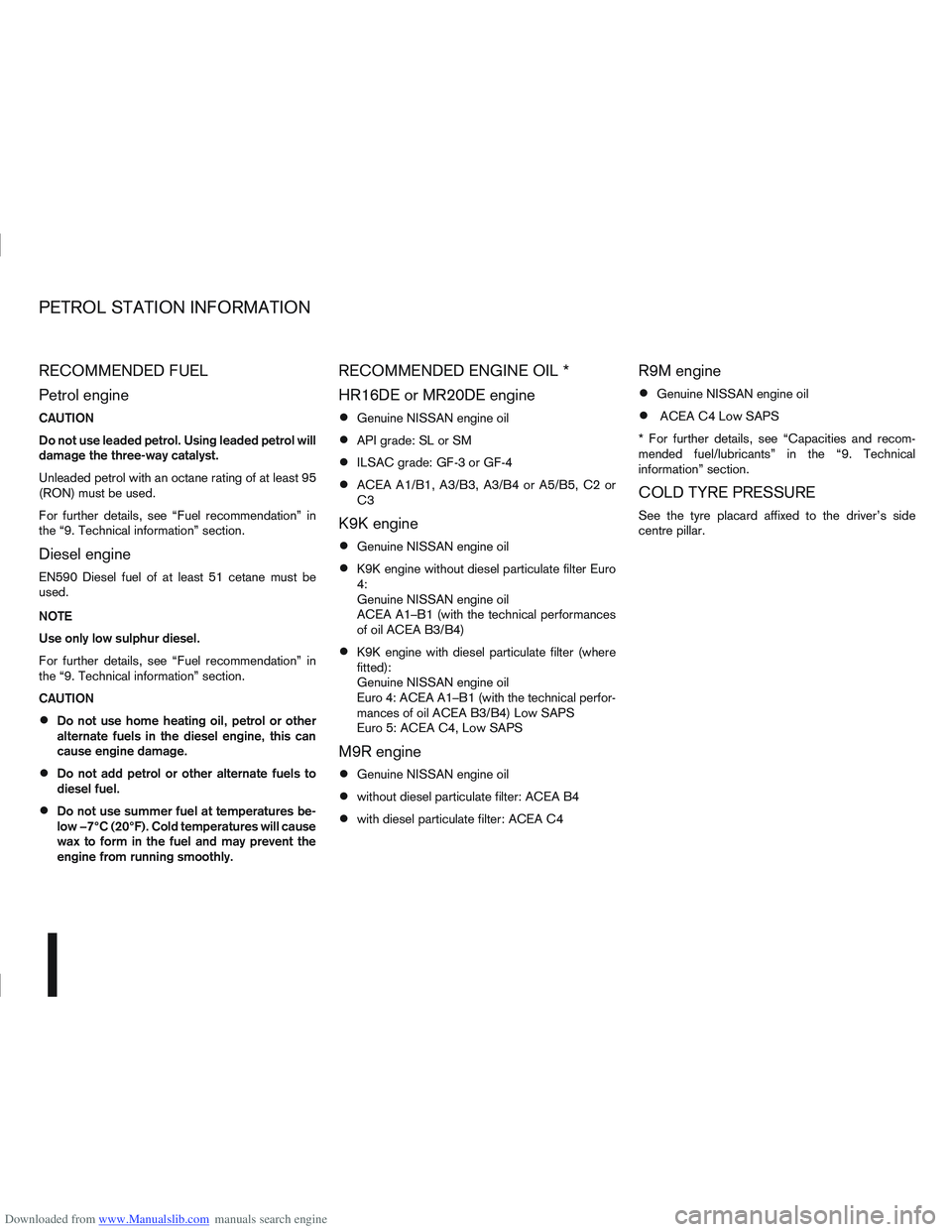
Downloaded from www.Manualslib.com manuals search engine RECOMMENDED FUEL
Petrol engine
CAUTION
Do not use leaded petrol. Using leaded petrol will
damage the three-way catalyst.
Unleaded petrol with an octane rating of at least 95
(RON) must be used.
For further details, see “Fuel recommendation” in
the “9. Technical information” section.
Diesel engine
EN590 Diesel fuel of at least 51 cetane must be
used.
NOTE
Use only low sulphur diesel.
For further details, see “Fuel recommendation” in
the “9. Technical information” section.
CAUTION
Do not use home heating oil, petrol or other
alternate fuels in the diesel engine, this can
cause engine damage.
Do not add petrol or other alternate fuels to
diesel fuel.
Do not use summer fuel at temperatures be-
low 7°C (20°F). Cold temperatures will cause
wax to form in the fuel and may prevent the
engine from running smoothly.
RECOMMENDED ENGINE OIL *
HR16DE or MR20DE engine
Genuine NISSAN engine oil
API grade: SL or SM
ILSAC grade: GF-3 or GF-4
ACEA A1/B1, A3/B3, A3/B4 or A5/B5, C2 or
C3
K9K engine
Genuine NISSAN engine oil
K9K engine without diesel particulate filter Euro
4:
Genuine NISSAN engine oil
ACEA A1–B1 (with the technical performances
of oil ACEA B3/B4)
K9K engine with diesel particulate filter (where
fitted):
Genuine NISSAN engine oil
Euro 4: ACEA A1–B1 (with the technical perfor-
mances of oil ACEA B3/B4) Low SAPS
Euro 5: ACEA C4, Low SAPS
M9R engine
Genuine NISSAN engine oil
without diesel particulate filter: ACEA B4
with diesel particulate filter: ACEA C4
R9M engine
Genuine NISSAN engine oil
ACEA C4 Low SAPS
* For further details, see “Capacities and recom-
mended fuel/lubricants” in the “9. Technical
information” section.
COLD TYRE PRESSURE
See the tyre placard affixed to the driver’s side
centre pillar.
PETROL STATION INFORMATION
Page 294 of 297
Downloaded from www.Manualslib.com manuals search engine Use the roof rack only when necessary
Only install the roof luggage system when you really
need it, otherwise put it inside the vehicle or store it
in your garage. Do not drive around with an empty
roof rack, kayak holder, or ski rack, this will reduce
your aerodynamic drag significantly.
Optimise the use of air conditioning
The air conditioning system has a positive effect on
driving and vehicle safety through comfort cooling
and dehumidifying, drivers are more alert and have
better visibility when window demisting/defogging
becomes necessary. However, use of the air condi-
tioning system will increase fuel consumption sub-
stantially in an urban environment. Optimise the use
of air conditioning by using the vents as much as
possible.
Use the parking brake on slopes
Use the parking brake when holding your vehicle on
a slope. Avoid using the clutch (manual transmis-
sion) or the accelerator (automatic transmission or
continuously variable transmission) to hold your ve-
hicle as this leads to unnecessary fuel consumption
and wear.
Maintain a safe distance
Anticipate traffic conditions for a smoother drive and
to assure comfort and safety during your trip. Drive
and maintain a safe distance from other vehicles
while in traffic. This will help reduce fuel consump-
tion as you will not be constantly tapping your
brakes.
Check your tyre pressure
Low tyre pressure increases fuel consumption as
well as the use of non-recommended tyres. Correct
tyre pressure will maximise the grip of your vehicle
and optimise fuel consumption.
Have your car serviced regularly
Regular service allows you to run your vehicle in
optimal condition and with the best fuel efficiency.
Have your vehicle serviced by your NISSAN dealer
or a qualified workshop to ensure that it is main-
tained to its original standard.
In case of emergency ... 6-2
(Flat tyre, engine will not start, overheating,
towing)
How to start the engine ... 5-2
How to read the meters and gauges ... 2-2
Maintenance and do-it-yourself ... 8-2
Technical information ... 9-2
QUICK REFERENCE