power steering NISSAN QASHQAI 2014 Owner´s Manual
[x] Cancel search | Manufacturer: NISSAN, Model Year: 2014, Model line: QASHQAI, Model: NISSAN QASHQAI 2014Pages: 338, PDF Size: 4.87 MB
Page 230 of 338
Your new vehicle was designed to be used primarily
to carry passengers and luggage.
Remember that towing a trailer will place additional
loads on your vehicle’s engine, drive-train, steering,
braking and other systems. Towing a trailer will also
exaggerate other conditions, such as sway caused
by crosswinds, rough road surfaces or passing
trucks. Driving style and speed must be adjusted
according to the circumstances. Before towing a
trailer, see a NISSAN dealer or qualified workshop
for an explanation of towing equipment and its
proper use.
OPERATING PRECAUTIONS
•Avoid towing a trailer during the running-in
schedule.
•Choose proper coupling devices (trailer hitch,
safety chain, roof carrier, etc.) for your vehicle
and trailer. These devices are available from a
NISSAN dealer or qualified workshop where you
can also obtain more detailed information about
trailer towing.
Heavy-duty kits are available at a NISSAN dealer
or qualified workshop.
•It is advisable to contact a NISSAN dealer or
qualified workshop for towing details, before
towing a trailer up steep slopes for long dis-
tances.
•Never allow the total trailer load (trailer weight
plus its cargo weight) to exceed the maximum
set for the coupling device.Contact a NISSAN dealer or qualified workshop
for more information on this matter.
•The trailer must be loaded so that heavy goods
are distributed over the axle and as low in the
trailer as possible. Poor load distribution can se-
riously affect the stability of the trailer and tow
vehicle.
•Do not exceed the maximum permitted vertical
load on the trailer hitch.
•Before driving, make sure that the lighting sys-
tem of the trailer works properly.
•When towing with 4WD models, the 4WD mode
switch should be in the AUTO position. Using
the vehicle in AUTO mode gives better traction,
particularly when moving off from stationary and/
or on an incline, as the vehicle is less likely to
wheel spin.
•Avoid abrupt starts, accelerations and stops.
•Avoid sharp turns and lane changes.
•Always drive your vehicle at a moderate speed.
•Always block the wheels on both vehicle and
trailer when parking. Apply the handbrake (where
fitted) on the trailer. Parking on a steep slope is
not recommended.
If parking on a steep slope is unavoidable it is
also advisable to put the vehicle into gear, or
select P (Park (XTRONIC models)), and turn the
front wheels into the kerb (in addition to the other
precautions described). Before parking on asteep slope consider the incline (the towing
weights quoted are for a 12% slope).
•Follow the trailer manufacturer’s instructions.
•Have your vehicle serviced more often than at
the intervals specified in the separately provided
Warranty Information and Maintenance booklet.
•Trailer towing requires more fuel than under nor-
mal circumstances because of a considerable
increase in traction power required and resis-
tance.
•When towing a trailer, observe the following re-
stricted towing speed:
Speed: below 100 km/h (62 MPH)
•Observe the legal maximum speeds for trailer
operation.
CAUTION
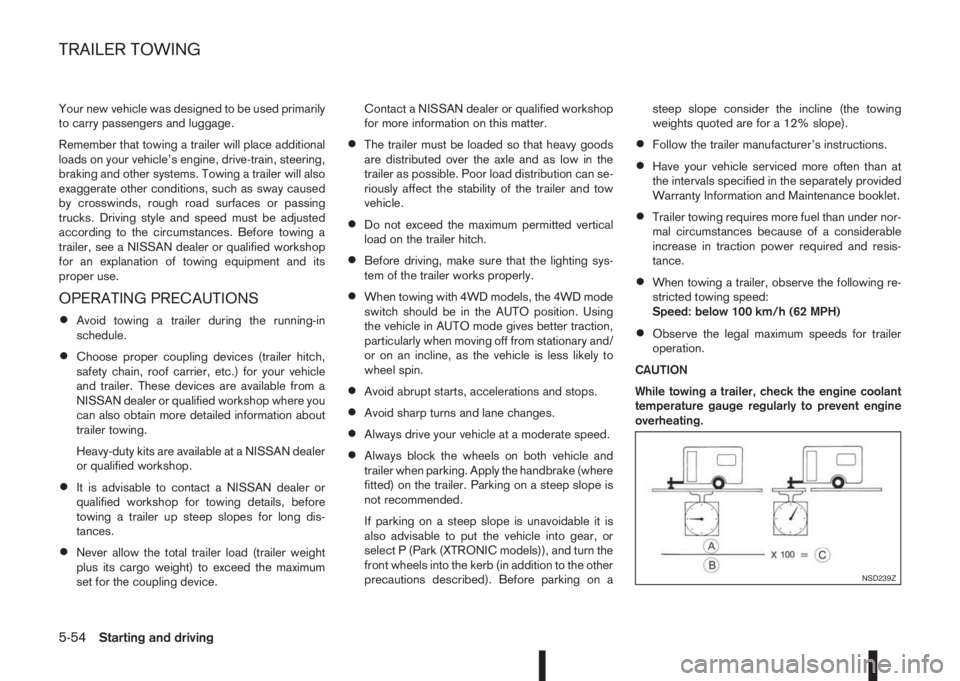
While towing a trailer, check the engine coolant
temperature gauge regularly to prevent engine
overheating.
NSD239Z
TRAILER TOWING
5-54Starting and driving
Page 233 of 338
When leaving your vehicle unoccupied:
•Always remove the ignition key and take it with
you – even in your own garage.
•Always remove the ignition key or Intelligent Key
(where fitted) and take it with you – even in your
own garage.
•Close all windows completely and lock all doors.
•Always park your vehicle where it can be seen.
At night, park in a well lit area.
•If the vehicle is equipped with an alarm or immo-
bilization device, use it – even for short periods.
•Do not leave children and pets in the vehicle
unattended.
•Do not leave valuables on view to tempt a thief.
Always take your valuables with you. If you must
leave something in your vehicle, lock it in the lug-
gage compartment or hide it out of sight.
•Do not leave the vehicle documents in your ve-
hicle. In the unfortunate event of your vehicle
being stolen, the documents will only help a thief
to sell the vehicle.
•Do not leave articles on a roof rack as they are
particularly vulnerable. If possible, remove them
from the rack and lock them inside the vehicle.
•Do not leave the spare key in the vehicle – keep
it in a safe place at home.
•Do not leave the spare key or Intelligent Key in
the vehicle – keep it in a safe place at home.
•Do not leave a note of your vehicle’s key number
in the vehicle. A thief may break into the vehicle,
note the key number and return with a new key
and drive the vehicle.WARNING
•If the engine is not running or is turned off
while driving, the power assistance for the
steering will not work. The steering will be
harder to operate.
•When the electric power steering warning light
illuminates with the engine running, the power
assistance for the steering will cease opera-
tion. You will still have control of the vehicle
but the steering will be harder to operate.
The electric power steering system is designed to
provide power assistance while driving to allow you
to operate the steering wheel with light force.
The steering effort can be set to [Normal] or [Sport]
in the vehicle information display under the heading
[Driver assistance]. (See “[Driver assistance]” in the
“2. Instruments and controls” section.)
NOTE
When the steering wheel is operated repeatedly
or continuously while parking or driving at a very
low speed, the power assistance for the steering
wheel will be reduced. This is to prevent over-
heating of the electric power steering system and
protect it from becoming damaged. While the
power assistance is reduced, steering wheel op-
eration will become heavy. When the tempera-
ture of the electric power steering system de-
creases, the power assistance level will return to
normal. Avoid repeating such steering wheel op-
erations that could cause the electric power
steering system to overheat.
VEHICLE SECURITY ELECTRIC POWER STEERING
SYSTEM
Starting and driving5-57
Page 234 of 338
You may hear a sound when the steering wheel
is operated quickly. However, this is not a mal-
function.
If the electric power steering warning light
illu-
minates while the engine is running, it may indicate
the electric power steering system is not functioning
properly and may need servicing. Have the electric
power steering system checked by a NISSAN dealer
or qualified workshop. (See “ Power steering warn-
ing light” in the “2. Instruments and controls” sec-
tion.)
When the electric power steering warning light illu-
minates with the engine running, the power assis-
tance for the steering will cease operation. You will
still have control of the vehicle. However, greater
steering effort is needed, especially in sharp turns
and at low speeds.The brake system has two separate hydraulic cir-
cuits. If one circuit malfunctions, two wheels will still
have braking ability.BRAKE PRECAUTIONS
Vacuum assisted brake
The brake booster aids braking by using engine
vacuum or vacuum from an engine-driven pump. If
the engine stops or the drive belt is broken, you can
stop the vehicle by depressing the brake pedal.
However, greater foot pressure on the brake pedal
will be required to stop the vehicle and the stopping
distance will be longer.
Wet brakes
When the vehicle is washed or driven through wa-
ter, the brakes may get wet. As a result, your brak-
ing distance will be longer and the vehicle may pull
to one side during braking.
To dry brakes, drive the vehicle at a safe speed
while lightly pressing the brake pedal to heat up the
brakes. Do this until the brakes return to normal.
Avoid driving the vehicle at high speeds until the
brakes function correctly.
Using the brakes
Avoid resting your foot on the brake pedal while
driving. This will overheat the brakes, wear out the
brake linings and pads faster and reduce fuel
economy performance.
To help reduce brake wear and to prevent the brakes
from overheating, reduce speed and shift to a lower
gear before going down a slope or long downhillgradient. Overheated brakes may reduce braking
performance and could result in loss of vehicle con-
trol.
CAUTION
While driving on a slippery surface, be careful
when braking, accelerating or downshifting.
Abrupt braking actions or sudden acceleration
could cause the wheels to skid and result in an
accident.
Be aware that brakes will fade if repeated heavy
brake applications are made.
Driving uphill
When starting on a steep gradient, it is sometimes
difficult to operate the brake or both the brake and
clutch (MT models). Use the parking brake to hold
the vehicle. Do not slip the clutch (MT models).
When ready to start, make sure that the shift lever is
in an appropriate forward or reverse driving posi-
tion, slowly release the parking brake while depress-
ing the accelerator pedal and releasing the clutch
(MT models) or depressing the accelerator pedal
(XTRONIC transmission models). If your vehicle has
an electric parking brake, this will automatically re-
lease when you depress the accelerator pedal and
release the clutch (MT models) or depress the ac-
celerator pedal (XTRONIC transmission models).
BRAKE SYSTEM
5-58Starting and driving
Page 236 of 338
NORMAL OPERATION
The ABS operates at speeds above 5 to 10 km/h (3
to 6 MPH). The speed varies according to road con-
ditions.
When the ABS senses that one or more wheels are
close to locking up, the actuator rapidly applies and
releases hydraulic pressure. This action is similar to
pumping the brakes very quickly. You may feel a
pulsation in the brake pedal and hear a noise from
under the bonnet or feel a vibration from the actua-
tor when it is operating. This is normal and indicates
that the ABS is operating properly. However, the
pulsation may indicate that road conditions are haz-
ardous and extra care is required while driving.When accelerating, driving on slippery surfaces or
suddenly avoiding obstacles on roads, the vehicle
might swerve or slip. The Electronic Stability Pro-
gramme (ESP) system continuously monitors and
compares the driver’s intended speed and the travel
direction. The system adjusts wheel brake pressure
and engine torque to assist in improving vehicle sta-
bility.
•When the ESP system is operating, the “SLIP”
indicator light () in the combination meter
blinks.
•When only the traction control (TCS) system in
the ESP system is operating, the “SLIP” indica-
tor light (
) in the combination meter will also
blink.
•If the “SLIP” indicator light () blinks, the road
conditions are slippery. Be sure to drive care-
fully. See “Warning/indicator lights and audible
reminders” in the “2. Instruments and controls”
section.
•Indicator light
If a malfunction occurs in the system, the “SLIP”
indicator light (
) will come on in the combina-
tion meter.
As long as these indicator lights are on, the trac-
tion control function is cancelled.
The ESP system uses Active Brake Limited Slip
(ABLS) system to improve vehicle traction. The Ac-
tive Brake Limited Slip (ABLS) system works when
one of the driving wheels is spinning on a slipperysurface. The Active Brake Limited Slip (ABLS) sys-
tem, brakes the spinning wheel to distribute the driv-
ing power to the other driving wheel.
If the vehicle is operated with the ESP system turned
off, all ESP and TCS functions will be turned off.
The Active Brake Limited Slip (ABLS) system and
ABS will still operate with the ESP system off. If the
Active Brake Limited Slip (ABLS) system is acti-
vated, the “SLIP” indicator light (
) will blink and
you may hear a clunk noise and/or feel a pulsation in
the brake pedal. This is normal and does not indi-
cate a malfunction.
While the ESP system is operating, you may feel a
pulsation in the brake pedal and hear a noise or
vibration from under the bonnet. This is normal and
indicates that the ESP system is working properly.
The ESP computer has a built in diagnostic feature
that tests the system each time the engine is started
and the vehicle moves forwards or reverses at a
slow speed. When the self-test occurs, you may
hear a clunk noise and/or feel a pulsation in the
brake pedal. This is normal and is not an indication
of a malfunction.
WARNING
•The ESP system is designed to help improve
driving stability but does not prevent accidents
caused by abrupt steering operation at high
speeds, or careless or dangerous driving
techniques. Reduce vehicle speed and be es-
pecially careful when driving and cornering on
slippery surfaces. Always drive carefully.
ELECTRONIC STABILITY PROGRAMME (ESP) SYSTEM (where fitted)
5-60Starting and driving
Page 238 of 338
If the vehicle is stuck in mud or snow, the ESP sys-
tem reduces the engine output to decrease wheel
spin. The engine speed will be reduced even if the
accelerator is depressed to the floor. If maximum
engine power is needed to free a stuck vehicle, turn
the ESP system off.
To turn off the ESP system, push the ESP OFF
switch. The ESP OFF indicator light (
) will
come on.
NOTE
The ESP system cannot be switched off when
the ESP system is operating and the “SLIP” indi-
cator light (
) is blinking.
Push the ESP OFF switch again, or restart the en-
gine, to turn the system ON. See “Electronic Stabil-
ity Programme (ESP) system (where fitted)” earlier
in this section for operational details.The chassis control is an electric control module
that includes the following functions:
•Active Trace Control
•Active Engine Brake
•Active Ride Control
ACTIVE TRACE CONTROL
WARNING
The active trace control may not be effective de-
pending on the driving condition. Always drive
carefully and attentively.
This system senses driving based on the driver’s
steering and acceleration/braking patterns, and con-
trols brake pressure at individual wheels to aid trac-
ing at corners and help smooth vehicle response.
The Active trace control system is switched ON
(enabled) or OFF (disabled) through the Vehicle In-
formation Display. See “[Driver assistance]” in the
“2. Instruments and controls” section for more infor-
mation.
When the Electronic Stability Programme (ESP)
OFF switch is used to turn off the ESP system, the
active trace control is also turned off.
CHASSIS CONTROL
5-62Starting and driving
Page 258 of 338
13. After the engine cools down, check the coolant
level in the engine coolant reservoir with the
engine running.
14. If the level is low, remove the engine coolant
reservoir cap and add coolant slowly into the
reservoir. After refilling the reservoir to the MAX
level, install the reservoir cap.
WARNING
Before removing the engine coolant reservoir
cap and to avoid the danger of being scalded,
cover the reservoir cap with a rag and loosen
the reservoir cap to the first notch to allow the
steam to escape.
15. Close the bonnet.
Have your vehicle inspected or repaired by a
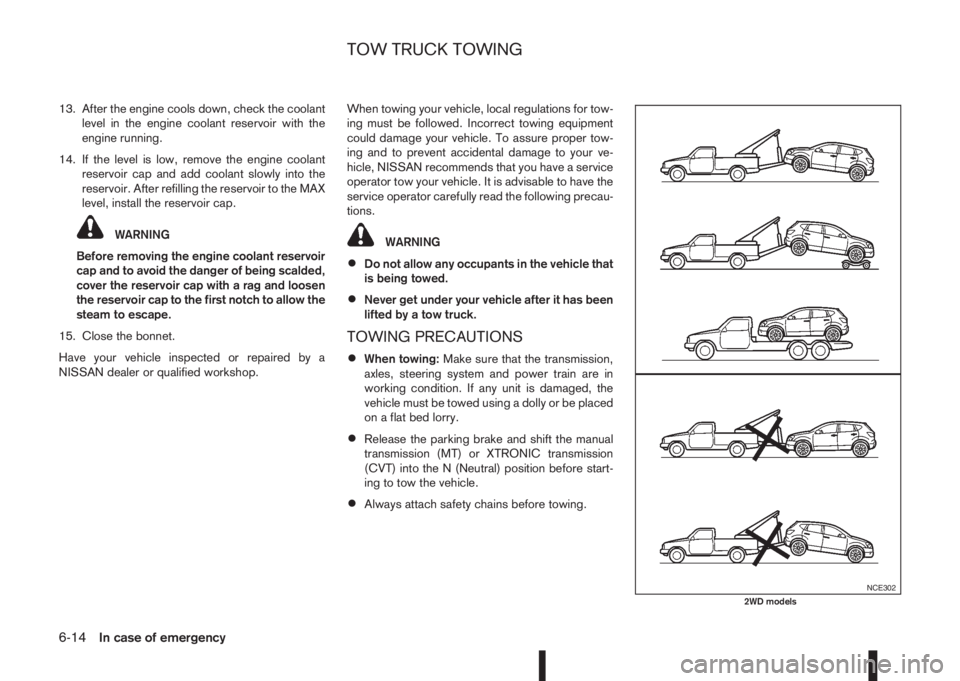
NISSAN dealer or qualified workshop.When towing your vehicle, local regulations for tow-
ing must be followed. Incorrect towing equipment
could damage your vehicle. To assure proper tow-
ing and to prevent accidental damage to your ve-
hicle, NISSAN recommends that you have a service
operator tow your vehicle. It is advisable to have the
service operator carefully read the following precau-
tions.WARNING
•Do not allow any occupants in the vehicle that
is being towed.
•Never get under your vehicle after it has been
lifted by a tow truck.
TOWING PRECAUTIONS
•When towing:Make sure that the transmission,
axles, steering system and power train are in
working condition. If any unit is damaged, the
vehicle must be towed using a dolly or be placed
on a flat bed lorry.
•Release the parking brake and shift the manual
transmission (MT) or XTRONIC transmission
(CVT) into the N (Neutral) position before start-
ing to tow the vehicle.
•Always attach safety chains before towing.
NCE3022WD models
TOW TRUCK TOWING
6-14In case of emergency
Page 323 of 338
Difference between predictive and actual distances ............... 4-9
Dimensions ........................................................................... 9-6
Door locks ............................................................................ 3-8
– Back door ..................................................................... 3-11
– Child safety rear door locks ........................................... 3-11
– Locking/unlocking with the key — vehicle dead battery .... 3-9
– Power door lock switch ................................................. 3-10
– Remote keyless entry system ........................................... 3-4
– Super Lock system .......................................................... 3-8
– When leaving the vehicle ............................................... 3-10
Drive belts ........................................................................... 8-20
Driving
– Care when driving ......................................................... 5-10
– Cold weather driving ..................................................... 5-66
– Driving four-wheel drive (4WD) safely ............................ 5-28
– Driving on wet road ....................................................... 5-10
– Driving the vehicle ......................................................... 5-17
– Driving under winter conditions ...................................... 5-10
– Driving with manual transmission ................................... 5-17
– On-pavement and off-road driving precautions ................. 5-9
– Precautions when starting and driving .............................. 5-3
– Stop/Start System ......................................................... 5-22
E
ECO mode system .............................................................. 5-65
Electric power steering system ............................................ 5-57
Electronic Stability Programme (ESP) system ...................... 5-60
– ESP OFF switch ........................................................... 5-61
Emergency tyre puncture repair kit ............................... 6-8, 8-36
Emergency/mechanical key ................................................... 3-3
Engine
– Before starting the engine ................................................ 5-2
– Changing engine coolant ................................................. 8-6
– Changing engine oil ......................................................... 8-9
– Changing engine oil filter ............................................... 8-10– Checking engine coolant level ......................................... 8-6
– Checking engine oil level ................................................. 8-8
– Data ................................................................................ 9-5
– Engine cold start period ................................................. 5-10
– Engine compartment .............................................. 0-11, 8-5
– Engine coolant ............................................................... 5-66
– Engine coolant temperature gauge ................................... 2-3
– Engine cooling system ..................................................... 8-6
– Engine oil ........................................................................ 8-8
– Engine overheat ............................................................. 6-13
– Engine serial number ....................................................... 9-7
– Fuel filter (Diesel engine models) ................................... 8-13
– Starting engine .............................................................. 5-15
Exhaust gas (Carbon Monoxide) ............................................ 5-3
Exterior lights ...................................................................... 8-29
F
Filter
– Air cleaner filter ............................................................. 8-23
– Air conditioner filter .............................................. 4-19, 4-22
– Fuel filter (Diesel engine models) ................................... 8-13
Floor mats ............................................................................. 7-4
Fluid
– Brake and clutch fluid .................................................... 8-14
– Continuously variable transmission fluid ......................... 8-13
– Window washer/headlight cleaner fluid .......................... 8-15
Fog light
– Front fog light ................................................................ 2-38
– Rear fog light ................................................................. 2-39
Forward emergency braking system .................................... 5-40
Four-wheel drive (4WD) ...................................................... 5-26
– Driving four-wheel drive (4WD) safely ............................ 5-28
– Four-wheel drive (4WD) model (Tyres) .......................... 8-35
– Four-wheel drive mode indicator light ............................. 5-28
Index10-3
Page 325 of 338
– Starting the engine .......................................................... 3-8
Intelligent Parking Assist (IPA) ............................................. 5-46
Interior lights .............................................................. 2-50, 8-29
iPod® player operation ........................................................ 4-31
ISOFIX ................................................................................ 1-19
ISOFIX child restraint system .............................................. 1-21
J
Jump-starting .............................................................. 6-11, 8-18
K
Key ....................................................................................... 3-2
– Immobilizer ...................................................................... 3-2
– Integrated keyfob (remote control system) ....................... 3-4
– Intelligent Key battery discharge .................................... 5-14
– Intelligent Key operating range ......................................... 3-6
– Intelligent Key system ............................................. 3-6, 5-12
– Key positions (Ignition switch) ........................................ 5-11
– NISSAN Anti-Theft System (NATS) ................................. 3-2
– NISSAN Anti-Theft System (NATS) key ........................... 3-2
– Radio approval number and information ........................... 9-8
– Remote keyless entry system ........................................... 3-4
– Using Intelligent Key system ............................................ 3-6
L
Lane Departure Warning (LDW) .......................................... 5-33
– LDW system operation .................................................. 5-34
Legal requirements .............................................................. 1-15
Light
– Exterior lights ................................................................. 8-29
– Fog light switch ............................................................. 2-38– Hazard warning flasher switch ......................................... 6-2
– Headlight aiming control switch ..................................... 2-39
– Headlight and turn signal switch .................................... 2-36
– Headlight cleaner .......................................................... 2-40
– Headlight switch ............................................................ 2-36
– Headlights ..................................................................... 8-28
– Interior lights ........................................................ 2-50, 8-29
– LED headlight ................................................................ 8-28
– Light locations ............................................................... 8-30
– Luggage compartment ................................................... 2-51
– Map lights ..................................................................... 2-50
– Rear room/reading light ................................................. 2-51
– Trailer direction indicator light ........................................ 5-56
– Turn signal switch .......................................................... 2-38
– Warning/indicator lights and audible reminders ................ 2-4
Lock
– Anti-Lock Braking System (ABS) ................................... 5-59
– Back door lock .............................................................. 3-11
– Child safety rear door locks ........................................... 3-11
– Door locks ....................................................................... 3-8
– Power door lock switch ................................................. 3-10
– Steering lock ........................................................ 5-11, 5-14
– Super Lock system .......................................................... 3-8
– Unlocking with inside door handle .................................. 3-10
Luggage compartment
– Luggage floor ................................................................ 2-47
M
Maintenance
– Camera unit maintenance .............................................. 5-33
– General maintenance ....................................................... 8-2
– Maintenance precautions ................................................. 8-4
– Maintenance requirements ............................................... 8-2
– Multi-sensing camera unit .............................................. 5-35
Manual transmission
– Driving with manual transmission ................................... 5-17
Index10-5
Page 326 of 338
Map lights ........................................................................... 2-50
Maximum load limits (for Australia) ....................................... 5-55
Mechanical/emergency key ................................................... 3-3
Meter and gauges
– Engine coolant temperature gauge ................................... 2-3
– Fuel gauge ...................................................................... 2-2
– Speedometer .................................................................. 2-2
– Tachometer ..................................................................... 2-2
Meters and gauges ............................................................... 2-2
Mirror .................................................................................. 3-18
– Automatic anti-dazzling inside mirror ....................... 3-19, 7-5
– Inside rear-view mirror ................................................... 3-18
– Outside rear-view mirrors .............................................. 3-19
– Vanity mirror .................................................................. 3-20
Mobile phone integration for FM AM radio with CD player ... 4-39
Monitor display
– Monitor display’s maintenance ......................................... 7-4
– Rear-view monitor ............................................................ 4-2
Moving object detection (MOD) ........................................... 4-12
N
NISSAN Anti-Theft System (NATS) .............................. 3-2, 5-12
– NATS key ........................................................................ 3-2
– NATS security indicator light .......................................... 3-13
– Radio approval number and information ........................... 9-8
O
Odometer/twin trip odometer ................................................ 2-2
Oil
– Changing engine oil ......................................................... 8-9
– Changing engine oil filter ............................................... 8-10
– Checking engine oil level ................................................. 8-8
– Engine oil ........................................................................ 8-8– Recommended lubricants ................................................ 9-2
– Recommended SAE viscosity number .............................. 9-4
On-pavement and off-road driving precautions ....................... 5-9
Overheat
– Engine overheat ............................................................. 6-13
P
Parcel shelf
– Installation ..................................................................... 2-45
– Removal ........................................................................ 2-45
Parking ............................................................................... 5-43
– Ultrasonic parking sensors ............................................. 5-45
Parking brake switch ........................................................... 3-16
Phone
– Bluetooth® .................................................................... 4-39
– Mobile phone integration for FM AM radio with CD
player ............................................................................ 4-39
Power
– Electric power steering system ...................................... 5-57
– Power door lock switch ................................................. 3-10
– Power outlet .................................................................. 2-42
Pre-tensioner seat belt system ............................................. 1-13
Precautions
– Audio operation precautions .......................................... 4-23
– Brake precautions ......................................................... 5-58
– Cruise control precautions ............................................. 5-36
– Maintenance precautions ................................................. 8-4
– On-pavement and off-road driving precautions ................. 5-9
– Operating precautions (trailer) ....................................... 5-54
– Precautions on push-button ignition switch operation ..... 5-12
– Precautions on Supplemental Restraint System ............. 1-29
– Safety precautions ........................................................... 4-2
– Towing precautions ....................................................... 6-14
– When starting and driving ................................................ 5-3
Precautions on child restraints ............................................. 1-15
10-6Index
Page 328 of 338
Spare tyre ............................................................................. 6-2
Spark plugs (Petrol engine models) ..................................... 8-21
Speed limiter ....................................................................... 5-38
Speed limiter operations ...................................................... 5-39
Speedometer ........................................................................ 2-2
Starting
– Before starting the engine ................................................ 5-2
– Jump-starting ........................................................ 6-11, 8-18
– Precautions when starting and driving .............................. 5-3
– Push-starting ................................................................. 6-13
– Starting engine .............................................................. 5-15
Steering
– Electric power steering system ...................................... 5-57
– Phone operating buttons ................................................ 4-44
– Steering lock ........................................................ 5-11, 5-14
– Steering wheel adjustment ............................................. 3-18
– Steering wheel switches for hands-free telephone
control ........................................................................... 4-44
– Steering-wheel switch for audio control ......................... 4-38
– Telephone button ........................................................... 4-39
Stop/Start System ............................................................... 5-22
Storage ............................................................................... 2-42
– Bottle holder .................................................................. 2-44
– Coat hooks ................................................................... 2-44
– Console box .................................................................. 2-43
– Cup holder .................................................................... 2-44
– Glove box ...................................................................... 2-42
– Luggage hooks ............................................................. 2-47
– Luggage/boot compartment ........................................... 2-47
– Map pockets ................................................................. 2-44
– Roof rail ........................................................................ 2-45
– Seat pockets ................................................................. 2-44
– Storage trays ................................................................. 2-42
– Sunglasses holder ......................................................... 2-43
Sun visors ........................................................................... 3-18
Sunshade
– Sunshade operation ...................................................... 2-50Super Lock system ............................................................... 3-8
– Emergency situations ....................................................... 3-9
– Power door lock switch ................................................. 3-11
Supplemental Restraint System ........................................... 1-29
Supplemental Restraint System (air bag system)
– Air bag system .............................................................. 1-29
Switch
– Defogger switch ............................................................ 2-35
– Fog light switch ............................................................. 2-38
– Front passenger air bag switch ...................................... 1-34
– Headlight and turn signal switch .................................... 2-36
– Headlight cleaner switch ................................................ 2-40
– Ignition switch positions ................................................. 5-13
– Ignition switch push button ............................................ 5-12
– Power door lock switch ................................................. 3-10
– Precautions on push-button ignition switch operation ..... 5-12
– Push-button ignition switch ............................................ 5-12
– Room light control switch .............................................. 2-50
– Wiper and washer switch .............................................. 2-32
Switch - Defogger switch
– ThermaClear ................................................................. 2-34
System operation ................................................................ 5-41
T
Tachometer ........................................................................... 2-2
Temporary-use spare tyre ...................................................... 6-2
ThermaClear Heated Windscreen
– ThermaClear Heated Windscreen button ....................... 2-34
Three-point type seat belts .................................................. 1-11
Three-way catalyst (Petrol engine models) ............................. 5-9
Tilting steering wheel ........................................................... 3-18
Towing
– Recommended towing for four-wheel drive (4WD)
models .......................................................................... 6-15
10-8Index