fuel NISSAN QASHQAI 2014 Owner´s Manual
[x] Cancel search | Manufacturer: NISSAN, Model Year: 2014, Model line: QASHQAI, Model: NISSAN QASHQAI 2014Pages: 338, PDF Size: 4.87 MB
Page 278 of 338
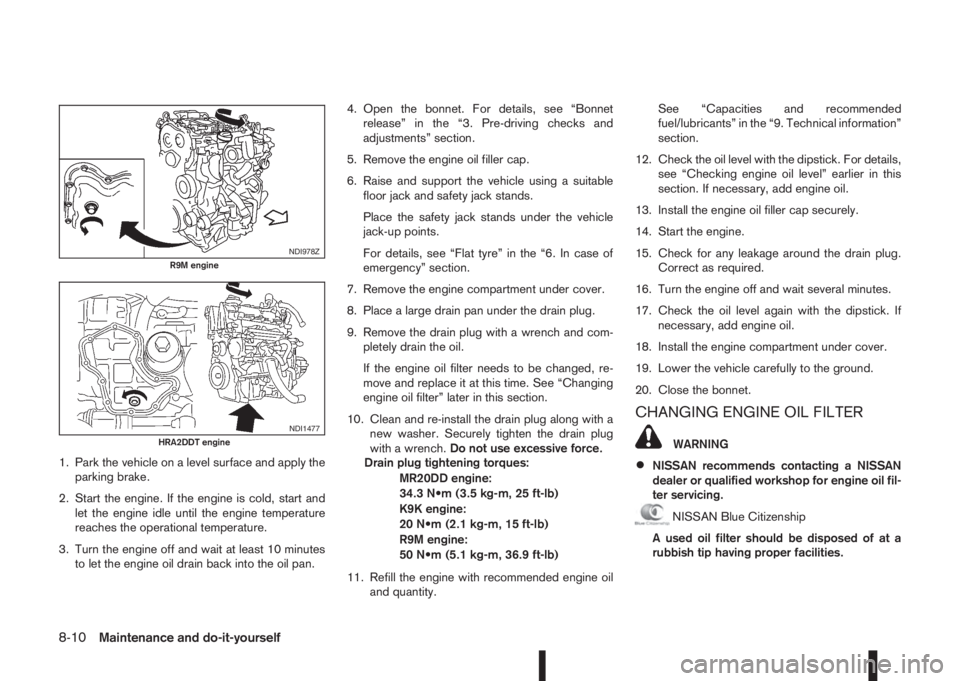
1. Park the vehicle on a level surface and apply the
parking brake.
2. Start the engine. If the engine is cold, start and
let the engine idle until the engine temperature
reaches the operational temperature.
3. Turn the engine off and wait at least 10 minutes
to let the engine oil drain back into the oil pan.4. Open the bonnet. For details, see “Bonnet
release” in the “3. Pre-driving checks and
adjustments” section.
5. Remove the engine oil filler cap.
6. Raise and support the vehicle using a suitable
floor jack and safety jack stands.
Place the safety jack stands under the vehicle
jack-up points.
For details, see “Flat tyre” in the “6. In case of
emergency” section.
7. Remove the engine compartment under cover.
8. Place a large drain pan under the drain plug.
9. Remove the drain plug with a wrench and com-
pletely drain the oil.
If the engine oil filter needs to be changed, re-
move and replace it at this time. See “Changing
engine oil filter” later in this section.
10. Clean and re-install the drain plug along with a
new washer. Securely tighten the drain plug
with a wrench.Do not use excessive force.
Drain plug tightening torques:
MR20DD engine:
34.3 N•m (3.5 kg-m, 25 ft-lb)
K9K engine:
20 N•m (2.1 kg-m, 15 ft-lb)
R9M engine:
50 N•m (5.1 kg-m, 36.9 ft-lb)
11. Refill the engine with recommended engine oil
and quantity.See “Capacities and recommended
fuel/lubricants” in the “9. Technical information”
section.
12. Check the oil level with the dipstick. For details,
see “Checking engine oil level” earlier in this
section. If necessary, add engine oil.
13. Install the engine oil filler cap securely.
14. Start the engine.
15. Check for any leakage around the drain plug.
Correct as required.
16. Turn the engine off and wait several minutes.
17. Check the oil level again with the dipstick. If
necessary, add engine oil.
18. Install the engine compartment under cover.
19. Lower the vehicle carefully to the ground.
20. Close the bonnet.
CHANGING ENGINE OIL FILTER
WARNING
•NISSAN recommends contacting a NISSAN
dealer or qualified workshop for engine oil fil-
ter servicing.
NISSAN Blue Citizenship
A used oil filter should be disposed of at a
rubbish tip having proper facilities.
NDI978ZR9M engine
NDI1477HRA2DDT engine
8-10Maintenance and do-it-yourself
Page 279 of 338
MR20DD and K9K engines
Removal:
1. Drain the engine oil. For details, see “Changing
engine oil” earlier in this section.
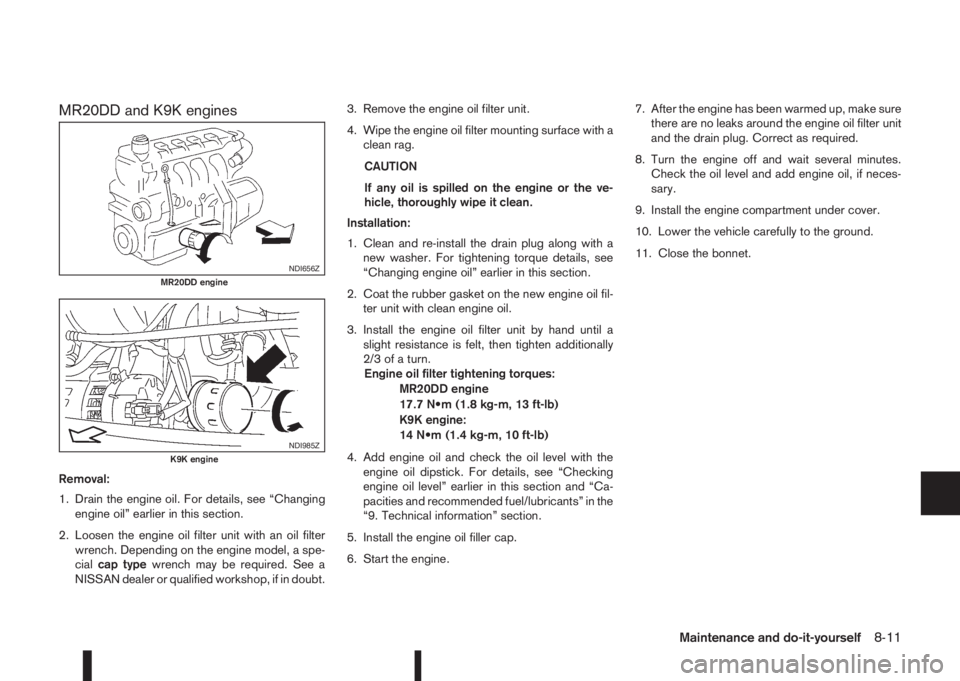
2. Loosen the engine oil filter unit with an oil filter
wrench. Depending on the engine model, a spe-
cialcap typewrench may be required. See a
NISSAN dealer or qualified workshop, if in doubt.3. Remove the engine oil filter unit.
4. Wipe the engine oil filter mounting surface with a
clean rag.
CAUTION
If any oil is spilled on the engine or the ve-
hicle, thoroughly wipe it clean.
Installation:
1. Clean and re-install the drain plug along with a
new washer. For tightening torque details, see
“Changing engine oil” earlier in this section.
2. Coat the rubber gasket on the new engine oil fil-
ter unit with clean engine oil.
3. Install the engine oil filter unit by hand until a
slight resistance is felt, then tighten additionally
2/3 of a turn.
Engine oil filter tightening torques:
MR20DD engine
17.7 N•m (1.8 kg-m, 13 ft-lb)
K9K engine:
14 N•m (1.4 kg-m, 10 ft-lb)
4. Add engine oil and check the oil level with the
engine oil dipstick. For details, see “Checking
engine oil level” earlier in this section and “Ca-
pacities and recommended fuel/lubricants” in the
“9. Technical information” section.
5. Install the engine oil filler cap.
6. Start the engine.7. After the engine has been warmed up, make sure
there are no leaks around the engine oil filter unit
and the drain plug. Correct as required.
8. Turn the engine off and wait several minutes.
Check the oil level and add engine oil, if neces-
sary.
9. Install the engine compartment under cover.
10. Lower the vehicle carefully to the ground.
11. Close the bonnet.
NDI656ZMR20DD engine
NDI985ZK9K engine
Maintenance and do-it-yourself8-11
Page 280 of 338
R9M and HRA2DDT engines
Removal:
1. Drain the engine oil. For details, see “Changing
engine oil” earlier in this section.
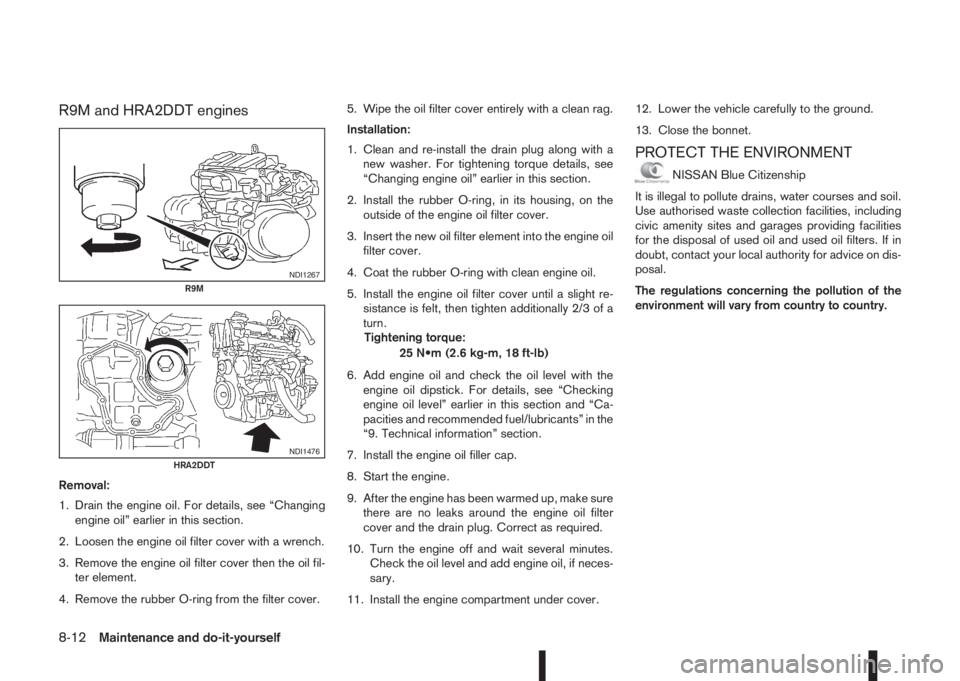
2. Loosen the engine oil filter cover with a wrench.
3. Remove the engine oil filter cover then the oil fil-
ter element.
4. Remove the rubber O-ring from the filter cover.5. Wipe the oil filter cover entirely with a clean rag.
Installation:
1. Clean and re-install the drain plug along with a
new washer. For tightening torque details, see
“Changing engine oil” earlier in this section.
2. Install the rubber O-ring, in its housing, on the
outside of the engine oil filter cover.
3. Insert the new oil filter element into the engine oil
filter cover.
4. Coat the rubber O-ring with clean engine oil.
5. Install the engine oil filter cover until a slight re-
sistance is felt, then tighten additionally 2/3 of a
turn.
Tightening torque:
25 N•m (2.6 kg-m, 18 ft-lb)
6. Add engine oil and check the oil level with the
engine oil dipstick. For details, see “Checking
engine oil level” earlier in this section and “Ca-
pacities and recommended fuel/lubricants” in the
“9. Technical information” section.
7. Install the engine oil filler cap.
8. Start the engine.
9. After the engine has been warmed up, make sure
there are no leaks around the engine oil filter
cover and the drain plug. Correct as required.
10. Turn the engine off and wait several minutes.
Check the oil level and add engine oil, if neces-
sary.
11. Install the engine compartment under cover.12. Lower the vehicle carefully to the ground.
13. Close the bonnet.
PROTECT THE ENVIRONMENT
NISSAN Blue Citizenship
It is illegal to pollute drains, water courses and soil.
Use authorised waste collection facilities, including
civic amenity sites and garages providing facilities
for the disposal of used oil and used oil filters. If in
doubt, contact your local authority for advice on dis-
posal.
The regulations concerning the pollution of the
environment will vary from country to country.
NDI1267R9M
NDI1476HRA2DDT
8-12Maintenance and do-it-yourself
Page 281 of 338
DRAINING WATER
Drain the water from the fuel filter. Contact a
NISSAN dealer or qualified workshop.:
BLEEDING THE FUEL SYSTEM
There is no need to perform any special operation to
bleed air from the system.
NISSAN Blue Citizenship
Fuel bled from the fuel filter must not be poured into
the ground, canals, rivers, etc. It should be disposed
of at a rubbish tip having proper facilities. Check
your local regulations.When checking or replacement is required, NISSAN
recommends contacting a NISSAN dealer or quali-
fied workshop for servicing.
CAUTION
•Use only Genuine NISSAN CVT Fluid NS3*. Do
not mix with other fluids.
•Using transmission fluid other than Genuine
NISSAN CVT Fluid NS3* will damage the
XTRONIC transmission, which is not covered
by the warranty.
*: For details, contact a NISSAN dealer or quali-
fied workshop.
CHECKING PARKING BRAKE
Periodically check the holding ability of the parking
brake by parking on a steep hill and restraining the
vehicle by using only the parking brake. If it does not
hold satisfactorily, see a NISSAN dealer or qualified
workshop.
CHECKING BRAKE PEDAL
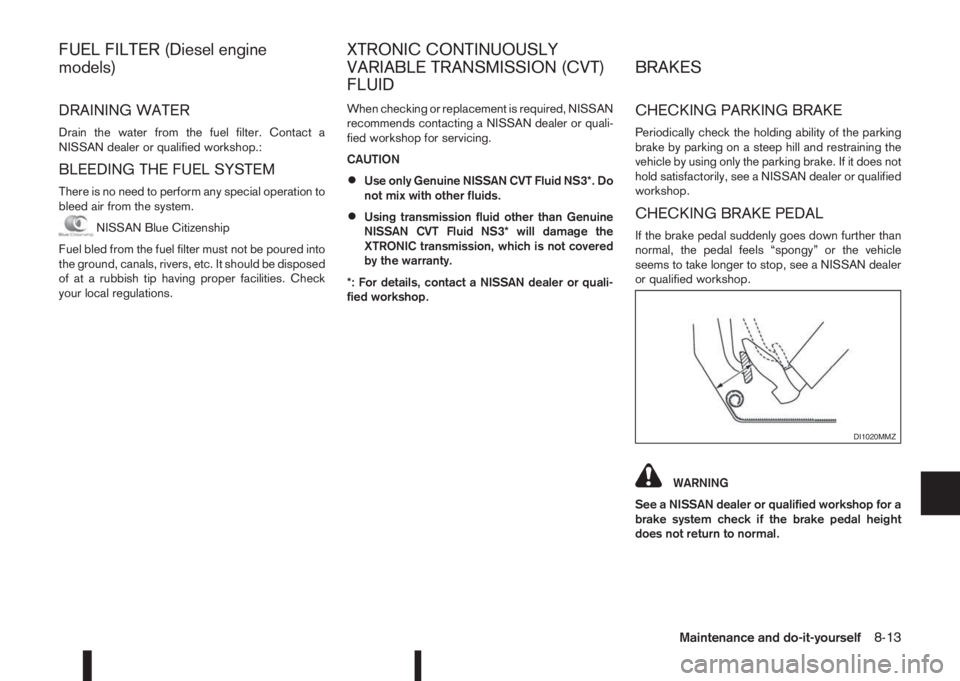
If the brake pedal suddenly goes down further than
normal, the pedal feels “spongy” or the vehicle
seems to take longer to stop, see a NISSAN dealer
or qualified workshop.
WARNING
See a NISSAN dealer or qualified workshop for a
brake system check if the brake pedal height
does not return to normal.
DI1020MMZ
FUEL FILTER (Diesel engine
models)XTRONIC CONTINUOUSLY
VARIABLE TRANSMISSION (CVT)
FLUIDBRAKES
Maintenance and do-it-yourself8-13
Page 283 of 338
See “Capacities and recommended fuel/lubricants”
in the “9. Technical information” section for the rec-
ommended brake and clutch fluid type.
If fluid must be added frequently, the system should
be thoroughly checked by a NISSAN dealer or quali-
fied workshop.
CAUTION
•NISSAN recommends that refilling and check-
ing the brake and clutch systems should be
left to a NISSAN dealer or qualified workshop
who will have the necessary fluids and techni-
cal knowledge.
•Do not spill the fluid on painted surfaces. This
will damage the paint. If fluid is spilled, wash
with water.
WARNING
Anti-freeze window washer is poisonous and
should be stored carefully in marked containers
out of the reach of children.
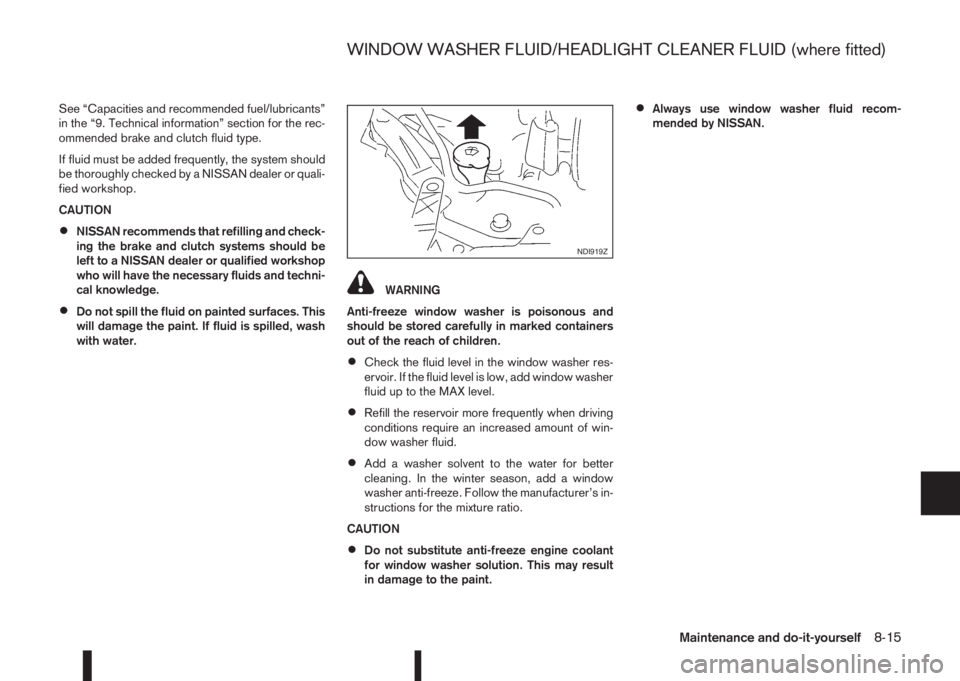
•Check the fluid level in the window washer res-
ervoir. If the fluid level is low, add window washer
fluid up to the MAX level.
•Refill the reservoir more frequently when driving
conditions require an increased amount of win-
dow washer fluid.
•Add a washer solvent to the water for better
cleaning. In the winter season, add a window
washer anti-freeze. Follow the manufacturer’s in-
structions for the mixture ratio.
CAUTION
•Do not substitute anti-freeze engine coolant
for window washer solution. This may result
in damage to the paint.
•Always use window washer fluid recom-
mended by NISSAN.
NDI919Z
WINDOW WASHER FLUID/HEADLIGHT CLEANER FLUID (where fitted)
Maintenance and do-it-yourself8-15
Page 305 of 338
9Technical informationTechnical information
Capacities and recommended fuel/lubricants ........... 9-2
Fuel information .................................................. 9-4
Recommended SAE viscosity number ................. 9-4
Engine ..................................................................... 9-5
Wheels and Tyres .................................................... 9-5
Dimensions .............................................................. 9-6
When travelling or transferring your registration to
another country........................................................ 9-6
Vehicle identification ................................................ 9-6
Vehicle identification plate ................................... 9-6
Vehicle identification number (VIN) (chassis
number).............................................................. 9-7Engine serial number .......................................... 9-7
Tyre placard ....................................................... 9-8
Air conditioner specification label (where
fitted).................................................................. 9-8
Approval numbers.................................................... 9-8
NISSAN Anti-Theft System (NATS), Intelligent
or remote keyless system.................................... 9-8
Tyre Pressure Monitoring System (TPMS)
(Transmitter) ....................................................... 9-9
Page 306 of 338
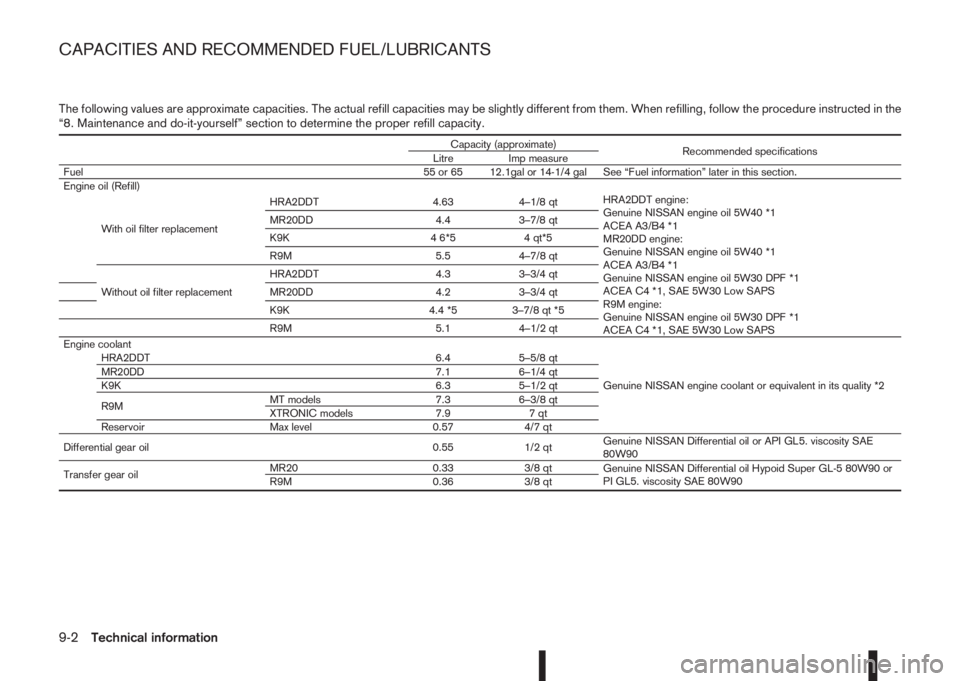
The following values are approximate capacities. The actual refill capacities may be slightly different from them. When refilling, follow the procedure instructed in the
“8. Maintenance and do-it-yourself” section to determine the proper refill capacity.
Capacity (approximate)
Recommended specifications
Litre Imp measure
Fuel 55 or 65 12.1gal or 14-1/4 gal See “Fuel information” later in this section
.Engine oil (Refill)
With oil filter replacementHRA2DDT 4.63 4–1/8 qtHRA2DDT engine:
Genuine NISSAN engine oil 5W40 *1
ACEA A3/B4 *1
MR20DD engine:
Genuine NISSAN engine oil 5W40 *1
ACEA A3/B4 *1
Genuine NISSAN engine oil 5W30 DPF *1
ACEA C4 *1, SAE 5W30 Low SAPS
R9M engine:
Genuine NISSAN engine oil 5W30 DPF *1
ACEA C4 *1, SAE 5W30 Low SAPS MR20DD 4.4 3–7/8 qt
K9K 4 6*5 4 qt*5
R9M 5.5 4–7/8 qt
Without oil filter replacementHRA2DDT 4.3 3–3/4 qt
MR20DD 4.2 3–3/4 qt
K9K 4.4 *5 3–7/8 qt *5
R9M 5.1 4–1/2 qt
Engine coolant
Genuine NISSAN engine coolant or equivalent in its quality *2 HRA2DDT 6.4 5–5/8 qt
MR20DD 7.1 6–1/4 qt
K9K 6.3 5–1/2 qt
R9MMT models 7.3 6–3/8 qt
XTRONIC models 7.9 7 qt
Reservoir Max level 0.57 4/7 qt
Differential gear oil 0.55 1/2 qtGenuine NISSAN Differential oil or API GL5. viscosity SAE
80W90
Transfer gear oilMR20 0.33 3/8 qt
Genuine NISSAN Differential oil Hypoid Super GL-5 80W90 or
PI GL5. viscosity SAE 80W90
R9M 0.36 3/8 qt
CAPACITIES AND RECOMMENDED FUEL/LUBRICANTS
9-2Technical information
Page 308 of 338
FUEL INFORMATION
Petrol engine
CAUTION
Do not use leaded petrol. Using leaded petrol will
damage the catalytic converter.
MR20DD engine:
Use UNLEADED REGULAR petrol with an octane
rating of at least 91 (RON).
HRA2DDT engine:
Use UNLEADED PREMIUM petrol with an octane
rating of at least 95 (RON).
Diesel engine
Diesel fuel above 51 cetane and with less than 10
ppm of sulphur (EN590 and Euro 5 specification)
must be used.
If two types of diesel fuel are available, use summer
or winter fuel properly according to the following
temperature conditions.
•Above –7°C (20°F)...Summer type diesel fuel.
•Below–7°C(20°F)...Wintertypedieselfuel.
If you are in any doubt, please consult a NISSAN
dealer or qualified workshop.
CAUTION
•Do not use home heating oil, petrol or other
alternate fuels in the diesel engine, this can
cause engine damage.
•Do not add petrol or other alternate fuels to
diesel fuel.
•Do not use summer fuel at temperatures be-
low −7°C (20°F). Cold temperatures will cause
wax to form in the fuel and may prevent the
engine from running smoothly.
RECOMMENDED SAE VISCOSITY
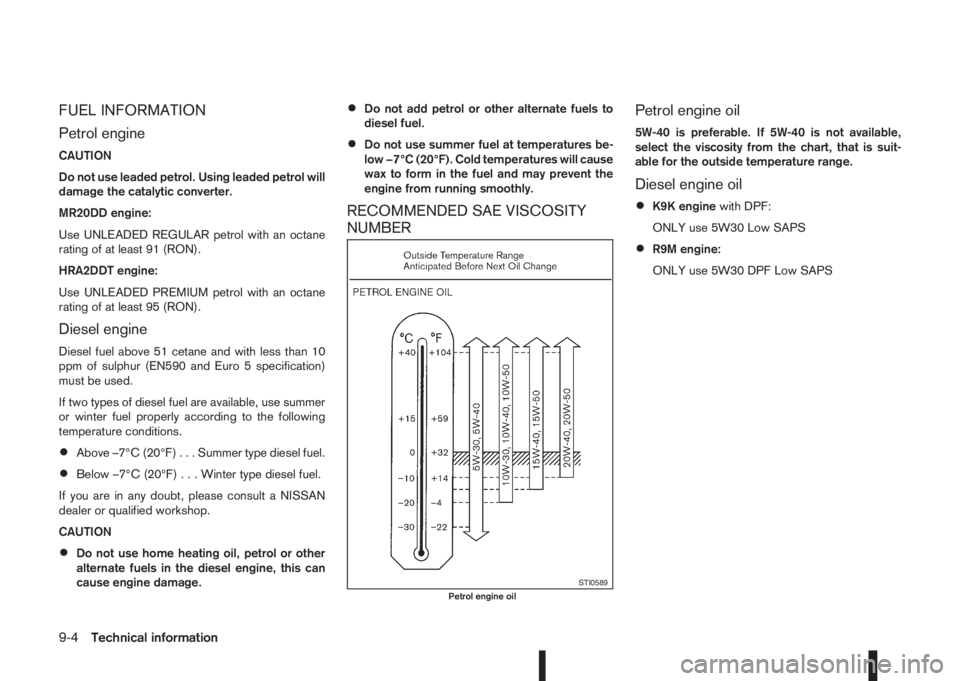
NUMBERPetrol engine oil
5W-40 is preferable. If 5W-40 is not available,
select the viscosity from the chart, that is suit-
able for the outside temperature range.
Diesel engine oil
•K9K enginewith DPF:
ONLY use 5W30 Low SAPS
•R9M engine:
ONLY use 5W30 DPF Low SAPS
STI0589Petrol engine oil
9-4Technical information
Page 310 of 338
Unit: mm (in)
Model mm (in.)
Overall length 2WD/ 4WD 4379 (172.3)
Overall width 2WD/ 4WD 1806 (71.1)
Overall height 2WD 1590 (62.6)
4WD 1595 (62.8)
2WD 1624 (63.9)*1
4WD 1630 (64.2)*1
Front tread 2WD/ 4WD 1560 (61.4)
Rear tread 2WD 1560 (61.4)
2WD*2/4WD 1550 (61)
Wheelbase 2WD/ 4WD 2646 (104.2)
*1 : with roof rail
*2: models with Independent Multi-link type suspen-
sion (where fitted)When planning to travel in another country,you
should first find out if the fuel available is suitable for
your vehicle’s engine.
Using fuel with too low octane/cetane rating may
cause engine damage. Therefore, avoid taking your
vehicle to areas where appropriate fuel is not avail-
able.
When transferring your vehicle registration to an-
other country,check with the appropriate authori-
ties that the vehicle complies with the requirements
as it may not be possible to adapt it. In some cases,
a vehicle cannot meet the legal requirements and in
other cases, it may be necessary to modify the ve-
hicle to meet specific laws and regulations.
The laws and regulations for motor vehicle emission
control and safety standards vary according to the
country; therefore, vehicle specifications may differ.
NISSAN is not responsible for any inconvenience
when the vehicle is taken and registered into an-
other country. The necessary modifications,
transportation and registration are the owner’s
responsibility.
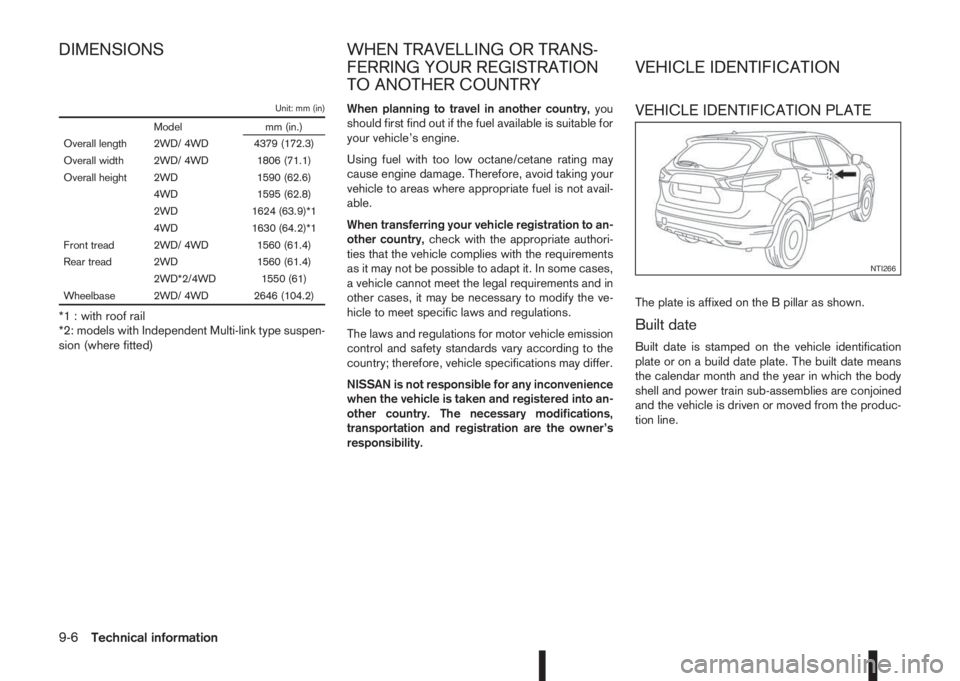
VEHICLE IDENTIFICATION PLATE
The plate is affixed on the B pillar as shown.
Built date
Built date is stamped on the vehicle identification
plate or on a build date plate. The built date means
the calendar month and the year in which the body
shell and power train sub-assemblies are conjoined
and the vehicle is driven or moved from the produc-
tion line.
NTI266
DIMENSIONS WHEN TRAVELLING OR TRANS-
FERRING YOUR REGISTRATION
TO ANOTHER COUNTRYVEHICLE IDENTIFICATION
9-6Technical information
Page 322 of 338
– Checking brake pedal ................................................... 8-13
– Checking parking brake ................................................. 8-13
– Parking brake ................................................................ 3-16
– Trailer brakes ................................................................ 5-55
C
Cable slots .......................................................................... 2-43
Capacities and recommended fuel/lubricants ......................... 9-2
– Fuel information ............................................................... 9-4
Car phone or CB radio ........................................................ 4-45
Care when driving ............................................................... 5-10
Cargo compartment
– Cargo floor .................................................................... 2-47
CENTRE mark on rear centre seat ...................................... 1-12
Changing
– Changing engine coolant ................................................. 8-6
– Changing engine oil ......................................................... 8-9
– Changing engine oil filter ............................................... 8-10
– Changing tyres and wheels ........................................... 8-35
Chassis control ................................................................... 5-62
Checking
– Checking brake pedal ................................................... 8-13
– Checking engine coolant level ......................................... 8-6
– Checking engine oil level ................................................. 8-8
– Checking parking brake ................................................. 8-13
Child restraint anchorage .................................................... 1-22
Child restraint and ISOFIX information ................................. 1-16
Child restraint installation using 3-point type seat belt .......... 1-25
Child restraint installation using ISOFIX ............................... 1-23
Child restraint systems (CRS)
– ISOFIX .......................................................................... 1-17
– Recommended .............................................................. 1-17
– Suitable ......................................................................... 1-17
Child restraints .................................................................... 1-15Child safety .................................................................. 1-14, 1-9
Cleaning
– Alloy wheels .................................................................... 7-3
– Chrome parts .................................................................. 7-3
– Exterior ............................................................................ 7-2
– Glass ....................................................................... 7-3, 7-5
– Interior ............................................................................ 7-4
– Plastic parts .................................................................... 7-5
– Rear-view camera lens .................................................... 7-3
– Removing spots ............................................................... 7-2
– Underbody ...................................................................... 7-3
Clutch fluid .......................................................................... 8-14
Coat hooks ......................................................................... 2-44
Cold weather driving ........................................................... 5-66
Console box ........................................................................ 2-43
Continuously variable transmission
– Continuously variable transmission fluid ......................... 8-13
– Driving with continuously variable transmission ............. 5-18
Coolant
– Changing engine coolant ................................................. 8-6
– Checking engine coolant level ......................................... 8-6
– Engine coolant ............................................................... 5-66
– Engine coolant temperature gauge ................................... 2-3
– Engine cooling system ..................................................... 8-6
Corrosion protection .................................................... 5-67, 7-5
– Environmental factors ...................................................... 7-5
Cruise control ..................................................................... 5-36
Cruise control system operations ......................................... 5-37
CVT
– Driving with XTRONIC transmission .............................. 5-18
D
Defogger switch
– Outside mirror defogger ................................................ 2-35
– Rear window defogger .................................................. 2-35
10-2Index