eco NISSAN QASHQAI 2015 Owner´s Manual
[x] Cancel search | Manufacturer: NISSAN, Model Year: 2015, Model line: QASHQAI, Model: NISSAN QASHQAI 2015Pages: 338, PDF Size: 4.88 MB
Page 47 of 338
5. Test the child restraint before you place the child
in itj5 . Push the child restraint from side to side
and tug it forward to make sure that it is held
securely in place.
6. Check to make sure that the child restraint is
properly secured prior to each use. If the child
restraint is loose, repeat steps 3 through 5.
Installation on front passenger’s seat
WARNING
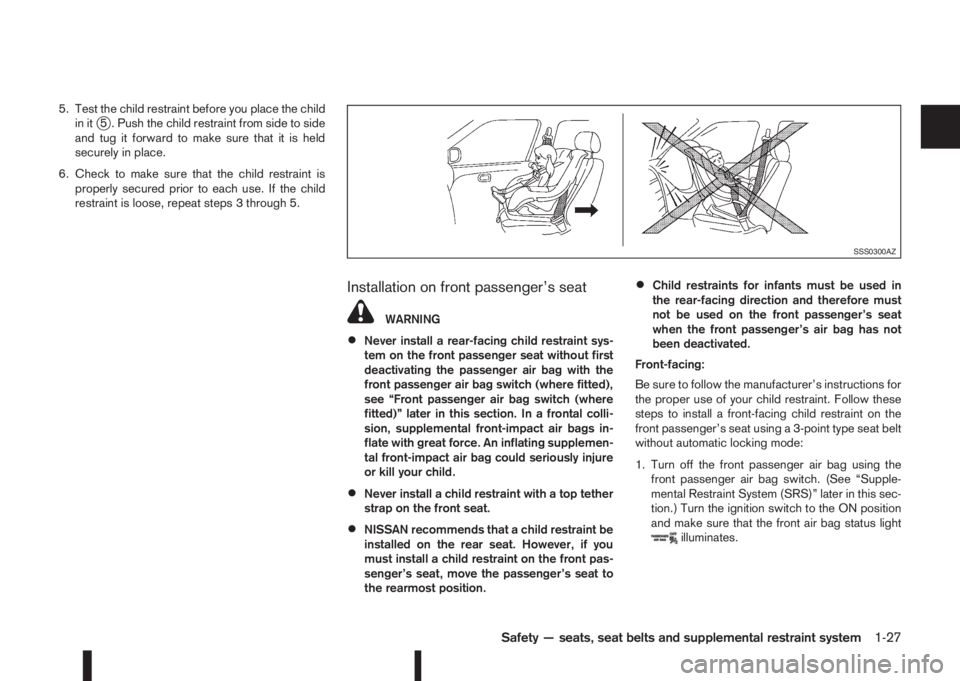
•Never install a rear-facing child restraint sys-
tem on the front passenger seat without first
deactivating the passenger air bag with the
front passenger air bag switch (where fitted),
see “Front passenger air bag switch (where
fitted)” later in this section. In a frontal colli-
sion, supplemental front-impact air bags in-
flate with great force. An inflating supplemen-
tal front-impact air bag could seriously injure
or kill your child.
•Never install a child restraint with a top tether
strap on the front seat.
•NISSAN recommends that a child restraint be
installed on the rear seat. However, if you
must install a child restraint on the front pas-
senger’s seat, move the passenger’s seat to
the rearmost position.
•Child restraints for infants must be used in
the rear-facing direction and therefore must
not be used on the front passenger’s seat
when the front passenger’s air bag has not
been deactivated.
Front-facing:
Be sure to follow the manufacturer’s instructions for
the proper use of your child restraint. Follow these
steps to install a front-facing child restraint on the
front passenger’s seat using a 3-point type seat belt
without automatic locking mode:
1. Turn off the front passenger air bag using the
front passenger air bag switch. (See “Supple-
mental Restraint System (SRS)” later in this sec-
tion.) Turn the ignition switch to the ON position
and make sure that the front air bag status light
illuminates.
SSS0300AZ
Safety — seats, seat belts and supplemental restraint system1-27
Page 48 of 338
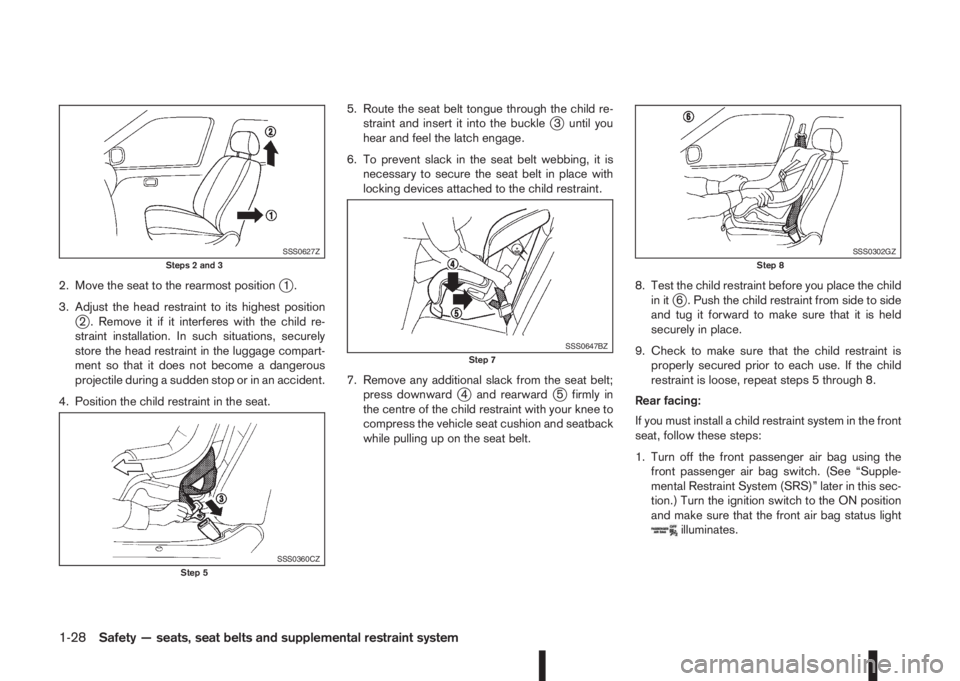
2. Move the seat to the rearmost positionj1.
3. Adjust the head restraint to its highest position
j2 . Remove it if it interferes with the child re-
straint installation. In such situations, securely
store the head restraint in the luggage compart-
ment so that it does not become a dangerous
projectile during a sudden stop or in an accident.
4. Position the child restraint in the seat.5. Route the seat belt tongue through the child re-
straint and insert it into the buckle
j3 until you
hear and feel the latch engage.
6. To prevent slack in the seat belt webbing, it is
necessary to secure the seat belt in place with
locking devices attached to the child restraint.
7. Remove any additional slack from the seat belt;
press downward
j4 and rearwardj5 firmly in
the centre of the child restraint with your knee to
compress the vehicle seat cushion and seatback
while pulling up on the seat belt.8. Test the child restraint before you place the child
in it
j6 . Push the child restraint from side to side
and tug it forward to make sure that it is held
securely in place.
9. Check to make sure that the child restraint is
properly secured prior to each use. If the child
restraint is loose, repeat steps 5 through 8.
Rear facing:
If you must install a child restraint system in the front
seat, follow these steps:
1. Turn off the front passenger air bag using the
front passenger air bag switch. (See “Supple-
mental Restraint System (SRS)” later in this sec-
tion.) Turn the ignition switch to the ON position
and make sure that the front air bag status light
illuminates.
SSS0627ZSteps 2 and 3
SSS0360CZStep 5
SSS0647BZStep 7
SSS0302GZStep 8
1-28Safety — seats, seat belts and supplemental restraint system
Page 49 of 338
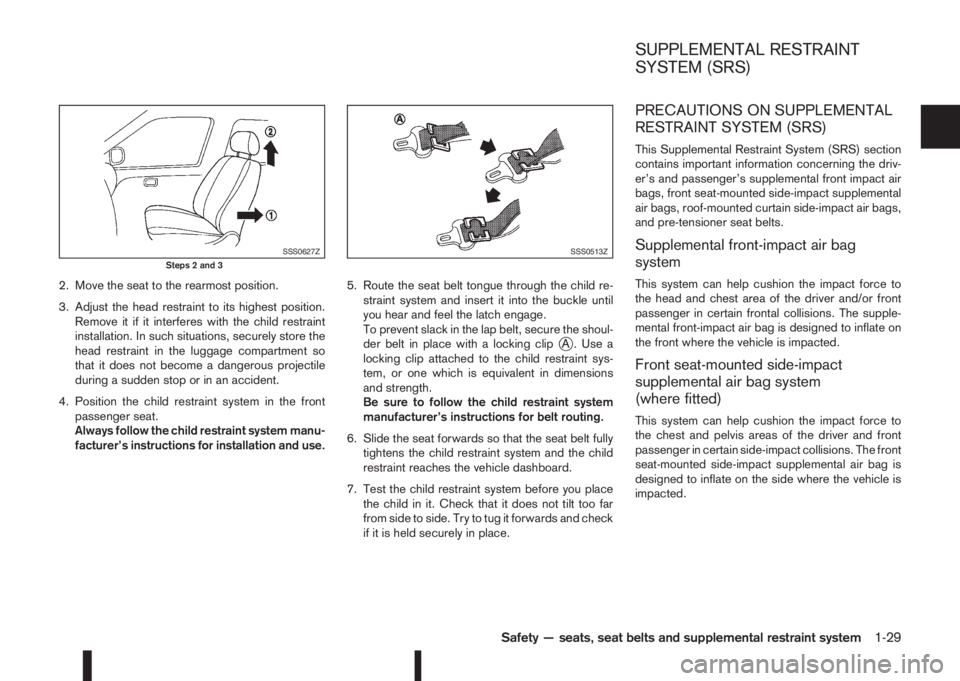
2. Move the seat to the rearmost position.
3. Adjust the head restraint to its highest position.
Remove it if it interferes with the child restraint
installation. In such situations, securely store the
head restraint in the luggage compartment so
that it does not become a dangerous projectile
during a sudden stop or in an accident.
4. Position the child restraint system in the front
passenger seat.
Always follow the child restraint system manu-
facturer’s instructions for installation and use.5. Route the seat belt tongue through the child re-
straint system and insert it into the buckle until
you hear and feel the latch engage.
To prevent slack in the lap belt, secure the shoul-
der belt in place with a locking clip
jA . Use a
locking clip attached to the child restraint sys-
tem, or one which is equivalent in dimensions
and strength.
Be sure to follow the child restraint system
manufacturer’s instructions for belt routing.
6. Slide the seat forwards so that the seat belt fully
tightens the child restraint system and the child
restraint reaches the vehicle dashboard.
7. Test the child restraint system before you place
the child in it. Check that it does not tilt too far
from side to side. Try to tug it forwards and check
if it is held securely in place.
PRECAUTIONS ON SUPPLEMENTAL
RESTRAINT SYSTEM (SRS)
This Supplemental Restraint System (SRS) section
contains important information concerning the driv-
er’s and passenger’s supplemental front impact air
bags, front seat-mounted side-impact supplemental
air bags, roof-mounted curtain side-impact air bags,
and pre-tensioner seat belts.
Supplemental front-impact air bag
system
This system can help cushion the impact force to
the head and chest area of the driver and/or front
passenger in certain frontal collisions. The supple-
mental front-impact air bag is designed to inflate on
the front where the vehicle is impacted.
Front seat-mounted side-impact
supplemental air bag system
(where fitted)
This system can help cushion the impact force to
the chest and pelvis areas of the driver and front
passenger in certain side-impact collisions. The front
seat-mounted side-impact supplemental air bag is
designed to inflate on the side where the vehicle is
impacted.
SSS0627ZSteps 2 and 3SSS0513Z
SUPPLEMENTAL RESTRAINT
SYSTEM (SRS)
Safety — seats, seat belts and supplemental restraint system1-29
Page 50 of 338
Roof-mounted curtain side-impact
supplemental air bag system
(where fitted)
This system can help cushion the impact force to
the head of the driver and passengers in front and
rear outer seating positions in certain side-impact
collisions. The roof-mounted curtain side-impact
supplemental air bag is designed to inflate on the
side where the vehicle is impacted.
The SRS is designed tosupplementthe crash pro-
tection provided by the driver and front passenger
seat belts and isnot designed to substitutethem.
Seat belts should always be correctly worn and the
driver and front passenger seated a suitable dis-
tance away from the steering wheel, instrument
panel and front door finishers. For additional infor-
mation, see “Seat belts” earlier in this section.
After placing the ignition switch in the ON or
START position, the air bag warning light will illu-
minate. The air bag warning light will turn off
after approximately 7 seconds if the system is
operational. See “Warning/indicator lights and
audible reminders” in the “2. Instruments and
controls” sectionfor further details.
The air bag will operate only when the ignition
switch is in the ON or START position.Driver and front passenger air bags:
WARNING
•The supplemental front-impact air bags ordi-
narily will not inflate in the event of a side
impact, rear impact, rollover, or lower sever-
ity frontal collision. Always wear the seat belts
to help reduce the risk or severity of injury in
accidents.
•The seat belts and the supplemental front-im-
pact air bags are most effective when you are
sitting well back and upright in the seat. The
front-impact air bags inflate with great force.
If you are unrestrained, leaning forward, sit-
ting sideways, or out of position in any way,
you are at greater risk of injury or death in an
accident. You may also receive serious or fa-
tal injuries from the supplemental front-im-
pact air bag if you are up against it when itinflates. Always sit back against the seatback
and as far away as practical from the steering
wheel. Always use the seat belts.
WARNING
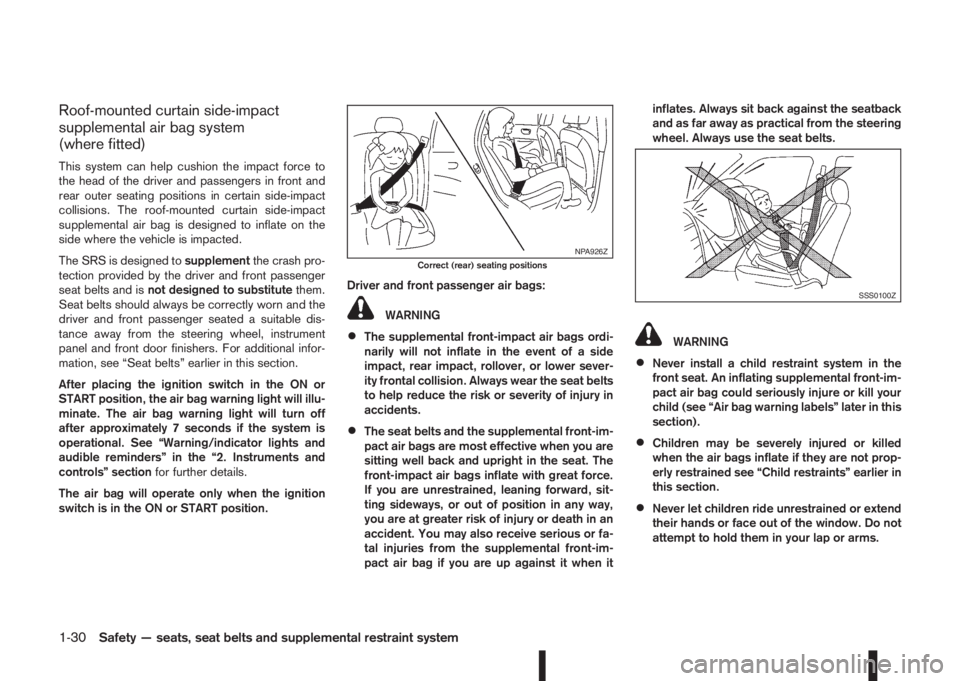
•Never install a child restraint system in the
front seat. An inflating supplemental front-im-
pact air bag could seriously injure or kill your
child (see “Air bag warning labels” later in this
section).
•Children may be severely injured or killed
when the air bags inflate if they are not prop-
erly restrained see “Child restraints” earlier in
this section.
•Never let children ride unrestrained or extend
their hands or face out of the window. Do not
attempt to hold them in your lap or arms.
NPA926ZCorrect (rear) seating positions
SSS0100Z
1-30Safety — seats, seat belts and supplemental restraint system
Page 51 of 338
Side and curtain air bags (where fitted):
WARNING
•The front seat-mounted side-impact supple-
mental air bags and roof-mounted curtain
side-impact supplemental air bags ordinarily
will not inflate in the event of a front impact,
rear impact, rollover, or lower severity side
collision. Always wear the seat belts to help
reduce the risk or severity of injury in acci-
dents.
•The seat belts, the front seat-mounted side-
impact supplemental air bags and roof-
mounted curtain side-impact supplemental
air bags are most effective when you are sit-
ting well back and upright in the seat. The
front seat-mounted side-impact supplemen-
tal air bags and roof-mounted curtain side-im-
pact supplemental air bags inflate with great
force. If you and your passengers are unre-
strained, leaning forward, sitting sideways, or
out of position in any way, you and your pas-
sengers are at greater risk of injury or death in
an accident.
•Do not allow anyone to place their hands, legs,
or face near the front seat-mounted side-im-
pact supplemental air bags and roof-mounted
curtain side-impact supplemental air bags on
the sides of the seatback of the front seats or
near the side roof rails. Do not allow anyone
sitting in the front seats or rear outer seats to
extend their hands out of the windows or lean
against the doors.
•When sitting in the rear seats, do not hold
onto the seatback of the front seats. If the
front seat-mounted side impact supplemental
air bags and roof-mounted curtain side-im-
pact supplemental air bags inflate, you may
be seriously injured. Be especially careful with
children, who should always be properly re-
strained.
•Do not use seat covers on the front seatbacks.
They may interfere with the front seat-
mounted side-impact supplemental air bag in-
flations.
NOTE
For an overview see “Seat belts and supplemen-
tal restraint system” in the “0. Illustrated table of
contents” section.
Pre-tensioner seat belt system
The pre-tensioner seat belt system may activate with
the supplemental air bag system in certain types of
collisions.
Working with the seat belt retractor and anchor, it
helps tighten the seat belt the instant the vehicle
becomes involved in certain types of collisions, help-
ing to restrain front seat occupants. See “Pre-ten-
sioner seat belt system” earlier in this section.
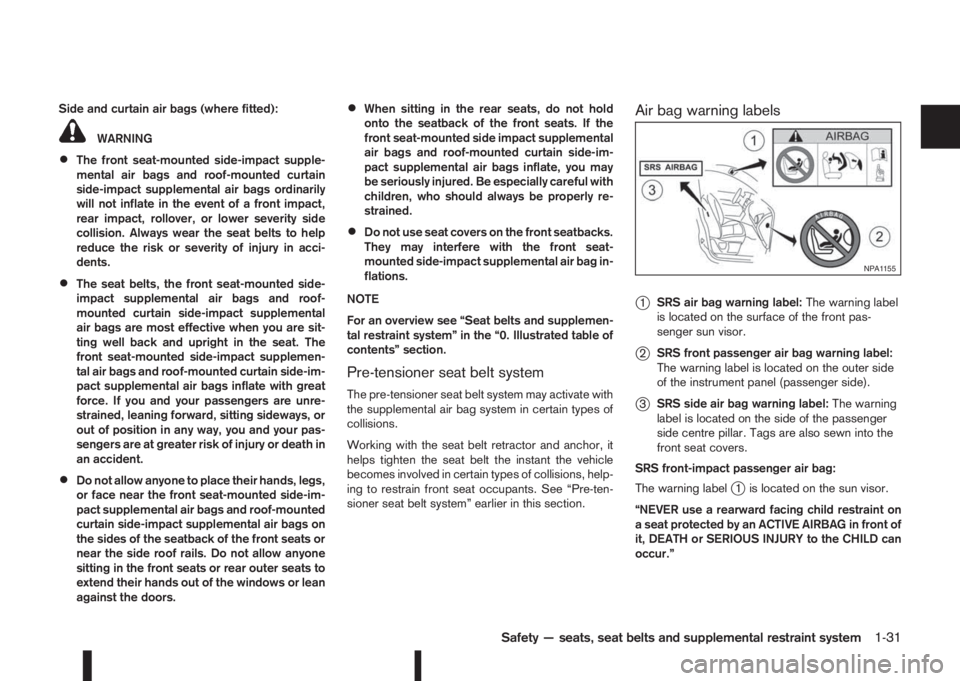
Air bag warning labels
j
1SRS air bag warning label:The warning label
is located on the surface of the front pas-
senger sun visor.
j2SRS front passenger air bag warning label:
The warning label is located on the outer side
of the instrument panel (passenger side).
j3SRS side air bag warning label:The warning
label is located on the side of the passenger
side centre pillar. Tags are also sewn into the
front seat covers.
SRS front-impact passenger air bag:
The warning label
j1 is located on the sun visor.
“NEVER use a rearward facing child restraint on
a seat protected by an ACTIVE AIRBAG in front of
it, DEATH or SERIOUS INJURY to the CHILD can
occur.”
NPA1155
Safety — seats, seat belts and supplemental restraint system1-31
Page 52 of 338
The BACK SEAT is the SAFEST place for children
aged 12 and under. Always use seat belts and
child restraints. For maximum safety protection
in all types of crashes, you must always wear
your safety belt. Do not sit or lean unnecessarily
close to the airbag. Do not place any objects over
the airbag or between the airbag and yourself. If
the airbag warning light stays on or is flashing
when the ignition switch is placed in the ON posi-
tion, go to a NISSAN dealer or qualified work-
shop. Airbags can only be removed or disposed
of by a NISSAN dealer or qualified workshop.
Be sure to read the “AIRBAG LABEL” description
at the end of this manual.
In vehicles equipped with a front-impact passenger
air bag system, use a rear-facing child restraint sys-
tem only on the rear seats.
When installing a child restraint system in your ve-
hicle, always follow the child restraint system manu-
facturer’s instructions for installation. For informa-
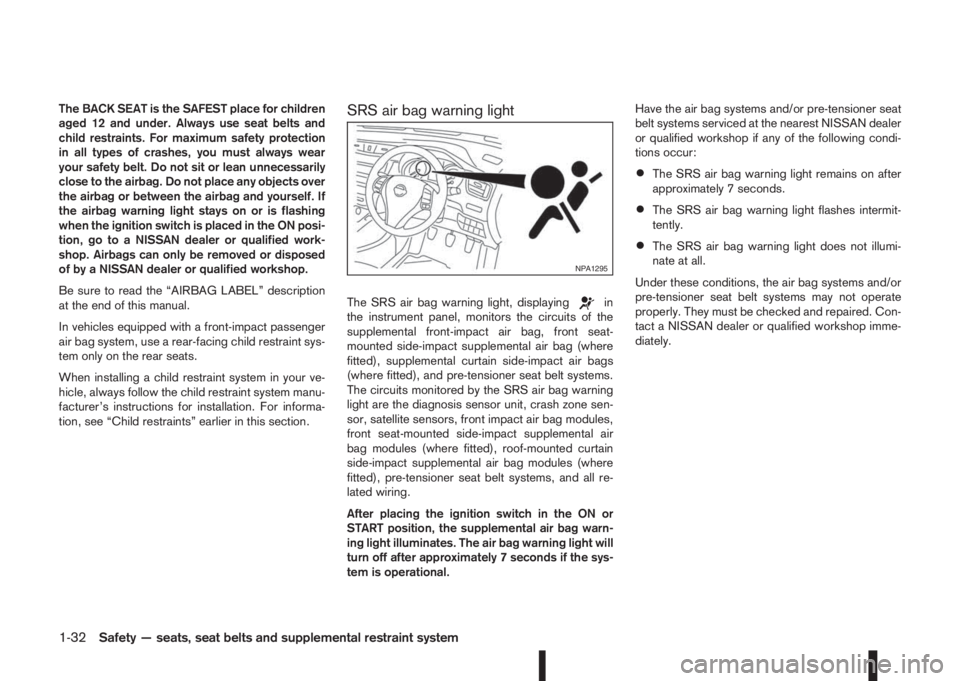
tion, see “Child restraints” earlier in this section.SRS air bag warning light
The SRS air bag warning light, displayingin
the instrument panel, monitors the circuits of the
supplemental front-impact air bag, front seat-
mounted side-impact supplemental air bag (where
fitted), supplemental curtain side-impact air bags
(where fitted), and pre-tensioner seat belt systems.
The circuits monitored by the SRS air bag warning
light are the diagnosis sensor unit, crash zone sen-
sor, satellite sensors, front impact air bag modules,
front seat-mounted side-impact supplemental air
bag modules (where fitted), roof-mounted curtain
side-impact supplemental air bag modules (where
fitted), pre-tensioner seat belt systems, and all re-
lated wiring.
After placing the ignition switch in the ON or
START position, the supplemental air bag warn-
ing light illuminates. The air bag warning light will
turn off after approximately 7 seconds if the sys-
tem is operational.Have the air bag systems and/or pre-tensioner seat
belt systems serviced at the nearest NISSAN dealer
or qualified workshop if any of the following condi-
tions occur:
•The SRS air bag warning light remains on after
approximately 7 seconds.
•The SRS air bag warning light flashes intermit-
tently.
•The SRS air bag warning light does not illumi-
nate at all.
Under these conditions, the air bag systems and/or
pre-tensioner seat belt systems may not operate
properly. They must be checked and repaired. Con-
tact a NISSAN dealer or qualified workshop imme-
diately.
NPA1295
1-32Safety — seats, seat belts and supplemental restraint system
Page 53 of 338
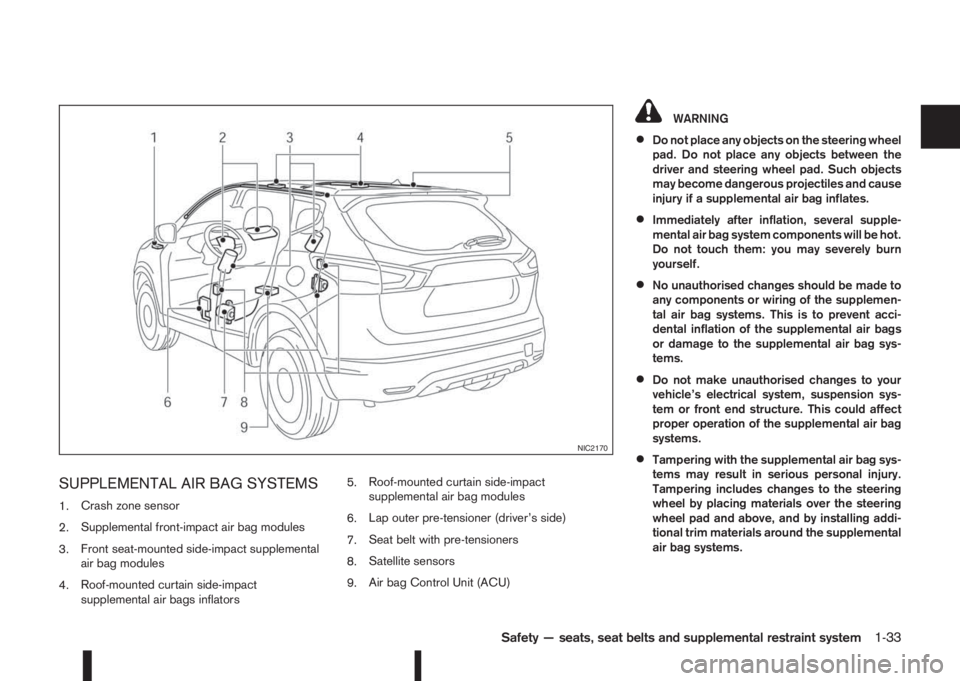
SUPPLEMENTAL AIR BAG SYSTEMS
1.Crash zone sensor
2.Supplemental front-impact air bag modules
3.Front seat-mounted side-impact supplemental
air bag modules
4.Roof-mounted curtain side-impact
supplemental air bags inflators5.Roof-mounted curtain side-impact
supplemental air bag modules
6.Lap outer pre-tensioner (driver’s side)
7.Seat belt with pre-tensioners
8.Satellite sensors
9.Air bag Control Unit (ACU)
WARNING
•Do not place any objects on the steering wheel
pad. Do not place any objects between the
driver and steering wheel pad. Such objects
may become dangerous projectiles and cause
injury if a supplemental air bag inflates.
•Immediately after inflation, several supple-
mental air bag system components will be hot.
Do not touch them: you may severely burn
yourself.
•No unauthorised changes should be made to
any components or wiring of the supplemen-
tal air bag systems. This is to prevent acci-
dental inflation of the supplemental air bags
or damage to the supplemental air bag sys-
tems.
•Do not make unauthorised changes to your
vehicle’s electrical system, suspension sys-
tem or front end structure. This could affect
proper operation of the supplemental air bag
systems.
•Tampering with the supplemental air bag sys-
tems may result in serious personal injury.
Tampering includes changes to the steering
wheel by placing materials over the steering
wheel pad and above, and by installing addi-
tional trim materials around the supplemental
air bag systems.NIC2170
Safety — seats, seat belts and supplemental restraint system1-33
Page 57 of 338
•No unauthorised changes should be made to
any components or wiring of the air bag sys-
tem. This is to prevent accidental inflation of
the air bag or damage to the air bag system.
•Tampering with the air bag system may result
in serious personal injury. Tampering includes
making changes to the steering wheel and
the instrument panel assembly by placing ma-
terial over the steering pad and above the
dashboard, or by installing additional trim ma-
terial around the air bag system.
•Do not attach any objects to the steering
wheel pad or to the instrument panel. Objects
attached to the steering wheel pad and in-
strument panel may become dangerous pro-
jectiles and cause injury if the air bag inflates.
•Work on and around the air bag system should
be done by a NISSAN dealer or qualified work-
shop. Installation of electrical equipment
should be done by a NISSAN dealer or quali-
fied workshop. The yellow SRS wiring har-
nesses* should not be modified or discon-
nected. Unauthorised electrical test equip-
ment and probing devices should not be used
on the air bag system.
* SRS wiring harnesses are covered with yellow
insulation either just before the harness con-
nectors or on the complete harness, for easy
identification.
REPAIR AND REPLACEMENT
PROCEDURE
WARNING
•Once the air bags have been inflated, the air
bag modules will not function and must be
replaced. The air bag modules must be re-
placed by a NISSAN dealer or qualified work-
shop. The inflated air bag modules cannot be
repaired.
•The air bag systems should be inspected by a
NISSAN dealer or qualified workshop if there
is any damage to the front end portion of the
vehicle.
•When selling your vehicle, we request that you
inform the buyer about the air bag system and
guide the buyer to the appropriate sections in
this Owner’s Manual.
•If you need to dispose of the SRS or scrap the
vehicle, contact a NISSAN dealer or qualified
workshop. Correct disposal procedures are
set forth in the appropriate NISSAN Service
Manual. Incorrect disposal procedures could
cause personal injury.
The air bags and pre-tensioner seat belts are de-
signed to activate on a one-time-only basis. As a
reminder, unless the SRS air bag warning light is
damaged, the SRS air bag warning light remains
illuminated after inflation has occurred. The repair
and replacement of the SRS should be done only by
a NISSAN dealer or qualified workshop.When maintenance work is required on the vehicle,
information about the air bags, pre-tensioner seat
belts and related parts should be pointed out to the
person performing the maintenance. The ignition
switch should always be in the LOCK position when
working under the bonnet or inside the vehicle.
Safety — seats, seat belts and supplemental restraint system1-37
Page 58 of 338
2Instruments and controlsInstruments and controls
Meters and gauges .................................................. 2-2
Speedometer...................................................... 2-2
Fuel gauge ......................................................... 2-2
Tachometer ........................................................ 2-2
Engine coolant temperature gauge ...................... 2-3
Instrument panel brightness control..................... 2-3
Warning/indicator lights and audible reminders ........ 2-4
Checking bulbs .................................................. 2-4
Warning lights .................................................... 2-5
Indicator lights .................................................... 2-10
Audible reminders............................................... 2-12
Vehicle information display ....................................... 2-13
How to use the Vehicle Information Display ......... 2-14
Startup display.................................................... 2-14
Settings .............................................................. 2-14
Vehicle information display warnings and
indicators............................................................ 2-21
Trip computer ..................................................... 2-27
[Clock] and [outside air temperature] .................. 2-29
Traffic sign recognition (where fitted) .................. 2-30
Wiper and washer switch ........................................ 2-32
Windscreen ........................................................ 2-32
Rear window ...................................................... 2-33
ThermaClear Heated Windscreen button ................. 2-34
ThermaClear Heated Windscreen (where
fitted).................................................................. 2-34
Defogger switch ...................................................... 2-35
Rear window defogger ....................................... 2-35
Outside mirror defogger (where fitted) ................ 2-35
Headlight and turn signal switch............................... 2-36Headlight switch ................................................. 2-36
Turn signal switch ............................................... 2-38
Fog light switch ....................................................... 2-38
Front fog light (where fitted)................................ 2-38
Rear fog light (where fitted)................................. 2-39
Headlight aiming control .......................................... 2-39
Headlight aiming control switch (where fitted) ..... 2-39
Automatic aiming control (LED headlights) .......... 2-40
Headlight cleaner (where fitted) ............................... 2-40
Headlight cleaner switch (where fitted) ............... 2-40
Horn ........................................................................ 2-41
Seat heating (where fitted) ....................................... 2-41
Power outlet ............................................................ 2-42
Storage ................................................................... 2-42
Storage trays ...................................................... 2-42
Glove box ........................................................... 2-42
Console box ....................................................... 2-43
Cup holders ....................................................... 2-44
Bottle holder ....................................................... 2-44
Coat hooks ......................................................... 2-44
Map pocket (where fitted) ................................... 2-44
Seat pocket (where fitted)................................... 2-44
Roof rail (where fitted) ........................................ 2-45
Parcel shelf ........................................................ 2-45
Luggage compartment/boot floor (where
fitted).................................................................. 2-47
Luggage hooks ................................................... 2-47
Windows ................................................................. 2-48
Power windows .................................................. 2-48
Fixed glass roof (where fitted) .................................. 2-49
Page 60 of 338
NOTE
For an overview see “Meters and gauges” in the
“0. Illustrated table of contents” section and see
“Instrument and control layout” in the “0. Illus-
trated table of contents” section.
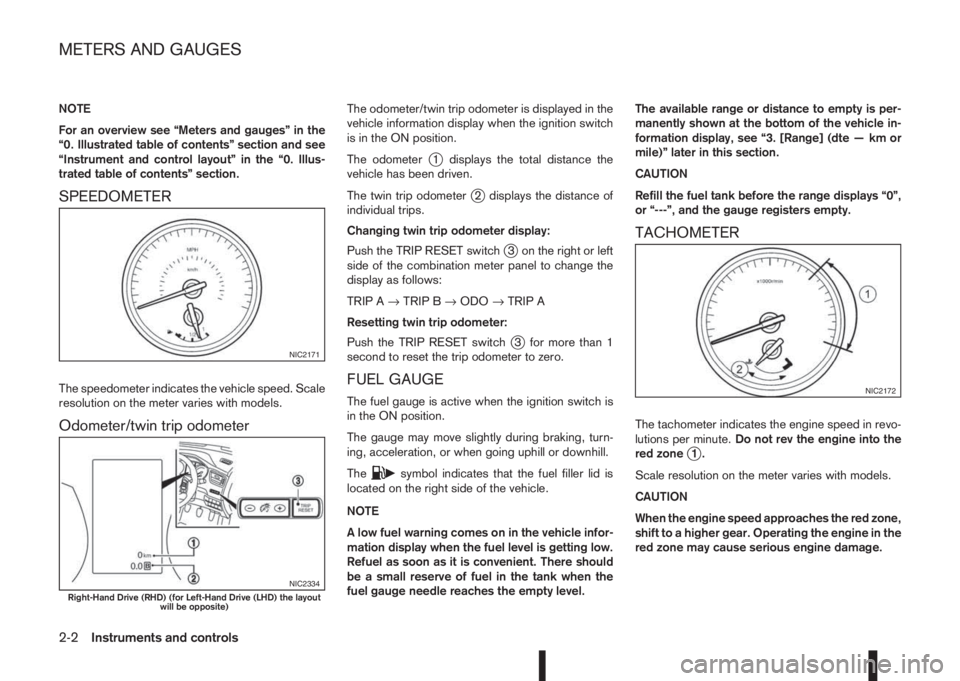
SPEEDOMETER
The speedometer indicates the vehicle speed. Scale
resolution on the meter varies with models.
Odometer/twin trip odometer
The odometer/twin trip odometer is displayed in the
vehicle information display when the ignition switch
is in the ON position.
The odometer
j1 displays the total distance the
vehicle has been driven.
The twin trip odometer
j2 displays the distance of
individual trips.
Changing twin trip odometer display:
Push the TRIP RESET switch
j3 on the right or left
side of the combination meter panel to change the
display as follows:
TRIP A→TRIP B→ODO→TRIP A
Resetting twin trip odometer:
Push the TRIP RESET switch
j3 for more than 1
second to reset the trip odometer to zero.
FUEL GAUGE
The fuel gauge is active when the ignition switch is
in the ON position.
The gauge may move slightly during braking, turn-
ing, acceleration, or when going uphill or downhill.
The
csymbol indicates that the fuel filler lid is
located on the right side of the vehicle.
NOTE
A low fuel warning comes on in the vehicle infor-
mation display when the fuel level is getting low.
Refuel as soon as it is convenient. There should
be a small reserve of fuel in the tank when the
fuel gauge needle reaches the empty level.The available range or distance to empty is per-
manently shown at the bottom of the vehicle in-
formation display, see “3. [Range] (dte — km or
mile)” later in this section.
CAUTION
Refill the fuel tank before the range displays “0”,
or “---”, and the gauge registers empty.
TACHOMETER
The tachometer indicates the engine speed in revo-
lutions per minute.Do not rev the engine into the
red zone
j1.
Scale resolution on the meter varies with models.
CAUTION
When the engine speed approaches the red zone,
shift to a higher gear. Operating the engine in the
red zone may cause serious engine damage.
NIC2171
NIC2334Right-Hand Drive (RHD) (for Left-Hand Drive (LHD) the layout
will be opposite)
NIC2172
METERS AND GAUGES
2-2Instruments and controls