clutch NISSAN QASHQAI 2015 Owner´s Manual
[x] Cancel search | Manufacturer: NISSAN, Model Year: 2015, Model line: QASHQAI, Model: NISSAN QASHQAI 2015Pages: 338, PDF Size: 4.88 MB
Page 234 of 338
You may hear a sound when the steering wheel
is operated quickly. However, this is not a mal-
function.
If the electric power steering warning light
illu-
minates while the engine is running, it may indicate
the electric power steering system is not functioning
properly and may need servicing. Have the electric
power steering system checked by a NISSAN dealer
or qualified workshop. (See “ Power steering warn-
ing light” in the “2. Instruments and controls” sec-
tion.)
When the electric power steering warning light illu-
minates with the engine running, the power assis-
tance for the steering will cease operation. You will
still have control of the vehicle. However, greater
steering effort is needed, especially in sharp turns
and at low speeds.The brake system has two separate hydraulic cir-
cuits. If one circuit malfunctions, two wheels will still
have braking ability.BRAKE PRECAUTIONS
Vacuum assisted brake
The brake booster aids braking by using engine
vacuum or vacuum from an engine-driven pump. If
the engine stops or the drive belt is broken, you can
stop the vehicle by depressing the brake pedal.
However, greater foot pressure on the brake pedal
will be required to stop the vehicle and the stopping
distance will be longer.
Wet brakes
When the vehicle is washed or driven through wa-
ter, the brakes may get wet. As a result, your brak-
ing distance will be longer and the vehicle may pull
to one side during braking.
To dry brakes, drive the vehicle at a safe speed
while lightly pressing the brake pedal to heat up the
brakes. Do this until the brakes return to normal.
Avoid driving the vehicle at high speeds until the
brakes function correctly.
Using the brakes
Avoid resting your foot on the brake pedal while
driving. This will overheat the brakes, wear out the
brake linings and pads faster and reduce fuel
economy performance.
To help reduce brake wear and to prevent the brakes
from overheating, reduce speed and shift to a lower
gear before going down a slope or long downhillgradient. Overheated brakes may reduce braking
performance and could result in loss of vehicle con-
trol.
CAUTION
While driving on a slippery surface, be careful
when braking, accelerating or downshifting.
Abrupt braking actions or sudden acceleration
could cause the wheels to skid and result in an
accident.
Be aware that brakes will fade if repeated heavy
brake applications are made.
Driving uphill
When starting on a steep gradient, it is sometimes
difficult to operate the brake or both the brake and
clutch (MT models). Use the parking brake to hold
the vehicle. Do not slip the clutch (MT models).
When ready to start, make sure that the shift lever is
in an appropriate forward or reverse driving posi-
tion, slowly release the parking brake while depress-
ing the accelerator pedal and releasing the clutch
(MT models) or depressing the accelerator pedal
(XTRONIC transmission models). If your vehicle has
an electric parking brake, this will automatically re-
lease when you depress the accelerator pedal and
release the clutch (MT models) or depress the ac-
celerator pedal (XTRONIC transmission models).
BRAKE SYSTEM
5-58Starting and driving
Page 268 of 338
8Maintenance and do-it-yourselfMaintenance and do-it-yourself
Maintenance requirements ....................................... 8-2
Scheduled maintenance...................................... 8-2
General maintenance .......................................... 8-2
Where to go for service ...................................... 8-2
General maintenance ............................................... 8-2
Explanation of general maintenance items ........... 8-2
Maintenance precautions ......................................... 8-4
Engine compartment ................................................ 8-5
Engine cooling system ............................................. 8-6
Checking engine coolant level............................. 8-6
Changing engine coolant .................................... 8-6
Engine oil................................................................. 8-8
Checking engine oil level .................................... 8-8
Changing engine oil ............................................ 8-9
Changing engine oil filter .................................... 8-10
Protect the environment ...................................... 8-12
Fuel filter (Diesel engine models) ............................. 8-13
Draining water .................................................... 8-13
Bleeding the fuel system ..................................... 8-13
XTRONIC Continuously variable transmission
(CVT) fluid ............................................................... 8-13
Brakes ..................................................................... 8-13
Checking parking brake ...................................... 8-13
Checking brake pedal......................................... 8-13
Brake booster ..................................................... 8-14
Brake and clutch fluid .............................................. 8-14
Window washer fluid/headlight cleaner fluid
(where fitted) ........................................................... 8-15
Battery..................................................................... 8-16
Vehicle battery .................................................... 8-16Jump-starting ...................................................... 8-18
Integrated keyfob/Intelligent Key battery
replacement........................................................ 8-18
Drive belts ............................................................... 8-20
Spark plugs (Petrol engine models).......................... 8-21
Air duct removal....................................................... 8-21
Air cleaner filter........................................................ 8-23
Viscous paper type ............................................. 8-23
Dry paper type (where fitted) .............................. 8-23
Wiper blades ........................................................... 8-24
Cleaning ............................................................. 8-24
Front window wiper replacement ........................ 8-24
Back door window wiper replacement ................ 8-24
Windscreen washer nozzle ................................. 8-25
Fuses ...................................................................... 8-25
Passenger compartment ..................................... 8-25
Engine compartment ........................................... 8-26
Lights ...................................................................... 8-27
Headlights .......................................................... 8-28
Exterior lights ...................................................... 8-29
Interior lights....................................................... 8-29
Light locations .................................................... 8-30
Wheels and tyres ..................................................... 8-33
Tyre inflation pressure......................................... 8-33
Types of tyres ..................................................... 8-33
Snow chains....................................................... 8-34
Tyre rotation ....................................................... 8-34
Tyre wear and damage ....................................... 8-35
Tyre age ............................................................. 8-35
Changing tyres and wheels................................. 8-35
Page 271 of 338
Lights*:
Clean the headlights on a regular basis. Make sure
that the headlights, stop lights, tail lights, turn signal
lights, and other lights are all operating properly and
installed securely. Also check headlight aim.
Tyres*:
Check the pressure with a gauge periodically when
at a service station (including the spare) and adjust
to the specified pressure if necessary. Check care-
fully for damage, cuts or excessive wear.
Tyre rotation*:
Tyres should be rotated every 10,000 km (6,000
miles) for Two-Wheel Drive (2WD) models and
5,000 km (3,000 miles) for Four-Wheel Drive (4WD)
models. However, the timing for tyre rotation may
vary according to your driving habits and road sur-
face conditions.
Tyre Pressure Monitoring System (TPMS)
transmitter components (where fitted):
Replace the TPMS transmitter grommet seal, valve
core and cap when the tyres are replaced due to
wear or age.
Wheel alignment and balance:
If the vehicle pull to either side while driving on a
straight and level road, or if you detect uneven or
abnormal tyre wear, there may be a need for wheel
alignment. If the steering wheel or seat vibrates at
normal highway speeds, wheel balancing may be
needed.Wheel nuts:
When checking the tyres, make sure no wheel nuts
are missing, and check for any loose wheel nuts.
Tighten if necessary.
Windscreen:
Clean the windscreen on a regular basis. Check the
windscreen at least every six months for cracks or
other damage. Have a damaged windscreen re-
paired by a qualified repair facility.
Wiper blades*:
Check for cracks or wear if they do not wipe prop-
erly.
Under the bonnet and vehicle
The maintenance items listed here should be
checked periodically, e.g. each time you check the
engine oil or refuel.
Battery*:
Check if the green indicator on the top of the main-
tenance free battery is visible. If it is not visible,
replace the battery as soon as possible.
Vehicles operated in high temperatures or under
severe conditions, check the fluid level frequently.
Brake and clutch fluid level*:
Make sure that the brake and clutch fluid level is
between the MAX and MIN lines on the reservoir.
Engine coolant level*:
Check the coolant level when the engine is cold.Engine drive belts*:
Make sure that the drive belts are not frayed, worn,
cracked or oily.
Engine oil level*:
Check the level after parking the vehicle on a level
surface and turning off the engine.
Fluid leaks:
Check under the vehicle for fuel, oil, water or other
fluid leaks after the vehicle has been parked for a
while. Water dripping from the air conditioner after
use is normal. If you should notice any leaks or if
petrol fumes are evident, check for the cause and
have it corrected immediately.
Window washer fluid*:
Check that there is adequate fluid in the tank.
Inside the vehicle
The maintenance items listed here should be
checked on a regular basis, such as when perform-
ing periodic maintenance, cleaning the vehicle, etc.
Accelerator pedal:
Check the pedal for smooth operation and make
sure that the pedal does not catch or require uneven
effort. Keep the floor mats away from the pedal.
Brake pedal*:
Check the pedal for smooth operation. If the brake
pedal suddenly goes down further than normal, the
pedal feels spongy or the vehicle seems to take
Maintenance and do-it-yourself8-3
Page 282 of 338
With the engine running, check the distance be-
tween the upper surface of the pedal and the metal
floor. If it is out the range listed, see a NISSAN
dealer or qualified workshop.
Depressing force of 490 N (50 kg, 110 lb)
183.7 – 193.7 mm (7.23 – 7.63 in.)
Self-adjusting brakes
Your vehicle is equipped with self-adjusting brakes.
The disc-type brakes self-adjust every time the brake
pedal is applied.
BRAKE BOOSTER
Check the brake booster function as follows:
1. With the engine off, depress and release the
footbrake pedal several times. When the foot-
brake pedal movement (distance of travel) re-
mains the same from one pedal application to the
next, continue on to the next step.
2. While depressing the footbrake pedal, start the
engine. The pedal height should drop a little.
3. With the footbrake pedal depressed, stop the
engine. Keep the pedal depressed for about 30
seconds. The pedal height should not change.
4. Run the engine for 1 minute without depressing
the footbrake pedal, then turn it off. Depress the
footbrake pedal several times. The pedal travel
distance will decrease gradually with each de-
pression as the vacuum is released from the
booster.If the brakes do not operate properly, have the
brakes checked by a NISSAN dealer or qualified
workshop.
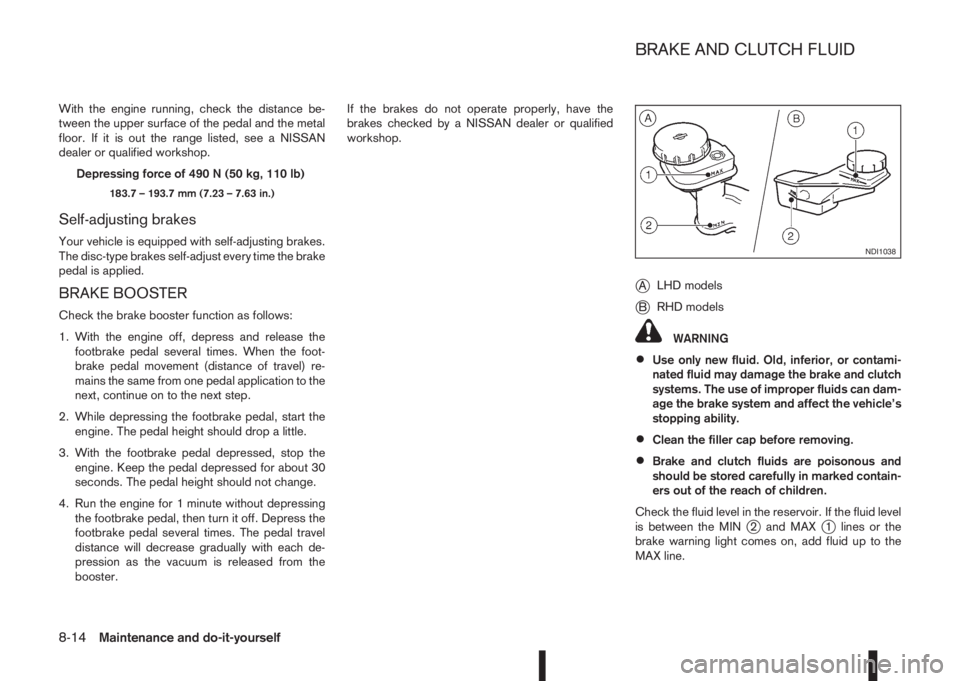
jALHD models
jBRHD models
WARNING
•Use only new fluid. Old, inferior, or contami-
nated fluid may damage the brake and clutch
systems. The use of improper fluids can dam-
age the brake system and affect the vehicle’s
stopping ability.
•Clean the filler cap before removing.
•Brake and clutch fluids are poisonous and
should be stored carefully in marked contain-
ers out of the reach of children.
Check the fluid level in the reservoir. If the fluid level
is between the MIN
j2 and MAXj1 lines or the
brake warning light comes on, add fluid up to the
MAX line.
NDI1038
BRAKE AND CLUTCH FLUID
8-14Maintenance and do-it-yourself
Page 283 of 338
See “Capacities and recommended fuel/lubricants”
in the “9. Technical information” section for the rec-
ommended brake and clutch fluid type.
If fluid must be added frequently, the system should
be thoroughly checked by a NISSAN dealer or quali-
fied workshop.
CAUTION
•NISSAN recommends that refilling and check-
ing the brake and clutch systems should be
left to a NISSAN dealer or qualified workshop
who will have the necessary fluids and techni-
cal knowledge.
•Do not spill the fluid on painted surfaces. This
will damage the paint. If fluid is spilled, wash
with water.
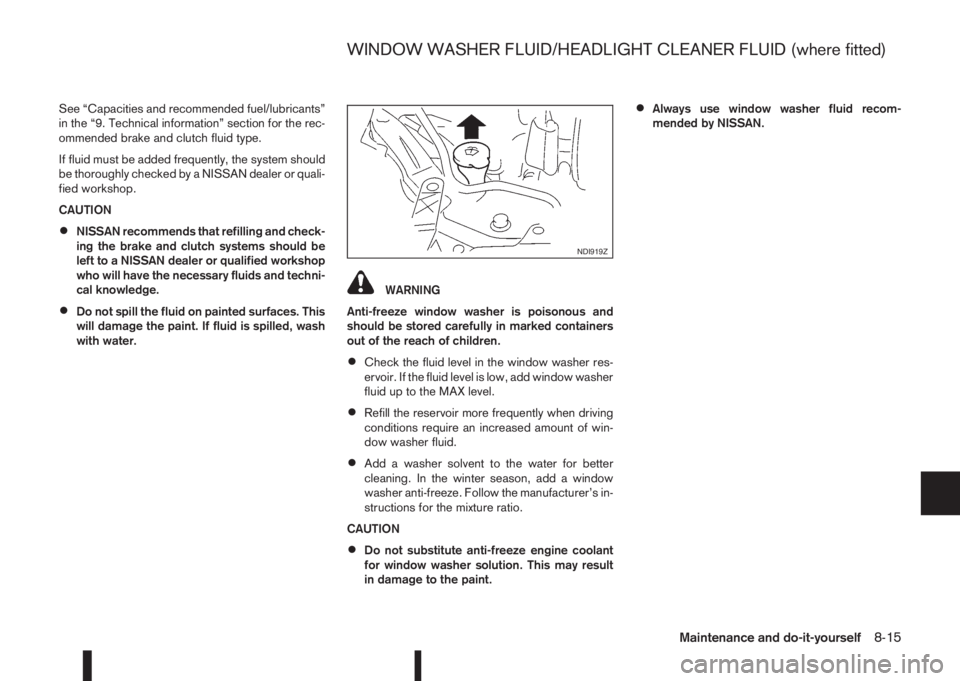
WARNING
Anti-freeze window washer is poisonous and
should be stored carefully in marked containers
out of the reach of children.
•Check the fluid level in the window washer res-
ervoir. If the fluid level is low, add window washer
fluid up to the MAX level.
•Refill the reservoir more frequently when driving
conditions require an increased amount of win-
dow washer fluid.
•Add a washer solvent to the water for better
cleaning. In the winter season, add a window
washer anti-freeze. Follow the manufacturer’s in-
structions for the mixture ratio.
CAUTION
•Do not substitute anti-freeze engine coolant
for window washer solution. This may result
in damage to the paint.
•Always use window washer fluid recom-
mended by NISSAN.
NDI919Z
WINDOW WASHER FLUID/HEADLIGHT CLEANER FLUID (where fitted)
Maintenance and do-it-yourself8-15
Page 307 of 338

Capacity (approximate)
Recommended specifications
Litre Imp measure
Manual transaxle gear oilR9M 4WD 1.7 1–1/2 qt
NISSAN MT-XZ Gear Oil Sports and Off-Road Vehicles or API GL-4 Viscosity
SAE 75W-85
R9M 2WD 1.7 1–1/2 qt
K9K
MR20
HRA2DDT2.0 1–3/4 qt NISSAN MT-XZ Gear Oil TL/JR Type or API GL-4 Viscosity SAE 75W-80
XTRONIC Transmission (CVT) fluidR9M with 2WD – –
Genuine NISSAN CVT fluid NS-3 *3 *4 HRA2DDT with 2WD – –
MR20 with 2WD – –
MR20 with 4WD – –
Brake & clutch fluidRefill to the correct level according
to the instructions in the “8.
Maintenance and do-it-yourself”
section.Genuine NISSAN brake fluid or equivalent. DOT 4 (US FMVSS No. 116)
Multi-purpose grease – – NLGI No. 2 (Lithium soap base)
Air conditioning system refrigerant – –HFO-1234yf (for Europe)
HFC-134a (R-134a) (except for Europe)
Air conditioning system lubricants – –ND-12 oil or equivalent (for Europe)
ND-8 oil (Except for Europe)
*1: For further details, see “Recommended SAE viscosity number” later in this section.
*2: Use Genuine NISSAN engine coolant, or equivalent in its quality, in order to avoid possible aluminium corrosion within the engine cooling system caused by the use of non-genuine
engine coolant.Note that any repairs for the incidents within the engine cooling system while using non-genuine engine coolant may not be covered by the warranty, even
if such incidents occurred during the warranty period.Contact a NISSAN dealer or qualified workshop for more information regarding the coolant type and capacity.
*3:Use only Genuine NISSAN CVT Fluid NS-3. Using transmission fluid other than Genuine NISSAN CVT Fluid NS-3 will damage the CVT, which is not covered by the war-
ranty.
*4: Contact a NISSAN dealer or qualified workshop for details or servicing.
*5: K9K engine with DPF.
Technical information9-3
Page 322 of 338
– Checking brake pedal ................................................... 8-13
– Checking parking brake ................................................. 8-13
– Parking brake ................................................................ 3-16
– Trailer brakes ................................................................ 5-55
C
Cable slots .......................................................................... 2-43
Capacities and recommended fuel/lubricants ......................... 9-2
– Fuel information ............................................................... 9-4
Car phone or CB radio ........................................................ 4-45
Care when driving ............................................................... 5-10
Cargo compartment
– Cargo floor .................................................................... 2-47
CENTRE mark on rear centre seat ...................................... 1-12
Changing
– Changing engine coolant ................................................. 8-6
– Changing engine oil ......................................................... 8-9
– Changing engine oil filter ............................................... 8-10
– Changing tyres and wheels ........................................... 8-35
Chassis control ................................................................... 5-62
Checking
– Checking brake pedal ................................................... 8-13
– Checking engine coolant level ......................................... 8-6
– Checking engine oil level ................................................. 8-8
– Checking parking brake ................................................. 8-13
Child restraint anchorage .................................................... 1-22
Child restraint and ISOFIX information ................................. 1-16
Child restraint installation using 3-point type seat belt .......... 1-25
Child restraint installation using ISOFIX ............................... 1-23
Child restraint systems (CRS)
– ISOFIX .......................................................................... 1-17
– Recommended .............................................................. 1-17
– Suitable ......................................................................... 1-17
Child restraints .................................................................... 1-15Child safety .................................................................. 1-14, 1-9
Cleaning
– Alloy wheels .................................................................... 7-3
– Chrome parts .................................................................. 7-3
– Exterior ............................................................................ 7-2
– Glass ....................................................................... 7-3, 7-5
– Interior ............................................................................ 7-4
– Plastic parts .................................................................... 7-5
– Rear-view camera lens .................................................... 7-3
– Removing spots ............................................................... 7-2
– Underbody ...................................................................... 7-3
Clutch fluid .......................................................................... 8-14
Coat hooks ......................................................................... 2-44
Cold weather driving ........................................................... 5-66
Console box ........................................................................ 2-43
Continuously variable transmission
– Continuously variable transmission fluid ......................... 8-13
– Driving with continuously variable transmission ............. 5-18
Coolant
– Changing engine coolant ................................................. 8-6
– Checking engine coolant level ......................................... 8-6
– Engine coolant ............................................................... 5-66
– Engine coolant temperature gauge ................................... 2-3
– Engine cooling system ..................................................... 8-6
Corrosion protection .................................................... 5-67, 7-5
– Environmental factors ...................................................... 7-5
Cruise control ..................................................................... 5-36
Cruise control system operations ......................................... 5-37
CVT
– Driving with XTRONIC transmission .............................. 5-18
D
Defogger switch
– Outside mirror defogger ................................................ 2-35
– Rear window defogger .................................................. 2-35
10-2Index
Page 323 of 338
Difference between predictive and actual distances ............... 4-9
Dimensions ........................................................................... 9-6
Door locks ............................................................................ 3-8
– Back door ..................................................................... 3-11
– Child safety rear door locks ........................................... 3-11
– Locking/unlocking with the key — vehicle dead battery .... 3-9
– Power door lock switch ................................................. 3-10
– Remote keyless entry system ........................................... 3-4
– Super Lock system .......................................................... 3-8
– When leaving the vehicle ............................................... 3-10
Drive belts ........................................................................... 8-20
Driving
– Care when driving ......................................................... 5-10
– Cold weather driving ..................................................... 5-66
– Driving four-wheel drive (4WD) safely ............................ 5-28
– Driving on wet road ....................................................... 5-10
– Driving the vehicle ......................................................... 5-17
– Driving under winter conditions ...................................... 5-10
– Driving with manual transmission ................................... 5-17
– On-pavement and off-road driving precautions ................. 5-9
– Precautions when starting and driving .............................. 5-3
– Stop/Start System ......................................................... 5-22
E
ECO mode system .............................................................. 5-65
Electric power steering system ............................................ 5-57
Electronic Stability Programme (ESP) system ...................... 5-60
– ESP OFF switch ........................................................... 5-61
Emergency tyre puncture repair kit ............................... 6-8, 8-36
Emergency/mechanical key ................................................... 3-3
Engine
– Before starting the engine ................................................ 5-2
– Changing engine coolant ................................................. 8-6
– Changing engine oil ......................................................... 8-9
– Changing engine oil filter ............................................... 8-10– Checking engine coolant level ......................................... 8-6
– Checking engine oil level ................................................. 8-8
– Data ................................................................................ 9-5
– Engine cold start period ................................................. 5-10
– Engine compartment .............................................. 0-11, 8-5
– Engine coolant ............................................................... 5-66
– Engine coolant temperature gauge ................................... 2-3
– Engine cooling system ..................................................... 8-6
– Engine oil ........................................................................ 8-8
– Engine overheat ............................................................. 6-13
– Engine serial number ....................................................... 9-7
– Fuel filter (Diesel engine models) ................................... 8-13
– Starting engine .............................................................. 5-15
Exhaust gas (Carbon Monoxide) ............................................ 5-3
Exterior lights ...................................................................... 8-29
F
Filter
– Air cleaner filter ............................................................. 8-23
– Air conditioner filter .............................................. 4-19, 4-22
– Fuel filter (Diesel engine models) ................................... 8-13
Floor mats ............................................................................. 7-4
Fluid
– Brake and clutch fluid .................................................... 8-14
– Continuously variable transmission fluid ......................... 8-13
– Window washer/headlight cleaner fluid .......................... 8-15
Fog light
– Front fog light ................................................................ 2-38
– Rear fog light ................................................................. 2-39
Forward emergency braking system .................................... 5-40
Four-wheel drive (4WD) ...................................................... 5-26
– Driving four-wheel drive (4WD) safely ............................ 5-28
– Four-wheel drive (4WD) model (Tyres) .......................... 8-35
– Four-wheel drive mode indicator light ............................. 5-28
Index10-3
Page 332 of 338
Manufacturing phase
NISSAN plants based in the UK and Spain already
achieve a recycling rate of over 90% and are look-
ing for further improvements. The UK plant installed
10 wind turbines to cut carbon dioxide emissions at
power plants by more than 3,000 tonnes per year.
NMISA (Spain) uses a solar panel water heating
system to save energy. This will generate 33% of
the energy consumed in the baths during the paint-
ing of your vehicle.
Production and distribution phase
Using resources efficiently to reduce the amount of
waste generated during the production and distribu-
tion stage. NISSAN promotes activities based on
Reducing, Reusing, and Recycling materials when-
ever possible. NISSAN’s goal is to achieve a 100%
recycling rate for operations in Japan and globally.
Use and service phase
NISSAN dealers are our window to you, our cus-
tomer. In order to meet your expectations they pro-
vide not only high quality services but are also envi-
ronmentally responsible. NISSAN promotes activi-
ties to recycle the waste generated as a result of
service centre activities.
Disposal phase
Recycle your end of life vehicle or its components.
When your NISSAN reaches the end of its life, and
is no longer suitable for daily use, it still has value.
You can help prevent waste affecting the environ-
ment by bringing your NISSAN to be recycled at ourcollection networks in your area. Our collection net-
works guarantee no cost for the treatment of your
ELV. For further information on how and where to
dispose of your ELV refer to your local NISSAN
dealer or consult: www.nissan-europe.com or con-
sult: www.nissan-global.com.
PROTECT THE ENVIRONMENT
WHEN DRIVING
Your driving behaviour has significant impact on fuel
economy and the environment. Follow the tips be-
low for better fuel-efficiency, better driving habits,
and to be environmentally friendly by reducing emis-
sions:
Fuel efficient driving
Anticipating traffic conditions and acting accordingly
reduces fuel consumption, helping to protect of our
natural environment. Take your foot off the accelera-
tor while approaching traffic lights and avoid last
minute braking when the light turns red.
Avoid speeding, harsh acceleration, and strong
braking. The gain in time does not offset pollution of
the environment. Try to maintain speed when driving
uphill to reduce fuel consumption and pollution.
Maintain speed or allow the vehicle to go slower
where traffic allows.
Close windows when driving
Driving with a window open at 100 km/h (62 MPH)
increases fuel consumption by up to 4%. Driving
with the windows closed allows for better fuel
economy.
Use the roof rack only when necessary
Only install the roof luggage system when you really
need it, otherwise put it inside the vehicle or store it
in your garage. Do not drive around with an empty
roof rack, kayak holder, or ski rack, this will reduce
your aerodynamic drag significantly.
Optimise the use of air conditioning
The air conditioning system has a positive effect on
driving and vehicle safety through comfort cooling
and dehumidifying, drivers are more alert and have
better visibility when window demisting/defogging
becomes necessary. However, use of the air condi-
tioning system will increase fuel consumption sub-
stantially in an urban environment. Optimise the use
of air conditioning by using the vents as much as
possible.
Use the parking brake on slopes
Use the parking brake when holding your vehicle on
a slope. Avoid using the clutch (manual transmis-
sion) or the accelerator (continuously variable trans-
mission) to hold your vehicle as this leads to unnec-
essary fuel consumption and wear.
Maintain a safe distance
Anticipate traffic conditions for a smoother drive and
to assure comfort and safety during your trip. Drive
and maintain a safe distance from other vehicles
while in traffic. This will help reduce fuel consump-
tion as you will not be constantly tapping your
brakes.