TPMS NISSAN QASHQAI 2016 Owner´s Manual
[x] Cancel search | Manufacturer: NISSAN, Model Year: 2016, Model line: QASHQAI, Model: NISSAN QASHQAI 2016Pages: 338, PDF Size: 4.87 MB
Page 301 of 338
In case of a flat tyre, see “Flat tyre” in the “6. In case
of emergency” section.
TYRE INFLATION PRESSURE
Periodically check the tyre pressure (including the
spare tyre). An incorrect tyre pressure may ad-
versely affect tyre life and vehicle handling. After
adjusting the tyre pressure, perform a TPMS tem-
perature calibration (see “TPMS temperature
calibration” in the “5. Starting and driving” section).
NOTE
Incorrectly inflated tyres can also lead to poor
steering ability and make the driver suspect a
steering problem: keep the vehicle’s tyres in-
flated to the correct pressure at all times.
The tyre pressure should be checked when tyres
are COLD. Tyres are considered COLD after the
vehicle has been parked for three or more hours, or
driven less than 1.6 km (1 mile). COLD tyre pres-
sures are shown on the tyre placard affixed to the
driver’s side centre pillar.
Insufficient pressure can lead to an overheating of
the tyre and subsequent internal damage. At high
speeds, this could result in tread separation and
even bursting of the tyre.
TYPES OF TYRES
CAUTION
•When changing or replacing tyres, be sure all
four tyres are of the same type (i.e., summer,
all season or snow) and construction.
NDI1480Reverse light, and/or rear fog light (where fitted)
NDI1438Rear turn signal light
WHEELS AND TYRES
Maintenance and do-it-yourself8-33
Page 302 of 338
•A NISSAN dealer or qualified workshop may
be able to help you with information about
tyre type, size, speed rating and availability.
•Replacement tyres may have a lower speed
rating than the factory equipped tyres, and
may not match the potential maximum vehicle
speed. Never exceed the maximum speed rat-
ing of the tyre.
All season tyres
NISSAN specifies all season tyres on some models
to provide good performance for use all year around,
including snowy and icy road conditions. All season
tyres are identified by ALL SEASON and/or M&S
on the tyre sidewall. Snow tyres have better snow
traction than all season tyres and may be more ap-
propriate in some areas.
Summer tyres
NISSAN specifies summer tyres as standard fit.
These tyres provide superior performance under
typical mild weather conditions.
If you plan to operate your vehicle in snowy or icy
conditions, NISSAN recommends the use of SNOW
or ALL SEASON tyres on all four wheels.
Snow tyres
If snow tyres are needed, it is necessary to select
tyres equivalent in size and load rating to the original
equipment tyres. If you do not, it can adversely af-
fect the safety and handling of your vehicle.
Generally, snow tyres will have lower speed ratingsthan factory equipped tyres and may not match the
potential maximum vehicle speed. Never exceed the
maximum speed rating of the tyre.
For additional traction on icy roads, studded tyres
may be used. However, some provinces and states
prohibit their use. Check local, state and provincial
laws before installing studded tyres. Skid and trac-
tion capabilities of studded snow tyres, on wet or
dry surfaces, may be poorer than that of non-stud-
ded snow tyres.
SNOW CHAINS
Use of snow chains may be prohibited in some ar-
eas. Check the local laws before installing snow
chains. When installing snow chains, make sure they
are of proper size for the tyres on your vehicle and
are installed according to the chain manufacturer’s
suggestions. Use chain tensioners when recom-
mended by the snow chain manufacturer to ensure
a tight fit. Loose end links of the snow chain must be
secured or removed to prevent the possibility of
whipping action damage to the fenders or undercar-
riage.
In addition, drive at a reduced speed. Otherwise,
your vehicle can be damaged and/or vehicle han-
dling and performance may be adversely affected.
Snow chains must be installed only on the front
wheels and not on the rear wheels.
CAUTION
•Never install snow chains on a temporary-use
or small size spare tyre.
•Do not drive with snow chains on paved roads
which are clear of snow. Driving with chains in
such conditions can cause damage to the
various mechanisms of the vehicle due to
some overstress. When driving on clear paved
roads, be sure to change to 2WD mode, see
“Four-wheel Drive (4WD) (where fitted)” in the
“5. Starting and driving” section.
TYRE ROTATION
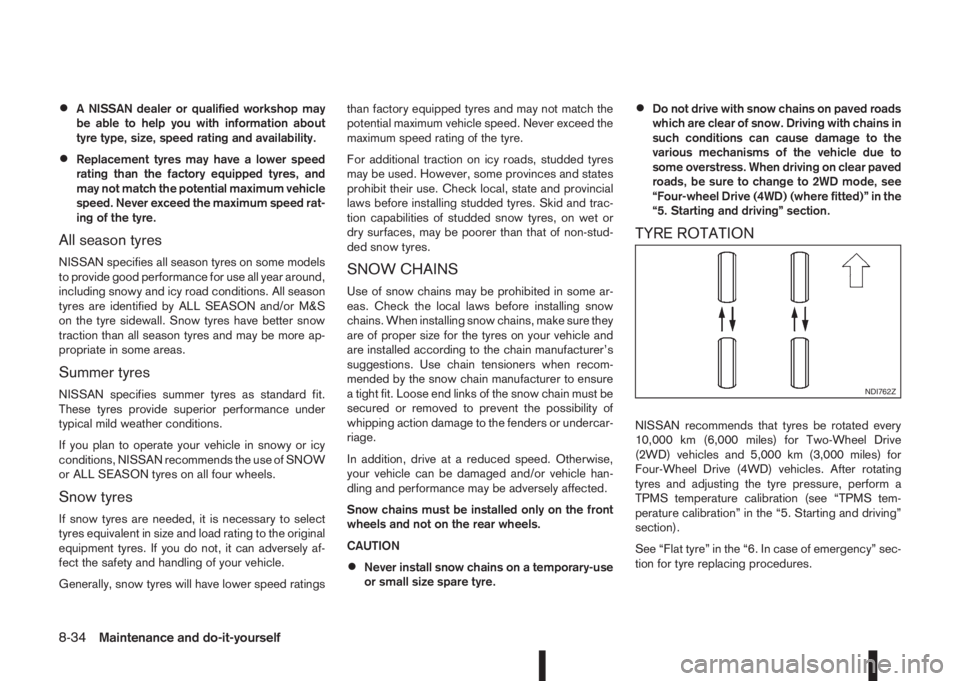
NISSAN recommends that tyres be rotated every
10,000 km (6,000 miles) for Two-Wheel Drive
(2WD) vehicles and 5,000 km (3,000 miles) for
Four-Wheel Drive (4WD) vehicles. After rotating
tyres and adjusting the tyre pressure, perform a
TPMS temperature calibration (see “TPMS tem-
perature calibration” in the “5. Starting and driving”
section).
See “Flat tyre” in the “6. In case of emergency” sec-
tion for tyre replacing procedures.
NDI762Z
8-34Maintenance and do-it-yourself
Page 303 of 338
WARNING
•After rotating the tyres, adjust the tyre pres-
sure and perform a TPMS temperature cali-
bration.
•Retighten the wheel nuts when the vehicle
has been driven for the first 1,000 km (600
miles) (also in cases of a flat tyre, etc.).
•Do not include the temporary-use spare tyre
in the tyre rotation.
•Incorrect tyre selection, fitting, care or main-
tenance can affect vehicle safety with risk of
accident and injury. If in doubt, consult a
NISSAN dealer or the tyre manufacturer.
TYRE WEAR AND DAMAGE
Tyres should be periodically inspected for wear,
cracking, bulging or objects caught in the tread. If
excessive wear, cracks, bulging or deep cuts are
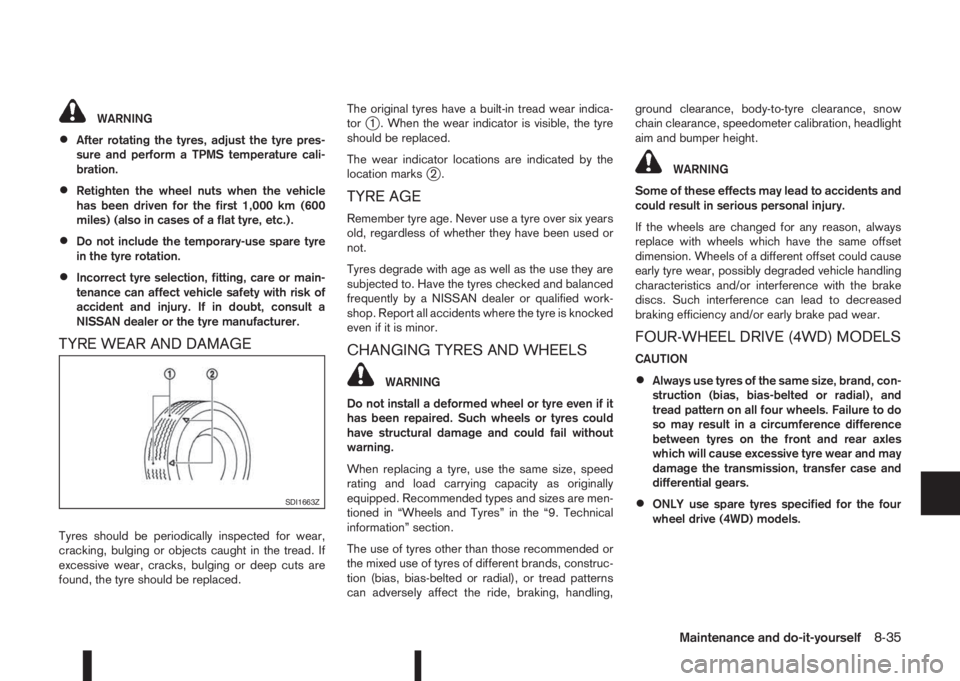
found, the tyre should be replaced.The original tyres have a built-in tread wear indica-
tor
j1 . When the wear indicator is visible, the tyre
should be replaced.
The wear indicator locations are indicated by the
location marks
j2.
TYRE AGE
Remember tyre age. Never use a tyre over six years
old, regardless of whether they have been used or
not.
Tyres degrade with age as well as the use they are
subjected to. Have the tyres checked and balanced
frequently by a NISSAN dealer or qualified work-
shop. Report all accidents where the tyre is knocked
even if it is minor.
CHANGING TYRES AND WHEELS
WARNING
Do not install a deformed wheel or tyre even if it
has been repaired. Such wheels or tyres could
have structural damage and could fail without
warning.
When replacing a tyre, use the same size, speed
rating and load carrying capacity as originally
equipped. Recommended types and sizes are men-
tioned in “Wheels and Tyres” in the “9. Technical
information” section.
The use of tyres other than those recommended or
the mixed use of tyres of different brands, construc-
tion (bias, bias-belted or radial), or tread patterns
can adversely affect the ride, braking, handling,ground clearance, body-to-tyre clearance, snow
chain clearance, speedometer calibration, headlight
aim and bumper height.
WARNING
Some of these effects may lead to accidents and
could result in serious personal injury.
If the wheels are changed for any reason, always
replace with wheels which have the same offset
dimension. Wheels of a different offset could cause
early tyre wear, possibly degraded vehicle handling
characteristics and/or interference with the brake
discs. Such interference can lead to decreased
braking efficiency and/or early brake pad wear.
FOUR-WHEEL DRIVE (4WD) MODELS
CAUTION
•Always use tyres of the same size, brand, con-
struction (bias, bias-belted or radial), and
tread pattern on all four wheels. Failure to do
so may result in a circumference difference
between tyres on the front and rear axles
which will cause excessive tyre wear and may
damage the transmission, transfer case and
differential gears.
•ONLY use spare tyres specified for the four
wheel drive (4WD) models.SDI1663Z
Maintenance and do-it-yourself8-35
Page 305 of 338
9Technical informationTechnical information
Capacities and recommended fuel/lubricants ........... 9-2
Fuel information .................................................. 9-4
Recommended SAE viscosity number ................. 9-4
Engine ..................................................................... 9-5
Wheels and Tyres .................................................... 9-5
Dimensions .............................................................. 9-6
When travelling or transferring your registration to
another country........................................................ 9-6
Vehicle identification ................................................ 9-6
Vehicle identification plate ................................... 9-6
Vehicle identification number (VIN) (chassis
number).............................................................. 9-7Engine serial number .......................................... 9-7
Tyre placard ....................................................... 9-8
Air conditioner specification label (where
fitted).................................................................. 9-8
Approval numbers.................................................... 9-8
NISSAN Anti-Theft System (NATS), Intelligent
or remote keyless system.................................... 9-8
Tyre Pressure Monitoring System (TPMS)
(Transmitter) ....................................................... 9-9
Page 313 of 338
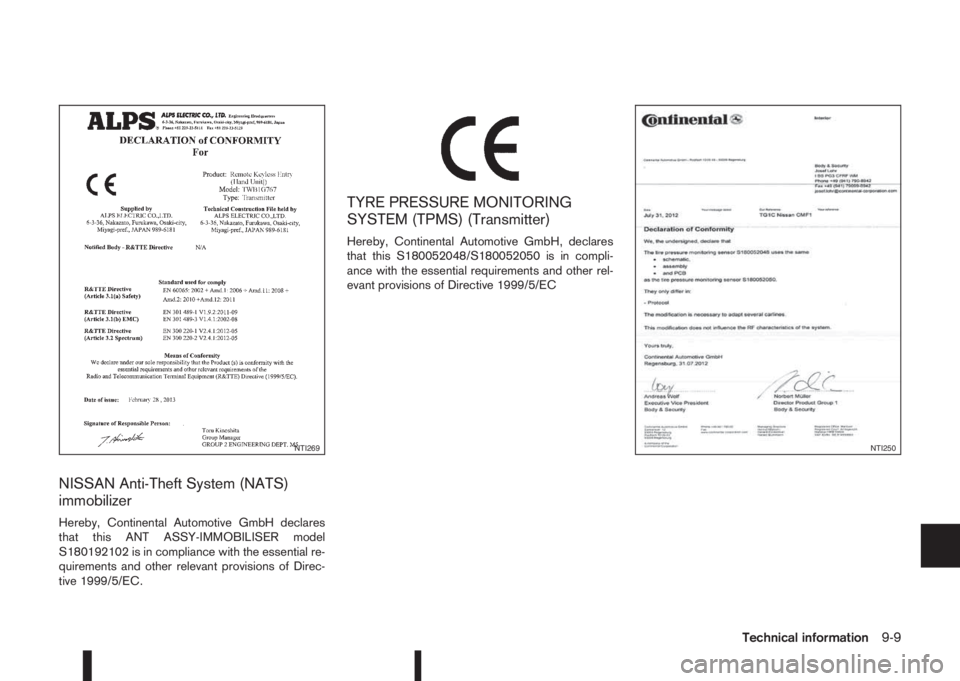
NISSAN Anti-Theft System (NATS)
immobilizer
Hereby, Continental Automotive GmbH declares
that this ANT ASSY-IMMOBILISER model
S180192102 is in compliance with the essential re-
quirements and other relevant provisions of Direc-
tive 1999/5/EC.
m
TYRE PRESSURE MONITORING
SYSTEM (TPMS) (Transmitter)
Hereby, Continental Automotive GmbH, declares
that this S180052048/S180052050 is in compli-
ance with the essential requirements and other rel-
evant provisions of Directive 1999/5/EC
NTI269NTI250
Technical information9-9
Page 329 of 338
– Recommended towing for two-wheel drive (2WD)
models .......................................................................... 6-15
– Tow bar Installation ....................................................... 5-56
– Tow truck towing ........................................................... 6-14
– Towing eye .................................................................... 6-16
– Towing precautions ....................................................... 6-14
– Trailer towing ................................................................ 5-54
Trailer
– Trailer brakes ................................................................ 5-55
– Trailer detection ............................................................. 5-56
– Trailer direction indicator light ........................................ 2-12
– Trailer towing ................................................................ 5-54
Transmission
– Continuously variable transmission fluid ......................... 8-13
– Driving with manual transmission ................................... 5-17
– Manual transmission (ignition switch) ............................. 5-11
– XTRONIC (ignition switch) ............................................ 5-11
Travelling or transferring your registration to another country .. 9-6
Trip computer ...................................................................... 2-27
Turbocharger system (Diesel engine models) ....................... 5-10
Turn signal switch ............................................................... 2-38
Tyre
– Changing tyres and wheels ........................................... 8-35
– Emergency tyre puncture repair kit ......................... 6-8, 8-36
– Flat tyre ........................................................................... 6-3
– Repairing flat tyre ............................................................ 6-8
– Spare tyre ..................................................................... 8-36
– Temporary-use spare tyre ................................................ 6-2
– Types of tyres ................................................................ 8-33
– Tyre age ........................................................................ 8-35
– Tyre equipment .............................................................. 5-66
– Tyre inflation pressure ................................................... 8-33
– Tyre placard .................................................................... 9-8
– Tyre pressure (Trailer) ................................................... 5-55
– Tyre Pressure Monitoring System (TPMS) ....................... 6-7
– Tyre rotation .................................................................. 8-34
– Tyre wear and damage .................................................. 8-35– Wheels and tyres ................................................... 8-33, 9-5
Tyre Pressure Monitoring System (TPMS) ............................. 5-4
U
Ultrasonic sensor
– Alarm sensor ................................................................. 3-12
– Parking sensor .............................................................. 5-45
Universal child restraints for front seat and rear seats .......... 1-16
USB Memory operation ....................................................... 4-30
Using Intelligent Key system .................................................. 3-6
V
Vehicle identification .............................................................. 9-6
– Vehicle identification number (VIN) (chassis number) ....... 9-7
– Vehicle identification plate ................................................ 9-6
Vehicle information display .................................................. 2-13
Vehicle information display warnings and indicators ............. 2-21
Vehicle security .......................................................... 3-12, 5-57
– Alarm system ................................................................. 3-12
Vents .................................................................................. 4-14
W
Warning/indicator lights and audible reminders ...................... 2-4
Washing ............................................................................... 7-2
Waxing .................................................................................. 7-2
Wheel
– Blocking the wheels ........................................................ 6-3
– Care of wheels ................................................................ 7-3
– Changing tyres and wheels ........................................... 8-35
– Getting the tools and spare wheel .................................... 6-3
– Installing the wheel .......................................................... 6-5
Index10-9