warning NISSAN QASHQAI 2017 Owner´s Manual
[x] Cancel search | Manufacturer: NISSAN, Model Year: 2017, Model line: QASHQAI, Model: NISSAN QASHQAI 2017Pages: 508, PDF Size: 2.68 MB
Page 348 of 508
Vehicle-to-vehicle distance control mode
operation
The vehicle-to-vehicle distance control mode is
designed to maintain a selected distance and
reduce the speed to match the slower vehicle
ahead. The system will decelerate the vehicle as
necessary and if the vehicle ahead comes to a
stop, the vehicle decelerates to a standstill.
However, the ICC system can only apply up to
approximately 40% of the vehicle’s total braking
power. This system should only be used when
traffic conditions allow vehicle speeds to remain
fairly constant or when vehicle speeds change
gradually. If a vehicle moves into the traveling
lane ahead or if a vehicle traveling ahead rapidly
decelerates, the distance between vehicles may
become closer because the ICC system cannot
decelerate the vehicle quickly enough. If this
occurs, the ICC system will sound a warning
chime and blink the system display to notify the
driver to take necessary action.
The system will cancel and a warning chime will
sound if the speed is below approximately 15
MPH (24 km/h) and a vehicle is not detected
ahead. The system will also disengage when the
vehicle goes above the maximum set speed.
See “Approach warning” (P.5-69).The following items are controlled in the vehicle-
to-vehicle distance control mode:
.When there are no vehicles traveling ahead,
the vehicle-to-vehicle distance control mode
maintains the speed set by the driver. The
set speed range is the following speed.
— 20 and 90 MPH (32 and 144 km/h)
.When there is a vehicle traveling ahead, the
vehicle-to-vehicle distance control mode
adjusts the speed to maintain the distance,
selected by driver, from the vehicle ahead.
The adjusting speed range is up to the set
speed. If the vehicle ahead comes to a stop,
the vehicle decelerates to a standstill within
the limitations of the system. The system will
cancel once it judges a standstill with a
warning chime.
.When the vehicle traveling ahead has
moved out from its lane of travel, the
vehicle-to-vehicle distance control mode
accelerates and maintains vehicle speed
up to the set speed.
The ICC system does not control vehicle speed
or warn you when you approach stationary and
slow moving vehicles. You must pay attention to
vehicle operation to maintain proper distance
from vehicles ahead when approaching toll
gates or traffic congestion.
SSD0254
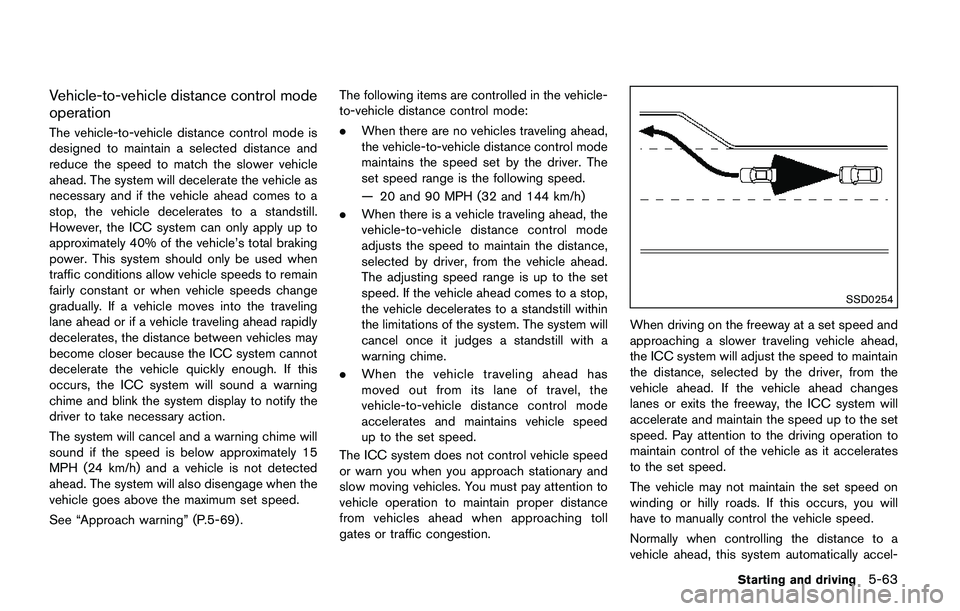
When driving on the freeway at a set speed and
approaching a slower traveling vehicle ahead,
the ICC system will adjust the speed to maintain
the distance, selected by the driver, from the
vehicle ahead. If the vehicle ahead changes
lanes or exits the freeway, the ICC system will
accelerate and maintain the speed up to the set
speed. Pay attention to the driving operation to
maintain control of the vehicle as it accelerates
to the set speed.
The vehicle may not maintain the set speed on
winding or hilly roads. If this occurs, you will
have to manually control the vehicle speed.
Normally when controlling the distance to a
vehicle ahead, this system automatically accel-
Starting and driving5-63
Page 350 of 508
JVS1069X
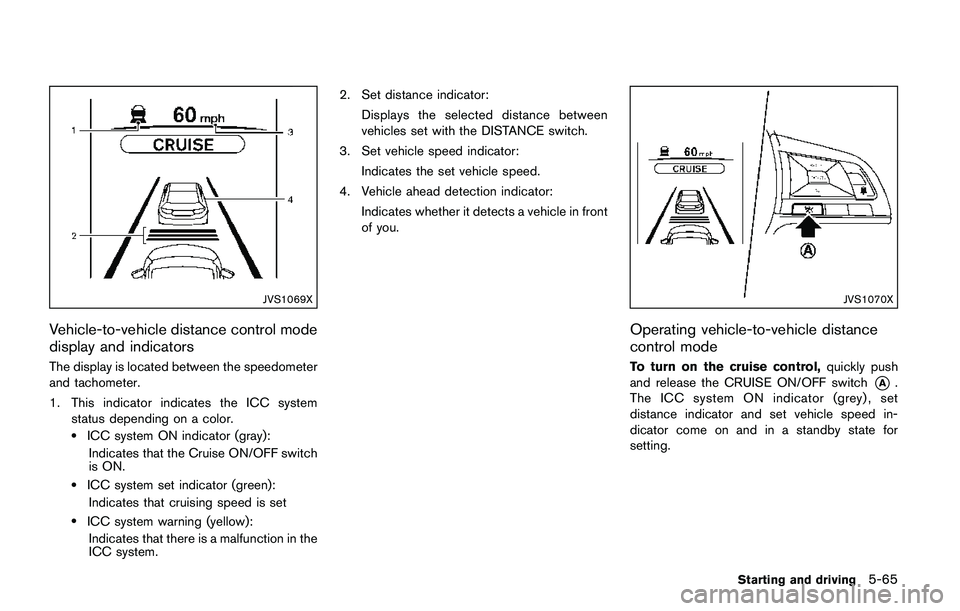
Vehicle-to-vehicle distance control mode
display and indicators
The display is located between the speedometer
and tachometer.
1. This indicator indicates the ICC system
status depending on a color.
.ICC system ON indicator (gray):
Indicates that the Cruise ON/OFF switch
is ON.
.ICC system set indicator (green):
Indicates that cruising speed is set
.ICC system warning (yellow):
Indicates that there is a malfunction in the
ICC system.2. Set distance indicator:
Displays the selected distance between
vehicles set with the DISTANCE switch.
3. Set vehicle speed indicator:
Indicates the set vehicle speed.
4. Vehicle ahead detection indicator:
Indicates whether it detects a vehicle in front
of you.
JVS1070X
Operating vehicle-to-vehicle distance
control mode
To turn on the cruise control,quickly push
and release the CRUISE ON/OFF switch
*A.
The ICC system ON indicator (grey) , set
distance indicator and set vehicle speed in-
dicator come on and in a standby state for
setting.
Starting and driving5-65
Page 351 of 508
5-66Starting and driving
JVS1071X
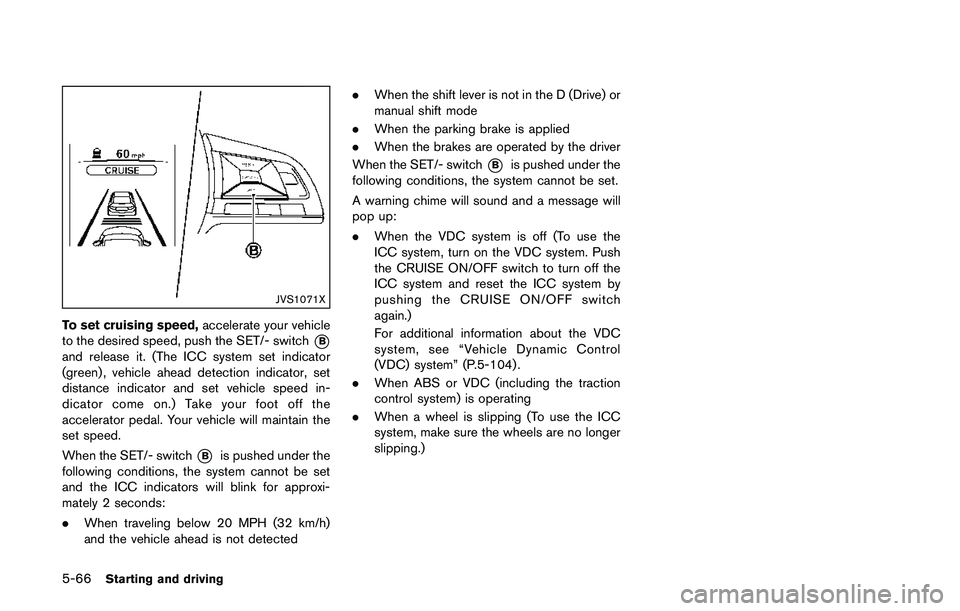
To set cruising speed,accelerate your vehicle
to the desired speed, push the SET/- switch
*B
and release it. (The ICC system set indicator
(green) , vehicle ahead detection indicator, set
distance indicator and set vehicle speed in-
dicator come on.) Take your foot off the
accelerator pedal. Your vehicle will maintain the
set speed.
When the SET/- switch
*Bis pushed under the
following conditions, the system cannot be set
and the ICC indicators will blink for approxi-
mately 2 seconds:
.When traveling below 20 MPH (32 km/h)
and the vehicle ahead is not detected.When the shift lever is not in the D (Drive) or
manual shift mode
.When the parking brake is applied
.When the brakes are operated by the driver
When the SET/- switch
*Bis pushed under the
following conditions, the system cannot be set.
A warning chime will sound and a message will
pop up:
.When the VDC system is off (To use the
ICC system, turn on the VDC system. Push
the CRUISE ON/OFF switch to turn off the
ICC system and reset the ICC system by
pushing the CRUISE ON/OFF switch
again.)
For additional information about the VDC
system, see “Vehicle Dynamic Control
(VDC) system” (P.5-104) .
.When ABS or VDC (including the traction
control system) is operating
.When a wheel is slipping (To use the ICC
system, make sure the wheels are no longer
slipping.)
Page 354 of 508
JVS0965X
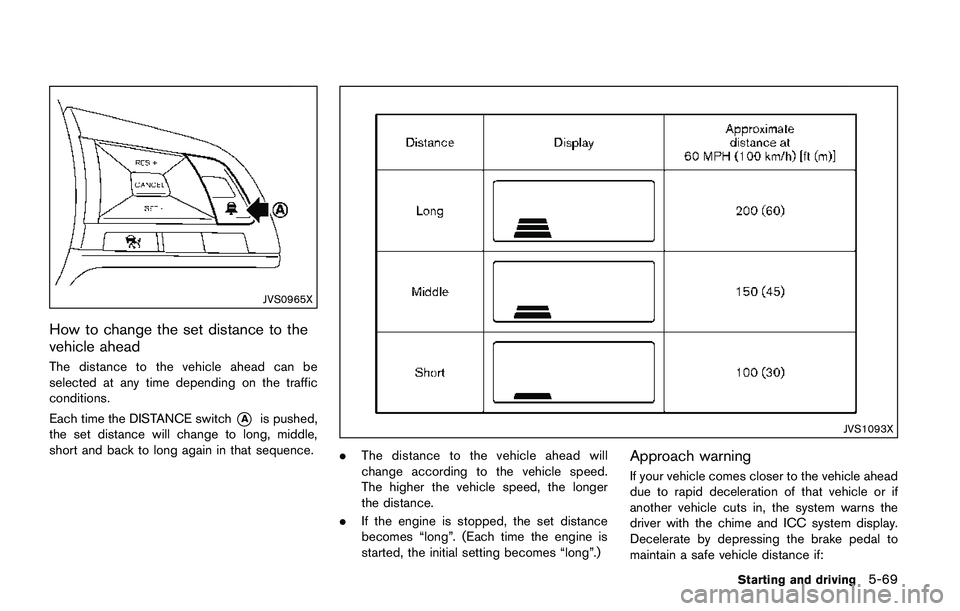
How to change the set distance to the
vehicle ahead
The distance to the vehicle ahead can be
selected at any time depending on the traffic
conditions.
Each time the DISTANCE switch
*Ais pushed,
the set distance will change to long, middle,
short and back to long again in that sequence.JVS1093X
.The distance to the vehicle ahead will
change according to the vehicle speed.
The higher the vehicle speed, the longer
the distance.
.If the engine is stopped, the set distance
becomes “long”. (Each time the engine is
started, the initial setting becomes “long”.)Approach warning
If your vehicle comes closer to the vehicle ahead
due to rapid deceleration of that vehicle or if
another vehicle cuts in, the system warns the
driver with the chime and ICC system display.
Decelerate by depressing the brake pedal to
maintain a safe vehicle distance if:
Starting and driving5-69
Page 355 of 508
5-70Starting and driving
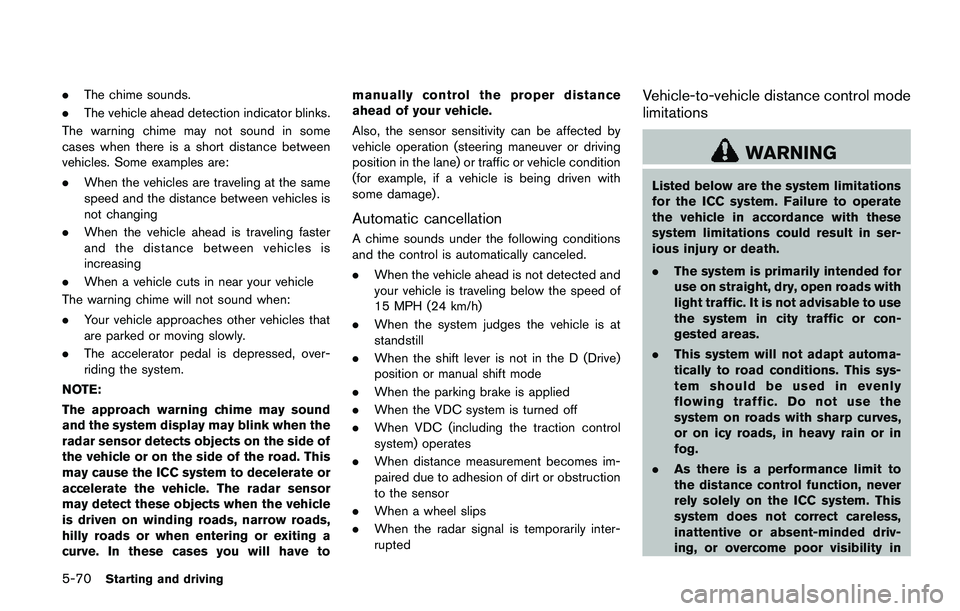
.The chime sounds.
.The vehicle ahead detection indicator blinks.
The warning chime may not sound in some
cases when there is a short distance between
vehicles. Some examples are:
.When the vehicles are traveling at the same
speed and the distance between vehicles is
not changing
.When the vehicle ahead is traveling faster
and the distance between vehicles is
increasing
.When a vehicle cuts in near your vehicle
The warning chime will not sound when:
.Your vehicle approaches other vehicles that
are parked or moving slowly.
.The accelerator pedal is depressed, over-
riding the system.
NOTE:
The approach warning chime may sound
and the system display may blink when the
radar sensor detects objects on the side of
the vehicle or on the side of the road. This
may cause the ICC system to decelerate or
accelerate the vehicle. The radar sensor
may detect these objects when the vehicle
is driven on winding roads, narrow roads,
hilly roads or when entering or exiting a
curve. In these cases you will have tomanually control the proper distance
ahead of your vehicle.
Also, the sensor sensitivity can be affected by
vehicle operation (steering maneuver or driving
position in the lane) or traffic or vehicle condition
(for example, if a vehicle is being driven with
some damage) .
Automatic cancellation
A chime sounds under the following conditions
and the control is automatically canceled.
.When the vehicle ahead is not detected and
your vehicle is traveling below the speed of
15 MPH (24 km/h)
.When the system judges the vehicle is at
standstill
.When the shift lever is not in the D (Drive)
position or manual shift mode
.When the parking brake is applied
.When the VDC system is turned off
.When VDC (including the traction control
system) operates
.When distance measurement becomes im-
paired due to adhesion of dirt or obstruction
to the sensor
.When a wheel slips
.When the radar signal is temporarily inter-
rupted
Vehicle-to-vehicle distance control mode
limitations
WARNING
Listed below are the system limitations
for the ICC system. Failure to operate
the vehicle in accordance with these
system limitations could result in ser-
ious injury or death.
.The system is primarily intended for
use on straight, dry, open roads with
light traffic. It is not advisable to use
the system in city traffic or con-
gested areas.
.This system will not adapt automa-
tically to road conditions. This sys-
tem should be used in evenly
flowing traffic. Do not use the
system on roads with sharp curves,
or on icy roads, in heavy rain or in
fog.
.As there is a performance limit to
the distance control function, never
rely solely on the ICC system. This
system does not correct careless,
inattentive or absent-minded driv-
ing, or overcome poor visibility in
Page 356 of 508
rain, fog, or other bad weather.
Decelerate the vehicle speed by
depressing the brake pedal, de-
pending on the distance to the
vehicle ahead and the surrounding
circumstances in order to maintain a
safe distance between vehicles.
.If the vehicle ahead comes to a stop,
the vehicle decelerates to a stand-
still within the limitations of the
system. The system will cancel once
it judges that the vehicle has come
to a standstill and sound a warning
chime. To prevent the vehicle from
moving, the driver must depress the
brake pedal.
.Always pay attention to the opera-
tion of the vehicle and be ready to
manually control the proper follow-
ing distance. The vehicle-to-vehicle
distance control mode of the ICC
system may not be able to maintain
the selected distance between ve-
hicles (following distance) or se-
lected vehicle speed under some
circumstances.
.The system may not detect the
vehicle in front of you in certain
road or weather conditions. To avoidaccidents, never use the ICC system
under the following conditions:
— On roads where the traffic is
heavy or there are sharp curves
— On slippery road surfaces such
as on ice or snow, etc.
— During bad weather (rain, fog,
snow, etc.)
— When rain, snow or dirt adhere
to the system sensor
— On steep downhill roads (the
vehicle may go beyond the set
vehicle speed and frequent
braking may result in overheat-
ing the brakes)
— On repeated uphill and downhill
roads
— When traffic conditions make it
difficult to keep a proper dis-
tance between vehicles because
of frequent acceleration or de-
celeration
— Interference by other radar
sources.
.In some road or traffic conditions, a
vehicle or object can unexpectedlycome into the sensor detection
zone and cause automatic braking.
You may need to control the dis-
tance from other vehicles using the
accelerator pedal. Always stay alert
and avoid using the ICC system
when it is not recommended in this
section.
The radar sensor will not detect the following
objects:
.Stationary and slow moving vehicles
.Pedestrians or objects in the roadway
.Oncoming vehicles in the same lane
.Motorcycles traveling offset in the travel lane
The sensor generally detects the signals re-
turned from the vehicle ahead. Therefore, if the
sensor cannot detect the reflection from the
vehicle ahead, the ICC system may not maintain
the selected distance.
The following are some conditions in which the
sensor cannot detect the signals:
.When the snow or road spray from traveling
vehicles reduces the sensor’s visibility
.When excessively heavy baggage is loaded
in the rear seat or the cargo area of your
vehicle
The ICC system is designed to automatically
Starting and driving5-71
Page 359 of 508
5-74Starting and driving
JVS1074X
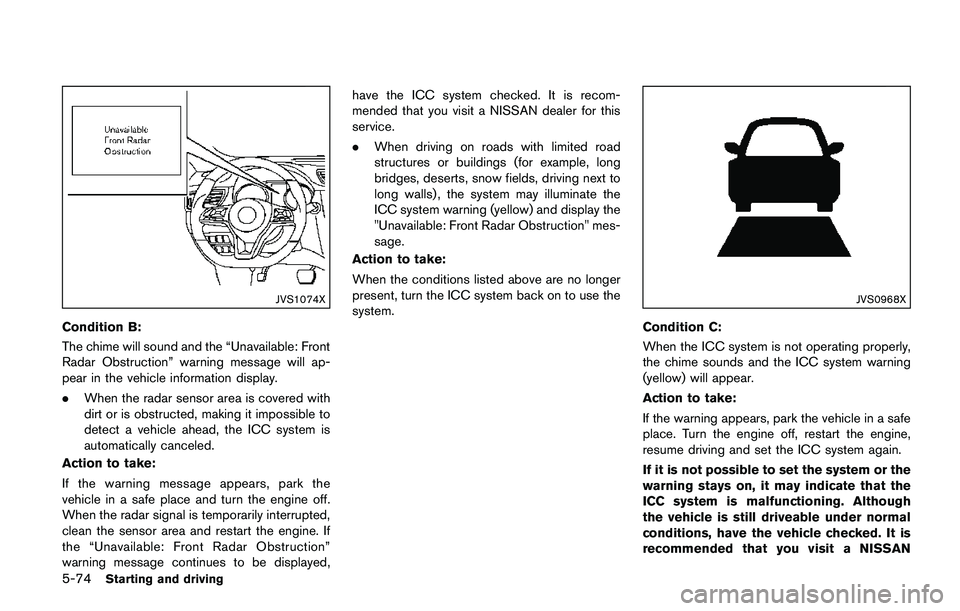
Condition B:
The chime will sound and the “Unavailable: Front
Radar Obstruction” warning message will ap-
pear in the vehicle information display.
.When the radar sensor area is covered with
dirt or is obstructed, making it impossible to
detect a vehicle ahead, the ICC system is
automatically canceled.
Action to take:
If the warning message appears, park the
vehicle in a safe place and turn the engine off.
When the radar signal is temporarily interrupted,
clean the sensor area and restart the engine. If
the “Unavailable: Front Radar Obstruction”
warning message continues to be displayed,have the ICC system checked. It is recom-
mended that you visit a NISSAN dealer for this
service.
.When driving on roads with limited road
structures or buildings (for example, long
bridges, deserts, snow fields, driving next to
long walls) , the system may illuminate the
ICC system warning (yellow) and display the
"Unavailable: Front Radar Obstruction" mes-
sage.
Action to take:
When the conditions listed above are no longer
present, turn the ICC system back on to use the
system.
JVS0968X
Condition C:
When the ICC system is not operating properly,
the chime sounds and the ICC system warning
(yellow) will appear.
Action to take:
If the warning appears, park the vehicle in a safe
place. Turn the engine off, restart the engine,
resume driving and set the ICC system again.
If it is not possible to set the system or the
warning stays on, it may indicate that the
ICC system is malfunctioning. Although
the vehicle is still driveable under normal
conditions, have the vehicle checked. It is
recommended that you visit a NISSAN
Page 360 of 508
dealer for this service.
JVS1041X
System maintenance
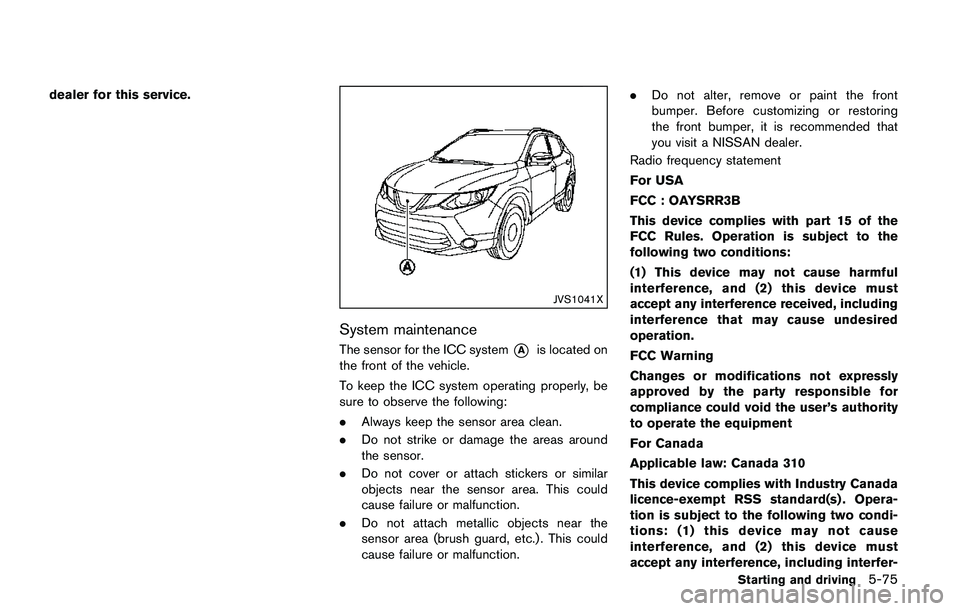
The sensor for the ICC system*Ais located on
the front of the vehicle.
To keep the ICC system operating properly, be
sure to observe the following:
.Always keep the sensor area clean.
.Do not strike or damage the areas around
the sensor.
.Do not cover or attach stickers or similar
objects near the sensor area. This could
cause failure or malfunction.
.Do not attach metallic objects near the
sensor area (brush guard, etc.) . This could
cause failure or malfunction..Do not alter, remove or paint the front
bumper. Before customizing or restoring
the front bumper, it is recommended that
you visit a NISSAN dealer.
Radio frequency statement
For USA
FCC : OAYSRR3B
This device complies with part 15 of the
FCC Rules. Operation is subject to the
following two conditions:
(1) This device may not cause harmful
interference, and (2) this device must
accept any interference received, including
interference that may cause undesired
operation.
FCC Warning
Changes or modifications not expressly
approved by the party responsible for
compliance could void the user’s authority
to operate the equipment
For Canada
Applicable law: Canada 310
This device complies with Industry Canada
licence-exempt RSS standard(s) . Opera-
tion is subject to the following two condi-
tions: (1) this device may not cause
interference, and (2) this device must
accept any interference, including interfer-
Starting and driving5-75
Page 361 of 508
5-76Starting and driving
ence that may cause undesired operation
of the device.
Frequency bands: 24.05 – 24.25GHz
Output power: less than 20 milliwatts
CONVENTIONAL (fixed speed) CRUISE
CONTROL MODE
This mode allows driving at a speed between 25
to 90 MPH (40 km/h to 144 km/h) without
keeping your foot on the accelerator pedal.
WARNING
.In the conventional (fixed speed)
cruise control mode, a warning
chime does not sound to warn you
if you are too close to the vehicle
ahead, as neither the presence of
the vehicle ahead nor the vehicle-to-
vehicle distance is detected.
.Pay special attention to the distance
between your vehicle and the vehi-
cle ahead of you or a collision could
occur.
.Always confirm the setting in the
ICC system display.
.Do not use the conventional (fixed
speed) cruise control mode whendriving under the following condi-
tions:
— when it is not possible to keep
the vehicle at a set speed
— in heavy traffic or in traffic that
varies in speed
— on winding or hilly roads
— on slippery roads (rain, snow,
ice, etc.)
— in very windy areas
.Doing so could cause a loss of
vehicle control and result in an
accident.JVS0999X
Type A
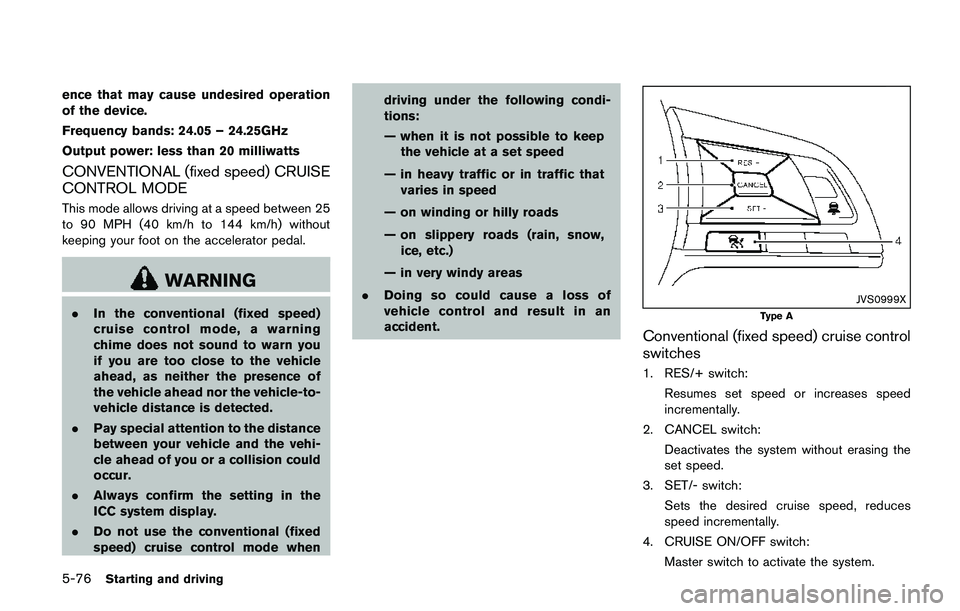
Conventional (fixed speed) cruise control
switches
1. RES/+ switch:
Resumes set speed or increases speed
incrementally.
2. CANCEL switch:
Deactivates the system without erasing the
set speed.
3. SET/- switch:
Sets the desired cruise speed, reduces
speed incrementally.
4. CRUISE ON/OFF switch:
Master switch to activate the system.
Page 362 of 508
JVS1075X
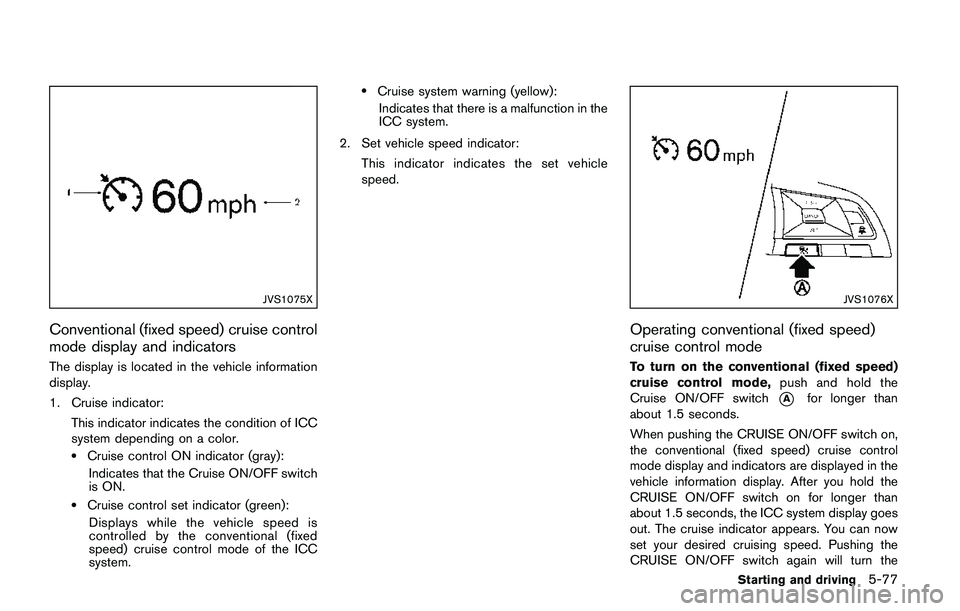
Conventional (fixed speed) cruise control
mode display and indicators
The display is located in the vehicle information
display.
1. Cruise indicator:
This indicator indicates the condition of ICC
system depending on a color.
.Cruise control ON indicator (gray):
Indicates that the Cruise ON/OFF switch
is ON.
.Cruise control set indicator (green):
Displays while the vehicle speed is
controlled by the conventional (fixed
speed) cruise control mode of the ICC
system.
.Cruise system warning (yellow):
Indicates that there is a malfunction in the
ICC system.
2. Set vehicle speed indicator:
This indicator indicates the set vehicle
speed.
JVS1076X
Operating conventional (fixed speed)
cruise control mode
To turn on the conventional (fixed speed)
cruise control mode,push and hold the
Cruise ON/OFF switch
*Afor longer than
about 1.5 seconds.
When pushing the CRUISE ON/OFF switch on,
the conventional (fixed speed) cruise control
mode display and indicators are displayed in the
vehicle information display. After you hold the
CRUISE ON/OFF switch on for longer than
about 1.5 seconds, the ICC system display goes
out. The cruise indicator appears. You can now
set your desired cruising speed. Pushing the
CRUISE ON/OFF switch again will turn the
Starting and driving5-77