fog light NISSAN QASHQAI 2017 Owner´s Manual
[x] Cancel search | Manufacturer: NISSAN, Model Year: 2017, Model line: QASHQAI, Model: NISSAN QASHQAI 2017Pages: 508, PDF Size: 2.68 MB
Page 213 of 508
4-32Heater, air conditioner, audio and phone systems
A/C indicator light on the button illuminates.
MAX A/C (Quick Air Conditioning) opera-
tion:
Push the MAX A/C button for maximum cooling
and dehumidifying.
When the MAX A/C mode is turned on, the air
flow mode indicator will turn off with the air flow
mode fixed at
.
At the same time, the indicator light on the A/C
button and the air recirculation mode will turn on.
Push the MAX A/C button again to turn off the
MAX A/C mode. When the MAX A/C mode is
turned off, most of the settings will return to the
previous state, while the indicator light on the
A/C button will stay on.
Heater operation
Heating:
This mode is used to direct heated air from the
foot outlets. Some air also flows from the
defroster outlets and the side ventilator outlets.
1. Push the air recirculation
button for
normal heating. (The indicator light will turn
off.)
2. Push the
button. (The indicator light will
turn on.)3. Turn the fan speed control
dial to the
desired position.
4. Turn the temperature control dial to the
desired position between the middle and the
hot (right) position.
Ventilation:
This mode directs outside air from the side and
center ventilators.
1. Push the air recirculation
button. (The
indicator light will turn off.)
2. Push the
button. (The indicator light will
turn on.)
3. Turn the fan speed control
dial to the
desired position.
4. Turn the temperature control dial to the
desired position.
Defrosting or defogging:
This mode directs the air to the defroster outlets
to defrost/defog the windows.
1. Push the front defroster
button. (The
indicator light will turn on.)
2. Turn the fan speed control
dial to the
desired position.
3. Turn the temperature control dial to the
desired position between the middle and the
hot (right) position.To remove frost from the windshield quickly,
turn the temperature control dial to the
maximum hot (right) position and the fan
speed control
dial to the maximum
position.
When the front defroster mode is selected,
the air conditioner automatically turns on if
the outside temperature is more than 368F
(28C) . This dehumidifies the air which helps
defog the windshield. The air recirculation
indicator automatically turns off, allowing
outside air to be drawn into the passenger
compartment to further improve the defog-
ging performance. The recirculation mode
cannot be activated in the front defroster
mode.
Bi-level heating:
The bi-level mode directs warmed air to the side
and center ventilators and to the front and rear
floor outlets.
1. Push the air recirculation
button. (The
indicator light will turn off.)
2. Push the
button. (The indicator light will
turn on.)
3. Turn the fan speed control
dial to the
desired position.
4. Turn the temperature control dial to the
desired position.
Page 214 of 508
Heating and defogging:
This mode heats the interior and defogs the
windows.
1. Push the
button. (The indicator light will
turn on.)
2. Turn the fan speed control
dial to the
desired position.
3. Turn the temperature control dial to the
maximum hot (right) position.
When the
button is pushed, the air
conditioner automatically turns on if the outside
temperature is more than 368F(28C) . This
dehumidifies the air which helps defog the
windshield. The air recirculation indicator auto-
matically turns off, allowing outside air to be
drawn into the passenger compartment to
further improve the defogging performance.
NOTE:
Clear snow and ice from the wiper blades
and air inlet in front of the windshield. This
improves heater operation.
Air conditioner operation
Start the engine, turn the fan speed controldial to the desired position, and push the A/C
button to activate the air conditioner. When the
air conditioner is on, cooling and dehumidifying
functions are added to the heater operation. The
air conditioner cooling function operates only
when the engine is running.
Cooling:
This mode is used to cool and dehumidify the air.
1. Push the
button. (The indicator light will
turn on.)
2. Turn the fan speed control
dial to the
desired position.
3. Push the A/C button. (The indicator light will
turn on.)
4. Turn the temperature control dial to the
desired position between the middle and the
cool (left) position.
For quick cooling, push the MAX A/C button.
When the MAX A/C button is pushed, it will
activate the air recirculation mode. The amount
of air coming through the ventilators is the
highest it can go when in MAX A/C mode
regardless of the position of the fan speed
control
dial.Dehumidified heating:
This mode is used to heat and dehumidify the
air.
1. Push the air recirculation
button. (The
indicator light will turn off.)
2. Push the
button. (The indicator light will
turn on.)
3. Turn the fan speed control
dial to the
desired position.
4. Push the A/C button on. (The indicator light
will turn on.)
5. Turn the temperature control dial to the
desired position between the middle and the
hot (right) position.
Dehumidified defogging:
This mode is used to defog the windows and
dehumidify the air.
1. Push the front defroster
button. (The
indicator light will turn on.)
2. Turn the fan speed control
dial to the
desired position.
3. Turn the temperature control dial to the
desired position.
When the front defroster or
mode is
selected, the air conditioner automatically turns
on if the outside temperature is more than 368F
(28C) . This dehumidifies the air which helps
Heater, air conditioner, audio and phone systems4-33
Page 215 of 508
4-34Heater, air conditioner, audio and phone systems
defog the windshield. The air recirculation mode
automatically turns off, allowing outside air to be
drawn into the passenger compartment to
further improve the defogging performance.
The air conditioner is always on in front defroster
or
mode, regardless of whether the
indicator light is on or off.
NOTE:
.The air conditioner system should be
operated for approximately 10 minutes
at least once a month. This helps
prevent damage to the air conditioner
system due to the lack of lubrication.
.A visible mist may be seen coming
from the ventilators in hot, humid
conditions as the air is cooled rapidly.
This does not indicate a malfunction.
.If the engine coolant temperature be-
comes too high, the air recirculation
mode will be activated and the indica-
tor light will come on automatically.
.If the engine coolant temperature
gauge indicates engine coolant tem-
perature over the normal range, turn
the air conditioner off. (See“If your
vehicle overheats”(P.6-11) .)
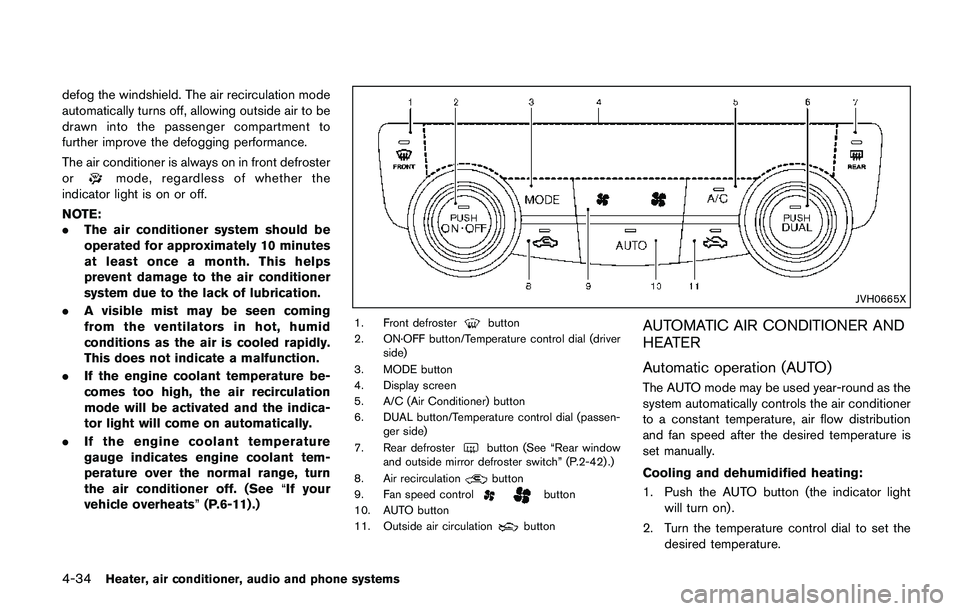
JVH0665X
1. Front defrosterbutton
2. ON·OFF button/Temperature control dial (driver
side)
3. MODE button
4. Display screen
5. A/C (Air Conditioner) button
6. DUAL button/Temperature control dial (passen-
ger side)
7. Rear defroster
button (See “Rear window
and outside mirror defroster switch” (P.2-42) .)
8. Air recirculation
button
9. Fan speed controlbutton
10. AUTO button
11. Outside air circulation
button
AUTOMATIC AIR CONDITIONER AND
HEATER
Automatic operation (AUTO)
The AUTO mode may be used year-round as the
system automatically controls the air conditioner
to a constant temperature, air flow distribution
and fan speed after the desired temperature is
set manually.
Cooling and dehumidified heating:
1. Push the AUTO button (the indicator light
will turn on) .
2. Turn the temperature control dial to set the
desired temperature.
Page 216 of 508
.When the DUAL indicator light is not
illuminated, pushing the DUAL button
(the indicator light will turn on) allows the
user to independently change the driver
and passenger side temperatures with
the corresponding temperature control
dial.
.To cancel the separate temperature
setting, push the DUAL button (the
indicator light will turn off) and the
driver’s side temperature setting will be
applied to both the driver and passenger
sides.
The temperature of the passenger compart-
ment will be maintained automatically. Air
flow distribution and fan speed are also
controlled automatically.
A visible mist may be seen coming from the
ventilators in hot and humid conditions as
the air is cooled rapidly. This does not
indicate a malfunction.
Dehumidified defrosting/defogging:
1. Push the front defroster
button (The
indicator light on the front defroster
button will illuminate) .
2. Turn the temperature control dial to set the
desired temperature..To quickly remove frost from the outside
surface of the windshield, set the tempera-
ture and the fan speed to the maximum
levels.
.After the windshield is cleared, push the
AUTO button (the AUTO indicator light will
turn on).
.When the front defroster
button is
pushed, the air conditioner will turn on when
the outside air temperature is above ap-
proximately 368F(28C) to defog the wind-
shield. The air recirculation mode will
automatically turn off. The outside air circu-
lation mode will be selected to improve the
defogging performance.
Do not set the temperature too low when the
front defroster mode is on (the indicator light is
illuminated) , because doing so may fog up the
windshield.
Manual operation
The manual mode can be used to control the
heater and air conditioner to your desired
settings.
Fan speed control:
Push the fan speed control button (
side orside) to manually control the fan speed.
Push the AUTO button to change the fan speed
to the automatic mode.
Air flow control:
Push the MODE button to select the desired
mode:
— Air flows mainly from the center and side
ventilators.
— Air flows mainly from the center and side
ventilators and foot outlets.
— Air flows mainly from the foot outlet and
partly from the defroster.
— Air flows mainly from the front defroster
outlets and foot outlets.
Temperature control:
Turn the temperature control dial to set the
desired temperature.
.When the DUAL indicator light is not
illuminated, pushing the DUAL button (the
indicator light will turn on) allows the user to
independently change the driver and pas-
senger side temperatures with the corre-
Heater, air conditioner, audio and phone systems4-35
Page 355 of 508
5-70Starting and driving
.The chime sounds.
.The vehicle ahead detection indicator blinks.
The warning chime may not sound in some
cases when there is a short distance between
vehicles. Some examples are:
.When the vehicles are traveling at the same
speed and the distance between vehicles is
not changing
.When the vehicle ahead is traveling faster
and the distance between vehicles is
increasing
.When a vehicle cuts in near your vehicle
The warning chime will not sound when:
.Your vehicle approaches other vehicles that
are parked or moving slowly.
.The accelerator pedal is depressed, over-
riding the system.
NOTE:
The approach warning chime may sound
and the system display may blink when the
radar sensor detects objects on the side of
the vehicle or on the side of the road. This
may cause the ICC system to decelerate or
accelerate the vehicle. The radar sensor
may detect these objects when the vehicle
is driven on winding roads, narrow roads,
hilly roads or when entering or exiting a
curve. In these cases you will have tomanually control the proper distance
ahead of your vehicle.
Also, the sensor sensitivity can be affected by
vehicle operation (steering maneuver or driving
position in the lane) or traffic or vehicle condition
(for example, if a vehicle is being driven with
some damage) .
Automatic cancellation
A chime sounds under the following conditions
and the control is automatically canceled.
.When the vehicle ahead is not detected and
your vehicle is traveling below the speed of
15 MPH (24 km/h)
.When the system judges the vehicle is at
standstill
.When the shift lever is not in the D (Drive)
position or manual shift mode
.When the parking brake is applied
.When the VDC system is turned off
.When VDC (including the traction control
system) operates
.When distance measurement becomes im-
paired due to adhesion of dirt or obstruction
to the sensor
.When a wheel slips
.When the radar signal is temporarily inter-
rupted
Vehicle-to-vehicle distance control mode
limitations
WARNING
Listed below are the system limitations
for the ICC system. Failure to operate
the vehicle in accordance with these
system limitations could result in ser-
ious injury or death.
.The system is primarily intended for
use on straight, dry, open roads with
light traffic. It is not advisable to use
the system in city traffic or con-
gested areas.
.This system will not adapt automa-
tically to road conditions. This sys-
tem should be used in evenly
flowing traffic. Do not use the
system on roads with sharp curves,
or on icy roads, in heavy rain or in
fog.
.As there is a performance limit to
the distance control function, never
rely solely on the ICC system. This
system does not correct careless,
inattentive or absent-minded driv-
ing, or overcome poor visibility in
Page 375 of 508
5-90Starting and driving
— Small pedestrians (including
small children) , animals and cy-
clists.
— Pedestrians in wheelchairs or
using mobile transport such as
scooters, child-operated toys, or
skateboards.
— Pedestrians who are seated or
otherwise not in a full upright
standing or walking position.
— Obstacles on the roadway
— Oncoming vehicles
— Crossing vehicles
— Obstacles on the roadside
.The FEB with pedestrian detection
system has some performance lim-
itations.
— If a stationary vehicle is in the
vehicle’s path, the FEB with
pedestrian detection system will
not function when the vehicle is
driven at speeds over approxi-
mately 50 MPH (80 km/h) .
— For pedestrian detection, the
FEB with pedestrian detection
system will not function whenthe vehicle is driven at speeds
over approximately 37 MPH (60
km/h) or below approximately 6
MPH (10 km/h) .
.The FEB with pedestrian detection
system may not function for pedes-
trians in darkness or in tunnels,
even if there is street lighting in
the area.
.For pedestrians, the FEB with pe-
destrian detection system will not
issue the first warning.
.The FEB with pedestrian detection
system may not function if the
vehicle ahead is narrow (for exam-
ple a motorcycle) .
.The FEB with pedestrian detection
system may not function if speed
difference between the two vehicles
is too small.
.The radar sensor may not function
properly or detect a vehicle ahead in
the following conditions:
— Poor visibility (conditions such
as rain, snow, fog, dust storms,
sandstorms, and road spray
from other vehicles)— Driving on a steep downhill
slope or roads with sharp
curves.
— Driving on a bumpy road sur-
face, such as an uneven dirt
road.
— If dirt, ice, snow or other materi-
al is covering the radar sensor
area.
— Interference by other radar
sources.
.The camera may not function prop-
erly or detect a vehicle ahead in the
following conditions:
— The camera area of windshield
is fogged up, or covered with
dirt, water drops, ice, snow, etc.
— Strong light (for example, sun-
light or high beams from on-
coming vehicles) enters the
front camera. Strong light
causes the area around the
pedestrian to be cast in a sha-
dow, making it difficult to see.
— A sudden change in brightness
occurs. (For example, when the
vehicle enters or exits a tunnel
Page 448 of 508
JVM0787X
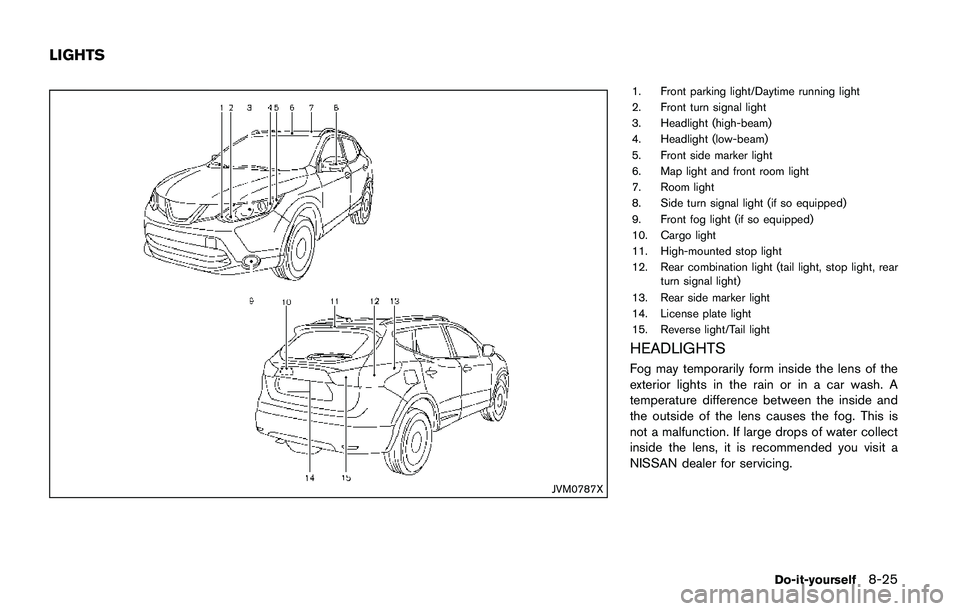
1. Front parking light/Daytime running light
2. Front turn signal light
3. Headlight (high-beam)
4. Headlight (low-beam)
5. Front side marker light
6. Map light and front room light
7. Room light
8. Side turn signal light (if so equipped)
9. Front fog light (if so equipped)
10. Cargo light
11. High-mounted stop light
12. Rear combination light (tail light, stop light, rear
turn signal light)
13. Rear side marker light
14. License plate light
15. Reverse light/Tail light
HEADLIGHTS
Fog may temporarily form inside the lens of the
exterior lights in the rain or in a car wash. A
temperature difference between the inside and
the outside of the lens causes the fog. This is
not a malfunction. If large drops of water collect
inside the lens, it is recommended you visit a
NISSAN dealer for servicing.
Do-it-yourself8-25
LIGHTS
Page 450 of 508
4. Install the new bulb in the reverse order of
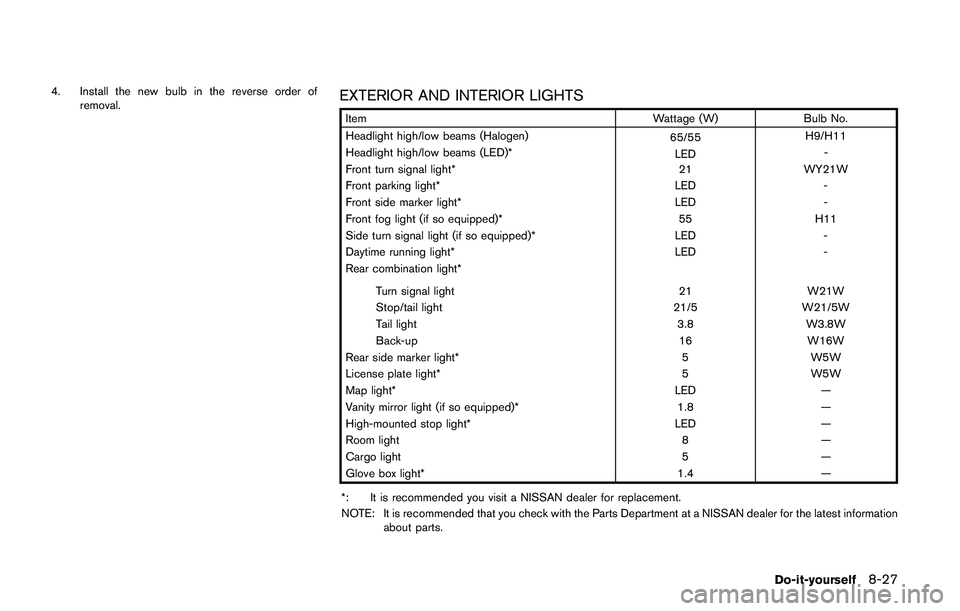
removal.EXTERIOR AND INTERIOR LIGHTS
Item Wattage (W) Bulb No.
Headlight high/low beams (Halogen)
65/55H9/H11
Headlight high/low beams (LED)*
LED-
Front turn signal light* 21 WY21W
Front parking light* LED -
Front side marker light* LED -
Front fog light (if so equipped)* 55 H11
Side turn signal light (if so equipped)* LED -
Daytime running light* LED -
Rear combination light*
Turn signal light 21 W21W
Stop/tail light 21/5 W21/5W
Tail light 3.8 W3.8W
Back-up 16 W16W
Rear side marker light* 5 W5W
License plate light* 5 W5W
Map light* LED —
Vanity mirror light (if so equipped)* 1.8 —
High-mounted stop light* LED —
Room light 8 —
Cargo light 5 —
Glove box light* 1.4 —
*: It is recommended you visit a NISSAN dealer for replacement.
NOTE: It is recommended that you check with the Parts Department at a NISSAN dealer for the latest information
about parts.
Do-it-yourself8-27
Page 501 of 508
11-2
Coolant
Capacities and
recommended fluids/lubricants ........................ 10-2
Changing engine coolant ..................................... 8-6
Checking engine coolant level ............................ 8-5
Corrosion protection .................................................... 7-7
Cruise control .............................................................. 5-58
Fixed speed cruise control (on
ICC system) .......................................................... 5-76
Intelligent Cruise Control (ICC) ....................... 5-60
Cup holders ................................................................. 2-54
CVT, Driving with CVT (Continuously
Variable Transmission) .................................. 5-13, 5-20
D
Daytime Running Lights (DRL) system ................. 2-47
Defroster switch, Rear window and outside
mirror defroster switch .............................................. 2-42
Dimensions and weights .......................................... 10-8
Display
Vehicle information display ................................ 2-18
Drive belt ...................................................................... 8-13
Driving
All-wheel drive (AWD) ....................................... 5-96
Cold weather driving ........................................ 5-110
Driving with CVT (Continuously
Variable Transmission) ....................................... 5-20
Driving with manual transmission .................... 5-25
On-pavement and off-road driving ..................... 5-8
Precautions when starting and driving ............. 5-4
Safety precautions .............................................. 5-10
E
ECO mode switch ..................................................... 2-52ECO mode system .................................................... 5-29
Ambient ECO ....................................................... 5-30
ECO Drive Report ............................................... 5-31
ECO Pedal Guide function ............................... 5-29
Economy, Fuel ............................................................. 5-96
Elapsed time ................................................................ 2-34
Elapsed time and trip odometer ............................. 2-34
Electric power steering .......................................... 5-101
Electric power steering warning light .................... 2-12
Emission control information label ...................... 10-10
Emission control system maintenance .................... 9-8
Emission control system warranty ....................... 10-17
Engine
Before starting the engine ................................ 5-17
Break-in schedule ................................................ 5-95
Capacities and
recommended fluids/lubricants ........................ 10-2
Changing engine coolant ..................................... 8-6
Changing engine oil and filter ............................. 8-6
Checking engine coolant level ............................ 8-5
Checking engine oil level ..................................... 8-6
Coolant temperature gauge ................................. 2-7
Emergency engine shut off ...................... 5-16, 6-3
Engine compartment check locations ............... 8-3
Engine cooling system .......................................... 8-4
Engine oil .................................................................. 8-6
Engine oil and oil filter recommendation ....... 10-5
Engine oil viscosity .............................................. 10-6
Engine serial number .......................................... 10-9
Engine specifications .......................................... 10-7
Engine start operation indicator
(for Continuously Variable Transmission
(CVT) models) ...................................................... 2-28
Engine start operation indicator (for Manual
Transmission (MT) models) ............................... 2-28
If your vehicle overheats .................................... 6-11
Starting the engine .................................. 5-17, 5-18Event Data Recorders (EDR) ............................... 10-19
Exhaust gas (carbon monoxide) ............................... 5-4
Explanation of scheduled maintenance items ....... 9-5
F
F.M.V.S.S./C.M.V.S.S. certification label ............... 10-9
Filter
Air cleaner housing filter .................................... 8-14
Changing engine oil and filter ............................. 8-6
Flashers (See hazard warning flasher switch) ...... 6-2
Flat tire ............................................................................ 6-3
Flat towing ................................................................. 10-15
Floor mat cleaning ........................................................ 7-5
Fluid
Brake and clutch fluid ........................................... 8-9
Capacities and
recommended fluids/lubricants ........................ 10-2
Continuously Variable Transmission
(CVT) fluid ................................................................ 8-9
Engine coolant ........................................................ 8-4
Engine oil .................................................................. 8-6
Window washer fluid .......................................... 8-10
FM-AM radio with Compact Disc (CD) player .... 4-48
FM-AM-SAT radio with Compact Disc (CD)
player (Type A) ............................................................ 4-55
FM-AM-SAT radio with Compact Disc (CD)
player (Type B) ............................................................ 4-63
Fog light switch .......................................................... 2-48
Forward Emergency Braking (FEB) ....................... 5-80
Forward Emergency Braking (FEB) system
warning light ................................................................ 2-12
Forward Emergency Braking (FEB) with
pedestrian detection system ................................... 5-86
Front manual seat adjustment ................................... 1-3
Front passenger air bag and status light ............. 1-47
Front seat, Front seat adjustment ............................ 1-3
Page 502 of 508
Fuel
Capacities and
recommended fluids/lubricants ........................ 10-2
Fuel economy ....................................................... 5-96
Fuel information .................................................... 10-3
Fuel octane rating ............................................... 10-3
Fuel-filler cap ........................................................ 3-27
Fuel-filler door ...................................................... 3-27
Gauge ........................................................................ 2-8
Fuel Efficient Driving Tips ........................................ 5-95
Fuses ............................................................................. 8-18
Fusible links ................................................................. 8-19
G
Gas cap ........................................................................ 3-27
Gauge .............................................................................. 2-5
Engine coolant temperature gauge ................... 2-7
Fuel gauge ............................................................... 2-8
Odometer ................................................................. 2-6
Speedometer ........................................................... 2-6
Tachometer ............................................................... 2-7
General maintenance .................................................. 9-2
Giving voice commands ........................................ 4-100
Glove box ..................................................................... 2-56
H
Hazard warning flasher switch .................................. 6-2
Head restraints/headrests .......................................... 1-6
Headlights
Bulb replacement ................................................ 8-25
Headlight switch .................................................. 2-43
Heated seats ............................................................... 2-50
Heated steering wheel .............................................. 2-49
Heater
Heater and air conditioner operation ............. 4-30High beam assist ........................................................ 2-45
Hill start assist system ........................................... 5-109
Hood release ............................................................... 3-24
Hook
Luggage hook ...................................................... 2-58
Horn ............................................................................... 2-49
I
Ignition switch ............................................................. 5-14
Ignition switch (model without Intelligent
Key system) ................................................................. 5-12
Ignition switch positions ........................................... 5-15
Immobilizer system ..................................................... 2-38
Indicator
Vehicle information display ................................ 2-18
Indicator lights ............................................................. 2-16
Inside mirror ................................................................. 3-31
Inspection/maintenance (I/M) test ....................... 10-18
Instrument brightness control .................................... 2-9
Instrument panel ........................................................... 2-4
Intelligent Cruise Control (ICC) .............................. 5-60
Intelligent Cruise Control (ICC) indicator ............ 2-30
Intelligent Key system ................................................ 3-11
Key operating range ........................................... 3-13
Key operation ........................................................ 3-14
Remote keyless operation ................................. 3-18
Interior light replacement .......................................... 8-27
Interior light switch ..................................................... 2-66
Interior lights ................................................................ 2-65
ISOFIX child restraint ................................................ 1-21
J
Jump starting ................................................................. 6-9
K
Key
Ignition switch (model without Intelligent
Key system) .......................................................... 5-12
Ignition switch positions .................................... 5-15
Key positions ............................................................... 5-14
Keyless entry
(See remote keyless entry system) ................... 3-8
With Intelligent Key system (See Intelligent
Key system) .......................................................... 3-18
Keys ................................................................................. 3-2
For Intelligent Key system ................................. 3-11
L
Labels
Air bag warning labels ....................................... 1-55
Air conditioner specification label ................. 10-10
Emission control information label ................ 10-10
Engine serial number .......................................... 10-9
F.M.V.S.S./C.M.V.S.S. certification label ........ 10-9
Tire and Loading information label .... 8-30, 10-10
Vehicle identification number (VIN) ................ 10-8
Lane Departure Prevention (LDP) .......................... 5-36
Lane Departure Warning (LDW) ............................ 5-31
LATCH system ............................................................ 1-21
License plate, Installing front license plate ....... 10-11
Liftgate
Liftgate release lever .......................................... 3-26
Operating manual liftgate .................................. 3-25
Light
Air bag warning light .......................................... 1-56
Bulb replacement ................................................ 8-25
Fog light switch ................................................... 2-48
Headlight switch .................................................. 2-43
Headlights bulb replacement ........................... 8-25
11-3