tow NISSAN QASHQAI 2017 Owner´s Manual
[x] Cancel search | Manufacturer: NISSAN, Model Year: 2017, Model line: QASHQAI, Model: NISSAN QASHQAI 2017Pages: 508, PDF Size: 2.68 MB
Page 413 of 508
6-16In case of emergency
Manual Transmission (MT) model:
1. Place the ignition switch in the OFF position.
2. Secure the steering wheel in a straight-
ahead position with rope or a similar device.
3. Move the shift lever to the N (Neutral)
position.
4. Release the parking brake.
5. Attach the safety chains whenever towing.
Rear wheels on the ground:
1. Place the ignition switch in the OFF position.
2. Move the shift lever to the N (Neutral)
position.
3. Release the parking brake.
4. Attach safety chains whenever towing.
All four wheels on the ground:
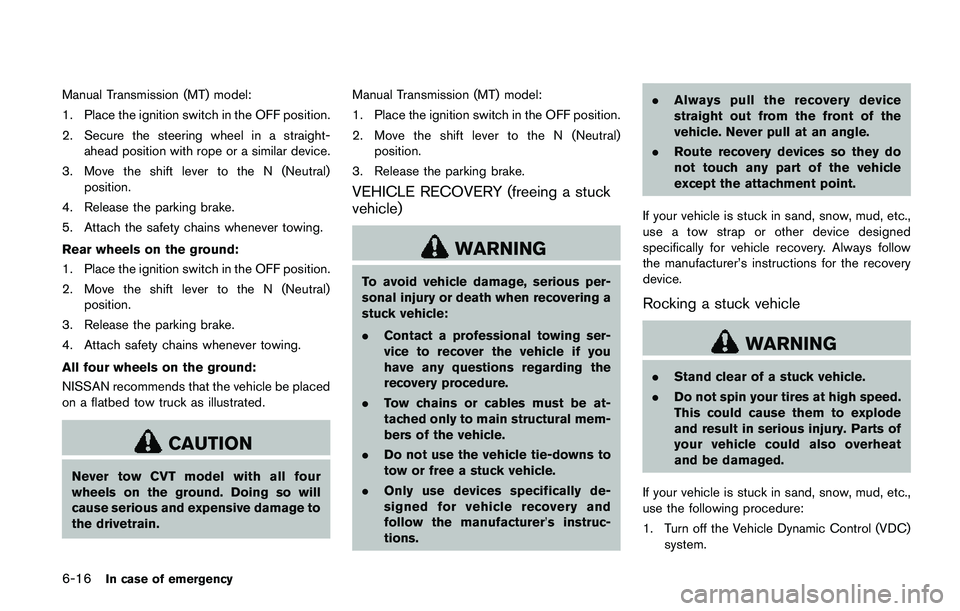
NISSAN recommends that the vehicle be placed
on a flatbed tow truck as illustrated.
CAUTION
Never tow CVT model with all four
wheels on the ground. Doing so will
cause serious and expensive damage to
the drivetrain.Manual Transmission (MT) model:
1. Place the ignition switch in the OFF position.
2. Move the shift lever to the N (Neutral)
position.
3. Release the parking brake.
VEHICLE RECOVERY (freeing a stuck
vehicle)
WARNING
To avoid vehicle damage, serious per-
sonal injury or death when recovering a
stuck vehicle:
.Contact a professional towing ser-
vice to recover the vehicle if you
have any questions regarding the
recovery procedure.
.Tow chains or cables must be at-
tached only to main structural mem-
bers of the vehicle.
.Do not use the vehicle tie-downs to
tow or free a stuck vehicle.
.Only use devices specifically de-
signed for vehicle recovery and
follow the manufacturer’s instruc-
tions..Always pull the recovery device
straight out from the front of the
vehicle. Never pull at an angle.
.Route recovery devices so they do
not touch any part of the vehicle
except the attachment point.
If your vehicle is stuck in sand, snow, mud, etc.,
use a tow strap or other device designed
specifically for vehicle recovery. Always follow
the manufacturer’s instructions for the recovery
device.
Rocking a stuck vehicle
WARNING
.Stand clear of a stuck vehicle.
.Do not spin your tires at high speed.
This could cause them to explode
and result in serious injury. Parts of
your vehicle could also overheat
and be damaged.
If your vehicle is stuck in sand, snow, mud, etc.,
use the following procedure:
1. Turn off the Vehicle Dynamic Control (VDC)
system.
Page 414 of 508
2. Make sure the area in front and behind the
vehicle is clear of obstructions.
3. Turn the steering wheel right and left to clear
an area around the front tires.
4. Slowly rock the vehicle forward and back-
ward.
.Shift back and forth between R (Reverse)
and D (Drive) (Continuously Variable
Transmission (CVT) models) or 1st and
R (Reverse) (Manual Transmission (MT)
models) .
.Apply the accelerator as little as possible
to maintain the rocking motion.
.Release the accelerator pedal before
shifting between R and D (CVT models)
or 1st and R (MT models) .
.Do not spin the tires above 35 MPH (55
km/h) .
5. If the vehicle cannot be freed after a few
tries, contact a professional towing service
to remove the vehicle.
In case of emergency6-17
Page 419 of 508
7-4Appearance and care
TIRE DRESSING
NISSAN does not recommend the use of tire
dressings. Tire manufacturers apply a coating to
the tires to help reduce discoloration of the
rubber. If a tire dressing is applied to the tires, it
may react with the coating and form a com-
pound. This compound may come off the tire
while driving and stain the vehicle paint.
If you choose to use a tire dressing, take the
following precautions:
.Use a water-based tire dressing. The coat-
ing on the tire dissolves more easily with an
oil-based tire dressing.
.Apply a light coat of tire dressing to help
prevent it from entering the tire tread/
grooves (where it would be difficult to
remove) .
.Wipe off excess tire dressing using a dry
towel. Make sure the tire dressing is
completely removed from the tire tread/
grooves.
.Allow the tire dressing to dry as recom-
mended by tire dressing manufacturer.Occasionally remove loose dust from the interior
trim, plastic parts and seats using a vacuum
cleaner or soft bristled brush. Wipe the vinyl and
leather surfaces with a clean, soft cloth dam-
pened in mild soap solution, then wipe clean
with a dry soft cloth.
Regular care and cleaning is required in order to
maintain the appearance of the leather.
Before using any fabric protector, read the
manufacturer’s recommendations. Some fabric
protectors contain chemicals that may stain or
bleach the seat material.
Use a cloth dampened only with water, to clean
the meter and gauge lens.
WARNING
Do not use water or acidic cleaners (hot
steam cleaners) on the seat. This can
damage the seat or occupant classifica-
tion sensors. This can also affect the
operation of the air bag system and
result in serious personal injury.
CAUTION
.Never use benzine, thinner, or any
similar material.
.For cleaning, use a soft cloth, dam-
pened with water. Never use a rough
cloth, alcohol, benzine, thinner or
any kind of solvent or paper towel
with a chemical cleaning agent.
They will scratch or cause discolora-
tion to the lens.
.Do not spray any liquid such as
water on the meter lens. Spraying
liquid may cause the system to
malfunction.
.Small dirt particles can be abrasive
and damaging to the leather sur-
faces and should be removed
promptly. Do not use saddle soap,
car waxes, polishes, oils, cleaning
fluids, solvents, detergents or am-
monia-based cleaners as they may
damage the leather’s natural finish.
.Never use fabric protectors unless
recommended by the manufacturer.
.Do not use glass or plastic cleaner
on meter or gauge lens covers. It
CLEANING INTERIOR
Page 480 of 508
10 Technical and consumer information
Capacities and recommended fluids/lubricants ............. 10-2
Fuel information ................................................................ 10-3
Engine oil and oil filter recommendation .................... 10-5
Air conditioning system refrigerant and
lubricant recommendations ............................................ 10-6
Specifications .......................................................................... 10-7
Engine ................................................................................. 10-7
Wheels and tires .............................................................. 10-7
Dimensions and weights ................................................ 10-8
When traveling or registering in another country .......... 10-8
Vehicle identification .............................................................. 10-8
Vehicle Identification Number (VIN) plate .................. 10-8
Vehicle identification number (chassis number) ....... 10-9
Engine serial number ....................................................... 10-9
F.M.V.S.S./C.M.V.S.S. certification label .................... 10-9
Emission control information label ............................ 10-10
Tire and Loading Information label ........................... 10-10
Air conditioner specification label ............................. 10-10
Installing front license plate .............................................. 10-11Vehicle loading information .............................................. 10-11
Terms .............................................................................. 10-11
Vehicle load capacity ................................................. 10-12
Securing the load ....................................................... 10-13
Loading tips .................................................................. 10-13
Measurement of weights ........................................... 10-14
Towing a trailer .................................................................... 10-14
Flat towing ............................................................................ 10-15
Flat towing for All–Wheel Drive vehicle (if
so equipped) ................................................................ 10-15
Flat towing for Front-Wheel Drive vehicle (if
so equipped) ................................................................ 10-15
Uniform tire quality grading .............................................. 10-16
Treadwear ..................................................................... 10-16
Traction AA, A, B and C ........................................... 10-16
Temperature A, B and C ........................................... 10-16
Emission control system warranty .................................. 10-17
Reporting safety defects .................................................. 10-17
Readiness for Inspection/Maintenance (I/M) test ...... 10-18
Event Data Recorders (EDR) .......................................... 10-19
Owner’s manual/service manual order information ..... 10-19
Page 482 of 508
FUEL INFORMATION
Use unleaded regular gasoline with an octane
rating of at least 87 AKI (Anti-Knock Index)
number (Research octane number 91) .
CAUTION
.Using a fuel other than that speci-
fied could adversely affect the emis-
sion control system, and may also
affect warranty coverage.
.Under no circumstances should a
leaded gasoline be used, because
this will damage the three-way cat-
alyst.
.Do not use E-15 or E-85 fuel in your
vehicle. Your vehicle is not designed
to run on E-15 or E-85 fuel. Using E-
15 or E-85 fuel in a vehicle not
specifically designed for E-15 or E-
85 fuel can adversely affect the
emission control devices and sys-
tems of the vehicle. Damage caused
by such fuel is not covered by the
NISSAN new vehicle limited war-
ranty.
.Do not use fuel that contains the
octane booster methylcyclopenta-dienyl manganese tricarbonyl
(MMT) . Using fuel containing MMT
may adversely affect vehicle perfor-
mance and vehicle emissions. Not
all fuel dispensers are labeled to
indicate MMT content, so you may
have to consult your gasoline retai-
ler for more details. Note that Fed-
eral and California laws prohibit the
use of MMT in reformulated gaso-
line.
.U.S. government regulations require
ethanol dispensing pumps to be
identified by a small, square, orange
and black label with the common
abbreviation or the appropriate per-
centage for that region.
Gasoline specifications
NISSAN recommends using gasoline that meets
the World-Wide Fuel Charter (WWFC) speci-
fications where it is available. Many of the
automobile manufacturers developed this spe-
cification to improve emission control system
and vehicle performance. Ask your service
station manager if the gasoline meets the
WWFC specifications.
Reformulated gasoline
Some fuel suppliers are now producing refor-
mulated gasolines. These gasolines are specially
designed to reduce vehicle emissions. NISSAN
supports efforts towards cleaner air and sug-
gests that you use reformulated gasoline when
available.
Gasoline containing oxygenates
Some fuel suppliers sell gasoline containing
oxygenates such as ethanol, MTBE and metha-
nol with or without advertising their presence.
NISSAN does not recommend the use of fuels
of which the oxygenate content and the fuel
compatibility for your vehicle cannot be readily
determined. If in doubt, ask your service station
manager.
If you use oxygenate-blend gasoline, please take
the following precautions as the usage of such
fuels may cause vehicle performance problems
and/or fuel system damage.
.The fuel should be unleaded and have
an octane rating no lower than that
recommended for unleaded gasoline.
.If an oxygenate-blend, other than
methanol blend is used, it should
contain no more than 10% oxygenate.
(MTBE may, however, be added up to
15%.)
Technical and consumer information10-3
Page 491 of 508
10-12Technical and consumer information
weight of occupants and cargo that
can be loaded into the vehicle. If the
vehicle is used to tow a trailer, the
trailer tongue weight must be in-
cluded as part of the cargo load. This
information is located on the Tire and
Loading Information label.
.Cargo capacity - permissible weight
of cargo, the subtracted weight of
occupants from the load limit.
VEHICLE LOAD CAPACITY
Do not exceed the load limit of your
vehicle shown as “The combined weight
of occupants and cargo” on the Tire and
Loading Information label. Do not exceed
the number of occupants shown as
“Seating Capacity” on the Tire and
Loading Information label.
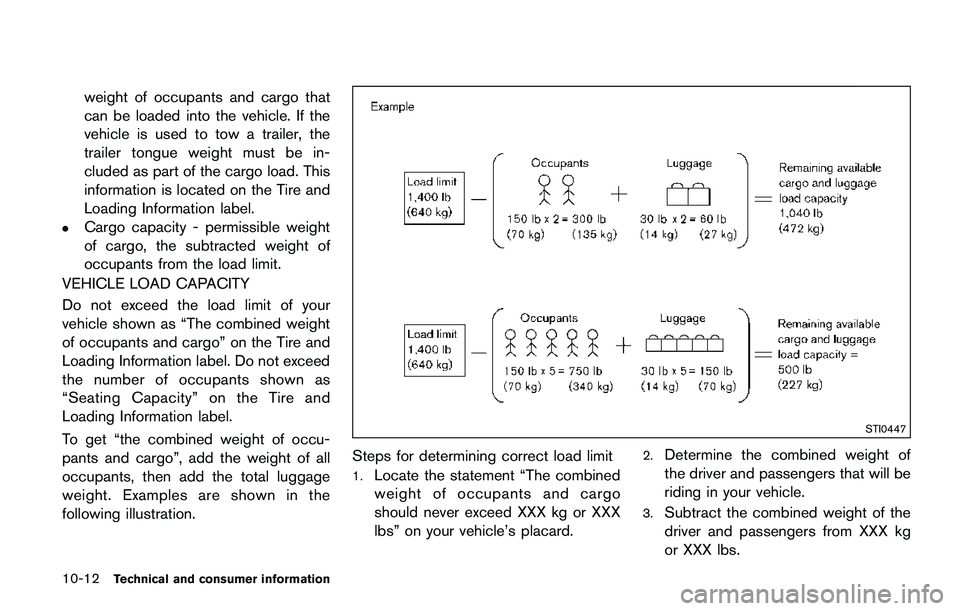
To get “the combined weight of occu-
pants and cargo”, add the weight of all
occupants, then add the total luggage
weight. Examples are shown in the
following illustration.
STI0447
Steps for determining correct load limit
1.Locate the statement “The combined
weight of occupants and cargo
should never exceed XXX kg or XXX
lbs” on your vehicle’s placard.
2.Determine the combined weight of
the driver and passengers that will be
riding in your vehicle.
3.Subtract the combined weight of the
driver and passengers from XXX kg
or XXX lbs.
Page 493 of 508
10-14Technical and consumer information
WARNING
.Properly secure all cargo with
ropes or straps to help prevent
it from sliding or shifting. Do
not place cargo higher than
the seatbacks. In a sudden
stop or collision, unsecured
cargo could cause personal
injury.
.Do not load your vehicle any
heavier than the GVWR or the
maximum front and rear
GAWRs. If you do, parts of
your vehicle can break, tire
damage could occur, or it can
change the way your vehicle
handles. This could result in
loss of control and cause per-
sonal injury.
.Overloading not only can
shorten the life of your vehicle
and the tire, but can cause
unsafe vehicle handling and
longer braking distances. Thismay cause a premature tire
failure, which could result in a
serious accident and personal
injury. Failures caused by
overloading are not covered
by the vehicle’s warranty.
MEASUREMENT OF WEIGHTS
Secure loose items to prevent weight
shifts that could affect the balance of
your vehicle. When the vehicle is loaded,
drive to a scale and weigh the front and
the rear wheels separately to determine
axle loads. Individual axle loads should
not exceed either of the Gross Axle
Weight Ratings (GAWR) . The total of
the axle loads should not exceed the
Gross Vehicle Weight Rating (GVWR) .
These ratings are given on the vehicle
certification label. If weight ratings are
exceeded, move or remove items to bring
all weights below the ratings.Do not tow a trailer with your
vehicle. TOWING A TRAILER
Page 494 of 508
FLAT TOWING FOR ALL–WHEEL
DRIVE VEHICLE (if so equipped)
Towing your vehicle with all four wheels on the
ground is sometimes called flat towing. This
method is sometimes used when towing a
vehicle behind a recreational vehicle, such as a
motor home.
CAUTION
.Failure to follow these guidelines
can result in severe transmission
damage.
.Never flat tow your All-Wheel Drive
(AWD) vehicle.
.DO NOT tow your All-Wheel Drive
(AWD) vehicle with any wheels on
the ground. Doing so may cause
serious and expensive damage to
the powertrain.
.For emergency towing procedures
refer to “Towing recommended by
NISSAN” (P.6-14) .
FLAT TOWING FOR FRONT-WHEEL
DRIVE VEHICLE (if so equipped)
Towing your vehicle with all four wheels on the
ground is sometimes called flat towing. This
method is sometimes used when towing a
vehicle behind a recreational vehicle, such as a
motor home.
CAUTION
.Failure to follow these guidelines
can result in severe transmission
damage.
.Whenever flat towing your vehicle,
always tow forward, never back-
ward.
.Never tow your front wheel drive
vehicle with the front tires on the
ground. Doing so may cause serious
and expensive damage to the
powertrain.
.DO NOT tow your front wheel drive
Continuously Variable Transmission
(CVT) vehicle with all four wheels on
the ground (flat towing) . Doing so
WILL DAMAGE internal transmis-
sion parts due to lack of transmis-
sion lubrication..For emergency towing procedures
refer to “Towing recommended by
NISSAN” in the “In case of emer-
gency” section of this manual.
Continuously Variable Transmission
(CVT)
To tow a vehicle equipped with a CVT, an
appropriate vehicle dollyMUSTbe placed
under the towed vehicle’s drive wheels.Always
follow the dolly manufacturer’s recommenda-
tions when using their product.
Manual Transmission (MT)
.Always tow with the Manual Transmission in
Neutral.
.Your vehicle speed should never exceed 70
MPH (112 km/h) when flat towing your
vehicle.
.After towing 500 miles, start and idle the
engine with the transmission in Neutral for
two minutes. Failure to idle the engine after
every 500 miles of towing may cause
damage to the transmission’s internal parts.
Technical and consumer information10-15
FLAT TOWING
Page 501 of 508
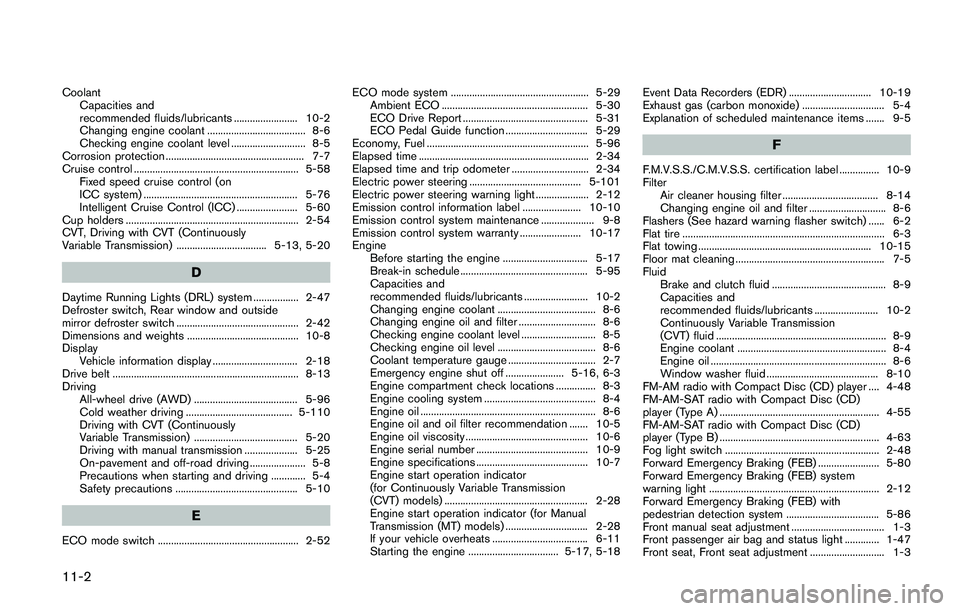
11-2
Coolant
Capacities and
recommended fluids/lubricants ........................ 10-2
Changing engine coolant ..................................... 8-6
Checking engine coolant level ............................ 8-5
Corrosion protection .................................................... 7-7
Cruise control .............................................................. 5-58
Fixed speed cruise control (on
ICC system) .......................................................... 5-76
Intelligent Cruise Control (ICC) ....................... 5-60
Cup holders ................................................................. 2-54
CVT, Driving with CVT (Continuously
Variable Transmission) .................................. 5-13, 5-20
D
Daytime Running Lights (DRL) system ................. 2-47
Defroster switch, Rear window and outside
mirror defroster switch .............................................. 2-42
Dimensions and weights .......................................... 10-8
Display
Vehicle information display ................................ 2-18
Drive belt ...................................................................... 8-13
Driving
All-wheel drive (AWD) ....................................... 5-96
Cold weather driving ........................................ 5-110
Driving with CVT (Continuously
Variable Transmission) ....................................... 5-20
Driving with manual transmission .................... 5-25
On-pavement and off-road driving ..................... 5-8
Precautions when starting and driving ............. 5-4
Safety precautions .............................................. 5-10
E
ECO mode switch ..................................................... 2-52ECO mode system .................................................... 5-29
Ambient ECO ....................................................... 5-30
ECO Drive Report ............................................... 5-31
ECO Pedal Guide function ............................... 5-29
Economy, Fuel ............................................................. 5-96
Elapsed time ................................................................ 2-34
Elapsed time and trip odometer ............................. 2-34
Electric power steering .......................................... 5-101
Electric power steering warning light .................... 2-12
Emission control information label ...................... 10-10
Emission control system maintenance .................... 9-8
Emission control system warranty ....................... 10-17
Engine
Before starting the engine ................................ 5-17
Break-in schedule ................................................ 5-95
Capacities and
recommended fluids/lubricants ........................ 10-2
Changing engine coolant ..................................... 8-6
Changing engine oil and filter ............................. 8-6
Checking engine coolant level ............................ 8-5
Checking engine oil level ..................................... 8-6
Coolant temperature gauge ................................. 2-7
Emergency engine shut off ...................... 5-16, 6-3
Engine compartment check locations ............... 8-3
Engine cooling system .......................................... 8-4
Engine oil .................................................................. 8-6
Engine oil and oil filter recommendation ....... 10-5
Engine oil viscosity .............................................. 10-6
Engine serial number .......................................... 10-9
Engine specifications .......................................... 10-7
Engine start operation indicator
(for Continuously Variable Transmission
(CVT) models) ...................................................... 2-28
Engine start operation indicator (for Manual
Transmission (MT) models) ............................... 2-28
If your vehicle overheats .................................... 6-11
Starting the engine .................................. 5-17, 5-18Event Data Recorders (EDR) ............................... 10-19
Exhaust gas (carbon monoxide) ............................... 5-4
Explanation of scheduled maintenance items ....... 9-5
F
F.M.V.S.S./C.M.V.S.S. certification label ............... 10-9
Filter
Air cleaner housing filter .................................... 8-14
Changing engine oil and filter ............................. 8-6
Flashers (See hazard warning flasher switch) ...... 6-2
Flat tire ............................................................................ 6-3
Flat towing ................................................................. 10-15
Floor mat cleaning ........................................................ 7-5
Fluid
Brake and clutch fluid ........................................... 8-9
Capacities and
recommended fluids/lubricants ........................ 10-2
Continuously Variable Transmission
(CVT) fluid ................................................................ 8-9
Engine coolant ........................................................ 8-4
Engine oil .................................................................. 8-6
Window washer fluid .......................................... 8-10
FM-AM radio with Compact Disc (CD) player .... 4-48
FM-AM-SAT radio with Compact Disc (CD)
player (Type A) ............................................................ 4-55
FM-AM-SAT radio with Compact Disc (CD)
player (Type B) ............................................................ 4-63
Fog light switch .......................................................... 2-48
Forward Emergency Braking (FEB) ....................... 5-80
Forward Emergency Braking (FEB) system
warning light ................................................................ 2-12
Forward Emergency Braking (FEB) with
pedestrian detection system ................................... 5-86
Front manual seat adjustment ................................... 1-3
Front passenger air bag and status light ............. 1-47
Front seat, Front seat adjustment ............................ 1-3
Page 505 of 508
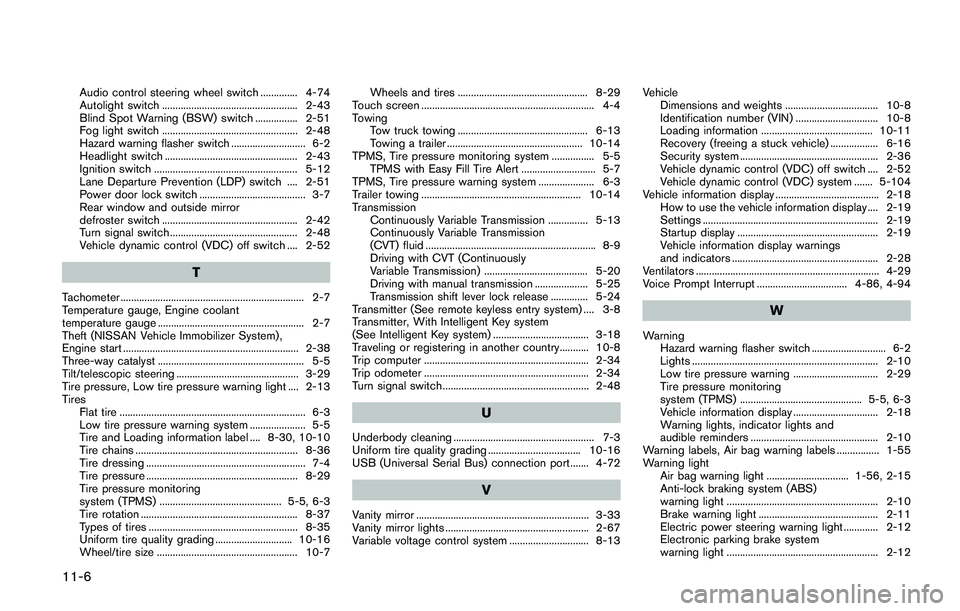
11-6
Audio control steering wheel switch .............. 4-74
Autolight switch ................................................... 2-43
Blind Spot Warning (BSW) switch ................ 2-51
Fog light switch ................................................... 2-48
Hazard warning flasher switch ............................ 6-2
Headlight switch .................................................. 2-43
Ignition switch ...................................................... 5-12
Lane Departure Prevention (LDP) switch .... 2-51
Power door lock switch ........................................ 3-7
Rear window and outside mirror
defroster switch ................................................... 2-42
Turn signal switch ................................................ 2-48
Vehicle dynamic control (VDC) off switch .... 2-52
T
Tachometer ..................................................................... 2-7
Temperature gauge, Engine coolant
temperature gauge ....................................................... 2-7
Theft (NISSAN Vehicle Immobilizer System) ,
Engine start .................................................................. 2-38
Three-way catalyst ....................................................... 5-5
Tilt/telescopic steering .............................................. 3-29
Tire pressure, Low tire pressure warning light .... 2-13
Tires
Flat tire ...................................................................... 6-3
Low tire pressure warning system ..................... 5-5
Tire and Loading information label .... 8-30, 10-10
Tire chains ............................................................. 8-36
Tire dressing ............................................................ 7-4
Tire pressure ......................................................... 8-29
Tire pressure monitoring
system (TPMS) .............................................. 5-5, 6-3
Tire rotation ........................................................... 8-37
Types of tires ........................................................ 8-35
Uniform tire quality grading ............................. 10-16
Wheel/tire size ..................................................... 10-7Wheels and tires ................................................. 8-29
Touch screen ................................................................. 4-4
Towing
Tow truck towing ................................................. 6-13
Towing a trailer ................................................... 10-14
TPMS, Tire pressure monitoring system ................ 5-5
TPMS with Easy Fill Tire Alert ............................ 5-7
TPMS, Tire pressure warning system ..................... 6-3
Trailer towing ............................................................ 10-14
Transmission
Continuously Variable Transmission ............... 5-13
Continuously Variable Transmission
(CVT) fluid ................................................................ 8-9
Driving with CVT (Continuously
Variable Transmission) ....................................... 5-20
Driving with manual transmission .................... 5-25
Transmission shift lever lock release .............. 5-24
Transmitter (See remote keyless entry system) .... 3-8
Transmitter, With Intelligent Key system
(See Intelligent Key system) .................................... 3-18
Traveling or registering in another country........... 10-8
Trip computer .............................................................. 2-34
Trip odometer .............................................................. 2-34
Turn signal switch ....................................................... 2-48
U
Underbody cleaning ..................................................... 7-3
Uniform tire quality grading ................................... 10-16
USB (Universal Serial Bus) connection port ....... 4-72
V
Vanity mirror ................................................................. 3-33
Vanity mirror lights ...................................................... 2-67
Variable voltage control system .............................. 8-13Vehicle
Dimensions and weights ................................... 10-8
Identification number (VIN) ............................... 10-8
Loading information .......................................... 10-11
Recovery (freeing a stuck vehicle) .................. 6-16
Security system .................................................... 2-36
Vehicle dynamic control (VDC) off switch .... 2-52
Vehicle dynamic control (VDC) system ....... 5-104
Vehicle information display ....................................... 2-18
How to use the vehicle information display .... 2-19
Settings .................................................................. 2-19
Startup display ..................................................... 2-19
Vehicle information display warnings
and indicators ....................................................... 2-28
Ventilators ..................................................................... 4-29
Voice Prompt Interrupt .................................. 4-86, 4-94
W
Warning
Hazard warning flasher switch ............................ 6-2
Lights ...................................................................... 2-10
Low tire pressure warning ................................ 2-29
Tire pressure monitoring
system (TPMS) .............................................. 5-5, 6-3
Vehicle information display ................................ 2-18
Warning lights, indicator lights and
audible reminders ................................................ 2-10
Warning labels, Air bag warning labels ................ 1-55
Warning light
Air bag warning light ............................... 1-56, 2-15
Anti-lock braking system (ABS)
warning light ......................................................... 2-10
Brake warning light ............................................. 2-11
Electric power steering warning light ............. 2-12
Electronic parking brake system
warning light ......................................................... 2-12