Recommended Fluids NISSAN QASHQAI 2018 Owner´s Manual
[x] Cancel search | Manufacturer: NISSAN, Model Year: 2018, Model line: QASHQAI, Model: NISSAN QASHQAI 2018Pages: 512, PDF Size: 3.19 MB
Page 421 of 512
7-4Appearance and care
CHROME PARTS
Clean chrome parts regularly with a non-
abrasive chrome polish to maintain the
finish.
TIRE DRESSING
NISSAN does not recommend the use of
tire dressings. Tire manufacturers apply a
coating to the tires to help reduce dis-
coloration of the rubber. If a tire dressing
is applied to the tires, it may react with
the coating and form a compound. This
compound may come off the tire while
driving and stain the vehicle paint.
If you choose to use a tire dressing, take
the following precautions:
.Use a water-based tire dressing. The
coating on the tire dissolves more
easily with an oil-based tire dressing.
. Apply a light coat of tire dressing to
help prevent it from entering the tire
tread/grooves (where it would be
difficult to remove).
. Wipe off excess tire dressing using a
dry towel. Make sure the tire dressing
is completely removed from the tire
tread/grooves.
. Allow the tire dressing to dry as
recommended by tire dressing manu-
facturer. Occasionally remove loose dust from the
interior trim, plastic parts and seats using
a vacuum cleaner or soft bristled brush.
Wipe the vinyl and leather surfaces with a
clean, soft cloth dampened in mild soap
solution, then wipe clean with a dry soft
cloth.
Regular care and cleaning is required in
order to maintain the appearance of the
leather.
Before using any fabric protector, read
the manufacturer’s recommendations.
Some fabric protectors contain chemicals
that may stain or bleach the seat materi-
al.
Use a cloth dampened only with water, to
clean the meter and gauge lens.
WARNING
Do not use water or acidic cleaners
(hot steam cleaners) on the seat. This
can damage the seat or occupant
classification sensors. This can also
affect the operation of the air bag
system and result in serious perso-
nal injury.
CAUTION
.
Never use benzine, thinner, or any
similar material.
. For cleaning, use a soft cloth,
dampened with water. Never use
a rough cloth, alcohol, benzine,
thinner or any kind of solvent or
paper towel with a chemical
cleaning agent. They will scratch
or cause discoloration to the lens.
. Do not spray any liquid such as
water on the meter lens. Spraying
liquid may cause the system to
malfunction.
. Small dirt particles can be abra-
sive and damaging to the leather
surfaces and should be removed
promptly. Do not use saddle soap,
car waxes, polishes, oils, cleaning
fluids, solvents, detergents or
ammonia-based cleaners as they
may damage the leather’s natural
finish.
. Never use fabric protectors un-
less recommended by the manu-
facturer.
. Do not use glass or plastic cleaner
on meter or gauge lens covers. It
CLEANING INTERIOR
Page 427 of 512
8-2Do-it-yourself
When performing any inspection or main-
tenance work on your vehicle, always
take care to prevent serious accidental
injury to yourself or damage to the
vehicle. The following are general precau-
tions which should be closely observed.
WARNING
.Park the vehicle on a level sur-
face, apply the parking brake
securely and block the wheels to
prevent the vehicle from moving.
Move the shift lever to the P
(Park) position (CVT model) or
the shift lever to the N (Neutral)
position (MT model).
. Be sure the ignition switch is in
the OFF or LOCK position when
performing any parts replace-
ment or repairs.
. If you must work with the engine
running, keep your hands, cloth-
ing, hair and tools away from
moving fans, belts and any other
moving parts.
. It is advisable to secure or re-
move any loose clothing and
remove any jewelry, such as
rings, watches, etc. before work-
ing on your vehicle. .
Always wear eye protection
whenever you work on your ve-
hicle.
. If you must run the engine in an
enclosed space such as a garage,
be sure there is proper ventilation
for exhaust gases to escape.
. Never get under the vehicle while
it is supported only by a jack. If it
is necessary to work under the
vehicle, support it with safety
stands.
. Because the fuel lines are under
high pressure even when the
engine is off, it is recommended
you visit a NISSAN dealer for
service of the fuel filter or fuel
lines.
. Do not work under the hood while
the engine is hot. Always turn off
the engine and wait until it cools
down.
. If you must work with the engine
running, keep your hands, cloth-
ing, hair and tools away from
moving fans, belts and any other
moving parts.
. Keep smoking materials, flame
and sparks away from fuel and
the battery. .
On gasoline engine models with
the Multiport Fuel Injection (MFI)
system, the fuel filter and fuel
lines should be serviced because
the fuel lines are under high
pressure even when the engine
is turned off. It is recommended
that you visit a NISSAN dealer for
this service.
. Your vehicle is equipped with an
automatic engine cooling fan. It
may come on at any time without
warning, even if the ignition
switch is in the OFF position and
the engine is not running. To
avoid injury, always disconnect
the negative battery cable before
working near the fan.
. Avoid direct contact with used
engine oil and coolant. Impro-
perly disposed engine oil, engine
coolant, and/or other vehicle
fluids can hurt the environment.
Always conform to local regula-
tions for disposal of vehicle fluids.
CAUTION
.Do not work under the hood while
the engine is hot. Turn the engine
MAINTENANCE PRECAUTIONS
Page 433 of 512
8-8Do-it-yourself
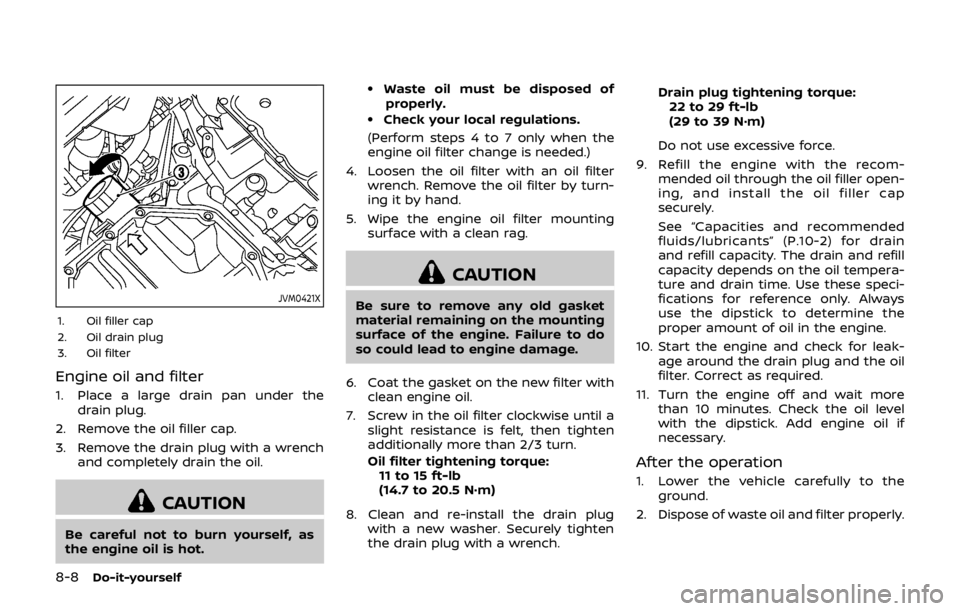
JVM0421X
1. Oil filler cap
2. Oil drain plug
3. Oil filter
Engine oil and filter
1. Place a large drain pan under thedrain plug.
2. Remove the oil filler cap.
3. Remove the drain plug with a wrench and completely drain the oil.
CAUTION
Be careful not to burn yourself, as
the engine oil is hot.
.Waste oil must be disposed ofproperly.
.Check your local regulations.
(Perform steps 4 to 7 only when the
engine oil filter change is needed.)
4. Loosen the oil filter with an oil filter wrench. Remove the oil filter by turn-
ing it by hand.
5. Wipe the engine oil filter mounting surface with a clean rag.
CAUTION
Be sure to remove any old gasket
material remaining on the mounting
surface of the engine. Failure to do
so could lead to engine damage.
6. Coat the gasket on the new filter with clean engine oil.
7. Screw in the oil filter clockwise until a slight resistance is felt, then tighten
additionally more than 2/3 turn.
Oil filter tightening torque:11 to 15 ft-lb
(14.7 to 20.5 N·m)
8. Clean and re-install the drain plug with a new washer. Securely tighten
the drain plug with a wrench. Drain plug tightening torque:
22 to 29 ft-lb
(29 to 39 N·m)
Do not use excessive force.
9. Refill the engine with the recom- mended oil through the oil filler open-
ing, and install the oil filler cap
securely.
See “Capacities and recommended
fluids/lubricants” (P.10-2) for drain
and refill capacity. The drain and refill
capacity depends on the oil tempera-
ture and drain time. Use these speci-
fications for reference only. Always
use the dipstick to determine the
proper amount of oil in the engine.
10. Start the engine and check for leak- age around the drain plug and the oil
filter. Correct as required.
11. Turn the engine off and wait more than 10 minutes. Check the oil level
with the dipstick. Add engine oil if
necessary.
After the operation
1. Lower the vehicle carefully to the
ground.
2. Dispose of waste oil and filter properly.
Page 434 of 512
WARNING
.Prolonged and repeated contact
with used engine oil may cause
skin cancer.
. Try to avoid direct skin contact
with used oil. If skin contact is
made, wash thoroughly with soap
or hand cleaner as soon as pos-
sible.
. Keep used engine oil out of reach
of children. When checking or replacement is re-
quired, we recommend a NISSAN dealer
for servicing.
CAUTION
.
NISSAN recommends using Gen-
uine NISSAN CVT Fluid NS-3 (or
equivalent) ONLY in NISSAN CVTs.
Do not mix with other fluids.
. Do not use Automatic transmis-
sion fluid (ATF) or Manual Trans-
mission fluid in a NISSAN CVT, as
it may damage the CVT. Damage
caused by the use of fluids other
than as recommended is not
covered by the NISSAN’s New
Vehicle Limited Warranty.
. Using fluids that are not equiva-
lent to Genuine NISSAN CVT Fluid
NS-3 may also damage the CVT.
Damage caused by the use of
fluids other than as recom-
mended is not covered by the
NISSAN’s New Vehicle Limited
Warranty. For additional brake and clutch fluid
information, see “Capacities and recom-
mended fluids/lubricants” (P.10-2) of this
manual.WARNING
.
Use only new fluid from a sealed
container. Old, inferior or con-
taminated fluid may damage the
brake and clutch systems. The
use of improper fluids can da-
mage the brake and clutch sys-
tems, and affect the vehicle’s
stopping ability.
. Clean the filler cap before remov-
ing.
. Brake and clutch fluid is poiso-
nous and should be stored care-
fully in marked containers out of
the reach of children.
CAUTION
Do not spill the fluid on any painted
surfaces. This will damage the paint.
If fluid is spilled, immediately wash
the surface with water.
Do-it-yourself8-9
CONTINUOUSLY VARIABLE
TRANSMISSION (CVT) FLUIDBRAKE AND CLUTCH (if so equipped) FLUID
Page 472 of 512

The following descriptions are provided
to give you a better understanding of the
scheduled maintenance items that
should be regularly checked or replaced.
The maintenance schedule indicates at
which mileage/time intervals each item
requires service.
In addition to scheduled maintenance,
your vehicle requires that some items be
checked during normal day-to-day op-
eration. Refer to “General maintenance”
(P.9-2).
Items marked with “*” are recommended
by NISSAN for reliable vehicle operation.
You are not required to perform main-
tenance on these items in order to
maintain the warranties which come with
your vehicle. Other maintenance items
and intervals are required.
When applicable, additional information
can be found in the “8. Do-it yourself”
section of this manual.
NOTE:
NISSAN does not advocate the use of
non-OEM approved aftermarket flush-
ing systems and strongly advises
against performing these services on a
NISSAN product. Many of the aftermar-
ket flushing systems use non-OEM ap-
proved chemicals or solvents, the use of
which has not been validated by
NISSAN.For recommended fuel, lubricants,
fluids, grease, and refrigerant, refer to
“Capacities and recommended fluids/
lubricants” (P.10-2) of this manual.
EMISSION CONTROL SYSTEM MAIN-
TENANCE
Drive belt*:
Check engine drive belt for wear, fraying
or cracking and for proper tension. Re-
place any damaged drive belt.
Engine air filter:
Replace at specified intervals. When driv-
ing for prolonged periods in dusty condi-
tions, check/replace the filter more
frequently.
Engine coolant*:
Replace coolant at the specified interval.
When adding or replacing coolant, be
sure to use only Genuine NISSAN Long
Life Antifreeze/Coolant (blue) or equiva-
lent with the proper mixture. (Refer to
“Engine cooling system” (P.8-4) to deter-
mine the proper mixture for your area.)
NOTE:
Mixing any other type of coolant or the
use of non-distilled water may reduce
the recommended service interval of
the coolant.
Engine oil and oil filter:
Replace engine oil and oil filter at the
specified intervals. For recommended oil
grade and viscosity refer to “Capacities
and recommended fluids/lubricants”
(P.10-2).
Engine valve clearance*:
Inspect only if valve noise increases.
Adjust valve clearance if necessary.
Evaporative emissions control vapor
lines*:
Check vapor lines for leaks or looseness.
Tighten connections or replace parts as
necessary.
Fuel filter
Periodic maintenance is not required (in-
tank type filter).
Fuel lines*:
Check the fuel hoses, piping and connec-
tions for leaks, looseness, or deterioration.
Tighten connections or replace parts as
necessary.
Spark plugs:
Replace at specified intervals. Install new
plugs of the type as originally equipped.
Maintenance and schedules9-5
EXPLANATION OF SCHEDULED
MAINTENANCE ITEMS
Page 484 of 512

10 Technical and consumer information
Capacities and
recommended fluids/lubricants .................................... 10-2Fuel information .................................................................. 10-3
Engine oil and oil filter recommendation ........ 10-5
Air conditioning system refrigerant and
lubricant recommendations ...................................... 10-6
Specifications ........................................................................\
........ 10-7 Engine ........................................................................\
.................. 10-7
Wheels and tires .................................................................. 10-7
Dimensions and weights .............................................. 10-8
When traveling or registering in
another country ........................................................................\
. 10-8
Vehicle identification .............................................................. 10-8 Vehicle Identification Number (VIN) plate ....... 10-8
Vehicle identification number
(chassis number) ................................................................. 10-9
Engine serial number ....................................................... 10-9
F.M.V.S.S./C.M.V.S.S. certification label ................. 10-9
Emission control information label .................. 10-10
Tire and Loading Information label ................. 10-10
Air conditioner specification label ..................... 10-10
Installing front license plate ......................................... 10-11 Vehicle loading information ......................................... 10-11
Terms ........................................................................\
............. 10-11
Vehicle load capacity ................................................ 10-12
Securing the load ......................................................... 10-13
Loading tips ...................................................................... 10-13
Measurement of weights ....................................... 10-14
Towing a trailer ...................................................................... 10-14
Flat towing ........................................................................\
......... 10-15 Flat towing for All–Wheel Drive vehicle (if
so equipped) ..................................................................... 10-15
Flat towing for Front-Wheel Drive vehicle
(if so equipped) ............................................................... 10-15
Uniform tire quality grading ........................................ 10-16
Treadwear ........................................................................\
.. 10-16
Traction AA, A, B and C ........................................... 10-16
Temperature A, B and C ......................................... 10-16
Emission control system warranty ......................... 10-17
Reporting safety defects ................................................ 10-17
Readiness for Inspection/Maintenance
(I/M) test ........................................................................\
............... 10-18
Event Data Recorders (EDR) ......................................... 10-19
Owner’s manual/service manual
order information ................................................................. 10-19
Page 485 of 512

10-2Technical and consumer information
The following are approximate capacities. The actual refill capacities may be a little different. When refilling, follow the
procedure instructed in the “8. Do-it-yourself” section to determine the proper refill capacity.
Fluid typeCapacity (approximate)
Recommended Fluids/Lubricants
Metric
Measure US
Measure Imperial
Measure
Fuel 55 L 14-1/2 gal 12-1/8 galÂSee “Fuel information” (P.10-3).
Engine oil
*1With oil filter change 3.8 L 4 qt 3-3/8 qtÂGenuine “Nissan Motor Oil 0W-20 SN” is recommended.
 If the above motor oil is not available, use an equivalent motor oil that matches
the above grade and viscosity. For additional information, see “Engine oil and oil
filter recommendation” (P.10-5).
Drain and refill
*1: For additional
information, see
“Changing engine
oil and filter” (P.8-
6). Without oil filter change
3.6 L 3-7/8 qt 3-1/8 qt
Engine coolant With reservoir CVT model 8.7 L 9-1/4 qt 7-5/8 qtÂPre-diluted Genuine NISSAN Long Life Antifreeze/Coolant (blue) or equivalent
MT model 8.5 L 8-3/8 qt 7 qt
Reservoir 0.6 L 5/8 qt 1/2 qt
Continuously Variable Transmission (CVT) fluid — — —ÂGenuine NISSAN CVT Fluid NS-3
 NISSAN recommends using Genuine NISSAN CVT Fluid NS-3 (or equivalent) ONLY
in NISSAN CVTs. Do not mix with other fluids. Using fluids that are not equivalent
to Genuine NISSAN CVT Fluid NS-3 may damage the CVT. Damage caused by the
use of fluids other than as recommended is not covered under NISSAN’s New
Vehicle Limited Warranty.
Manual Transmission (MT) gear oil — — —ÂManual Transmission Fluid (MTF) TRANSELF NFJ 75W-80 or equivalent
 If Manual Transmission Fluid (MTF) TRANSELF NFJ is not available, API GL-4,
Viscosity SAE 75W-80 may be used as a temporary replacement. However, use
Manual Transmission Fluid (MTF) TRANSELF NFJ as soon as it is available.
Differential gear oil — — —ÂGenuine NISSAN Differential Oil Hypoid Super GL-5 80W-90 or equivalent
conventional (non-synthetic) oil
Transfer fluid — — —
Brake and clutch fluid Refill to the proper oil level ac-
cording to the instructions in the “8. Do-it-yourself” section. Â
Genuine NISSAN Super Heavy Duty Brake Fluid
*2or equivalent DOT 3*2: Available in mainland U.S.A. through a NISSAN dealer.
Multi-purpose grease — — — ÂNLGI No. 2 (Lithium soap base)
Air conditioning system refrigerant — — — ÂSee “Vehicle identification” (P.10-8) for air conditioner specification label.
 HFC-134a (R-134a) or HFO-1234yf (R-1234yf)
Air conditioning system lubricants — — — ÂSee “Vehicle identification” (P.10-8) for air conditioner specification label.
 A/C System Oil ND-OIL8(PAG) or ND-OIL12(PAG) or equivalent
Window washer fluid 4.5 L 1-1/4 gal 1 gal ÂGenuine NISSAN Windshield Washer Concentrate Cleaner & Antifreeze or
equivalent
CAPACITIES AND RECOMMENDED
FLUIDS/LUBRICANTS
Page 488 of 512

ing, which may cause excessive fuel
consumption or engine damage. If any
of the above symptoms are encountered,
have your vehicle checked. It is recom-
mended you visit a NISSAN dealer for
servicing.
However, now and then you may notice
light spark knock for a short time while
accelerating or driving up hills. This is
not a cause for concern, because you
get the greatest fuel benefit when there
is light spark knock for a short time
under heavy engine load.
JVT0351X
API certification markAPI service symbol
ENGINE OIL AND OIL FILTER RE-
COMMENDATION
Selecting the correct oil
It is essential to choose the correct grade,
quality, and viscosity engine oil to ensure
satisfactory engine life and performance,
see “Capacities and recommended fluids/
lubricants” (P.10-2). NISSAN recommends
the use of an energy conserving oil in
order to improve fuel economy.
Select only engine oils that meet the
American Petroleum Institute (API) certifi-
cation or International Lubricant Standar-dization and Approval Committee (ILSAC)
certification and SAE viscosity standard.
These oils have the API certification mark
on the front of the container. Oils which
do not have the specified quality label
should not be used as they could cause
engine damage.
Oil additives
NISSAN does not recommend the use of
oil additives. The use of an oil additive is
not necessary when the proper oil type is
used and maintenance intervals are fol-
lowed.
Oil which may contain foreign matter or
has been previously used should not be
used.
Technical and consumer information10-5
Page 504 of 512

11 Index
A
ABS (Anti-lock Braking System) .................... 5-107
Active Ride Control ................................................. 5-112
Advanced air bag system ..................................... 1-46
Air bag systemAdvanced air bag system .............................. 1-46
Front passenger air bag and
status light................................................................. 1-48
Front-seat mounted side-impact
supplemental air bag system..................... 1-54
Roof-mounted curtain side-impact
supplemental air bag system..................... 1-54
Air bag warning labels ............................................ 1-56
Air bag warning light................................. 1-57, 2-15
Air cleaner housing filter ....................................... 8-15
Air conditioner Air conditioner operation............................... 4-30
Air conditioner service...................................... 4-37
Air conditioner specification label....... 10-10
Air conditioning system refrigerant
and lubricant
recommendations ................................ 4-37, 10-6
Alarm, How to stop alarm (see vehicle
security system)............................................................ 2-38
Alcohol, drugs and driving ................................... 5-10
Antenna........................................................................\
....... 4-77
Anti-lock Braking System (ABS) .................... 5-107
Anti-lock braking system (ABS)
warning light ................................................................... 2-10
Appearance care Exterior appearance care ................................. 7-2
Interior appearance care................................... 7-4
Application download.............................................. 4-78
Armrest ........................................................................\
............ 1-6
Audible reminders....................................................... 2-17 Audio operation precautions ............................. 4-38
Audio system .................................................................. 4-38
Steering wheel audio controls................... 4-75
Automatic Door locks...................................................................... 3-7
Automatic air conditioner .................................... 4-35
Automatic Emergency Braking (AEB) .......... 5-82
Automatic Emergency Braking (AEB)
system warning light................................................ 2-12
Automatic Emergency Braking (AEB) with
pedestrian detection system ............................. 5-89
AUX (Auxiliary) input jack....................................... 4-75
Average speed ............................................................... 2-34
Avoiding collision and rollover.............................. 5-8
B
Battery........................................................................\
.......... 8-11 Battery replacement, Intelligent Key ..... 8-23
Battery replacement, Key fob..................... 8-21
Battery saver system......................................... 2-47
Variable voltage control system .............. 8-13
Before starting the engine................................... 5-17
Blind Spot Warning (BSW) ..................................... 5-42
Bluetooth® Hands-Free
Phone System ................................................. 4-83, 4-93
Booster seats.................................................................. 1-36
Brake Anti-lock Braking System (ABS) ............ 5-107
Brake and clutch fluid ......................................... 8-9
Brake system ....................................................... 5-106
Electronic parking brake system
warning light ............................................................ 2-12
Parking brake .......................................................... 5-27 Press Brake Pedal warning
(for electronic parking brake
equipped models) ................................................ 2-32
Warning light............................................................ 2-11
Break-in schedule ....................................................... 5-99
Brightness control Instrument panel ..................................................... 2-9
Bulb check/instrument panel............................ 2-10
Bulb replacement ........................................................ 8-25
C
Capacities and
recommended fluids/lubricants...................... 10-2
Car phone or CB radio ............................................ 4-83
Card holder....................................................................... 2-57
Cargo area ........................................................................\
2-55
Catalytic converter, Three way catalyst ....... 5-4
CD/USB memory care and cleaning............ 4-77
Chassis and body maintenance...................... 9-11
Chassis control............................................ 2-35, 5-110
Child restraints .............................................................. 1-20 Booster seats........................................................... 1-36
LATCH system ......................................................... 1-22
Precautions on child restraints................. 1-20
Child safety....................................................................... 1-17
Child safety rear door lock ...................................... 3-7
Chimes, Audible reminders.................................. 2-17
Circuit breaker, Fusible link ................................. 8-19
Cleaning exterior and interior ................... 7-2, 7-4
Clock ........................................................................\
.............. 2-36
Clutch fluid........................................................................\
.... 8-9
Cockpit ........................................................................\
............. 2-3
Cold weather driving ............................................. 5-113
Console box ..................................................................... 2-56
Console light ................................................................... 2-66
Page 505 of 512
 fluid........................................................................\
....... 8-9
Continuously Variable Transmission (CVT)
position indicator ...")
11-2
Continuously Variable Transmission
(CVT) fluid........................................................................\
....... 8-9
Continuously Variable Transmission (CVT)
position indicator ............................................................ 2-9
Control buttons and function ............................... 4-3
Controls, Steering wheel
audio controls ................................................................ 4-75
CoolantCapacities and
recommended fluids/lubricants............... 10-2
Changing engine coolant ................................. 8-6
Checking engine coolant level...................... 8-5
Corrosion protection .................................................... 7-7
Cruise control ................................................................. 5-60 Fixed speed cruise control (on
ICC system)................................................................ 5-78
Intelligent Cruise Control (ICC) .................. 5-62
Cup holders...................................................................... 2-54
CVT, Driving with CVT (Continuously
Variable Transmission)............................. 5-13, 5-20
D
Daytime Running Lights (DRL) system....... 2-47
Defroster switch, Rear window and
outside mirror defroster switch....................... 2-42
Dimensions and weights....................................... 10-8
Display Vehicle information display.......................... 2-18
Drive belt ........................................................................\
.... 8-13
Driving Cold weather driving ..................................... 5-113
Driving with CVT (Continuously
Variable Transmission)..................................... 5-20
Driving with manual transmission.......... 5-25
Intelligent 4x4 ..................................................... 5-100
On-pavement and off-road driving .......... 5-8 Precautions when starting
and driving.................................................................... 5-4
Safety precautions .............................................. 5-10
E
ECO mode switch........................................................ 2-52
ECO mode system ...................................................... 5-29
Ambient ECO............................................................ 5-30
ECO Drive Report.................................................. 5-31
ECO Pedal Guide function ............................. 5-30
Economy, Fuel............................................................. 5-100
Elapsed time.................................................................... 2-34
Elapsed time and trip odometer..................... 2-34
Electric power steering........................................ 5-105
Electric power steering warning light ........ 2-12
Emission control information label............ 10-10
Emission control system maintenance ......... 9-8
Emission control system warranty ............ 10-17
Engine Before starting the engine............................ 5-17
Break-in schedule ................................................ 5-99
Capacities and
recommended fluids/lubricants............... 10-2
Changing engine coolant ................................. 8-6
Changing engine oil and filter ...................... 8-6
Checking engine coolant level...................... 8-5
Checking engine oil level................................... 8-6
Coolant temperature gauge .......................... 2-7
Emergency engine shut off.............. 5-16, 6-3
Engine compartment
check locations ......................................................... 8-3
Engine cooling system ........................................ 8-4
Engine oil.....................................................................\
... 8-6
Engine oil and oil
filter recommendation ..................................... 10-5
Engine oil viscosity .............................................. 10-6 Engine serial number ........................................ 10-9
Engine specifications......................................... 10-7
Engine start operation indicator
(for Continuously Variable
Transmission (CVT) models) ........................ 2-28
Engine start operation indicator
(for Manual Transmission (MT)
models) ........................................................................\
. 2-28
If your vehicle overheats ................................ 6-11
Starting the engine.............................. 5-18, 5-19
Event Data Recorders (EDR)............................. 10-19
Exhaust gas (carbon monoxide) ......................... 5-4
Explanation of scheduled
maintenance items ........................................................ 9-5
F
F.M.V.S.S./C.M.V.S.S. certification label ......... 10-9
Filter Air cleaner housing filter ................................ 8-15
Changing engine oil and filter ...................... 8-6
Flashers (See hazard warning
flasher switch).................................................................... 6-2
Flat tire........................................................................\
............. 6-3
Flat towing..................................................................... 10-15
Floor mat cleaning ......................................................... 7-5
Fluid Brake and clutch fluid ......................................... 8-9
Capacities and
recommended fluids/lubricants............... 10-2
Continuously Variable Transmission
(CVT) fluid....................................................................... 8-9
Engine coolant........................................................... 8-4
Engine oil.....................................................................\
... 8-6
Window washer fluid ......................................... 8-10
FM-AM radio with Compact Disc
(CD) player ........................................................................\
. 4-48