service NISSAN QASHQAI 2019 Owner´s Manual
[x] Cancel search | Manufacturer: NISSAN, Model Year: 2019, Model line: QASHQAI, Model: NISSAN QASHQAI 2019Pages: 500, PDF Size: 2.38 MB
Page 460 of 500
9-6Maintenance and schedules
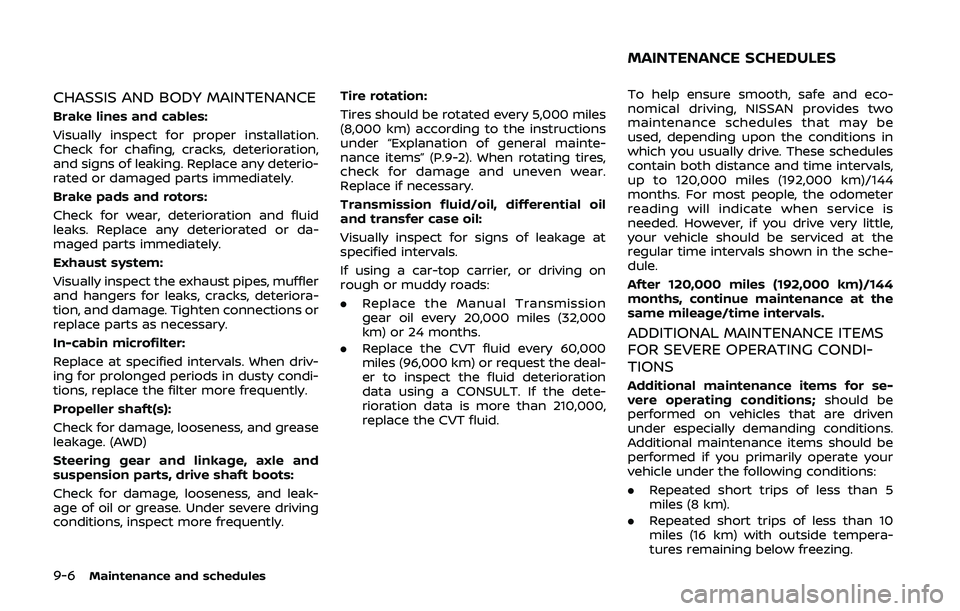
CHASSIS AND BODY MAINTENANCE
Brake lines and cables:
Visually inspect for proper installation.
Check for chafing, cracks, deterioration,
and signs of leaking. Replace any deterio-
rated or damaged parts immediately.
Brake pads and rotors:
Check for wear, deterioration and fluid
leaks. Replace any deteriorated or da-
maged parts immediately.
Exhaust system:
Visually inspect the exhaust pipes, muffler
and hangers for leaks, cracks, deteriora-
tion, and damage. Tighten connections or
replace parts as necessary.
In-cabin microfilter:
Replace at specified intervals. When driv-
ing for prolonged periods in dusty condi-
tions, replace the filter more frequently.
Propeller shaft(s):
Check for damage, looseness, and grease
leakage. (AWD)
Steering gear and linkage, axle and
suspension parts, drive shaft boots:
Check for damage, looseness, and leak-
age of oil or grease. Under severe driving
conditions, inspect more frequently.Tire rotation:
Tires should be rotated every 5,000 miles
(8,000 km) according to the instructions
under “Explanation of general mainte-
nance items” (P.9-2). When rotating tires,
check for damage and uneven wear.
Replace if necessary.
Transmission fluid/oil, differential oil
and transfer case oil:
Visually inspect for signs of leakage at
specified intervals.
If using a car-top carrier, or driving on
rough or muddy roads:
.
Replace the Manual Transmission
gear oil every 20,000 miles (32,000
km) or 24 months.
. Replace the CVT fluid every 60,000
miles (96,000 km) or request the deal-
er to inspect the fluid deterioration
data using a CONSULT. If the dete-
rioration data is more than 210,000,
replace the CVT fluid. To help ensure smooth, safe and eco-
nomical driving, NISSAN provides two
maintenance schedules that may be
used, depending upon the conditions in
which you usually drive. These schedules
contain both distance and time intervals,
up to 120,000 miles (192,000 km)/144
months. For most people, the odometer
reading will indicate when service is
needed. However, if you drive very little,
your vehicle should be serviced at the
regular time intervals shown in the sche-
dule.
After 120,000 miles (192,000 km)/144
months, continue maintenance at the
same mileage/time intervals.
ADDITIONAL MAINTENANCE ITEMS
FOR SEVERE OPERATING CONDI-
TIONS
Additional maintenance items for se-
vere operating conditions;
should be
performed on vehicles that are driven
under especially demanding conditions.
Additional maintenance items should be
performed if you primarily operate your
vehicle under the following conditions:
. Repeated short trips of less than 5
miles (8 km).
. Repeated short trips of less than 10
miles (16 km) with outside tempera-
tures remaining below freezing.
MAINTENANCE SCHEDULES
Page 466 of 500
9-12Maintenance and schedules
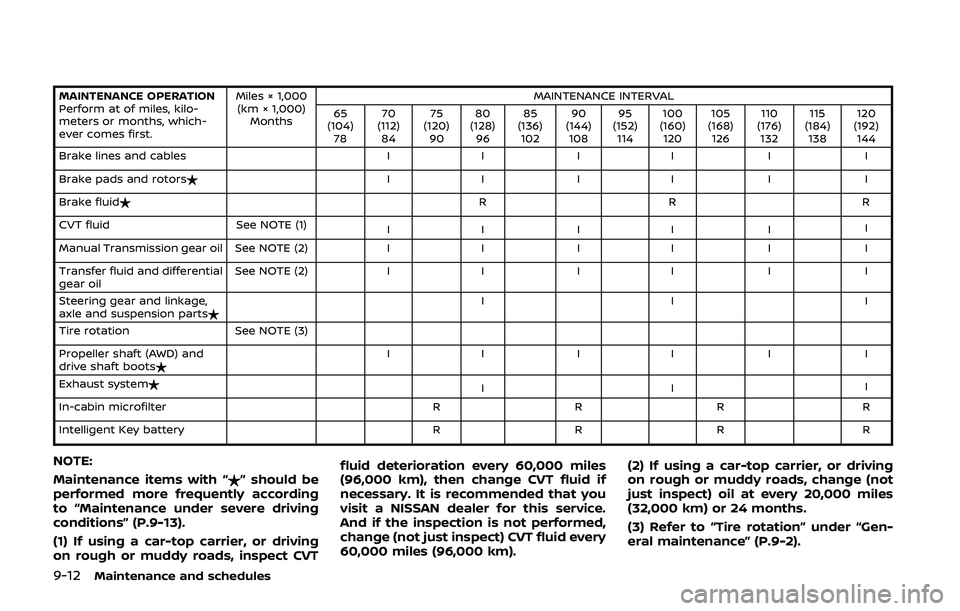
MAINTENANCE OPERATION
Perform at of miles, kilo-
meters or months, which-
ever comes first.Miles × 1,000
(km × 1,000) Months MAINTENANCE INTERVAL
65
(104) 78 70
(112) 84 75
(120) 90 80
(128) 96 85
(136) 102 90
(144) 108 95
(152) 114 100
(160) 120 105
(168) 126 110
(176) 132 115
(184) 138 120
(192) 144
Brake lines and cables II II I I
Brake pads and rotors$ II II I I
Brake fluid$ RR R
CVT fluid See NOTE (1)
II II I I
Manual Transmission gear oil See NOTE (2) II II I I
Transfer fluid and differential
gear oil See NOTE (2)
II II I I
Steering gear and linkage,
axle and suspension parts$ II I
Tire rotation See NOTE (3)
Propeller shaft (AWD) and
drive shaft boots$ II II I I
Exhaust system$ III
In-cabin microfilter RRR R
Intelligent Key battery RRR R
NOTE:
Maintenance items with “$” should be
performed more frequently according
to “Maintenance under severe driving
conditions” (P.9-13).
(1) If using a car-top carrier, or driving
on rough or muddy roads, inspect CVT fluid deterioration every 60,000 miles
(96,000 km), then change CVT fluid if
necessary. It is recommended that you
visit a NISSAN dealer for this service.
And if the inspection is not performed,
change (not just inspect) CVT fluid every
60,000 miles (96,000 km).
(2) If using a car-top carrier, or driving
on rough or muddy roads, change (not
just inspect) oil at every 20,000 miles
(32,000 km) or 24 months.
(3) Refer to “Tire rotation” under “Gen-
eral maintenance” (P.9-2).
Page 471 of 500
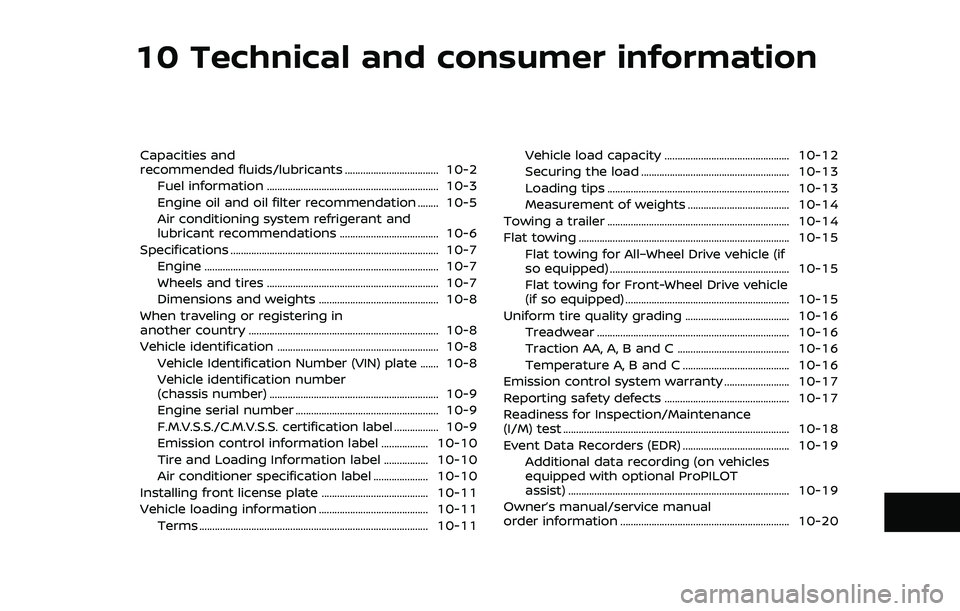
10 Technical and consumer information
Capacities and
recommended fluids/lubricants .................................... 10-2Fuel information .................................................................. 10-3
Engine oil and oil filter recommendation ........ 10-5
Air conditioning system refrigerant and
lubricant recommendations ...................................... 10-6
Specifications ........................................................................\
........ 10-7 Engine ........................................................................\
.................. 10-7
Wheels and tires .................................................................. 10-7
Dimensions and weights .............................................. 10-8
When traveling or registering in
another country ........................................................................\
. 10-8
Vehicle identification .............................................................. 10-8 Vehicle Identification Number (VIN) plate ....... 10-8
Vehicle identification number
(chassis number) ................................................................. 10-9
Engine serial number ....................................................... 10-9
F.M.V.S.S./C.M.V.S.S. certification label ................. 10-9
Emission control information label .................. 10-10
Tire and Loading Information label ................. 10-10
Air conditioner specification label ..................... 10-10
Installing front license plate ......................................... 10-11
Vehicle loading information .......................................... 10-11
Terms ........................................................................\
................ 10-11 Vehicle load capacity ................................................ 10-12
Securing the load ......................................................... 10-13
Loading tips ...................................................................... 10-13
Measurement of weights ....................................... 10-14
Towing a trailer ...................................................................... 10-14
Flat towing ........................................................................\
......... 10-15
Flat towing for All–Wheel Drive vehicle (if
so equipped) ..................................................................... 10-15
Flat towing for Front-Wheel Drive vehicle
(if so equipped) ............................................................... 10-15
Uniform tire quality grading ........................................ 10-16 Treadwear ........................................................................\
.. 10-16
Traction AA, A, B and C ........................................... 10-16
Temperature A, B and C ......................................... 10-16
Emission control system warranty ......................... 10-17
Reporting safety defects ................................................ 10-17
Readiness for Inspection/Maintenance
(I/M) test ........................................................................\
............... 10-18
Event Data Recorders (EDR) ......................................... 10-19 Additional data recording (on vehicles
equipped with optional ProPILOT
assist) ........................................................................\
............. 10-19
Owner’s manual/service manual
order information ................................................................. 10-20
Page 473 of 500
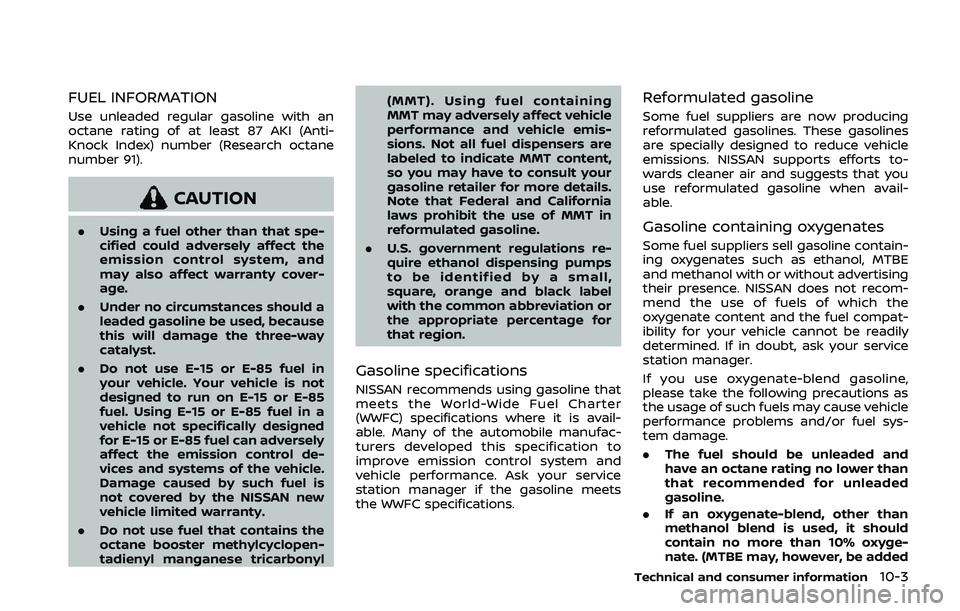
FUEL INFORMATION
Use unleaded regular gasoline with an
octane rating of at least 87 AKI (Anti-
Knock Index) number (Research octane
number 91).
CAUTION
.Using a fuel other than that spe-
cified could adversely affect the
emission control system, and
may also affect warranty cover-
age.
. Under no circumstances should a
leaded gasoline be used, because
this will damage the three-way
catalyst.
. Do not use E-15 or E-85 fuel in
your vehicle. Your vehicle is not
designed to run on E-15 or E-85
fuel. Using E-15 or E-85 fuel in a
vehicle not specifically designed
for E-15 or E-85 fuel can adversely
affect the emission control de-
vices and systems of the vehicle.
Damage caused by such fuel is
not covered by the NISSAN new
vehicle limited warranty.
. Do not use fuel that contains the
octane booster methylcyclopen-
tadienyl manganese tricarbonyl (MMT). Using fuel containing
MMT may adversely affect vehicle
performance and vehicle emis-
sions. Not all fuel dispensers are
labeled to indicate MMT content,
so you may have to consult your
gasoline retailer for more details.
Note that Federal and California
laws prohibit the use of MMT in
reformulated gasoline.
. U.S. government regulations re-
quire ethanol dispensing pumps
to be identified by a small,
square, orange and black label
with the common abbreviation or
the appropriate percentage for
that region.
Gasoline specifications
NISSAN recommends using gasoline that
meets the World-Wide Fuel Charter
(WWFC) specifications where it is avail-
able. Many of the automobile manufac-
turers developed this specification to
improve emission control system and
vehicle performance. Ask your service
station manager if the gasoline meets
the WWFC specifications.
Reformulated gasoline
Some fuel suppliers are now producing
reformulated gasolines. These gasolines
are specially designed to reduce vehicle
emissions. NISSAN supports efforts to-
wards cleaner air and suggests that you
use reformulated gasoline when avail-
able.
Gasoline containing oxygenates
Some fuel suppliers sell gasoline contain-
ing oxygenates such as ethanol, MTBE
and methanol with or without advertising
their presence. NISSAN does not recom-
mend the use of fuels of which the
oxygenate content and the fuel compat-
ibility for your vehicle cannot be readily
determined. If in doubt, ask your service
station manager.
If you use oxygenate-blend gasoline,
please take the following precautions as
the usage of such fuels may cause vehicle
performance problems and/or fuel sys-
tem damage.
.The fuel should be unleaded and
have an octane rating no lower than
that recommended for unleaded
gasoline.
. If an oxygenate-blend, other than
methanol blend is used, it should
contain no more than 10% oxyge-
nate. (MTBE may, however, be added
Technical and consumer information10-3
Page 475 of 500
ing, which may cause excessive fuel
consumption or engine damage. If any
of the above symptoms are encountered,
have your vehicle checked. It is recom-
mended you visit a NISSAN dealer for
servicing.
However, now and then you may notice
light spark knock for a short time while
accelerating or driving up hills. This is
not a cause for concern, because you
get the greatest fuel benefit when there
is light spark knock for a short time
under heavy engine load.
JVT0351X
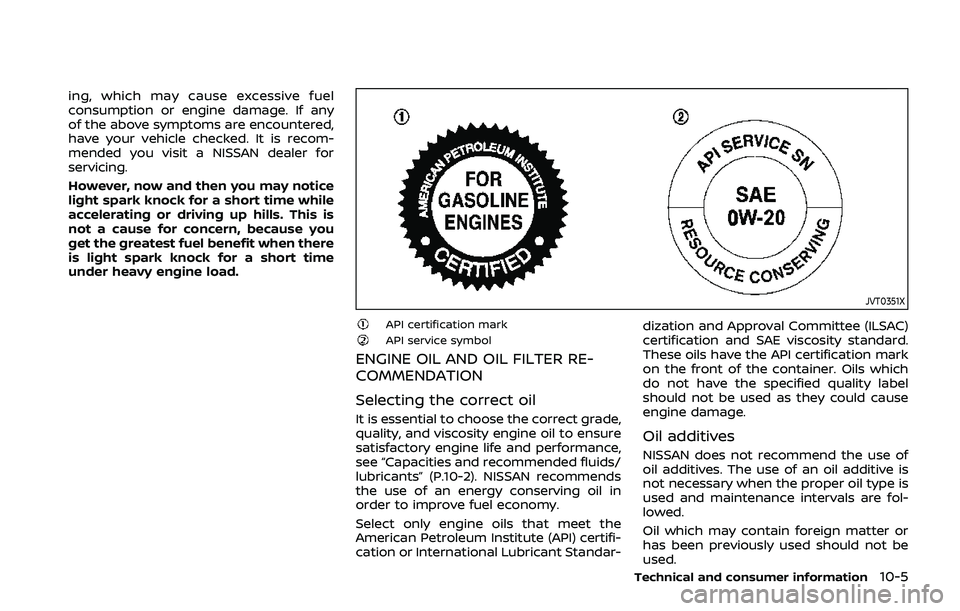
API certification markAPI service symbol
ENGINE OIL AND OIL FILTER RE-
COMMENDATION
Selecting the correct oil
It is essential to choose the correct grade,
quality, and viscosity engine oil to ensure
satisfactory engine life and performance,
see “Capacities and recommended fluids/
lubricants” (P.10-2). NISSAN recommends
the use of an energy conserving oil in
order to improve fuel economy.
Select only engine oils that meet the
American Petroleum Institute (API) certifi-
cation or International Lubricant Standar-dization and Approval Committee (ILSAC)
certification and SAE viscosity standard.
These oils have the API certification mark
on the front of the container. Oils which
do not have the specified quality label
should not be used as they could cause
engine damage.
Oil additives
NISSAN does not recommend the use of
oil additives. The use of an oil additive is
not necessary when the proper oil type is
used and maintenance intervals are fol-
lowed.
Oil which may contain foreign matter or
has been previously used should not be
used.
Technical and consumer information10-5
Page 486 of 500
10-16Technical and consumer information
DOT (Department Of Transportation)
Quality Grades: All passenger car tires
must conform to federal safety require-
ments in addition to these grades.
Quality grades can be found where ap-
plicable on the tire sidewall between
tread shoulder and maximum section
width. For example:
Treadwear 200 Traction AA Tempera-
ture A
TREADWEAR
The treadwear grade is a comparative
rating based on the wear rate of the tire
when tested under controlled conditions
on a specified government test course.
For example, a tire graded 150 would
wear one and one-half
(1 1/2) times as well on the government
course as a tire graded 100. The relative
performance of tires depends upon ac-
tual conditions of their use, however, and
may depart significantly from the norm
due to variations in driving habits, service
practices and differences in road charac-
teristics and climate.
TRACTION AA, A, B AND C
The traction grades, from highest to low-
est, are AA, A, B and C. Those grades
represent the tire’s ability to stop on wet
pavement as measured under controlled
conditions on specified government test
surfaces of asphalt and concrete. A tire
marked C may have poor traction perfor-
mance.
WARNING
The traction grade assigned to this
tire is based on straight-ahead brak-
ing traction tests, and does not
include acceleration, cornering, hy-
droplaning, or peak traction charac-
teristics.
TEMPERATURE A, B AND C
The temperature grades A (the highest),
B, and C, representing the tire’s resistance
to the generation of heat and its ability to
dissipate heat when tested under con-
trolled conditions on a specified indoor
laboratory test wheel. Sustained high
temperature can cause the material of
the tire to degenerate and reduce tire life,
and excessive temperature can lead to
sudden tire failure. The grade C corre-
sponds to a level of performance whichall passenger car tires must meet under
the Federal Motor Vehicle Safety Stan-
dard No. 109. Grades B and A represent
higher levels of performance on the
laboratory test wheel than the minimum
required by law.
WARNING
The temperature grade for this tire is
established for a tire that is properly
inflated and not overloaded. Exces-
sive speed, under-inflation, or exces-
sive loading, either separately or in
combination, can cause heat build-
up and possible tire failure.
UNIFORM TIRE QUALITY GRADING
Page 490 of 500
10-20Technical and consumer information
.In response to an official request from
law enforcement, court order, govern-
mental agency, or other legally en-
forceable request
. For research purposes after the data
is modified such that it is no longer
tied to a specific vehicle or vehicle
owner (anonymized) Genuine NISSAN Service Manuals for this
model year and prior can be purchased. A
genuine NISSAN Service Manual is the
best source of service and repair informa-
tion for your vehicle. This manual is the
same one used by the factory trained
technicians working at a NISSAN dealer.
Genuine NISSAN Owner’s Manuals can
also be purchased.
In the USA:
For current pricing and availability of
genuine
NISSAN Service Manuals con-
tact:
www.nissan-techinfo.com
For current pricing and availability of
genuine NISSAN Owner’s Manuals con-
tact:
1-800-247-5321
In Canada:
To purchase a copy of a genuine NISSAN
Service Manual or Owner’s Manual for this
model year and prior please contact a
NISSAN dealer. For the phone number
and location of a NISSAN dealer in your
area call the NISSAN Information Center
at 1-800-387-0122 and a bilingual NISSAN
representative will assist you.
OWNER’S MANUAL/SERVICE
MANUAL ORDER INFORMATION
Page 491 of 500
11 Index
A
ABS (Anti-lock Braking System) .................... 5-146
Active Ride Control ................................................. 5-151
Advanced air bag system ..................................... 1-46
Air bag systemAdvanced air bag system .............................. 1-46
Front passenger air bag and
status light................................................................. 1-48
Front-seat mounted side-impact
supplemental air bag system..................... 1-55
Roof-mounted curtain side-impact
supplemental air bag system..................... 1-55
Air bag warning labels ............................................ 1-58
Air bag warning light................................. 1-59, 2-15
Air cleaner housing filter ....................................... 8-15
Air conditioner Air conditioner operation............................... 4-26
Air conditioner service...................................... 4-33
Air conditioner specification label....... 10-10
Air conditioning system refrigerant
and lubricant
recommendations ................................ 4-33, 10-6
Alarm, How to stop alarm (see vehicle
security system)............................................................ 2-43
Alcohol, drugs and driving ................................... 5-10
Antenna........................................................................\
....... 4-33
Anti-lock Braking System (ABS) .................... 5-146
Anti-lock braking system (ABS)
warning light ................................................................... 2-11
Appearance care Exterior appearance care ................................. 7-2
Interior appearance care................................... 7-4
Armrest ........................................................................\
............ 1-7
Audible reminders....................................................... 2-18 Audio........................................................................\
.................. 4-2
Automatic
Door locks...................................................................... 3-7
Automatic air conditioner .................................... 4-30
Automatic brake hold .............................................. 5-29
Automatic Emergency Braking (AEB) ....... 5-115
Automatic Emergency Braking (AEB)
system warning light................................................ 2-12
Automatic Emergency Braking (AEB)
with pedestrian detection system.............. 5-122
Average speed ............................................................... 2-39
Avoiding collision and rollover.............................. 5-8
B
Battery........................................................................\
.......... 8-11 Battery replacement, Intelligent Key ..... 8-23
Battery replacement, Key fob..................... 8-21
Battery saver system......................................... 2-52
Variable voltage control system .............. 8-13
Before starting the engine................................... 5-17
Blind Spot Warning (BSW) ..................................... 5-46
Bluetooth® Hands-Free Phone System ......... 4-2
Booster seats.................................................................. 1-37
Brake Anti-lock Braking System (ABS) ............ 5-146
Brake and clutch fluid ......................................... 8-9
Brake system ....................................................... 5-145
Electronic parking brake warning
light........................................................................\
.......... 2-12
Parking brake .......................................................... 5-27
Warning light............................................................ 2-11
Break-in schedule .................................................... 5-137
Brightness control
Instrument panel ..................................................... 2-9
Bulb check/instrument panel............................ 2-11 Bulb replacement ........................................................ 8-25
C
Capacities and recommended fluids/
lubricants ........................................................................\
... 10-2
Car phone or CB radio ............................................ 4-34
Card holder....................................................................... 2-65
Cargo area ........................................................................\
2-63
Catalytic converter, Three way catalyst ....... 5-4
Chassis and body maintenance...................... 9-11
Chassis control............................................ 2-40, 5-149
Child restraints .............................................................. 1-20
Booster seats........................................................... 1-37
LATCH system ......................................................... 1-22
Precautions on child restraints................. 1-20
Child safety....................................................................... 1-17
Child safety rear door lock ...................................... 3-7
Chimes, Audible reminders.................................. 2-18
Circuit breaker, Fusible link ................................. 8-19
Cleaning exterior and interior ................... 7-2, 7-4
Clock ........................................................................\
.............. 2-41
Clutch fluid........................................................................\
.... 8-9
Cockpit ........................................................................\
............. 2-3
Cold weather driving ............................................. 5-157
Console box ..................................................................... 2-64
Console light ................................................................... 2-74
Continuously Variable Transmission
(CVT) fluid........................................................................\
....... 8-9
Continuously Variable Transmission
(CVT) position indicator.............................................. 2-9
Conventional (fixed speed) cruise
control mode ............................................................... 5-112
Coolant Capacities and
recommended fluids/lubricants............... 10-2
Page 494 of 500
11-4
Emission control information label .... 10-10
Engine serial number ........................................ 10-9
F.M.V.S.S./C.M.V.S.S.
certification label .................................................. 10-9
Tire and Loading information
label .............................................................. 8-31, 10-10
Vehicle identification number (VIN)........ 10-8
Lane Departure Warning (LDW) ........................ 5-35
LATCH system ................................................................ 1-22
License plate, Installing front
license plate.................................................................. 10-11
Liftgate Liftgate release lever ......................................... 3-27
Operating manual liftgate............................. 3-26
Light Air bag warning light......................................... 1-59
Bulb replacement ................................................. 8-25
Fog light switch ..................................................... 2-54
Headlight switch ................................................... 2-48
Headlights bulb replacement ..................... 8-25
Indicator lights........................................................ 2-16
Interior lights............................................................ 2-73
Map lights ................................................................... 2-74
Replacement ............................................................ 8-25
Room light.................................................................. 2-74
Vanity mirror lights ............................................. 2-75
Warning/indicator lights and audible
reminders.................................................................... 2-11
Lights, Exterior and interior light
replacement..................................................................... 8-27
Loading information (See vehicle
loading information) .............................................. 10-11
Lock Automatic door locks........................................... 3-7
Door locks...................................................................... 3-5
Power door lock ....................................................... 3-5
Loose fuel cap warning.......................................... 3-30 Low tire pressure warning................................... 2-32
Low tire pressure warning (Low
tire pressure) ................................................................... 2-32
Low tire pressure warning light ...................... 2-13
Low tire pressure warning system
(See Tire Pressure Monitoring System
(TPMS))........................................................................\
.............. 5-5
Luggage hooks ............................................................. 2-65
M
Maintenance
Battery........................................................................\
... 8-11
General maintenance........................................... 9-2
Inside the vehicle..................................................... 9-3
Maintenance log.................................................... 9-14
Maintenance precautions................................. 8-2
Maintenance requirements ............................. 9-2
Maintenance schedules...................................... 9-6
Maintenance under severe
driving conditions ................................................ 9-13
Outside the vehicle ................................................ 9-2
Seat belt maintenance..................................... 1-17
Standard maintenance ....................................... 9-7
Maintenance schedules.............................................. 9-6
Malfunction indicator light (MIL)...................... 2-17
Manual air conditioner and heater ............... 4-27
Manual front seat adjustment .............................. 1-3
Manual Transmission (MT) ................................... 5-13
Map lights ........................................................................\
.. 2-74
Master warning light................................................. 2-14
Mechanical key (Intelligent Key system) ....... 3-4
Mechanical key (NISSAN Vehicle
Immobilizer System)...................................................... 3-3
Meters and gauges ........................................................ 2-5 Instrument brightness control ..................... 2-9 Mirror
Inside mirror ............................................................. 3-32
Outside mirrors ...................................................... 3-33
Vanity mirror ............................................................ 3-34
Moonroof........................................................................\
.... 2-71
Moving Object Detection (MOD) ...................... 4-21
MR20DD engine model............................................... 8-4
N
New vehicle break-in ............................................. 5-137
NISSAN Vehicle Immobilizer System ............ 2-43
NISSAN Vehicle Immobilizer System key ...... 3-2
O
Odometer........................................................................\
....... 2-6
Off-road recovery ............................................................ 5-9
Oil Capacities and
recommended fluids/lubricants............... 10-2
Changing engine oil and filter ...................... 8-6
Checking engine oil level................................... 8-6
Engine oil.....................................................................\
... 8-6
Engine oil viscosity .............................................. 10-6
Operating ProPILOT assist ................................... 5-91
Outside air temperature ........................................ 2-41
Outside mirrors ............................................................. 3-33
Overheat, If your vehicle overheats.............. 6-11
Owner’s Manual/Service Manual
order information..................................................... 10-20
P
Panic alarm............................................................ 3-9, 3-21
Parcel shelf ....................................................................... 2-66