ECU NISSAN QUEST 2004 V42 / 3.G Owners Manual
[x] Cancel search | Manufacturer: NISSAN, Model Year: 2004, Model line: QUEST, Model: NISSAN QUEST 2004 V42 / 3.GPages: 320, PDF Size: 5.6 MB
Page 16 of 320
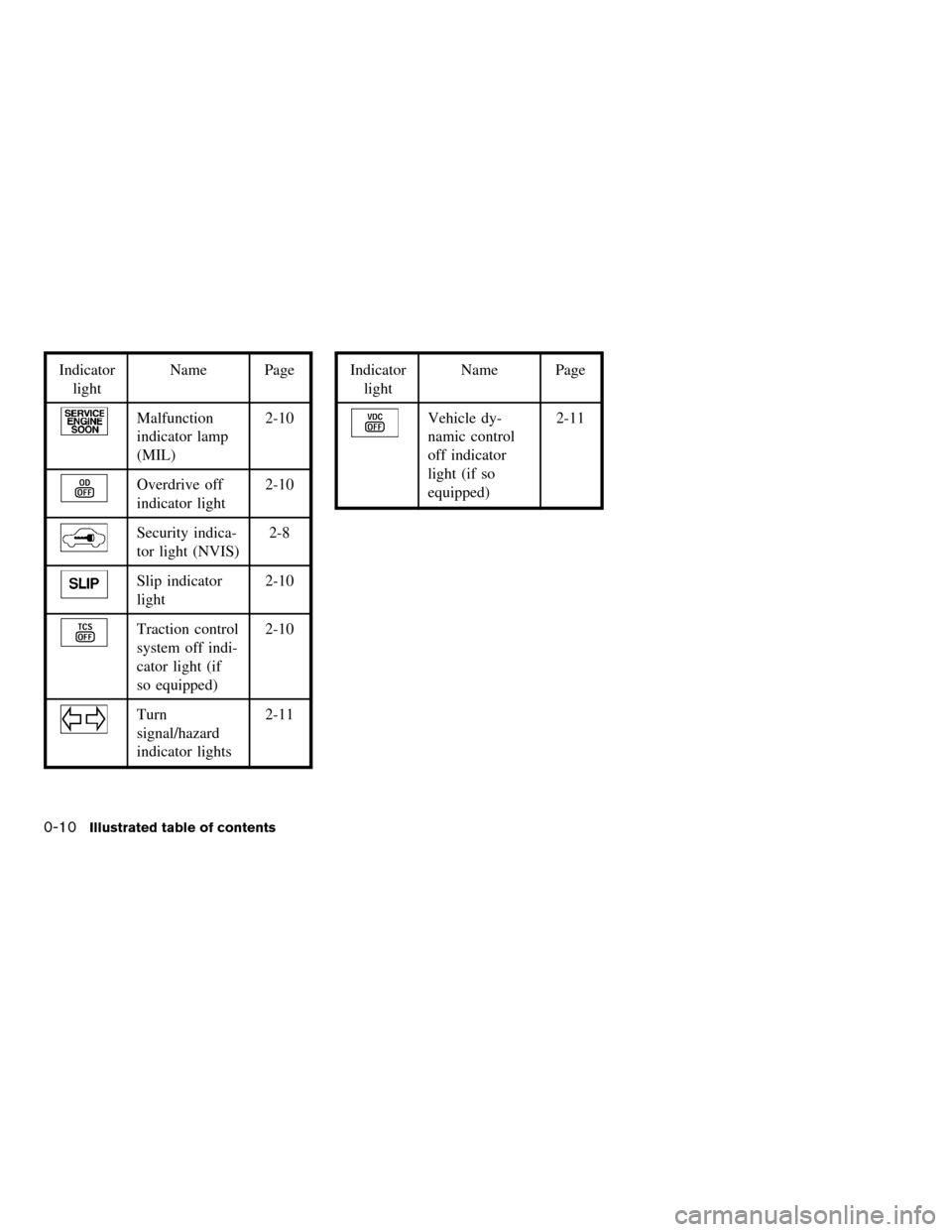
Indicator
lightName Page
Malfunction
indicator lamp
(MIL)2-10
Overdrive off
indicator light2-10
Security indica-
tor light (NVIS)2-8
Slip indicator
light2-10
Traction control
system off indi-
cator light (if
so equipped)2-10
Turn
signal/hazard
indicator lights2-11
Indicator
lightName Page
Vehicle dy-
namic control
off indicator
light (if so
equipped)2-11
0-10
Illustrated table of contents
ZREVIEW COPY:Ð2004 Quest(van)
Owners Manual(owners)ÐUSA English(nna)
10/08/03Ðtbrooks
X
Page 18 of 320
WARNING
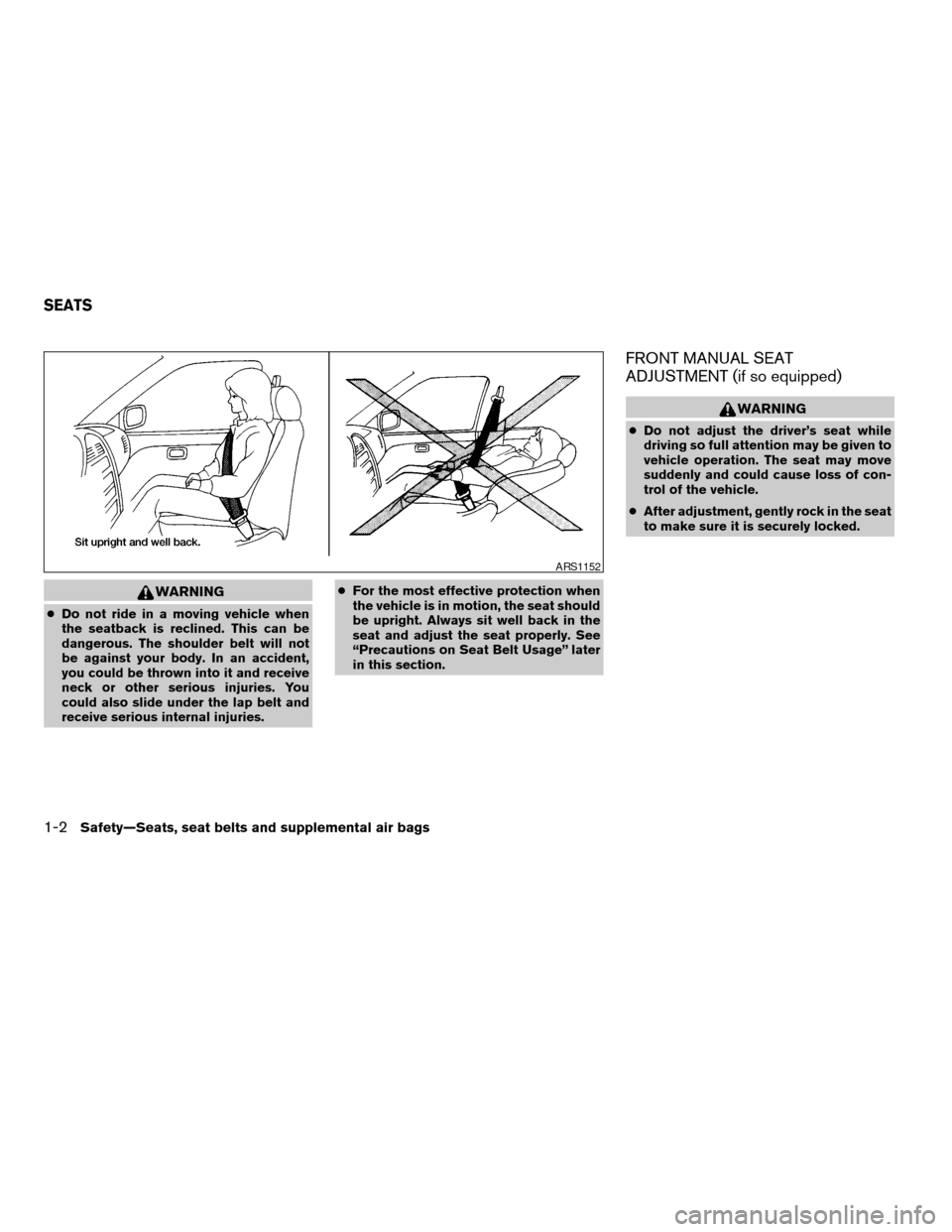
cDo not ride in a moving vehicle when
the seatback is reclined. This can be
dangerous. The shoulder belt will not
be against your body. In an accident,
you could be thrown into it and receive
neck or other serious injuries. You
could also slide under the lap belt and
receive serious internal injuries.cFor the most effective protection when
the vehicle is in motion, the seat should
be upright. Always sit well back in the
seat and adjust the seat properly. See
“Precautions on Seat Belt Usage” later
in this section.
FRONT MANUAL SEAT
ADJUSTMENT (if so equipped)
WARNING
cDo not adjust the driver’s seat while
driving so full attention may be given to
vehicle operation. The seat may move
suddenly and could cause loss of con-
trol of the vehicle.
cAfter adjustment, gently rock in the seat
to make sure it is securely locked.
ARS1152
SEATS
1-2Safety—Seats, seat belts and supplemental air bags
ZREVIEW COPY:Ð2004 Quest(van)
Owners Manual(owners)ÐUSA English(nna)
10/08/03Ðtbrooks
X
Page 19 of 320
Forward and backward
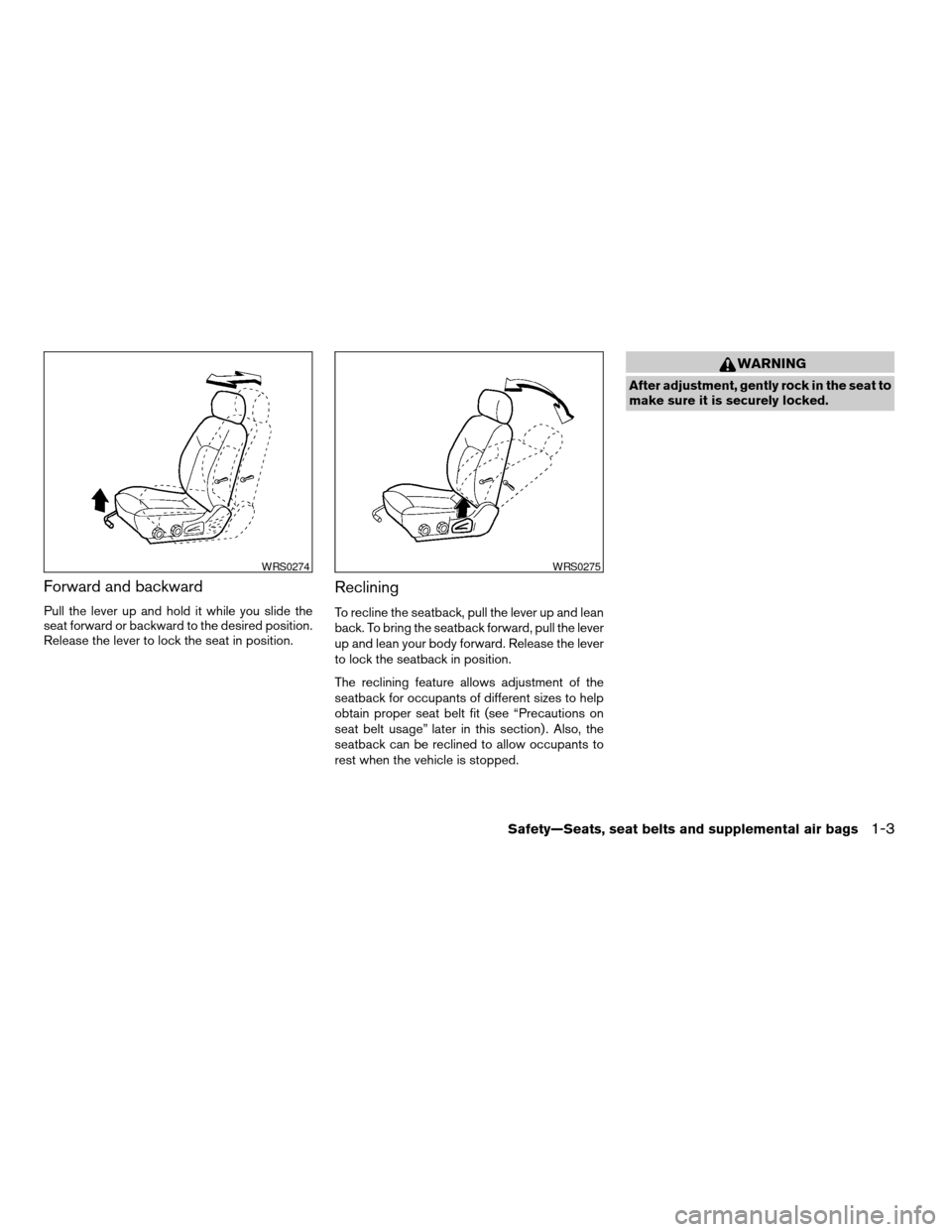
Pull the lever up and hold it while you slide the
seat forward or backward to the desired position.
Release the lever to lock the seat in position.
Reclining
To recline the seatback, pull the lever up and lean
back. To bring the seatback forward, pull the lever
up and lean your body forward. Release the lever
to lock the seatback in position.
The reclining feature allows adjustment of the
seatback for occupants of different sizes to help
obtain proper seat belt fit (see “Precautions on
seat belt usage” later in this section) . Also, the
seatback can be reclined to allow occupants to
rest when the vehicle is stopped.
WARNING
After adjustment, gently rock in the seat to
make sure it is securely locked.
WRS0274WRS0275
Safety—Seats, seat belts and supplemental air bags1-3
ZREVIEW COPY:Ð2004 Quest(van)
Owners Manual(owners)ÐUSA English(nna)
10/08/03Ðtbrooks
X
Page 23 of 320
Reclining
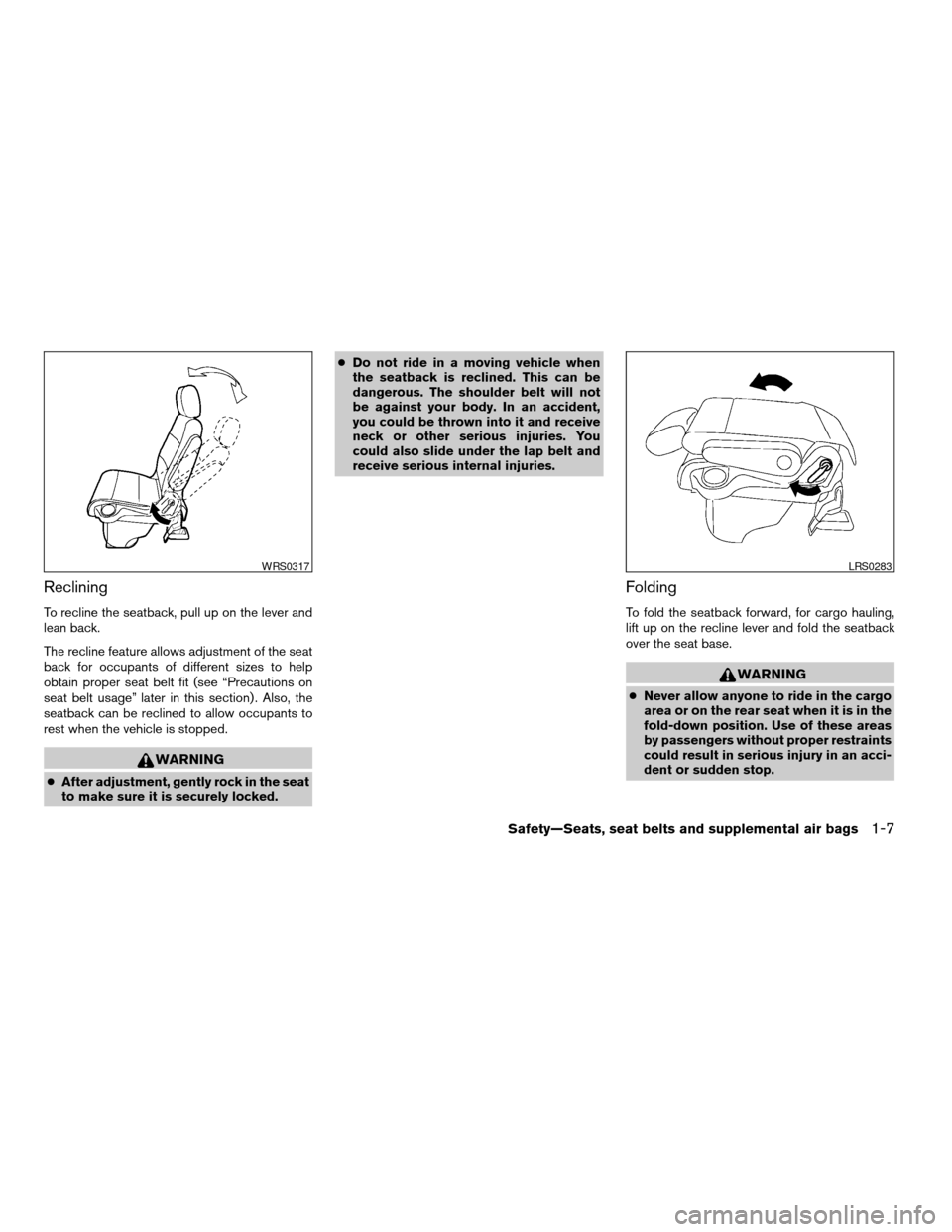
To recline the seatback, pull up on the lever and
lean back.
The recline feature allows adjustment of the seat
back for occupants of different sizes to help
obtain proper seat belt fit (see “Precautions on
seat belt usage” later in this section) . Also, the
seatback can be reclined to allow occupants to
rest when the vehicle is stopped.
WARNING
cAfter adjustment, gently rock in the seat
to make sure it is securely locked.cDo not ride in a moving vehicle when
the seatback is reclined. This can be
dangerous. The shoulder belt will not
be against your body. In an accident,
you could be thrown into it and receive
neck or other serious injuries. You
could also slide under the lap belt and
receive serious internal injuries.
Folding
To fold the seatback forward, for cargo hauling,
lift up on the recline lever and fold the seatback
over the seat base.
WARNING
cNever allow anyone to ride in the cargo
area or on the rear seat when it is in the
fold-down position. Use of these areas
by passengers without proper restraints
could result in serious injury in an acci-
dent or sudden stop.
WRS0317LRS0283
Safety—Seats, seat belts and supplemental air bags1-7
ZREVIEW COPY:Ð2004 Quest(van)
Owners Manual(owners)ÐUSA English(nna)
10/08/03Ðtbrooks
X
Page 24 of 320
cIt is extremely dangerous to ride in a
cargo area inside a vehicle. In a colli-
sion, people riding in these areas are
more likely to be seriously injured or
killed.
cDo not allow people to ride in any area
of your vehicle that is not equipped with
seats and seat belts. Be sure everyone
in your vehicle is in a seat and using a
seat belt properly.
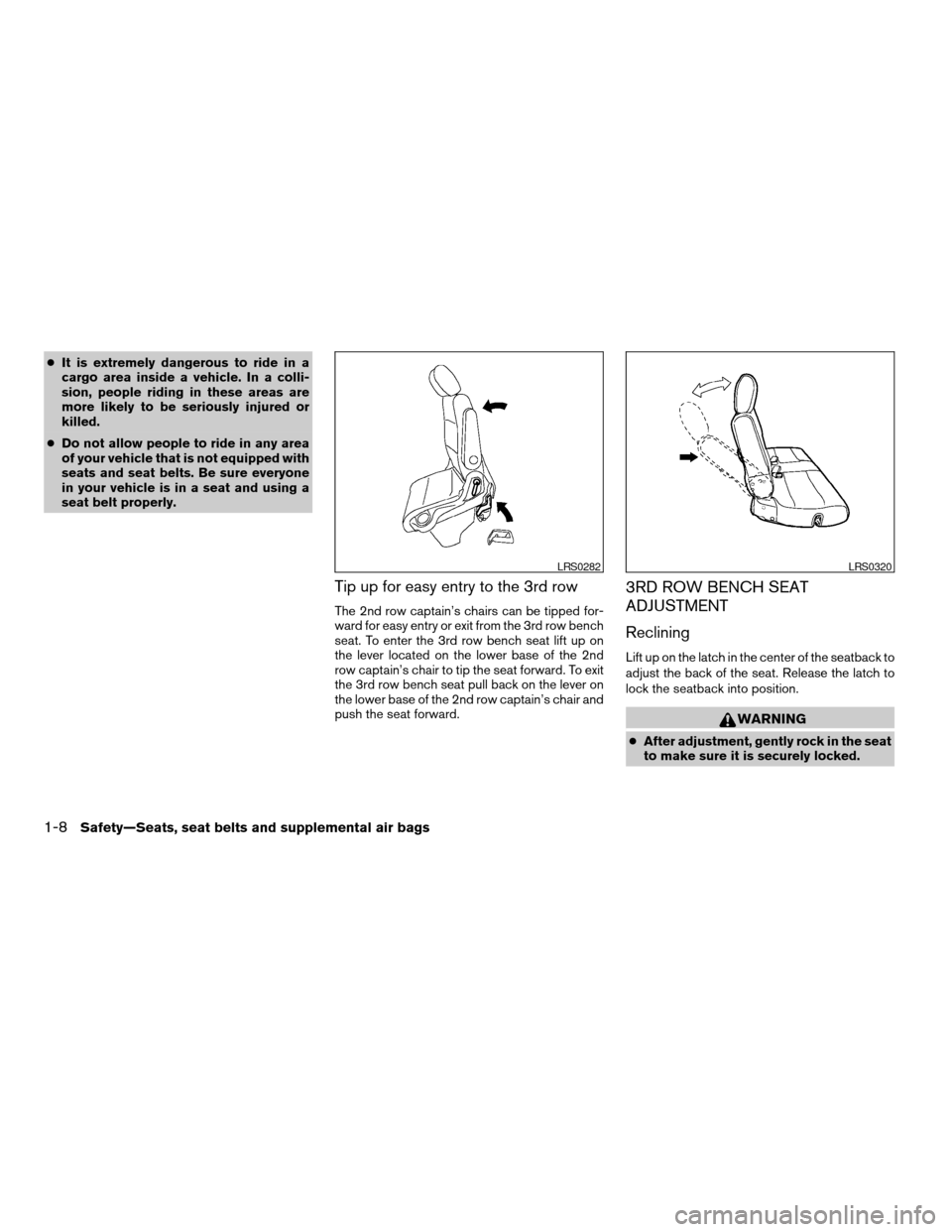
Tip up for easy entry to the 3rd row
The 2nd row captain’s chairs can be tipped for-
ward for easy entry or exit from the 3rd row bench
seat. To enter the 3rd row bench seat lift up on
the lever located on the lower base of the 2nd
row captain’s chair to tip the seat forward. To exit
the 3rd row bench seat pull back on the lever on
the lower base of the 2nd row captain’s chair and
push the seat forward.
3RD ROW BENCH SEAT
ADJUSTMENT
Reclining
Lift up on the latch in the center of the seatback to
adjust the back of the seat. Release the latch to
lock the seatback into position.
WARNING
cAfter adjustment, gently rock in the seat
to make sure it is securely locked.
LRS0282LRS0320
1-8Safety—Seats, seat belts and supplemental air bags
ZREVIEW COPY:Ð2004 Quest(van)
Owners Manual(owners)ÐUSA English(nna)
10/08/03Ðtbrooks
X
Page 27 of 320

ARMRESTS
To use the armrests on any seat, pull them down
to the resting position.
FLEXIBLE SEATING
Folding the 2nd row captain’s chair
s1To fold the 2nd row captain’s chairs to the
floor for maximum cargo hauling, remove the
head restraints. Remove the head restraints
by lifting up, then push and hold the release
knob and place them in the storage bag.
Make sure to secure the storage bag, see
“Head restraint storage” in the “Instrument
and controls” section of this Owner’s
Manual.
s2Lift up on the recline lever to fold the seat-
back forward on the seat base.
s3Push down on the small knob on the back of
the seat to release the base of the seat.
WRS0287WRS0288WRS0289
Safety—Seats, seat belts and supplemental air bags1-11
ZREVIEW COPY:Ð2004 Quest(van)
Owners Manual(owners)ÐUSA English(nna)
10/08/03Ðtbrooks
X
Page 28 of 320
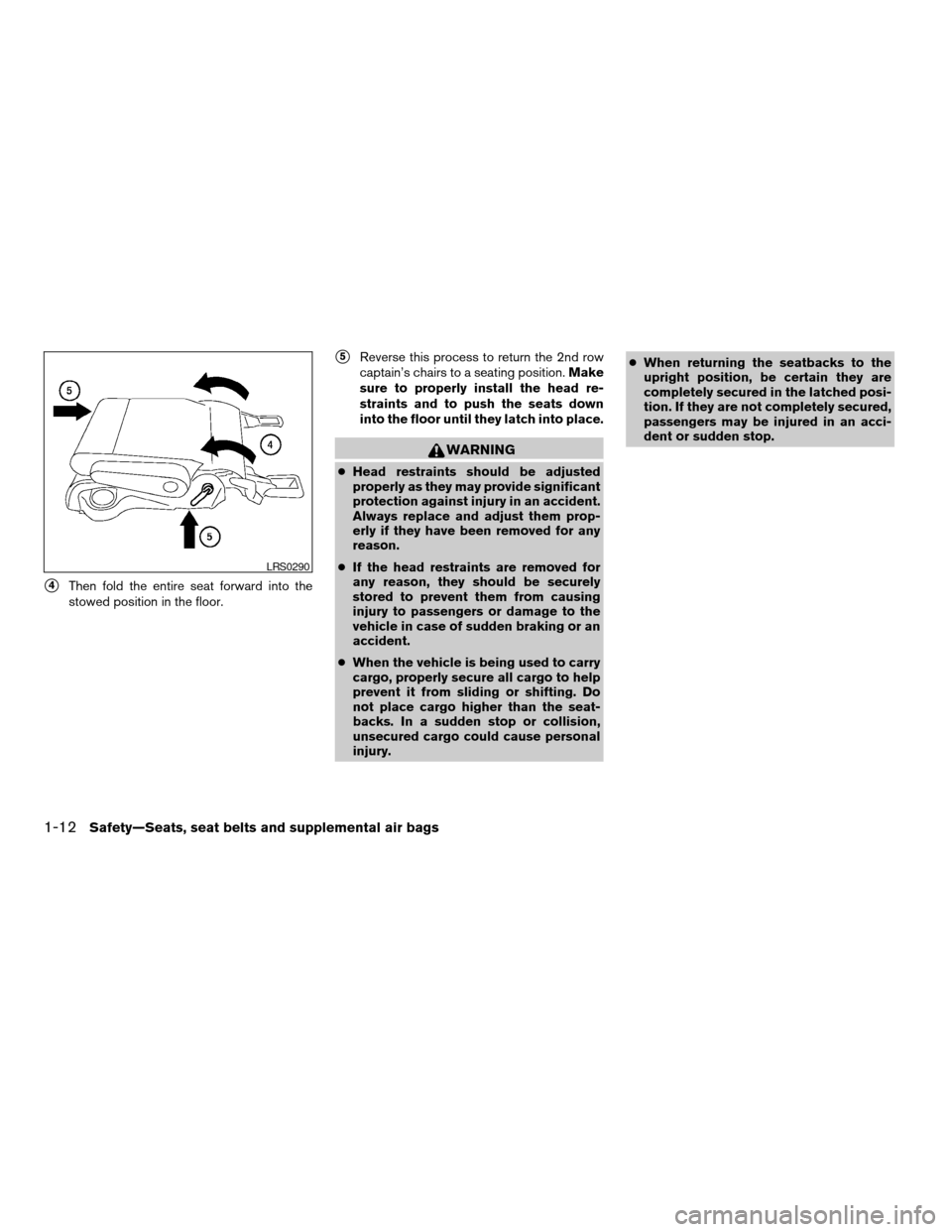
s4Then fold the entire seat forward into the
stowed position in the floor.
s5Reverse this process to return the 2nd row
captain’s chairs to a seating position.Make
sure to properly install the head re-
straints and to push the seats down
into the floor until they latch into place.
WARNING
cHead restraints should be adjusted
properly as they may provide significant
protection against injury in an accident.
Always replace and adjust them prop-
erly if they have been removed for any
reason.
cIf the head restraints are removed for
any reason, they should be securely
stored to prevent them from causing
injury to passengers or damage to the
vehicle in case of sudden braking or an
accident.
cWhen the vehicle is being used to carry
cargo, properly secure all cargo to help
prevent it from sliding or shifting. Do
not place cargo higher than the seat-
backs. In a sudden stop or collision,
unsecured cargo could cause personal
injury.cWhen returning the seatbacks to the
upright position, be certain they are
completely secured in the latched posi-
tion. If they are not completely secured,
passengers may be injured in an acci-
dent or sudden stop.
LRS0290
1-12Safety—Seats, seat belts and supplemental air bags
ZREVIEW COPY:Ð2004 Quest(van)
Owners Manual(owners)ÐUSA English(nna)
10/08/03Ðtbrooks
X
Page 29 of 320
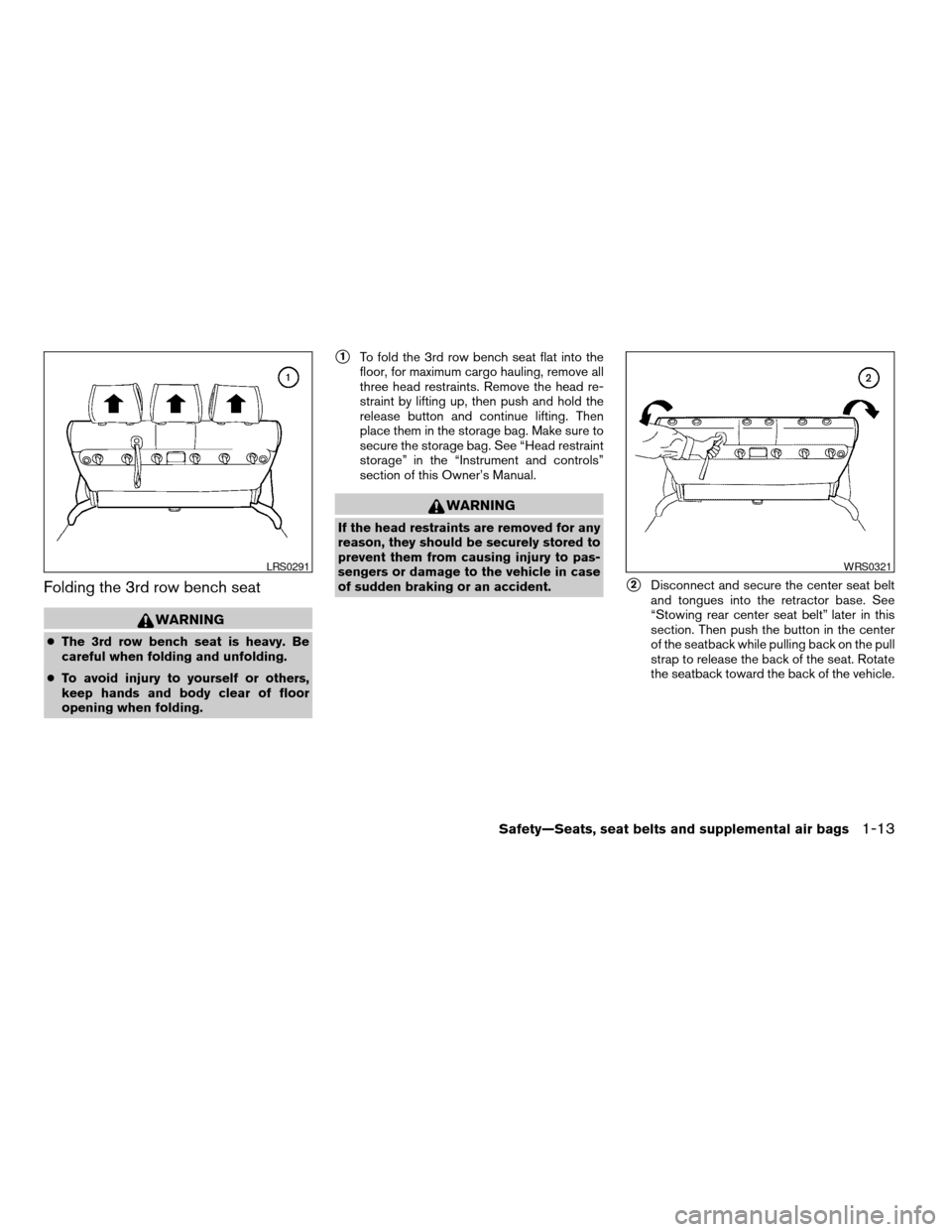
Folding the 3rd row bench seat
WARNING
cThe 3rd row bench seat is heavy. Be
careful when folding and unfolding.
cTo avoid injury to yourself or others,
keep hands and body clear of floor
opening when folding.
s1To fold the 3rd row bench seat flat into the
floor, for maximum cargo hauling, remove all
three head restraints. Remove the head re-
straint by lifting up, then push and hold the
release button and continue lifting. Then
place them in the storage bag. Make sure to
secure the storage bag. See “Head restraint
storage” in the “Instrument and controls”
section of this Owner’s Manual.
WARNING
If the head restraints are removed for any
reason, they should be securely stored to
prevent them from causing injury to pas-
sengers or damage to the vehicle in case
of sudden braking or an accident.
s2Disconnect and secure the center seat belt
and tongues into the retractor base. See
“Stowing rear center seat belt” later in this
section. Then push the button in the center
of the seatback while pulling back on the pull
strap to release the back of the seat. Rotate
the seatback toward the back of the vehicle.
LRS0291WRS0321
Safety—Seats, seat belts and supplemental air bags1-13
ZREVIEW COPY:Ð2004 Quest(van)
Owners Manual(owners)ÐUSA English(nna)
10/08/03Ðtbrooks
X
Page 31 of 320
WARNING
cWhen the vehicle is being used to carry
cargo, properly secure all cargo to help
prevent it from sliding or shifting. Do
not place cargo higher than the seat-
backs. In a sudden stop or collision,
unsecured cargo could cause personal
injury.
cWhen returning the seatbacks to the
upright position, be certain they are
completely secured in the latched posi-
tion. If they are not completely secured,
passengers may be injured in an acci-
dent or sudden stop.
cHead restraints should be adjusted
properly as they may provide significant
protection against injury in an accident.
Always replace and adjust them prop-
erly if they have been removed for any
reason.
cNever allow anyone to ride in the cargo
area or on the rear seat when it is in the
fold-down position. Use of these areas
by passengers without proper restraints
could result in serious injury in an acci-
dent or sudden stop.
PRECAUTIONS ON
SUPPLEMENTAL RESTRAINT
SYSTEM
This Supplemental Restraint System (SRS) sec-
tion contains important information concerning
the driver and passenger supplemental front air
bags (NISSAN Advanced Air Bag System) ,
supplemental side air bags, curtain side-impact
air bags and pre-tensioner seat belts.
Supplemental front impact air bag system:
The NISSAN advanced air bag system can help
cushion the impact force to the head and chest of
the driver and front passenger in certain frontal
collisions.
Supplemental side-impact air bag system
(if so equipped):This system can help cushion
the impact force to the chest area of the driver
and front passenger in certain side impact colli-
sions. The supplemental side air bag is designed
to inflate on the side where the vehicle is im-
pacted.
Supplemental curtain side-impact air bag
system:This system can help cushion the im-
pact force to the head of occupants in front and
rear outboard seating positions in certain side
impact collisions. The curtain side-impact air
bags are designed to inflate on the side where
the vehicle is impacted.These supplemental restraint systems are de-
signed tosupplementthe crash protection pro-
vided by the seat belts and arenot a substitute
for them. Seat belts should always be correctly
worn and the occupant seated a suitable dis-
tance away from the steering wheel, instrument
panel and door finishers. See “Seat belts” later in
this section for instructions and precautions on
seat belt usage.
The supplemental air bags operate only
when the ignition switch is in the ON or
START position.
After turning the ignition key to the ON
position, the supplemental air bag warning
light illuminates. The supplemental air bag
warning light will turn off after about 7
seconds if the system is operational.
SUPPLEMENTAL RESTRAINT
SYSTEM
Safety—Seats, seat belts and supplemental air bags1-15
ZREVIEW COPY:Ð2004 Quest(van)
Owners Manual(owners)ÐUSA English(nna)
10/08/03Ðtbrooks
X
Page 41 of 320
tected on the seat belt, the advanced air bag
system determines whether the front passenger
air bag should be automatically turned OFF as
required by the regulations.
Front passenger seat adult occupants who are
properly seated and using the seat belt as out-
lined in this manual should not cause the passen-
ger air bag to be automatically turned OFF. For
small adults it may be turned OFF. Also, if the
occupant takes his/her weight off the seat cush-
ion (for example, by not sitting upright, by sitting
on an edge of the seat, or by otherwise being out
of position) , this could cause the sensor to turn
the air bag OFF. In addition, if the occupant
improperly uses the seat belt in the automatic
locking mode (child restraint mode) , this could
cause the air bag to be turned OFF. Always be
sure to be seated and wearing the seat belt
properly for the most effective protection by the
seat belt and supplemental air bag.
NISSAN recommends that pre-teens and chil-
dren be properly restrained in a rear seat.
NISSAN also recommends that appropriate child
restraints and booster seats be properly installed
in a rear seat. If this is not possible, the weight
sensor and seat belt sensors are designed to
operate as described above to turn the front
passenger air bag OFF for specified child re-
straints as required by the regulations. Failing to
properly secure child restraints and to use theautomatic locking mode (child restraint mode)
may allow the restraint to tip or move in an acci-
dent or sudden stop. This can also result in the
passenger air bag inflating in a crash instead of
being OFF. See “Child restraints” later in this
section for proper use and installation.
If the front passenger seat is not occupied and
the seat belt is not buckled, the passenger air bag
is designed not to inflate in a crash. However,
heavy objects placed on the seat could result in
air bag inflation, because of the object’s weight
detected by the weight sensor. Other conditions
could also result in air bag inflation, such as if a
child is standing on the seat, or if two children are
on the seat, contrary to the instructions in this
manual. Always be sure that you and all vehicle
occupants are seated and restrained properly.
Using the passenger air bag status light, you can
monitor when the front passenger air bag is au-
tomatically turned OFF. The light will illuminate
(indicating the air bag is OFF and will not inflate)
when the front passenger seat is not occupied.
If an adult occupant is in the seat and the pas-
senger air bag status light is illuminated (indicat-
ing that the air bag is OFF) , it could be that the
person is a small adult, not sitting on the seat, or
using the seat belt properly. If a child restraint
must be used in the front seat, but the status light
is not lit (indicating that the air bag might inflate ina crash) , it could be that the child restraint or seat
belt is not being used properly. If such situations
happen, properly position and restrain the occu-
pant or child restraint. Otherwise reposition the
occupant or child restraint in a rear seat.
If a malfunction occurs in the front passenger air
bag system, the passenger air bag status
light
orwill illuminate and the
supplemental air bag warning light, located
in the meter and gauges area in the center of the
instrument panel, will blink. Have the system
checked by a NISSAN dealer.
Other supplemental front air bag precau-
tions
WARNING
cDo not place any objects on the steer-
ing wheel pad or on the instrument
panel. Also, do not place any objects
between any occupant and the steering
wheel or instrument panel. Such ob-
jects may become dangerous projec-
tiles and cause injury if the supplemen-
tal front air bag inflates.
cImmediately after inflation, several
front air bag system components will be
hot. Do not touch them; you may se-
verely burn yourself.
Safety—Seats, seat belts and supplemental air bags1-25
ZREVIEW COPY:Ð2004 Quest(van)
Owners Manual(owners)ÐUSA English(nna)
10/08/03Ðtbrooks
X