stop start NISSAN ROGUE 2008 1.G Owner's Guide
[x] Cancel search | Manufacturer: NISSAN, Model Year: 2008, Model line: ROGUE, Model: NISSAN ROGUE 2008 1.GPages: 309, PDF Size: 4.38 MB
Page 247 of 309
Black plate (254,1)
Model "S35-D" EDITED: 2007/ 12/ 19
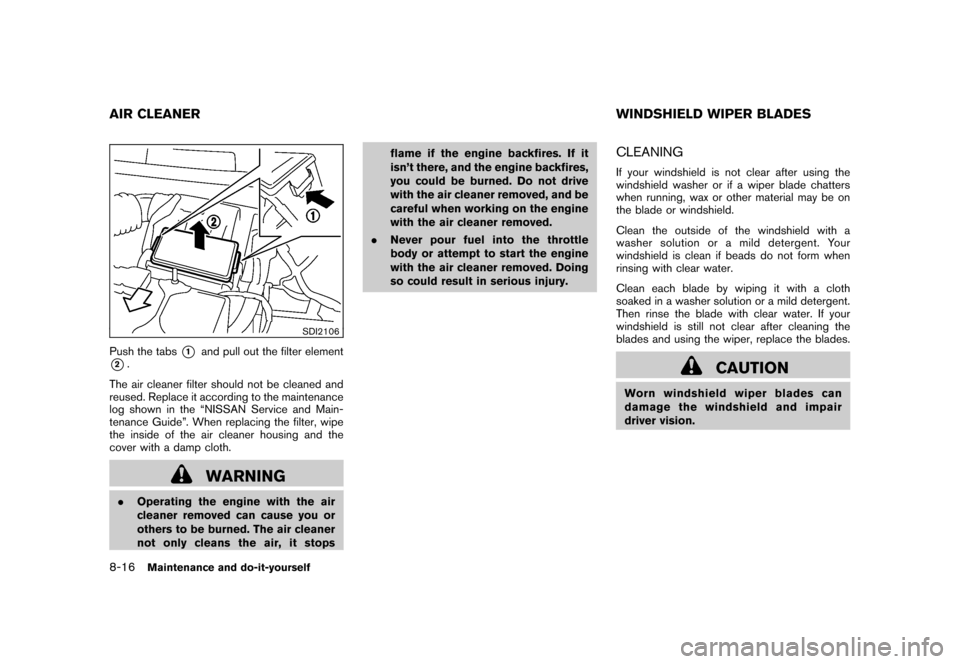
SDI2106
Push the tabs
*1
and pull out the filter element
*2.
The air cleaner filter should not be cleaned and
reused. Replace it according to the maintenance
log shown in the “NISSAN Service and Main-
tenance Guide”. When replacing the filter, wipe
the inside of the air cleaner housing and the
cover with a damp cloth.
WARNING
.Operating the engine with the air
cleaner removed can cause you or
others to be burned. The air cleaner
not only cleans the air, it stopsflame if the engine backfires. If it
isn’t there, and the engine backfires,
you could be burned. Do not drive
with the air cleaner removed, and be
careful when working on the engine
with the air cleaner removed.
.Never pour fuel into the throttle
body or attempt to start the engine
with the air cleaner removed. Doing
so could result in serious injury.
CLEANINGIf your windshield is not clear after using the
windshield washer or if a wiper blade chatters
when running, wax or other material may be on
the blade or windshield.
Clean the outside of the windshield with a
washer solution or a mild detergent. Your
windshield is clean if beads do not form when
rinsing with clear water.
Clean each blade by wiping it with a cloth
soaked in a washer solution or a mild detergent.
Then rinse the blade with clear water. If your
windshield is still not clear after cleaning the
blades and using the wiper, replace the blades.
CAUTION
Worn windshield wiper blades can
damage the windshield and impair
driver vision.
AIR CLEANER WINDSHIELD WIPER BLADES8-16
Maintenance and do-it-yourself
Page 287 of 309
Black plate (296,1)
Model "S35-D" EDITED: 2007/ 12/ 19
LOADING TIPS.
The GVW must not exceed GVWR or
GAWR as specified on the F.M.V.S.S./
C.M.V.S.S. certification label.
.
Do not load the front and rear axle to
the GAWR. Doing so will exceed the
GVWR.
WARNING
.
Properly secure all cargo with
ropes or straps to help prevent it
from sliding or shifting. Do not
place cargo higher than the
seatbacks. In a sudden stop or
collision, unsecured cargo could
cause personal injury.
.
Do not load your vehicle any
heavier than the GVWR or the
maximum front and rear
GAWRs. If you do, parts of your
vehicle can break, tire damage
could occur, or it can change the
way your vehicle handles. This
could result in loss of control
and cause personal injury.
.
Overloading not only can short-
en the life of your vehicle andthe tire, but can cause unsafe
vehicle handling and longer
braking distances. This may
cause a premature tire failure,
which could result in a serious
accident and personal injury.
Failures caused by overloading
are not covered by the vehicle’s
warranty.
MEASUREMENT OF WEIGHTSSecure loose items to prevent weight shifts
that could affect the balance of your
vehicle. When the vehicle is loaded, drive
to a scale and weigh the front and the rear
wheels separately to determine axle loads.
Individual axle loads should not exceed
either of the Gross Axle Weight Ratings
(GAWR) . The total of the axle loads should
not exceed the Gross Vehicle Weight
Rating (GVWR) . These ratings are given
on the vehicle certification label. If weight
ratings are exceeded, move or remove
items to bring all weights below the ratings.
WARNING
Overloading or improper loading of a
trailer and its cargo can adversely affect
vehicle handling, braking and perfor-
mance and may lead to accidents.
CAUTION
.Do not tow a trailer or haul a heavy
load for the first 500 miles (800 km) .
Your engine, axle or other parts
could be damaged.
.For the first 500 miles (800 km) that
you tow a trailer, do not drive over
50 MPH (80 km/h) and do not make
starts at full throttle. This helps the
engine and other parts of your
vehicle wear in at the heavier loads.
Your new vehicle was designed to be used
primarily to carry passengers and cargo. Re-
member that towing a trailer places additional
loads on your vehicle’s engine, drivetrain, steer-
ing, braking and other systems.
A NISSAN Towing Guide (U.S. only) is available
on the website at www.nissanusa.com. This
guide includes information on trailer towing
capability and the special equipment requiredTOWING A TRAILER
9-16
Technical and consumer information
Page 293 of 309
Black plate (302,1)
Model "S35-D" EDITED: 2007/ 12/ 19
WARNING
Never connect a trailer brake system
directly to the vehicle brake system.Pre-towing tips.Be certain your vehicle maintains a level
position when a loaded or unloaded trailer is
hitched. Do not drive the vehicle if it has an
abnormal nose-up or nose-down condition;
check for improper tongue load, overload,
worn suspension or other possible causes
of either condition.
.Always secure items in the trailer to prevent
load shift while driving.
.Keep the cargo load as low as possible in
the trailer to keep the trailer center of gravity
low.
.Load the trailer so approximately 60% of the
trailer load is in the front half and 40% is in
the back half. Also make sure the load is
balanced side to side.
.Check your hitch, trailer tire pressure,
vehicle tire pressure, trailer light operation,
and trailer wheel lug nuts every time you
attach a trailer to the vehicle.
.Be certain your rearview mirrors conform to
all federal, state or local regulations. If not,install any mirrors required for towing before
driving the vehicle.
.Determine the overall height of the vehicle
and trailer so the required clearance is
known.
Trailer towing tipsIn order to gain skill and an understanding of the
vehicle’s behavior, you should practice turning,
stopping and backing up in an area which is free
from traffic. Steering stability, and braking
performance will be somewhat different than
under normal driving conditions.
.Always secure items in the trailer to prevent
load shift while driving.
.Lock the trailer hitch coupler with a pin or
lock to prevent the coupler from inadver-
tently becoming unlatched.
.Avoid abrupt starts, acceleration or stops.
.Avoid sharp turns or lane changes.
.Always drive your vehicle at a moderate
speed. Some states or provinces have
specific speed limits for vehicles that are
towing trailers. Obey the local speed limits.
.When backing up, hold the bottom of the
steering wheel with one hand. Move your
hand in the direction in which you want the
trailer to go. Make small corrections andback up slowly. If possible, have someone
guide you when you are backing up.
Always block the wheels on both vehicle and
trailer when parking. Parking on a slope is not
recommended; however, if you must do so:
CAUTION
If you move the shift selector lever to
the P (Park) position before blocking
the wheels and applying the parking
brake, transmission damage could oc-
cur.
1. Apply and hold the brake pedal.
2. Have someone place blocks on the downhill
side of the vehicle and trailer wheels.
3. After the wheel blocks are in place, slowly
release the brake pedal until the blocks
absorb the vehicle load.
4. Apply the parking brake.
5. Shift the transmission into P (Park) .
6. Turn off the engine.
To drive away:
1. Apply and hold the brake pedal.
2. Start the engine.
9-22
Technical and consumer information
Page 298 of 309
Black plate (307,1)
Model "S35-D" EDITED: 2007/ 12/ 19
“ready”.
If the MIL indicates the vehicle is in a “not ready”
condition, drive the vehicle through the following
pattern to set the vehicle to the “ready condi-
tion”. If you cannot or do not want to perform the
driving pattern, a NISSAN dealer can conduct it
for you.
WARNING
Always drive the vehicle in a safe and
prudent manner according to traffic
conditions and obey all traffic laws.
1. Start the engine. Allow the engine to idle
until the engine coolant temperature gauge
needle points between the C and H (normal
operating temperature) .
2. Accelerate the vehicle to 55 MPH (88
km/h) , then quickly release the accelerator
pedal completely and keep it released for at
least 10 seconds.
3. Quickly depress the accelerator pedal for a
moment, then drive the vehicle at a speed of
53 to 60 MPH (86 to 96 km/h) for at least 9
minutes.
4. Stop the vehicle. Leave the engine running.
5. Accelerate the vehicle to 35 MPH (55 km/h)
and maintain the speed for 20 seconds.6. Repeat steps 4 and 5 at least 10 times.
7. Accelerate the vehicle to 55 MPH (88 km/h)
and maintain the speed for at least 3
minutes.
8. Stop the vehicle. Place the transmission
selector lever in the P (Park) or N (Neutral)
position.
9. Turn the engine off.
10. Repeat steps 1 through 8 at least one more
time.
If step 1 through 7 is interrupted, repeat the
preceding step. Any safe driving mode is
acceptable between steps. Do not stop the
engine until step 7 is completed.This vehicle is equipped with an Event Data
Recorder (EDR) . The main purpose of an EDR is
to record, in certain crash or near crash-like
situations, such as an air bag deployment or
hitting a road obstacle, data that will assist in
understanding how a vehicle’s systems per-
formed. The EDR is designed to record data
related to vehicle dynamics and safety systems
for a short period of time, typically 30 seconds
or less. The EDR in this vehicle is designed to
record such data as:
.How various systems in your vehicle were
operating;
.Whether or not the driver and passenger
safety belts were buckled/fastened;
.How far (if at all) the driver was depressing
the accelerator and/or brake pedal; and,
.How fast the vehicle was traveling.
.Sounds are not recorded.
These data can help provide a better under-
standing of the circumstances in which crashes
and injuries occur.
NOTE: EDR data are recorded by your vehicle
only if a nontrivial crash situation occurs; no data
are recorded by the EDR under normal driving
conditions and no personal data (e.g. name,
gender, age and crash location) are recorded.
However, other parties, such as law enforce-
EVENT DATA RECORDERS (EDR)Technical and consumer information
9-27
Page 302 of 309
Black plate (1,1)
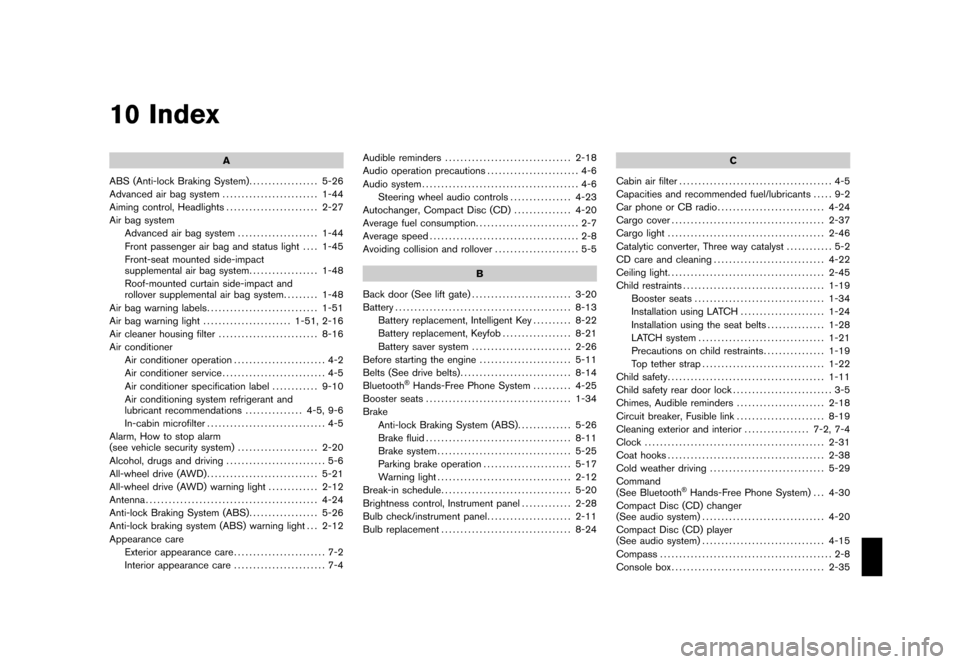
10 Index
A
ABS (Anti-lock Braking System).................. 5-26
Advanced air bag system......................... 1-44
Aiming control, Headlights........................ 2-27
Air bag system
Advanced air bag system..................... 1-44
Front passenger air bag and status light.... 1-45
Front-seat mounted side-impact
supplemental air bag system.................. 1-48
Roof-mounted curtain side-impact and
rollover supplemental air bag system......... 1-48
Air bag warning labels............................. 1-51
Air bag warning light....................... 1-51, 2-16
Air cleaner housing filter.......................... 8-16
Air conditioner
Air conditioner operation........................ 4-2
Air conditioner service........................... 4-5
Air conditioner specification label............ 9-10
Air conditioning system refrigerant and
lubricant recommendations............... 4-5, 9-6
In-cabin microfilter............................... 4-5
Alarm, How to stop alarm
(see vehicle security system)..................... 2-20
Alcohol, drugs and driving.......................... 5-6
All-wheel drive (AWD)............................. 5-21
All-wheel drive (AWD) warning light............. 2-12
Antenna............................................. 4-24
Anti-lock Braking System (ABS).................. 5-26
Anti-lock braking system (ABS) warning light . . . 2-12
Appearance care
Exterior appearance care........................ 7-2
Interior appearance care........................ 7-4Audible reminders................................. 2-18
Audio operation precautions........................ 4-6
Audio system......................................... 4-6
Steering wheel audio controls................ 4-23
Autochanger, Compact Disc (CD)............... 4-20
Average fuel consumption........................... 2-7
Average speed....................................... 2-8
Avoiding collision and rollover...................... 5-5
B
Back door (See lift gate).......................... 3-20
Battery.............................................. 8-13
Battery replacement, Intelligent Key.......... 8-22
Battery replacement, Keyfob.................. 8-21
Battery saver system.......................... 2-26
Before starting the engine........................ 5-11
Belts (See drive belts)............................. 8-14
Bluetooth
®Hands-Free Phone System.......... 4-25
Booster seats...................................... 1-34
Brake
Anti-lock Braking System (ABS).............. 5-26
Brake fluid...................................... 8-11
Brake system................................... 5-25
Parking brake operation....................... 5-17
Warning light................................... 2-12
Break-in schedule.................................. 5-20
Brightness control, Instrument panel............. 2-28
Bulb check/instrument panel...................... 2-11
Bulb replacement.................................. 8-24C
Cabin air filter........................................ 4-5
Capacities and recommended fuel/lubricants..... 9-2
Car phone or CB radio............................ 4-24
Cargo cover........................................ 2-37
Cargo light......................................... 2-46
Catalytic converter, Three way catalyst............ 5-2
CD care and cleaning............................. 4-22
Ceiling light......................................... 2-45
Child restraints..................................... 1-19
Booster seats .................................. 1-34
Installation using LATCH...................... 1-24
Installation using the seat belts............... 1-28
LATCH system................................. 1-21
Precautions on child restraints................ 1-19
Top tether strap................................ 1-22
Child safety......................................... 1-11
Child safety rear door lock.......................... 3-5
Chimes, Audible reminders....................... 2-18
Circuit breaker, Fusible link ....................... 8-19
Cleaning exterior and interior................. 7-2, 7-4
Clock............................................... 2-31
Coat hooks......................................... 2-38
Cold weather driving.............................. 5-29
Command
(See Bluetooth
®Hands-Free Phone System) . . . 4-30
Compact Disc (CD) changer
(See audio system) ................................ 4-20
Compact Disc (CD) player
(See audio system) ................................ 4-15
Compass............................................. 2-8
Console box........................................ 2-35
Model "S35-D" EDITED: 2007/ 12/ 25