tire size NISSAN ROGUE 2010 Owner´s Manual
[x] Cancel search | Manufacturer: NISSAN, Model Year: 2010, Model line: ROGUE, Model: NISSAN ROGUE 2010Pages: 328, PDF Size: 2.84 MB
Page 283 of 328
Black plate (283,1)
Model "S35-D" EDITED: 2009/ 9/ 4
SDI1575
Example
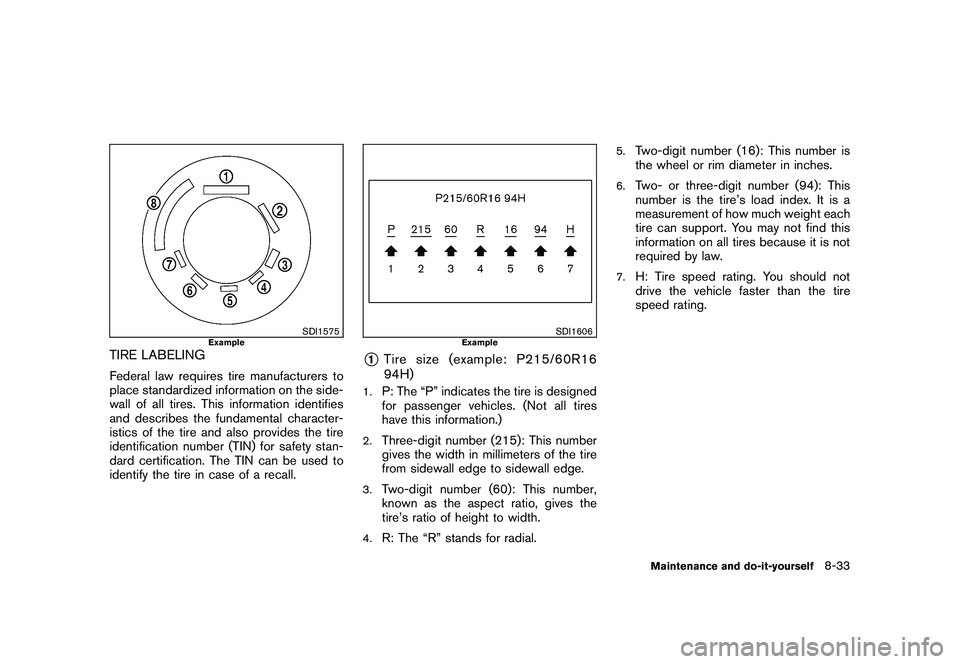
TIRE LABELINGFederal law requires tire manufacturers to
place standardized information on the side-
wall of all tires. This information identifies
and describes the fundamental character-
istics of the tire and also provides the tire
identification number (TIN) for safety stan-
dard certification. The TIN can be used to
identify the tire in case of a recall.
SDI1606
Example
*1
Tire size (example: P215/60R16
94H)
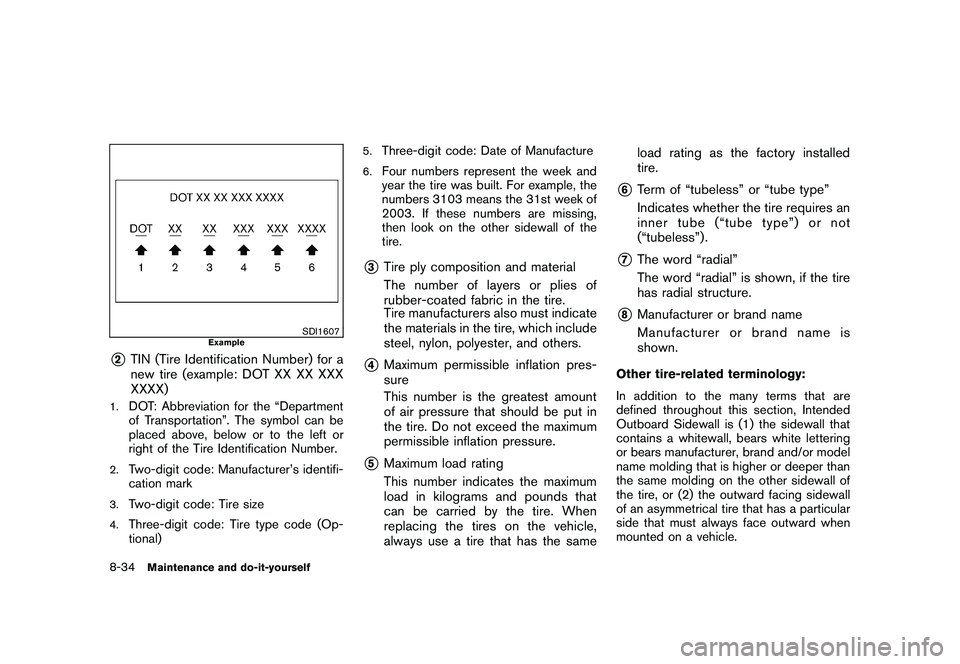
1.
P: The “P” indicates the tire is designed
for passenger vehicles. (Not all tires
have this information.)
2.
Three-digit number (215): This number
gives the width in millimeters of the tire
from sidewall edge to sidewall edge.
3.
Two-digit number (60): This number,
known as the aspect ratio, gives the
tire’s ratio of height to width.
4.
R: The “R” stands for radial.
5.
Two-digit number (16): This number is
the wheel or rim diameter in inches.
6.
Two- or three-digit number (94): This
number is the tire’s load index. It is a
measurement of how much weight each
tire can support. You may not find this
information on all tires because it is not
required by law.
7.
H: Tire speed rating. You should not
drive the vehicle faster than the tire
speed rating.
Maintenance and do-it-yourself
8-33
Page 284 of 328
Black plate (284,1)
Model "S35-D" EDITED: 2009/ 9/ 4
SDI1607
Example
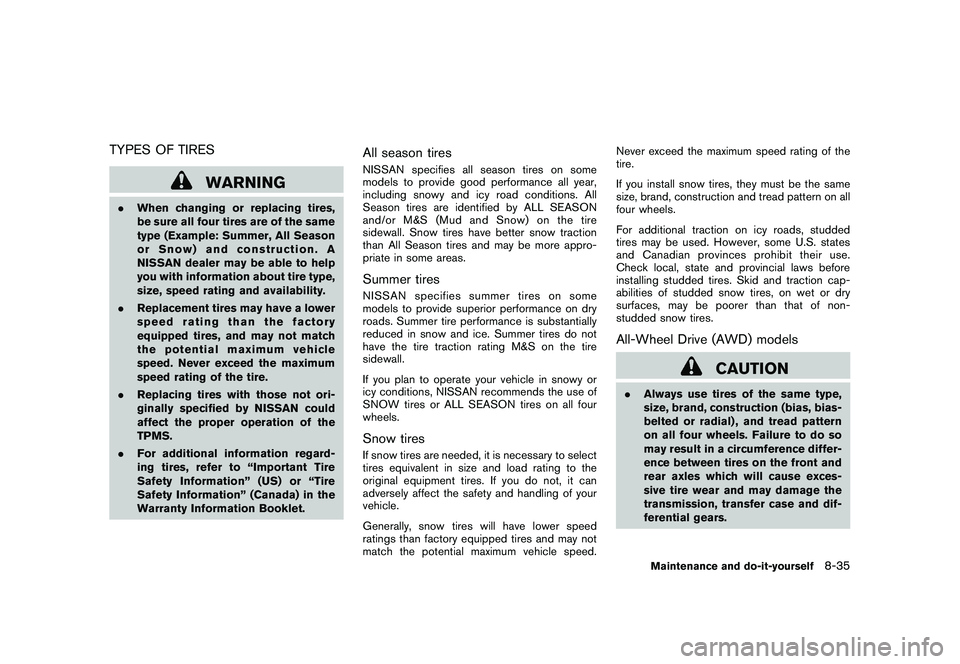
*2
TIN (Tire Identification Number) for a
new tire (example: DOT XX XX XXX
XXXX)
1.
DOT: Abbreviation for the “Department
of Transportation”. The symbol can be
placed above, below or to the left or
right of the Tire Identification Number.
2.
Two-digit code: Manufacturer’s identifi-
cation mark
3.
Two-digit code: Tire size
4.
Three-digit code: Tire type code (Op-
tional)
5.
Three-digit code: Date of Manufacture
6.
Four numbers represent the week and
year the tire was built. For example, the
numbers 3103 means the 31st week of
2003. If these numbers are missing,
then look on the other sidewall of the
tire.
*3
Tire ply composition and material
The number of layers or plies of
rubber-coated fabric in the tire.
Tire manufacturers also must indicate
the materials in the tire, which include
steel, nylon, polyester, and others.
*4
Maximum permissible inflation pres-
sure
This number is the greatest amount
of air pressure that should be put in
the tire. Do not exceed the maximum
permissible inflation pressure.
*5
Maximum load rating
This number indicates the maximum
load in kilograms and pounds that
can be carried by the tire. When
replacing the tires on the vehicle,
always use a tire that has the sameload rating as the factory installed
tire.
*6
Term of “tubeless” or “tube type”
Indicates whether the tire requires an
inner tube (“tube type”) or not
(“tubeless”) .
*7
The word “radial”
The word “radial” is shown, if the tire
has radial structure.
*8
Manufacturer or brand name
Manufacturer or brand name is
shown.
Other tire-related terminology:
In addition to the many terms that are
defined throughout this section, Intended
Outboard Sidewall is (1) the sidewall that
contains a whitewall, bears white lettering
or bears manufacturer, brand and/or model
name molding that is higher or deeper than
the same molding on the other sidewall of
the tire, or (2) the outward facing sidewall
of an asymmetrical tire that has a particular
side that must always face outward when
mounted on a vehicle.
8-34
Maintenance and do-it-yourself
Page 285 of 328
Black plate (285,1)
Model "S35-D" EDITED: 2009/ 9/ 4
TYPES OF TIRES
WARNING
.When changing or replacing tires,
be sure all four tires are of the same
type (Example: Summer, All Season
or Snow) and construction. A
NISSAN dealer may be able to help
you with information about tire type,
size, speed rating and availability.
. Replacement tires may have a lower
speed rating than the factory
equipped tires, and may not match
the potential maximum vehicle
speed. Never exceed the maximum
speed rating of the tire.
. Replacing tires with those not ori-
ginally specified by NISSAN could
affect the proper operation of the
TPMS.
. For additional information regard-
ing tires, refer to “Important Tire
Safety Information” (US) or “Tire
Safety Information” (Canada) in the
Warranty Information Booklet.
All season tiresNISSAN specifies all season tires on some
models to provide good performance all year,
including snowy and icy road conditions. All
Season tires are identified by ALL SEASON
and/or M&S (Mud and Snow) on the tire
sidewall. Snow tires have better snow traction
than All Season tires and may be more appro-
priate in some areas.Summer tiresNISSAN specifies summer tires on some
models to provide superior performance on dry
roads. Summer tire performance is substantially
reduced in snow and ice. Summer tires do not
have the tire traction rating M&S on the tire
sidewall.
If you plan to operate your vehicle in snowy or
icy conditions, NISSAN recommends the use of
SNOW tires or ALL SEASON tires on all four
wheels.Snow tiresIf snow tires are needed, it is necessary to select
tires equivalent in size and load rating to the
original equipment tires. If you do not, it can
adversely affect the safety and handling of your
vehicle.
Generally, snow tires will have lower speed
ratings than factory equipped tires and may not
match the potential maximum vehicle speed. Never exceed the maximum speed rating of the
tire.
If you install snow tires, they must be the same
size, brand, construction and tread pattern on all
four wheels.
For additional traction on icy roads, studded
tires may be used. However, some U.S. states
and Canadian provinces prohibit their use.
Check local, state and provincial laws before
installing studded tires. Skid and traction cap-
abilities of studded snow tires, on wet or dry
surfaces, may be poorer than that of non-
studded snow tires.
All-Wheel Drive (AWD) models
CAUTION
.
Always use tires of the same type,
size, brand, construction (bias, bias-
belted or radial) , and tread pattern
on all four wheels. Failure to do so
may result in a circumference differ-
ence between tires on the front and
rear axles which will cause exces-
sive tire wear and may damage the
transmission, transfer case and dif-
ferential gears.
Maintenance and do-it-yourself
8-35
Page 286 of 328
Black plate (286,1)
Model "S35-D" EDITED: 2009/ 9/ 4
.ONLY use spare tires specified for
the AWD model.
If excessive tire wear is found, it is recom-
mended that all four tires be replaced with tires
of the same size, brand, construction and tread
pattern. The tire pressure and wheel alignment
should also be checked and corrected as
necessary. Contact a NISSAN dealer.TIRE CHAINS
CAUTION
NISSAN recommends using the follow-
ing tire cables made by Peerless Chain
Company for this vehicle due to limited
tire clearance. Call 800-533-8056 to
order tire chains for your vehicle.
. 215/70R16 - Sno-trac1000 part num-
ber 0103855 with chain tightener
part number 2007020
. 225/60R17 - Sno-trac1000 part num-
ber 0103855 with chain tightener
part number 2007190
Failure to use the correct traction
device will cause damage to the brakes,
suspension or other vehicle parts.
The tire chain part numbers and Peerless Chain Company phone number are correct at the time
of printing that is shown on the back cover of
this Owner’s Manual. Always confirm the correct
part numbers with Peerless Chain Company
before ordering.
Only use other types of traction devices if the
traction device manufacturer recommends it for
use on your specific vehicle and the tire and
wheel installed on your vehicle.
Use of traction devices may be prohibited
according to location. Check the local laws
before installing traction devices. When instal-
ling traction devices, make sure they are the
proper size for the tires on your vehicle and are
installed according to the traction device man-
ufacturer’s suggestions. When using traction
devices, avoid fully loading your vehicle and
drive at reduced speeds. Failure to do so may
cause damage to the brakes and suspension
and adversely affect handling and performance.
Traction devices must be installed only on
the front wheels and not on the rear
wheels.
Do not drive with traction devices on paved
roads that are clear of snow. Driving with
traction devices in such conditions can cause
damage to the various mechanisms of the
vehicle due to some overstress.
CAUTION
.
Do not use traction devices on dry
roads.
. Never install traction devices on a T-
type spare tire as doing so could
damage the brakes, suspension or
other vehicle parts.
8-36
Maintenance and do-it-yourself
Page 287 of 328
Black plate (287,1)
Model "S35-D" EDITED: 2009/ 9/ 4
SDI1662
CHANGING WHEELS AND TIRES
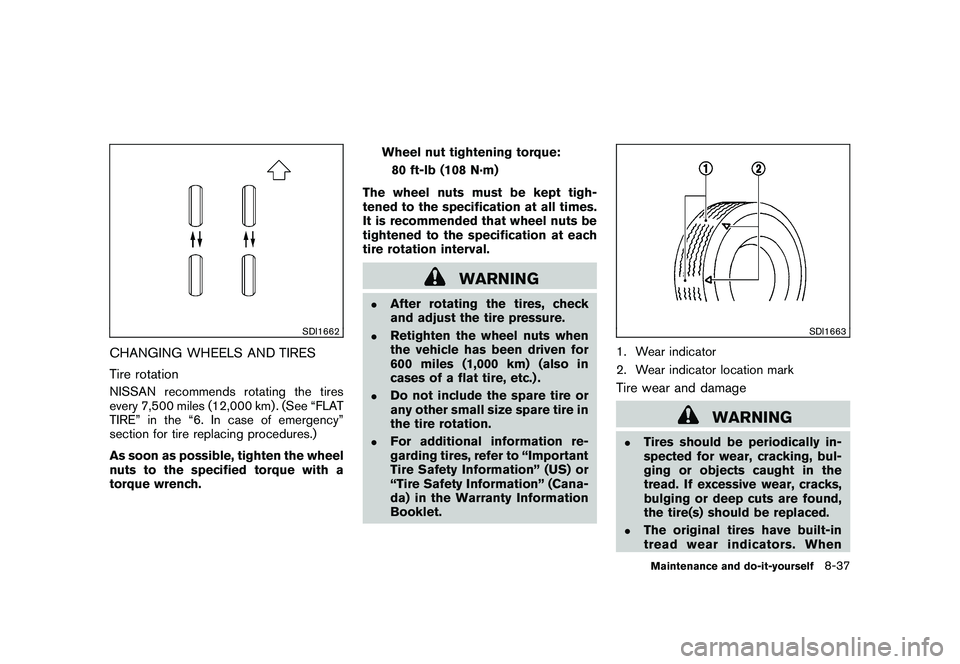
Tire rotationNISSAN recommends rotating the tires
every 7,500 miles (12,000 km) . (See “FLAT
TIRE” in the “6. In case of emergency”
section for tire replacing procedures.)
As soon as possible, tighten the wheel
nuts to the specified torque with a
torque wrench.Wheel nut tightening torque:
80 ft-lb (108 N·m)
The wheel nuts must be kept tigh-
tened to the specification at all times.
It is recommended that wheel nuts be
tightened to the specification at each
tire rotation interval.
WARNING
.
After rotating the tires, check
and adjust the tire pressure.
.
Retighten the wheel nuts when
the vehicle has been driven for
600 miles (1,000 km) (also in
cases of a flat tire, etc.) .
.
Do not include the spare tire or
any other small size spare tire in
the tire rotation.
.
For additional information re-
garding tires, refer to “Important
Tire Safety Information” (US) or
“Tire Safety Information” (Cana-
da) in the Warranty Information
Booklet.
SDI1663
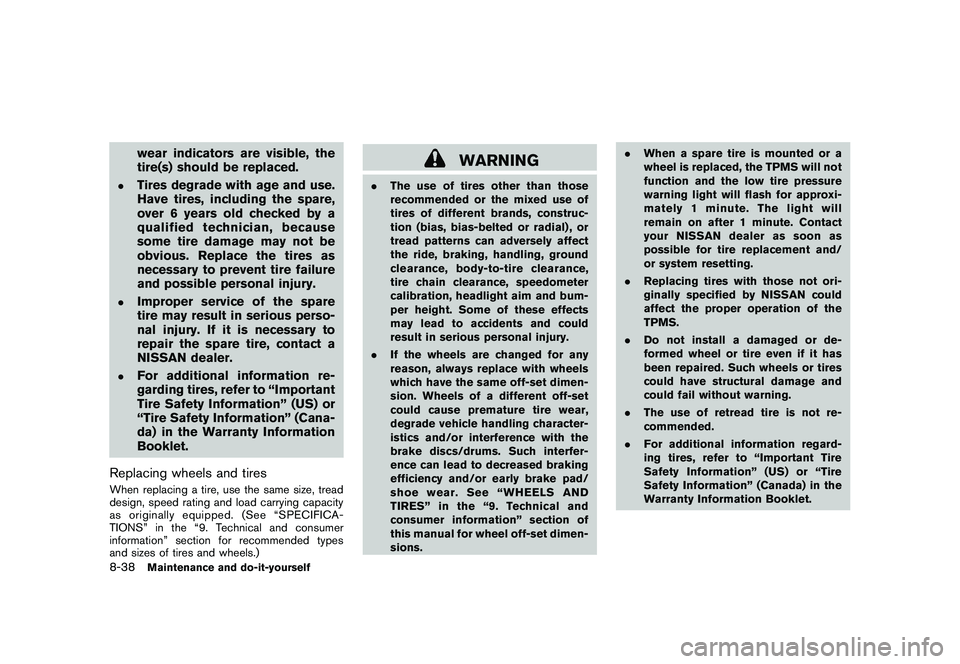
1. Wear indicator
2. Wear indicator location markTire wear and damage
WARNING
.
Tires should be periodically in-
spected for wear, cracking, bul-
ging or objects caught in the
tread. If excessive wear, cracks,
bulging or deep cuts are found,
the tire(s) should be replaced.
.
The original tires have built-in
tread wear indicators. WhenMaintenance and do-it-yourself
8-37
Page 288 of 328
Black plate (288,1)
Model "S35-D" EDITED: 2009/ 9/ 4
wear indicators are visible, the
tire(s) should be replaced.
.
Tires degrade with age and use.
Have tires, including the spare,
over 6 years old checked by a
qualified technician, because
some tire damage may not be
obvious. Replace the tires as
necessary to prevent tire failure
and possible personal injury.
.
Improper service of the spare
tire may result in serious perso-
nal injury. If it is necessary to
repair the spare tire, contact a
NISSAN dealer.
.
For additional information re-
garding tires, refer to “Important
Tire Safety Information” (US) or
“Tire Safety Information” (Cana-
da) in the Warranty Information
Booklet.
Replacing wheels and tiresWhen replacing a tire, use the same size, tread
design, speed rating and load carrying capacity
as originally equipped. (See “SPECIFICA-
TIONS” in the “9. Technical and consumer
information” section for recommended types
and sizes of tires and wheels.)
WARNING
.The use of tires other than those
recommended or the mixed use of
tires of different brands, construc-
tion (bias, bias-belted or radial) , or
tread patterns can adversely affect
the ride, braking, handling, ground
clearance, body-to-tire clearance,
tire chain clearance, speedometer
calibration, headlight aim and bum-
per height. Some of these effects
may lead to accidents and could
result in serious personal injury.
. If the wheels are changed for any
reason, always replace with wheels
which have the same off-set dimen-
sion. Wheels of a different off-set
could cause premature tire wear,
degrade vehicle handling character-
istics and/or interference with the
brake discs/drums. Such interfer-
ence can lead to decreased braking
efficiency and/or early brake pad/
shoe wear. See “WHEELS AND
TIRES” in the “9. Technical and
consumer information” section of
this manual for wheel off-set dimen-
sions. .
When a spare tire is mounted or a
wheel is replaced, the TPMS will not
function and the low tire pressure
warning light will flash for approxi-
mately 1 minute. The light will
remain on after 1 minute. Contact
your NISSAN dealer as soon as
possible for tire replacement and/
or system resetting.
. Replacing tires with those not ori-
ginally specified by NISSAN could
affect the proper operation of the
TPMS.
. Do not install a damaged or de-
formed wheel or tire even if it has
been repaired. Such wheels or tires
could have structural damage and
could fail without warning.
. The use of retread tire is not re-
commended.
. For additional information regard-
ing tires, refer to “Important Tire
Safety Information” (US) or “Tire
Safety Information” (Canada) in the
Warranty Information Booklet.
8-38
Maintenance and do-it-yourself
Page 289 of 328
Black plate (289,1)
Model "S35-D" EDITED: 2009/ 9/ 4
CAUTION
Always use tires of the same type, size,
brand, construction (bias, bias-belted
or radial) , and tread pattern on all four
wheels. Failure to do so may result in a
circumference difference between tires
on the front and rear axles which will
cause excessive tire wear and may
damage the transmission, transfer case
and differential gears (AWD models) .Wheel balanceUnbalanced wheels may affect vehicle handling
and tire life. Even with regular use, wheels can
get out of balance. Therefore, they should be
balanced as required.
Wheel balance service should be per-
formed with the wheels off the vehicle.
Spin balancing the wheels on the vehicle
could lead to mechanical damage.
For additional information regarding tires, refer
to “Important Tire Safety Information” (US) or
“Tire Safety Information” (Canada) in the War-
ranty Information Booklet.Care of wheelsSee “CLEANING EXTERIOR” in the “7. Ap-
pearance and care” section for details aboutcare of the wheels.
Spare tireWhen a spare tire is mounted (TEMPORARY
USE ONLY or conventional) , the TPMS will not
function.
Observe the following precautions if the TEM-
PORARY USE ONLY spare tire must be used,
otherwise your vehicle could be damaged or
involved in an accident.
WARNING
.
The TEMPORARY USE ONLY spare
tire should be used for emergency
use. It should be replaced with the
standard tire at the first opportunity
to avoid possible tire or differential
damage.
. Drive carefully while the TEMPOR-
ARY USE ONLY spare tire is in-
stalled. Avoid sharp turns and
abrupt braking while driving.
. Periodically check spare tire infla-
tion pressure. Always keep the
pressure of the TEMPORARY USE
ONLY spare tire at 60 psi (420 kPa,
4.2 bar) . Always keep the pressure
of the full size spare tire (if so equipped) at the recommended
pressure for standard tires, as in-
dicated on the Tire and Loading
Information label.
. With the TEMPORARY USE ONLY
spare tire installed do not drive your
vehicle at speeds faster than 50
MPH (80 km/h) .
. When driving on roads covered with
snow or ice, the TEMPORARY USE
ONLY spare tire should be used on
the rear wheels and original tire
used on the front wheels (drive
wheels) . Use tire chains only on
the front (original) tires.
. Tire tread of the TEMPORARY USE
ONLY spare tire will wear at a faster
rate than the standard tire. Replace
the spare tire as soon as the tread
wear indicators appear.
. Do not use the spare tire on other
vehicles.
. Do not use more than one spare tire
at the same time.
. Do not tow a trailer while the
TEMPORARY USE ONLY spare tire
is installed.
Maintenance and do-it-yourself
8-39
Page 297 of 328
Black plate (299,1)
Model "S35-D" EDITED: 2009/ 9/ 4
ENGINEModelQR25DE
Type Gasoline, 4-cycle, DOHC
Cylinder arrangement 4-cylinder, in-line
Bore 6Stroke in (mm)3.563.9 (89.0 6100.0)
Displacement cu in (cm
3) 151.82 (2,488)
Firing order 1-3-4-2
Idle speed rpm
No adjustment is necessary.
Ignition timing (B.T.D.C.) degree/rpm
Spark plug Standard DILKAR6A-11
Spark plug gap (Normal) in (mm)0.043 (1.1)
Camshaft operation Timing chain
This spark ignition system complies with the Canadian standard ICES-002.
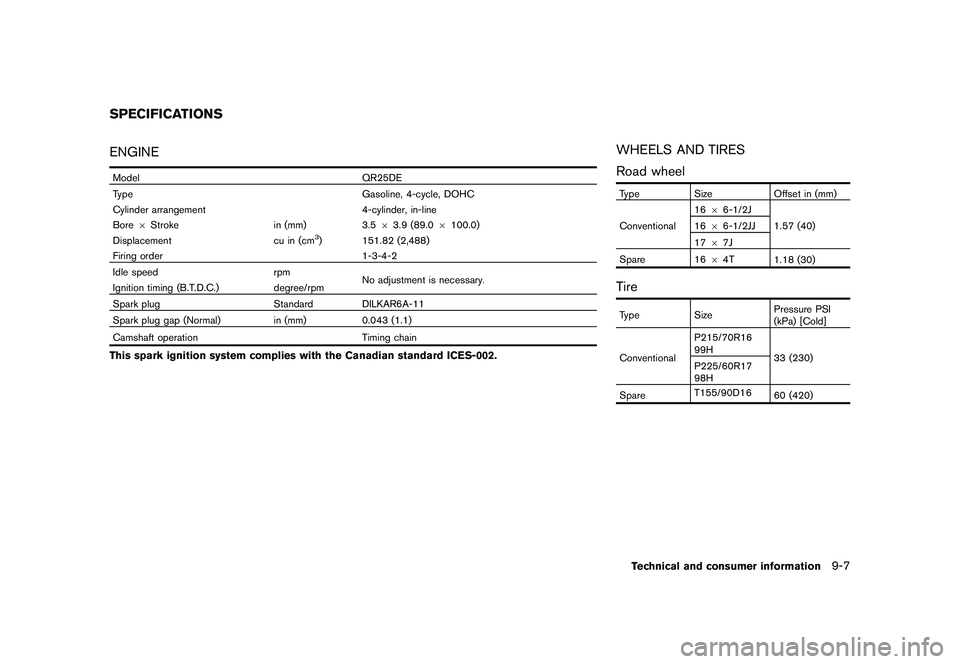
WHEELS AND TIRES
Road wheelTypeSize Offset in (mm)
Conventional 16
66-1/2J
1.57 (40)
16 66-1/2JJ
17 67J
Spare 16 64T
1.18 (30)TireType Size Pressure PSI
(kPa) [Cold]
Conventional P215/70R16
99H
33 (230)
P225/60R17
98H
Spare T155/90D16
60 (420)
SPECIFICATIONS
Technical and consumer information
9-7
Page 312 of 328
Black plate (314,1)
Model "S35-D" EDITED: 2009/ 9/ 4
TOWING SAFETY
Trailer hitchChoose a proper hitch for your vehicle and
trailer. A genuine NISSAN trailer hitch is
available from a NISSAN dealer. Make sure the
trailer hitch is securely attached to the vehicle to
help avoid personal injury or property damage
due to sway caused by crosswinds, rough road
surfaces or passing trucks.Hitch ballChoose a hitch ball of the proper size and
weight rating for your trailer:
. The required hitch ball size is stamped on
most trailer couplers. Most hitch balls also
have the size printed on top of the ball.
. Choose the proper class hitch ball based on
the trailer weight.
. The diameter of the threaded shank of the
hitch ball must be matched to the ball mount
hole diameter. The hitch ball shank should
be no more than 1/16@ smaller than the hole
in the ball mount.
. The threaded shank of the hitch ball must be
long enough to be properly secured to the
ball mount. There should be at least 2
threads showing beyond the lock washer
and nut.
Sway control deviceSudden maneuvers, wind gusts and buffeting
caused by other vehicles can affect trailer
handling. Sway control devices may be used to
help control these affects. If you choose to use
one, contact a reputable trailer hitch supplier to
make sure the sway control device will work with
the vehicle, hitch, trailer and the trailer’s brake
system. Follow the instructions provided by the
manufacturer for installing and using the sway
control device.Class I hitchClass I trailer hitch equipment (receiver, ball
mount and hitch ball) can be used to tow trailers
of a maximum weight of 2,000 lb (909 kg) .
CAUTION
.The hitch should not be attached to
or affect the operation of the im-
pact-absorbing bumper.
. Do not use axle-mounted hitches.
. Do not modify the vehicle exhaust
system, brake system, etc. to install
a trailer hitch.
. To reduce the possibility of addi-
tional damage if your vehicle is
struck from the rear, where practi-
cal, remove the hitch and/or recei- ver when not in use. After the hitch
is removed, seal the bolt holes to
prevent exhaust fumes, water or
dust from entering the passenger
compartment.
. Regularly check that all trailer hitch
mounting bolts are securely
mounted.
Tire pressures.When towing a trailer, inflate the vehicle
tires to the recommended cold tire pressure
indicated on the Tire and Loading Informa-
tion label.
. Trailer tire condition, size, load rating and
proper inflation pressure should be in
accordance with the trailer and tire manu-
facturers’ specifications.Safety chainsAlways use a suitable chain between your
vehicle and the trailer. The safety chains should
be crossed and should be attached to the hitch,
not to the vehicle bumper or axle. The safety
chains can be attached to the bumper if the
hitch ball is mounted to the bumper. Be sure to
leave enough slack in the chains to permit
turning corners.
9-22
Technical and consumer information
Page 326 of 328
Black plate (6,1)
10-6TiresFlat tire ............................................ 6-2
Low tire pressure warning system .............. 5-3
Tire and Loading information label .... 8-31, 9-10
Tire chains ...................................... 8-36
Tire dressing ..................................... 7-4
Tire pressure ................................... 8-29
Tire pressure monitoring system
(TPMS) ..................................... 5-3, 6-2
Tire rotation .................................... 8-37
Types of tires ................................... 8-35
Uniform tire quality grading ................... 9-26
Wheel/tire size ................................... 9-7
Wheels and tires ............................... 8-29
Tonneau cover (see cargo cover) ................. 2-37
To p
Tether strap child restraints ................... 1-24
Towing Flat towing ...................................... 9-25
Tow truck towing ............................... 6-12
Towing safety .................................. 9-22
Trailer towing ................................... 9-17
TPMS, Tire pressure monitoring system ........... 5-3
TPMS, Tire pressure warning system .............. 6-2
Trailer towing ....................................... 9-17
Transceiver, HomeLink
®Universal
Transceiver ......................................... 2-47
Transmission Continuously Variable Transmission (CVT)
fluid ............................................. 8-11
Driving with CVT (Continuously Variable
Transmission) ............................ 5-11, 5-13
Transmission selector lever lock release ..... 5-17
Transmitter (See remote keyless entry system) .... 3-6Transmitter, With Intelligent Key system
(See Intelligent Key system)
...................... 3-18
Traveling or registering your vehicle in another
country ................................................ 9-8
Trip computer ........................................ 2-7
Turn signal switch .................................. 2-28
U
Underbody cleaning ................................. 7-3
Uniform tire quality grading ....................... 9-26
Utility hook .......................................... 2-39
V
Vanity mirror lights ................................. 2-46
Vehicle Dimensions and weights ........................ 9-8
Identification number (VIN) ...................... 9-8
Information display ............................... 2-6
Loading information ............................ 9-13
Recovery (freeing a stuck vehicle) ............ 6-15
Security system ................................ 2-19
Vehicle dynamic control (VDC) off switch . . . 2-31
Vehicle dynamic control (VDC) system ...... 5-28
Ventilators ............................................ 4-2
Voice command
(See Bluetooth
®Hands-Free Phone System) . . . 4-31
W
Warning Hazard warning flasher switch ................ 2-29
Lights ........................................... 2-12
Tire pressure monitoring system
(TPMS) ..................................... 5-3, 6-2 Warning/indicator lights and audible
reminders
....................................... 2-11
Warning labels, Air bag warning labels .......... 1-53
Warning light Air bag warning light ................... 1-53, 2-16
All-wheel drive (AWD) warning light ......... 2-12
Anti-lock braking system (ABS) warning
light ............................................. 2-12
AWD warning light ............................ 5-23
Brake warning light ............................ 2-12
Door open warning light ....................... 2-13
Electric power steering warning light ........ 2-13
Intelligent Key system warning light .......... 2-14
Low fuel warning light ......................... 2-14
Low tire pressure warning light ............... 2-14
Seat belt warning light ........................ 2-15
Warranty, Emission control system warranty ..... 9-27
Washer switch Rear window wiper and washer switch ...... 2-23
Windshield wiper and washer switch ........ 2-22
Washing .............................................. 7-2
Waxing ................................................ 7-3
Weights (See dimensions and weights) ........... 9-8
Wheel/tire size ....................................... 9-7
Wheels and tires ................................... 8-29
Care of wheels ................................... 7-3
Cleaning aluminum alloy wheels ................ 7-4
Window washer fluid .............................. 8-12
Window(s) Cleaning .......................................... 7-3
Power windows ................................ 2-40
Windshield wiper and washer switch ............ 2-22
Wiper Rear window wiper and washer switch ...... 2-23
Model "S35-D" EDITED: 2009/ 9/ 4