towing NISSAN ROGUE 2010 Owner´s Manual
[x] Cancel search | Manufacturer: NISSAN, Model Year: 2010, Model line: ROGUE, Model: NISSAN ROGUE 2010Pages: 328, PDF Size: 2.84 MB
Page 241 of 328
Black plate (241,1)
Model "S35-D" EDITED: 2009/ 9/ 4
hooks.
. Always pull the cable straight out
from the front of the vehicle. Never
pull on the vehicle at an angle.
. Pulling devices should be routed so
they do not touch any part of the
suspension, steering, brake or cool-
ing systems.
. Pulling devices such as ropes or
canvas straps are not recommended
for use in vehicle towing or recov-
ery.
Rocking a stuck vehicleIf your vehicle is stuck in sand, snow, mud, etc.,
use the following procedure:
1. Turn off the Vehicle Dynamic Control (VDC)
system.
2. Make sure the area in front and behind the vehicle is clear of obstructions.
3. Turn the steering wheel right and left to clear an area around the front tires.
4. Slowly rock the vehicle forward and back- ward.
.Shift back and forth between R (Re-
verse) and D (Drive) . .
Apply the accelerator as little as possi-
ble to maintain the rocking motion.
. Release the accelerator pedal before
shifting between R and D.
. Do not spin the tires above 35 MPH (55
km/h) .
5. If the vehicle cannot be freed after a few tries, contact a professional towing service
to remove the vehicle.
In case of emergency
6-17
Page 291 of 328
Black plate (28,1)
9 Technical and consumer information
Model "S35-D" EDITED: 2009/ 9/ 7
Capacities and recommended fuel/lubricants............ 9-2
Fuel recommendation ...................................... 9-3
Engine oil and oil filter recommendation ............... 9-5
Air conditioning system refrigerant and lubricant
recommendations ........................................... 9-6
Specifications. ................................................... 9-7
Engine ......................................................... 9-7
Wheels and tires ............................................ 9-7
Dimensions and weights .................................. 9-8
When traveling or registering your vehicle in
another country .................................................. 9-8
Vehicle identification ........................................... 9-8
Vehicle Identification Number (VIN) plate ............. 9-8
Vehicle identification number (chassis number) ...... 9-9
Engine serial number ...................................... 9-9
F.M.V.S.S./C.M.V.S.S. certification label ............... 9-9
Emission control information label .................... 9-10
Tire and loading information label ..................... 9-10
Air conditioner specification label ..................... 9-10
Installing front license plate ................................ 9-11
Except for Kro ¯
m models ................................. 9-11
For Kro ¯
m models ......................................... 9-13 Vehicle loading information
................................. 9-13
Terms ........................................................ 9-13
Vehicle load capacity .................................... 9-14
Securing the load ......................................... 9-16
Loading tips ................................................ 9-17
Measurement of weights ................................ 9-17
Towing a trailer (except for Kro ¯
m models) .............. 9-17
Maximum load limits ...................................... 9-18
Maximum Gross Vehicle Weight (GVW)/
maximum Gross Axle Weight (GAW) ................ 9-19
Towing load/specification ............................... 9-21
Towing safety .............................................. 9-22
Flat towing ................................................. 9-25
Uniform tire quality grading ................................. 9-26
Treadwear .................................................. 9-26
Traction AA, A, B and C ................................ 9-26
Temperature A, B and C ................................ 9-26
Emission control system warranty ......................... 9-27
Reporting safety defects (US only) ....................... 9-27
Readiness for Inspection/Maintenance (I/M) test . . .... 9-28
Event Data Recorders (EDR) .............................. 9-29
Owner’s Manual/Service Manual order information . . . 9-29 In the event of a collision ............................... 9-29
Page 296 of 328
Black plate (298,1)
Model "S35-D" EDITED: 2009/ 9/ 4
upon how you use your vehicle.
Operation under the following conditions may
require more frequent oil and filter changes.
.repeated short distance driving at cold
outside temperatures
. driving in dusty conditions
. extensive idling
. towing a trailer
. stop and go commuting
Refer to the “NISSAN Service and Maintenance
Guide” for the maintenance schedule.AIR CONDITIONING SYSTEM RE-
FRIGERANT AND LUBRICANT RE-
COMMENDATIONSThe air conditioning system in your
NISSAN vehicle must be charged with the
refrigerant HFC-134a (R-134a) and the oil,
NISSAN A/C system oil Type S or the exact
equivalents.
CAUTION
The use of any other refrigerant or oil
will cause severe damage to the air
conditioning system and will require
the replacement of all air conditioner system components.
The refrigerant HFC-134a (R-134a) in your
NISSAN vehicle will not harm the earth’s ozone
layer. Although this refrigerant does not affect
the earth’s atmosphere, certain governmental
regulations require the recovery and recycling of
any refrigerant during automotive air condition-
ing system service. A NISSAN dealer has the
trained technicians and equipment needed to
recover and recycle your air conditioning system
refrigerant.
Contact a NISSAN dealer when servicing your
air conditioning system.9-6
Technical and consumer information
Page 306 of 328
Black plate (308,1)
Model "S35-D" EDITED: 2009/ 9/ 4
6.
If your vehicle will be towing a trailer,
load from your trailer will be transferred
to your vehicle. Consult this manual to
determine how this reduces the avail-
able cargo and luggage load capacity
of your vehicle.
Before driving a loaded vehicle, confirm
that you do not exceed the Gross Vehicle
Weight Rating (GVWR) or the Gross Axle
Weight Rating (GAWR) for your vehicle.
(See “MEASUREMENT OF WEIGHTS”
later in this section.)
Also check tires for proper inflation pres-
sures. See the Tire and Loading Information
label.
SIC3504
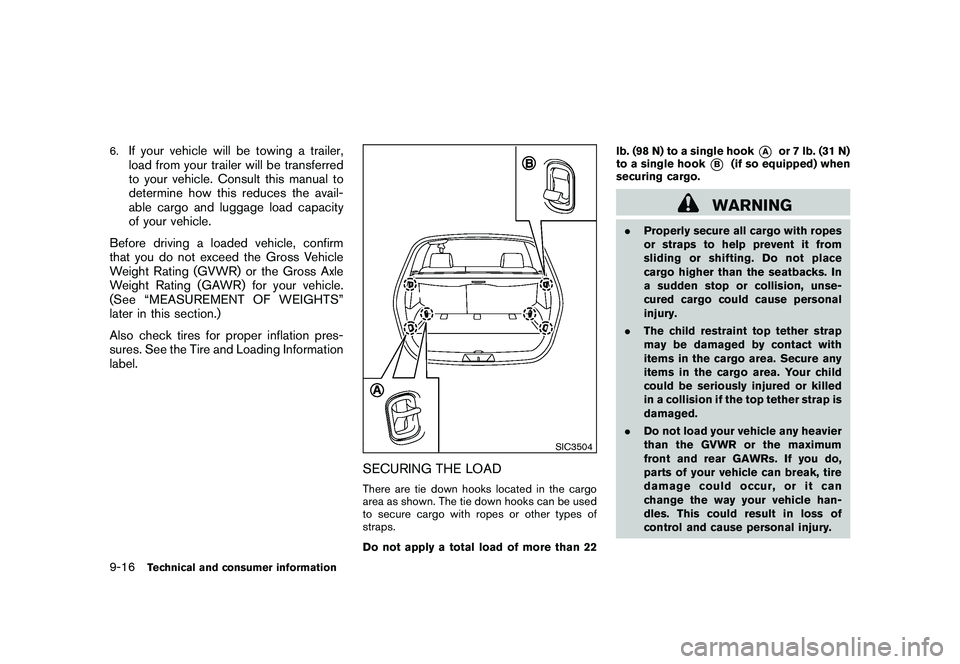
SECURING THE LOADThere are tie down hooks located in the cargo
area as shown. The tie down hooks can be used
to secure cargo with ropes or other types of
straps.
Do not apply a total load of more than 22 lb. (98 N) to a single hook
*A
or 7 lb. (31 N)
to a single hook
*B
(if so equipped) when
securing cargo.
WARNING
. Properly secure all cargo with ropes
or straps to help prevent it from
sliding or shifting. Do not place
cargo higher than the seatbacks. In
a sudden stop or collision, unse-
cured cargo could cause personal
injury.
. The child restraint top tether strap
may be damaged by contact with
items in the cargo area. Secure any
items in the cargo area. Your child
could be seriously injured or killed
in a collision if the top tether strap is
damaged.
. Do not load your vehicle any heavier
than the GVWR or the maximum
front and rear GAWRs. If you do,
parts of your vehicle can break, tire
damage could occur, or it can
change the way your vehicle han-
dles. This could result in loss of
control and cause personal injury.
9-16
Technical and consumer information
Page 307 of 328
Black plate (309,1)
Model "S35-D" EDITED: 2009/ 9/ 4
LOADING TIPS.
The GVW must not exceed GVWR or
GAWR as specified on the F.M.V.S.S./
C.M.V.S.S. certification label.
.
Do not load the front and rear axle to
the GAWR. Doing so will exceed the
GVWR.
WARNING
.
Properly secure all cargo with
ropes or straps to help prevent it
from sliding or shifting. Do not
place cargo higher than the
seatbacks. In a sudden stop or
collision, unsecured cargo could
cause personal injury.
.
Do not load your vehicle any
heavier than the GVWR or the
maximum front and rear
GAWRs. If you do, parts of your
vehicle can break, tire damage
could occur, or it can change the
way your vehicle handles. This
could result in loss of control
and cause personal injury.
.
Overloading not only can short-
en the life of your vehicle andthe tire, but can cause unsafe
vehicle handling and longer
braking distances. This may
cause a premature tire failure,
which could result in a serious
accident and personal injury.
Failures caused by overloading
are not covered by the vehicle’s
warranty.
MEASUREMENT OF WEIGHTSSecure loose items to prevent weight shifts
that could affect the balance of your
vehicle. When the vehicle is loaded, drive
to a scale and weigh the front and the rear
wheels separately to determine axle loads.
Individual axle loads should not exceed
either of the Gross Axle Weight Ratings
(GAWR) . The total of the axle loads should
not exceed the Gross Vehicle Weight
Rating (GVWR) . These ratings are given
on the vehicle certification label. If weight
ratings are exceeded, move or remove
items to bring all weights below the ratings.
WARNING
Overloading or improper loading of a
trailer and its cargo can adversely affect
vehicle handling, braking and perfor-
mance and may lead to accidents.
CAUTION
.
Do not tow a trailer or haul a heavy
load for the first 500 miles (800 km) .
Your engine, axle or other parts
could be damaged.
. For the first 500 miles (800 km) that
you tow a trailer, do not drive over
50 MPH (80 km/h) and do not make
starts at full throttle. This helps the
engine and other parts of your
vehicle wear in at the heavier loads.
Your new vehicle was designed to be used
primarily to carry passengers and cargo. Re-
member that towing a trailer places additional
loads on your vehicle’s engine, drivetrain, steer-
ing, braking and other systems.
A NISSAN Towing Guide (U.S. only) is available
on the website at www.nissanusa.com. This
guide includes information on trailer towing
capability and the special equipment requiredTOWING A TRAILER (except for
Kro ¯
m models)Technical and consumer information
9-17
Page 308 of 328
Black plate (310,1)
Model "S35-D" EDITED: 2009/ 9/ 4
for proper towing.
For Kro¯
m models:
Do not attach the towing equipment to Kro ¯
m
models. The equipment will contact the exhaust
pipes located on the rear center of the vehicle.MAXIMUM LOAD LIMITS
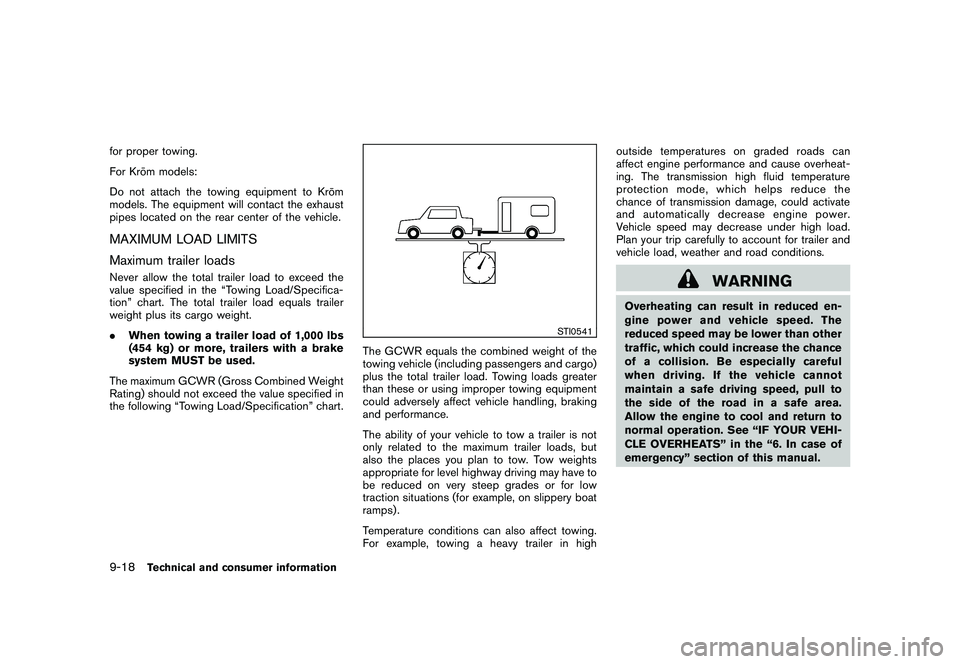
Maximum trailer loadsNever allow the total trailer load to exceed the
value specified in the “Towing Load/Specifica-
tion” chart. The total trailer load equals trailer
weight plus its cargo weight.
. When towing a trailer load of 1,000 lbs
(454 kg) or more, trailers with a brake
system MUST be used.
The maximum GCWR (Gross Combined Weight
Rating) should not exceed the value specified in
the following “Towing Load/Specification” chart.
STI0541
The GCWR equals the combined weight of the
towing vehicle (including passengers and cargo)
plus the total trailer load. Towing loads greater
than these or using improper towing equipment
could adversely affect vehicle handling, braking
and performance.
The ability of your vehicle to tow a trailer is not
only related to the maximum trailer loads, but
also the places you plan to tow. Tow weights
appropriate for level highway driving may have to
be reduced on very steep grades or for low
traction situations (for example, on slippery boat
ramps) .
Temperature conditions can also affect towing.
For example, towing a heavy trailer in high outside temperatures on graded roads can
affect engine performance and cause overheat-
ing. The transmission high fluid temperature
protection mode, which helps reduce the
chance of transmission damage, could activate
and automatically decrease engine power.
Vehicle speed may decrease under high load.
Plan your trip carefully to account for trailer and
vehicle load, weather and road conditions.
WARNING
Overheating can result in reduced en-
gine power and vehicle speed. The
reduced speed may be lower than other
traffic, which could increase the chance
of a collision. Be especially careful
when driving. If the vehicle cannot
maintain a safe driving speed, pull to
the side of the road in a safe area.
Allow the engine to cool and return to
normal operation. See “IF YOUR VEHI-
CLE OVERHEATS” in the “6. In case of
emergency” section of this manual.
9-18
Technical and consumer information
Page 309 of 328
Black plate (311,1)
Model "S35-D" EDITED: 2009/ 9/ 4
CAUTION
Vehicle damage resulting from impro-
per towing procedures are not covered
by NISSAN warranties.
STI0542
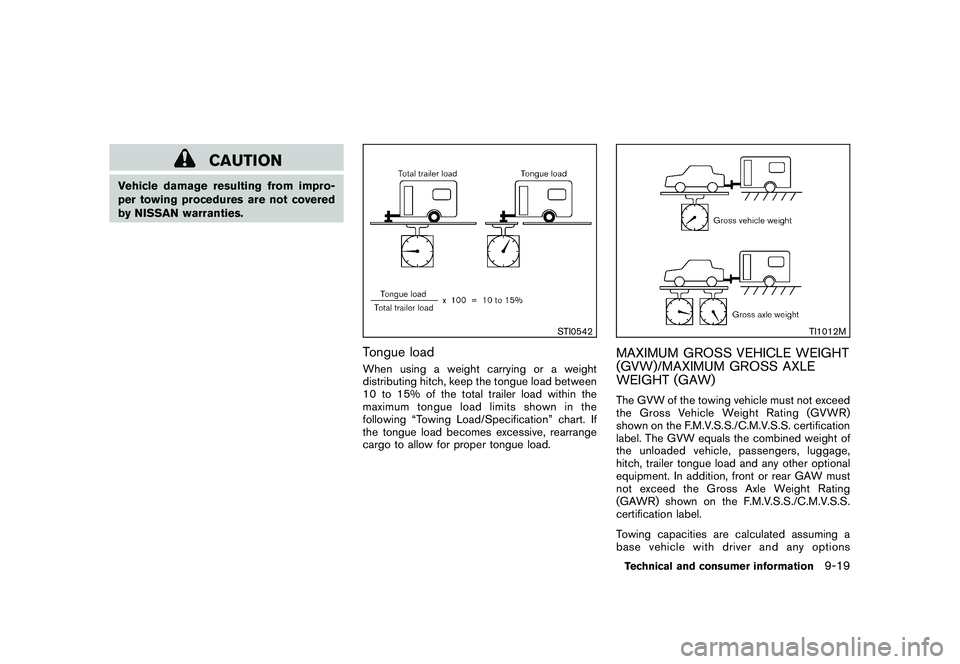
Tongue loadWhen using a weight carrying or a weight
distributing hitch, keep the tongue load between
10 to 15% of the total trailer load within the
maximum tongue load limits shown in the
following “Towing Load/Specification” chart. If
the tongue load becomes excessive, rearrange
cargo to allow for proper tongue load.
TI1012M
MAXIMUM GROSS VEHICLE WEIGHT
(GVW)/MAXIMUM GROSS AXLE
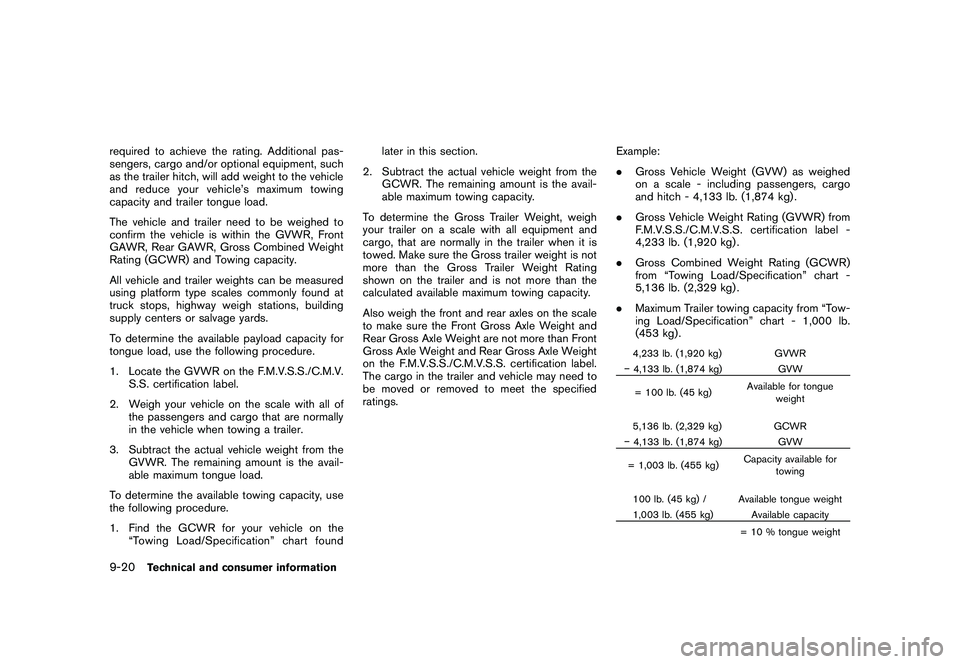
WEIGHT (GAW)The GVW of the towing vehicle must not exceed
theGrossVehicleWeightRating(GVWR)
shown on the F.M.V.S.S./C.M.V.S.S. certification
label. The GVW equals the combined weight of
the unloaded vehicle, passengers, luggage,
hitch, trailer tongue load and any other optional
equipment. In addition, front or rear GAW must
not exceed the Gross Axle Weight Rating
(GAWR) shown on the F.M.V.S.S./C.M.V.S.S.
certification label.
Towing capacities are calculated assuming a
base vehicle with driver and any optionsTechnical and consumer information
9-19
Page 310 of 328
Black plate (312,1)
Model "S35-D" EDITED: 2009/ 9/ 4
required to achieve the rating. Additional pas-
sengers, cargo and/or optional equipment, such
as the trailer hitch, will add weight to the vehicle
and reduce your vehicle’s maximum towing
capacity and trailer tongue load.
The vehicle and trailer need to be weighed to
confirm the vehicle is within the GVWR, Front
GAWR, Rear GAWR, Gross Combined Weight
Rating (GCWR) and Towing capacity.
All vehicle and trailer weights can be measured
using platform type scales commonly found at
truck stops, highway weigh stations, building
supply centers or salvage yards.
To determine the available payload capacity for
tongue load, use the following procedure.
1. Locate the GVWR on the F.M.V.S.S./C.M.V.S.S. certification label.
2. Weigh your vehicle on the scale with all of the passengers and cargo that are normally
in the vehicle when towing a trailer.
3. Subtract the actual vehicle weight from the GVWR. The remaining amount is the avail-
able maximum tongue load.
To determine the available towing capacity, use
the following procedure.
1. Find the GCWR for your vehicle on the “Towing Load/Specification” chart found later in this section.
2. Subtract the actual vehicle weight from the GCWR. The remaining amount is the avail-
able maximum towing capacity.
To determine the Gross Trailer Weight, weigh
your trailer on a scale with all equipment and
cargo, that are normally in the trailer when it is
towed. Make sure the Gross trailer weight is not
more than the Gross Trailer Weight Rating
shown on the trailer and is not more than the
calculated available maximum towing capacity.
Also weigh the front and rear axles on the scale
to make sure the Front Gross Axle Weight and
Rear Gross Axle Weight are not more than Front
Gross Axle Weight and Rear Gross Axle Weight
on the F.M.V.S.S./C.M.V.S.S. certification label.
The cargo in the trailer and vehicle may need to
be moved or removed to meet the specified
ratings. Example:
.
Gross Vehicle Weight (GVW) as weighed
on a scale - including passengers, cargo
and hitch - 4,133 lb. (1,874 kg) .
. Gross Vehicle Weight Rating (GVWR) from
F.M.V.S.S./C.M.V.S.S. certification label -
4,233 lb. (1,920 kg) .
. Gross Combined Weight Rating (GCWR)
from “Towing Load/Specification” chart -
5,136 lb. (2,329 kg) .
. Maximum Trailer towing capacity from “Tow-
ing Load/Specification” chart - 1,000 lb.
(453 kg).
4,233 lb. (1,920 kg) GVWR
4,133 lb. (1,874 kg) GVW
= 100 lb. (45 kg) Available for tongue
weight
5,136 lb. (2,329 kg) GCWR
4,133 lb. (1,874 kg) GVW
= 1,003 lb. (455 kg) Capacity available for
towing
100 lb. (45 kg) / Available tongue weight
1,003 lb. (455 kg) Available capacity
= 10 % tongue weight
9-20
Technical and consumer information
Page 311 of 328
Black plate (313,1)
Model "S35-D" EDITED: 2009/ 9/ 4
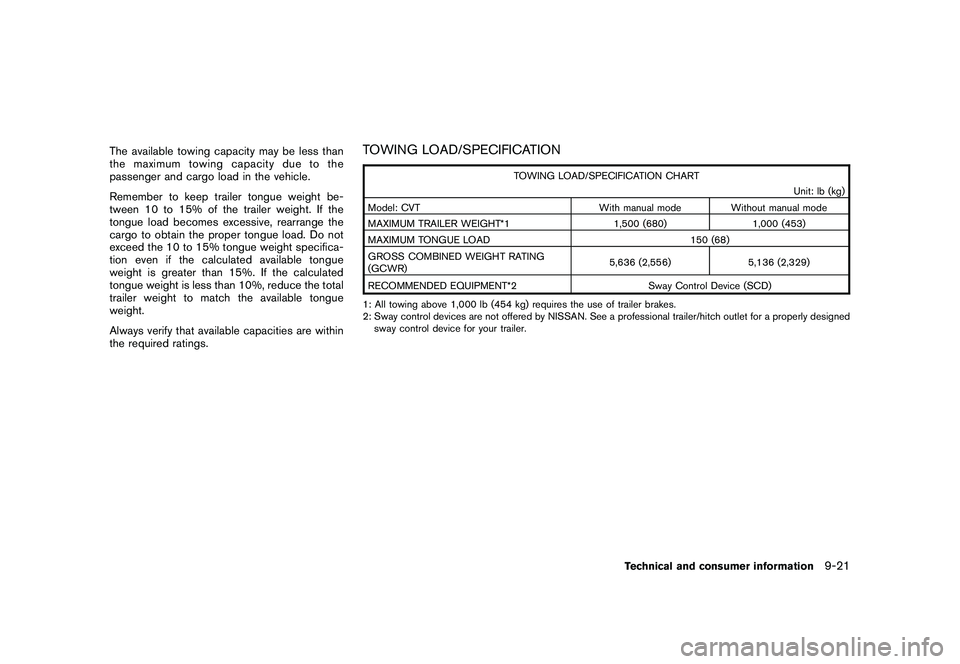
The available towing capacity may be less than
the maximum towing capacity due to the
passenger and cargo load in the vehicle.
Remember to keep trailer tongue weight be-
tween 10 to 15% of the trailer weight. If the
tongue load becomes excessive, rearrange the
cargo to obtain the proper tongue load. Do not
exceed the 10 to 15% tongue weight specifica-
tion even if the calculated available tongue
weight is greater than 15%. If the calculated
tongue weight is less than 10%, reduce the total
trailer weight to match the available tongue
weight.
Always verify that available capacities are within
the required ratings.
TOWING LOAD/SPECIFICATION
TOWING LOAD/SPECIFICATION CHARTUnit: lb (kg)
Model: CVT With manual mode Without manual mode
MAXIMUM TRAILER WEIGHT*1 1,500 (680) 1,000 (453)
MAXIMUM TONGUE LOAD 150 (68)
GROSS COMBINED WEIGHT RATING
(GCWR) 5,636 (2,556) 5,136 (2,329)
RECOMMENDED EQUIPMENT*2 Sway Control Device (SCD)
1: All towing above 1,000 lb (454 kg) requires the use of trailer brakes.
2: Sway control devices are not offered by NISSAN. See a professional trailer/hitch outlet for a properly designed sway control device for your trailer.
Technical and consumer information
9-21
Page 312 of 328
Black plate (314,1)
Model "S35-D" EDITED: 2009/ 9/ 4
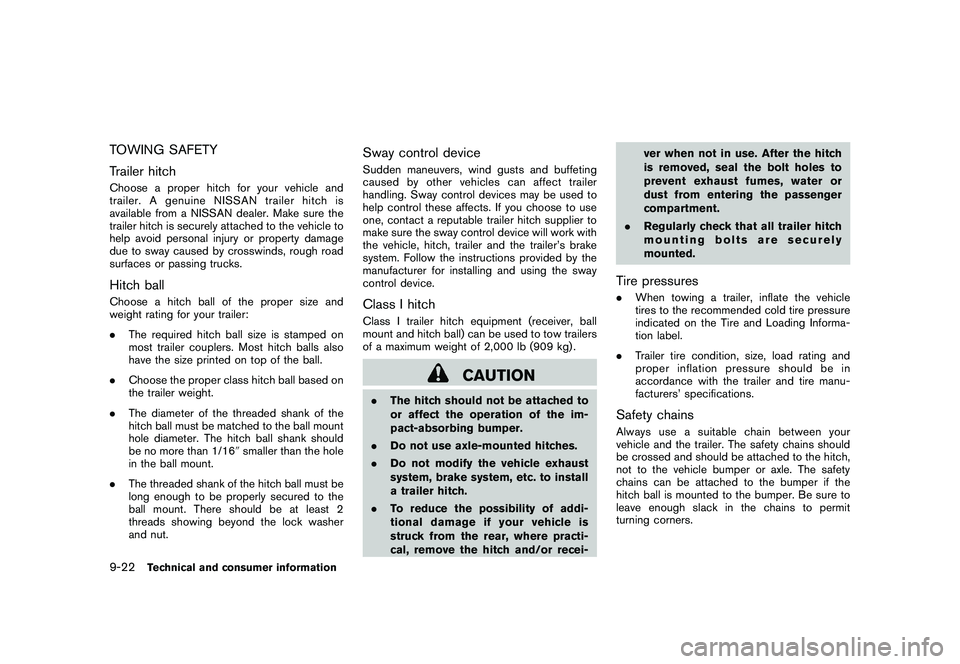
TOWING SAFETY
Trailer hitchChoose a proper hitch for your vehicle and
trailer. A genuine NISSAN trailer hitch is
available from a NISSAN dealer. Make sure the
trailer hitch is securely attached to the vehicle to
help avoid personal injury or property damage
due to sway caused by crosswinds, rough road
surfaces or passing trucks.Hitch ballChoose a hitch ball of the proper size and
weight rating for your trailer:
. The required hitch ball size is stamped on
most trailer couplers. Most hitch balls also
have the size printed on top of the ball.
. Choose the proper class hitch ball based on
the trailer weight.
. The diameter of the threaded shank of the
hitch ball must be matched to the ball mount
hole diameter. The hitch ball shank should
be no more than 1/16@ smaller than the hole
in the ball mount.
. The threaded shank of the hitch ball must be
long enough to be properly secured to the
ball mount. There should be at least 2
threads showing beyond the lock washer
and nut.
Sway control deviceSudden maneuvers, wind gusts and buffeting
caused by other vehicles can affect trailer
handling. Sway control devices may be used to
help control these affects. If you choose to use
one, contact a reputable trailer hitch supplier to
make sure the sway control device will work with
the vehicle, hitch, trailer and the trailer’s brake
system. Follow the instructions provided by the
manufacturer for installing and using the sway
control device.Class I hitchClass I trailer hitch equipment (receiver, ball
mount and hitch ball) can be used to tow trailers
of a maximum weight of 2,000 lb (909 kg) .
CAUTION
.The hitch should not be attached to
or affect the operation of the im-
pact-absorbing bumper.
. Do not use axle-mounted hitches.
. Do not modify the vehicle exhaust
system, brake system, etc. to install
a trailer hitch.
. To reduce the possibility of addi-
tional damage if your vehicle is
struck from the rear, where practi-
cal, remove the hitch and/or recei- ver when not in use. After the hitch
is removed, seal the bolt holes to
prevent exhaust fumes, water or
dust from entering the passenger
compartment.
. Regularly check that all trailer hitch
mounting bolts are securely
mounted.
Tire pressures.When towing a trailer, inflate the vehicle
tires to the recommended cold tire pressure
indicated on the Tire and Loading Informa-
tion label.
. Trailer tire condition, size, load rating and
proper inflation pressure should be in
accordance with the trailer and tire manu-
facturers’ specifications.Safety chainsAlways use a suitable chain between your
vehicle and the trailer. The safety chains should
be crossed and should be attached to the hitch,
not to the vehicle bumper or axle. The safety
chains can be attached to the bumper if the
hitch ball is mounted to the bumper. Be sure to
leave enough slack in the chains to permit
turning corners.
9-22
Technical and consumer information