key fob NISSAN ROGUE 2018 Owner´s Manual
[x] Cancel search | Manufacturer: NISSAN, Model Year: 2018, Model line: ROGUE, Model: NISSAN ROGUE 2018Pages: 547, PDF Size: 6.42 MB
Page 202 of 547
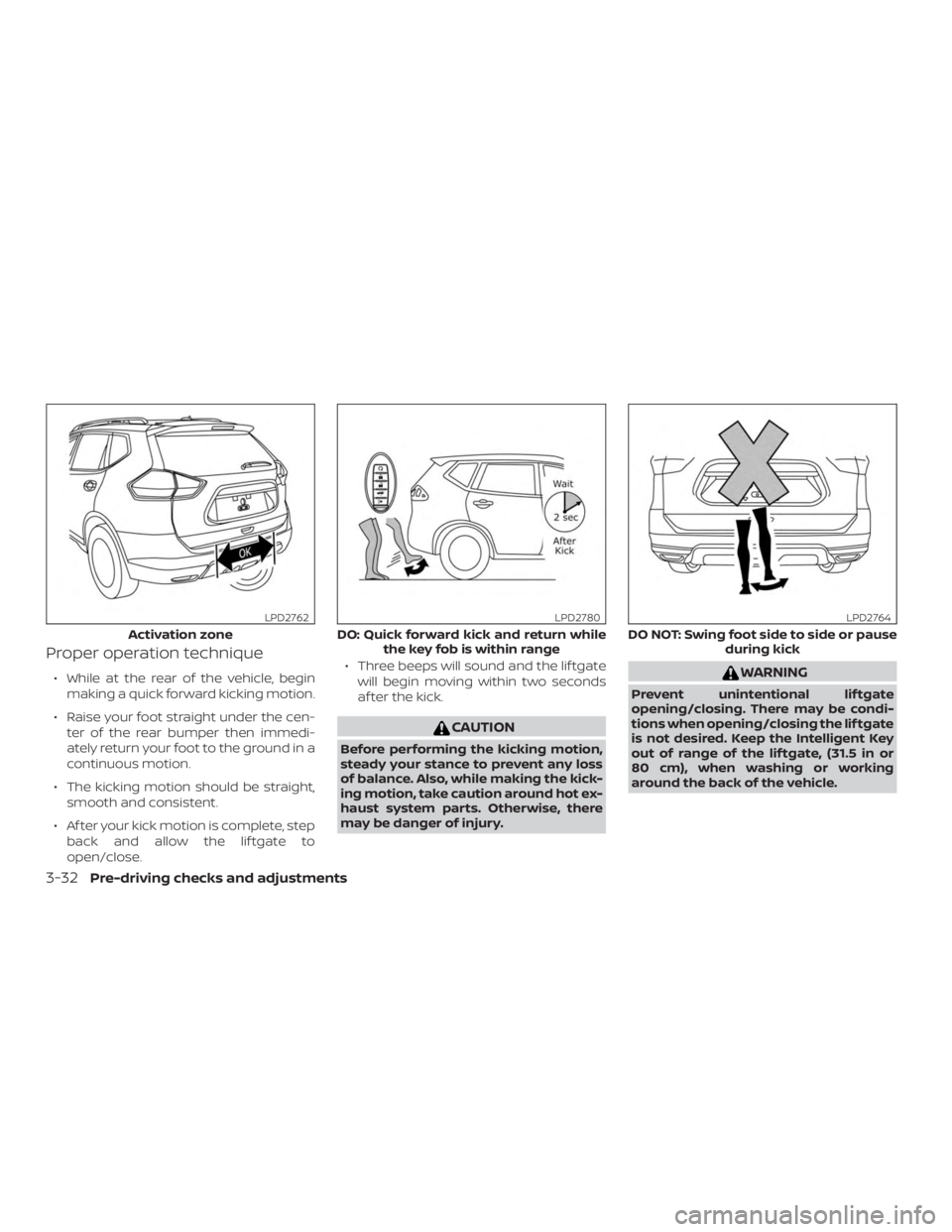
Proper operation technique
∙ While at the rear of the vehicle, beginmaking a quick forward kicking motion.
∙ Raise your foot straight under the cen- ter of the rear bumper then immedi-
ately return your foot to the ground in a
continuous motion.
∙ The kicking motion should be straight, smooth and consistent.
∙ Af ter your kick motion is complete, step back and allow the lif tgate to
open/close. ∙ Three beeps will sound and the lif tgate
will begin moving within two seconds
af ter the kick.
CAUTION
Before performing the kicking motion,
steady your stance to prevent any loss
of balance. Also, while making the kick-
ing motion, take caution around hot ex-
haust system parts. Otherwise, there
may be danger of injury.
WARNING
Prevent unintentional lif tgate
opening/closing. There may be condi-
tions when opening/closing the lif tgate
is not desired. Keep the Intelligent Key
out of range of the lif tgate, (31.5 in or
80 cm), when washing or working
around the back of the vehicle.
Activation zone
LPD2762
DO: Quick forward kick and return while the key fob is within range
LPD2780
DO NOT: Swing foot side to side or pause during kick
LPD2764
3-32Pre-driving checks and adjustments
Page 203 of 547
CAUTION
∙ Interference or malfunction can becaused by parking in close proximity
to radio or satellite towers.
∙ Intelligent Key interference could be caused if you have your key fob stored
next to your cell phone or any RF-
enabled smart card. For additional in-
formation, refer to “NISSAN Intelligent
Key®” in this section.
LIFTGATE RELEASE
WARNING
∙ Always be sure the lif tgate has beenclosed securely to prevent it from
opening while driving.
∙ Do not drive with the lif tgate open. This could allow dangerous exhaust
gases to be drawn into the vehicle. For
additional information, refer to “Ex-
haust gas (carbon monoxide)” in the
“Starting and driving” section of this
manual.
∙ To avoid personal injury, do not at- tempt to activate the power lif tgate if
one or both of the lif tgate struts are
removed.
CAUTION
∙ If the power lif tgate does not stayopen or if the lif tgate unexpectedly
closes at any time while a continuous
warning chime sounds, do not oper-
ate the lif tgate. There may be a pres-
sure loss in one or both of the lif tgate
struts. It is recommended that you
have the lif tgate inspected. It is rec-
ommended that you visit a NISSAN
dealer for this service.
∙ Do not activate the power lif tgate if one or both of the lif tgate struts are
removed. Damage to the lif tgate or
power lif tgate mechanisms may
occur.
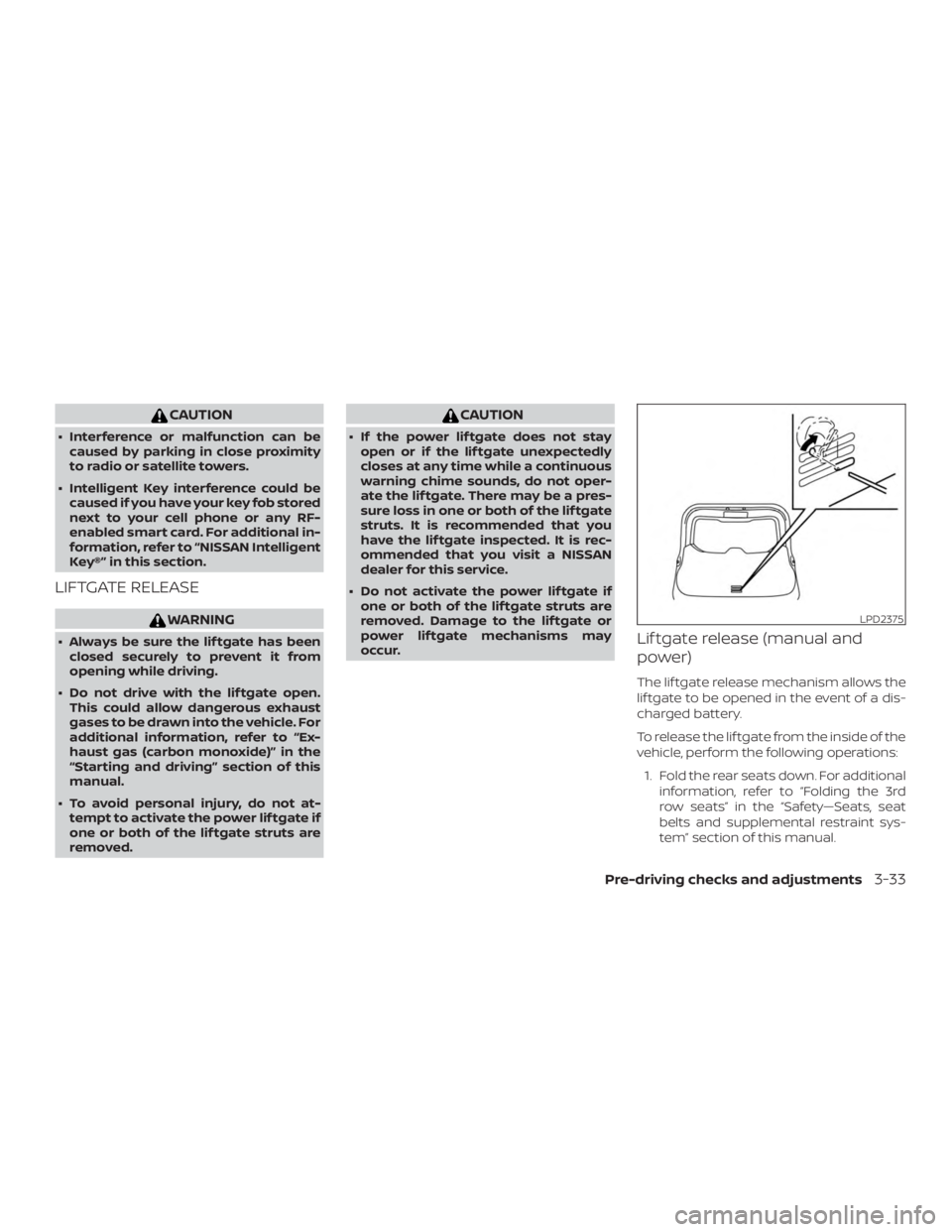
Lif tgate release (manual and
power)
The lif tgate release mechanism allows the
lif tgate to be opened in the event of a dis-
charged battery.
To release the lif tgate from the inside of the
vehicle, perform the following operations:
1. Fold the rear seats down. For additional information, refer to “Folding the 3rd
row seats” in the “Safety—Seats, seat
belts and supplemental restraint sys-
tem” section of this manual.
LPD2375
Pre-driving checks and adjustments3-33
Page 214 of 547
Linking a key fob to a stored
memory position
Each key fob can be linked to a stored
memory position (memory switch 1 or 2)
with the following procedure.1. Follow steps 1-3 in the “Memory storage function” section for storing the
memory position.
2. The indicator light for the pushed memory switch will come on. While the
indicator light is on for 5 seconds, press
the
button on the key fob. The
indicator light of the linked memory
switch will blink. Af ter the indicator light
goes off, the key fob is linked to that
memory setting.
Once it is linked, when ignition switch is
placed in the OFF position, pressing
the
button on the key fob will move
the driver’s seat and outside mirrors to the
linked memory switch position.
NOTE:
If a new memory position is stored in the
linked memory switch, then the key fob
will link the new position and overwrites
the previous position.
ENTRY/EXIT FUNCTION
This system is designed so that the driver’s
seat will automatically move when the shif t
lever is in the P (Park) position. This allows
the driver to get into and out of the driver’s
seat more easily.
The driver’s seat will slide backward:
∙ When the driver’s door is opened with the ignition switch placed in the OFF
position.
∙ When the ignition switch is changed from ON to OFF with the driver’s door
open.
The driver’s seat will return to the previous
position: ∙ When the ignition switch is turned to ON while the shif t lever is in the P (Park)
position.
The entry/exit function can be adjusted or
canceled through “Vehicle Settings” in the
vehicle information display by performing
the following: ∙ Switch the “Exit Seat Slide” from ON to OFF. For additional information, refer to
“Vehicle Settings” in the “Instruments
and controls” section of this manual.
SYSTEM OPERATION
The automatic drive positioner system will
not work or will stop operating under the
following conditions:
∙ When the vehicle speed is above 4 mph (7 km/h).
∙ When any of the memory switches are pushed while the automatic drive posi-
tioner is operating.
∙
When the switch for the driver’s seat and
steering column is pushed while the au-
tomatic drive positioner is operating.
∙ When the seat has already been moved to the memorized position.
∙ When no seat position is stored in the memory switch.
∙ When the shif t lever is moved from P (Park) to any other position.
3-44Pre-driving checks and adjustments
Page 277 of 547
AUTO ACC:
With the vehicle in the P (Park) position, the
Intelligent Key with you and the ignition
switch placed from the ON position to the
OFF position, the radio can still be used for
a period of time, or until the driver’s door is
opened.
Af ter a period of time, functions such as
radio, navigation, and Bluetooth® Hands-
Free Phone System may be restarted by
pressing the POWER button/VOLUME con-
trol knob or the key fob unlock button. For
additional information, refer to the “Monitor,
climate, audio, phone and voice recogni-
tion systems” section of this manual.
EMERGENCY ENGINE SHUT OFF
To shut off the engine in an emergency
situation while driving, perform the follow-
ing procedure:∙ Rapidly push the push-button ignition switch three consecutive times in less
than 1.5 seconds, or
∙ Push and hold the push-button ignition switch for more than 2 seconds.
NISSAN INTELLIGENT KEY®
BATTERY DISCHARGE (if so
equipped)
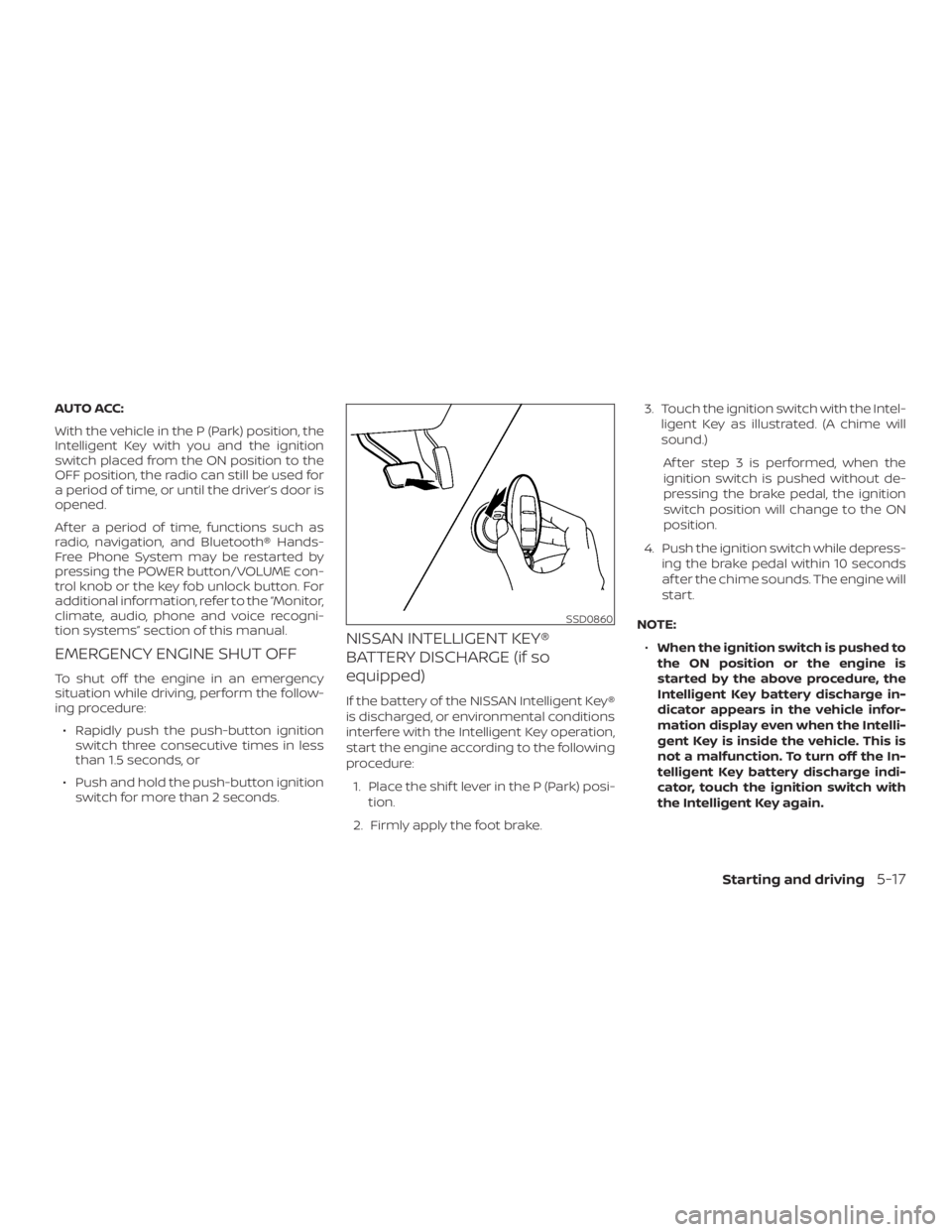
If the battery of the NISSAN Intelligent Key®
is discharged, or environmental conditions
interfere with the Intelligent Key operation,
start the engine according to the following
procedure:
1. Place the shif t lever in the P (Park) posi- tion.
2. Firmly apply the foot brake. 3. Touch the ignition switch with the Intel-
ligent Key as illustrated. (A chime will
sound.)
Af ter step 3 is performed, when the
ignition switch is pushed without de-
pressing the brake pedal, the ignition
switch position will change to the ON
position.
4. Push the ignition switch while depress- ing the brake pedal within 10 seconds
af ter the chime sounds. The engine will
start.
NOTE: ∙ When the ignition switch is pushed to
the ON position or the engine is
started by the above procedure, the
Intelligent Key battery discharge in-
dicator appears in the vehicle infor-
mation display even when the Intelli-
gent Key is inside the vehicle. This is
not a malfunction. To turn off the In-
telligent Key battery discharge indi-
cator, touch the ignition switch with
the Intelligent Key again.
SSD0860
Starting and driving5-17
Page 535 of 547
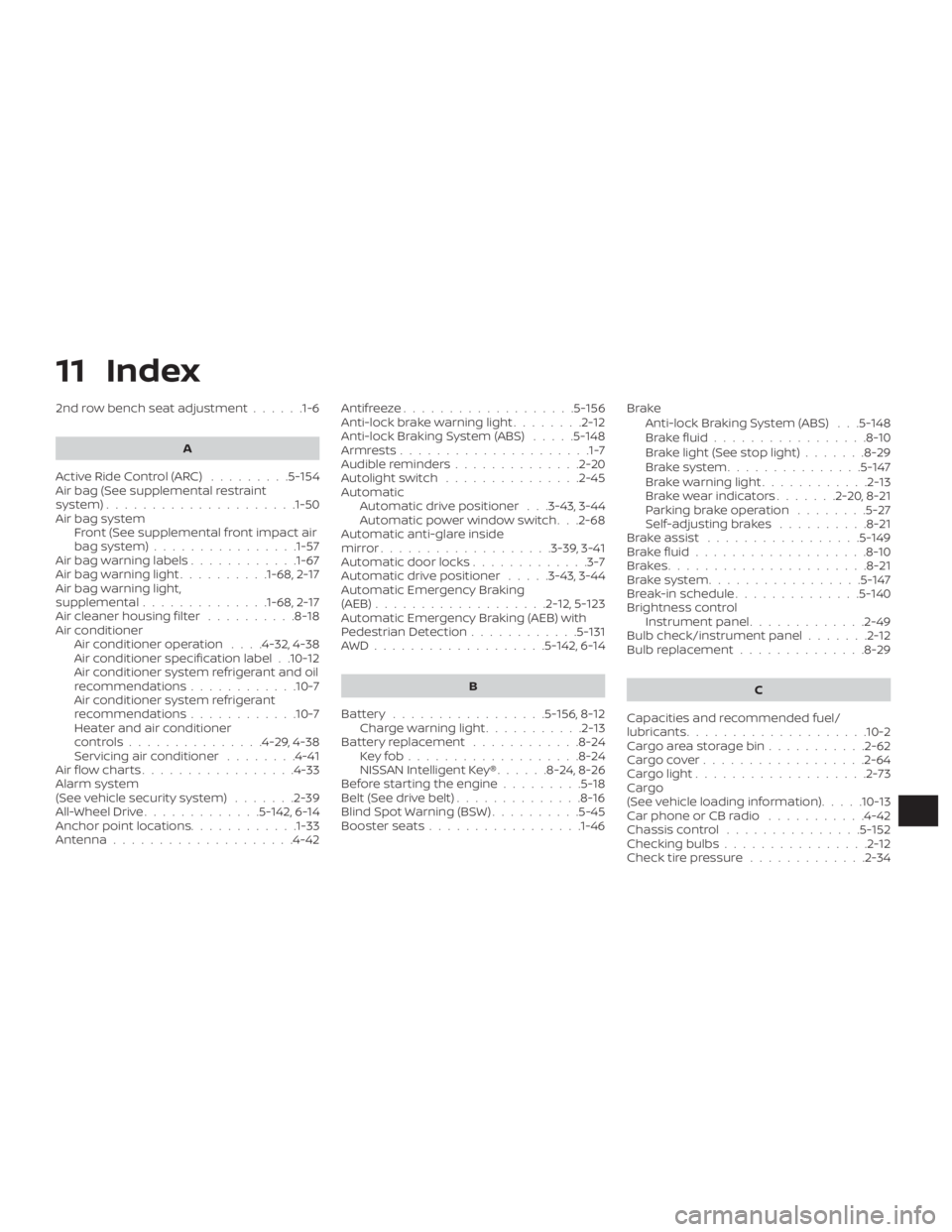
11 Index
2nd row bench seat adjustment......1-6
A
ActiveRideControl(ARC) .........5-154
Air bag (See supplemental restraint
system) .................... .1-50
Air bag system Front (See supplemental front impact air
bagsystem)................1-57
Air bag warning labels ............1-67
Airbagwarninglight..........1-68, 2-17
Air bag warning light,
supplemental ..............1-68, 2-17
Air cleaner housing filter ..........8-18
Air conditioner Air conditioner operation ....4-32,4-38
Air conditioner specification label . .10-12
Air conditioner system refrigerant and oil
recommendations ............10-7
Air conditioner system refrigerant
recommendations ............10-7
Heater and air conditioner
controls...............4-29,4-38
Servicing air conditioner ........4-41
Air flow charts .................4-33
Alarm system
(See vehicle security system) .......2-39
All-Wheel Drive .............5-142,6-14
Anchor point locations ............1-33
Antenna ....................4-42 Antifreeze
...................5-156
Anti-lock brake warning light ........2-12
Anti-lock Braking System (ABS) .....5-148
Armrests.................... .1-7
Audible reminders ..............2-20
Autolightswitch ...............2-45
Automatic Automatic drive positioner . . .3-43, 3-44
Automatic power window switch. . .2-68
Automatic anti-glare inside
mirror...................3-39,3-41
Automatic door locks .............3-7
Automatic drive positioner .....3-43,3-44
Automatic Emergency Braking
(AEB) ...................2-12,5-123
Automatic Emergency Braking (AEB) with
Pedestrian Detection ............5-131
AWD...................5-142,6-14
B
Battery .................5-156,8-12 Charge warning light ...........2-13
Battery replacement ............8-24
Keyfob...................8-24
NISSAN Intelligent Key® ......8-24,8-26
Before starting the engine .........5-18
Belt(Seedrivebelt)..............8-16
Blind Spot Warning (BSW) ..........5-45
Booster seats .................1-46 Brake
Anti-lock Braking System (ABS) . . .5-148
Brakefluid.................8-10
Brakelight(Seestoplight).......8-29
Brakesystem...............5-147
Brakewarninglight............2-13
Brakewearindicators.......2-20,8-21
Parking brake operation ........5-27
Self-adjustingbrakes ..........8-21
Brakeassist .................5-149
Brakefluid...................8-10
Brakes......................8-21
Brakesystem.................5-147
Break-in schedule ..............5-140
Brightness control Instrument panel .............2-49
Bulb check/instrument panel .......2-12
Bulb replacement ..............8-29
C
Capacities and recommended fuel/
lubricants....................10-2
Cargoareastoragebin...........2-62
Cargocover................. .2-64
Cargolight...................2-73
Cargo
(See vehicle loading information) .....10-13
Car phone or CB radio ...........4-42
Chassis control ...............
5-152
Checking bulbs ................2-12
Check tire pressure .............2-34
Page 538 of 547
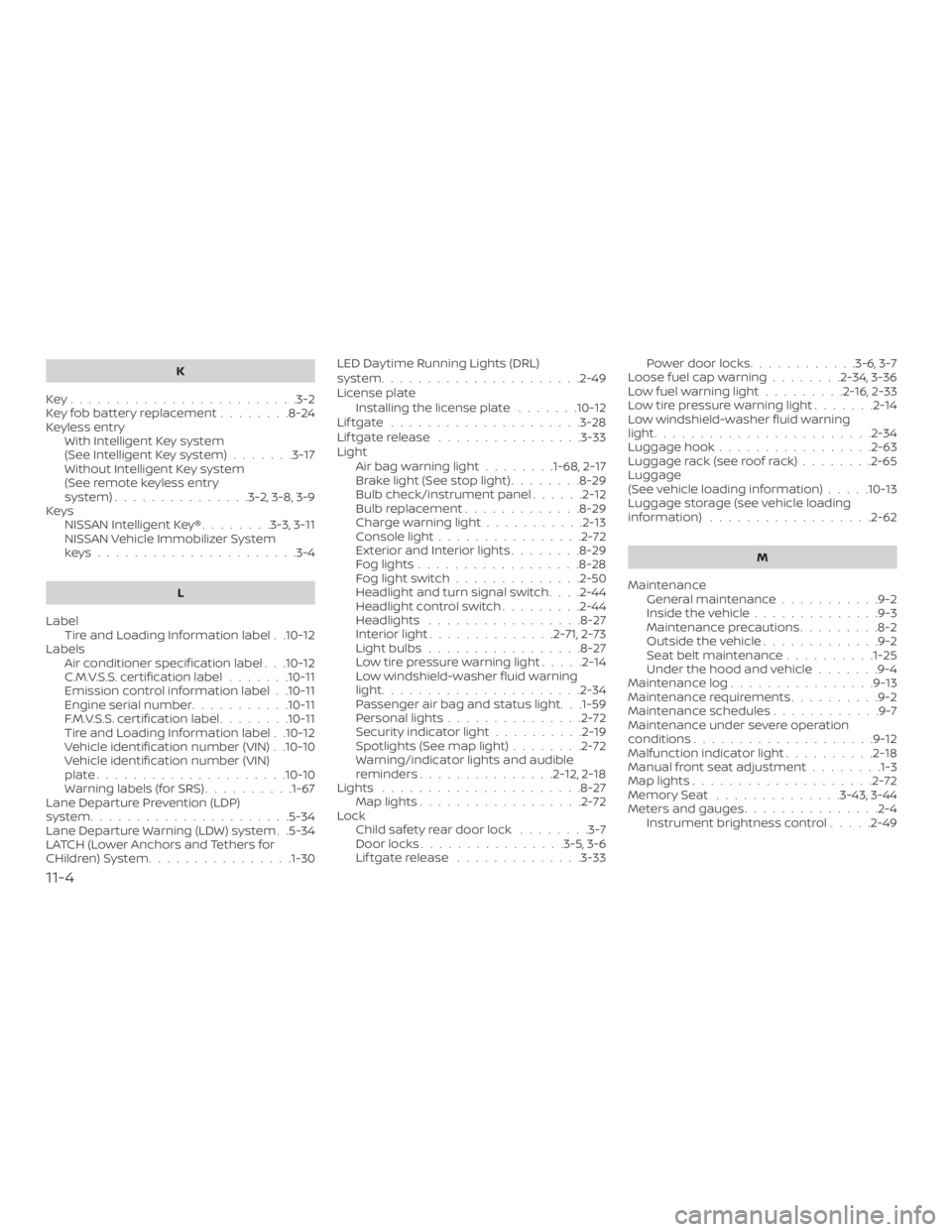
K
Key.........................3-2
Key fob battery replacement ........8-24
Keyless entry With Intelligent Key system
(See Intelligent Key system) .......3-17
Without Intelligent Key system
(See remote keyless entry
system) ...............3-2,3-8,3-9
Keys NISSAN Intelligent Key® ........3-3,3-11
NISSAN Vehicle Immobilizer System
keys......................3-4
L
Label Tire and Loading Information label . .10-12
Labels Air conditioner specification label . . .10-12
C.M.V.S.S. certification label .......10-11
Emission control information label . .10-11
Engine serial number ...........10-11
F.M.V.S.S. certification label ........10-11
Tire and Loading Information label . .10-12
Vehicle identification number (VIN) . .10-10
Vehicle identification number (VIN)
plate.....................10-10
Warning labels (for SRS) ..........1-67
Lane Departure Prevention (LDP)
system ......................5-34
Lane Departure Warning (LDW) system . .5-34
LATCH (Lower Anchors and Tethers for
CHildren)System............... .1-30LED Daytime Running Lights (DRL)
system
......................2-49
License plate Installing the license plate .......10-12
Liftgate .....................3-28
Liftgaterelease ................3-33
Light Airbagwarninglight........1-68, 2-17
Brakelight(Seestoplight)........8-29
Bulb check/instrument panel ......2-12
Bulb replacement .............8-29
Charge warning light ...........2-13
Console light ................2-72
ExteriorandInteriorlights........8-29
Foglights..................8-28
Foglightswitch..............2-50
Headlight and turn signal switch ....2-44
Headlightcontrolswitch.........2-44
Headlights .................8-27
Interiorlight..............2 -71, 2-73
Lightbulbs.................8-27
Low tire pressure warning light .....2-14
Low windshield-washer fluid warning
light......................2-34
Passenger air bag and status light. . .1-59
Personal lights ...............2-72
Security indicator light ..........2-19
Spotlights(Seemaplight)........2-72
Warning/indicator lights and audible
reminders ...............2-12,2-18
Lights ......................8-27 Maplights..................2-72
Lock Child safety rear door lock ........3-7
Door locks ................3-5,3-6
Liftgaterelease ..............3-33 Power door locks
............3-6,3-7
Loose fuel cap warning ........2-34,3-36
Lowfuelwarninglight.........2-16,2-33
Low tire pressure warning light .......2-14
Low windshield-washer fluid warning
light........................2-34
Luggage hook .................2-63
Luggage rack (see roof rack) ........2-65
Luggage
(See vehicle loading information) .....10-13
Luggage storage (see vehicle loading
information) ..................2-62
M
Maintenance General maintenance ...........9-2
Insidethevehicle..............9-3
Maintenance precautions .........8-2
Outsidethevehicle.............9-2
Seat belt maintenance ..........1-25
Under the hood and vehicle .......9-4
Maintenance log ................9-13
Maintenance requirements ..........9-2
Maintenance schedules ............9-7
Maintenance under severe operation
conditions....................9-12
Malfunctionindicatorlight..........2-18
Manual front seat adjustment ........1-3
M
aplights................... .2-72
Memory Seat ..............3-43,3-44
Meters and gauges ...............2-4
Instrument brightness control .....2-49
11-4