engine oil NISSAN ROGUE 2018 Owner´s Manual
[x] Cancel search | Manufacturer: NISSAN, Model Year: 2018, Model line: ROGUE, Model: NISSAN ROGUE 2018Pages: 547, PDF Size: 6.42 MB
Page 495 of 547
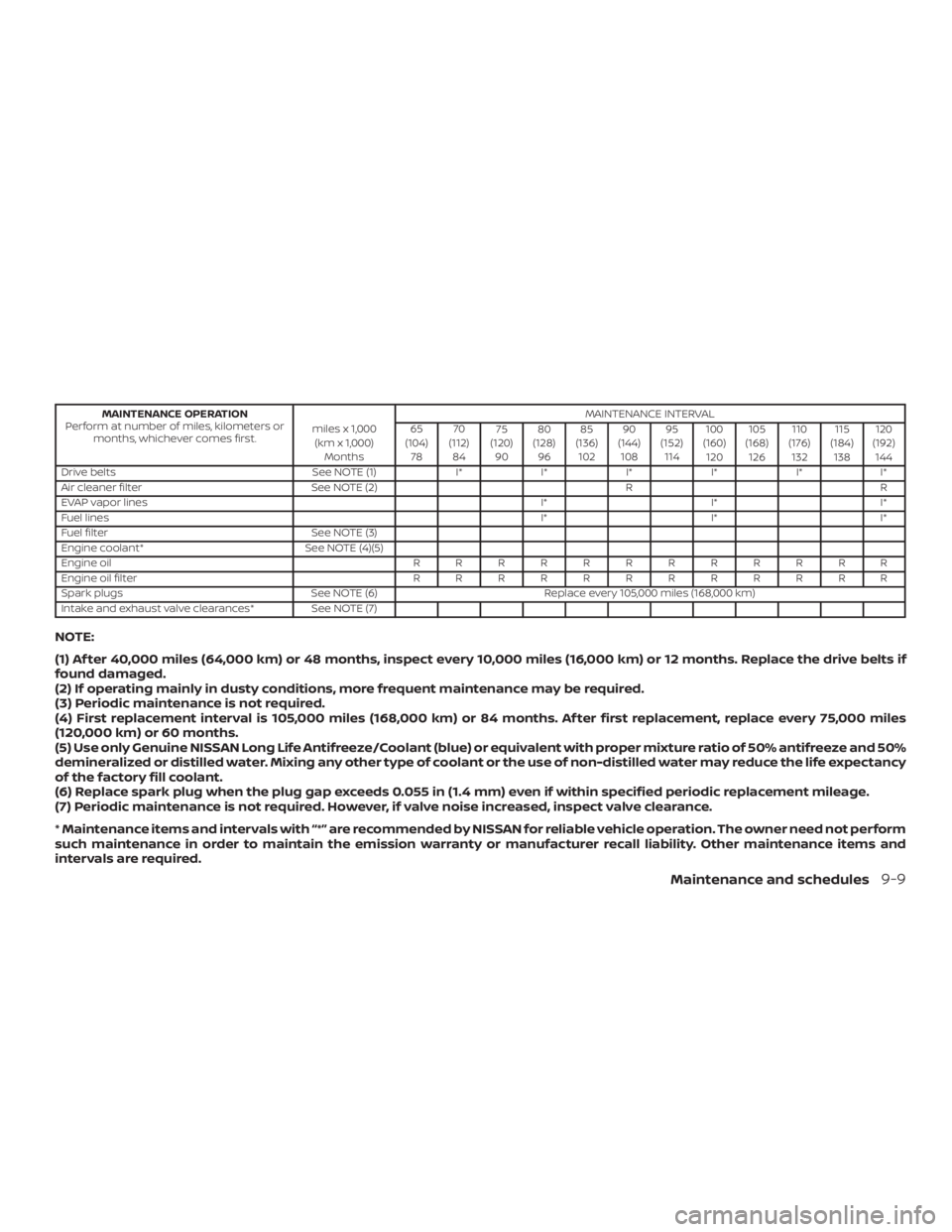
MAINTENANCE OPERATION
Perform at number of miles, kilometers or months, whichever comes first. miles x 1,000
(km x 1,000) Months MAINTENANCE INTERVAL
65
(104) 78 70
(112) 84 75
(120) 90 80
(128) 96 85
(136) 102 90
(144) 108 95
(152) 114 100
(160) 120 105
(168) 126 110
(176) 132 115
(184) 138 120
(192) 144
Drive belts See NOTE (1)I*I*I*I*I*I*
Air cleaner filter See NOTE (2) RR
EVAP vapor lines I*I*I*
Fuel lines I*I*I*
Fuel filter See NOTE (3)
Engine coolant* See NOTE (4)(5)
Engine oil RRRRRRRRRRRR
Engine oil filter RRRRRRRRRRRR
Spark plugs See NOTE (6)Replace every 105,000 miles (168,000 km)
Intake and exhaust valve clearances* See NOTE (7)
NOTE:
(1) Af ter 40,000 miles (64,000 km) or 48 months, inspect every 10,000 miles (16,000 km) or 12 months. Replace the drive belts if
found damaged.
(2) If operating mainly in dusty conditions, more frequent maintenance may be required.
(3) Periodic maintenance is not required.
(4) First replacement interval is 105,000 miles (168,000 km) or 84 months. Af ter first replacement, replace every 75,000 miles
(120,000 km) or 60 months.
(5) Use only Genuine NISSAN Long Life Antifreeze/Coolant (blue) or equivalent with proper mixture ratio of 50% antifreeze and 50%
demineralized or distilled water. Mixing any other type of coolant or the use of non-distilled water may reduce the life expectancy
of the factory fill coolant.
(6) Replace spark plug when the plug gap exceeds 0.055 in (1.4 mm) even if within specified periodic replacement mileage.
(7) Periodic maintenance is not required. However, if valve noise increased, inspect valve clearance.
* Maintenance items and intervals with “*” are recommended by NISSAN for reliable vehicle operation. The owner need not perform
such maintenance in order to maintain the emission warranty or manufacturer recall liability. Other maintenance items and
intervals are required.
Maintenance and schedules9-9
Page 502 of 547
10 Technical and consumer information
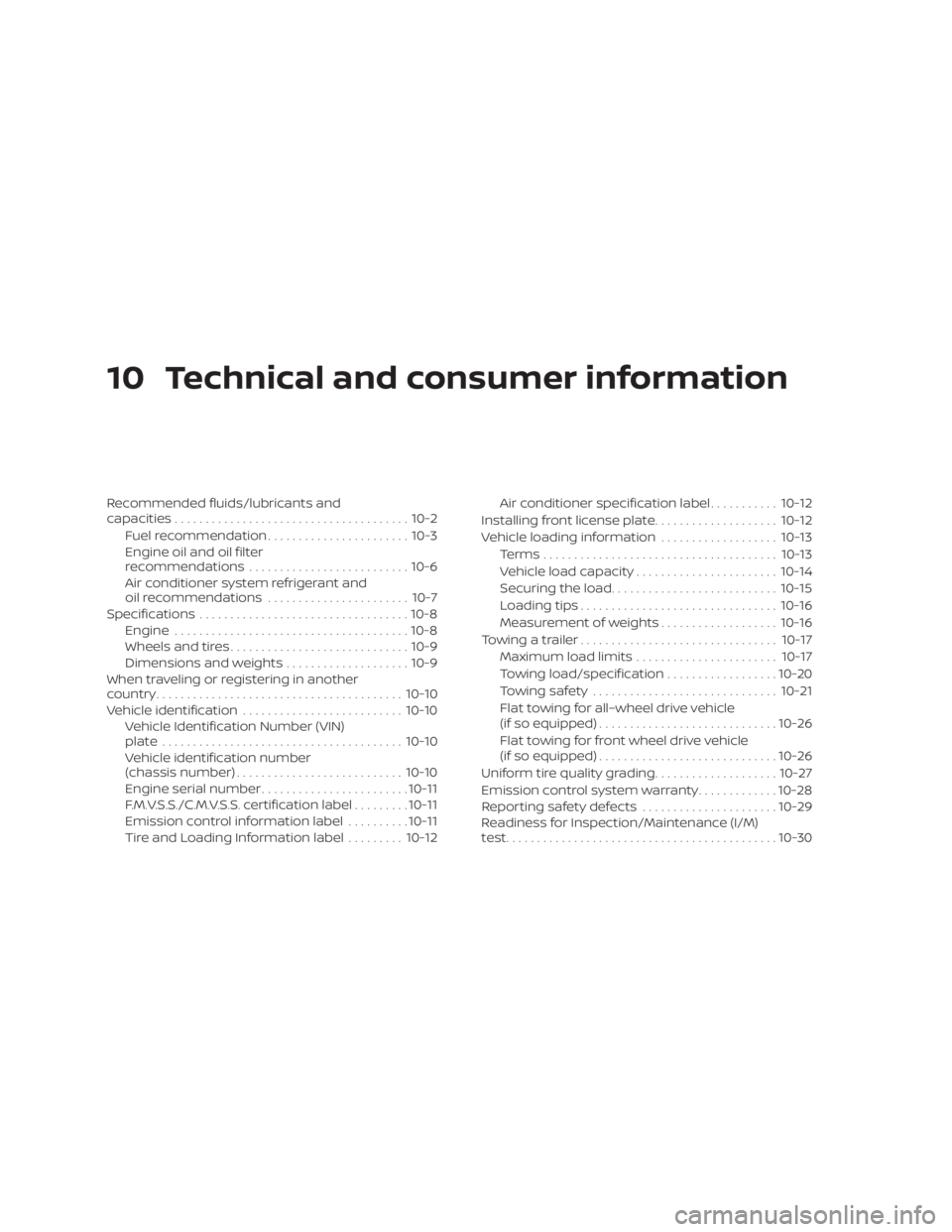
Recommended fluids/lubricants and
capacities...................................... 10-2
Fuel recommendation ....................... 10-3
Engine oil and oil filter
recommendations .......................... 10-6
Air conditioner system refrigerant and
oil recommendations ....................... 10-7
Specifications .................................. 10-8
Engine ...................................... 10-8
Wheels and tires ............................. 10-9
Dimensions and weights ....................10-9
When traveling or registering in another
country ........................................ 10-10
Vehicle identification .......................... 10-10
Vehicle Identification Number (VIN)
plate ....................................... 10-10
Vehicle identification number
(chassis number) ........................... 10-10
Engine serial number ........................ 10-11
F.M.V.S.S./C.M.V.S.S. certification label .........10-11
Emission control information label ..........10-11
Tire and Loading Information label .........10-12 Air conditioner specification label
...........10-12
Installing front license plate ....................10-12
Vehicle loading information ...................10-13
Terms ...................................... 10-13
Vehicle load capacity ....................... 10-14
Securing the load ........................... 10-15
Loading tips ................................ 10-16
Measurement of weights ...................10-16
Towing a trailer ................................ 10-17
Maximum load limits ....................... 10-17
Towing load/specification ..................10-20
Towing safety .............................. 10-21
Flat towing for all–wheel drive vehicle
(if so equipped) ............................. 10-26
Flat towing for front wheel drive vehicle
(if so equipped) ............................. 10-26
Uniform tire quality grading ....................10-27
Emission control system warranty .............10-28
R
eporting safety defects ......................10-29
Readiness for Inspection/Maintenance (I/M)
test ............................................ 10-30
Page 504 of 547
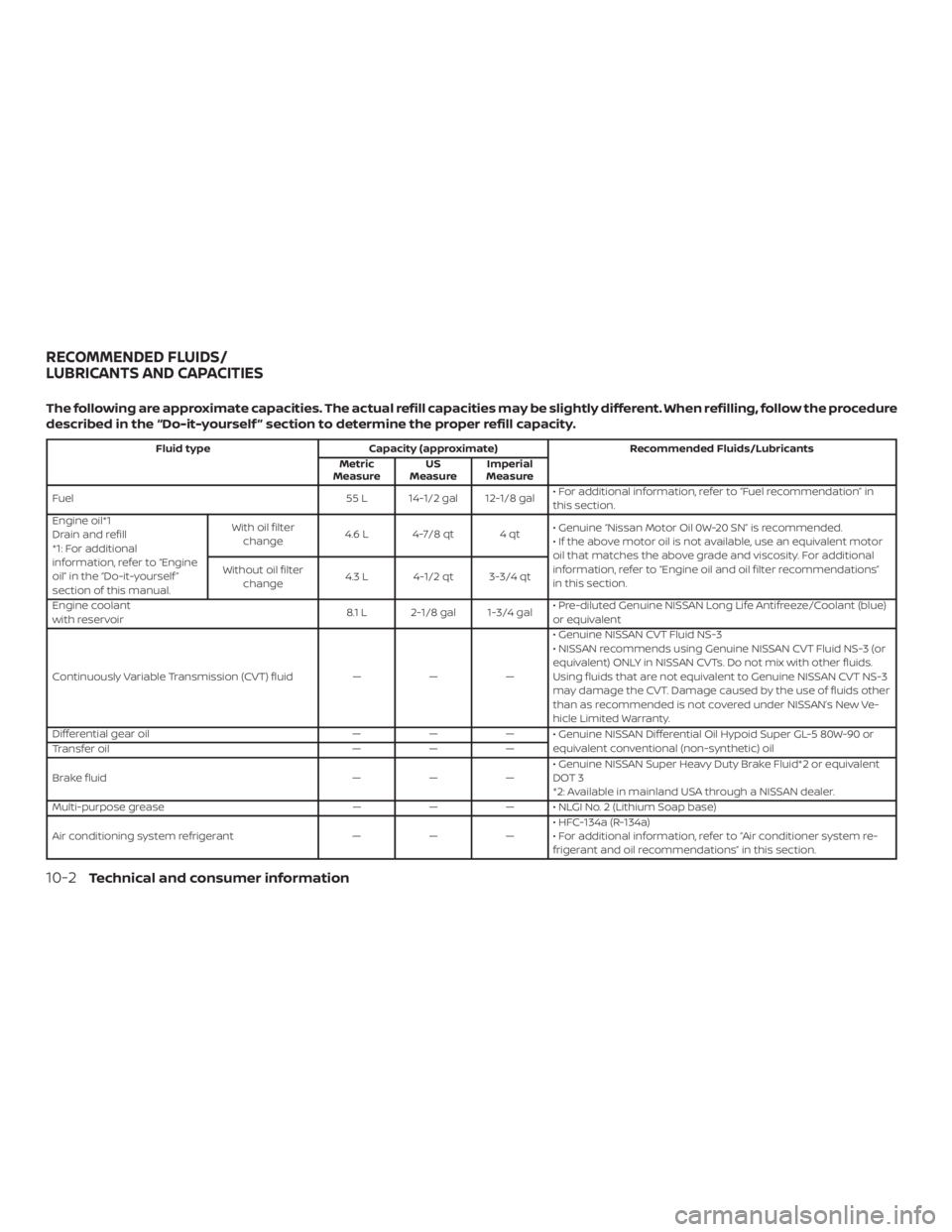
The following are approximate capacities. The actual refill capacities may be slightly different. When refilling, follow the procedure
described in the “Do-it-yourself ” section to determine the proper refill capacity.
Fluid typeCapacity (approximate) Recommended Fluids/Lubricants
Metric
Measure US
Measure Imperial
Measure
Fuel 55 L 14-1/2 gal 12-1/8 gal• For additional information, refer to “Fuel recommendation” in
this section.
Engine oil*1
Drain and refill
*1: For additional
information, refer to “Engine
oil” in the “Do-it-yourself ”
section of this manual. With oil filter
change 4.6 L 4-7/8 qt 4 qt
• Genuine “Nissan Motor Oil 0W-20 SN” is recommended.
• If the above motor oil is not available, use an equivalent motor
oil that matches the above grade and viscosity. For additional
information, refer to “Engine oil and oil filter recommendations”
in this section.
Without oil filter
change 4.3 L 4-1/2 qt 3-3/4 qt
Engine coolant
with reservoir 8.1 L 2-1/8 gal 1-3/4 gal• Pre-diluted Genuine NISSAN Long Life Antifreeze/Coolant (blue)
or equivalent
Continuously Variable Transmission (CVT) fluid ———• Genuine NISSAN CVT Fluid NS-3
• NISSAN recommends using Genuine NISSAN CVT Fluid NS-3 (or
equivalent) ONLY in NISSAN CVTs. Do not mix with other fluids.
Using fluids that are not equivalent to Genuine NISSAN CVT NS-3
may damage the CVT. Damage caused by the use of fluids other
than as recommended is not covered under NISSAN’s New Ve-
hicle Limited Warranty.
Differential gear oil ———
• Genuine NISSAN Differential Oil Hypoid Super GL-5 80W-90 or
equivalent conventional (non-synthetic) oil
Transfer oil ———
Brake fluid ———• Genuine NISSAN Super Heavy Duty Brake Fluid*2 or equivalent
DOT 3
*2: Available in mainland USA through a NISSAN dealer.
Multi-purpose grease ——— • NLGI No. 2 (Lithium Soap base)
Air conditioning system refrigerant ———• HFC-134a (R-134a)
• For additional information, refer to “Air conditioner system re-
frigerant and oil recommendations” in this section.
RECOMMENDED FLUIDS/
LUBRICANTS AND CAPACITIES
10-2Technical and consumer information
Page 508 of 547
ENGINE OIL AND OIL FILTER
RECOMMENDATIONS
Selecting the correct oil
It is essential to choose the correct grade,
quality and viscosity engine oil to ensure
satisfactory engine life and performance.
For additional information, refer to “Recom-
mended fluids/lubricants and capacities”
in this section. NISSAN recommends the
use of an energy conserving oil in order to
improve fuel economy.
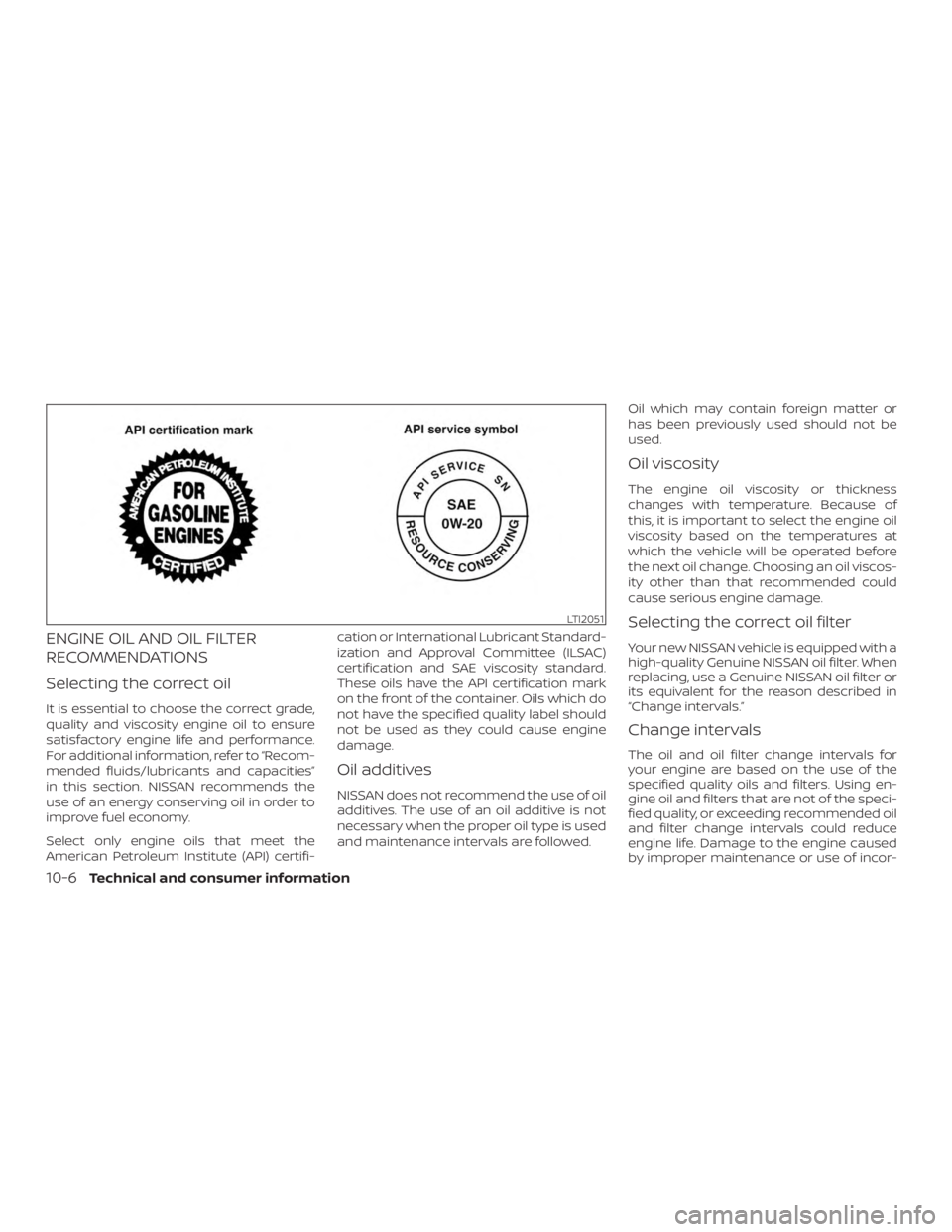
Select only engine oils that meet the
American Petroleum Institute (API) certifi-cation or International Lubricant Standard-
ization and Approval Committee (ILSAC)
certification and SAE viscosity standard.
These oils have the API certification mark
on the front of the container. Oils which do
not have the specified quality label should
not be used as they could cause engine
damage.
Oil additives
NISSAN does not recommend the use of oil
additives. The use of an oil additive is not
necessary when the proper oil type is used
and maintenance intervals are followed.Oil which may contain foreign matter or
has been previously used should not be
used.
Oil viscosity
The engine oil viscosity or thickness
changes with temperature. Because of
this, it is important to select the engine oil
viscosity based on the temperatures at
which the vehicle will be operated before
the next oil change. Choosing an oil viscos-
ity other than that recommended could
cause serious engine damage.
Selecting the correct oil filter
Your new NISSAN vehicle is equipped with a
high-quality Genuine NISSAN oil filter. When
replacing, use a Genuine NISSAN oil filter or
its equivalent for the reason described in
“Change intervals.”
Change intervals
The oil and oil filter change intervals for
your engine are based on the use of the
specified quality oils and filters. Using en-
gine oil and filters that are not of the speci-
fied quality, or exceeding recommended oil
and filter change intervals could reduce
engine life. Damage to the engine caused
by improper maintenance or use of incor-
LTI2051
10-6Technical and consumer information
Page 509 of 547
rect oil and filter quality and/or viscosity is
not covered by the NISSAN New Vehicle
Limited Warranty.
Your engine was filled with a high-quality
engine oil when it was built. You do not have
to change the oil before the first recom-
mended change interval. Oil and filter
change intervals depend upon how you
use your vehicle.
Operation under the following conditions
may require more frequent oil and filter
changes:∙ repeated short distance driving at cold outside temperatures
∙ driving in dusty conditions
∙ extensive idling
∙ towing a trailer
∙ stop and go commuting
For additional information, refer to the
“Maintenance and schedules” section of
this manual.AIR CONDITIONER SYSTEM
REFRIGERANT AND OIL
RECOMMENDATIONS
The air conditioner system in your
NISSAN vehicle must be charged with the
refrigerant HFC-134a (R-134a) and
NISSAN A/C system oil Type ND-OIL8 or
the exact equivalents.
CAUTION
The use of any other refrigerant or oil
will cause severe damage to the air con-
ditioning system and will require the re-
placement of all air conditioner system
components.
The refrigerant HFC-134a (R-134a) in your
NISSAN vehicle does not harm the earth’s
ozone layer. Although this refrigerant does
not affect the earth’s atmosphere, certain
government regulations require the recov-
ery and recycling of any refrigerant during
automotive air conditioner system service.
A NISSAN dealer has the trained techni-
cians and equipment needed to recover
and recycle your air conditioner system re-
frigerant. It is recommended that you visit a NISSAN
dealer when servicing your air conditioner
system.
Technical and consumer information10-7
Page 528 of 547
∙ Be careful when passing other vehicles.Passing while towing a trailer requires
considerably more distance than nor-
mal passing. Remember, the length of
the trailer must also pass the other ve-
hicle before you can safely change
lanes.
∙ Downshif t the transmission to a lower gear for engine braking when driving
down steep or long hills. This will help
slow the vehicle without applying the
brakes.
∙ Avoid holding the brake pedal down too long or too frequently. This could cause
the brakes to overheat, resulting in re-
duced braking efficiency.
∙ Increase your following distance to al- low for greater stopping distances
while towing a trailer. Anticipate stops
and brake gradually.
∙ NISSAN recommends that the cruise control not be used while towing a
trailer.
∙ Some states or provinces have specific regulations and speed limits for ve-
hicles that are towing trailers. Obey the
local speed limits. ∙ Check your hitch, trailer wiring harness
connections, and trailer wheel lug nuts
af ter 50 miles (80 km) of travel and at
every break.
∙ When launching a boat, don’t allow the water level to go over the exhaust tail
pipe or rear bumper.
∙ Make sure you disconnect the trailer lights before backing the trailer into the
water or the trailer lights may burn out.
When towing a trailer, final drive gear oil
should be replaced and transmission
oil/fluid should be changed more fre-
quently. For additional information, refer
to the “Do-it-yourself ” section of this
manual.
FLAT TOWING FOR ALL–WHEEL
DRIVE VEHICLE (if so equipped)
Towing your vehicle with all four wheels on
the ground is sometimes called flat towing.
This method is sometimes used when
towing a vehicle behind a recreational ve-
hicle, such as a motor home.
CAUTION
∙ Failure to follow these guidelines can result in severe transmission damage.
∙ Never flat tow your All-Wheel Drive (AWD) vehicle.
∙ DO NOT tow your All-Wheel Drive (AWD) vehicle with any wheels on the
ground. Doing so may cause serious
and expensive damage to the
powertrain.
∙ For emergency towing procedures re- fer to “Towing recommended by
NISSAN” in the “In case of emergency ”
section of this manual.
FLAT TOWING FOR FRONT WHEEL
DRIVE VEHICLE (if so equipped)
Towing your vehicle with all four wheels on
the ground is sometimes called flat towing.
This method is sometimes used when
towing a vehicle behind a recreational ve-
hicle, such as a motor home.
10-26Technical and consumer information
Page 535 of 547
11 Index
2nd row bench seat adjustment......1-6
A
ActiveRideControl(ARC) .........5-154
Air bag (See supplemental restraint
system) .................... .1-50
Air bag system Front (See supplemental front impact air
bagsystem)................1-57
Air bag warning labels ............1-67
Airbagwarninglight..........1-68, 2-17
Air bag warning light,
supplemental ..............1-68, 2-17
Air cleaner housing filter ..........8-18
Air conditioner Air conditioner operation ....4-32,4-38
Air conditioner specification label . .10-12
Air conditioner system refrigerant and oil
recommendations ............10-7
Air conditioner system refrigerant
recommendations ............10-7
Heater and air conditioner
controls...............4-29,4-38
Servicing air conditioner ........4-41
Air flow charts .................4-33
Alarm system
(See vehicle security system) .......2-39
All-Wheel Drive .............5-142,6-14
Anchor point locations ............1-33
Antenna ....................4-42 Antifreeze
...................5-156
Anti-lock brake warning light ........2-12
Anti-lock Braking System (ABS) .....5-148
Armrests.................... .1-7
Audible reminders ..............2-20
Autolightswitch ...............2-45
Automatic Automatic drive positioner . . .3-43, 3-44
Automatic power window switch. . .2-68
Automatic anti-glare inside
mirror...................3-39,3-41
Automatic door locks .............3-7
Automatic drive positioner .....3-43,3-44
Automatic Emergency Braking
(AEB) ...................2-12,5-123
Automatic Emergency Braking (AEB) with
Pedestrian Detection ............5-131
AWD...................5-142,6-14
B
Battery .................5-156,8-12 Charge warning light ...........2-13
Battery replacement ............8-24
Keyfob...................8-24
NISSAN Intelligent Key® ......8-24,8-26
Before starting the engine .........5-18
Belt(Seedrivebelt)..............8-16
Blind Spot Warning (BSW) ..........5-45
Booster seats .................1-46 Brake
Anti-lock Braking System (ABS) . . .5-148
Brakefluid.................8-10
Brakelight(Seestoplight).......8-29
Brakesystem...............5-147
Brakewarninglight............2-13
Brakewearindicators.......2-20,8-21
Parking brake operation ........5-27
Self-adjustingbrakes ..........8-21
Brakeassist .................5-149
Brakefluid...................8-10
Brakes......................8-21
Brakesystem.................5-147
Break-in schedule ..............5-140
Brightness control Instrument panel .............2-49
Bulb check/instrument panel .......2-12
Bulb replacement ..............8-29
C
Capacities and recommended fuel/
lubricants....................10-2
Cargoareastoragebin...........2-62
Cargocover................. .2-64
Cargolight...................2-73
Cargo
(See vehicle loading information) .....10-13
Car phone or CB radio ...........4-42
Chassis control ...............
5-152
Checking bulbs ................2-12
Check tire pressure .............2-34
Page 536 of 547
Childrestraints........1-25, 1-26, 1-28, 1-30LATCH (Lower Anchors and Tethers for
CHildren)System..............1-30
Precautions on child
restraints.........1-28, 1-35, 1-41, 1-46
Top tether strap anchor point
locations.................. .1-33
Child restraint with top tether strap . . . .1-32
Child safety rear door lock ..........3-7
Chimes, audible reminders .........2-20
Cleaningexteriorandinterior......7-2,7-4
C.M.V.S.S. certification label .........10-11
Coldweatherdriving ............5-156
Console box ..................2-59
Console light ..................2-72
Continuously Variable Transmission
(CVT) .......................5-21
Continuously Variable Transmission
(CVT) fluid ...................8-9
Driving with Continuously Variable
Transmission (CVT) ............5-21
Controls Heater and air conditioner
controls................4-29,4-38
Coolant Capacities and recommended
fuel/lubricants...............10-2
Changing engine coolant .........8-5
Checking engine coolant level ......8-5
Engine coolant temperature gauge . .2-6
Corrosionprotection..............7-7
Cruisecontrol.................5-64
Cupholders ..................2-60 D
Defroster switch Rear window and outside mirror
defrosterswitch..............2-44
Dimensions and weights ...........10-9
Dimmer switch for instrument panel . . .2-49
Display......................2-21
Door locks ..................3-5,3-6
Drivebelt ....................8-16
Drive positioner, Automatic ......3-43,3-44
Driving Cold weather driving ..........5-156
Driving with Continuously Variable
Transmission (CVT) ............5-21
Precautions when starting and
driving..................5-4,5-11
Drivingthevehicle...............5-21
Dynamic driver assistance switch
(for vehicles without ProPILOT Assist) . . .2-53
E
ECO mode switch ...............5-33
Economy - fuel ................5-142
Emergency engine shutoff ..........5-17
Emission control information label . . . .10-11
Emission control system warranty . . . .10-28
Engine Before starting the engine ........5-18
Capacities and recommended
fuel/lubricants...............10-2
Changing engine coolant .........8-5
Changing engine oil ............8-7
Changing engine oil filter .........8-8Checking engine coolant level
......8-5
Checking engine oil level .........8-6
Engine compartment check
locations...................8-3
Engine coolant temperature gauge . .2-6
Engine cooling system ..........8-4
Engine oil ...................8-6
Engine oil and oil filter
recommendation .............10-6
Engine oil viscosity .............10-6
Engine serial number ...........10-11
Engine specifications ...........10-8
Starting the engine ............5-19
Engine coolant temperature gauge ....2-6
EventDatarecorders.........10-30,10-31
Exhaust gas (Carbon monoxide) .......5-4
Explanation of maintenance items .....9-2
Explanation of scheduled maintenance
items .......................9-5
Extended storage switch ..........2-57
Eyeglasscase.................2-59
F
Flashers
(Seehazardwarningflasherswitch)....6-2
Flattire......................6-3
Floormatpositioningaid...........7-6
Fluid Brakefluid..................8-10
Capacities and recommended
fuel/lubricants...............10-2
Continuously Variable Transmission (CVT)
fluid......................8-9
Engine
coolant ...............8-4
11-2
Page 537 of 547
Engine oil...................8-6
Windshield-washer fluid .........8-10
F.M.V.S.S. certification label ..........10-11
Foglightswitch................2-50
Front air bag system
(See supplemental restraint system) . . .1-57
Front-door pocket ..............2-58
Front power seat adjustment ........1-5
Frontseats................... .1-2
Fuel Capacities and recommended
fuel/lubricants...............10-2
Fuel economy ...............5-142
Fuel-filler door and cap ..........3-35
Fuel gauge ..................2-7
Fueloctanerating.............10-5
Fuel recommendation ..........10-3
Loose fuel cap warning .........2-34
Fuelefficientdrivingtips..........5-140
Fuel-filler door .................3-34
Fuel gauge ....................2-7
Fuses .......................8-22
Fusiblelinks...................8-22
G
Garage door opener, HomeLink® Universal
Transceiver ..........2-74,2-76,2-77,2-77
Gascap.....................3-35
Gauge Engine coolant temperature gauge . .2-6
Fuel gauge ..................2-7
Odometer ..................2-5
Speedometer ................2-4
Tachometer .................2-6 Trip odometer
................2-5
General maintenance .............9-2
Glovebox....................2-59
H
Hazard warning flasher switch ........6-2
Headlight and turn signal switch ......2-44
Headlightcontrolswitch...........2-44
Headlights ...................8-27
Headrestraints.................1-11
Heatedseats..................2-51
Heated steering wheel switch .......2-52
Heater Heater and air conditioner
controls................4-29,4-38
Heater operation ..........4-30,4-39
Hill start assist system ...........5-155
HomeLink® Universal
Transceiver ..........2-74,2-76,2-77,2-77
Hood .......................3-27
Hook Luggage hook ...............2-63
Horn .......................2-51
I
Ignition switch .................5-13
Push-button ignition switch .......5-15
Immobilizer system .......2-40,5-14,5-18
Important vehicle information label . . . .10-11
In-cabinmicrofilter..............8-18
Increasing fuel economy ..........5-142Indicator
NISSAN Intelligent Key® battery discharge
indicator...................5-17
Indicator lights and audible reminders
(See warning/indicator lights and audible
reminders) ................2-12,2-18
Informationdisplay............. .2-21
Inside automatic anti-glare mirror. .3-39, 3-41
Instrument brightness control .......2-49
Instrument panel .............0-6,2-2
Instrument panel dimmer switch .....2-49
Intelligent Around View Monitor .......4-11
Intelligent Cruise Control (ICC)
(for vehicles without ProPILOT Assist) . . .5-66
Intelligent Cruise Control (ICC)
(for vehicles with ProPILOT Assist) . . . .5-102
Intelligent Engine Brake (I-EB) .......5-153
Intelligent Key system K
ey operating range ............3-13
Key operation ................3-14
Mechanical key ...............3-4
Remote keyless entry operation ....3-17
Troubleshooting guide ..........3-22
Warning signals ..............3-22
Intelligent Lane Intervention (I-LI) .....5-39
Intelligent Trace Control (I-TC) .......5-152
Interiorlight................2 -71, 2-73
ISOFIX child restraints .............1-30
J
Jumpstarting..............6-10,8-15
11-3
Page 539 of 547
MirrorAutomatic anti-glare inside
mirror.................3-39,3-41
Outsidemirrors ..............3-41
Rearview...................3-39
Vanitymirror................3-38
Mirrors......................3-39
Moonroof ....................2-69
Moving Object Detection (MOD) ......4-23
N
NissanConnect® Owner's Manual ......4-2
NISSAN Intelligent Key® ..........3-3,3-11
NISSAN Intelligent Key® battery discharge
indicator.....................5-17
NISSAN Vehicle Immobilizer
System...............2-40,5-14,5-18
O
Octane rating (See fuel octane rating). . .10-5
Odometer ....................2-5
Oil Capacities and recommended
fuel/lubricants...............10-2
Changing engine oil ............8-7
Changing engine oil filter .........8-8
Checking engine oil level .........8-6
Engine oil ...................8-6
Engine oil and oil filter
recommendation .............10-6
Engine oil viscosity .............10-6 Outsidemirrors ................3-41
Overhead sunglasses holder
........2-59
Overheat Ifyourvehicleoverheats.........6-12
Owner's manual order form ........10-32
Owner's manual/service manual order
information..................10-32
P
Parking Parking brake operation .........5-27
Parking/parkingonhills.........5-146
Parkingbrake...........2-14,2-18,5-27
Personal lights .................2-72
Power Front seat adjustment ...........1-5
Power door locks ............3-6,3-7
Poweroutlet................2-55
Powerrearwindows...........2-67
Power steering system .........5-146
Powerwindows..............2-66
Rearpowerwindows...........2-67
Poweroutlet..................2-55
Powersteering................5-146
Precautions Maintenance precautions .........8-2
On-pavement and off-road driving
precautions .................5-9
Precautions on booster
seats............1-28, 1-35, 1-41, 1-46
Precautions on child
restraints.........1-28, 1-35, 1-41, 1-46
Precautions on seat belt usage .....1-16Precautions on supplemental restraint
system
....................1-50
Precautions when starting and
driving ..................5-4,5-11
ProPILOTAssist ................5-90
Push starting ..................6-12
R
Radio Car phone or CB radio ..........4-42
Readiness for inspection maintenance
(I/M) test ....................10-30
RearCrossTrafficAlert(RCTA) .......5-56
Rearpowerwindows.............2-67
Rearviewmirror................3-39
RearViewMonitor................4-3 Adjustingthescreen............4-8
Rear window and outside mirror defroster
switch......................2-44
Rear window wiper and washer
switches .................... .2-43
Recommended Fluids ............10-2
Recorders EventData.............10-30,10-31
Refrigerant recommendation ........10-7
Registering a vehicle in another
country .....................10-10
Remote Engine Start ..........3-24,5-21
Remote keyless entry system . . .3-2, 3-8, 3-9
Reporting safety defects (US only) . . . .10-29
Roofrack....................2-65
11-5