belt NISSAN ROGUE 2019 Owner´s Manual
[x] Cancel search | Manufacturer: NISSAN, Model Year: 2019, Model line: ROGUE, Model: NISSAN ROGUE 2019Pages: 564, PDF Size: 6.97 MB
Page 508 of 564
The following descriptions are provided to
give you a better understanding of the
scheduled maintenance items that should
be regularly checked or replaced. The
maintenance schedule indicates at which
mileage/time intervals each item requires
service.
In addition to scheduled maintenance,
your vehicle requires that some items be
checked during normal day-to-day opera-
tion. For additional information, refer to
“General maintenance” in this section.
Items marked with“*”are recommended
by NISSAN for reliable vehicle operation.
You are not required to perform mainte-
nance on these items in order to maintain
the warranties which come with your
NISSAN. Other maintenance items and in-
tervals are required.
When applicable, additional information
can be found in the “Do-it-yourself ” section
of this manual. NOTE:
NISSAN does not advocate the use of
non-OEM approved af termarket flush-
ing systems and strongly advises
against performing these services on a
NISSAN product. Many of the af termar-
ket flushing systems use non-OEM ap-
proved chemicals or solvents, the use of
which has not been validated by NISSAN.
For recommended fuel, lubricants, fluids,
grease, and refrigerant, refer to “Recom-
mended fluids/lubricants and capaci-
ties” in the “Technical and consumer in-
formation” section of this manual.
EMISSION CONTROL SYSTEM
MAINTENANCE:
Drive belt*:
Check engine drive belt for
wear, fraying or cracking and for proper
tension. Replace any damaged drive belt.
Engine air filter: Replace at specified inter-
vals. When driving for prolonged periods in
dusty conditions, check/replace the filter
more frequently. Engine coolant*:
Replace coolant at the
specified interval. When adding or replac-
ing coolant, be sure to use only Genuine
NISSAN Long Life Antifreeze/Coolant (blue)
or equivalent with the proper mixture. (For
additional information on the proper mix-
ture for your area, refer to “Engine cooling
system” in the “Do-it-yourself ” section of
this manual.)
NOTE:
Mixing any other type of coolant or the
use of non-distilled water may reduce
the recommended service interval of the
coolant.
Engine oil and oil filter: Replace engine oil
and oil filter at the specified intervals. For
recommended oil grade and viscosity refer
to “Recommended fluids/lubricants and
capacities” in the “Technical and consumer
information” section of this manual.
Engine valve clearance*: Inspect only if
valve noise increase. Adjust valve clearance
if necessary.
Evaporative emissions control vapor
lines*: Check vapor lines for leaks or loose-
ness. Tighten connections or replace parts
as necessary.
EXPLANATION OF SCHEDULED
MAINTENANCE ITEMS
9-6Maintenance and schedules
Page 511 of 564

The following tables show the standard
maintenance schedule. Depending upon
weather and atmospheric conditions,
varying road surfaces, individual driving
habits and vehicle usage, additional or
more frequent maintenance may be re-
quired.Af ter 120,000 miles
(192,000 km)/144 months, continue
maintenance at the same mileage/time
interval.
EMISSION CONTROL SYSTEM MAINTENANCE
Abbreviations: I = Inspect and correct or replace as necessary, R = Replace
MAINTENANCE OPERATION
Perform at number of miles, kilometers or months, whichever comes first. miles x 1,000
(km x 1,000) Months MAINTENANCE INTERVAL
5
(8) 6 10
(16) 12 15
(24) 18 20
(32) 24 25
(40) 30 30
(48) 36 35
(56) 42 40
(64) 48 45
(72) 54 50
(80) 60 55
(88) 66 60
(96) 72
Drive belt See NOTE (1) I*I*I*
Air cleaner filter See NOTE (2) RR
EVAP vapor lines I*I*I*
Fuel lines I*I*I*
Fuel filter See NOTE (3)
Engine coolant* See NOTE (4)(5)
Engine oil RRRRRRRRRRRR
Engine oil filter RRRRRRRRRRRR
Spark plugs See NOTE (6)Replace every 105,000 miles (168,000 km)
Intake and exhaust valve clearances* See NOTE (7)
STANDARD MAINTENANCE
Maintenance and schedules9-9
Page 512 of 564

MAINTENANCE OPERATION
Perform at number of miles, kilometers or months, whichever comes first. miles x 1,000
(km x 1,000) Months MAINTENANCE INTERVAL
65
(104) 78 70
(112) 84 75
(120) 90 80
(128) 96 85
(136) 102 90
(144) 108 95
(152) 114 100
(160) 120 105
(168) 126 110
(176) 132 115
(184) 138 120
(192) 144
Drive belt See NOTE (1)I*I*I*I*I*I*
Air cleaner filter See NOTE (2) RR
EVAP vapor lines I*I*I*
Fuel lines I*I*I*
Fuel filter See NOTE (3)
Engine coolant* See NOTE (4)(5)
Engine oil RRRRRRRRRRRR
Engine oil filter RRRRRRRRRRRR
Spark plugs See NOTE (6)Replace every 105,000 miles (168,000 km)
Intake and exhaust valve clearances* See NOTE (7)
NOTE:
(1) Af ter 40,000 miles (64,000 km) or 48 months, inspect every 10,000 miles (16,000 km) or 12 months. Replace the drive belt if
found damaged.
(2) If operating mainly in dusty conditions, more frequent maintenance may be required.
(3) Periodic maintenance is not required.
(4) First replacement interval is 105,000 miles (168,000 km) or 84 months. Af ter first replacement, replace every 75,000 miles
(120,000 km) or 60 months.
(5) Use only Genuine NISSAN Long Life Antifreeze/Coolant (blue) or equivalent with proper mixture ratio of 50% antifreeze and 50%
demineralized or distilled water. Mixing any other type of coolant or the use of non-distilled water may reduce the life expectancy
of the factory fill coolant.
(6) Replace spark plug when the plug gap exceeds 0.055 in (1.4 mm) even if within specified periodic replacement mileage.
(7) Periodic maintenance is not required. However, if valve noise increased, inspect valve clearance.
* Maintenance items and intervals with “*” are recommended by NISSAN for reliable vehicle operation. The owner need not perform
such maintenance in order to maintain the emission warranty or manufacturer recall liability. Other maintenance items and
intervals are required.
9-10Maintenance and schedules
Page 533 of 564
WARNING
∙ It is extremely dangerous to ride in a cargo area inside a ve-
hicle. In a collision, people riding
in these areas are more likely to
be seriously injured or killed.
∙ Do not allow people to ride in any area of your vehicle that is
not equipped with seats and
seat belts.
∙ Be sure everyone in your vehicle is in a seat and using a seat belt
properly.
TERMS
It is important to familiarize yourself
with the following terms before
loading your vehicle:
∙ Curb Weight (actual weight of your vehicle) - vehicle weight in-
cluding: standard and optional
equipment, fluids, emergency
tools, and spare tire assembly.
This weight does notinclude
passengers and cargo. ∙ GVW (Gross Vehicle Weight) - curb
weight plus the combined weight
of passengers and cargo.
∙ GVWR (Gross Vehicle Weight Rat- ing) - maximum total combined
weight of the unloaded vehicle,
passengers, luggage, hitch, trailer
tongue load and any other op-
tional equipment. This informa-
tion is located on the
F.M.V.S.S./C.M.V.S.S. certification
label.
∙ GAWR (Gross Axle Weight Rating) - maximum weight (load) limit
specified for the front or rear axle.
This information is located on the
F.M.V.S.S./C.M.V.S.S. certification
label.
∙ GCWR (Gross Combined Weight rating) - The maximum total
weight rating of the vehicle, pas-
sengers, cargo, and trailer. ∙ Vehicle Capacity Weight, Load
limit, Total load capacity - maxi-
mum total weight limit specified
of the load (passengers and
cargo) for the vehicle. This is the
maximum combined weight of
occupants and cargo that can be
loaded into the vehicle. If the ve-
hicle is used to tow a trailer, the
trailer tongue weight must be in-
cluded as part of the cargo load.
This information is located on the
Tire and Loading Information la-
bel.
∙ Cargo capacity - permissible weight of cargo, the subtracted
weight of occupants from the
load limit.
VEHICLE LOADING INFORMATION
Technical and consumer information10-13
Page 550 of 564
WARNING
A vehicle equipped with All -Wheel Drive
(AWD) should never be tested using a
two wheel dynamometer (such as the
dynamometers used by some states for
emissions testing), or similar equip-
ment. Make sure you inform the test fa-
cility personnel that your vehicle is
equipped with AWD before it is placed
on a dynamometer. Using the wrong
test equipment may result in drivetrain
damage or unexpected vehicle move-
ment which could result in serious ve-
hicle damage or personal injury.
Due to legal requirements in some states
and Canadian Provinces, your vehicle may
be required to be in what is called the
“ready condition” for an
Inspection/Maintenance (I/M) test of the
emission control system.
The vehicle is set to the “ready condition”
when it is driven through certain driving
patterns. Usually, the ready condition can
be obtained by ordinary usage of the ve-
hicle. If a powertrain system component is re-
paired or the battery is disconnected, the
vehicle may be reset to a “not ready” condi-
tion. Before taking the I/M test, check the
vehicle’s inspection/maintenance test
readiness condition. Place the ignition
switch in the ON position without starting
the engine. If the Malfunction Indicator
Light (MIL) comes on steady for 20 seconds
and then blinks for 10 seconds , the I/M test
condition is “not ready”. If the MIL does not
blink af ter 20 seconds, the I/M test condi-
tion is “ready”. It is recommended that you
visit a NISSAN dealer to set the “ready con-
dition” or to prepare the vehicle for testing.
This vehicle is equipped with an Event Data
Recorder (EDR). The main purpose of an
EDR is to record, in certain crash or near
crash-like situations, such as an air bag
deployment or hitting a road obstacle, data
that will assist in understanding how a ve-
hicle’s systems performed. The EDR is de-
signed to record data related to vehicle dy-
namics and safety systems for a short
period of time, typically 30 seconds or less.
The EDR in this vehicle is designed to re-
cord such data as:
∙ How various systems in your vehicle were operating;
∙ Whether or not the driver and passen- ger safety belts were buckled/fastened;
∙ How far (if at all) the driver was depress- ing the accelerator and/or brake pedal;
and,
∙ How fast the vehicle was traveling.
∙ Sounds are not recorded.
READINESS FOR INSPECTION/
MAINTENANCE (I/M) TEST EVENT DATA RECORDERS (EDR)
10-30Technical and consumer information
Page 553 of 564
11 Index
2nd row bench seat adjustment......1-6
A
ActiveRideControl(ARC)..........5-161
Air bag (See supplemental restraint
system) .................... .1-46
Air bag system Front (See supplemental front impact
airbagsystem)..............1-53
Air bag warning labels ............1-64
Airbagwarninglight..........1-65, 2-17
Air bag warning light,
supplemental ..............1-65, 2-17
Air cleaner housing filter ..........8-18
Air conditioner Air conditioner operation ....4-32,4-38
Air conditioner specification label . .10-12
Air conditioner system refrigerant
and oil recommendations .......10-7
Air conditioner system refrigerant
recommendations ............10-7
Heater and air conditioner
controls...............4-29,4-38
Servicing air conditioner ........4-41
Air flow charts .................4-33
Alarm system
(See vehicle security system) .......2-42
All-Wheel Drive .............5-149,6-15
All-Wheel Drive (AWD) LOCK switch . . .5-150
Anchor point locations ...........1-29Antenna
....................4-42
Antifreeze ...................5-168
Anti-lock brake warning light ........2-12
Anti-lock Braking System (ABS) ......5-154
Armrests.................... .1-6
Audible reminders ..............2-21
Autolightswitch ...............2-49
Automatic Automatic drive positioner . . .3-44, 3-45
Automatic power window switch . . .2-72
Automatic anti-glare inside mirror ....3-41
Automaticbrakehold............5-31
Automatic door locks .............3-7
Automatic drive positioner .....3-44, 3-45
Automatic Emergency Braking
(AEB) ................2-12,2-17,5-124
Automatic Emergency Braking (AEB) with
Pedestrian Detection ............5-132
AWD...................5-149,6-15
B
Battery.................5-168,8-13 Charge warning light ...........2-13
Battery replacement ............8-25
Keyfob...................8-25
NISSAN Intelligent Key® ......8-25,8-27
Before starting the engine .........5-19
Belt(Seedrivebelt)..............8-17
Blind Spot Warning (BSW) ..........5-46
Booster seats .................1-42 Brake
Anti-lock Braking System (ABS) ....5-154
Brakefluid .................8-11
Brakelight(Seestoplight).......8-30
Brakesystem ..............5-154
Brakewarninglight............2-13
Brakewearindicators.......2-21,8-22
Parking brake operation ........5-28
Self-adjustingbrakes..........8-22
Brake Assist .................5 -155
Brakefluid ...................8-11
Brakes .....................8-22
Brakesystem ................5-154
Break-in schedule ..............5-147
Brightness control Instrument panel .............2-53
Bulb check/instrument panel .......2-12
Bulb replacement ..............8-30
C
Capacities and recommended fuel/
l
ubricants....................10-2
Cargocover..................2-68
Cargolight...................2-78
Cargo
(See vehicle loading information) .....10-13
Car phone or CB radio ...........4-42
Chassis control ...............5-159
Checking bulbs ................2-12
Check tire pressure .............2-36
Page 554 of 564
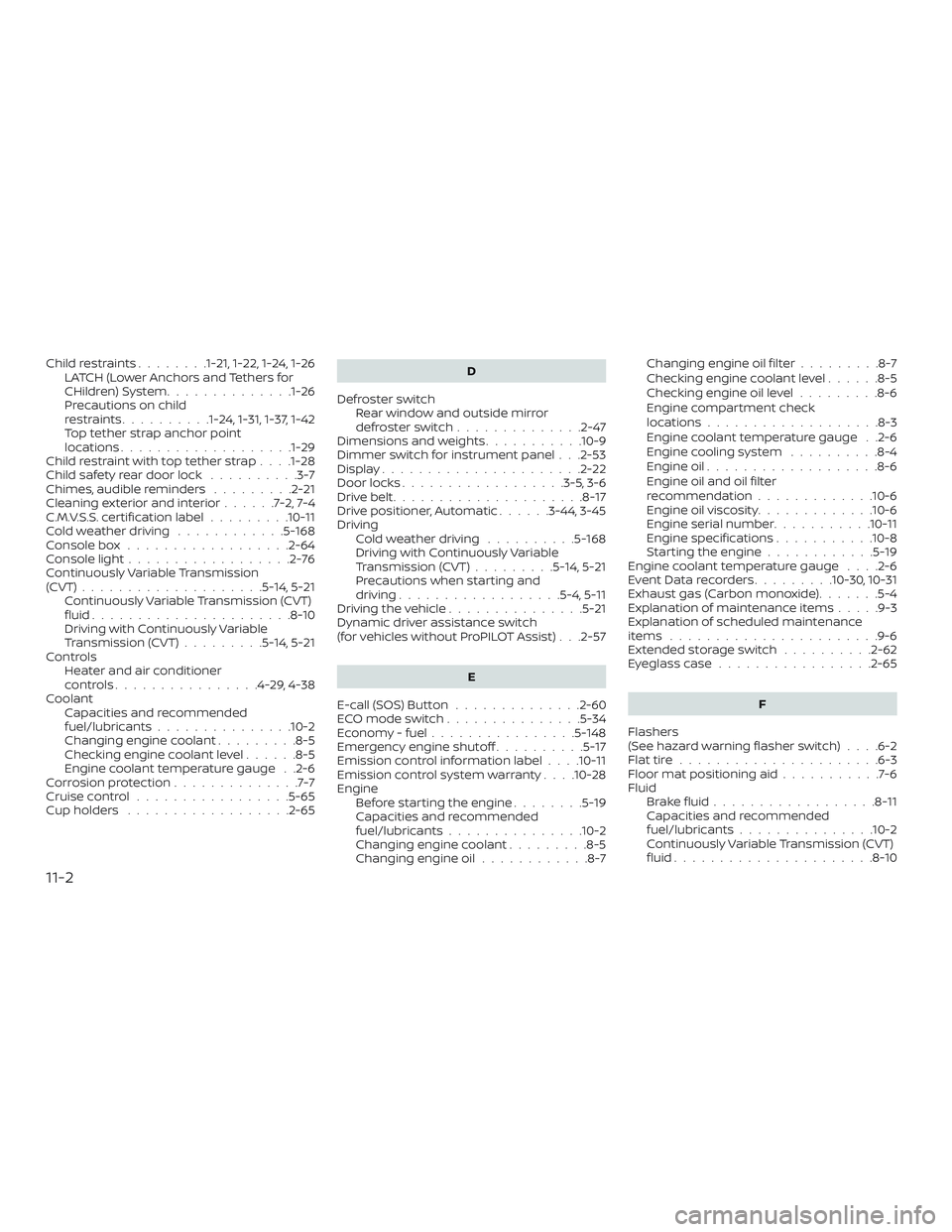
Childrestraints........1-21, 1-22, 1-24, 1-26LATCH (Lower Anchors and Tethers for
CHildren)System..............1-26
Precautions on child
restraints..........1-24, 1-31, 1-37, 1-42
Top tether strap anchor point
locations...................1-29
Child restraint with top tether strap . . . .1-28
Child safety rear door lock ..........3-7
Chimes, audible reminders .........2-21
Cleaningexteriorandinterior......7-2,7-4
C.M.V.S.S. certification label .........10-11
Coldweatherdriving ............5-168
Console box ..................2-64
Console light ..................2-76
Continuously Variable Transmission
(CVT) ....................5-14,5-21
Continuously Variable Transmission (CVT)
fluid......................8-10
Driving with Continuously Variable
Transmission (CVT) .........5-14,5-21
Controls Heater and air conditioner
controls................4-29,4-38
Coolant Capacities and recommended
fuel/lubricants...............10-2
Changing engine coolant .........8-5
Checking engine coolant level ......8-5
Engine coolant temperature gauge . .2-6
Corrosionprotection..............7-7
Cruisecontrol.................5-65
Cupholders ..................2-65 D
Defroster switch Rear window and outside mirror
defrosterswitch..............2-47
Dimensions and weights ...........10-9
Dimmer switch for instrument panel . . .2-53
Display......................2-22
Door locks ..................3-5,3-6
Drivebelt.....................8-17
Drive positioner, Automatic ......3-44,3-45
Driving Cold weather driving ..........5-168
Driving with Continuously Variable
Transmission (CVT) .........5-14,5-21
Precautions when starting and
driving..................5-4,5-11
Drivingthevehicle...............5-21
Dynamic driver assistance switch
(for vehicles without ProPILOT Assist) . . .2-57
E
E-call (SOS) Button ..............2-60
ECO mode switch ...............5-34
Economy - fuel ................5-148
Emergency engine shutoff ..........5-17
Emission control information label . . . .10-11
Emission control system warranty . . . .10-28
Engine Before starting the engine ........5-19
Capacities and recommended
fuel/lubricants...............10-2
Changing engine coolant .........8-5
Changing engine oil ............8-7 Changing engine oil filter
.........8-7
Checking engine coolant level ......8-5
Checking engine oil level .........8-6
Engine compartment check
locations...................8-3
Engine coolant temperature gauge . .2-6
Engine cooling system ..........8-4
Engine oil ...................8-6
Engine oil and oil filter
recommendation .............10-6
Engine oil viscosity .............10-6
Engine serial number ...........10-11
Engine specifications ...........10-8
Starting the engine ............5-19
Engine coolant temperature gauge ....2-6
EventDatarecorders.........10-30,10-31
Exhaust gas (Carbon monoxide) .......5-4
Explanation of maintenance items .....9-3
Explanation of scheduled maintenance
items .......................9-6
Extended storage switch ..........2-62
Eyeglasscase.................2-65
F
Flashers
(Seehazardwarningflasherswitch)....6-2
Flattire......................6-3
Floormatpositioningaid...........7-6
Fluid Brakefluid..................8-11
Capacities and recommended
fuel/lubricants...............10-2
Continuously Variable Transmission (CVT)
f
luid......................8-10
11-2
Page 556 of 564
K
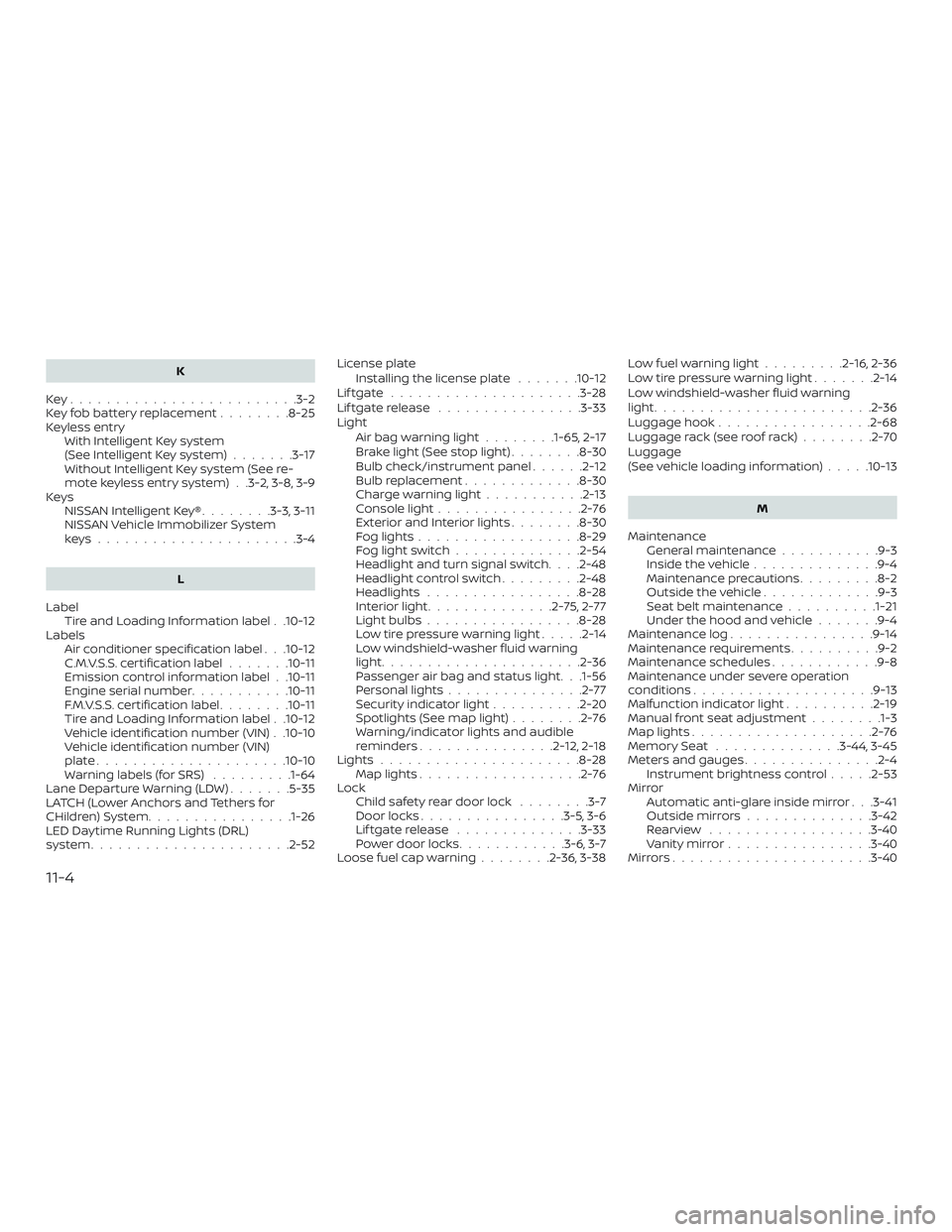
Key.........................3-2
Key fob battery replacement ........8-25
Keyless entry With Intelligent Key system
(See Intelligent Key system) .......3-17
Without Intelligent Key system (See re-
mote keyless entry system) . .3-2, 3-8, 3-9
Keys NISSAN Intelligent Key® ........3-3,3-11
NISSAN Vehicle Immobilizer System
keys......................3-4
L
Label Tire and Loading Information label . .10-12
Labels Air conditioner specification label . . .10-12
C.M.V.S.S. certification label .......10-11
Emission control information label . .10-11
Engine serial number ...........10-11
F.M.V.S.S. certification label ........10-11
Tire and Loading Information label . .10-12
Vehicle identification number (VIN) . .10-10
Vehicle identification number (VIN)
plate.....................10-10
Warning labels (for SRS) .........1-64
Lane Departure Warning (LDW) .......5-35
LATCH (Lower Anchors and Tethers for
CHildren)System............... .1-26
LED Daytime Running Lights (DRL)
system ......................2-52 License plate
Installing the license plate .......10-12
Liftgate .....................3-28
Liftgaterelease ................3-33
Light Airbagwarninglight........1-65, 2-17
Brakelight(Seestoplight)........8-30
Bulb check/instrument panel ......2-12
Bulb replacement .............8-30
Charge warning light ...........2-13
Console light ................2-76
ExteriorandInteriorlights........8-30
Foglights..................8-29
Foglightswitch..............2-54
Headlight and turn signal switch ....2-48
Headlightcontrolswitch.........2-48
Headlights.................8-28
Interiorlight..............2-75,2-77
Lightbulbs.................8-28
Low tire pressure warning light .....2-14
Low windshield-washer fluid warning
light......................2-36
Passenger air bag and status light. . .1-56
Personal lights ...............2-77
Security indicator light ..........2-20
Spotlights(Seemaplight)........2-76
Warning/indicator lights and audible
reminders ...............2-12,2-18
Lights......................8-28 Maplights..................2-76
Lock Child safety rear door lock ........3-7
Door locks ................3-5,3-6
Liftgaterelease ..............3-33
Power door locks ............3-6,3-7
Loose fuel cap warning ........2-36,3-38 Lowfuelwarninglight.........2-16,2-36
Low tire pressure warning light
.......2-14
Low windshield-washer fluid warning
light........................2-36
Luggage hook .................2-68
Luggage rack (see roof rack) ........2-70
Luggage
(See vehicle loading information) .....10-13
M
Maintenance General maintenance ...........9-3
Insidethevehicle..............9-4
Maintenance precautions .........8-2
Outsidethevehicle.............9-3
Seat belt maintenance ..........1-21
Under the hood and vehicle .......9-4
Maintenance log ................9-14
Maintenance requirements ..........9-2
Maintenance schedules ............9-8
Maintenance under severe operation
conditions....................9-13
Malfunctionindicatorlight..........2-19
Manual front seat adjustment ........1-3
Maplights....................2-76
Memory Seat ............. .3-44, 3-45
Meter
s and gauges ...............2-4
Instrument brightness control .....2-53
Mirror Automatic anti-glare inside mirror . . .3-41
Outsidemirrors..............3-42
Rearview ..................3-40
Vanitymirror................3-40
Mirrors......................3-40
11-4
Page 557 of 564
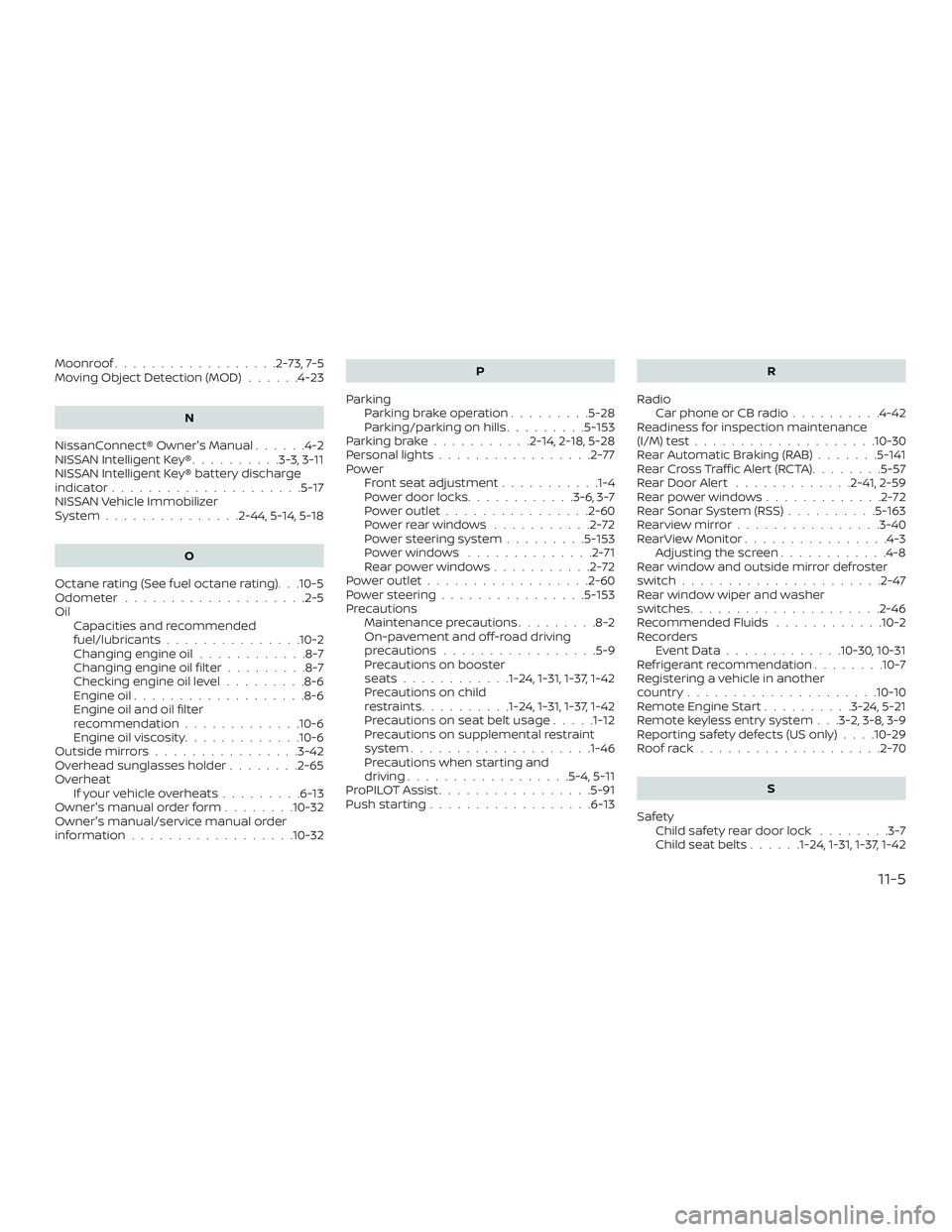
Moonroof..................2-73,7-5
Moving Object Detection (MOD) ......4-23
N
NissanConnect® Owner's Manual ......4-2
NISSAN Intelligent Key® ..........3-3,3-11
NISSAN Intelligent Key® battery discharge
indicator.....................5-17
NISSAN Vehicle Immobilizer
System...............2-44,5-14,5-18
O
Octane rating (See fuel octane rating). . .10-5
Odometer ....................2-5
Oil Capacities and recommended
fuel/lubricants...............10-2
Changing engine oil ............8-7
Changing engine oil filter .........8-7
Checking engine oil level .........8-6
Engine oil ...................8-6
Engine oil and oil filter
recommendation .............10-6
Engine oil viscosity .............10-6
Outsidemirrors................3-42
Overhead sunglasses holder ........2-65
Overheat Ifyourvehicleoverheats.........6-13
Owner's manual order form ........10-32
Owner's manual/service manual order
information..................10-32 P
Parking Parking brake operation .........5-28
Parking/parkingonhills.........5-153
Parkingbrake...........2-14,2-18,5-28
Personal lights .................2-77
Power Front seat adjustment ...........1-4
Power door locks ............3-6,3-7
Poweroutlet................2-60
Powerrearwindows ...........2-72
Power steering system .........5-153
Powerwindows ..............2-71
Rearpowerwindows...........2-72
Poweroutlet..................2-60
Powersteering................5-153
Precautions Maintenance precautions .........8-2
On-pavement and off-road driving
precautions .................5-9
Precautions on booster
seats............1-24, 1-31, 1-37, 1-42
Precautions on child
restraints..........1-24, 1-31, 1-37, 1-42
Precautions on seat belt usage .....1-12
Precautions on supplemental restraint
system ................... .1-46
Precautions when starting and
driving..................5-4,5-11
ProPILOT Assist .................5-91
Push starting ..................6-13 R
Radio Car phone or CB radio ..........4-42
Readiness for inspection maintenance
(I/M) test ....................10-30
Rear Automatic Braking (RAB) .......5-141
RearCrossTrafficAlert(RCTA)........5-57
Rear Door Alert .............2-41,2-59
Rearpowerwindows.............2-72
Rear Sonar System (RSS) ..........5-163
Rearviewmirror................3-40
RearViewMonitor................4-3 Adjustingthescreen............4-8
Rear window and outside mirror defroster
switch......................2-47
Rear window wiper and washer
switches .....................2-46
Recommended Fluids ............10-2
Recorders EventData.............10-30,10-31
Refrigerant recommendation ........10-7
Registering a vehicle in another
country .....................10-10
Remote Engine Start ..........3-24,5-21
Remote keyless entry system . . .3-2, 3-8, 3-9
Reporting safety defects (US only) . . . .10-29
Roofrack................... .2-70
S
Safety Child
safety rear door lock ........3-7
Childseatbelts......1-24, 1-31, 1-37, 1-42
11-5
Page 558 of 564

Reporting safety defects (US only) . .10-29
Seat adjustment Front manual seat adjustment ......1-3
Front power seat adjustment ......1-4
Second row bench seats .........1-6
Seatback pockets ...............2-63
Seat belt Childsafety ................ .1-21
Infants and small children ........1-22
InjuredPerson............... .1-15
Largerchildren.............. .1-22
Precautions on seat belt usage .....1-12
Pregnant women ..............1-15
Seat belt extenders ............1-20
Seat belt maintenance ..........1-21
Seatbelts................1-12, 7-6
Shoulder belt height adjustment . . . .1-19
Three-pointtypewithretractor.....1-15
Seat belt extenders ..............1-20
Seatbeltwarninglight .........1-15, 2-17
Seats 2nd row bench seat adjustment .....1-6
Adjustment ..................1-2
Armrests .................. .1-6
Automatic drive positioner ....3-44,3-45
Frontseats..................1-2
Heatedseats................2-55
Manual front seat adjustment ......1-3
Security indicator light ............2-20
Security system (NISSAN Vehicle Immobilizer
System), engine start ......2-44,5-14,5-18
Security systems Vehicle security system .........2-42
Self-adjustingbrakes.............8-22
Service manual order form .........10-32
Servicing air conditioner ...........4-41Shoulder belt height adjustment
......1-19
Sonar Rear system ................5-163
Spark plug replacement ...........8-18
Spark plugs ...................8-18
Specifications .................10-8
Speedometer ..................2-4
Speedometer and odometer ........2-4
SPORT mode switch .............5-34
Spotlights(Seemaplight)..........2-76
SRS warning label ...............1-64
Standard maintenance ............9-9
Starting Before starting the engine ........5-19
Jumpstarting.............6 -11, 8-16
Precautions when starting and
d
riving..................5-4,5-11
Push starting ................6-13
Starting the engine ............5-19
Starting the engine ..............5-19
Starting the engine (models with
NISSAN Intelligent Key® system) ......5-20
Steering Powersteeringsystem.........5-153
Steering Assist switch (for vehicles with
ProPILOT Assist) ................2-57
Steering wheel .................3-38
Stoplight....................8-30
Storage.....................2-63
Sunglasses case ................2-65
Sunglasses holder ..............2-65
Sunroof ...................2-73,7-5
Sunroof (see Moonroof ) ...........2-73
Sunvisors....................3-39
Supplemental air bag warning labels . . .1-64 Supplemental air bag warning
light.....................1-65, 2-17
Supplemental front impact air bag
system.....................
.1-53
Supplemental restraint system Information and warning labels . . . .1-64
Precautions on supplemental restraint
system ....................1-46
Supplemental restraint system
(Supplemental air bag system) .......1-46
Switch Autolightswitch..............2-49
Automatic power window switch . . .2-72
Foglightswitch..............2-54
Hazard warning flasher switch ......6-2
Headlight and turn signal switch . . . .2-48
Headlightcontrolswitch.........2-48
Ignition switch ...............5-13
Instrument brightness control .....2-53
Power door lock switch ........3-6,3-7
Rear window and outside mirror
defrosterswitch..............2-47
Rear window wiper and washer
switches ...................2-46
Turn signal switch .............2-53
T
Tachometer ...................2-6
Temperature gauge Engine coolant temperature gauge . .2-6
Thef t (NISSAN Vehicle Immobilizer System),
engine start ............2-44,5-14,5-18
Three-waycatalyst...............5-5
11-6