oil level NISSAN ROGUE 2019 Owner´s Manual
[x] Cancel search | Manufacturer: NISSAN, Model Year: 2019, Model line: ROGUE, Model: NISSAN ROGUE 2019Pages: 564, PDF Size: 6.97 MB
Page 507 of 564
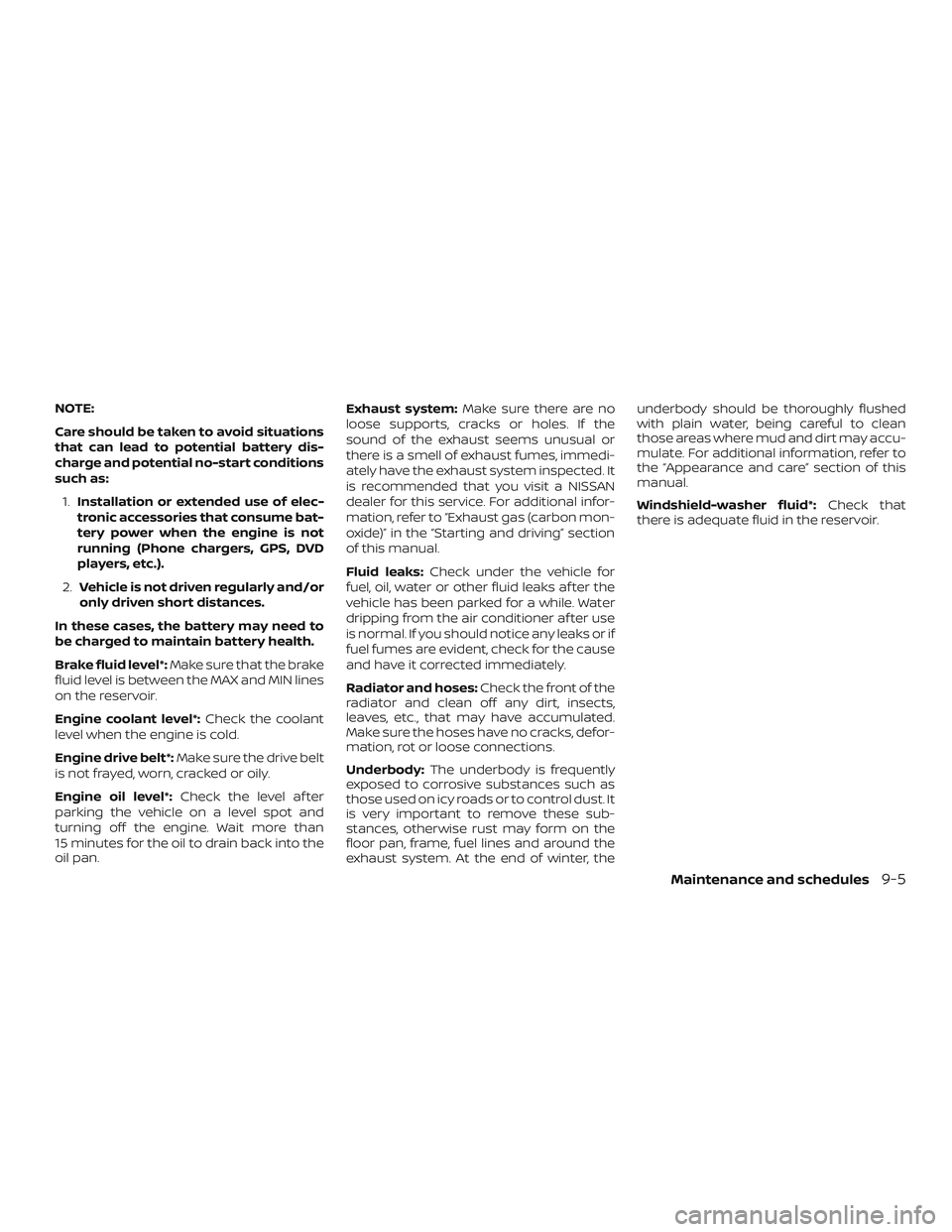
NOTE:
Care should be taken to avoid situations
that can lead to potential battery dis-
charge and potential no-start conditions
such as:1. Installation or extended use of elec-
tronic accessories that consume bat-
tery power when the engine is not
running (Phone chargers, GPS, DVD
players, etc.).
2. Vehicle is not driven regularly and/or
only driven short distances.
In these cases, the battery may need to
be charged to maintain battery health.
Brake fluid level*: Make sure that the brake
fluid level is between the MAX and MIN lines
on the reservoir.
Engine coolant level*: Check the coolant
level when the engine is cold.
Engine drive belt*: Make sure the drive belt
is not frayed, worn, cracked or oily.
Engine oil level*: Check the level af ter
parking the vehicle on a level spot and
turning off the engine. Wait more than
15 minutes for the oil to drain back into the
oil pan. Exhaust system:
Make sure there are no
loose supports, cracks or holes. If the
sound of the exhaust seems unusual or
there is a smell of exhaust fumes, immedi-
ately have the exhaust system inspected. It
is recommended that you visit a NISSAN
dealer for this service. For additional infor-
mation, refer to “Exhaust gas (carbon mon-
oxide)” in the “Starting and driving” section
of this manual.
Fluid leaks: Check under the vehicle for
fuel, oil, water or other fluid leaks af ter the
vehicle has been parked for a while. Water
dripping from the air conditioner af ter use
is normal. If you should notice any leaks or if
fuel fumes are evident, check for the cause
and have it corrected immediately.
Radiator and hoses: Check the front of the
radiator and clean off any dirt, insects,
leaves, etc., that may have accumulated.
Make sure the hoses have no cracks, defor-
mation, rot or loose connections.
Underbody: The underbody is frequently
exposed to corrosive substances such as
those used on icy roads or to control dust. It
is very important to remove these sub-
stances, otherwise rust may form on the
floor pan, frame, fuel lines and around the
exhaust system. At the end of winter, the underbody should be thoroughly flushed
with plain water, being careful to clean
those areas where mud and dirt may accu-
mulate. For additional information, refer to
the “Appearance and care” section of this
manual.
Windshield-washer fluid*:
Check that
there is adequate fluid in the reservoir.
Maintenance and schedules9-5
Page 546 of 564
∙ Be careful when passing other vehicles.Passing while towing a trailer requires
considerably more distance than nor-
mal passing. Remember, the length of
the trailer must also pass the other ve-
hicle before you can safely change
lanes.
∙ Downshif t the transmission to a lower gear for engine braking when driving
down steep or long hills. This will help
slow the vehicle without applying the
brakes.
∙ Avoid holding the brake pedal down too long or too frequently. This could cause
the brakes to overheat, resulting in re-
duced braking efficiency.
∙ Increase your following distance to al- low for greater stopping distances
while towing a trailer. Anticipate stops
and brake gradually.
∙ NISSAN recommends that the cruise control not be used while towing a
trailer.
∙ Some states or provinces have specific regulations and speed limits for ve-
hicles that are towing trailers. Obey the
local speed limits. ∙ Check your hitch, trailer wiring harness
connections, and trailer wheel lug nuts
af ter 50 miles (80 km) of travel and at
every break.
∙ When launching a boat, don’t allow the water level to go over the exhaust tail
pipe or rear bumper.
∙ Make sure you disconnect the trailer lights before backing the trailer into the
water or the trailer lights may burn out.
When towing a trailer, final drive gear oil
should be replaced and transmission
oil/fluid should be changed more fre-
quently. For additional information, refer
to the “Do-it-yourself ” section of this
manual.
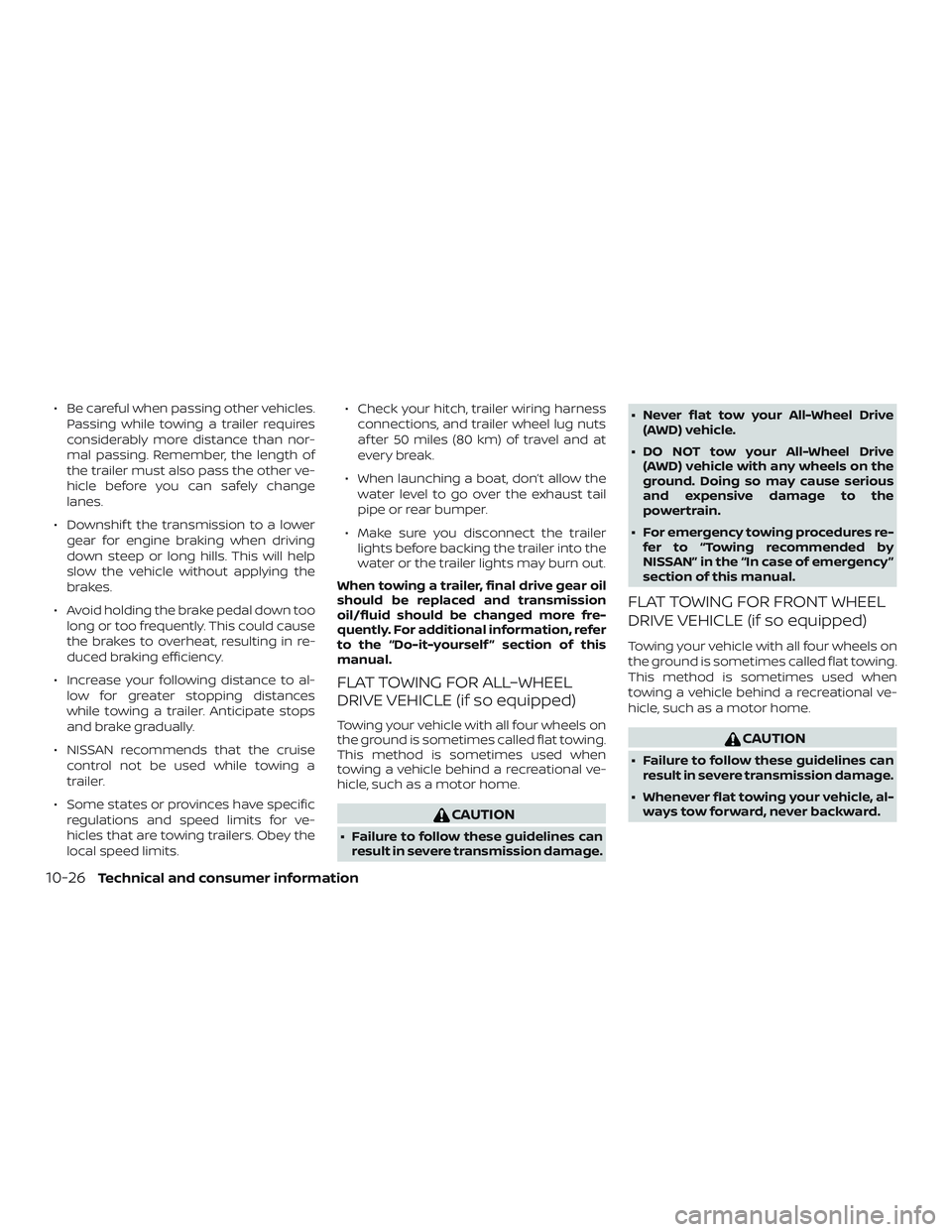
FLAT TOWING FOR ALL–WHEEL
DRIVE VEHICLE (if so equipped)
Towing your vehicle with all four wheels on
the ground is sometimes called flat towing.
This method is sometimes used when
towing a vehicle behind a recreational ve-
hicle, such as a motor home.
CAUTION
∙ Failure to follow these guidelines can result in severe transmission damage. ∙ Never flat tow your All-Wheel Drive
(AWD) vehicle.
∙ DO NOT tow your All-Wheel Drive (AWD) vehicle with any wheels on the
ground. Doing so may cause serious
and expensive damage to the
powertrain.
∙ For emergency towing procedures re- fer to “Towing recommended by
NISSAN” in the “In case of emergency ”
section of this manual.
FLAT TOWING FOR FRONT WHEEL
DRIVE VEHICLE (if so equipped)
Towing your vehicle with all four wheels on
the ground is sometimes called flat towing.
This method is sometimes used when
towing a vehicle behind a recreational ve-
hicle, such as a motor home.
CAUTION
∙ Failure to follow these guidelines canresult in severe transmission damage.
∙ Whenever flat towing your vehicle, al- ways tow forward, never backward.
10-26Technical and consumer information
Page 554 of 564
Childrestraints........1-21, 1-22, 1-24, 1-26LATCH (Lower Anchors and Tethers for
CHildren)System..............1-26
Precautions on child
restraints..........1-24, 1-31, 1-37, 1-42
Top tether strap anchor point
locations...................1-29
Child restraint with top tether strap . . . .1-28
Child safety rear door lock ..........3-7
Chimes, audible reminders .........2-21
Cleaningexteriorandinterior......7-2,7-4
C.M.V.S.S. certification label .........10-11
Coldweatherdriving ............5-168
Console box ..................2-64
Console light ..................2-76
Continuously Variable Transmission
(CVT) ....................5-14,5-21
Continuously Variable Transmission (CVT)
fluid......................8-10
Driving with Continuously Variable
Transmission (CVT) .........5-14,5-21
Controls Heater and air conditioner
controls................4-29,4-38
Coolant Capacities and recommended
fuel/lubricants...............10-2
Changing engine coolant .........8-5
Checking engine coolant level ......8-5
Engine coolant temperature gauge . .2-6
Corrosionprotection..............7-7
Cruisecontrol.................5-65
Cupholders ..................2-65 D
Defroster switch Rear window and outside mirror
defrosterswitch..............2-47
Dimensions and weights ...........10-9
Dimmer switch for instrument panel . . .2-53
Display......................2-22
Door locks ..................3-5,3-6
Drivebelt.....................8-17
Drive positioner, Automatic ......3-44,3-45
Driving Cold weather driving ..........5-168
Driving with Continuously Variable
Transmission (CVT) .........5-14,5-21
Precautions when starting and
driving..................5-4,5-11
Drivingthevehicle...............5-21
Dynamic driver assistance switch
(for vehicles without ProPILOT Assist) . . .2-57
E
E-call (SOS) Button ..............2-60
ECO mode switch ...............5-34
Economy - fuel ................5-148
Emergency engine shutoff ..........5-17
Emission control information label . . . .10-11
Emission control system warranty . . . .10-28
Engine Before starting the engine ........5-19
Capacities and recommended
fuel/lubricants...............10-2
Changing engine coolant .........8-5
Changing engine oil ............8-7 Changing engine oil filter
.........8-7
Checking engine coolant level ......8-5
Checking engine oil level .........8-6
Engine compartment check
locations...................8-3
Engine coolant temperature gauge . .2-6
Engine cooling system ..........8-4
Engine oil ...................8-6
Engine oil and oil filter
recommendation .............10-6
Engine oil viscosity .............10-6
Engine serial number ...........10-11
Engine specifications ...........10-8
Starting the engine ............5-19
Engine coolant temperature gauge ....2-6
EventDatarecorders.........10-30,10-31
Exhaust gas (Carbon monoxide) .......5-4
Explanation of maintenance items .....9-3
Explanation of scheduled maintenance
items .......................9-6
Extended storage switch ..........2-62
Eyeglasscase.................2-65
F
Flashers
(Seehazardwarningflasherswitch)....6-2
Flattire......................6-3
Floormatpositioningaid...........7-6
Fluid Brakefluid..................8-11
Capacities and recommended
fuel/lubricants...............10-2
Continuously Variable Transmission (CVT)
f
luid......................8-10
11-2
Page 557 of 564
Moonroof..................2-73,7-5
Moving Object Detection (MOD) ......4-23
N
NissanConnect® Owner's Manual ......4-2
NISSAN Intelligent Key® ..........3-3,3-11
NISSAN Intelligent Key® battery discharge
indicator.....................5-17
NISSAN Vehicle Immobilizer
System...............2-44,5-14,5-18
O
Octane rating (See fuel octane rating). . .10-5
Odometer ....................2-5
Oil Capacities and recommended
fuel/lubricants...............10-2
Changing engine oil ............8-7
Changing engine oil filter .........8-7
Checking engine oil level .........8-6
Engine oil ...................8-6
Engine oil and oil filter
recommendation .............10-6
Engine oil viscosity .............10-6
Outsidemirrors................3-42
Overhead sunglasses holder ........2-65
Overheat Ifyourvehicleoverheats.........6-13
Owner's manual order form ........10-32
Owner's manual/service manual order
information..................10-32 P
Parking Parking brake operation .........5-28
Parking/parkingonhills.........5-153
Parkingbrake...........2-14,2-18,5-28
Personal lights .................2-77
Power Front seat adjustment ...........1-4
Power door locks ............3-6,3-7
Poweroutlet................2-60
Powerrearwindows ...........2-72
Power steering system .........5-153
Powerwindows ..............2-71
Rearpowerwindows...........2-72
Poweroutlet..................2-60
Powersteering................5-153
Precautions Maintenance precautions .........8-2
On-pavement and off-road driving
precautions .................5-9
Precautions on booster
seats............1-24, 1-31, 1-37, 1-42
Precautions on child
restraints..........1-24, 1-31, 1-37, 1-42
Precautions on seat belt usage .....1-12
Precautions on supplemental restraint
system ................... .1-46
Precautions when starting and
driving..................5-4,5-11
ProPILOT Assist .................5-91
Push starting ..................6-13 R
Radio Car phone or CB radio ..........4-42
Readiness for inspection maintenance
(I/M) test ....................10-30
Rear Automatic Braking (RAB) .......5-141
RearCrossTrafficAlert(RCTA)........5-57
Rear Door Alert .............2-41,2-59
Rearpowerwindows.............2-72
Rear Sonar System (RSS) ..........5-163
Rearviewmirror................3-40
RearViewMonitor................4-3 Adjustingthescreen............4-8
Rear window and outside mirror defroster
switch......................2-47
Rear window wiper and washer
switches .....................2-46
Recommended Fluids ............10-2
Recorders EventData.............10-30,10-31
Refrigerant recommendation ........10-7
Registering a vehicle in another
country .....................10-10
Remote Engine Start ..........3-24,5-21
Remote keyless entry system . . .3-2, 3-8, 3-9
Reporting safety defects (US only) . . . .10-29
Roofrack................... .2-70
S
Safety Child
safety rear door lock ........3-7
Childseatbelts......1-24, 1-31, 1-37, 1-42
11-5