lights NISSAN ROGUE 2019 Owner´s Manual
[x] Cancel search | Manufacturer: NISSAN, Model Year: 2019, Model line: ROGUE, Model: NISSAN ROGUE 2019Pages: 564, PDF Size: 6.97 MB
Page 488 of 564
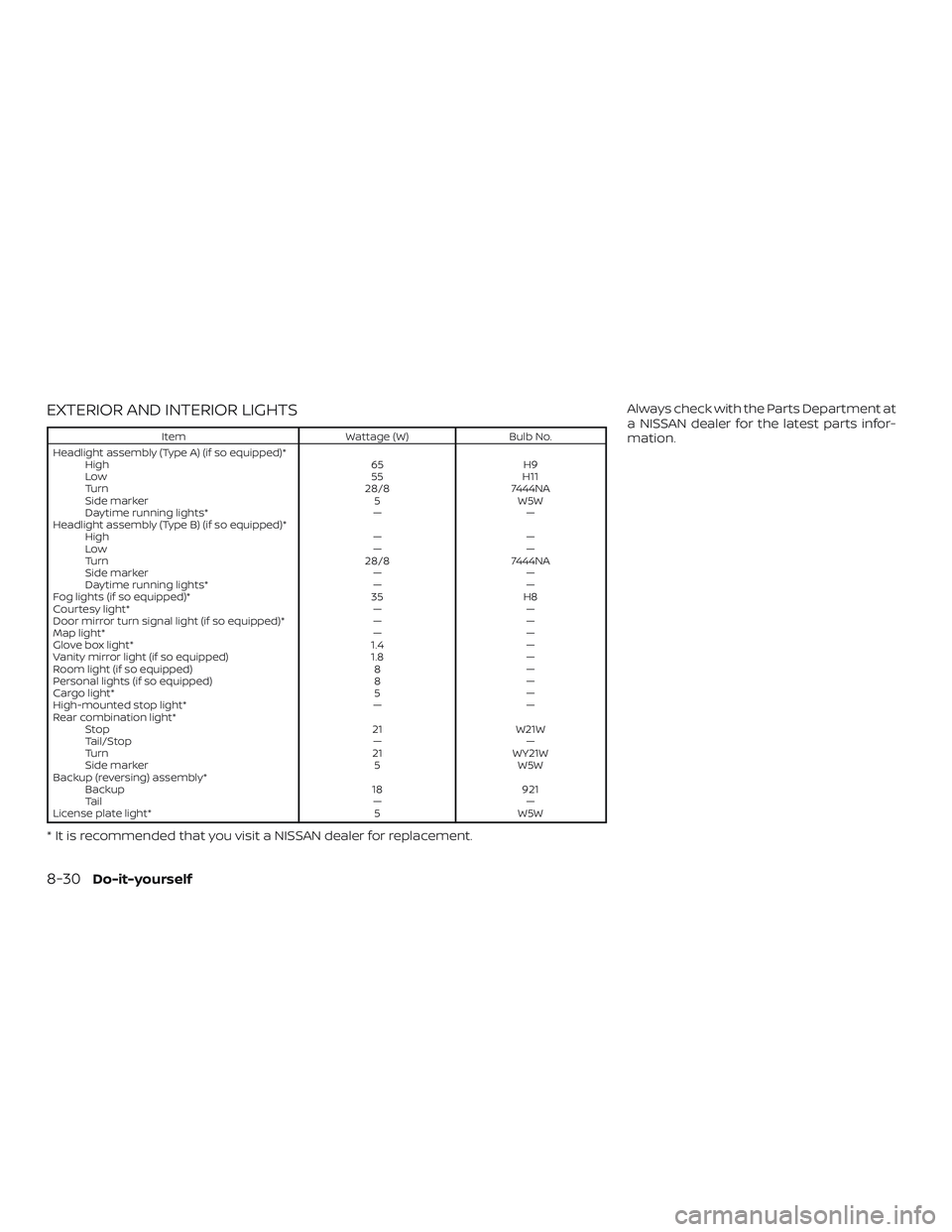
EXTERIOR AND INTERIOR LIGHTS
ItemWattage (W)Bulb No.
Headlight assembly (Type A) (if so equipped)* High 65H9
Low 55H11
Turn 28/87444NA
Side marker 5W5W
Daytime running lights* ——
Headlight assembly (Type B) (if so equipped)* High ——
Low ——
Turn 28/87444NA
Side marker ——
Daytime running lights* ——
Fog lights (if so equipped)* 35H8
Courtesy light* ——
Door mirror turn signal light (if so equipped)* ——
Map light* ——
Glove box light* 1.4—
Vanity mirror light (if so equipped) 1.8—
Room light (if so equipped) 8—
Personal lights (if so equipped) 8—
Cargo light* 5—
High-mounted stop light* ——
Rear combination light* Stop 21W21W
Tail/Stop ——
Turn 21WY21W
Side marker 5W5W
Backup (reversing) assembly* Backup 18921
Ta i l ——
License plate light* 5W5W
* It is recommended that you visit a NISSAN dealer for replacement. Always check with the Parts Department at
a NISSAN dealer for the latest parts infor-
mation.
8-30Do-it-yourself
Page 489 of 564
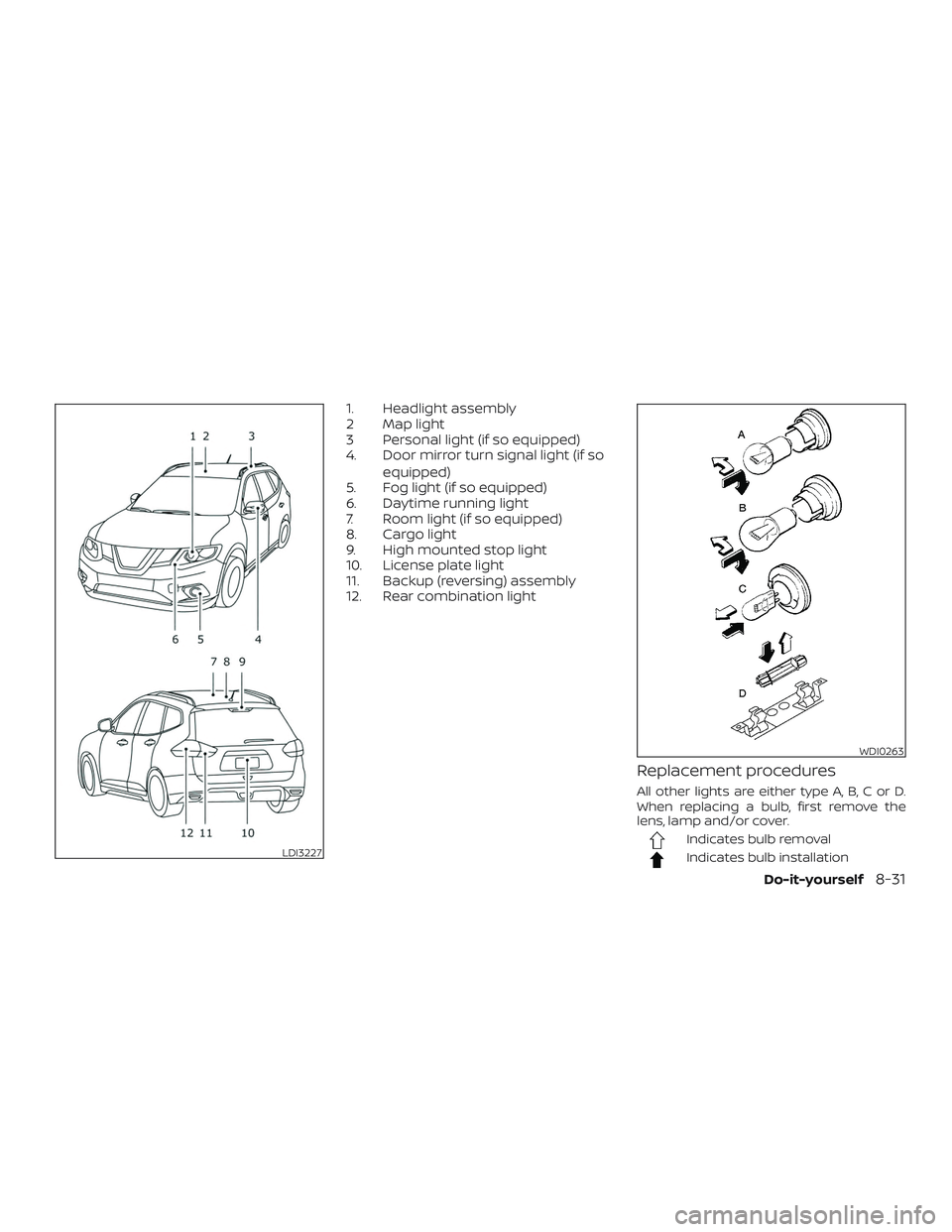
1. Headlight assembly
2 Map light
3 Personal light (if so equipped)
4. Door mirror turn signal light (if soequipped)
5. Fog light (if so equipped)
6. Daytime running light
7. Room light (if so equipped)
8. Cargo light
9. High mounted stop light
10. License plate light
11. Backup (reversing) assembly
12. Rear combination light
Replacement procedures
All other lights are either type A, B, C or D.
When replacing a bulb, first remove the
lens, lamp and/or cover.
Indicates bulb removal
Indicates bulb installationLDI3227
WDI0263
Do-it-yourself8-31
Page 505 of 564
During the normal day-to-day operation of
the vehicle, general maintenance should
be performed regularly as prescribed in
this section. If you detect any unusual
sounds, vibrations or smells, be sure to
check for the cause or have it checked
promptly. In addition, it is recommended
that you visit a NISSAN dealer if you think
that repairs are required.
When performing any checks or mainte-
nance work, closely observe the “Mainte-
nance precautions” in the “Do-it-yourself ”
section of this manual.
EXPLANATION OF GENERAL
MAINTENANCE ITEMS
Additional information on the following
items with“*”isfound in the “Do-it-
yourself ” section of this manual.
Outside the vehicle
The maintenance items listed here should
be performed from time to time, unless
otherwise specified.
Doors and engine hood: Check that the
doors and engine hood operate properly.
Also ensure that all latches lock securely.
Lubricate hinges, latches, latch pins, rollers
and links if necessary. Make sure that the secondary latch keeps the hood from
opening when the primary latch is re-
leased.
When driving in areas using road salt or
other corrosive materials, check lubrica-
tion frequently.
Lights*:
Clean the headlights on a regular
basis. Make sure that the headlights, stop
lights, tail lights, turn signal lights, and other
lights are all operating properly and in-
stalled securely. Also check headlight aim.
Road wheel nuts (lug nuts)*: When check-
ing the tires, make sure no wheel nuts are
missing, and check for any loose wheel
nuts. Tighten if necessary.
Tire rotation*: Tires should be rotated ev-
ery 5,000 miles (8,000 km).
Tires*: Check the pressure with a gauge
of ten and always prior to long distance
trips. If necessary, adjust the pressure in all
tires, including the spare, to the pressure
specified. Check carefully for damage, cuts
or excessive wear.
Tire Pressure Monitoring System (TPMS)
transmitter components: Replace the
TPMS transmitter grommet seal, valve core
and cap when the tires are replaced due to
wear or age. Wheel alignment and balance:
If the ve-
hicle should pull to either side while driving
on a straight and level road, or if you detect
uneven or abnormal tire wear, there may
be a need for wheel alignment. If the steer-
ing wheel or seat vibrates at normal high-
way speeds, wheel balancing may be
needed.
For additional information regarding tires,
refer to “Important Tire Safety Information”
(US) or “Tire Safety Information” (Canada) in
the Warranty Information Booklet.
Windshield: Clean the windshield on a
regular basis. Check the windshield at least
every six months for cracks or other dam-
age. Have a damaged windshield repaired
by a qualified repair facility. It is recom-
mended that you have a damaged wind-
shield repaired by a NISSAN dealer, or a
NISSAN Certified Collision Center. To locate
a collision center in your area, refer to
http://collision.nissanusa.com.
Windshield wiper blades*: Check for
cracks or wear if they do not wipe properly.
GENERAL MAINTENANCE
Maintenance and schedules9-3
Page 506 of 564
Inside the vehicle
The maintenance items listed here should
be checked on a regular basis, such as
when performing scheduled maintenance,
cleaning the vehicle, etc.
Accelerator pedal:Check the pedal for
smooth operation and make sure the
pedal does not catch or require uneven
effort. Keep the floor mat away from the
pedal.
Brake pedal: Check the pedal for smooth
operation. If the brake pedal suddenly goes
down further than normal, the pedal feels
spongy or the vehicle seems to take longer
to stop, have your vehicle checked imme-
diately. It is recommended that you visit a
NISSAN dealer for this service. Keep the
floor mat away from the pedal.
Brakes: Check that the brakes do not pull
the vehicle to one side when applied.
Continuously Variable Transmission
(CVT) P (Park) position mechanism: On a
fairly steep hill check that the vehicle is held
securely with the shif t lever in the P (Park)
position without applying any brakes. Parking brake:
Check the parking brake
operation regularly. The vehicle should be
securely held on a fairly steep hill with only
the parking brake applied. If the parking
brake needs adjustment, it is recom-
mended that you visit a NISSAN dealer for
this service.
Seats: Check seat position controls such
as seat adjusters, seatback recliner, etc., to
ensure they operate smoothly and all
latches lock securely in every position.
Check that the head restraints/headrests
move up and down smoothly and the locks
(if so equipped) hold securely in all latched
positions.
Seat belts: Check that all parts of the seat
belt system (for example, buckles, anchors,
adjusters and retractors) operate properly
and smoothly, and are installed securely.
Check the belt webbing for cuts, fraying,
wear or damage.
Steering wheel: Check for changes in the
steering system, such as excessive free
play, hard steering or strange noises.
Warning lights and chimes: Make sure all
warning lights and chimes are operating
properly. Windshield defroster:
Check that the air
comes out of the defroster outlets properly
and in sufficient quantity when operating
the heater or air conditioner.
Windshield wiper and washer*: Check
that the wipers and washer operate prop-
erly and that the wipers do not streak.
Under the hood and vehicle
The maintenance items listed here should
be checked periodically (for example, each
time you check the engine oil or refuel).
Battery (except for maintenance free
batteries)*: Check the fluid level in each
cell. It should be between the UPPER LEVEL
and LOWER LEVEL lines. Vehicles operated
in high temperatures or under severe con-
ditions require frequent checks of the bat-
tery fluid level.
Battery (for maintenance free batter-
ies)*: This vehicle is equipped with a sealed
maintenance free battery. It is recom-
mended that you visit a NISSAN dealer for
service.
9-4Maintenance and schedules
Page 543 of 564
2. Measure the height of a reference pointon the front and rear bumpers at the
center of the vehicle.
3. Attach the trailer to the vehicle and ad- just the hitch equalizers so that the
front bumper height is within 0 -
.5 inches (0 – 13 mm) of the reference
height measured in step 2. The rear
bumper should be no higher than the
reference height measured in step 2.
WARNING
Properly adjust the weight distributing
hitch so the rear of the bumper is no
higher than the measured reference
height when the trailer is attached. If
the rear bumper is higher than the mea-
sured reference height when loaded,
the vehicle may handle unpredictably
which could cause a loss of vehicle con-
trol and cause serious personal injury or
property damage.
Sway control device
Sudden maneuvers, wind gusts, and buf-
feting caused by other vehicles can affect
trailer handling. Sway control devices may
be used to help control these affects. If you
choose to use one, contact a reputable
trailer hitch supplier to make sure the sway control device will work with the vehicle,
hitch, trailer and the trailer’s brake system.
Follow the instructions provided by the
manufacturer for installing and using the
sway control device.
Class I hitch
Class I trailer hitch equipment (receiver, ball
mount and hitch ball) can be used to tow
trailers of a maximum weight of 2,000 lbs.
(907 kg).
Tire pressures
∙ When towing a trailer, inflate the
vehicle tires to the recom-
mended cold tire pressure indi-
cated on the Tire and Loading In-
formation label.
∙ Trailer tire condition, size, load rat- ing and proper inflation pressure
should be in accordance with the
trailer and tire manufacturer’s
specifications.
Safety chains
Always use suitable safety chains between
your vehicle and the trailer. The safety chains
should be crossed and should be attached
to the hitch, not to the vehicle bumper or
axle. The safety chains can be attached to
the bumper if the hitch ball is mounted to the
bumper. Be sure to leave enough slack in the
chains to permit turning corners.
Trailer lights
CAUTION
When splicing into the vehicle electrical
system, a commercially available power-
type module/converter must be used to
provide power for all trailer lighting. This
unit uses the vehicle battery as a direct
power source for all trailer lights while us-
ing the vehicle tail light, stop light and
turn signal circuits as a signal source. The
module/converter must draw no more
that 15 milliamps from the stop and tail
lamp circuits. Using a module/converter
that exceeds these power requirements
may damage the vehicle’s electrical sys-
tem. It is recommended that you visit a
reputable trailer retailer to obtain the
proper equipment and to have it installed.
Technical and consumer information10-23
Page 544 of 564
Trailer lights should comply with federal
and/or local regulations. For assistance in
hooking up trailer lights, contact a NISSAN
dealer or reputable trailer retailer. Vehicles
equipped with the optional trailer tow
package are equipped with a 7-pin trailer
harness connector. If your trailer is
equipped with a flat 4-pin connector, an
adapter will be needed to connect the
trailer lights to the vehicle. Adapters are
available at auto parts stores and hitch re-
tailers.
Pre-towing tips
∙ Be certain your vehicle maintains a levelposition when a loaded and/or un-
loaded trailer is hitched. Do not drive the
vehicle if it has an abnormal nose-up or
nose-down condition; check for im-
proper tongue load, overload, worn sus-
pension or other possible causes of ei-
ther condition.
∙ Always secure items in the trailer to pre- vent load shif t while driving.
∙ Keep the cargo load as low as possible in the trailer to keep the trailer center of
gravity low. ∙ Load the trailer so approximately 60%
of the trailer load is in the front half and
40% is in the back half. Also make sure
the load is balanced side to side.
∙ Check your hitch, trailer tire pressure, vehicle tire pressure, trailer light opera-
tion, and trailer wheel lug nuts every
time you attach a trailer to the vehicle.
∙ Be certain your rearview mirrors con- form to all federal, state or local regula-
tions. If not, install any mirrors required
for towing before driving the vehicle.
∙ Determine the overall height of the ve- hicle and trailer so the required clear-
ance is known.
Trailer towing tips
In order to gain skill and an understanding
of the vehicle’s behavior, you should prac-
tice turning, stopping and backing up in an
area which is free from traffic. Steering sta-
bility and braking performance will be
somewhat different than under normal
driving conditions.
∙ Always secure items in the trailer to pre- vent load shif t while driving. ∙ Lock the trailer hitch coupler with a pin
or lock to prevent the coupler from in-
advertently becoming unlatched.
∙ Avoid abrupt starts, acceleration or stops.
∙ Avoid sharp turns or lane changes.
∙ Always drive your vehicle at a moderate speed.
∙ When backing up, hold the bottom of the steering wheel with one hand. Move
your hand in the direction in which you
want the trailer to go. Make small cor-
rections and back up slowly. If possible,
have someone guide you when you are
backing up.
Always block the wheels on both vehicle
and trailer when parking. Parking on a
slope is not recommended; however, if you
must do so:
CAUTION
If you move the shif t lever to the P (Park)
position before blocking the wheels
and applying the parking brake, trans-
mission damage could occur.
10-24Technical and consumer information
Page 546 of 564
∙ Be careful when passing other vehicles.Passing while towing a trailer requires
considerably more distance than nor-
mal passing. Remember, the length of
the trailer must also pass the other ve-
hicle before you can safely change
lanes.
∙ Downshif t the transmission to a lower gear for engine braking when driving
down steep or long hills. This will help
slow the vehicle without applying the
brakes.
∙ Avoid holding the brake pedal down too long or too frequently. This could cause
the brakes to overheat, resulting in re-
duced braking efficiency.
∙ Increase your following distance to al- low for greater stopping distances
while towing a trailer. Anticipate stops
and brake gradually.
∙ NISSAN recommends that the cruise control not be used while towing a
trailer.
∙ Some states or provinces have specific regulations and speed limits for ve-
hicles that are towing trailers. Obey the
local speed limits. ∙ Check your hitch, trailer wiring harness
connections, and trailer wheel lug nuts
af ter 50 miles (80 km) of travel and at
every break.
∙ When launching a boat, don’t allow the water level to go over the exhaust tail
pipe or rear bumper.
∙ Make sure you disconnect the trailer lights before backing the trailer into the
water or the trailer lights may burn out.
When towing a trailer, final drive gear oil
should be replaced and transmission
oil/fluid should be changed more fre-
quently. For additional information, refer
to the “Do-it-yourself ” section of this
manual.
FLAT TOWING FOR ALL–WHEEL
DRIVE VEHICLE (if so equipped)
Towing your vehicle with all four wheels on
the ground is sometimes called flat towing.
This method is sometimes used when
towing a vehicle behind a recreational ve-
hicle, such as a motor home.
CAUTION
∙ Failure to follow these guidelines can result in severe transmission damage. ∙ Never flat tow your All-Wheel Drive
(AWD) vehicle.
∙ DO NOT tow your All-Wheel Drive (AWD) vehicle with any wheels on the
ground. Doing so may cause serious
and expensive damage to the
powertrain.
∙ For emergency towing procedures re- fer to “Towing recommended by
NISSAN” in the “In case of emergency ”
section of this manual.
FLAT TOWING FOR FRONT WHEEL
DRIVE VEHICLE (if so equipped)
Towing your vehicle with all four wheels on
the ground is sometimes called flat towing.
This method is sometimes used when
towing a vehicle behind a recreational ve-
hicle, such as a motor home.
CAUTION
∙ Failure to follow these guidelines canresult in severe transmission damage.
∙ Whenever flat towing your vehicle, al- ways tow forward, never backward.
10-26Technical and consumer information
Page 553 of 564
11 Index
2nd row bench seat adjustment......1-6
A
ActiveRideControl(ARC)..........5-161
Air bag (See supplemental restraint
system) .................... .1-46
Air bag system Front (See supplemental front impact
airbagsystem)..............1-53
Air bag warning labels ............1-64
Airbagwarninglight..........1-65, 2-17
Air bag warning light,
supplemental ..............1-65, 2-17
Air cleaner housing filter ..........8-18
Air conditioner Air conditioner operation ....4-32,4-38
Air conditioner specification label . .10-12
Air conditioner system refrigerant
and oil recommendations .......10-7
Air conditioner system refrigerant
recommendations ............10-7
Heater and air conditioner
controls...............4-29,4-38
Servicing air conditioner ........4-41
Air flow charts .................4-33
Alarm system
(See vehicle security system) .......2-42
All-Wheel Drive .............5-149,6-15
All-Wheel Drive (AWD) LOCK switch . . .5-150
Anchor point locations ...........1-29Antenna
....................4-42
Antifreeze ...................5-168
Anti-lock brake warning light ........2-12
Anti-lock Braking System (ABS) ......5-154
Armrests.................... .1-6
Audible reminders ..............2-21
Autolightswitch ...............2-49
Automatic Automatic drive positioner . . .3-44, 3-45
Automatic power window switch . . .2-72
Automatic anti-glare inside mirror ....3-41
Automaticbrakehold............5-31
Automatic door locks .............3-7
Automatic drive positioner .....3-44, 3-45
Automatic Emergency Braking
(AEB) ................2-12,2-17,5-124
Automatic Emergency Braking (AEB) with
Pedestrian Detection ............5-132
AWD...................5-149,6-15
B
Battery.................5-168,8-13 Charge warning light ...........2-13
Battery replacement ............8-25
Keyfob...................8-25
NISSAN Intelligent Key® ......8-25,8-27
Before starting the engine .........5-19
Belt(Seedrivebelt)..............8-17
Blind Spot Warning (BSW) ..........5-46
Booster seats .................1-42 Brake
Anti-lock Braking System (ABS) ....5-154
Brakefluid .................8-11
Brakelight(Seestoplight).......8-30
Brakesystem ..............5-154
Brakewarninglight............2-13
Brakewearindicators.......2-21,8-22
Parking brake operation ........5-28
Self-adjustingbrakes..........8-22
Brake Assist .................5 -155
Brakefluid ...................8-11
Brakes .....................8-22
Brakesystem ................5-154
Break-in schedule ..............5-147
Brightness control Instrument panel .............2-53
Bulb check/instrument panel .......2-12
Bulb replacement ..............8-30
C
Capacities and recommended fuel/
l
ubricants....................10-2
Cargocover..................2-68
Cargolight...................2-78
Cargo
(See vehicle loading information) .....10-13
Car phone or CB radio ...........4-42
Chassis control ...............5-159
Checking bulbs ................2-12
Check tire pressure .............2-36
Page 555 of 564
Engine coolant...............8-4
Engine oil ...................8-6
Windshield-washer fluid .........8-11
F.M.V.S.S. certification label ..........10-11
Foglightswitch................2-54
Front air bag system
(See supplemental restraint system) . . .1-53
Front-door pocket ...............2-63
Front power seat adjustment ........1-4
Frontseats................... .1-2
Fuel Capacities and recommended
fuel/lubricants...............10-2
Fuel economy ...............5-148
Fuel-filler door and cap ..........3-36
Fuel gauge ..................2-7
Fueloctanerating.............10-5
Fuel recommendation ..........10-3
Loose fuel cap warning .........2-36
Fuelefficientdrivingtips ..........5-147
Fuel-filler door .................3-36
Fuel gauge ....................2-7
Fuses .......................8-23
Fusiblelinks...................8-23
G
Garage door opener, HomeLink® Universal
Transceiver .........2-78,2-79,2-81,2-82
Gascap.....................3-36
Gauge Engine coolant temperature gauge . .2-6
Fuel gauge ..................2-7
Odometer ..................2-5 Speedometer
................2-4
Tachometer .................2-6
Trip odometer ................2-5
General maintenance .............9-3
Glovebox....................2-64
H
Hazard warning flasher switch ........6-2
Headlight and turn signal switch ......2-48
Headlightcontrolswitch...........2-48
Headlights...................8-28
Headrestraints .................1-8
Heatedseats..................2-55
Heated steering wheel switch .......2-56
Heater Heater and air conditioner
controls................4-29,4-38
Heater operation ..........4-30,4-39
Hill start assist system ...........5-162
HomeLink® Universal
Transceiver .........2-78,2-79,2-81,2-82
Hood .......................3-27
Hook Luggage hook ...............2-68
Horn.......................2-55
I
Ignition switch .................5-13
Push-button ignition switch .......5-15
Immobilizer system .......2-44,5-14,5-18
Important vehicle information label . . . .10-11
In-cabinmicrofilter ..............8-19 Increasing fuel economy
..........5-148
Indicator NISSAN Intelligent Key® battery discharge
indicator...................5-17
Indicator lights and audible reminders
(See warning/indicator lights and audible
reminders) ................2-12,2-18
Informationdisplay..............2-22
Inside automatic anti-glare mirror .....3-41
Instrument brightness control .......2-53
Instrument panel .............0-6,2-2
Instrument panel dimmer switch .....2-53
Intelligent Around View Monitor .......4-11
Intelligent
Cruise Control (ICC)
(for vehicles without ProPILOT Assist) . . .5-67
Intelligent Cruise Control (ICC)
(for vehicles with ProPILOT Assist) ....5-103
Intelligent Engine Brake (I-EB) .......5-160
Intelligent Key system Key operating range ............3-13
Key operation ................3-14
Mechanical key ...............3-4
Remote keyless entry operation ....3-17
Troubleshooting guide ..........3-22
Warning signals ..............3-22
Intelligent Lane Intervention (I-LI) .....5-40
Intelligent Trace Control (I-TC) .......5-159
Interiorlight................2-75,2-77
ISOFIX child restraints .............1-26
J
Jumpstarting...............6 -11, 8-16
11-3
Page 556 of 564
K
Key.........................3-2
Key fob battery replacement ........8-25
Keyless entry With Intelligent Key system
(See Intelligent Key system) .......3-17
Without Intelligent Key system (See re-
mote keyless entry system) . .3-2, 3-8, 3-9
Keys NISSAN Intelligent Key® ........3-3,3-11
NISSAN Vehicle Immobilizer System
keys......................3-4
L
Label Tire and Loading Information label . .10-12
Labels Air conditioner specification label . . .10-12
C.M.V.S.S. certification label .......10-11
Emission control information label . .10-11
Engine serial number ...........10-11
F.M.V.S.S. certification label ........10-11
Tire and Loading Information label . .10-12
Vehicle identification number (VIN) . .10-10
Vehicle identification number (VIN)
plate.....................10-10
Warning labels (for SRS) .........1-64
Lane Departure Warning (LDW) .......5-35
LATCH (Lower Anchors and Tethers for
CHildren)System............... .1-26
LED Daytime Running Lights (DRL)
system ......................2-52 License plate
Installing the license plate .......10-12
Liftgate .....................3-28
Liftgaterelease ................3-33
Light Airbagwarninglight........1-65, 2-17
Brakelight(Seestoplight)........8-30
Bulb check/instrument panel ......2-12
Bulb replacement .............8-30
Charge warning light ...........2-13
Console light ................2-76
ExteriorandInteriorlights........8-30
Foglights..................8-29
Foglightswitch..............2-54
Headlight and turn signal switch ....2-48
Headlightcontrolswitch.........2-48
Headlights.................8-28
Interiorlight..............2-75,2-77
Lightbulbs.................8-28
Low tire pressure warning light .....2-14
Low windshield-washer fluid warning
light......................2-36
Passenger air bag and status light. . .1-56
Personal lights ...............2-77
Security indicator light ..........2-20
Spotlights(Seemaplight)........2-76
Warning/indicator lights and audible
reminders ...............2-12,2-18
Lights......................8-28 Maplights..................2-76
Lock Child safety rear door lock ........3-7
Door locks ................3-5,3-6
Liftgaterelease ..............3-33
Power door locks ............3-6,3-7
Loose fuel cap warning ........2-36,3-38 Lowfuelwarninglight.........2-16,2-36
Low tire pressure warning light
.......2-14
Low windshield-washer fluid warning
light........................2-36
Luggage hook .................2-68
Luggage rack (see roof rack) ........2-70
Luggage
(See vehicle loading information) .....10-13
M
Maintenance General maintenance ...........9-3
Insidethevehicle..............9-4
Maintenance precautions .........8-2
Outsidethevehicle.............9-3
Seat belt maintenance ..........1-21
Under the hood and vehicle .......9-4
Maintenance log ................9-14
Maintenance requirements ..........9-2
Maintenance schedules ............9-8
Maintenance under severe operation
conditions....................9-13
Malfunctionindicatorlight..........2-19
Manual front seat adjustment ........1-3
Maplights....................2-76
Memory Seat ............. .3-44, 3-45
Meter
s and gauges ...............2-4
Instrument brightness control .....2-53
Mirror Automatic anti-glare inside mirror . . .3-41
Outsidemirrors..............3-42
Rearview ..................3-40
Vanitymirror................3-40
Mirrors......................3-40
11-4