fuel NISSAN ROGUE 2020 Owner´s Manual
[x] Cancel search | Manufacturer: NISSAN, Model Year: 2020, Model line: ROGUE, Model: NISSAN ROGUE 2020Pages: 567, PDF Size: 6.63 MB
Page 529 of 567
When planning to drive your NISSAN ve-
hicle in another country,you should first
find out if the fuel available is suitable for
your vehicle's engine.
Using fuel with an octane rating that is too
low may cause engine damage. All gaso-
line vehicles must be operated with un-
leaded gasoline. Therefore, avoid taking
your vehicle to areas where appropriate
fuel is not available.
When transferring the registration of
your vehicle to another country, state,
province or district, it may be necessary
to modif y the vehicle to meet local laws
and regulations.
The laws and regulations for motor vehicle
emission control and safety standards
vary according to the country, state, prov-
ince or district; therefore, vehicle specifica-
tions may differ.
When any vehicle is to be taken into an-
other country, state, province or district
and registered, its modifications, trans-
portation and registration are the re-
sponsibility of the user. NISSAN is not re-
sponsible for any inconvenience that
may result.
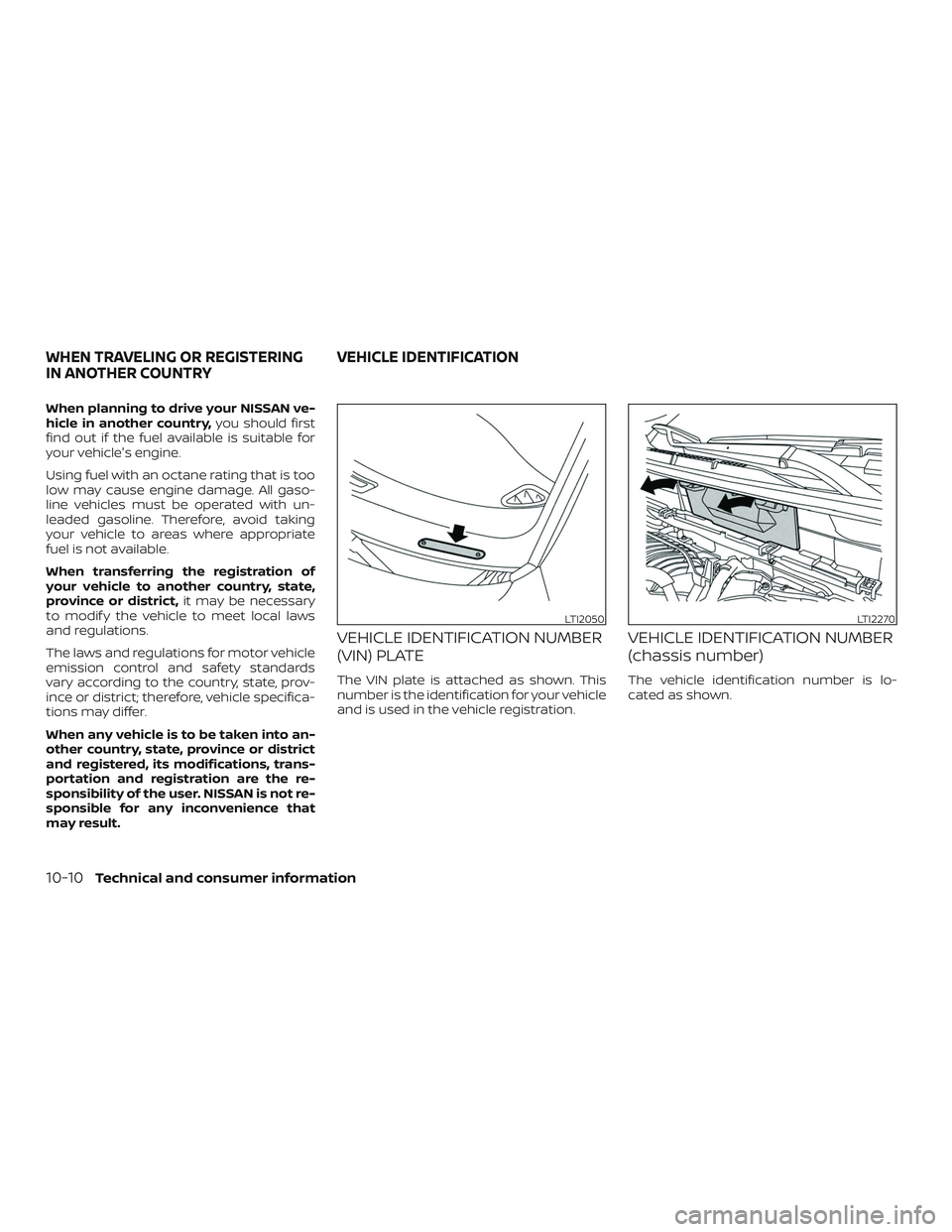
VEHICLE IDENTIFICATION NUMBER
(VIN) PLATE
The VIN plate is attached as shown. This
number is the identification for your vehicle
and is used in the vehicle registration.
VEHICLE IDENTIFICATION NUMBER
(chassis number)
The vehicle identification number is lo-
cated as shown.
LTI2050LTI2270
WHEN TRAVELING OR REGISTERING
IN ANOTHER COUNTRY VEHICLE IDENTIFICATION
10-10Technical and consumer information
Page 544 of 567
1. Apply and hold the brake pedal.
2. Have someone place blocks on thedownhill side of the vehicle and trailer
wheels.
3. Af ter the wheel blocks are in place, slowly release the brake pedal until the
blocks absorb the vehicle load.
4. Apply the parking brake.
5. Shif t the transmission into P (Park).
6. Turn off the engine.
To drive away: 1. Start the vehicle.
2. Apply and hold the brake pedal.
3. Shif t the transmission into gear.
4. Release the parking brake.
5. Drive slowly until the vehicle and trailer are clear from the blocks.
6. Apply and hold the brake pedal.
7. Have someone retrieve and store the blocks. ∙ While going downhill, the weight of the
trailer pushing on the tow vehicle may
decrease overall stability. Therefore, to
maintain adequate control, reduce your
speed and shif t to a lower gear. Avoid
long or repeated use of the brakes
when descending a hill, as this reduces
their effectiveness and could cause
overheating. Shif ting to a lower gear in-
stead provides “engine braking” and re-
duces the need to brake as frequently.
∙ If the engine coolant temperature rises to a high temperature, refer to “If your
vehicle overheats” in the “In case of
emergency” section of this owner’s
manual.
∙ Trailer towing requires more fuel than normal circumstances.
∙ Avoid towing a trailer for your vehicle’s first 500 miles (805 km).
∙ For the first 500 miles (805 km) that you do tow, do not drive over 50 mph
(80 km/h).
∙ Have your vehicle serviced more of ten than at intervals specified. For addi-
tional information, refer to "Mainte-
nance schedules" in the "Maintenance
and schedules" section of this manual. ∙ When making a turn, your trailer wheels
will be closer to the inside of the turn
than your vehicle wheels. To compen-
sate for this, make a larger than normal
turning radius during the turn.
∙ Crosswinds and rough roads will ad- versely affect vehicle/trailer handling,
possibly causing vehicle sway. When
being passed by larger vehicles, be pre-
pared for possible changes in cross-
winds that could affect vehicle han-
dling.
Do the following if the trailer begins to
sway: 1. Take your foot off the accelerator pedal to allow the vehicle to coast and steer
as straight ahead as the road condi-
tions allow. This combination will help
stabilize the vehicle
– Do not correct trailer sway by steer- ing or applying the brakes.
2. When the trailer sway stops, gently ap- ply the brakes and pull to the side of the
road in a safe area.
3. Try to rearrange the trailer load so it is balanced as described in this section.
Technical and consumer information10-25
Page 552 of 567
11 Index
2nd row bench seat adjustment......1-6
A
ActiveRideControl(ARC) .........5-160
Air bag (See supplemental restraint
system) .................... .1-46
Air bag system Front (See supplemental front impact
airbagsystem)..............1-54
Air bag warning labels ............1-65
Airbagwarninglight..........1-66, 2-17
Air bag warning light,
supplemental ..............1-66, 2-17
Air cleaner housing filter ..........8-18
Air conditioner Air conditioner operation ....4-32,4-38
Air conditioner specification label . .10-12
Air conditioner system refrigerant and oil
recommendations ............10-7
Air conditioner system refrigerant
recommendations ............10-7
Heater and air conditioner
controls...............4-29,4-38
Servicing air conditioner ........4-41
Air flow charts .................4-33
Alarm system
(See vehicle security system) .......2-42
All-Wheel Drive .............5-148,6-15
All-Wheel Drive (AWD) LOCK switch . . .5-149
Anchor point locations ...........1-29Antenna
....................4-42
Antifreeze ...................5-167
Anti-lock brake warning light ........2-12
Anti-lock Braking System (ABS) ......5-154
Armrests.................... .1-6
Audible reminders ..............2-20
Autolightswitch ...............2-49
Automatic Automatic drive positioner . . . .3-41, 3-43
Automatic power window switch . . .2-72
Automatic anti-glare inside mirror ....3-38
Automaticbrakehold............5-31
Automatic door locks .............3-7
Automatic drive positioner ......3-41, 3-43
Automatic Emergency Braking
(AEB) ................2-12,2-16,5-124
Automatic Emergency Braking (AEB) with
Pedestrian Detection ............5-132
AWD...................5-148,6-15
B
Battery..................5-167,8-13 Charge warning light ...........2-13
Battery replacement ............8-25
Keyfob...................8-25
NISSAN Intelligent Key® ......8-25,8-27
Before starting the engine .........5-19
Belt(Seedrivebelt)..............8-17
Blind Spot Warning (BSW) ..........5-46
Booster seats .................1-42 Brake
Anti-lock Braking System (ABS) ....5-154
Brakefluid.................8-10
Brakelight(Seestoplight).......8-30
Brakesystem ..............5-153
Brakewarninglight............2-13
Brakewearindicators ......2-20,8-22
Parking brake operation ........5-28
Self-adjustingbrakes..........8-22
Brake Assist .................5 -155
Brakefluid...................8-10
Brakes .....................8-22
Brakesystem ................5-153
Break-in schedule ..............5-146
Brightness control Instrument panel .............2-53
Bulb check/instrument panel .......2
-12
Bulb replacement ..............8-30
C
Capacities and recommended fuel/
lubricants....................10-2
Cargocover..................2-68
Cargolight...................2-78
Cargo
(See vehicle loading information) .....10-13
Car phone or CB radio ...........4-42
Chassis control ...............5-158
Checking bulbs ................2-12
Check tire pressure .............2-36
Page 553 of 567
Childrestraints........1-21, 1-22, 1-24, 1-26LATCH (Lower Anchors and Tethers for
CHildren)System..............1-26
Precautions on child
restraints..........1-24, 1-31, 1-37, 1-42
Top tether strap anchor point
locations...................1-29
Child restraint with top tether strap . . . .1-28
Child safety rear door lock ..........3-7
Chimes, audible reminders .........2-20
Cleaningexteriorandinterior......7-2,7-4
C.M.V.S.S. certification label .........10-11
Coldweatherdriving.............5-167
Console box ..................2-64
Console light ..................2-76
Continuously Variable Transmission
(CVT) ....................5-14,5-21
Continuously Variable Transmission
(CVT) fluid ..................8-10
Driving with Continuously Variable
Transmission (CVT) .........5-14,5-21
Controls Heater and air conditioner
controls................4-29,4-38
Coolant Capacities and recommended
fuel/lubricants...............10-2
Changing engine coolant .........8-5
Checking engine coolant level ......8-5
Engine coolant temperature gauge . .2-6
Corrosionprotection..............7-7
Cruisecontrol.................5-65
Cupholders ..................2-65 D
Defroster switch Rear window and outside mirror
defrosterswitch..............2-47
Dimensions and weights ...........10-9
Dimmer switch for instrument panel . . .2-53
Display......................2-21
Door locks ....................3-5
Drivebelt.....................8-17
Drive positioner, Automatic ......3-41,3-43
Driving Cold weather driving ...........5-167
Driving with Continuously Variable
Transmission (CVT) .........5-14,5-21
Precautions when starting and
driving..................5-4,5-11
Drivingthevehicle...............5-21
Dynamic driver assistance switch
(for vehicles without ProPILOT Assist) . . .2-57
E
E-call (SOS) Button ..............2-60
ECO mode switch ...............5-34
Economy - fuel ................5-148
Emergency engine shutoff ..........5-17
Emission control information label . . . .10-11
Emission control system warranty . . . .10-28
Engine Before starting the engine ........5-19
Capacities and recommended
fuel/lubricants...............10-2
Changing engine coolant .........8-5
Changing engine oil ............8-7 Changing engine oil filter
.........8-7
Checking engine coolant level ......8-5
Checking engine oil level .........8-6
Engine compartment check
locations...................8-3
Engine coolant temperature gauge . .2-6
Engine cooling system ..........8-4
Engine oil ...................8-6
Engine oil and oil filter
recommendation .............10-6
Engine oil viscosity .............10-6
Engine serial number ...........10-11
Engine specifications ...........10-8
Starting the engine ............5-19
Engine coolant temperature gauge ....2-6
EventDatarecorders.........10-30,10-31
Exhaust gas (Carbon monoxide) .......5-4
Explanation of maintenance items .....9-2
Explanation of scheduled maintenance
items .......................9-5
Extended storage switch ..........2-62
Eyeglasscase.................2-65
F
Flashers
(Seehazardwarningflasherswitch)....6-2
Flattire......................6-3
F l
oormatpositioningaid...........7-6
Fluid Brakefluid..................8-10
Capacities and recommended
fuel/lubricants...............10-2
Continuously Variable Transmission
(CVT) fluid ..................8-10
11-2
Page 554 of 567
Engine coolant...............8-4
Engine oil ...................8-6
Windshield-washer fluid .........8-11
F.M.V.S.S. certification label ..........10-11
Foglightswitch................2-54
Front air bag system
(See supplemental restraint system) . . .1-54
Front-door pocket ...............2-63
Front power seat adjustment ........1-4
Frontseats....................1-2
Fuel Capacities and recommended
fuel/lubricants...............10-2
Fuel economy ...............5-148
Fuel-filler door and cap ..........3-34
Fuel gauge ..................2-7
Fueloctanerating.............10-5
Fuel recommendation ..........10-3
Loose fuel cap warning .........2-36
Fuelefficientdrivingtips ..........5-147
Fuel-filler door .................3-33
Fuel gauge ....................2-7
Fuses .......................8-23
Fusiblelinks...................8-23
G
Garage door opener, HomeLink® Universal
Transceiver .........2-78,2-79,2-81,2-82
Gascap.....................3-34
Gauge Engine coolant temperature gauge . .2-6
Fuel gauge ..................2-7
Odometer ..................2-5
Speedometer ................2-4 Tachometer
.................2-6
Trip odometer ................2-5
General maintenance .............9-2
Glovebox....................2-64
H
Hazard warning flasher switch ........6-2
Headlight and turn signal switch ......2-48
Headlightcontrolswitch...........2-48
Headlights...................8-28
Headrestraints .................1-8
Heatedseats..................2-55
Heated steering wheel switch .......2-56
Heater Heater and air conditioner
controls................4-29,4-38
Heater operation ..........4-30,4-39
Hill start assist system ............5-161
HomeLink® Universal
Transceiver .........2-78,2-79,2-81,2-82
Hood .......................3-25
Hook Luggage hook ...............2-68
Horn.......................2-55
I
Ignition switch .................5-14
Push-button ignition switch .......5-15
Immobilizer system .......2-44,5-15,5-18
Important vehicle information label . . . .10-11
In-cabinmicrofilter ..............8-19
Increasing fuel economy ..........5-148Indicator
NISSAN Intelligent Key® battery discharge
indicator...................5-18
Indicator lights and audible reminders
(See warning/indicator lights and audible
reminders) .................2-12,2-17
Informationdisplay............. .2-21
Inside automatic anti-glare mirror .....3-38
Instrument brightness control .......2-53
Instrument panel .............0-6,2-2
Instrument panel dimmer switch .....2-53
Intelligent Around View Monitor .......4-11
Intelligent Cruise Control (ICC)
(f or
vehicles without ProPILOT Assist) . . .5-67
Intelligent Cruise Control (ICC)
(for vehicles with ProPILOT Assist) ....5-103
Intelligent Engine Brake (I-EB) .......5-159
Intelligent Key system Key operating range ............3-12
Key operation ................3-13
Mechanical key ...............3-4
Remote keyless entry operation ....3-16
Troubleshooting guide ..........3-20
Warning signals ..............3-20
Intelligent Lane Intervention (I-LI) .....5-40
Intelligent Trace Control (I-TC) .......5-158
Interiorlight................2-75,2-77
ISOFIX child restraints .............1-26
J
Jumpstarting...............6 -11, 8-16
11-3
Page 555 of 567
K
Key.........................3-2
Key fob battery replacement ........8-25
Keyless entry With Intelligent Key system
(See Intelligent Key system) .......3-16
Without Intelligent Key system
(See remote keyless entry
system) ...............3-2,3-8,3-9
Keys NISSAN Intelligent Key® .......3-3,3-10
NISSAN Vehicle Immobilizer System
keys......................3-4
L
Label Tire and Loading Information label . .10-12
Labels Air conditioner specification label . . .10-12
C.M.V.S.S. certification label .......10-11
Emission control information label . .10-11
Engine serial number ...........10-11
F.M.V.S.S. certification label ........10-11
Tire and Loading Information label . .10-12
Vehicle identification number (VIN) . .10-10
Vehicle identification number (VIN)
plate.....................10-10
Warning labels (for SRS) ..........1-65
Lane Departure Warning (LDW) .......5-35
LATCH (Lower Anchors and Tethers for
CHildren)System............... .1-26
LED Daytime Running Lights (DRL)
system ......................2-52 License plate
Installing the license plate .......10-12
Liftgate .....................3-26
Liftgaterelease.................3-31
Light Airbagwarninglight........1-66, 2-17
Brakelight(Seestoplight)........8-30
Bulb check/instrument panel ......2-12
Bulb replacement .............8-30
Charge warning light ...........2-13
Console light ................2-76
ExteriorandInteriorlights........8-30
Foglights..................8-29
Foglightswitch..............2-54
Headlight and turn signal switch ....2-48
Headlightcontrolswitch.........2-48
Headlights.................8-28
Interiorlight..............2-75,2-77
Lightbulbs.................8-28
Low tire pressure warning light .....2-14
Low windshield-washer fluid warning
light......................2-36
Passenger air bag and status light . . .1-57
Personal lights ...............2-77
Security indicator light ..........2-19
Spotlights(Seemaplight)........2-76
Warning/indicator lights and audible
reminders ...............2-12,2-17
Lights......................8-28 Maplights..................2-76
Lock Child safety rear door lock ........3-7
Door locks ..................3-5
Liftgaterelease...............3-31
Power door locks ............3-6,3-7
Loose fuel cap warning ........2-36,3-35Lowfuelwarninglight.........2-15,2-36
Low tire pressure warning light
.......2-14
Low windshield-washer fluid warning
light........................2-36
Luggage hook .................2-68
Luggage rack (see roof rack) ........2-70
Luggage
(See vehicle loading information) .....10-13
M
Maintenance General maintenance ...........9-2
Insidethevehicle..............9-3
Maintenance precautions .........8-2
Outsidethevehicle.............9-2
Seat belt maintenance ..........1-21
Under the hood and vehicle .......9-4
Maintenance log ................9-11
Maintenance requirements ..........9-2
Maintenance schedules ............9-7
Maintenance under severe operation
conditions....................9-10
Malfunctionindicatorlight..........2-19
Manual front seat adjustment ........1-3
Maplights....................2-76
Memory Seat ...............3-41,3-43
Meters and gauges ...............
2
-4
Instrument brightness control .....2-53
Mirror Automatic anti-glare inside mirror. . .3-38
Outsidemirrors..............3-40
Rearview ..................3-38
Vanitymirror................3-37
Mirrors......................3-38
11-4
Page 556 of 567
Moonroof..................2-73,7-5
Moving Object Detection (MOD) ......4-23
N
NissanConnect® Owner's Manual ......4-2
NISSAN Intelligent Key® .........3-3,3-10
NISSAN Intelligent Key® battery discharge
indicator.....................5-18
NISSAN Vehicle Immobilizer
System...............2-44,5-15,5-18
O
Octane rating (See fuel octane rating). . .10-5
Odometer ....................2-5
Oil Capacities and recommended
fuel/lubricants...............10-2
Changing engine oil ............8-7
Changing engine oil filter .........8-7
Checking engine oil level .........8-6
Engine oil ...................8-6
Engine oil and oil filter
recommendation .............10-6
Engine oil viscosity .............10-6
Outsidemirrors................3-40
Overhead sunglasses holder ........2-65
Overheat Ifyourvehicleoverheats.........6-13
Owner's manual order form ........10-32
Owner's manual/service manual order
information..................10-32 P
Parking Parking brake operation .........5-28
Parking/parkingonhills.........5-152
Parkingbrake...........2-13,2-18,5-28
Personal lights .................2-77
Power Power door locks ............3-6,3-7
Poweroutlet................2-60
Powerrearwindows ...........2-72
Power steering system .........5-152
Powerwindows ..............2-71
Rearpowerwindows...........2-72
Poweroutlet..................2-60
Powersteering................5-152
Precautions Maintenance precautions .........8-2
On-pavement and off-road driving
precautions .................5-9
Precautions on booster
seats............1-24, 1-31, 1-37, 1-42
Precautions on child
restraints..........1-24, 1-31, 1-37, 1-42
Precautions on seat belt usage .....1-12
Precautions on supplemental restraint
system ....................1-46
Precautions when starting and
driving..................5-4,5-11
ProPILOT Assist .................5-91
Push starting ..................6-13 R
Radio Car phone or CB radio ..........4-42
Readiness for inspection maintenance (I/M)
test.......................10-30
Rear Automatic Braking (RAB) .......5-141
RearCrossTrafficAlert(RCTA)........5-57
Rear Door Alert .............2-41,2-59
Rearpowerwindows.............2-72
Rear Sonar System (RSS) ..........5-162
Rearviewmirror................3-38
RearViewMonitor................4-3 Adjustingthescreen............4-8
Rear window and outside mirror defroster
switch......................2-47
Rear window wiper and washer
switches .....................2-46
Recommended Fluids ............10-2
Recorders EventData.............10-30,10-31
Refrigerant recommendation ........10-7
Registering a vehicle in another
country .....................10-10
Remote Engine Start ..........3-22,5-21
Remote keyless entry system . . .3-2, 3-8, 3-9
Reporting safety defects (US only) . . . .10-29
Roofrack....................2-70
S
Safety Child safety rear door lock ........3-7
C h
ildseatbelts......1-24, 1-31, 1-37, 1-42
Reporting safety defects (US only) . .10-29
11-5
Page 558 of 567
Tire and Loading Information label . .10-12
Tire chains.................8-39
Tire pressure ................8-32
Tirerotation ................8-40
Types of tires ................8-38
Uniform tire quality grading ......10-27
Wheels and tires ..............8-32
Wheel/tire size ...............10-9
Tire pressure Low tire pressure warning light .....2-14
Tire Pressure Monitoring System (TPMS) . .5-5
Toptetherstrapchildrestraint.......1-28
Towing 4-wheel drive models ...........6-16
Flattowing.................10-26
Towing load/specification .......10-20
Towtrucktowing .............6-14
Trailertowing ...............10-17
Towingatrailer................10-17
Transceiver HomeLink® Universal
Transceiver .......2-78,2-79,2-81,2-82
Transmission Continuously Variable Transmission (CVT)
fluid......................8-10
Driving with Continuously Variable
Transmission (CVT) .........5-14,5-21
Travel (See registering a vehicle in another
country) .....................10-10
Trip odometer ..................2-5
Turn signal switch ...............2-53
U
Uniform tire quality grading ........10-27USB/iPod® Charging Ports
.........4-42
V
Vanitymirror..................3-37
Variable voltage control system ......8-17
Vehicle dimensions and weights ......10-9
Vehicle Dynamic Control (VDC) OFF
switch......................2-58
Vehicle Dynamic Control (VDC)
system .....................5-155
Vehicle identification .............10-10
Vehicle identification number (VIN) . . . .10-10
Vehicle identification number (VIN)
(Chassis number) ...............10-10
Vehicle identification number (VIN)
plate.......................10-10
Vehicle immobilizer system . .2-44, 5-15, 5-18
VehicleInformationDisplay.........2-21
Vehicle loading information ........10-13
Vehiclerecovery.............6-16,6-17
Vehicle security system ...........2-42
Vehicle security system (NISSAN Vehicle
Immobilizer System), engine
start.................2-44,5-15,5-18
Ventilators ...................4-28
Visors.......................3-37
W
Warning Airbagwarninglight........1-66, 2-17
Anti-lock brake warning light ......2-12
Battery charge warning light ......2-13Brakewarninglight............2-13
Hazard warning flasher switch
......6-2
Loose fuel cap warning ......2-36, 3-35
Lowfuelwarninglight.......2-15,2-36
Lowtirepressurewarninglight.....2-14
Low windshield-washer fluid warning
light......................2-36
Passenger air bag and status light . . .1-57
Seatbeltwarninglight .......1-15, 2-17
Supplemental air bag warning
light...................1-66, 2-17
TPMS......................2-4
Vehicle security system .........2-42
Warning/indicator lights and audible
reminders ...............2-12, 2-17
Warning labels (for SRS) ..........1-65
Warning/indicator lights and audible
reminders .................2-12,2-17
Audible reminders ..........2-12,2-17
Checking bulbs ...............2-12
Indicatorlights............2-12,2-17
Warninglights ............2-12,2-17
Warninglights ..............2-12,2-17
Warning lights, indicator lights and
audible reminders ...............2-11
Washer switch Rear window wiper and washer
switches ...................
2
-46
Weights (See dimensions and weights) . .10-9
Wheels and tires ................8-32
Wheel/tire size .................10-9
When traveling or registering in another
country .....................10-10
Windows.....................2-71 Locking passengers' windows .....2-71
Powerrearwindows ...........2-72
11-7
Page 564 of 567
FUEL RECOMMENDATION:
Use unleaded regular gasoline with an oc-
tane rating of at least 87 AKI (Anti-Knock
Index) number (Research octane number
91).
CAUTION
∙ Only vehicles with the E-85 filler doorlabel can operate on E-85. Fuel system
or other damage can occur if E-85 is
used in vehicles that are not designed
to run on E-85.
∙ Using a fuel other than that specified could adversely affect the emission
control system, and may also affect
the warranty coverage.
∙ Under no circumstances should a leaded gasoline be used, because this
will damage the three-way catalyst. ∙ Do not use a fuel containing more
than 15% ethanol in your vehicle. Your
vehicle is not designed to run on a fuel
containing more than 15% ethanol.
Using a fuel containing more than 15%
ethanol in a vehicle not specifically
designed for a fuel containing more
than 15% ethanol can adversely affect
the emission control devices and sys-
tems of the vehicle. Damage caused
by such fuel is not covered by the
NISSAN New Vehicle Limited Warranty.
∙ Do not use fuel that contains the oc- tane booster methylcyclopentadienyl
manganese tricarbonyl (MMT). Using
fuel containing MMT may adversely
affect vehicle performance and ve-
hicle emissions. Not all fuel dispens-
ers are labeled to indicate MMT con-
tent, so you may have to consult your
gasoline retailer for more details.
Note that Federal and California laws
prohibit the use of MMT in reformu-
lated gasoline. ∙ U.S. government regulations require
ethanol dispensing pumps to be iden-
tified by a small, square, orange and
black label with the common abbre-
viation or the appropriate percentage
for that region.
For additional information, refer to “Recom-
mended fluids/lubricants and capacities”
in the “Technical and consumer informa-
tion” section of this manual.
ENGINE OIL RECOMMENDATION:
For additional information, refer to “Recom-
mended fluids/lubricants and capacities”
in the “Technical and consumer informa-
tion” section of this manual.
COLD TIRE PRESSURE:
For additional information, refer to “Tire and
Loading Information label” in the “Technical
and consumer information” section of this
manual.
The label is typically located on the driver
side center pillar or on the driver’s door. For
additional information, refer to “Wheels and
tires” in the “Do-it-yourself ” section of this
manual.
GAS STATION INFORMATION