ignition NISSAN ROGUE 2021 Owner´s Manual
[x] Cancel search | Manufacturer: NISSAN, Model Year: 2021, Model line: ROGUE, Model: NISSAN ROGUE 2021Pages: 556, PDF Size: 2.7 MB
Page 456 of 556
8-2Do-it-yourself
When performing any inspection or main-
tenance work on your vehicle, always
take care to prevent serious accidental
injury to yourself or damage to the
vehicle. The following are general precau-
tions which should be closely observed.
WARNING
.Park the vehicle on a level sur-
face, apply the parking brake
securely and block the wheels to
prevent the vehicle from moving.
Push the park button to shift to
the P (Park) position.
. Be sure the ignition switch is in
the OFF position when perform-
ing any parts replacement or
repairs.
. If you must work with the engine
running, keep your hands, cloth-
ing, hair and tools away from
moving fans, belts and any other
moving parts.
. It is advisable to secure or re-
move any loose clothing and
remove any jewelry, such as
rings, watches, etc. before work-
ing on your vehicle. .
Always wear eye protection
whenever you work on your ve-
hicle.
. If you must run the engine in an
enclosed space such as a garage,
be sure there is proper ventilation
for exhaust gases to escape.
. Never get under the vehicle while
it is supported only by a jack. If it
is necessary to work under the
vehicle, support it with safety
stands.
. Because the fuel lines are under
high pressure even when the
engine is off, it is recommended
you visit a NISSAN dealer for
service of the fuel filter or fuel
lines.
. Keep smoking materials, flame
and sparks away from fuel and
the battery.
. On gasoline engine models with
the Multiport Fuel Injection (MFI)
system, the fuel filter and fuel
lines should be serviced because
the fuel lines are under high
pressure even when the engine
is turned off. It is recommended
that you visit a NISSAN dealer for
this service. .
Your vehicle is equipped with an
automatic engine cooling fan. It
may come on at any time without
warning, even if the ignition
switch is in the OFF position and
the engine is not running. To
avoid injury, always disconnect
the negative battery cable before
working near the fan.
CAUTION
.Do not work under the hood while
the engine is hot. Turn the engine
off and wait until it cools down.
. Avoid direct contact with used
engine oil and coolant. Impro-
perly disposed engine oil, and
engine coolant and/or other ve-
hicle fluids can damage the en-
vironment. Always conform to
local regulations for disposal of
vehicle fluid.
. Never leave the engine or the CVT
related component harnesses
disconnected while the ignition
switch is in the ON position.
. Never connect or disconnect the
battery or any transistorized
component while the ignition
MAINTENANCE PRECAUTIONS
Page 467 of 556
WAI0223X
CAUTION
.Do not ground accessories di-
rectly to the battery terminal.
Doing so will bypass the variable
voltage control system and the
vehicle battery may not charge
completely.
. Use electrical accessories with
the engine running to avoid dis-
charging the vehicle battery.
The variable voltage control system mea-
sures the amount of electrical discharge
from the battery and controls voltage generated by the generator.
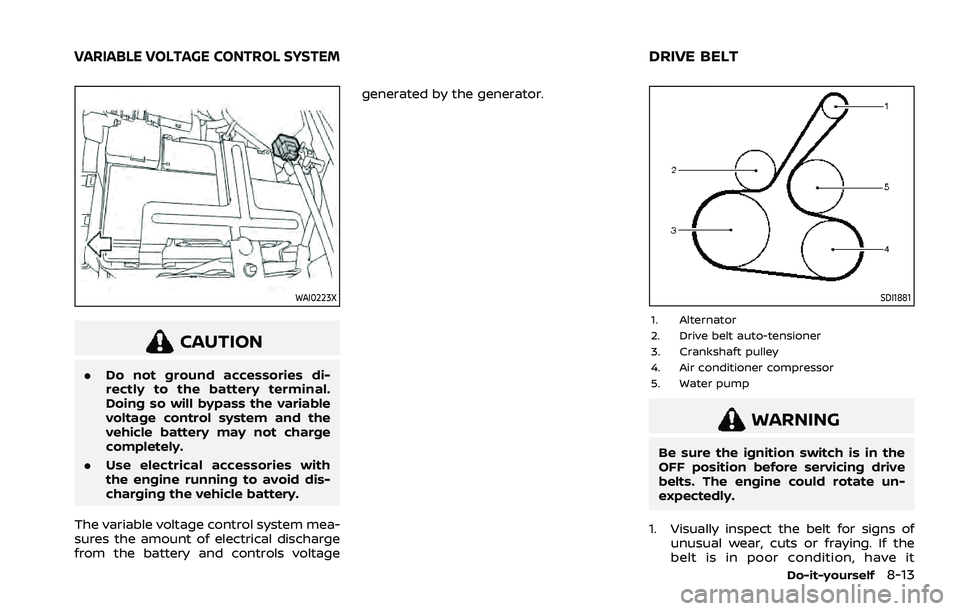
SDI1881
1. Alternator
2. Drive belt auto-tensioner
3. Crankshaft pulley
4. Air conditioner compressor
5. Water pump
WARNING
Be sure the ignition switch is in the
OFF position before servicing drive
belts. The engine could rotate un-
expectedly.
1. Visually inspect the belt for signs of unusual wear, cuts or fraying. If the
belt is in poor condition, have it
Do-it-yourself8-13
VARIABLE VOLTAGE CONTROL SYSTEMDRIVE BELT
Page 468 of 556
8-14Do-it-yourself
replaced. It is recommended that you
visit a NISSAN dealer for this service.
2. Have the belt condition checked reg- ularly.
WARNING
Be sure the engine and ignition
switch are off and that the parking
brake is applied.
CAUTION
Be sure to use the correct socket to
remove the spark plugs. An incorrect
socket can damage the spark plugs.
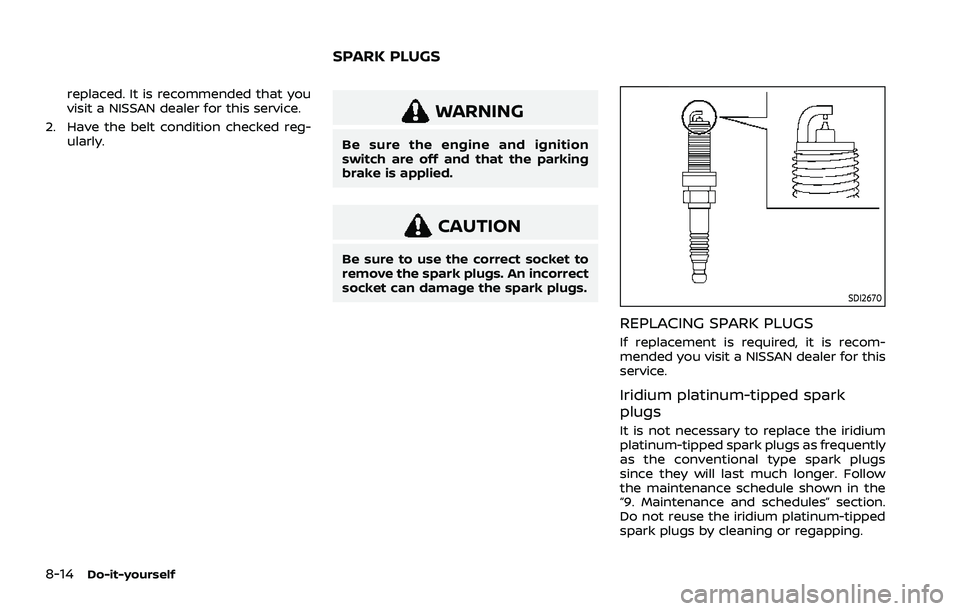
SDI2670
REPLACING SPARK PLUGS
If replacement is required, it is recom-
mended you visit a NISSAN dealer for this
service.
Iridium platinum-tipped spark
plugs
It is not necessary to replace the iridium
platinum-tipped spark plugs as frequently
as the conventional type spark plugs
since they will last much longer. Follow
the maintenance schedule shown in the
“9. Maintenance and schedules” section.
Do not reuse the iridium platinum-tipped
spark plugs by cleaning or regapping.
SPARK PLUGS
Page 472 of 556

8-18Do-it-yourself
WAI0124X
ENGINE COMPARTMENT
WARNING
Never use a fuse of a higher or lower
amperage rating than that specified
on the fuse box cover. This could
damage the electrical system or
electronic control units or cause a
fire.
If any electrical equipment does not
operate, check for an open fuse.
1. Be sure the ignition switch is turned off and the headlights are off. 2. Open the engine hood.
3. Remove the fuse/fusible link box cov-
er by using a suitable tool and pushing
the tab.
4. Locate the fuse that needs to be replaced.
5. Remove the fuse using the fuse puller located in the passenger compart-
ment fuse box.
SDI1753
6. If the fuse is open, replace it with a
new fuse.
7. If a new fuse also opens, have the electrical system checked and re-
paired. It is recommended you visit a
NISSAN dealer for this service.
Fusible links
If any electrical equipment does not
operate and the fuses are in good condi-
tion, check the fusible links. If any of these
fusible links are melted, replace only with
genuine NISSAN parts.
For checking and replacing the fusible
links, it is recommended you visit a
NISSAN dealer.
FUSES
Page 473 of 556

WAI0205X
PASSENGER COMPARTMENT
WARNING
Never use a fuse of a higher or lower
amperage rating than that specified
on the fuse box cover. This could
damage the electrical system or
electronic control units or cause a
fire.
If any electrical equipment does not
operate, check for an open fuse.
1. Be sure the ignition switch is turned off and the headlights are off. 2. Remove the fuse box cover.
3. Remove the fuse with the fuse puller
.
SDI1753
4. If the fuse is open, replace it with a
new fuse.
5. If a new fuse also opens, have the electrical system checked and re-
paired. It is recommended you visit a
NISSAN dealer for this service.
Do-it-yourself8-19
Page 474 of 556
8-20Do-it-yourself
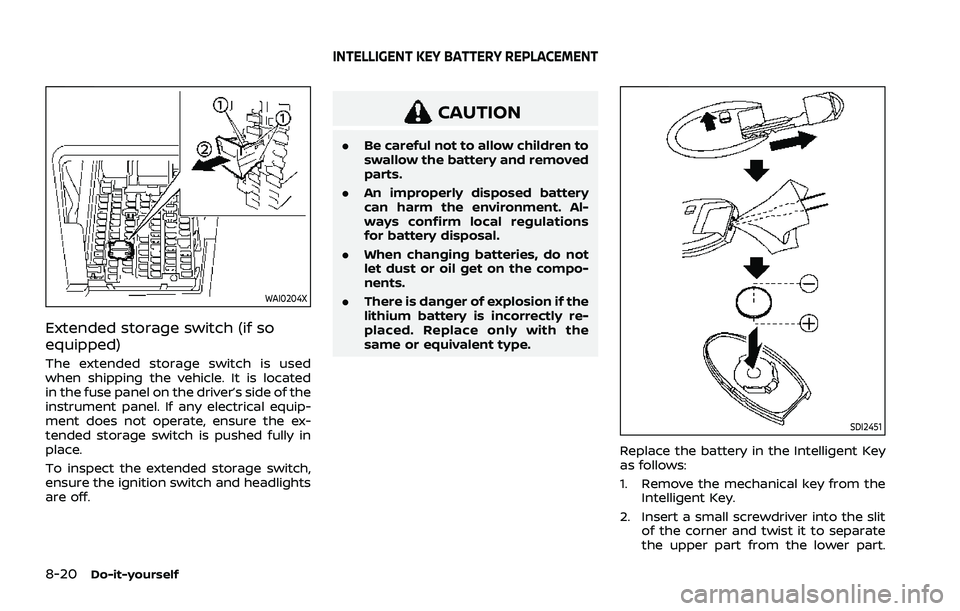
WAI0204X
Extended storage switch (if so
equipped)
The extended storage switch is used
when shipping the vehicle. It is located
in the fuse panel on the driver’s side of the
instrument panel. If any electrical equip-
ment does not operate, ensure the ex-
tended storage switch is pushed fully in
place.
To inspect the extended storage switch,
ensure the ignition switch and headlights
are off.
CAUTION
.Be careful not to allow children to
swallow the battery and removed
parts.
. An improperly disposed battery
can harm the environment. Al-
ways confirm local regulations
for battery disposal.
. When changing batteries, do not
let dust or oil get on the compo-
nents.
. There is danger of explosion if the
lithium battery is incorrectly re-
placed. Replace only with the
same or equivalent type.
SDI2451
Replace the battery in the Intelligent Key
as follows:
1. Remove the mechanical key from the
Intelligent Key.
2. Insert a small screwdriver into the slit of the corner and twist it to separate
the upper part from the lower part.
INTELLIGENT KEY BATTERY REPLACEMENT
Page 517 of 556
.If a methanol blend is used, it should
contain no more than 5% methanol
(methyl alcohol, wood alcohol). It
should also contain a suitable
amount of appropriate cosolvents
and corrosion inhibitors. If not prop-
erly formulated with appropriate
cosolvents and corrosion inhibitors,
such methanol blends may cause
fuel system damage and/or vehicle
performance problems. At this time,
sufficient data is not available to
ensure that all methanol blends are
suitable for use in NISSAN vehicles.
If any driveability problems such as en-
gine stalling and difficult hot-starting are
experienced after using oxygenate-blend
fuels, immediately change to a non-oxy-
genate fuel or a fuel with a low blend of
MTBE.
Take care not to spill gasoline during
refueling. Gasoline containing oxyge-
nates can cause paint damage.
E-15 fuel
E-15 fuel is a mixture of approximately
15% fuel ethanol and 85% unleaded gaso-
line. E-15 can only be used in vehicles
designed to run on E- 15 fuel. U.S. govern-
ment regulations require fuel ethanol
dispensing pumps to be identified with
small, square, orange and black label with
the common abbreviation or the appro- priate percentage for that region.
E-85 fuel
E-85 fuel is a mixture of approximately
85% fuel ethanol and 15% unleaded gaso-
line. E-85 can only be used in a Flexible
Fuel Vehicle (FFV). Do not use E-85 fuel in
your vehicle. U.S. government regulations
require fuel ethanol dispensing pumps to
be identified by a small, square, orange
and black label with the common abbre-
viation or the appropriate percentage for
that region.
Fuel containing MMT
MMT, or methylcyclopentadienyl manga-
nese tricarbonyl, is an octane boosting
additive. NISSAN does not recommend
the use of fuel containing MMT. Such fuel
may adversely affect vehicle perfor-
mance, including the emissions control
system. Note that while some fuel pumps
label MMT content, not all do, so you may
have to consult your gasoline retailer for
more details.
Aftermarket fuel additives
NISSAN does not recommend the use of
any aftermarket fuel additives (for exam-
ple, fuel injector cleaner, octane booster,
intake valve deposit removers, etc.) which
are sold commercially. Many of these
additives intended for gum, varnish or
deposit removal may contain active sol-
vent or similar ingredients that can be
harmful to the fuel system and engine.
Octane rating tips
Using unleaded gasoline with an octane
rating lower than recommended can
cause persistent, heavy “spark knock”.
(Spark knock is a metallic rapping
noise.) If severe, this can lead to engine
damage. If you detect a persistent
heavy spark knock even when using
gasoline of the stated octane rating, or
if you hear steady spark knock while
holding a steady speed on level roads, it
is recommended you have a NISSAN
dealer correct the condition. Failure to
correct the condition is misuse of the
vehicle, for which NISSAN is not respon-
sible.
Incorrect ignition timing will result in
spark knock, after-run and/or overheat-
ing, which may cause excessive fuel
consumption or engine damage. If any
of the above symptoms are encountered,
have your vehicle checked. It is recom-
mended you visit a NISSAN dealer for
servicing.
However, now and then you may notice
light spark knock for a short time while
accelerating or driving up hills. This is
not a cause for concern, because you
Technical and consumer information10-5
Page 520 of 556

10-8Technical and consumer information
ENGINE
ModelPR25DD
Type Gasoline, 4-cycle, DOHC
Cylinder arrangement 4-cylinder, in-line
Bore × Stroke in (mm)3.504 × 3.937 (89.0 × 100.0)
Displacement cu in (cm
3)151.85 (2,488)
Firing order 1-3-4-2
Idle speed rpm
No adjustment is necessary.
Ignition timing (B.T.D.C.) degree/rpm
Spark plug StandardDXE22H11C
Spark plug gap (Normal) in (mm)0.043 (1.1)
Camshaft operation Timing chain
This spark ignition system complies with the Canadian standard ICES-002.
WHEELS AND TIRES
Road wheel
TypeSize Offset in
(mm)
Conven-
tional 17 × 7.5J 1.57 (40)
18 × 7.5J 1.57 (40)
19 × 7.5J 1.57 (40)
Spare 17 × 4T 1.18 (30)
Tire
Type
SizePressure PSI
(kPa) [Cold]
Con-
ven-
tional 235/65 R17Front: 36
(250)
Rear: 33 (230)
235/60 R18 Front: 33
(230)
Rear: 30 (210)
235/55 R19
Spare T155/80 D17
(2WD)
T165/90 D17
(AWD)
60 (420)
SPECIFICATIONS
Page 534 of 556
10-22Technical and consumer information
.The diameter of the threaded shank of
the hitch ball must be matched to the
ball mount hole diameter. The hitch
ball shank should be no more than
1/16″ smaller than the hole in the ball
mount.
. The threaded shank of the hitch ball
must be long enough to be properly
secured to the ball mount. There
should be at least 2 threads showing
beyond the lock washer and nut.
Ball mount
The hitch ball is attached to the ball
mount and the ball mount is inserted into
the hitch receiver. Choose a proper class
ball mount based on the trailer weight.
Additionally, the ball mount should be
chosen to keep the trailer tongue level
with the ground.
Weight carrying hitches
A weight carrying or “dead weight” ball
mount is one that is designed to carry the
whole amount of tongue weight and
gross weight directly on the ball mount
and on the receiver.
Weight distribution hitch
This type of hitch is also called a “load-
leveling” or “equalizing” hitch. A set of bars
attach to the ball mount and to the trailer
to distribute the tongue weight (hitch
weight) of your trailer. Many vehicles
cannot carry the full tongue weight of a
given trailer, and need some of the
tongue weight transferred through the
frame and pushing down on the front
wheels. This gives stability to the tow
vehicle.
A weight-distributing hitch system (Class
IV) is recommended if you plan to tow
trailers with a maximum weight over
5,000 lbs (2,267 kg). Check with the trailer
and towing equipment manufacturers to
determine if they recommend the use of a
weight-distributing hitch system.
NOTE:
A weight-distributing hitch system may
affect the operation of trailer surge
brakes. If you are considering use of a
weight-distributing hitch system with a
surge brake-equipped trailer, check
with the surge brake, hitch or trailer
manufacturer to determine if and how
this can be done.
Follow the instructions provided by the
manufacturer for installing and using the
weight-distributing hitch system. General set-up instructions are as follows:
1. Park unloaded vehicle on a level sur-
face. With the ignition switch in the ON
position and the doors closed, allow
the vehicle to stand for several min-
utes so that it can level.
2. Measure the height of a reference point on the front and rear bumpers
at the center of the vehicle.
3. Attach the trailer to the vehicle and adjust the hitch equalizers so that the
front bumper height is within 0 - .5
inches (0 - 13 mm) of the reference
height measured in step 2. The rear
bumper should be no higher than the
reference height measured in step 2.
WARNING
Properly adjust the weight distribut-
ing hitch so the rear of the bumper is
no higher than the measured refer-
ence height when the trailer is at-
tached. If the rear bumper is higher
than the measured reference height
when loaded, the vehicle may handle
unpredictably which could cause a
loss of vehicle control and cause
serious personal injury or property
damage.
Page 542 of 556
10-30Technical and consumer information
condition”. Before taking the I/M test,
check the vehicle’s inspection/mainte-
nance test readiness condition. Place the
ignition switch in the ON position without
starting the engine. If the Malfunction
Indicator Light (MIL) comes on steady for
20 seconds and then blinks for 10 sec-
onds, the I/M test condition is “not ready”.
If the MIL does not blink after 20 seconds,
the I/M test condition is “ready”.
It is recommended you visit a NISSAN
dealer to set “ready condition” or to
prepare the vehicle for testing.This vehicle is equipped with an Event
Data Recorder (EDR). The main purpose of
an EDR is to record, in certain crash or
near crash-like situations, such as an air
bag deployment or hitting a road obsta-
cle, data that will assist in understanding
how a vehicle’s systems performed. The
EDR is designed to record data related to
vehicle dynamics and safety systems for a
short period of time, typically 30 seconds
or less. The EDR in this vehicle is designed
to record such data as:
.How various systems in your vehicle
were operating;
. Whether or not the driver and passen-
ger safety belts were buckled/fas-
tened;
. How far (if at all) the driver was
depressing the accelerator and/or
brake pedal; and,
. How fast the vehicle was traveling.
. Sounds are not recorded.
These data can help provide a better
understanding of the circumstances in
which crashes and injuries occur.
NOTE: EDR data are recorded by your
vehicle only if a nontrivial crash situation
occurs; no data are recorded by the EDR
under normal driving conditions and no
personal data (e.g. name, gender, age and
crash location) are recorded. However,
other parties, such as law enforcement, could combine the EDR data with the type
of personally identifying data routinely
acquired during a crash investigation.
To read data recorded by an EDR, special
equipment is required and access to the
vehicle or the EDR is needed. In addition
to the vehicle manufacturer and NISSAN
dealer, other parties, such as law enforce-
ment, that have the special equipment,
can read the information if they have
access to the vehicle or the EDR. EDR data
will only be accessed with the consent of
the vehicle owner or lessee or as other-
wise required or permitted by law.
ADDITIONAL DATA RECORDING (on
vehicles equipped with optional
ProPILOT Assist)
If your vehicle is equipped with the
optional ProPILOT Assist, it will also be
equipped with supplemental data record-
ing function intended to assist in under-
standing how ProPILOT Assist performs in
certain nontrivial crash or near-crash
scenarios. Specifically, supplemental re-
cording is designed to capture the follow-
ing:
.
Driver operational status of the accel-
erator, brakes, steering, etc.
. Detection status of a vehicle ahead
and lane markers
EVENT DATA RECORDERS (EDR)