flat tire NISSAN ROGUE 2021 Owner´s Manual
[x] Cancel search | Manufacturer: NISSAN, Model Year: 2021, Model line: ROGUE, Model: NISSAN ROGUE 2021Pages: 556, PDF Size: 2.7 MB
Page 483 of 556
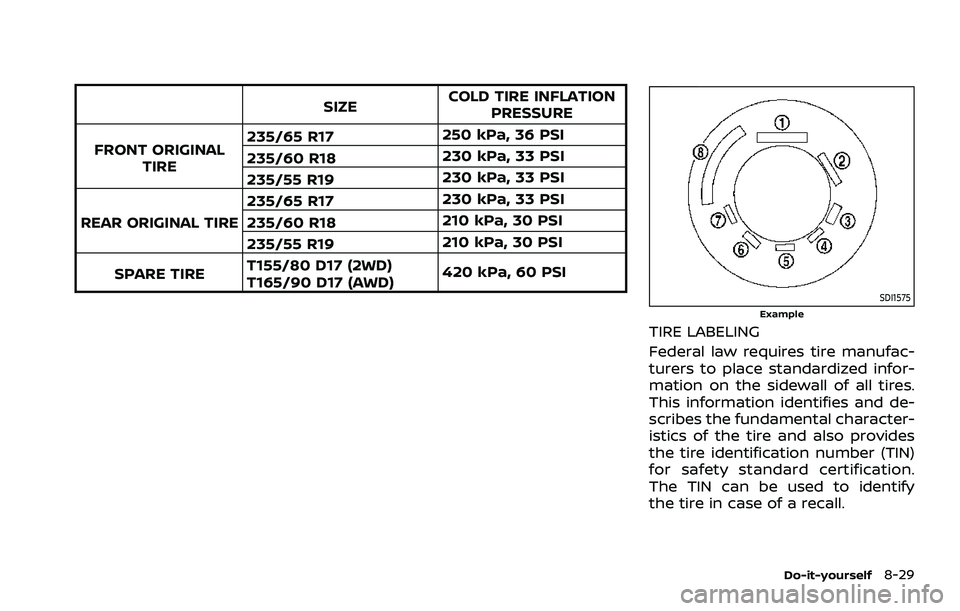
SIZECOLD TIRE INFLATION
PRESSURE
FRONT ORIGINAL TIRE 235/65 R17
250 kPa, 36 PSI
235/60 R18 230 kPa, 33 PSI
235/55 R19 230 kPa, 33 PSI
REAR ORIGINAL TIRE 235/65 R17
230 kPa, 33 PSI
235/60 R18 210 kPa, 30 PSI
235/55 R19 210 kPa, 30 PSI
SPARE TIRE T155/80 D17 (2WD)
T165/90 D17 (AWD) 420 kPa, 60 PSI
SDI1575Example
TIRE LABELING
Federal law requires tire manufac-
turers to place standardized infor-
mation on the sidewall of all tires.
This information identifies and de-
scribes the fundamental character-
istics of the tire and also provides
the tire identification number (TIN)
for safety standard certification.
The TIN can be used to identify
the tire in case of a recall.
Do-it-yourself8-29
Page 485 of 556
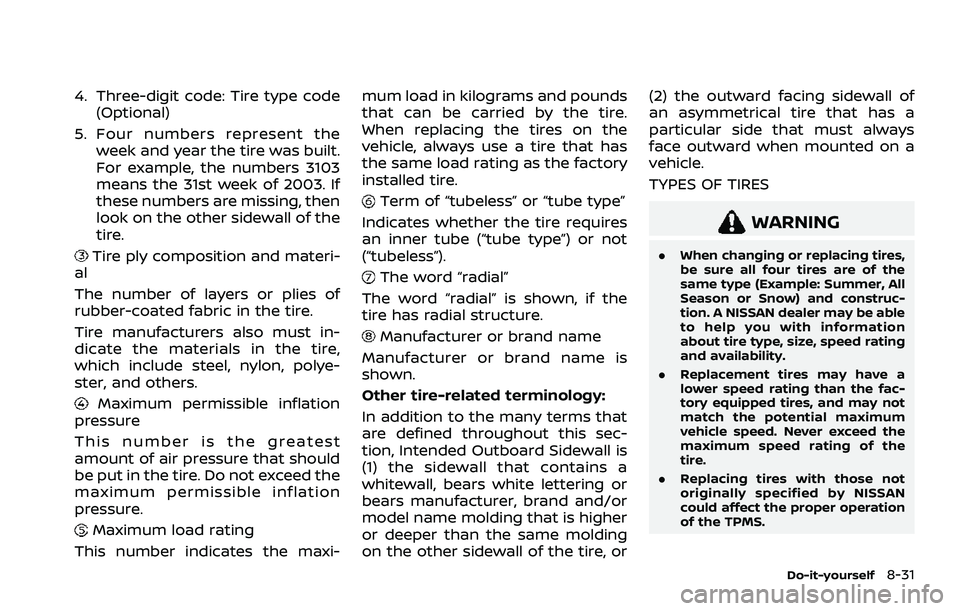
4. Three-digit code: Tire type code(Optional)
5. Four numbers represent the week and year the tire was built.
For example, the numbers 3103
means the 31st week of 2003. If
these numbers are missing, then
look on the other sidewall of the
tire.
Tire ply composition and materi-
al
The number of layers or plies of
rubber-coated fabric in the tire.
Tire manufacturers also must in-
dicate the materials in the tire,
which include steel, nylon, polye-
ster, and others.
Maximum permissible inflation
pressure
This number is the greatest
amount of air pressure that should
be put in the tire. Do not exceed the
maximum permissible inflation
pressure.
Maximum load rating
This number indicates the maxi- mum load in kilograms and pounds
that can be carried by the tire.
When replacing the tires on the
vehicle, always use a tire that has
the same load rating as the factory
installed tire.
Term of “tubeless” or “tube type”
Indicates whether the tire requires
an inner tube (“tube type”) or not
(“tubeless”).
The word “radial”
The word “radial” is shown, if the
tire has radial structure.
Manufacturer or brand name
Manufacturer or brand name is
shown.
Other tire-related terminology:
In addition to the many terms that
are defined throughout this sec-
tion, Intended Outboard Sidewall is
(1) the sidewall that contains a
whitewall, bears white lettering or
bears manufacturer, brand and/or
model name molding that is higher
or deeper than the same molding
on the other sidewall of the tire, or (2) the outward facing sidewall of
an asymmetrical tire that has a
particular side that must always
face outward when mounted on a
vehicle.
TYPES OF TIRES
WARNING
.
When changing or replacing tires,
be sure all four tires are of the
same type (Example: Summer, All
Season or Snow) and construc-
tion. A NISSAN dealer may be able
to help you with information
about tire type, size, speed rating
and availability.
. Replacement tires may have a
lower speed rating than the fac-
tory equipped tires, and may not
match the potential maximum
vehicle speed. Never exceed the
maximum speed rating of the
tire.
. Replacing tires with those not
originally specified by NISSAN
could affect the proper operation
of the TPMS.
Do-it-yourself8-31
Page 487 of 556
stricted tire to vehicle clearance. Vehicles
that can use Class “S” chains are designed
to meet the SAE standard minimum
clearances between the tire and the
closest vehicle suspension or body com-
ponent required to accommodate the
use of a winter traction device (tire chains
or cables). The minimum clearances are
determined using the factory equipped
tire size. Other types may damage your
vehicle. Use chain tensioners when re-
commended by the tire chain manufac-
turer to ensure a tight fit. Loose end links
of the tire chain must be secured or
removed to prevent the possibility of
whipping action damage to the fenders
or underbody. If possible, avoid fully load-
ing your vehicle when using tire chains. In
addition, drive at a reduced speed. Other-
wise, your vehicle may be damaged and/
or vehicle handling and performance may
be adversely affected.
Tire chains must be installed only on
the front wheels and not on the rear
wheels.
Never install tire chains on a TEMPORARY
USE ONLY spare tire.
Do not use tire chains on dry roads.
Driving with tire chains in such conditions
can cause damage to the various me-
chanisms of the vehicle due to some
overstress.
JVM0287X
CHANGING WHEELS AND TIRES
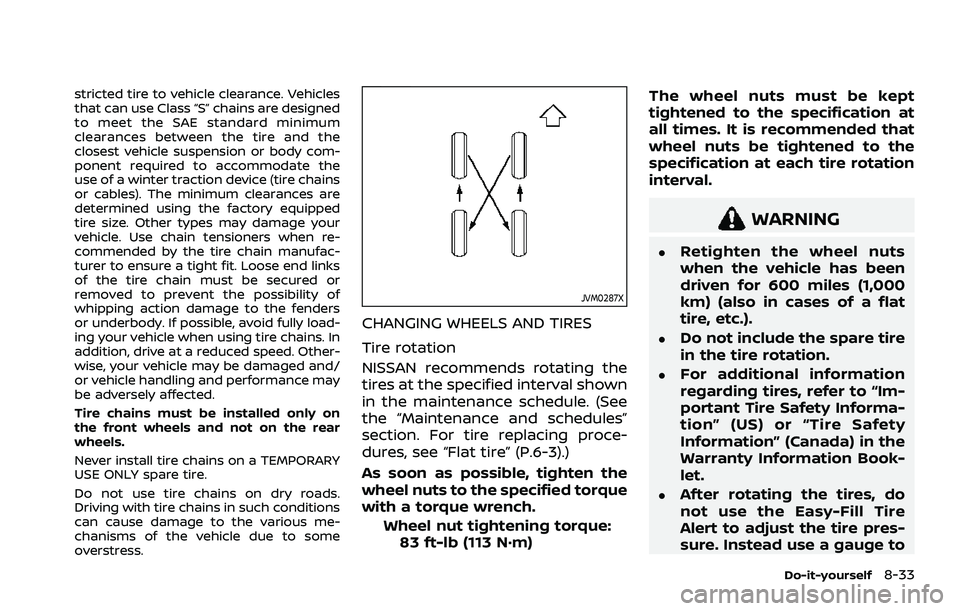
Tire rotation
NISSAN recommends rotating the
tires at the specified interval shown
in the maintenance schedule. (See
the “Maintenance and schedules”
section. For tire replacing proce-
dures, see “Flat tire” (P.6-3).)
As soon as possible, tighten the
wheel nuts to the specified torque
with a torque wrench.Wheel nut tightening torque:83 ft-lb (113 N·m) The wheel nuts must be kept
tightened to the specification at
all times. It is recommended that
wheel nuts be tightened to the
specification at each tire rotation
interval.
WARNING
.Retighten the wheel nuts
when the vehicle has been
driven for 600 miles (1,000
km) (also in cases of a flat
tire, etc.).
.Do not include the spare tire
in the tire rotation.
.For additional information
regarding tires, refer to “Im-
portant Tire Safety Informa-
tion” (US) or “Tire Safety
Information” (Canada) in the
Warranty Information Book-
let.
.After rotating the tires, do
not use the Easy-Fill Tire
Alert to adjust the tire pres-
sure. Instead use a gauge to
Do-it-yourself8-33
Page 490 of 556
8-36Do-it-yourself
.The use of retread tire is not
recommended.
. For additional information re-
garding tires, refer to “Important
Tire Safety Information” (US) or
“Tire Safety Information” (Cana-
da) in the Warranty Information
Booklet.
All-Wheel Drive (AWD) models
CAUTION
.Always use tires of the same size,
brand, construction (bias, bias-
belted or radial), and tread pat-
tern on all four wheels. Failure to
do so may result in a circumfer-
ence difference between tires on
the front and rear axles which will
cause excessive tire wear and
may damage the transmission
and the drivetrain parts.
. Only use spare tires specified for
each AWD model.
If excessive tire wear is found, it is
recommended that all four tires be re-
placed with tires of the same size, brand,
construction and tread pattern. The tire pressure and wheel alignment should
also be checked and corrected as neces-
sary. It is recommended you visit a
NISSAN dealer for this service.
Wheel balance
Unbalanced wheels may affect vehicle
handling and tire life. Even with regular
use, wheels can get out of balance.
Therefore, they should be balanced as
required.
Wheel balance service should be per-
formed with the wheels off the vehicle.
Spin balancing the wheels on the vehi-
cle could lead to mechanical damage.
For additional information regarding tires,
refer to “Important Tire Safety Informa-
tion” (US) or “Tire Safety Information”
(Canada) in the Warranty Information
Booklet.
Care of wheels
See “Cleaning exterior” (P.7-2) for details
about care of the wheels.
Spare tire
Since the spare tire is not equipped with
the TPMS, when a spare tire is mounted
(TEMPORARY USE ONLY), the TPMS will
not function.
Observe the following precautions if the
TEMPORARY USE ONLY spare tire must beused, otherwise your vehicle could be
damaged or involved in an accident.
WARNING
.
The TEMPORARY USE ONLY spare
tire should be used for emer-
gency use. It should be replaced
with the standard tire at the first
opportunity to avoid possible tire
or differential damage.
. Drive carefully while the TEMPOR-
ARY USE ONLY spare tire is in-
stalled. Avoid sharp turns and
abrupt braking while driving.
. Periodically check spare tire in-
flation pressure. Always keep the
pressure of the TEMPORARY USE
ONLY spare tire at 60 psi (420
kPa, 4.2 bar).
. With the TEMPORARY USE ONLY
spare tire installed, do not drive
your vehicle at speeds faster than
50 MPH (80 km/h).
. When driving on roads covered
with snow or ice, the TEMPORARY
USE ONLY spare tire should be
used on the rear wheels and
original tire used on the front
wheels (drive wheels). Use tire
chains only on the front (original)
Page 513 of 556

10 Technical and consumer information
Capacities and
recommended fluids/lubricants .................................... 10-3Fuel information .................................................................. 10-4
Engine oil and oil filter recommendation ........ 10-6
Air conditioning system refrigerant and
lubricant recommendations ...................................... 10-7
Specifications ........................................................................\
........ 10-8 Engine ........................................................................\
.................. 10-8
Wheels and tires .................................................................. 10-8
Dimensions and weights .............................................. 10-9
When traveling or registering in
another country ........................................................................\
. 10-9
Vehicle identification .............................................................. 10-9 Vehicle Identification Number (VIN) plate ....... 10-9
Vehicle identification number
(chassis number) ............................................................. 10-10
Engine serial number ................................................... 10-10
F.M.V.S.S./C.M.V.S.S. certification label ............. 10-10
Emission control information label .................. 10-11
Tire and Loading Information label ................. 10-11
Air conditioner specification label ..................... 10-11
Installing front license plate ......................................... 10-12
Vehicle loading information .......................................... 10-13
Terms ........................................................................\
................ 10-13
Vehicle load capacity ................................................... 10-13 Securing the load ......................................................... 10-15
Loading tips ...................................................................... 10-15
Measurement of weights ....................................... 10-16
Towing a trailer ...................................................................... 10-16 Maximum load limits ................................................. 10-17
Maximum Gross Vehicle Weight (GVW)/
maximum Gross Axle Weight (GAW) .............. 10-18
Towing load/specification ..................................... 10-20
Towing safety .................................................................. 10-21
Flat towing ........................................................................\
......... 10-26
Flat towing for All–Wheel Drive vehicle
(if so equipped) ............................................................... 10-26
Flat towing for Front-Wheel Drive vehicle
(if so equipped) ............................................................... 10-26
Uniform tire quality grading ........................................ 10-27 Treadwear ........................................................................\
.. 10-27
Traction AA, A, B and C ........................................... 10-27
Temperature A, B and C ......................................... 10-27
Emission control system warranty ......................... 10-28
Reporting safety defects ................................................ 10-28
Readiness for Inspection/Maintenance
(I/M) test ........................................................................\
............... 10-29
Event Data Recorders (EDR) ......................................... 10-30
Additional data recording (on vehicles
equipped with optional ProPILOT
Assist) ........................................................................\
............. 10-30
Page 527 of 556
weight may not safely exceed
the available cargo and luggage
load capacity calculated in Step
4.
Before driving a loaded vehicle,
confirm that you do not exceed
the Gross Vehicle Weight Rating
(GVWR) or the Gross Axle Weight
Rating (GAWR) for your vehicle. (See
“Measurement of weights” (P.10-16).)
Also check tires for proper inflation
pressures. See the Tire and Loading
Information label.
WAC0534X
SECURING THE LOAD
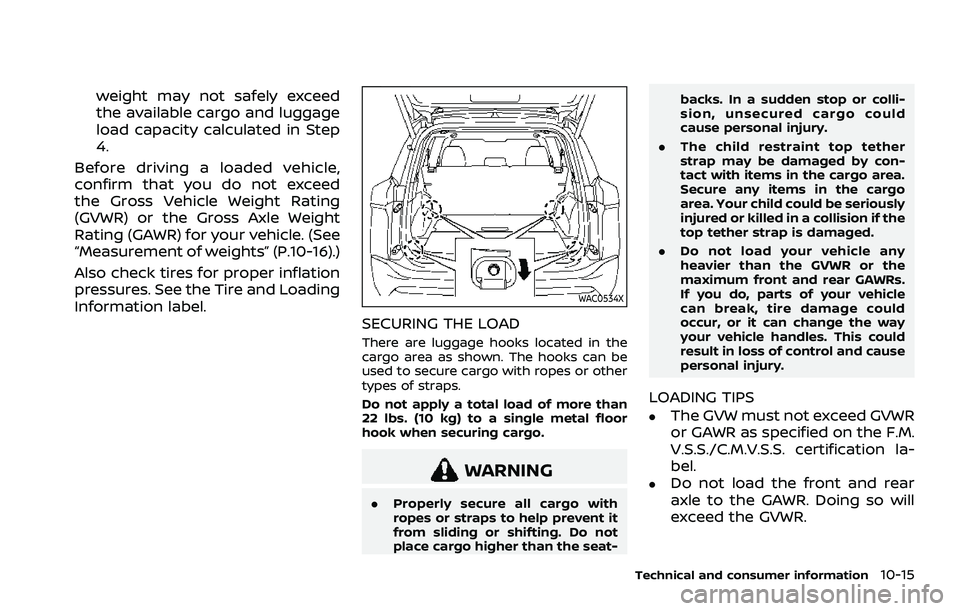
There are luggage hooks located in the
cargo area as shown. The hooks can be
used to secure cargo with ropes or other
types of straps.
Do not apply a total load of more than
22 lbs. (10 kg) to a single metal floor
hook when securing cargo.
WARNING
. Properly secure all cargo with
ropes or straps to help prevent it
from sliding or shifting. Do not
place cargo higher than the seat- backs. In a sudden stop or colli-
sion, unsecured cargo could
cause personal injury.
. The child restraint top tether
strap may be damaged by con-
tact with items in the cargo area.
Secure any items in the cargo
area. Your child could be seriously
injured or killed in a collision if the
top tether strap is damaged.
. Do not load your vehicle any
heavier than the GVWR or the
maximum front and rear GAWRs.
If you do, parts of your vehicle
can break, tire damage could
occur, or it can change the way
your vehicle handles. This could
result in loss of control and cause
personal injury.
LOADING TIPS
.The GVW must not exceed GVWR
or GAWR as specified on the F.M.
V.S.S./C.M.V.S.S. certification la-
bel.
.Do not load the front and rear
axle to the GAWR. Doing so will
exceed the GVWR.
Technical and consumer information10-15
Page 535 of 556

Sway control device
Sudden maneuvers, wind gusts and buf-
feting caused by other vehicles can affect
trailer handling. Sway control devices
may be used to help control these affects.
If you choose to use one, contact a
reputable trailer hitch supplier to make
sure the sway control device will work
with the vehicle, hitch, trailer and the
trailer’s brake system. Follow the instruc-
tions provided by the manufacturer for
installing and using the sway control
device.
Class I hitch
Class I trailer hitch equipment (receiver,
ball mount and hitch ball) can be used to
tow trailers of a maximum weight of
2,000 lb (907 kg).
Tire pressures
.When towing a trailer, inflate the
vehicle tires to the recom-
mended cold tire pressure indi-
cated on the Tire and Loading
Information label.
. Trailer tire condition, size, load
rating and proper inflation pres-
sure should be in accordance
with the trailer and tire manu-
facturers’ specifications. Safety chains
Always use a suitable chain between your
vehicle and the trailer. The safety chains
should be crossed and should be at-
tached to the hitch, not to the vehicle
bumper or axle. Be sure to leave enough
slack in the chains to permit turning
corners.
Trailer lights (if so equipped)
CAUTION
When splicing into the vehicle elec-
trical system, a commercially avail-
able power-type module/converter
must be used to provide power for
all trailer lighting. This unit uses the
vehicle battery as a direct power
source for all trailer lights while
using the vehicle tail light, stoplight
and turn signal circuits as a signal
source. The module/converter must
draw no more than 15 milliamps
from the stop and tail lamp circuits.
Using a module/converter that ex-
ceeds these power requirements
may damage the vehicle’s electrical
system. See a reputable trailer retai-
ler to obtain the proper equipment
and to have it installed. Trailer lights should comply with federal
and/or local regulations. For assistance in
hooking up trailer lights, contact a NISSAN
dealer or reputable trailer retailer.
Pre-towing tips
.
Be certain your vehicle maintains a
level position when a loaded or un-
loaded trailer is hitched. Do not drive
the vehicle if it has an abnormal nose-
up or nose-down condition; check for
improper tongue load, overload, worn
suspension or other possible causes
of either condition.
. Always secure items in the trailer to
prevent load shift while driving.
. Keep the cargo load as low as possible
in the trailer to keep the trailer center
of gravity low.
. Load the trailer so approximately 60%
of the trailer load is in the front half
and 40% is in the back half. Also make
sure the load is balanced side to side.
. Check your hitch, trailer tire pressure,
vehicle tire pressure, trailer light op-
eration, and trailer wheel lug nuts
every time you attach a trailer to the
vehicle.
. Be certain your rearview mirrors con-
form to all federal, state or local
regulations. If not, install any mirrors
required for towing before driving the
Technical and consumer information10-23
Page 538 of 556
10-26Technical and consumer information
the water or the trailer lights may
burn out.
When towing a trailer, the Continuously
Variable Transmission (CVT) fluid, trans-
fer fluid and differential gear oil should
be changed more frequently. For addi-
tional information, see the "9. Mainte-
nance and schedules" section.FLAT TOWING FOR ALL–WHEEL
DRIVE VEHICLE (if so equipped)
Towing your vehicle with all four wheels
on the ground is sometimes called flat
towing. This method is sometimes used
when towing a vehicle behind a recrea-
tional vehicle, such as a motor home.
CAUTION
. Failure to follow these guidelines
can result in severe transmission
damage.
. Never flat tow your All-Wheel
Drive (AWD) vehicle.
. DO NOT tow your All-Wheel Drive
(AWD) vehicle with any wheels on
the ground. Doing so may cause
serious and expensive damage to
the powertrain.
. For emergency towing proce-
dures refer to “Towing recom-
mended by NISSAN” (P.6-16).
FLAT TOWING FOR FRONT-WHEEL
DRIVE VEHICLE (if so equipped)
Towing your vehicle with all four wheels
on the ground is sometimes called flat
towing. This method is sometimes used
when towing a vehicle behind a recrea-
tional vehicle, such as a motor home.
CAUTION
.Failure to follow these guidelines
can result in severe transmission
damage.
. Whenever flat towing your vehi-
cle, always tow forward, never
backward.
. Never tow your front wheel drive
vehicle with the front tires on the
ground. Doing so may cause ser-
ious and expensive damage to
the powertrain.
. DO NOT tow your front wheel
drive Continuously Variable
Transmission (CVT) vehicle with
all four wheels on the ground (flat
towing). Doing so WILL DAMAGE
internal transmission parts due
to lack of transmission lubrica-
tion.
FLAT TOWING
Page 540 of 556
10-28Technical and consumer information
all passenger car tires must meet under
the Federal Motor Vehicle Safety Stan-
dard No. 109. Grades B and A represent
higher levels of performance on the
laboratory test wheel than the minimum
required by law.
WARNING
The temperature grade for this tire is
established for a tire that is properly
inflated and not overloaded. Exces-
sive speed, under-inflation, or exces-
sive loading, either separately or in
combination, can cause heat build-
up and possible tire failure.Your vehicle is covered by the following
emission warranties.
For USA:
.
Emission Defects Warranty
. Emissions Performance Warranty
Details of these warranties may be found
with other vehicle warranties in your
Warranty Information Booklet which
comes with your vehicle. If you did not
receive a Warranty Information Booklet,
or it has become lost, you may obtain a
replacement by writing to:
. Nissan North America, Inc.
Consumer Affairs Department
P.O. Box 685003
Franklin, TN 37068-5003
For Canada:
Emission Control System Warranty
Details of this warranty may be found
with other vehicle warranties in your
Warranty Information Booklet which
comes with your vehicle. If you did not
receive a Warranty Information Booklet,
or it has become lost, you may obtain a
replacement by writing to:
. Nissan Canada Inc.
5290 Orbitor Drive
Mississauga, Ontario,
L4W 4Z5
For USA
If you believe that your vehicle has
a defect which could cause a crash
or could cause injury or death, you
should immediately inform the Na-
tional Highway Traffic Safety Ad-
ministration (NHTSA) in addition to
notifying NISSAN.
If NHTSA receives similar com-
plaints, it may open an investiga-
tion, and if it finds that a safety
defect exists in a group of vehicles,
it may order a recall and remedy
campaign. However, NHTSA cannot
become involved in individual pro-
blems between you, your dealer, or
NISSAN.
To contact NHTSA, you may call the
Vehicle Safety Hotline toll-free at 1-
888- 327-4236 (TTY: 1-800-424-
9153); go to http://www.safercar.
gov; or write to: Administrator,
NHTSA, 400 Seventh Street, SW.,
Washington, D.C. 20590. You can
also obtain other information
about motor vehicle safety from
http://www.safercar.gov.
EMISSION CONTROL SYSTEM WARRANTYREPORTING SAFETY DEFECTS
Page 549 of 556

F
F.M.V.S.S./C.M.V.S.S. certification label ...... 10-10
FilterAir cleaner housing filter ................................ 8-15
Changing engine oil and filter ...................... 8-6
Flashers (See hazard warning
flasher switch).................................................................... 6-2
Flat tire........................................................................\
............. 6-3
Flat towing..................................................................... 10-26
Floor mat cleaning ......................................................... 7-5
Fluid Brake fluid ..................................................................... 8-9
Capacities and
recommended fluids/lubricants............... 10-3
Continuously Variable Transmission
(CVT) fluid....................................................................... 8-8
Engine coolant........................................................... 8-4
Engine oil.....................................................................\
... 8-5
Window washer fluid ............................................ 8-9
Fog light switch ............................................................ 2-62
Forward Driving Aids ................................................ 5-34
Front manual seat adjustment ............................ 1-4
Front passenger air bag and status
light........................................................................\
................. 1-54
Front seat, Front seat adjustment .................... 1-4
Fuel Capacities and
recommended fluids/lubricants............... 10-3
Fuel economy...................................................... 5-150
Fuel information.................................................... 10-4
Fuel octane rating ............................................... 10-4
Fuel-filler door......................................................... 3-29
Gauge........................................................................\
..... 2-10
Fuel Efficient Driving Tips................................... 5-149
Fuses........................................................................\
.............. 8-18 Fusible links...................................................................... 8-18G
Garage mode system............................................... 3-27
Gauge........................................................................\
................ 2-5
Engine coolant temperature gauge......... 2-9
Fuel gauge ................................................................. 2-10
Odometer....................................................................... 2-8
Speedometer .............................................................. 2-8
Tachometer.................................................................. 2-9
General maintenance................................................... 9-2
Glove box ........................................................................\
... 2-75
H
Hazard warning flasher switch ............................ 6-2
Head restraints/headrests....................................... 1-9
Head Up Display (HUD) ............................................ 2-47
Headlights Bulb replacement ................................................. 8-23
Headlight switch ................................................... 2-55
Heated seats ................................................................... 2-63
Heated steering wheel ............................................ 2-63
Heater Heater and air conditioner
operation..................................................................... 4-27
High beam assist ......................................................... 2-59
Hill start assist system ......................................... 5-161
Hood release ................................................................... 3-22
Hook Coat hook................................................................... 2-77
Luggage hook ......................................................... 2-78
Horn........................................................................\
................ 2-63
I
Ignition switch ............................................................... 5-14
Ignition switch positions ....................................... 5-15
Immobilizer system.................................................... 2-51
Indicator Lights..................................................................\
............ 2-17
Vehicle information display.......................... 2-22
indicator light Electronic parking brake warning
light........................................................................\
.......... 2-15
Inside mirror .................................................................... 3-33
Inspection/maintenance (I/M) test ............ 10-29
Instrument brightness control ......................... 2-11
Instrument panel ............................................................. 2-4
Intelligent 4x4 ............................................................. 5-151
Intelligent Around View® Monitor....................... 4-9
Intelligent Auto Headlight system ................. 2-56
Intelligent Blind Spot
Intervention (I-BSI) ...................................................... 5-65
Intelligent Cruise Control (ICC) ......................... 5-97
Intelligent Driver Alertness (I-DA) ................. 5-141
Intelligent Forward Collision Warning
(I-FCW)........................................................................\
........ 5-132
Intelligent Key button operation light ........ 3-17
Intelligent Key system ................................................. 3-7 Key operating range ............................................. 3-9
Key operation .......................................................... 3-11
Remote keyless operation ............................ 3-15
Intelligent Lane Intervention (I-LI) .................. 5-51
Intelligent Trace Control..................................... 5-160
Interior light replacement..................................... 8-23
Interior light switch.................................................... 2-85
Interior lights................................................................... 2-85
ISOFIX child restraint ................................................ 1-25
11-3