seats NISSAN ROGUE 2021 Owner´s Manual
[x] Cancel search | Manufacturer: NISSAN, Model Year: 2021, Model line: ROGUE, Model: NISSAN ROGUE 2021Pages: 556, PDF Size: 2.7 MB
Page 7 of 556
Illustrated table of contents0
Safety — Seats, seat belts and supplemental restraint
system1
Instruments and controls
Pre-driving checks and adjustments
Monitor, heater, air conditioner, audio and phone
systems
Starting and driving
In case of emergency
Appearance and care
Do-it-yourself
Maintenance and schedules
Technical and consumer information
2
3
4
5
6
7
8
9
10
Table of
Contents
Index11
Page 9 of 556
 ........................................................................\
............. 0-2
Exterior front ...")
0 Illustrated table of contents
Seats, seat belts and Supplemental Restraint
System (SRS) ........................................................................\
............. 0-2
Exterior front ........................................................................\
............ 0-3
Exterior rear ........................................................................\
.............. 0-4
Passenger compartment ....................................................... 0-5
Cockpit ........................................................................\
.......................... 0-6
Instrument panel ........................................................................\
.. 0-7Meters and gauges .................................................................... 0-8
Models with analog meter and color
display ........................................................................\
.................. 0-8
Models with full-screen display ................................ 0-9
Engine compartment ............................................................ 0-10 PR25DD engine model ................................................. 0-10
Warning and indicator lights ........................................... 0-11
Page 10 of 556
0-2Illustrated table of contents
WAA0168X
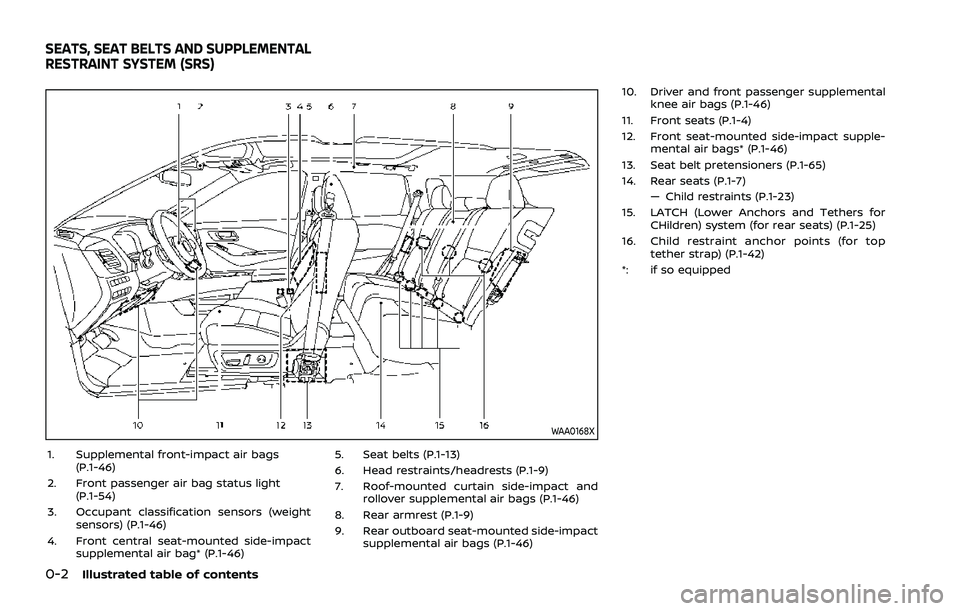
1. Supplemental front-impact air bags(P.1-46)
2. Front passenger air bag status light (P.1-54)
3. Occupant classification sensors (weight sensors) (P.1-46)
4. Front central seat-mounted side-impact supplemental air bag* (P.1-46) 5. Seat belts (P.1-13)
6. Head restraints/headrests (P.1-9)
7. Roof-mounted curtain side-impact and
rollover supplemental air bags (P.1-46)
8. Rear armrest (P.1-9)
9. Rear outboard seat-mounted side-impact supplemental air bags (P.1-46) 10. Driver and front passenger supplemental
knee air bags (P.1-46)
11. Front seats (P.1-4)
12. Front seat-mounted side-impact supple- mental air bags* (P.1-46)
13. Seat belt pretensioners (P.1-65)
14. Rear seats (P.1-7) — Child restraints (P.1-23)
15. LATCH (Lower Anchors and Tethers for CHildren) system (for rear seats) (P.1-25)
16. Child restraint anchor points (for top tether strap) (P.1-42)
*: if so equipped
SEATS, SEAT BELTS AND SUPPLEMENTAL
RESTRAINT SYSTEM (SRS)
Page 21 of 556

1 Safety — Seats, seat belts and supple-mental restraint system
Seats ........................................................................\
............................... 1-3
Front seats ........................................................................\
.......... 1-4
Rear seats ........................................................................\
............ 1-7
Armrest ........................................................................\
................. 1-9
Head restraints/headrests .................................................... 1-9 Adjustable head
restraint/headrest components ............................. 1-10
Non-adjustable head
restraint/headrest components ............................. 1-10
Remove ........................................................................\
............... 1-11
Install ........................................................................\
..................... 1-11
Adjust ........................................................................\
.................... 1-11
Seat belts ........................................................................\
................. 1-13
Precautions on seat belt usage .............................. 1-13
Seat belt warning light and chime ....................... 1-15
Pregnant women ................................................................ 1-16
Injured persons ..................................................................... 1-16
Three-point type seat belt with retractor ...... 1-16
Seat belt extenders ........................................................... 1-19
Seat belt maintenance ................................................... 1-20
Child safety ........................................................................\
............. 1-20 Infants ........................................................................\
.................. 1-21
Small children ........................................................................\
1-21
Larger children ...................................................................... 1-21 Child restraints ........................................................................\
... 1-23
Precautions on child restraints ............................. 1-23
Lower Anchors and Tethers for CHildren
(LATCH) system .................................................................. 1-25
Rear-facing child restraint installation
using LATCH ........................................................................\
. 1-30
Rear-facing child restraint installation
using the seat belts ........................................................ 1-32
Forward-facing child restraint installation
using LATCH ........................................................................\
. 1-35
Forward-facing child restraint installation
using the seat belts ........................................................ 1-38
Booster seats ....................................................................... 1-42
Supplemental Restraint System (SRS) ..................... 1-46 Precautions on SRS ........................................................ 1-46
NISSAN Advanced Air Bag System
(front seats) ........................................................................\
... 1-52
Driver and front passenger supplemental
knee air bag ........................................................................\
.. 1-61
Front, rear outboard and front central
seat-mounted side-impact supplemental
air bag and roof-mounted curtain
side-impact and rollover supplemental air
bag systems ........................................................................\
. 1-63
Seat belts with pretensioners (front and
rear outboard seats) ...................................................... 1-65
Page 23 of 556
SSS0133
WARNING
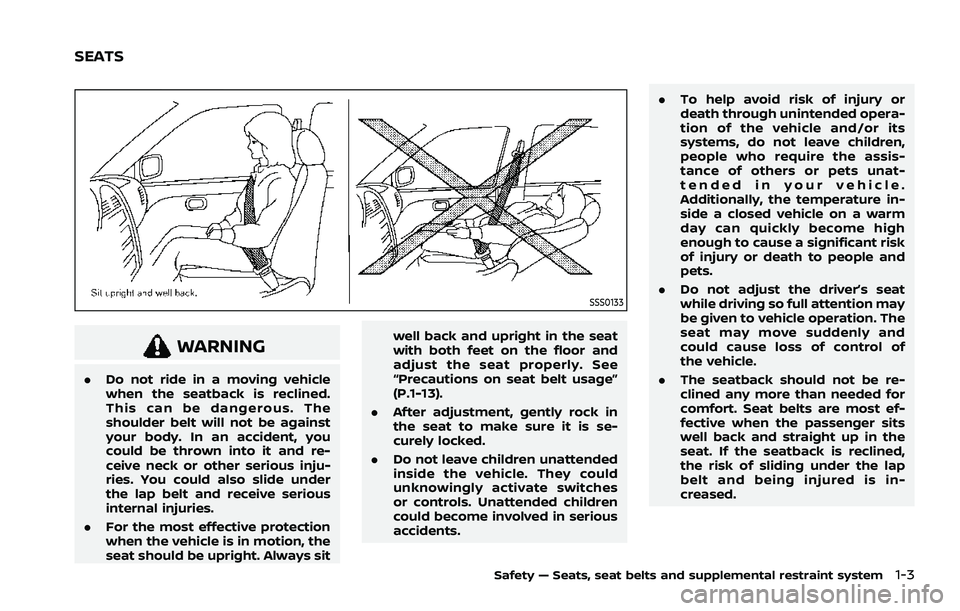
.Do not ride in a moving vehicle
when the seatback is reclined.
This can be dangerous. The
shoulder belt will not be against
your body. In an accident, you
could be thrown into it and re-
ceive neck or other serious inju-
ries. You could also slide under
the lap belt and receive serious
internal injuries.
. For the most effective protection
when the vehicle is in motion, the
seat should be upright. Always sit well back and upright in the seat
with both feet on the floor and
adjust the seat properly. See
“Precautions on seat belt usage”
(P.1-13).
. After adjustment, gently rock in
the seat to make sure it is se-
curely locked.
. Do not leave children unattended
inside the vehicle. They could
unknowingly activate switches
or controls. Unattended children
could become involved in serious
accidents. .
To help avoid risk of injury or
death through unintended opera-
tion of the vehicle and/or its
systems, do not leave children,
people who require the assis-
tance of others or pets unat-
tended in your vehicle.
Additionally, the temperature in-
side a closed vehicle on a warm
day can quickly become high
enough to cause a significant risk
of injury or death to people and
pets.
. Do not adjust the driver’s seat
while driving so full attention may
be given to vehicle operation. The
seat may move suddenly and
could cause loss of control of
the vehicle.
. The seatback should not be re-
clined any more than needed for
comfort. Seat belts are most ef-
fective when the passenger sits
well back and straight up in the
seat. If the seatback is reclined,
the risk of sliding under the lap
belt and being injured is in-
creased.
Safety — Seats, seat belts and supplemental restraint system1-3
SEATS
Page 24 of 556
1-4Safety — Seats, seat belts and supplemental restraint system
CAUTION
When adjusting the seat positions,
be sure not to contact any moving
parts to avoid possible injuries and/
or damage.
FRONT SEATS
Your vehicle seats can be adjusted in
manual or power operation. For addi-
tional information about adjusting the
seats, refer to the steps outlined in this
section.
JVR0332X
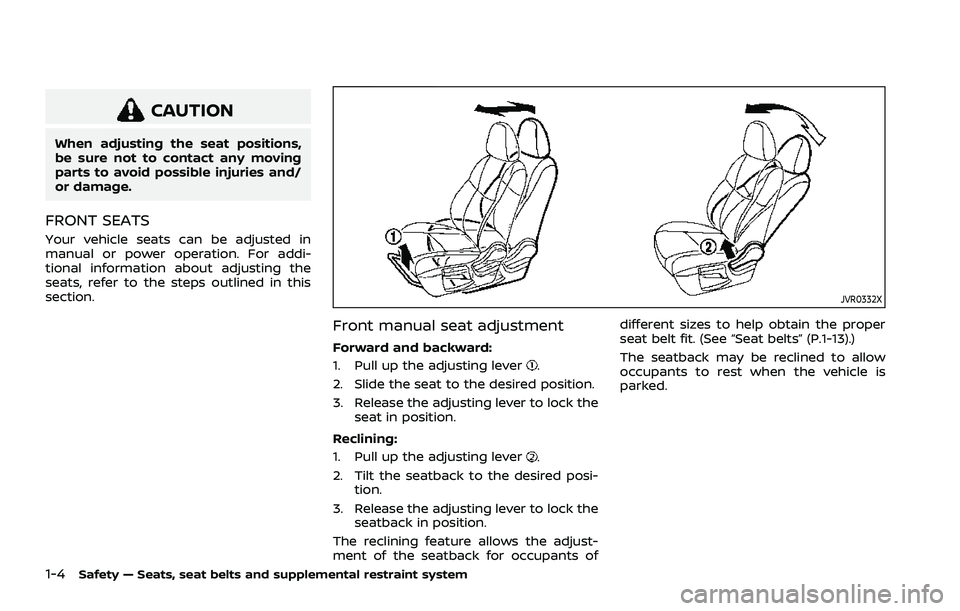
Front manual seat adjustment
Forward and backward:
1. Pull up the adjusting lever
.
2. Slide the seat to the desired position.
3. Release the adjusting lever to lock the seat in position.
Reclining:
1. Pull up the adjusting lever
.
2. Tilt the seatback to the desired posi- tion.
3. Release the adjusting lever to lock the seatback in position.
The reclining feature allows the adjust-
ment of the seatback for occupants of different sizes to help obtain the proper
seat belt fit. (See “Seat belts” (P.1-13).)
The seatback may be reclined to allow
occupants to rest when the vehicle is
parked.
Page 25 of 556
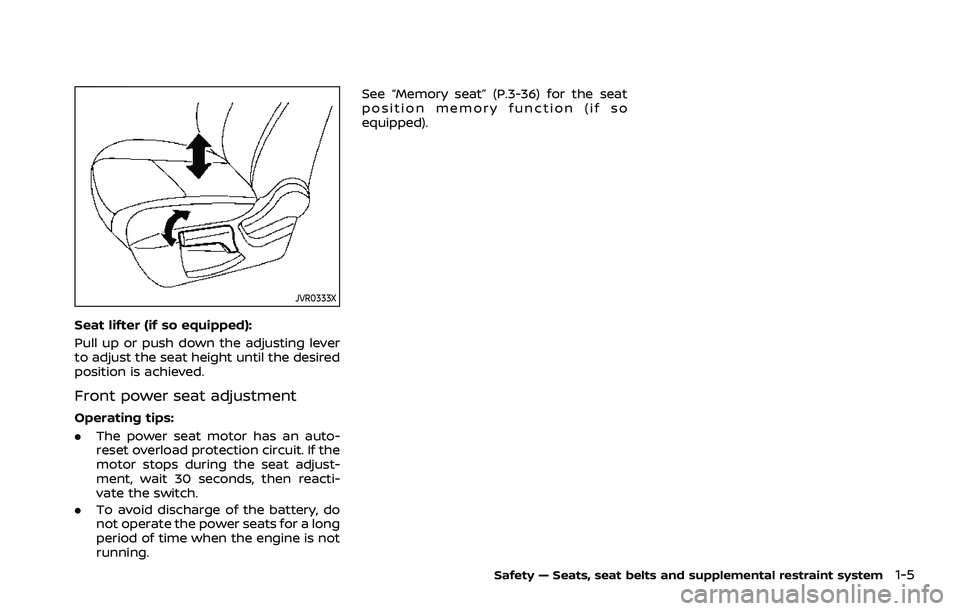
JVR0333X
Seat lifter (if so equipped):
Pull up or push down the adjusting lever
to adjust the seat height until the desired
position is achieved.
Front power seat adjustment
Operating tips:
.The power seat motor has an auto-
reset overload protection circuit. If the
motor stops during the seat adjust-
ment, wait 30 seconds, then reacti-
vate the switch.
. To avoid discharge of the battery, do
not operate the power seats for a long
period of time when the engine is not
running. See “Memory seat” (P.3-36) for the seat
position memory function (if so
equipped).
Safety — Seats, seat belts and supplemental restraint system1-5
Page 26 of 556
1-6Safety — Seats, seat belts and supplemental restraint system
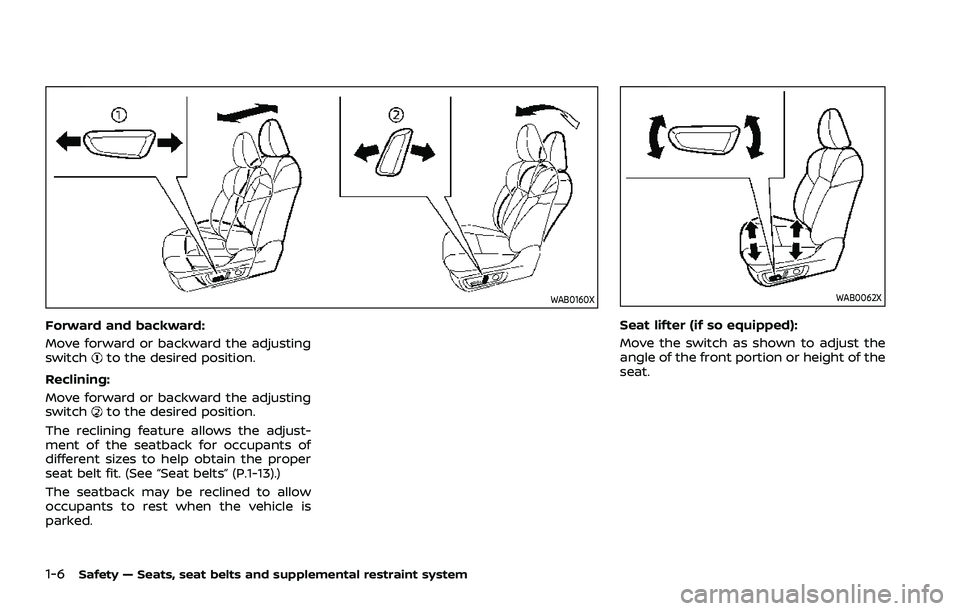
WAB0160X
Forward and backward:
Move forward or backward the adjusting
switch
to the desired position.
Reclining:
Move forward or backward the adjusting
switch
to the desired position.
The reclining feature allows the adjust-
ment of the seatback for occupants of
different sizes to help obtain the proper
seat belt fit. (See “Seat belts” (P.1-13).)
The seatback may be reclined to allow
occupants to rest when the vehicle is
parked.
WAB0062X
Seat lifter (if so equipped):
Move the switch as shown to adjust the
angle of the front portion or height of the
seat.
Page 27 of 556
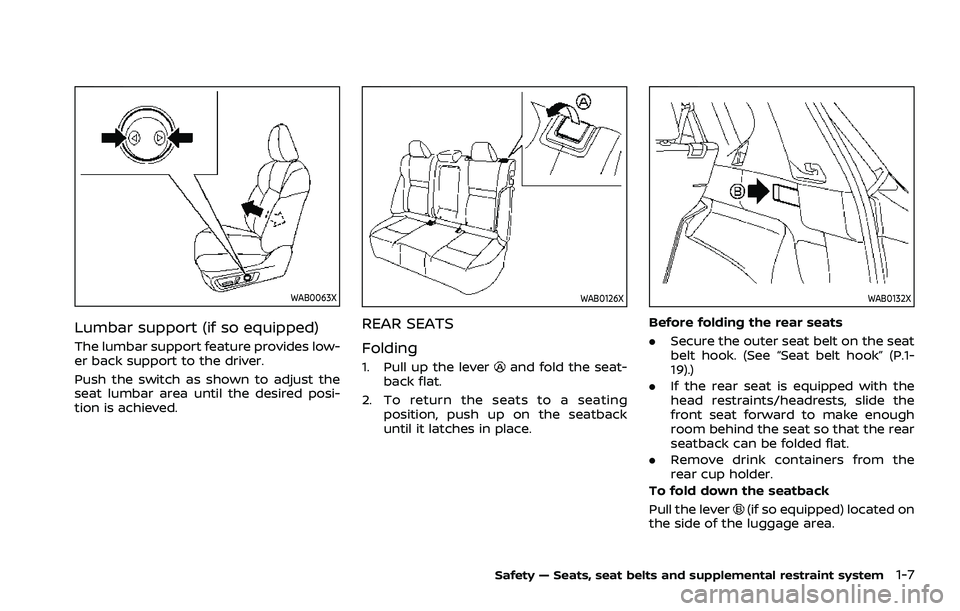
WAB0063X
Lumbar support (if so equipped)
The lumbar support feature provides low-
er back support to the driver.
Push the switch as shown to adjust the
seat lumbar area until the desired posi-
tion is achieved.
WAB0126X
REAR SEATS
Folding
1. Pull up the leverand fold the seat-
back flat.
2. To return the seats to a seating position, push up on the seatback
until it latches in place.
WAB0132X
Before folding the rear seats
.Secure the outer seat belt on the seat
belt hook. (See “Seat belt hook” (P.1-
19).)
. If the rear seat is equipped with the
head restraints/headrests, slide the
front seat forward to make enough
room behind the seat so that the rear
seatback can be folded flat.
. Remove drink containers from the
rear cup holder.
To fold down the seatback
Pull the lever
(if so equipped) located on
the side of the luggage area.
Safety — Seats, seat belts and supplemental restraint system1-7
Page 28 of 556
1-8Safety — Seats, seat belts and supplemental restraint system
To return the seatback
To return the rear seatback, raise the
seatback until it latches.
When returning the seatback, make sure
that the seat belt is not interfering with
the seatback latch mechanism.
WARNING
.Never allow anyone to ride in the
cargo area or on the rear seats
when they are in the fold-down
position. In a collision, people
riding in these areas without
proper restraints are more likely
to be seriously injured or killed.
. Do not allow people to ride in any
area of your vehicle that is not
equipped with seats and seat
belts. Be sure everyone in your
vehicle is in a seat and using a
seat belt properly.
. Do not allow more than one
person to use the same seat belt.
. Do not fold down the rear seats
when occupants are in the rear
seat area or any luggage is on the
rear seats.
— Make sure that the seat path
is clear before moving the seat.
— Be careful not to allow hands or feet to get caught or
pinched in the seat.
. Head restraints/headrests should
be adjusted properly as they may
provide significant protection
against injury in an accident. Al-
ways replace and adjust them
properly if they have been re-
moved for any reason.
. If the head restraints/headrests
are removed for any reason, they
should be securely stored to pre-
vent them from causing injury to
passengers or damage to the
vehicle in case of sudden braking
or an accident.
. When returning the seatbacks to
the upright position, be certain
they are completely secured in
the latched position. If they are
not completely secured, passen-
gers may be injured in an acci-
dent or sudden stop.
. Properly secure all cargo to help
prevent it from sliding or shifting.
Do not place cargo higher than
the seatbacks. In a sudden stop
or collision, unsecured cargo could cause personal injury.
WARNING
.
After adjustment, gently rock in
the seat to make sure it is se-
curely locked.
. Do not ride in a moving vehicle
when the seatback is reclined.
This can be dangerous. The
shoulder belt will not be against
your body. In an accident, you
could be thrown into it and re-
ceive neck or other serious inju-
ries. You could also slide under
the lap belt and receive serious
internal injuries.
. For the most effective protection
when the vehicle is in motion, the
seat should be upright. Always sit
well back and upright in the seat
with both feet on the floor and
adjust the seat belt properly. (See
“Precautions on seat belt usage”
(P.1-13).)