headlights NISSAN ROGUE 2021 Owner´s Manual
[x] Cancel search | Manufacturer: NISSAN, Model Year: 2021, Model line: ROGUE, Model: NISSAN ROGUE 2021Pages: 556, PDF Size: 2.7 MB
Page 370 of 556
5-116Starting and driving
Steering Assist limitations
WARNING
.In the following situations, the
camera may not detect lane mar-
kers correctly or may detect lane
markers incorrectly and the
Steering Assist may not operate
properly:
— When driving on roads where
there are multiple parallel
lane markers, lane markers
that are faded or not painted
clearly, non-standard lane
markers, or lane markers cov-
ered with water, dirt, snow,
etc.
— When driving on roads with discontinued lane markers
— When driving on roads with a widening or narrowing lane
width
— When driving on roads where there are multiple lanes or
unclear lane markers due to
road construction
— When driving on roads where there are sharply contrasting
objects, such as shadows, snow, water, wheel ruts,
seams, or lines remaining
after road repairs (the Steer-
ing Assist could detect these
items as lane markers)
— When driving on roads where the traveling lane merges or
separates
. Do not use the Steering Assist
under the following conditions
because the system may not
properly detect lane markers.
Doing so could cause a loss of
vehicle control and result in an
accident.
— During bad weather (rain, fog,
snow, dust, etc.)
— When rain, snow, sand, etc., is thrown up by the wheels of
other vehicles
— When dirt, oil, ice, snow, water, or another object adheres to
the camera unit
— When the lens of the camera unit is foggy
— When strong light (for exam- ple, sunlight or high beams
from oncoming vehicles)
shines on the camera — When the headlights are not
bright due to dirt on the lens
or the headlights are off in
tunnels or darkness
— When a sudden change in brightness occurs (for exam-
ple, when the vehicle enters or
exits a tunnel or is under a
bridge)
— When driving on roads where the traveling lane merges or
separates or where there are
temporary lane markers be-
cause of road construction
— When there is a lane closure due to road repairs
— When driving on a bumpy road surface, such as an uneven
dirt road
— When driving on sharp curves or winding roads
— When driving on repeated up- hill and downhill roads
. Do not use the Steering Assist
under the following conditions
because the system will not op-
erate properly:
— When driving with a tire that is
not within normal tire condi-
Page 380 of 556
5-126Starting and driving
AEB WITH PEDESTRIAN DETECTION
SYSTEM LIMITATIONS
WARNING
Listed below are the system limita-
tions for the AEB with pedestrian
detection system. Failure to operate
the vehicle in accordance with these
system limitations could result in
serious injury or death.
.The AEB with pedestrian detec-
tion system cannot detect all
vehicles, pedestrians or cyclists
under all conditions.
. The AEB with pedestrian detec-
tion system does not detect the
following:
— Pedestrians that are small (for
example, children), in a sitting
position, operating toys/ska-
teboards, on scooters or in
wheelchairs, or not in an up-
right standing or walking po-
sition.
— Animals of any size.
— Obstacles (for example, cargo or debris) on the roadway or
roadside. — Oncoming or crossing vehi-
cles.
— Vehicles where the tires are difficult to see or the shape of
the rear of the vehicle is un-
clear or obstructed.
— Parked vehicles.
. The AEB with pedestrian detec-
tion system has some perfor-
mance limitations.
— If a stationary vehicle is in the
vehicle’s path, the system will
not function when the vehicle
approaches the stationary ve-
hicle at speeds over approxi-
mately 50 MPH (80 km/h).
— Pedestrian and cyclist detec- tion will not function when the
vehicle is driven at speeds
over approximately 37 MPH
(60 km/h) or below approxi-
mately 6 MPH (10 km/h).
. For pedestrians, the AEB with
pedestrian detection system will
not issue the first warning.
. The AEB with pedestrian detec-
tion system may not function
properly or detect a vehicle, pe-
destrian or cyclist ahead in the
following conditions: — In poor visibility conditions
(such as rain, snow, fog, dust
storms, sand storms, smoke,
and road spray from other
vehicles).
— If dirt, ice, snow, fog or other material is covering the radar
sensor area or camera area of
the windshield.
— If strong light (for example, sunlight or high beams) en-
ters the front camera or a
sudden change in brightness
occurs (for example, entering
a tunnel or driving in light-
ning).
— In dark or dimly lit conditions, such as at night or in tunnels,
including cases where your
vehicle’s headlights are off or
dim, or the tail lights of the
vehicle ahead are off.
— When the direction of the camera is misaligned.
— When driving on a steep downhill slope, on roads with
sharp curves, and/or bumpy
or dirt roads.
Page 440 of 556
6-12In case of emergency
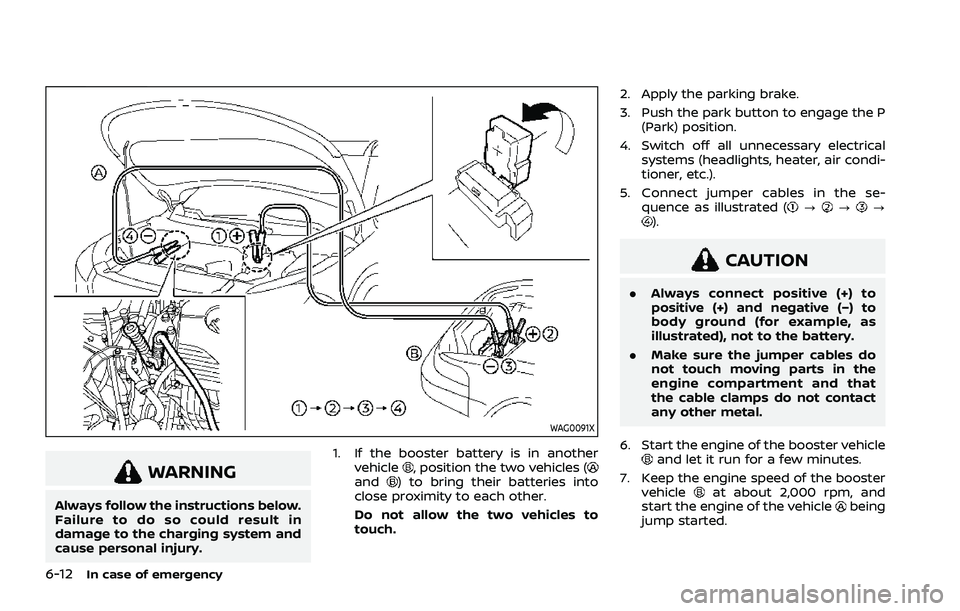
WAG0091X
WARNING
Always follow the instructions below.
Failure to do so could result in
damage to the charging system and
cause personal injury.1. If the booster battery is in another
vehicle
, position the two vehicles (and) to bring their batteries into
close proximity to each other.
Do not allow the two vehicles to
touch. 2. Apply the parking brake.
3. Push the park button to engage the P
(Park) position.
4. Switch off all unnecessary electrical systems (headlights, heater, air condi-
tioner, etc.).
5. Connect jumper cables in the se- quence as illustrated (
???).
CAUTION
.Always connect positive (+) to
positive (+) and negative (−) to
body ground (for example, as
illustrated), not to the battery.
. Make sure the jumper cables do
not touch moving parts in the
engine compartment and that
the cable clamps do not contact
any other metal.
6. Start the engine of the booster vehicle
and let it run for a few minutes.
7. Keep the engine speed of the booster vehicle
at about 2,000 rpm, and
start the engine of the vehiclebeing
jump started.
Page 455 of 556
8 Do-it-yourself
Maintenance precautions ...................................................... 8-2
Engine compartment check locations ........................ 8-3PR25DD engine model ...................................................... 8-3
Engine cooling system ............................................................. 8-4 Checking engine coolant level .................................... 8-5
Changing engine coolant ................................................ 8-5
Engine oil ........................................................................\
..................... 8-5 Checking engine oil level ................................................. 8-5
Changing engine oil and filter ..................................... 8-6
Continuously Variable Transmission
(CVT) fluid ........................................................................\
.................... 8-8
Brake fluid ........................................................................\
.................. 8-9
Window washer fluid ................................................................. 8-9
Battery ........................................................................\
........................ 8-11 Jump starting ........................................................................\
. 8-12
Variable voltage control system ................................... 8-13
Drive belt ........................................................................\
.................. 8-13
Spark plugs ........................................................................\
............. 8-14 Replacing spark plugs ..................................................... 8-14
Air cleaner ........................................................................\
............... 8-15 Windshield wiper blades ..................................................... 8-16
Cleaning ........................................................................\
........... 8-16
Replacing ........................................................................\
........ 8-16
Rear window wiper blade .................................................. 8-17
Brakes ........................................................................\
........................ 8-17 Self-adjusting brakes ..................................................... 8-17
Brake pad wear warning ............................................ 8-17
Fuses ........................................................................\
........................... 8-18 Engine compartment .................................................... 8-18
Passenger compartment ........................................... 8-19
Intelligent Key battery replacement .......................... 8-20
Lights ........................................................................\
.......................... 8-22 Headlights ........................................................................\
...... 8-23
Exterior and interior lights ........................................ 8-23
Wheels and tires ........................................................................\
8-25 Tire pressure ........................................................................\
8-25
Tire labeling ........................................................................\
.. 8-29
Types of tires ....................................................................... 8-31
Tire chains ........................................................................\
...... 8-32
Changing wheels and tires ...................................... 8-33
Page 472 of 556

8-18Do-it-yourself
WAI0124X
ENGINE COMPARTMENT
WARNING
Never use a fuse of a higher or lower
amperage rating than that specified
on the fuse box cover. This could
damage the electrical system or
electronic control units or cause a
fire.
If any electrical equipment does not
operate, check for an open fuse.
1. Be sure the ignition switch is turned off and the headlights are off. 2. Open the engine hood.
3. Remove the fuse/fusible link box cov-
er by using a suitable tool and pushing
the tab.
4. Locate the fuse that needs to be replaced.
5. Remove the fuse using the fuse puller located in the passenger compart-
ment fuse box.
SDI1753
6. If the fuse is open, replace it with a
new fuse.
7. If a new fuse also opens, have the electrical system checked and re-
paired. It is recommended you visit a
NISSAN dealer for this service.
Fusible links
If any electrical equipment does not
operate and the fuses are in good condi-
tion, check the fusible links. If any of these
fusible links are melted, replace only with
genuine NISSAN parts.
For checking and replacing the fusible
links, it is recommended you visit a
NISSAN dealer.
FUSES
Page 473 of 556

WAI0205X
PASSENGER COMPARTMENT
WARNING
Never use a fuse of a higher or lower
amperage rating than that specified
on the fuse box cover. This could
damage the electrical system or
electronic control units or cause a
fire.
If any electrical equipment does not
operate, check for an open fuse.
1. Be sure the ignition switch is turned off and the headlights are off. 2. Remove the fuse box cover.
3. Remove the fuse with the fuse puller
.
SDI1753
4. If the fuse is open, replace it with a
new fuse.
5. If a new fuse also opens, have the electrical system checked and re-
paired. It is recommended you visit a
NISSAN dealer for this service.
Do-it-yourself8-19
Page 474 of 556
8-20Do-it-yourself
WAI0204X
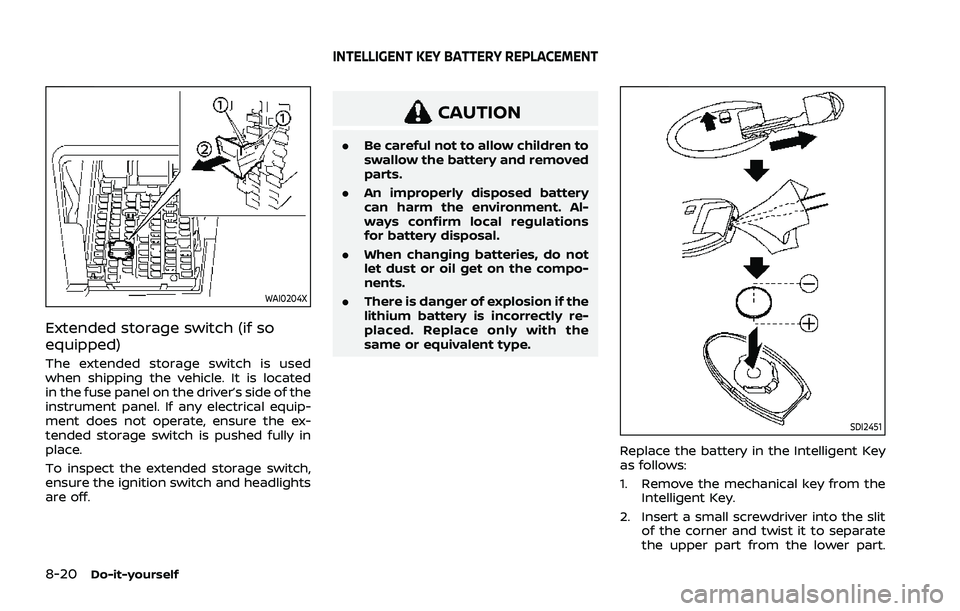
Extended storage switch (if so
equipped)
The extended storage switch is used
when shipping the vehicle. It is located
in the fuse panel on the driver’s side of the
instrument panel. If any electrical equip-
ment does not operate, ensure the ex-
tended storage switch is pushed fully in
place.
To inspect the extended storage switch,
ensure the ignition switch and headlights
are off.
CAUTION
.Be careful not to allow children to
swallow the battery and removed
parts.
. An improperly disposed battery
can harm the environment. Al-
ways confirm local regulations
for battery disposal.
. When changing batteries, do not
let dust or oil get on the compo-
nents.
. There is danger of explosion if the
lithium battery is incorrectly re-
placed. Replace only with the
same or equivalent type.
SDI2451
Replace the battery in the Intelligent Key
as follows:
1. Remove the mechanical key from the
Intelligent Key.
2. Insert a small screwdriver into the slit of the corner and twist it to separate
the upper part from the lower part.
INTELLIGENT KEY BATTERY REPLACEMENT
Page 477 of 556
HEADLIGHTS
Fog may temporarily form inside the lens
of the exterior lights in the rain or in a car
wash. A temperature difference between
the inside and the outside of the lens
causes the fog. This is not a malfunction.
If large drops of water collect inside the
lens, it is recommended you visit a NISSAN
dealer for servicing.
Replacing
If LED headlight replacement is required,
it is recommended that you visit a NISSAN
dealer for this service.
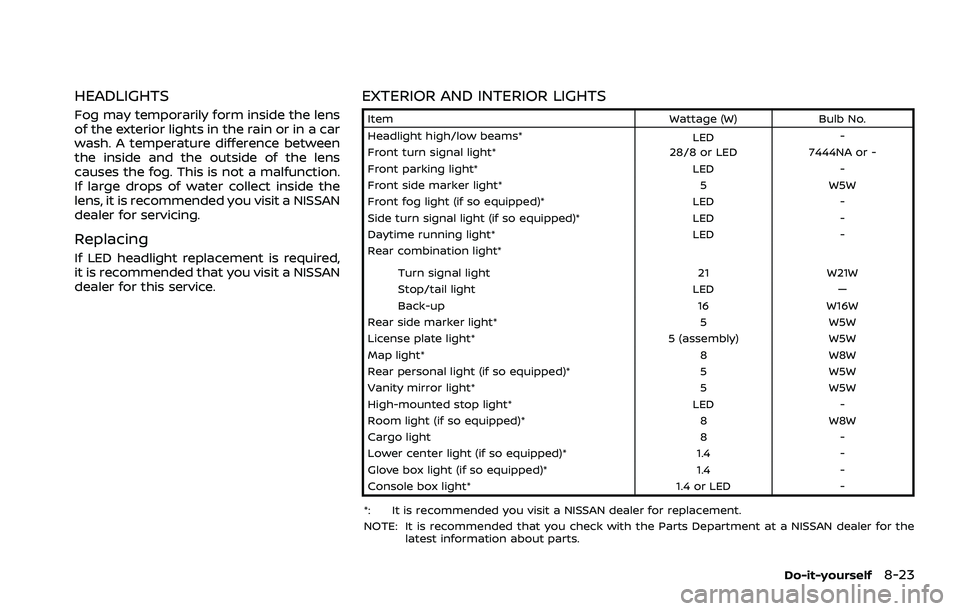
EXTERIOR AND INTERIOR LIGHTS
ItemWattage (W)Bulb No.
Headlight high/low beams* LED-
Front turn signal light* 28/8 or LED7444NA or -
Front parking light* LED-
Front side marker light* 5W5W
Front fog light (if so equipped)* LED-
Side turn signal light (if so equipped)* LED-
Daytime running light* LED-
Rear combination light*
Turn signal light 21W21W
Stop/tail light LED—
Back-up 16W16W
Rear side marker light* 5W5W
License plate light* 5 (assembly)W5W
Map light* 8W8W
Rear personal light (if so equipped)* 5W5W
Vanity mirror light* 5W5W
High-mounted stop light* LED-
Room light (if so equipped)* 8W8W
Cargo light 8-
Lower center light (if so equipped)* 1.4-
Glove box light (if so equipped)* 1.4-
Console box light* 1.4 or LED-
*: It is recommended you visit a NISSAN dealer for replacement.
NOTE: It is recommended that you check with the Parts Department at a NISSAN dealer for the latest information about parts.
Do-it-yourself8-23
Page 495 of 556
other corrosive materials, check lubrica-
tion frequently.
Lights*:Clean the headlights on a regular
basis. Make sure that the headlights, stop
lights, tail lights, turn signal lights, and
other lights are all operating properly and
installed securely. Also check headlight
aim.
Road wheel nuts (lug nuts)*: When
checking the tires, make sure no wheel
nuts are missing, and check for any loose
wheel nuts. Tighten if necessary.
Tire rotation*: Rotate tires at the speci-
fied interval shown in the maintenance
schedule.
Tires*: Check the pressure with a gauge
often and always prior to long distance
trips. If necessary, adjust the pressure in
all tires, including the spare (if so
equipped), to the pressure specified.
Check carefully for damage, cuts or
excessive wear.
Tire Pressure Monitoring System (TPMS)
transmitter components: Replace the
TPMS transmitter snap-in type, valve core
and cap when the tires are replaced due
to wear or age.
Wheel alignment and balance: If the
vehicle should pull to either side while
driving on a straight and level road, or if
you detect uneven or abnormal tire wear, there may be a need for wheel alignment.
If the steering wheel or seat vibrates at
normal highway speeds, wheel balancing
may be needed.
For additional information regarding tires,
refer to “Important Tire Safety Informa-
tion” (US) or “Tire Safety Information”
(Canada) in the NISSAN Warranty Infor-
mation Booklet.
Windshield:
Clean the windshield on a
regular basis. Check the windshield at
least every six months for cracks or other
damage. Have a damaged windshield
repaired by a qualified repair facility.
It is recommended that you have a
damaged windshield repaired by a
NISSAN dealer, or a NISSAN Certified
Collision Center. To locate a collision
center in your area, refer to http://colli-
sion.nissanusa.com.
Windshield wiper blades*: Check for
cracks or wear if they do not wipe
properly.
Inside the vehicle
The maintenance items listed here should
be checked on a regular basis, such as
when performing scheduled mainte-
nance, cleaning the vehicle, etc.
Accelerator pedal: Check the pedal for
smooth operation and make sure the pedal does not catch or require uneven
effort. Keep the floor mat away from the
pedal.
Brake pedal:
Check the pedal for smooth
operation. If the brake pedal suddenly
goes down further than normal, the pedal
feels spongy or the vehicle seems to take
longer to stop, have your vehicle checked
immediately. It is recommended you visit
a NISSAN dealer for this service. Keep the
floor mat away from the pedal.
Brakes: Check that the brakes do not pull
the vehicle to one side when applied.
Continuously Variable Transmission
(CVT) P (Park) mechanism: On a fairly
steep hill, check that the vehicle is held
securely with the shift lever in the P (Park)
position without applying any brakes.
Parking brake: Check the parking brake
operation regularly. The vehicle should be
securely held on a fairly steep hill with
only the parking brake applied. If the
parking brake needs adjusted, it is re-
commended you visit a NISSAN dealer for
this service.
Seat belts: Check that all parts of the seat
belt system (for example, buckles, an-
chors, adjusters and retractors) operate
properly and smoothly, and are installed
securely. Check the belt webbing for cuts,
fraying, wear or damage.
Maintenance and schedules9-3
Page 549 of 556

F
F.M.V.S.S./C.M.V.S.S. certification label ...... 10-10
FilterAir cleaner housing filter ................................ 8-15
Changing engine oil and filter ...................... 8-6
Flashers (See hazard warning
flasher switch).................................................................... 6-2
Flat tire........................................................................\
............. 6-3
Flat towing..................................................................... 10-26
Floor mat cleaning ......................................................... 7-5
Fluid Brake fluid ..................................................................... 8-9
Capacities and
recommended fluids/lubricants............... 10-3
Continuously Variable Transmission
(CVT) fluid....................................................................... 8-8
Engine coolant........................................................... 8-4
Engine oil.....................................................................\
... 8-5
Window washer fluid ............................................ 8-9
Fog light switch ............................................................ 2-62
Forward Driving Aids ................................................ 5-34
Front manual seat adjustment ............................ 1-4
Front passenger air bag and status
light........................................................................\
................. 1-54
Front seat, Front seat adjustment .................... 1-4
Fuel Capacities and
recommended fluids/lubricants............... 10-3
Fuel economy...................................................... 5-150
Fuel information.................................................... 10-4
Fuel octane rating ............................................... 10-4
Fuel-filler door......................................................... 3-29
Gauge........................................................................\
..... 2-10
Fuel Efficient Driving Tips................................... 5-149
Fuses........................................................................\
.............. 8-18 Fusible links...................................................................... 8-18G
Garage mode system............................................... 3-27
Gauge........................................................................\
................ 2-5
Engine coolant temperature gauge......... 2-9
Fuel gauge ................................................................. 2-10
Odometer....................................................................... 2-8
Speedometer .............................................................. 2-8
Tachometer.................................................................. 2-9
General maintenance................................................... 9-2
Glove box ........................................................................\
... 2-75
H
Hazard warning flasher switch ............................ 6-2
Head restraints/headrests....................................... 1-9
Head Up Display (HUD) ............................................ 2-47
Headlights Bulb replacement ................................................. 8-23
Headlight switch ................................................... 2-55
Heated seats ................................................................... 2-63
Heated steering wheel ............................................ 2-63
Heater Heater and air conditioner
operation..................................................................... 4-27
High beam assist ......................................................... 2-59
Hill start assist system ......................................... 5-161
Hood release ................................................................... 3-22
Hook Coat hook................................................................... 2-77
Luggage hook ......................................................... 2-78
Horn........................................................................\
................ 2-63
I
Ignition switch ............................................................... 5-14
Ignition switch positions ....................................... 5-15
Immobilizer system.................................................... 2-51
Indicator Lights..................................................................\
............ 2-17
Vehicle information display.......................... 2-22
indicator light Electronic parking brake warning
light........................................................................\
.......... 2-15
Inside mirror .................................................................... 3-33
Inspection/maintenance (I/M) test ............ 10-29
Instrument brightness control ......................... 2-11
Instrument panel ............................................................. 2-4
Intelligent 4x4 ............................................................. 5-151
Intelligent Around View® Monitor....................... 4-9
Intelligent Auto Headlight system ................. 2-56
Intelligent Blind Spot
Intervention (I-BSI) ...................................................... 5-65
Intelligent Cruise Control (ICC) ......................... 5-97
Intelligent Driver Alertness (I-DA) ................. 5-141
Intelligent Forward Collision Warning
(I-FCW)........................................................................\
........ 5-132
Intelligent Key button operation light ........ 3-17
Intelligent Key system ................................................. 3-7 Key operating range ............................................. 3-9
Key operation .......................................................... 3-11
Remote keyless operation ............................ 3-15
Intelligent Lane Intervention (I-LI) .................. 5-51
Intelligent Trace Control..................................... 5-160
Interior light replacement..................................... 8-23
Interior light switch.................................................... 2-85
Interior lights................................................................... 2-85
ISOFIX child restraint ................................................ 1-25
11-3