ignition NISSAN ROGUE HYBRID 2017 2.G Dismantling Guide
[x] Cancel search | Manufacturer: NISSAN, Model Year: 2017, Model line: ROGUE HYBRID, Model: NISSAN ROGUE HYBRID 2017 2.GPages: 53, PDF Size: 3.51 MB
Page 7 of 53
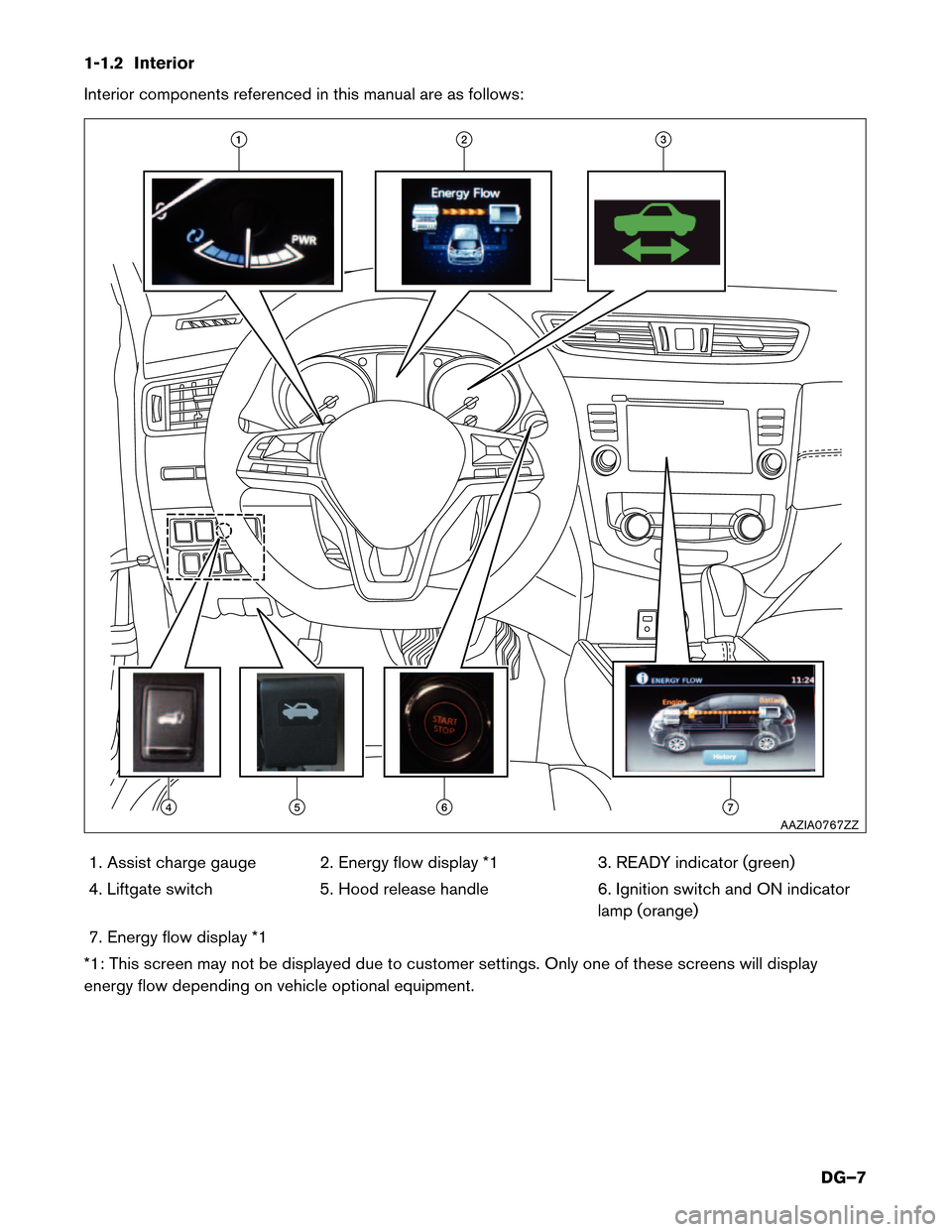
1-1.2 Interior
Interior
components referenced in this manual are as follows:
1. Assist charge gauge 2. Energy flow display *1 3. READY indicator (green)
4. Liftgate switch 5. Hood release handle 6. Ignition switch and ON indicator
lamp (orange)
7. Energy flow display *1
*1: This screen may not be displayed due to customer settings. Only one of these screens will display
energy flow depending on vehicle optional equipment. 1
4 5 6 72 3
AAZIA0767ZZ
DG–7
Page 16 of 53
2-6 High-voltage Circuit Shut-Off System
This
vehicle is equipped with a system to shut off the current from the high-voltage battery by the following
methods: Service plug
Positioned on RH rear of the high-voltage battery, this plug shuts off the
output
of high-voltage when manually removed.
System main relays
(located in the
high-voltage battery) Controlled by the ignition switch, these relays are powered by the 12-volt
system and shut off high-voltage from the high-voltage battery.
Emergency shut-off
system In the case of a collision (front and side collisions in which the air bags are
deployed, certain rear collisions) or certain system malfunctions this system
is designed to shut off the high-voltage from the high-voltage battery.
2-7 Preventing Electrical Shock 1. If it is necessary to touch any of the high-voltage harnesses or components, always wearappropriate Personal Protective Equipment (PPE) [refer to 3-1 Preparation Items (DG–18)].
Shut
off the high-voltage system by referring to 3-4.1 High-voltage System Shut-Down
Procedure
(DG–22) .
2.
To avoid the risk of electrocution, NEVER touch the inside of the high-voltage battery with bare
hands after shutting off the high-voltage system. The high-voltage battery maintains charge even
though the high-voltage system is shut down. PPE must always be worn when touching or
working on high-voltage components.
3. Cover damaged high-voltage components with insulated tape.
DG–16
Page 19 of 53

3-2 Personal Protective Equipment (PPE) and Insulated Tools
3-2.1
Personal Protective Equipment (PPE) Protective Wear Control
Perform an inspection of the Personal Protective Equipment (PPE) items before beginning work. Do not use
any damaged PPE items.
3-2.2 Daily Inspection
This inspection is performed before and after use. The worker who will be using the items should perform
the inspection and check for deterioration and damage. • Insulated rubber gloves should be inspected for scratches, holes and tears. (Visual check and airleakage test)
• Insulated safety boots should be inspected for holes, damage, nails, metal pieces, wear or other problems on the soles. (Visual check)
• Insulated rubber sheet should be inspected for tears. (Visual check)
3-2.3 Insulated Tools
When performing work at locations where high-voltage is applied (such as terminals) , use insulated tools
meeting 1,000V/300A specifications.
3-3 Discharge Procedures DANGER
Do not perform this procedure if the battery is damaged. If you are unsure of battery
damage,
use extreme caution and wear appropriate Personal Protective Equipment (PPE) .
High-voltage battery discharging must take place before dismantling. Sufficient discharging can be
achieved by following these steps. 1. Place the shift selector into the Park (P) position.
2. Apply the parking brake.
3. Set wheel chocks to ensure the vehicle is completely immobilized.
4. Fasten the driver seat belt and close the driver door.
5. Apply foot brake and press the ignition switch to turn the system ON. Confirm READY indicator in instrument cluster turns ON.
a.
If the engine starts, leave the engine running until reaching normal operating temperature
and the idling stops. It may take more than 10 minutes for complete engine warm up and
idling to stop.
b. If the engine is at normal operating temperature and does NOT start, move on to next step.
DG–19
Page 21 of 53

11. Press the ignition switch
(A)to turn the system OFF.
Please contact following number if the vehicle could not be discharged. • 1-800-647-7261 (US) or 1-800-387-0122 (Canada)
• Hours of operation are 8am - 5pm (Monday-Friday) Eastern, Central and Pacific time zones. AAYIA0177GB
AAYIA0552ZZ
DG–21
Page 23 of 53
Powering Down the High-voltage System
The
high-voltage system can be shut down with any 1 of the following procedures:• Turn OFF the ignition switch and disconnect the 12-volt battery. Refer to Primary Procedure (DG–23) .
•
Remove the underhood fuse for the high-voltage control system and disconnect the 12-volt battery.
Refer to Alternate Procedure 1 (Remove Fuses) (DG–26).
•
Remove the service plug and disconnect the 12-volt battery.
Refer to Alternate Procedure 2 (Remove Service Plug) (DG–29).
Primary
Procedure
NOTE:
Before disconnecting the 12-volt battery terminal, if necessary, lower the windows, adjust
the steering column, adjust the seats, unlock the doors, etc. Once 12-volt battery is
disconnected, power controls will not operate.
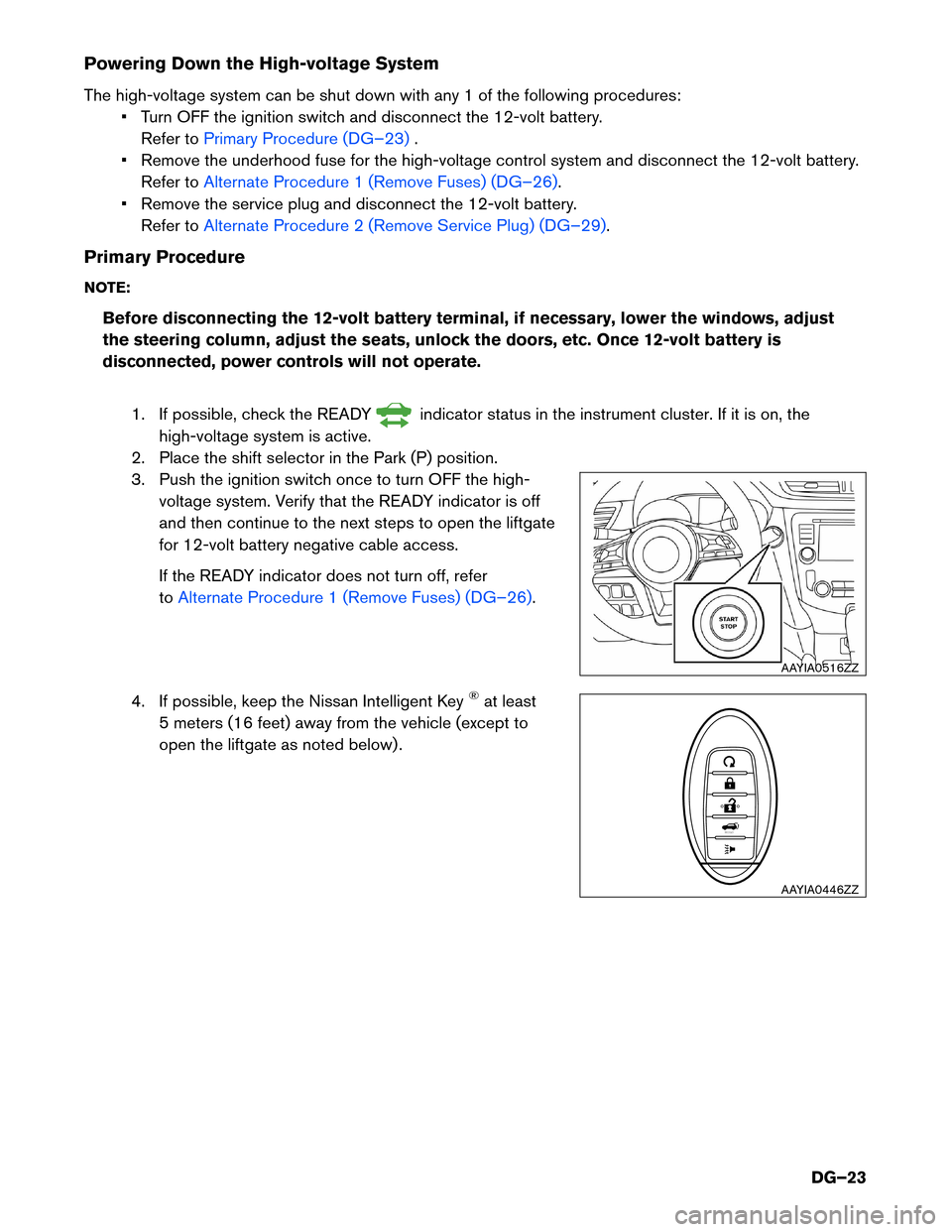
1. If possible, check the READY indicator status in the instrument cluster. If it is on, the
high-voltage
system is active.
2. Place the shift selector in the Park (P) position.
3. Push the ignition switch once to turn OFF the high- voltage system. Verify that the READY indicator is off
and then continue to the next steps to open the liftgate
for 12-volt battery negative cable access.
If the READY indicator does not turn off, refer
toAlternate Procedure 1 (Remove Fuses) (DG–26).
4.
If possible, keep the Nissan Intelligent Key
®at least
5 meters (16 feet) away from the vehicle (except to
open the liftgate as noted below) . AAYIA0516ZZ
HOLD
AAYIA0446ZZ
DG–23
Page 29 of 53
Alternate Procedure 2 (Remove Service Plug)
DANGER
• Do not remove the service plug without always wearing appropriate Personal
Protective Equipment (PPE) to help protect the dismantler from serious injury or death
by electrical shock.
• Immediately cover the service plug socket with insulated tape. The high-voltage
battery
retains high-voltage power even when the service plug is removed. To avoid
electric shock, NEVER touch the terminals inside the socket. To avoid unintended reinstallation and risk of electrical shock and severe personal injury
or
death, the dismantler should carry the service plug on his/her person while work is in
progress.
NOTE: Before disconnecting the 12-volt battery terminal, if necessary, lower the windows, adjust
the steering column, adjust the seats, unlock the doors, etc. Once 12-volt battery is
disconnected, power controls will not operate.
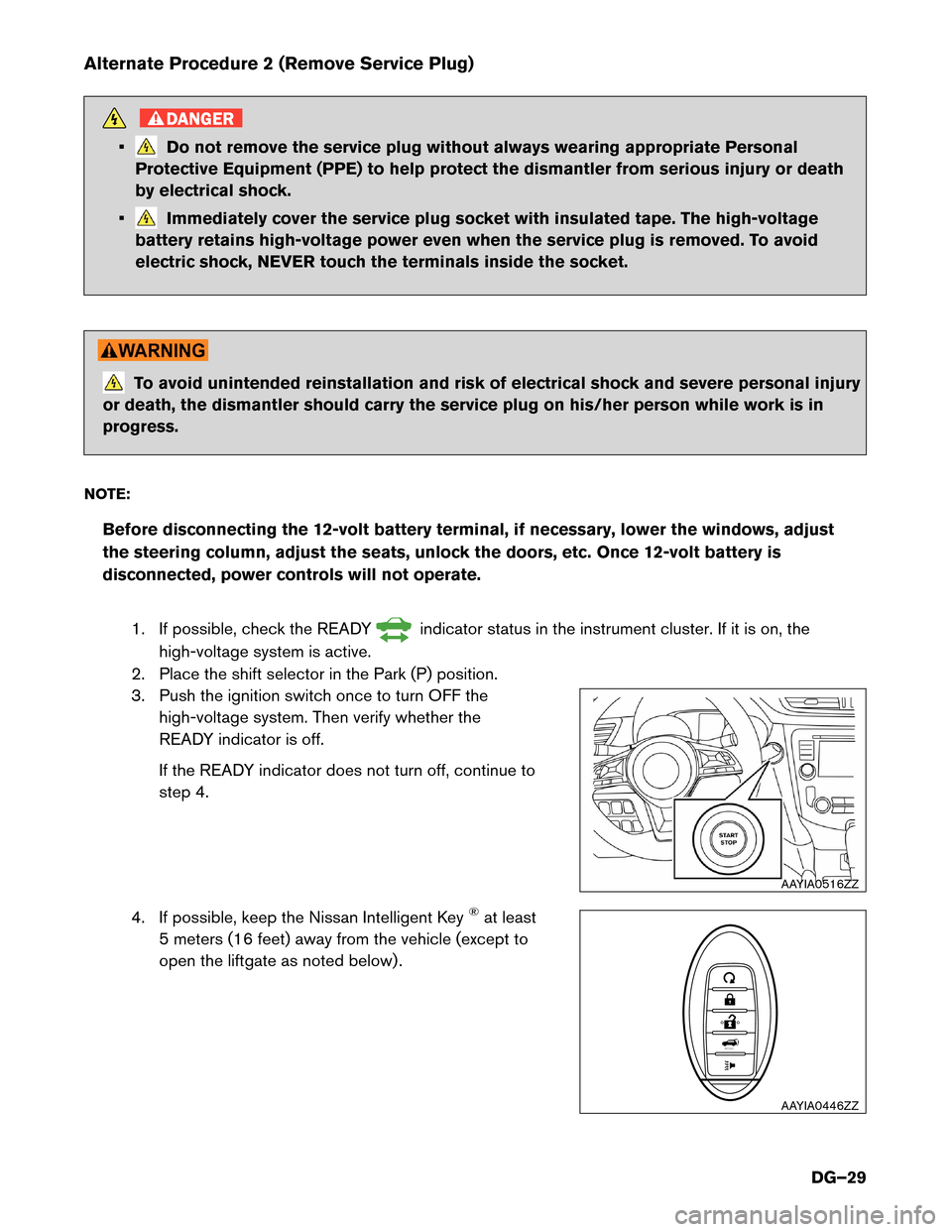
1. If possible, check the READY indicator status in the instrument cluster. If it is on, the
high-voltage
system is active.
2. Place the shift selector in the Park (P) position.
3. Push the ignition switch once to turn OFF the high-voltage system. Then verify whether the
READY indicator is off.
If the READY indicator does not turn off, continue to
step 4.
4. If possible, keep the Nissan Intelligent Key
®at least
5 meters (16 feet) away from the vehicle (except to
open the liftgate as noted below) . AAYIA0516ZZ
HOLD
AAYIA0446ZZ
DG–29
Page 36 of 53

3-4.3 Water Submersion
DANGER
Damage level of submerged vehicle may not be apparent. Handling a submerged
vehicle without appropriate Personal Protective Equipment (PPE) will result in serious
injury or death from electrical shock. • The ignition switch of the submerged vehicle must be turned OFF first, if possible.
Then
the vehicle must be completely out of the water and drained to avoid electrical
shock.
• Always wear appropriate Personal Protective Equipment (PPE) and remove/drain
water
before removing the service plug when working on a vehicle after a fire or
submersion to avoid electrical shock.
• If the vehicle is in the water, to avoid electrical shock NEVER touch the high-voltage
components,
harnesses or service plug. PPE must always be worn when touching or
working on high-voltage components.
3-4.4 Vehicle Fire • Always utilize appropriate full Personal Protective Equipment (PPE) and self-contained
breathing
apparatus during fire fighting operations. Smoke from a Rogue HYBRID
vehicle fire is similar to smoke from a conventional vehicle fire.
• In the case of extinguishing a fire with water, large amounts of water from a fire hydrant (if possible) must be used. DO NOT extinguish fire with a small amount of water. In the event of a small fire, a Type ABC fire extinguisher may be used for an electrical fire
caused
by wiring harnesses, electrical components, etc. or oil fire.
In case of vehicle fire, contact fire department immediately and extinguish the fire if possible. If you must
walk away from the vehicle, notify an appropriate responder or a rescue person of the fact that the vehicle is
a hybrid vehicle that contains a high-voltage system and warn all others.
DG–36
Page 38 of 53

4. Jump Starting
T
o start the hybrid system with a booster battery, the instructions and precautions below must be followed. If done incorrectly, jump starting can lead to a 12-volt battery explosion, resulting in severe
personal
injury or death. It could also damage your vehicle.
Jump starting provides power to the 12-volt system to allow the electrical systems to operate. The electrical
systems must be operating to allow the high-voltage battery to be charged. Jump starting does not charge
the high-voltage battery.
Discharged 12-volt battery may cause the following issues: • The instrument cluster cannot be displayed while the ignition switch is turned ON. (The hybridsystem cannot start.)
• Headlamps, horn, etc. are weak. • To avoid electrical shock, the high-voltage battery CANNOT be jump started.
•
Explosive hydrogen gas is always present in the vicinity of the 12-volt battery. Keep all
sparks and flames away from the 12-volt battery. Make sure the vent tube is mounted.
• Do not allow battery fluid to come into contact with eyes, skin, clothing or painted surfaces. Battery fluid is a corrosive sulfuric acid solution that can cause severe burns.
If the fluid comes into contact with anything, immediately flush the contacted area
with water.
• The booster battery must be rated at 12 volts. Use of an improperly rated battery can damage the vehicle.
• Whenever working on or near a 12-volt battery, always wear suitable eye protectors (for example, goggles or industrial safety spectacles) and remove rings, metal bands, or any
other jewelry. Do not lean over the 12-volt battery when jump starting.
• Do not attempt to jump start a frozen battery. It could explode and cause serious injury.
• Rogue HYBRID is equipped with an automatic cooling fan. It could come on at any time. Keep hands and other objects away from it.
• Always follow the jump starting instructions below. Failure to do so could result in damage to the charging system and cause personal injury.
DG–38
Page 40 of 53

If the green READY light does not come on, press the START button to turn the
Hybrid
System OFF. Carefully disconnect the negative cable then the positive cable.
It is recommended you visit a NISSAN dealer for repair.
9. After the green READY light in the meter display comes ON, carefully disconnect the
negative
cable and then the positive cable.
10. Replace the vent caps (if so equipped) . Be sure to dispose of the cloth used to cover the vent holes as it may be contaminated with corrosive acid.
11. Reinstall the fusible link box cover.
NOTE:
If it is not possible to turn the hybrid system ON by following this procedure, it is
recommended you contact a NISSAN dealer immediately.
4-2 Shift Selector Lever Lock Release
If the 12-volt battery is low or discharged, the selector lever cannot be moved from the Park (P) position. If a
booster battery is not available, the selector lever lock can be manually released. To manually release the
selector lever lock, perform the following procedure: 1. Push the ignition switch to the LOCK or OFF position.
2. Apply the parking brake.
3. Remove the shift lock cover using a suitable tool.
4. Push down the shift lock using a suitable tool as shown in the illustration.
5. Push the selector lever button and move the selector lever to the Neutral (N) position whileholding down the shift lock. AAYIA0551ZZ
DG–40