transmission NISSAN ROGUE HYBRID 2019 Owner's Guide
[x] Cancel search | Manufacturer: NISSAN, Model Year: 2019, Model line: ROGUE HYBRID, Model: NISSAN ROGUE HYBRID 2019Pages: 508, PDF Size: 6.17 MB
Page 460 of 508

Engine coolant*:Replace coolant at the
specified interval. When adding or replac-
ing coolant, be sure to use only Genuine
NISSAN Long Life Antifreeze/Coolant (blue)
or equivalent with the proper mixture. (For
additional information on the proper mix-
ture for your area, refer to “Engine cooling
system” in the “Do-it-yourself ” section of
this manual.)
NOTE: Mixing any other type of coolant
or the use of non-distilled water may re-
duce the recommended service interval
of the coolant.
Hybrid Electronic Vehicle (HEV) inverter
coolant: Replace coolant at the specified
interval. When adding or replacing coolant,
be sure to use only Genuine NISSAN Long
Life Antifreeze/Coolant (blue) or equivalent
with the proper mixture. (For additional in-
formation on the proper mixture for your
area, refer to “Engine cooling system” in the
“Do-it-yourself ” section of this manual.)
NOTE: Mixing any other type of coolant
or the use of non-distilled water may re-
duce the recommended service interval
of the coolant.
Engine oil and oil filter: Replace engine oil
and oil filter at the specified intervals. For
recommended oil grade and viscosity refer to “Recommended fluids/lubricants and
capacities” in the “Technical and consumer
information” section of this manual.
Engine valve clearance*:
Inspect only if
valve noise increase. Adjust valve clearance
if necessary.
Evaporative emissions control vapor
lines*: Check vapor lines for leaks or loose-
ness. Tighten connections or replace parts
as necessary.
Fuel filter*: Periodic maintenance is not re-
quires. (in-tank type filter)
Fuel lines*: Check the fuel hoses, piping
and connections for leaks, looseness, or
deterioration. Tighten connections or re-
place parts as necessary.
Spark plugs: Replace at specified intervals.
Install new plugs of the same type as origi-
nally equipped.
CHASSIS AND BODY
MAINTENANCE:
Brake lines and cables: Visually inspect for
proper installation. Check for chafing,
cracks, deterioration, and signs of leaking.
Replace any deteriorated or damaged
parts immediately. Brake pads and rotors:
Check for wear,
deterioration and fluid leaks. Replace any
deteriorated or damaged parts immedi-
ately.
Exhaust system: Visually inspect the ex-
haust pipes, muffler and hangers for leaks,
cracks, deterioration, and damage. Tighten
connections or replace parts as necessary.
In-cabin microfilter: Replace at specified
intervals. When driving for prolonged peri-
ods in dusty conditions, replace the filter
more frequently.
Propeller shaf t(s): Check for damage,
looseness, and grease leakage. (AWD)
Steering gear and linkage, axle and sus-
pension parts, drive shaf t boots: Check
for damage, looseness, and leakage of oil
or grease. Under severe driving conditions,
inspect more frequently.
Tire rotation: Tires should be rotated every
5,000 miles (8,000 km) according to the in-
structions under “Explanation of general
maintenance items” in this section. When
rotating tires, check for damage and un-
even wear. Replace if necessary.
Transmission fluid/oil, differential oil,
transfer case oil: Visually inspect for signs
of leakage at specified intervals.
9-6Maintenance and schedules
Page 461 of 508

If using a car-top carrier or driving on rough
or muddy roads:∙ Replace the fluid/oil every 20,000 miles (32,000 km) or 24 months.
∙ Replace the CVT fluid every 30,000 miles (48,000 km).
Off-road maintenance: Check the follow-
ing items frequently whenever you drive
off-road through deep sand, mud or water:
∙ Brake pads and rotors
∙ Brake lines and hoses
∙ Differential, transmission and transfer case oil
∙ Steering linkage
∙ Propeller shaf t(s) and front drive shaf ts
∙ Engine air filter To help ensure smooth, safe and economi-
cal driving, NISSAN provides two mainte-
nance schedules that may be used, de-
pending upon the conditions in which you
usually drive. These schedules contain
both distance and time intervals, up to
120,000 miles (192,000 km)/144 months. For
most people, the odometer reading will in-
dicate when service is needed. However, if
you drive very little, your vehicle should be
serviced at the regular time intervals
shown in the schedule.
Af ter 120,000 miles (192,000 km)/
144 months, continue maintenance at
the same mileage/time intervals.
ADDITIONAL MAINTENANCE ITEMS
FOR SEVERE OPERATING
CONDITIONS
Additional maintenance items for severe
operating conditions
should be per-
formed on vehicles that are driven under
especially demanding conditions. Addi-
tional maintenance items should be per-
formed if you primarily operate your vehicle
under the following conditions:
∙ Repeated short trips of less than 5 miles (8 km). ∙ Repeated short trips of less than
10 miles (16 km) with outside tempera-
tures remaining below freezing.
∙ Operating in hot weather in stop-an-go “rush hour” traffic.
∙ Extensive idling and/or low speed driv- ing for long distances, such as police,
taxi or door-to-door delivery use.
∙ Driving in dusty conditions.
∙ Driving on rough, muddy or salt spread roads.
∙ Using a car-top carrier.
NOTE:
For vehicles operated in Canada, both
standard and severe maintenance items
should be performed at every interval.
MAINTENANCE SCHEDULES
Maintenance and schedules9-7
Page 474 of 508
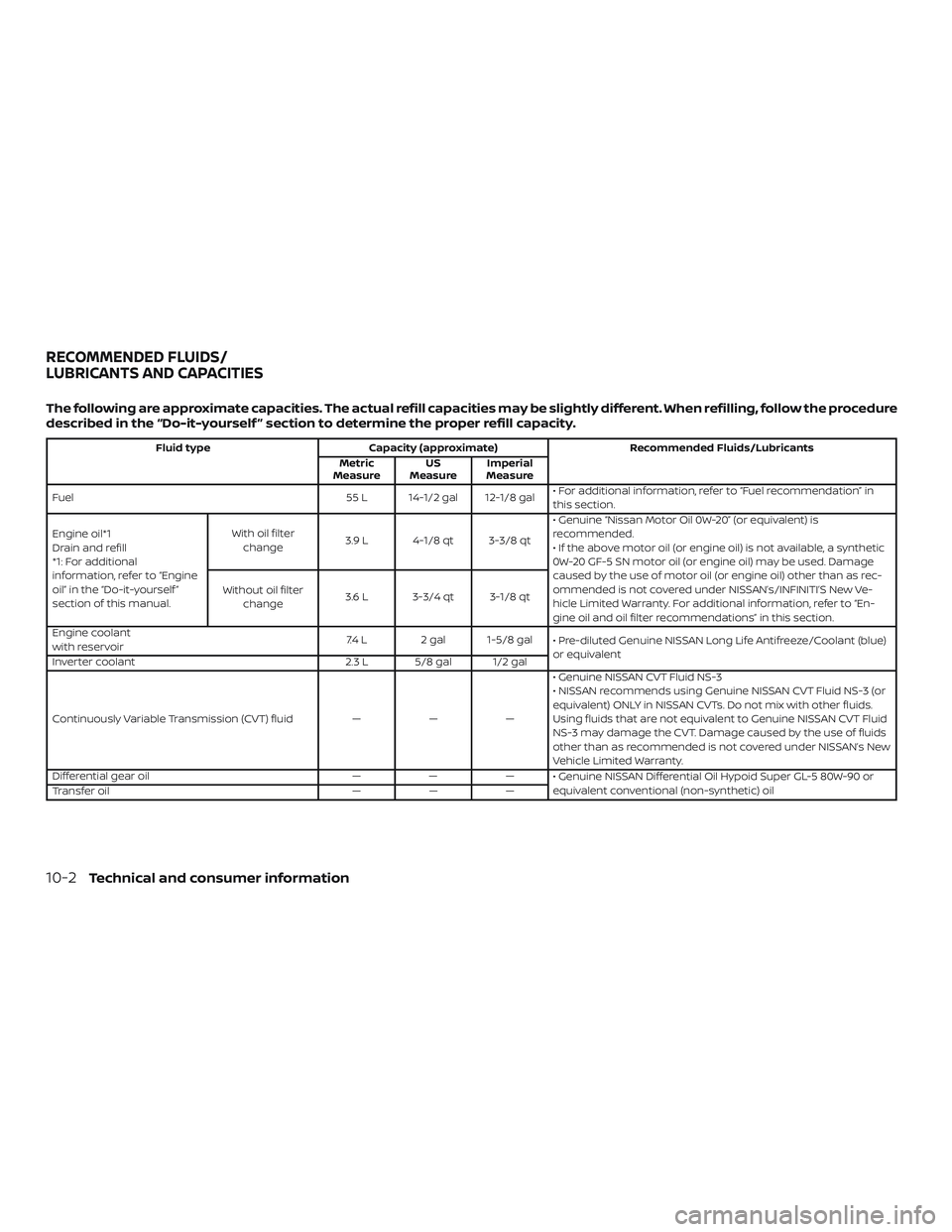
The following are approximate capacities. The actual refill capacities may be slightly different. When refilling, follow the procedure
described in the “Do-it-yourself ” section to determine the proper refill capacity.
Fluid typeCapacity (approximate) Recommended Fluids/Lubricants
Metric
Measure US
Measure Imperial
Measure
Fuel 55 L 14-1/2 gal 12-1/8 gal• For additional information, refer to “Fuel recommendation” in
this section.
Engine oil*1
Drain and refill
*1: For additional
information, refer to “Engine
oil” in the “Do-it-yourself ”
section of this manual. With oil filter
change 3.9 L 4-1/8 qt 3-3/8 qt • Genuine “Nissan Motor Oil 0W-20” (or equivalent) is
recommended.
• If the above motor oil (or engine oil) is not available, a synthetic
0W-20 GF-5 SN motor oil (or engine oil) may be used. Damage
caused by the use of motor oil (or engine oil) other than as rec-
ommended is not covered under NISSAN’s/INFINITI’S New Ve-
hicle Limited Warranty. For additional information, refer to “En-
gine oil and oil filter recommendations” in this section.
Without oil filter
change 3.6 L 3-3/4 qt 3-1/8 qt
Engine coolant
with reservoir 7.4 L 2 gal 1-5/8 gal
• Pre-diluted Genuine NISSAN Long Life Antifreeze/Coolant (blue)
or equivalent
Inverter coolant 2.3 L 5/8 gal 1/2 gal
Continuously Variable Transmission (CVT) fluid ———• Genuine NISSAN CVT Fluid NS-3
• NISSAN recommends using Genuine NISSAN CVT Fluid NS-3 (or
equivalent) ONLY in NISSAN CVTs. Do not mix with other fluids.
Using fluids that are not equivalent to Genuine NISSAN CVT Fluid
NS-3 may damage the CVT. Damage caused by the use of fluids
other than as recommended is not covered under NISSAN’s New
Vehicle Limited Warranty.
Differential gear oil ———
• Genuine NISSAN Differential Oil Hypoid Super GL-5 80W-90 or
equivalent conventional (non-synthetic) oil
Transfer oil ———
RECOMMENDED FLUIDS/
LUBRICANTS AND CAPACITIES
10-2Technical and consumer information
Page 490 of 508

Do not tow a trailer with your vehicle.
FLAT TOWING FOR ALL–WHEEL
DRIVE VEHICLE (if so equipped)
Towing your vehicle with all four wheels on
the ground is sometimes called flat towing.
This method is sometimes used when
towing a vehicle behind a recreational ve-
hicle, such as a motor home.
CAUTION
∙ Failure to follow these guidelines canresult in severe transmission damage.
∙ Never flat tow your All-wheel drive (AWD) vehicle.
∙ DO NOT tow your All-wheel drive (AWD) vehicle with any wheels on the
ground. Doing so may cause serious
and expensive damage to the
powertrain.
∙ For emergency towing procedures re- fer to “Towing recommended by
NISSAN” in the “In case of emergency ”
section of this manual.
FLAT TOWING FOR FRONT WHEEL
DRIVE VEHICLE (if so equipped)
Towing your vehicle with all four wheels on
the ground is sometimes called flat towing.
This method is sometimes used when
towing a vehicle behind a recreational ve-
hicle, such as a motor home.
CAUTION
∙ Failure to follow these guidelines canresult in severe transmission damage.
∙ Whenever flat towing your vehicle, al- ways tow forward, never backward.
∙ Never tow your front wheel drive ve- hicle with the front tires on the
ground. Doing so may cause serious
and expensive damage to the
powertrain.
∙ DO NOT tow your front wheel drive continuously variable transmission
vehicle with all four wheels on the
ground (flat towing). Doing so WILL
DAMAGE internal transmission parts
due to lack of transmission
lubrication. ∙ For emergency towing procedures re-
fer to “Towing recommended by
NISSAN” in the “In case of emergency ”
section of this manual.
Continuously Variable
Transmission
To tow a vehicle equipped with a continu-
ously variable transmission, an appropriate
vehicle dolly MUSTbe placed under the
towed vehicle’s drive wheels. Alwaysfollow
the dolly manufacturer’s recommenda-
tions when using their product.
TOWING A TRAILER
10-18Technical and consumer information
Page 496 of 508
LATCH (Lower Anchors and Tethers for
CHildren)System..............1-25
Precautions on child
restraints .........1-23, 1-30, 1-36, 1-41
Top tether strap anchor point
locations...................1-28
Child restraint with top tether strap . . . .1-27
Child safety rear door lock ..........3-7
Chimes, audible reminders .........2-20
Cleaningexteriorandinterior......7-2,7-4
C.M.V.S.S. certification label .........10-12
Coldweatherdriving ............5-124
Console box ...................2-61
Console light ..................2-73
Continuously Variable Transmission
(CVT) .......................5-19
Continuously Variable Transmission
(CVT) fluid ..................8-11
Driving with Continuously Variable
Transmission (CVT) ............5-19
Controls Heater and air conditioner controls . .4-31
Coolant Capacities and recommended
fuel/lubricants...............10-2
Changing engine coolant .........8-5
Checking engine coolant level ......8-5
Checking inverter coolant level .....8-7
Corrosionprotection..............7-7
Cruisecontrol .................5-55
Cupholders...................2-62 D
Defroster switch Rear window and outside mirror
defrosterswitch..............2-45
Dimensions and weights ..........10-10
Dimmer switch for instrument panel . . .2-51
Display......................2-21
Door locks ..................3-4,3-5
Drive positioner, Automatic ......3-39,3-41
Driving Cold weather driving ..........5-124
Driving with Continuously Variable
Transmission (CVT) ............5-19
Precautions when starting and
driving..................5-4,5-12
Drivingthevehicle...............5-19
Dynamic driver assistance switch ....2-54
E
E-CALL (SOS) SWITCH .............2-57
ECO mode switch ...............5-25
Economy - fuel ................5-105
Efficientuseofyourvehicle........HEV-11
Emergency hybrid system shut off ....5-16
Emergency shut-off system .......HEV-4
Emission control information label . . . .10-12
Emission control system warranty . . . .10-20
Energy monitors ...............HEV-6
Engine Capacities and recommended
fuel/lubricants...............10-2
Changing engine coolant .........8-5
Changing engine oil ............8-8 Changing engine oil filter
.........8-10
Checking engine coolant level ......8-5
Checking engine oil level .........8-7
Engine compartment check
locations...................8-3
Engine cooling system ..........8-4
Engine oil ...................8-7
Engine oil and oil filter
recommendation .............10-7
Engine oil viscosity .............10-7
Engine serial number ..........10-12
Engine specifications ...........10-9
EventDatarecorders............10-22
Exhaust gas (Carbon monoxide) .......5-4
Explanation of maintenance items .....9-2
Explanation of scheduled maintenance
items .......................9-5
Extended storage switch ..........2-59
Eyeglasscase................ .2-62
F
Flashers
(Seehazardwarningflasherswitch)....6-2
Flattire......................6-3
Floormatpositioningaid...........7-6
Fluid Brakefluid..................8-11
Capacities and recommended
fu
el/lubricants...............10-2
Continuously Variable Transmission
(CVT) fluid ..................8-11
Engine coolant ...............8-4
Engine oil ...................8-7
11-2
Page 501 of 508
TireFlattire....................6-3
Spare tire ................6-5,8-39
Tire and Loading Information label . .10-13
Tire chains .................8-35
Tire pressure ................8-28
Tirerotation ................8-36
Types of tires ................8-34
Uniform tire quality grading ......10-19
Wheels and tires ..............8-28
Wheel/tire size ...............10-10
Tire pressure Low tire pressure warning light .....2-13
Tire Pressure Monitoring System (TPMS) . .5-5
Toptetherstrapchildrestraint.......1-27
Towing 4-wheel drive models ...........6-18
Flattowing.................10-18
Towtrucktowing .............6-16
Trailertowing...............10-18
Towingatrailer................10-18
Transceiver HomeLink® Universal
Transceiver ....2-75,2-76,2-77,2-78,2-78
Transmission Continuously Variable Transmission
(CVT) fluid ..................8-11
Driving with Continuously Variable
Transmission (CVT) ............5-19
Travel (See registering a vehicle in another
country) .....................10-11
Trip odometer ..................2-5
Turn signal switch ...............2-51 U
Uniform tire quality grading ........10-19
USB/iPod® Charging Ports ..........4-35
V
Vanitymirror..................3-35
Vehicle dimensions and weights .....10-10
Vehicle does not start .............6-11
Vehicle Dynamic Control (VDC) OFF
switch......................2-55
Vehicle Dynamic Control (VDC)
system .....................5 -112
Vehicle identification .............10-11
Vehicle identification number (VIN) . . . .10-11
Vehicle identification number (VIN)
(Chassis number) ...............10-11
Vehicle identification number (VIN)
plate.......................10-11
Vehicle immobilizer system ......2-42,5-17
VehicleInformationDisplay.........2-21
Vehicle loading information ........10-14
Vehiclerecovery.............6-18,6-19
Vehicle security system ...........2-40
Vehicle security system (NISSAN Vehicle
Immobilizer System), engine start . .2-42, 5-17
Ventilators ...................4-29
Visors ......................3-34 W
Warning Airbagwarninglight........1-64, 2-16
Anti-lock brake warning light ......2-11
Battery charge warning light ......2-11
Brakewarninglight............2-12
Hazard warning flasher switch ......6-2
Loose fuel cap warning ......2-35,3-33
Lowfuelwarninglight....2-15,2-16,2-34
Lowtirepressurewarninglight.....2-13
Low windshield-washer fluid warning
light......................2-34
Passenger air bag and status light. . .1-55
Seatbeltwarninglight.......1-14,2-16
Supplemental air bag warning
light...................1-64, 2-16
TPMS......................2-4
Vehicle security system .........2-40
Warning/indicator lights and audible
reminders ............2-10,2 -11, 2-17
Warning labels (for SRS) ..........1-63
Warning/indicator lights and audible
reminders ..............2-10, 2-11, 2-17
Audible reminders .......2-10,2-11, 2-17
Checking bulbs ...............2-11
I n
dicatorlights.........2-10, 2-11, 2-17
Warninglights..........2-10, 2-11, 2-17
Warninglights............2-10,2 -11, 2-17
Warning lights, indicator lights and audible
reminders ....................2-10
11-7