fuel NISSAN ROGUE SELECT 2015 Owner's Manual
[x] Cancel search | Manufacturer: NISSAN, Model Year: 2015, Model line: ROGUE SELECT, Model: NISSAN ROGUE SELECT 2015Pages: 322, PDF Size: 2.21 MB
Page 201 of 322
5-14Starting and driving
may shift to N (Neutral) and restart a stalled
engine while the vehicle is moving.
D (Drive):
Use this position for all normal forward driving.
L (Low):
Use this position for maximum engine braking on
steep downhill gradients/climbing steep slopes
and whenever approaching sharp bends. Do not
use the L position in any other circumstances.
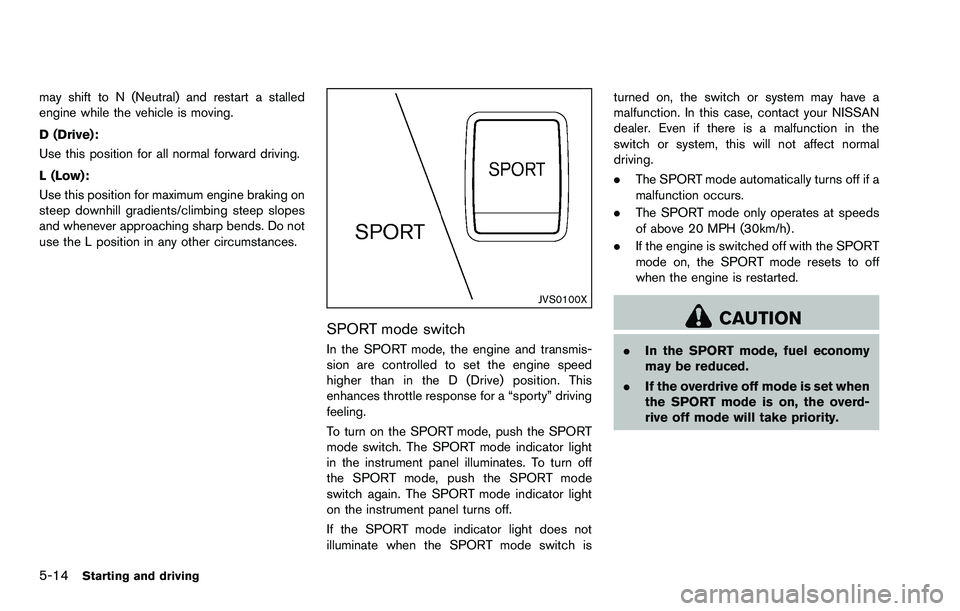
JVS0100X
SPORT mode switch
In the SPORT mode, the engine and transmis-
sion are controlled to set the engine speed
higher than in the D (Drive) position. This
enhances throttle response for a “sporty” driving
feeling.
To turn on the SPORT mode, push the SPORT
mode switch. The SPORT mode indicator light
in the instrument panel illuminates. To turn off
the SPORT mode, push the SPORT mode
switch again. The SPORT mode indicator light
on the instrument panel turns off.
If the SPORT mode indicator light does not
illuminate when the SPORT mode switch isturned on, the switch or system may have a
malfunction. In this case, contact your NISSAN
dealer. Even if there is a malfunction in the
switch or system, this will not affect normal
driving.
.
The SPORT mode automatically turns off if a
malfunction occurs.
. The SPORT mode only operates at speeds
of above 20 MPH (30km/h) .
. If the engine is switched off with the SPORT
mode on, the SPORT mode resets to off
when the engine is restarted.
CAUTION
.In the SPORT mode, fuel economy
may be reduced.
. If the overdrive off mode is set when
the SPORT mode is on, the overd-
rive off mode will take priority.
Page 206 of 322
CAUTION
During the first 1,200 miles (2,000 km) ,
follow these recommendations to ob-
tain maximum engine performance and
ensure the future reliability and econo-
my of your new vehicle. Failure to
follow these recommendations may
result in shortened engine life and
reduced engine performance.
. Avoid driving for long periods at constant
speed, either fast or slow. Do not run the
engine over 4,000 rpm.
. Do not accelerate at full throttle in any gear.
. Avoid quick starts.
. Avoid hard braking as much as possible.
. Do not tow a trailer for the first 500 miles
(800 km) . Your engine, axle or other parts
could be damaged. Follow these easy-to-use Fuel Efficient Driving
Tips to help you achieve the most fuel economy
from your vehicle.
1. Use smooth accelerator and brake pedal
application.
.Avoid rapid starts and stops..Use smooth, gentle accelerator andbrake application whenever possible.
.Maintain constant speed while commut-
ing and coast whenever possible.
2. Maintain constant speed.
.Look ahead to try and anticipate and minimize stops.
.Synchronizing your speed with traffic
lights allows you to reduce your number
of stops.
.Maintaining a steady speed can minimize red light stops and improve fuel effi-
ciency.
3. Use air conditioning (A/C) at higher vehicle speeds.
.Below 40 MPH (64 km/h) , it is moreefficient to open windows to cool the
vehicle due to reduced engine load.
.Above 40 MPH (64 km/h) , it is moreefficient to use A/C to cool the vehicle
due to increased aerodynamic drag.
.Recirculating the cool air in the cabinwhen the A/C is on reduces cooling load.
4. Drive at economical speeds and distances.
.Observing the speed limit and not ex- ceeding 60 MPH (97 km/h) (where
legally allowed) can improve fuel effi-
ciency due to reduced aerodynamic
drag.
.Maintaining a safe following distancebehind other vehicles reduces unneces-
sary braking.
.Safely monitoring traffic to anticipatechanges in speed permits reduced brak-
ing and smooth acceleration changes.
.Select a gear range suitable to road conditions.
5. Use cruise control.
.Using cruise control during highway driving helps maintain a steady speed.
.Cruise control is particularly effective in providing fuel savings when driving on
flat terrains.
6. Plan for the shortest route.
.Utilize a map or navigation system to determine the best route to save time.
7. Avoid idling.
.Shutting off your engine when safe for stops exceeding 30-60 seconds saves
Starting and driving5-19
BREAK-IN SCHEDULE FUEL EFFICIENT DRIVING TIPS
Page 207 of 322
5-20Starting and driving
fuel and reduces emissions.
8. Buy an automated pass for toll roads.
.Automated passes permit drivers to use special lanes to maintain cruising speed
through the toll and avoid stopping and
starting.
9. Winter warm up.
.Limit idling time to minimize impact to fuel economy.
.Vehicles typically need no more than 30seconds of idling at start-up to effectively
circulate the engine oil before driving.
.Your vehicle will reach its ideal operatingtemperature more quickly while driving
versus idling.
10. Keeping your vehicle cool.
.Park your vehicle in a covered parking area or in the shade whenever possible.
.When entering a hot vehicle, opening thewindows will help to reduce the inside
temperature faster, resulting in reduced
demand on your A/C system. .
Keep your engine tuned up.
. Follow the recommended scheduled main-
tenance.
. Keep the tires inflated to the correct
pressure. Low tire pressure increases tire
wear and lowers fuel economy.
. Keep the wheels in correct alignment.
Improper alignment increases tire wear and
lowers fuel economy.
. Use the recommended viscosity engine oil.
(See “Engine oil and oil filter recommenda-
tion” (P.9-5) .)
WARNING
.For AWD equipped vehicles, do not
attempt to raise two wheels off the
ground and shift the transmission to
any drive or reverse position with
the engine running. Doing so may
result in drivetrain damage or un-
expected vehicle movement which
could result in serious vehicle da-
mage or personal injury.
. Do not attempt to test an AWD
equipped vehicle on a 2-wheel dy-
namometer (such as the dynam-
ometers used by some states for
emissions testing) or similar equip-
ment even if the other two wheels
are raised off the ground. Make sure
that you inform the test facility
personnel that your vehicle is
equipped with AWD before it is
placed on a dynamometer. Using
the wrong test equipment may re-
sult in drivetrain damage or unex-
pected vehicle movement which
could result in serious vehicle da-
mage or personal injury.
INCREASING FUEL ECONOMY ALL-WHEEL DRIVE (AWD) (if so
equipped)
Page 240 of 322
Remove dirt with a vacuum cleaner.
. Never allow water or other liquids to
come in contact with electronic
components inside the vehicle as
this may damage them.
Chemicals used for road surface deicing are
extremely corrosive. They accelerate corrosion
and deterioration of underbody components
such as the exhaust system, fuel and brake
lines, brake cables, floor pan and fenders.
In winter, the underbody must be cleaned
periodically.
For additional protection against rust and
corrosion, which may be required in some areas,
consult a NISSAN dealer.
Appearance and care7-7
Page 245 of 322
8-4Maintenance and do-it-yourself
Windshield defroster:Check that the air
comes out of the defroster outlets properly and
in sufficient quantity when operating the heater
or air conditioner.
Windshield wiper and washer*: Check that
the wipers and washer operate properly and that
the wipers do not streak.
Under the hood and vehicle
The maintenance items listed here should be
checked periodically (for example, each time you
check the engine oil or refuel) .
Battery*: Check the fluid level in each cell.
It should be between the MAX and MIN lines.
Vehicles operated in high temperatures or under
severe condition require frequent checks of the
battery fluid level.
NOTE:
Care should be taken to avoid situations
that can lead to potential battery discharge
and potential no-start conditions such as:
1. Installation or extended use of electro-
nic accessories that consume battery
power when the engine is not running
(Phone chargers, GPS, DVD players,
etc.)
2. Vehicle is not driven regularly and/or
only driven short distances. In these cases, the battery may need to be
charged to maintain battery health.
Brake fluid level*:
Make sure that the brake
fluid level is between the MAX and MIN lines on
the reservoir.
Engine coolant level*: Check the coolant level
when the engine is cold.
Engine drive belts*: Make sure that the drive
belts are not frayed, worn, cracked or oily.
Engine oil level*: Check the level after parking
the vehicle on a level surface and turning off the
engine. Wait more than 10 minutes for the oil to
drain back into the oil pan.
Exhaust system: Make sure there are no loose
supports, cracks or holes. If the sound of the
exhaust seems unusual or there is a smell of
exhaust fumes, immediately have the exhaust
system inspected by a NISSAN dealer. (See
“Precautions when starting and driving” (P.5-2)
for exhaust gas (carbon monoxide) .)
Fluid leaks: Check under the vehicle for fuel,
oil, water or other fluid leaks after the vehicle has
been parked for a while. Water dripping from the
air conditioner after use is normal. If you should
notice any leaks or if gasoline fumes are evident,
check for the cause and have it corrected
immediately. Radiator and hoses:
Check the front of the
radiator and clean off any dirt, insects, leaves,
etc., that may have accumulated. Make sure the
hoses have no cracks, deformation, rot or loose
connections.
Underbody: The underbody is frequently ex-
posed to corrosive substances such as those
used on icy roads or to control dust. It is very
important to remove these substances, other-
wise rust will form on the floor pan, frame, fuel
lines and around the exhaust system. At the end
of winter, the underbody should be thoroughly
flushed with plain water, being careful to clean
those areas where mud and dirt may accumu-
late. For additional information, see “Cleaning
exterior” (P.7-2).
Windshield washer fluid*: Check that there is
adequate fluid in the reservoir.
Page 246 of 322
When performing any inspection or mainte-
nance work on your vehicle, always take care
to prevent serious accidental injury to yourself or
damage to the vehicle. The following are general
precautions which should be closely observed.
WARNING
.Park the vehicle on a level surface,
apply the parking brake securely
and block the wheels to prevent
the vehicle from moving. Move the
shift lever to P (Park) .
. Be sure the ignition switch is in the
OFF or LOCK position when per-
forming any parts replacement or
repairs.
. If you must work with the engine
running, keep your hands, clothing,
hair and tools away from moving
fans, belts and any other moving
parts.
. It is advisable to secure or remove
any loose clothing and remove any
jewelry, such as rings, watches, etc.
before working on your vehicle.
. Always wear eye protection when-
ever you work on your vehicle. .
If you must run the engine in an
enclosed space such as a garage, be
sure there is proper ventilation for
exhaust gases to escape.
. Never get under the vehicle while it
is supported only by a jack. If it is
necessary to work under the vehicle,
support it with safety stands.
. Keep smoking materials, flame and
sparks away from fuel tank and the
battery.
. The fuel filter or fuel lines should be
serviced by a NISSAN dealer be-
cause the fuel lines are under high
pressure even when the engine is
off.
CAUTION
.Do not work under the hood while
the engine is hot. Turn the engine
off and wait until it cools down.
. Avoid direct contact with used en-
gine oil and coolant. Improperly
disposed engine oil, and engine
coolant and/or other vehicle fluids
can damage the environment. Al- ways conform to local regulations
for disposal of vehicle fluid.
. Never leave the engine or the CVT
related component harnesses dis-
connected while the ignition switch
is in the ON position.
. Never connect or disconnect the
battery or any transistorized com-
ponent while the ignition switch is
in the ON position.
. Your vehicle is equipped with an
automatic engine cooling fan. It may
come on at any time without warn-
ing, even if the ignition key is in the
OFF position and the engine is not
running. To avoid injury, always
disconnect the negative battery
cable before working near the fan.
This “8. Maintenance and do-it-yourself” section
gives instructions regarding only those items
which are relatively easy for an owner to perform.
A genuine NISSAN Service Manual is also
available. (See “Owner’s Manual/Service Man-
ual order information” (P.9-28).)
You should be aware that incomplete or
improper servicing may result in operating
difficulties or excessive emissions, and could
Maintenance and do-it-yourself8-5
MAINTENANCE PRECAUTIONS
Page 257 of 322
8-16Maintenance and do-it-yourself
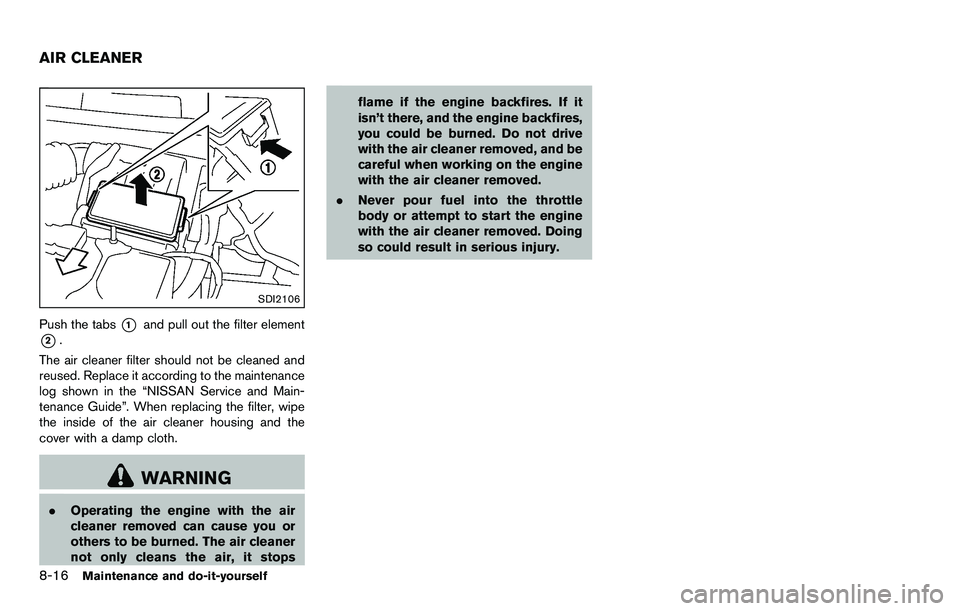
SDI2106
Push the tabs*1and pull out the filter element
*2.
The air cleaner filter should not be cleaned and
reused. Replace it according to the maintenance
log shown in the “NISSAN Service and Main-
tenance Guide”. When replacing the filter, wipe
the inside of the air cleaner housing and the
cover with a damp cloth.
WARNING
. Operating the engine with the air
cleaner removed can cause you or
others to be burned. The air cleaner
not only cleans the air, it stops flame if the engine backfires. If it
isn’t there, and the engine backfires,
you could be burned. Do not drive
with the air cleaner removed, and be
careful when working on the engine
with the air cleaner removed.
. Never pour fuel into the throttle
body or attempt to start the engine
with the air cleaner removed. Doing
so could result in serious injury.
AIR CLEANER
Page 282 of 322

9 Technical and consumer information
Capacities and recommended fluids/lubricants ................ 9-2Fuel information ................................................................... 9-3
Engine oil and oil filter recommendation ....................... 9-5
Air conditioning system refrigerant and
lubricant recommendations ............................................... 9-6
Specifications ........................................................................\
..... 9-7
Engine ........................................................................\
............ 9-7
Wheels and tires ................................................................. 9-7
Dimensions and weights ................................................... 9-8
When traveling or registering your vehicle in
another country ........................................................................\
.. 9-8
Vehicle identification ................................................................. 9-8 Vehicle Identification Number (VIN) plate ..................... 9-8
Vehicle identification number (chassis number) .......... 9-9
Engine serial number .......................................................... 9-9
F.M.V.S.S. certification label ............................................. 9-9
Emission control information label ............................... 9-10
Tire and loading information label ................................ 9-10
Air conditioner specification label ................................ 9-10
Installing front license plate ................................................. 9-11 Vehicle loading information ................................................. 9-12
Terms ........................................................................\
......... 9-12
Vehicle load capacity .................................................... 9-13
Securing the load .......................................................... 9-14
Loading tips ..................................................................... 9-15
Measurement of weights .............................................. 9-15
Towing a trailer ....................................................................... 9-16 Maximum load limits ...................................................... 9-16
Maximum Gross Vehicle Weight (GVW)/maximum
Gross Axle Weight (GAW) ......................................... 9-18
Towing load/specification ............................................ 9-20
Towing safety .................................................................. 9-20
Flat towing ....................................................................... 9-24
Uniform tire quality grading ................................................. 9-25 Treadwear ........................................................................\
9-25
Traction AA, A, B and C .............................................. 9-25
Temperature A, B and C .............................................. 9-25
Emission control system warranty ..................................... 9-26
Reporting safety defects ..................................................... 9-26
Readiness for Inspection/Maintenance (I/M) test ......... 9-26
Event Data Recorders (EDR) ............................................. 9-27
Owner’s Manual/Service Manual order information ..... 9-28
Page 283 of 322

9-2Technical and consumer information
The following are approximate capacities. The actual refill capacities may be a little different. When refilling, follow the procedure
instructed in the “8. Maintenance and do-it-yourself” section to determine the proper refill capacity.
Capacity (Approximate)Recommended specifications
US measure Imp measure Liter
Fuel 15-7/8 gal 13-1/4 gal60.
See “Fuel information” (P.9-3) .
Engine oil* With oil filter change 5-1/8 qt 4-1/4 qt4.8.
Genuine NISSAN engine oil or equivalent
. Engine oil with API Certification Mark*, Viscosity SAE 5W-30
. As an alternative to this recommended oil, SAE 5W-30 or SAE 10W-30
conventional petroleum based oils may be used and meet all
specifications and requirements necessary to maintain the New Vehicle
Limited Warranty.
*: For additional information, see “Engine oil and oil filter recommenda-
tion” (P.9-5) .
Drain and refill
* For additional information, see
“Changing engine oil and filter” (P.8-9) Without oil filter change 4-3/4 qt 4 qt4.5
Cooling system With reservoir
7-3/4 qt 6-3/8 qt7.3.
Pre-diluted Genuine NISSAN Long Life Antifreeze/Coolant (blue) or
equivalent
Reservoir 3/4 qt 5/8 qt0.75
Continuously Variable Transmission (CVT) fluid —— —.
Genuine NISSAN CVT Fluid NS-3
. NISSAN recommends using Genuine NISSAN CVT Fluid NS-3 ONLY in
NISSAN CVTs. Do not mix with other fluids. Using fluids that are not
equivalent to Genuine NISSAN CVT Fluid NS-3 may damage the CVT.
Damage caused by the use of fluids other than as recommended is not
covered under NISSAN’s New Vehicle Limited Warranty.
Differential gear oil —— —.
Genuine NISSAN Differential Oil Hypoid Super GL-5 80W-90 or
equivalent conventional (non-synthetic) oil
Transfer oil ———
Brake fluid Refill to the proper oil level according to the instruc-
tions in the “8. Maintenance and do-it-yourself”
section..
Genuine NISSAN Super Heavy Duty Brake Fluid* or equivalent DOT 3
*: Available in mainland U.S.A. through a NISSAN dealer.
Multi-purpose grease —— —.
NLGI No. 2 (Lithium soap base)
Air conditioning system refrigerant —— —.
HFC-134a (R-134a)
. For additional information, see “Vehicle identification” (P.9-8) for air
conditioner specification label.
Air conditioning system lubricants —— —.
NISSAN A/C System Oil Type S or exact equivalent
Window washer fluid 1-1/4 gal 1 gal4.5.
Genuine NISSAN Windshield Washer Concentrate Cleaner & Antifreeze
or equivalent
CAPACITIES AND RECOMMENDED
FLUIDS/LUBRICANTS
Page 284 of 322

FUEL INFORMATION
Use unleaded regular gasoline with an octane
rating of at least 87 AKI (Anti-Knock Index)
number (Research octane number 91) .
CAUTION
.Using a fuel other than that speci-
fied could adversely affect the emis-
sion control system, and may also
affect warranty coverage.
. Under no circumstances should a
leaded gasoline be used, because
this will damage the three-way cat-
alyst.
. Do not use E-15 or E-85 fuel in your
vehicle. Your vehicle is not designed
to run on E-15 or E-85 fuel. Using E-
15 or E-85 fuel in a vehicle not
specifically designed for E-15 or E-
85 fuel can adversely affect the
emission control devices and sys-
tems of the vehicle. Damage caused
by such fuel is not covered by the
NISSAN new vehicle limited war-
ranty.
. U.S. government regulations require
ethanol dispensing pumps to be identified by a small, square, orange
and black label with the common
abbreviation or the appropriate per-
centage for that region.
Gasoline specifications
NISSAN recommends using gasoline that meets
the World-Wide Fuel Charter (WWFC) speci-
fications where it is available. Many of the
automobile manufacturers developed this spe-
cification to improve emission control system
and vehicle performance. Ask your service
station manager if the gasoline meets the
WWFC specifications.
Reformulated gasoline
Some fuel suppliers are now producing refor-
mulated gasolines. These gasolines are specially
designed to reduce vehicle emissions. NISSAN
supports efforts towards cleaner air and sug-
gests that you use reformulated gasoline when
available.
Gasoline containing oxygenates
Some fuel suppliers sell gasoline containing
oxygenates such as ethanol, MTBE and metha-
nol with or without advertising their presence.
NISSAN does not recommend the use of fuels
of which the oxygenate content and the fuel
compatibility for your NISSAN cannot be readilydetermined. If in doubt, ask your service station
manager.
If you use oxygenate-blend gasoline, please take
the following precautions as the usage of such
fuels may cause vehicle performance problems
and/or fuel system damage.
.
The fuel should be unleaded and have
an octane rating no lower than that
recommended for unleaded gasoline.
. If an oxygenate-blend, other than
methanol blend is used, it should
contain no more than 10% oxygenate.
(MTBE may, however, be added up to
15%.)
. E-15 fuel contains more than 10%
oxygenate. E-15 fuel will adversely
affect the emission control devices
and systems of the vehicle and should
not be used. Damage caused by such
fuel is not covered by the NISSAN new
vehicle limited warranty.
. If a methanol blend is used, it should
contain no more than 5% methanol
(methyl alcohol, wood alcohol) . It
should also contain a suitable amount
of appropriate cosolvents and corro-
sion inhibitors. If not properly formu-
lated with appropriate cosolvents and
corrosion inhibitors, such methanol
Technical and consumer information9-3