spare tire NISSAN ROGUE SPORT 2020 Owner's Manual
[x] Cancel search | Manufacturer: NISSAN, Model Year: 2020, Model line: ROGUE SPORT, Model: NISSAN ROGUE SPORT 2020Pages: 492, PDF Size: 2.02 MB
Page 437 of 492

SDI2503
Tire and Loading Information label
Seating capacity: The max-
imum number of occu-
pants that can be seated
in the vehicle.
Vehicle load limit: See “Ve-hicle loading information”
(P.10-11).
Original size: The size of
the tires originally installed
on the vehicle at the fac-
tory.
Cold tire pressure: Inflate
the tires to this pressure
when the tires are cold.
Tires are considered COLD
after the vehicle has been
parked for 3 or more hours,
or driven less than 1 mile
(1.6 km) at moderate
speeds. The recommended
cold tire inflation is set by
the manufacturer to pro-
vide the best balance of
tire wear, vehicle handling,
driveability, tire noise, etc.,
up to the vehicle’s GVWR.
Tire size — see “Tire label-
ing” (P.8-33).
Spare tire size or compact
spare tire size (if so
equipped)
Do-it-yourself8-31
Page 438 of 492

8-32Do-it-yourself
SDI1949
Checking the tire pressure
1. Remove the valve stem cap fromthe tire.
2.Press the pressure gauge
squarely onto the valve stem.
Do not press too hard or force
the valve stem sideways, or air
will escape. If the hissing sound
of air escaping from the tire is
heard while checking the pres-
sure, reposition the gauge to
eliminate this leakage.
3.Remove the gauge.
4.Read the tire pressure on the
gauge stem and compare it to
the specification shown on the
Tire and Loading Information
label.
5.Add air to the tire as needed. If
too much air is added, press the
core of the valve stem briefly
with the tip of the gauge stem to
release pressure. Recheck the
pressure and add or release air
as needed.
6.Install the valve stem cap.
7.Check the pressure of all other
tires, including the spare (if so
equipped).
Page 439 of 492

SIZECOLD TIRE INFLATION
PRESSURE
FRONT ORIGINAL TIRE 215/65 R16 98H
230 kPa, 33 PSI
215/60 R17 96H 230 kPa, 33 PSI
225/45 R19 92W 240 kPa, 35 PSI
REAR ORIGINAL TIRE 215/65 R16 98H
230 kPa, 33 PSI
215/60 R17 96H 230 kPa, 33 PSI
225/45 R19 92W 240 kPa, 35 PSI
SPARE TIRE (if so equipped) T145/90 D16 106M
T135/90 D16 102M
420 kPa, 60 PSI
SDI1575
Example
TIRE LABELING
Federal law requires tire manufac-
turers to place standardized infor-
mation on the sidewall of all tires.
This information identifies and de-
scribes the fundamental character-
istics of the tire and also provides
the tire identification number (TIN)
for safety standard certification.
The TIN can be used to identify
the tire in case of a recall.
Do-it-yourself8-33
Page 443 of 492
addition, drive at a reduced speed. Other-
wise, your vehicle may be damaged and/
or vehicle handling and performance may
be adversely affected.
Tire chains must be installed only on
the front wheels and not on the rear
wheels.
Never install tire chains on a TEMPORARY
USE ONLY spare tire (if so equipped).
Do not use tire chains on dry roads.
Driving with tire chains in such conditions
can cause damage to the various me-
chanisms of the vehicle due to some
overstress.
SDI1662
CHANGING WHEELS AND TIRES
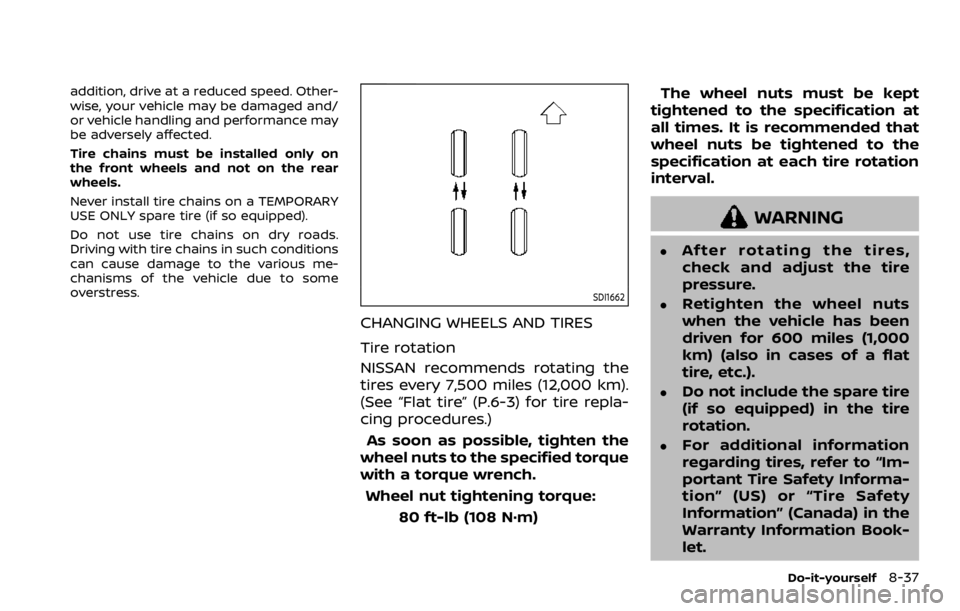
Tire rotation
NISSAN recommends rotating the
tires every 7,500 miles (12,000 km).
(See “Flat tire” (P.6-3) for tire repla-
cing procedures.)As soon as possible, tighten the
wheel nuts to the specified torque
with a torque wrench.
Wheel nut tightening torque:
80 ft-lb (108 N·m) The wheel nuts must be kept
tightened to the specification at
all times. It is recommended that
wheel nuts be tightened to the
specification at each tire rotation
interval.
WARNING
.After rotating the tires,
check and adjust the tire
pressure.
.Retighten the wheel nuts
when the vehicle has been
driven for 600 miles (1,000
km) (also in cases of a flat
tire, etc.).
.Do not include the spare tire
(if so equipped) in the tire
rotation.
.For additional information
regarding tires, refer to “Im-
portant Tire Safety Informa-
tion” (US) or “Tire Safety
Information” (Canada) in the
Warranty Information Book-
let.
Do-it-yourself8-37
Page 444 of 492
8-38Do-it-yourself
SDI1663
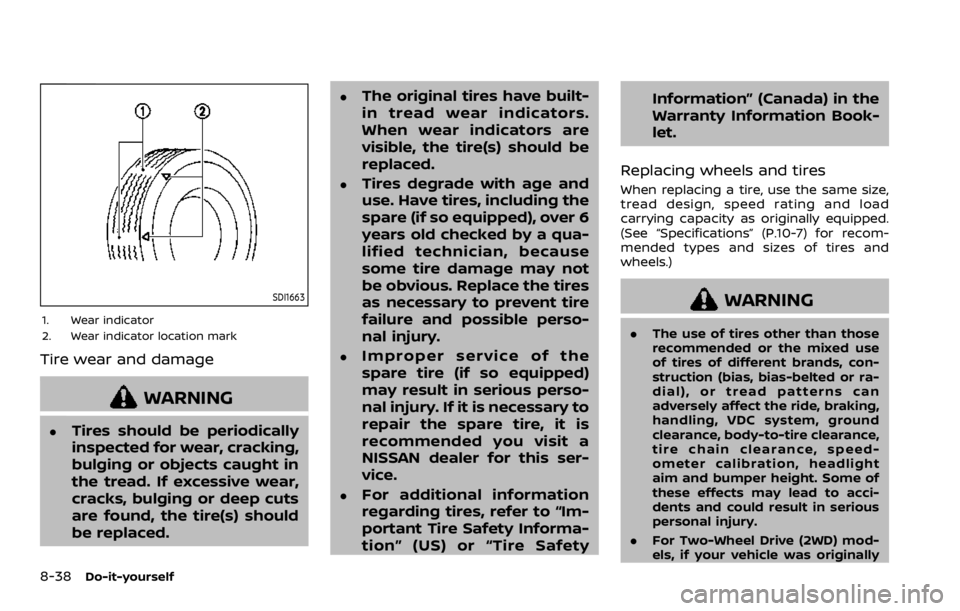
1. Wear indicator
2. Wear indicator location mark
Tire wear and damage
WARNING
.Tires should be periodically
inspected for wear, cracking,
bulging or objects caught in
the tread. If excessive wear,
cracks, bulging or deep cuts
are found, the tire(s) should
be replaced.
.The original tires have built-
in tread wear indicators.
When wear indicators are
visible, the tire(s) should be
replaced.
.Tires degrade with age and
use. Have tires, including the
spare (if so equipped), over 6
years old checked by a qua-
lified technician, because
some tire damage may not
be obvious. Replace the tires
as necessary to prevent tire
failure and possible perso-
nal injury.
.Improper service of the
spare tire (if so equipped)
may result in serious perso-
nal injury. If it is necessary to
repair the spare tire, it is
recommended you visit a
NISSAN dealer for this ser-
vice.
.For additional information
regarding tires, refer to “Im-
portant Tire Safety Informa-
tion” (US) or “Tire SafetyInformation” (Canada) in the
Warranty Information Book-
let.
Replacing wheels and tires
When replacing a tire, use the same size,
tread design, speed rating and load
carrying capacity as originally equipped.
(See “Specifications” (P.10-7) for recom-
mended types and sizes of tires and
wheels.)
WARNING
. The use of tires other than those
recommended or the mixed use
of tires of different brands, con-
struction (bias, bias-belted or ra-
dial), or tread patterns can
adversely affect the ride, braking,
handling, VDC system, ground
clearance, body-to-tire clearance,
tire chain clearance, speed-
ometer calibration, headlight
aim and bumper height. Some of
these effects may lead to acci-
dents and could result in serious
personal injury.
. For Two-Wheel Drive (2WD) mod-
els, if your vehicle was originally
Page 445 of 492
equipped with 4 tires that were
the same size and you are only
replacing 2 of the 4 tires, install
the new tires on the rear axle.
Placing new tires on the front
axle may cause loss of vehicle
control in some driving condi-
tions and cause an accident and
personal injury.
. If the wheels are changed for any
reason, always replace with
wheels which have the same off-
set dimension. Wheels of a differ-
ent off-set could cause prema-
ture tire wear, degrade vehicle
handling characteristics and/or
interference with the brake
discs/drums. Such interference
can lead to decreased braking
efficiency and/or early brake
pad/shoe wear. See “Wheels and
tires” (P.10-7) of this manual for
wheel off-set dimensions.
. Since the spare tire (if so
equipped) is not equipped with
the TPMS, when a spare tire is
mounted or a wheel is replaced,
the TPMS will not function and
the low tire pressure warning
light will flash for approximately
1 minute. The light will remain on
after 1 minute. Have your tires replaced and/or TPMS system
reset as soon as possible. It is
recommended you visit a NISSAN
dealer for these services.
. Replacing tires with those not
originally specified by NISSAN
could affect the proper operation
of the TPMS.
. The TPMS sensor may be da-
maged if it is not handled cor-
rectly. Be careful when handling
the TPMS sensor.
. When replacing the TPMS sensor,
the ID registration may be re-
quired. It is recommended you
visit a NISSAN dealer for ID regis-
tration.
. Do not use a valve stem cap that
is not specified by NISSAN. The
valve stem cap may become
stuck.
. Be sure that the valve stem caps
are correctly fitted. Otherwise the
valve may be clogged up with dirt
and cause a malfunction or loss
of pressure.
. Do not install a damaged or
deformed wheel or tire even if it
has been repaired. Such wheels
or tires could have structural
damage and could fail without warning.
. The use of retread tire is not
recommended.
. For additional information re-
garding tires, refer to “Important
Tire Safety Information” (US) or
“Tire Safety Information” (Cana-
da) in the Warranty Information
Booklet.
All-Wheel Drive (AWD) models
CAUTION
.Always use tires of the same size,
brand, construction (bias, bias-
belted or radial), and tread pat-
tern on all four wheels. Failure to
do so may result in a circumfer-
ence difference between tires on
the front and rear axles which will
cause excessive tire wear and
may damage the transmission,
transfer case and rear differential
gears.
. Only use spare tires (if so
equipped) specified for each
AWD model.
Do-it-yourself8-39
Page 446 of 492
8-40Do-it-yourself
If excessive tire wear is found, it is
recommended that all four tires be re-
placed with tires of the same size, brand,
construction and tread pattern. The tire
pressure and wheel alignment should
also be checked and corrected as neces-
sary. It is recommended you visit a
NISSAN dealer for this service.
Wheel balance
Unbalanced wheels may affect vehicle
handling and tire life. Even with regular
use, wheels can get out of balance.
Therefore, they should be balanced as
required.
Wheel balance service should be per-
formed with the wheels off the vehicle.
Spin balancing the wheels on the vehi-
cle could lead to mechanical damage.
For additional information regarding tires,
refer to “Important Tire Safety Informa-
tion” (US) or “Tire Safety Information”
(Canada) in the Warranty Information
Booklet.
Care of wheels
See “Cleaning exterior” (P.7-2) for details
about care of the wheels.
Spare tire (if so equipped)
Since the spare tire is not equipped with
the TPMS, when a spare tire is mounted
(TEMPORARY USE ONLY), the TPMS will
not function.
Observe the following precautions if the
TEMPORARY USE ONLY spare tire must be
used, otherwise your vehicle could be
damaged or involved in an accident.
WARNING
.The TEMPORARY USE ONLY spare
tire should be used for emer-
gency use. It should be replaced
with the standard tire at the first
opportunity to avoid possible tire
or differential damage.
. Drive carefully while the TEMPOR-
ARY USE ONLY spare tire is in-
stalled. Avoid sharp turns and
abrupt braking while driving.
. Periodically check spare tire in-
flation pressure. Always keep the
pressure of the TEMPORARY USE
ONLY spare tire at 60 psi (420
kPa, 4.2 bar).
. With the TEMPORARY USE ONLY
spare tire installed, do not drive
your vehicle at speeds faster than 50 MPH (80 km/h).
. When driving on roads covered
with snow or ice, the TEMPORARY
USE ONLY spare tire should be
used on the rear wheels and
original tire used on the front
wheels (drive wheels). Use tire
chains only on the front (original)
tires.
. Tire tread of the TEMPORARY USE
ONLY spare tire will wear at a
faster rate than the standard tire.
Replace the spare tire as soon as
the tread wear indicators appear.
. Do not use the spare tire on other
vehicles.
. Do not use more than one spare
tire at the same time.
CAUTION
.Do not use tire chains on a
TEMPORARY USE ONLY spare tire.
Tire chains will not fit properly
and may cause damage to the
vehicle.
. Because the TEMPORARY USE
ONLY spare tire is smaller than
the original tire, ground clearance
Page 447 of 492
is reduced. To avoid damage to
the vehicle, do not drive over
obstacles. Also do not drive the
vehicle through an automatic car
wash since it may get caught.
Emergency tire puncture repair kit
(if so equipped)
The emergency tire puncture repair kit is
supplied to the vehicle instead of a spare
tire. The kit must be used for temporarily
fixing a minor tire puncture. After using
the repair kit, it is recommended that visit
a NISSAN dealer as soon as possible for
tire inspection and repair/replacement.
See “Flat tire” (P.6-3) for more details.
Do-it-yourself8-41
Page 451 of 492

other corrosive materials, check lubrica-
tion frequently.
Lights*:Clean the headlights on a regular
basis. Make sure that the headlights, stop
lights, tail lights, turn signal lights, and
other lights are all operating properly and
installed securely. Also check headlight
aim.
Road wheel nuts (lug nuts)*: When
checking the tires, make sure no wheel
nuts are missing, and check for any loose
wheel nuts. Tighten if necessary.
Tire rotation*: Tires should be rotated
every 7,500 miles (12,000 km).
Tires*: Check the pressure with a gauge
often and always prior to long distance
trips. If necessary, adjust the pressure in
all tires, including the spare (if so
equipped), to the pressure specified.
Check carefully for damage, cuts or
excessive wear.
Tire Pressure Monitoring System (TPMS)
transmitter components: Replace the
TPMS transmitter grommet seal, valve
core and cap when the tires are replaced
due to wear or age.
Wheel alignment and balance: If the
vehicle should pull to either side while
driving on a straight and level road, or if
you detect uneven or abnormal tire wear,
there may be a need for wheel alignment. If the steering wheel or seat vibrates at
normal highway speeds, wheel balancing
may be needed.
For additional information regarding tires,
refer to “Important Tire Safety Informa-
tion” (US) or “Tire Safety Information”
(Canada) in the NISSAN Warranty Infor-
mation Booklet.
Windshield:
Clean the windshield on a
regular basis. Check the windshield at
least every six months for cracks or other
damage. Have a damaged windshield
repaired by a qualified repair facility.
It is recommended that you have a
damaged windshield repaired by a
NISSAN dealer, or a NISSAN Certified
Collision Center. To locate a collision
center in your area, refer to http://colli-
sion.nissanusa.com.
Windshield wiper blades*: Check for
cracks or wear if they do not wipe
properly.
Inside the vehicle
The maintenance items listed here should
be checked on a regular basis, such as
when performing scheduled mainte-
nance, cleaning the vehicle, etc.
Accelerator pedal: Check the pedal for
smooth operation and make sure the
pedal does not catch or require uneven effort. Keep the floor mat away from the
pedal.
Brake pedal:
Check the pedal for smooth
operation. If the brake pedal suddenly
goes down further than normal, the pedal
feels spongy or the vehicle seems to take
longer to stop, have your vehicle checked
immediately. It is recommended you visit
a NISSAN dealer for this service. Keep the
floor mat away from the pedal.
Brakes: Check that the brakes do not pull
the vehicle to one side when applied.
Continuously Variable Transmission
(CVT) P (Park) mechanism: On a fairly
steep hill, check that the vehicle is held
securely with the shift lever in the P (Park)
position without applying any brakes.
Parking brake: Check the parking brake
operation regularly. The vehicle should be
securely held on a fairly steep hill with
only the parking brake applied. If the
parking brake needs adjusted, it is re-
commended you visit a NISSAN dealer for
this service.
Seat belts: Check that all parts of the seat
belt system (for example, buckles, an-
chors, adjusters and retractors) operate
properly and smoothly, and are installed
securely. Check the belt webbing for cuts,
fraying, wear or damage.
Seats: Check seat position controls such
Maintenance and schedules9-3
Page 469 of 492

ENGINE
ModelMR20DD
Type Gasoline, 4-cycle, DOHC
Cylinder arrangement 4-cylinder, in-line
Bore × Stroke in (mm)3.307 × 3.547 (84.0 × 90.1)
Displacement cu in (cm
3)121.86 (1,997)
Firing order 1-3-4-2
Idle speed rpm
No adjustment is necessary.
Ignition timing (B.T.D.C.) degree/rpm
Spark plug StandardDILKAR7D11H
Spark plug gap (Normal) in (mm)0.043 (1.1)
Camshaft operation Timing chain
This spark ignition system complies with the Canadian standard ICES-002.
WHEELS AND TIRES
Road wheel
TypeSizeOffset in
(mm)
Conventional 16 × 6.5JJ 1.57 (40)
17 × 7J 1.38 (35)
19 × 7J 1.57 (40)
Spare (if so
equipped) 16 × 4T 1.18 (30)
Tire
Type
SizePressure PSI
(kPa) [Cold]
Conventional 215/65R16
98H33 (230)
215/60R17
96H 33 (230)
225/45R19
92W 35 (240)
Spare (if so
equipped) T145/90 D16
106M
T135/90 D16
102M
60 (420)
Depending on the models, the emergency
tire puncture repair kit is supplied.
Technical and consumer information10-7
SPECIFICATIONS