light NISSAN SENTRA 2017 B17 / 7.G Owners Manual
[x] Cancel search | Manufacturer: NISSAN, Model Year: 2017, Model line: SENTRA, Model: NISSAN SENTRA 2017 B17 / 7.GPages: 491
Page 432 of 491
If you have a flat tire, refer to “Flat tire” in
the “In case of emergency” section of this
manual.
TIRE PRESSURE
Tire Pressure Monitoring System
(TPMS)
This vehicle is equipped with the Tire
Pressure Monitoring System (TPMS) . It
monitors tire pressure of all tires except
the spare. When the low tire pressure
warning light is lit and the CHECK TIRE
PRES warning is displayed in the odom-
eter, one or more of your tires is signifi-
cantly under-inflated.
The TPMS will activate only when the
vehicle is driven at speeds above 16 mph
(25 km/h). Also, this system may not de-
tect a sudden drop in tire pressure (for
example a flat tire while driving) .
For additional information, refer to “Low
tire pressure warning light” in the “Instru-
ments and controls” section, “Tire Pres-
sure Monitoring System (TPMS)” in the“Starting and driving” section, and “Flat
tire” in the “In case of emergency” section
of this manual.
Tire inflation pressure
Check the tire pressures (including the
spare) often and always prior to long dis-
tance trips. The recommended tire pres-
sure specifications are shown on the
F.M.V.S.S./C.M.V.S.S. certification label
or the Tire and Loading Information label
under the “Cold Tire Pressure” heading.
The Tire and Loading Information label is
affixed to the driver side center pillar. Tire
pressures should be checked regularly
because:
● Most tires naturally lose air over time.
● Tires can lose air suddenly when
driven over potholes or other objects
or if the vehicle strikes a curb while
parking. The tire pressures should be checked
when the tires are cold. The tires are
considered COLD after the vehicle has
been parked for 3 or more hours, or driven
less than 1 mile (1.6 km) at moderate
speeds.
The TPMS with Easy-Fill Tire Alert (if so
equipped) provides visual and audible
signals outside the vehicle for inflating
tires to the recommended COLD tire
pressure. For additional information, refer
to “TPMS with Easy-Fill Tire Alert” in the
“Starting and driving” section of this
manual.
WHEELS AND TIRES
Do-it-yourself8-33
Page 441 of 491
Replacing wheels and tires
When replacing a tire, use the same size, tread
design, speed rating and load carrying capacity
as originally equipped. For additional information,
refer to “Wheels and tires” in the “Technical and
consumer information” section of this manual.
WARNING
●The use of tires other than those recom-
mended or the mixed use of tires of
different brands, construction (bias,
bias-belted or radial) , or tread patterns
can adversely affect the ride, braking,
handling, Vehicle Dynamic Control
(VDC) system, ground clearance, body-
to-tire clearance, tire chain clearance,
speedometer calibration, headlight aim
and bumper height. Some of these ef-
fects may lead to accidents and could
result in serious personal injury.
● If your vehicle was originally equipped
with four tires that were the same size
and you are only replacing two of the
four tires, install the new tires on the
rear axle. Placing new tires on the front
axle may cause loss of vehicle control in
some driving conditions and cause an
accident and personal injury ●
If the wheels are changed for any rea-
son, always replace with wheels which
have the same off-set dimension.
Wheels of a different off-set could
cause premature tire wear, degrade ve-
hicle handling characteristics, affect the
VDC system and/or interference with
the brake discs. Such interference can
lead to decreased braking efficiency
and/or early brake pad wear. For addi-
tional information on wheel off-set di-
mensions, refer to “Wheels and tires” in
the “Technical and consumer informa-
tion” section of this manual.
● Since the spare tire is not equipped with
the TPMS, when a spare tire is mounted
or a wheel is replaced, tire pressure will
not be indicated, the TPMS will not
function and the low tire pressure warn-
ing light will flash for approximately
1 minute. The light will remain on after
1 minute. Have your tires replaced
and/or TPMS system reset as soon as
possible. It is recommended that you
visit a NISSAN dealer for this service.
● Replacing tires with those not originally
specified by NISSAN could affect the
proper operation of the TPMS. ●
The TPMS sensor may be damaged if it
is not handled correctly. Be careful
when handling the TPMS sensor.
● When replacing the TPMS sensor, the
ID registration may be required. It is
recommended that you visit a NISSAN
dealer for ID registration.
● Do not use a valve stem cap that is not
specified by NISSAN. The valve stem
cap may become stuck.
● Be sure that the valve stem caps are
correctly fitted. Otherwise the valve may
be clogged up with dirt and cause a
malfunction or loss of pressure.
● Do not install a damaged or deformed
wheel or tire even if it has been re-
paired. Such wheels or tires could have
structural damage and could fail with-
out warning.
● The use of retread tires is not
recommended.
● For additional information regarding
tires, refer to “Important Tire Safety In-
formation” (US) or “Tire Safety Informa-
tion” (Canada) in the Warranty Informa-
tion Booklet.
8-42Do-it-yourself
Page 446 of 491
Make sure that the secondary latch keeps the
hood from opening when the primary latch is
released.
When driving in areas using road salt or other
corrosive materials, check lubrication frequently.
Lights*:Clean the headlights on a regular basis.
Make sure that the headlights, stop lights, tail
lights, turn signal lights, and other lights are all
operating properly and installed securely. Also
check headlight aim.
Road wheel nuts (lug nuts)*: When checking
the tires, make sure no wheel nuts are missing,
and check for any loose wheel nuts. Tighten if
necessary.
Tire rotation*: Tires should be rotated every
5,000 miles (8,000 km).
Tires*: Check the pressure with a gauge often
and always prior to long distance trips. If neces-
sary, adjust the pressure in all tires, including the
spare, to the pressure specified. Check carefully
for damage, cuts or excessive wear.
Tire Pressure Monitoring System (TPMS)
transmitter components: Replace the TPMS
transmitter grommet seal, valve core and cap
when the tires are replaced due to wear or age. Wheel alignment and balance:
If the vehicle
should pull to either side while driving on a
straight and level road, or if you detect uneven or
abnormal tire wear, there may be a need for wheel
alignment. If the steering wheel or seat vibrates at
normal highway speeds, wheel balancing may be
needed.
For additional information regarding tires, refer to
“Important Tire Safety Information” (US) or “Tire
Safety Information” (Canada) in the Warranty In-
formation Booklet.
Windshield: Clean the windshield on a regular
basis. Check the windshield at least every six
months for cracks or other damage. Have a dam-
aged windshield repaired by a qualified repair
facility.
Windshield wiper blades*: Check for cracks
or wear if they do not wipe properly.
Inside the vehicle
The maintenance items listed here should be
checked on a regular basis, such as when per-
forming scheduled maintenance, cleaning the ve-
hicle, etc.
Accelerator pedal: Check the pedal for smooth
operation and make sure the pedal does not
catch or require uneven effort. Keep the floor mat
away from the pedal. Brake pedal:
Check the pedal for smooth op-
eration. If the brake pedal suddenly goes down
further than normal, the pedal feels spongy or the
vehicle seems to take longer to stop, have your
vehicle checked immediately. It is recommended
that you visit a NISSAN dealer for this service.
Keep the floor mat away from the pedal.
Brakes: Check that the brakes do not pull the
vehicle to one side when applied.
Continuously Variable Transmission (CVT)
P (Park) position mechanism (if so
equipped): On a fairly steep hill check that the
vehicle is held securely with the shift lever in the P
(Park) position without applying any brakes.
Parking brake: Check the parking brake opera-
tion regularly. The vehicle should be securely held
on a fairly steep hill with only the parking brake
applied. If the parking brake needs adjustment, it
is recommended that you visit a NISSAN dealer
for this service.
Seats: Check seat position controls such as
seat adjusters, seatback recliner, etc., to ensure
they operate smoothly and all latches lock se-
curely in every position. Check that the head
restraints/headrests move up and down
smoothly and the locks (if so equipped) hold
securely in all latched positions.
Maintenance and schedules9-3
Page 447 of 491
Seat belts:Check that all parts of the seat belt
system (for example, buckles, anchors, adjusters
and retractors) operate properly and smoothly,
and are installed securely. Check the belt web-
bing for cuts, fraying, wear or damage.
Steering wheel: Check for changes in the
steering system, such as excessive free play,
hard steering or strange noises.
Warning lights and chimes: Make sure all
warning lights and chimes are operating properly.
Windshield defroster: Check that the air
comes out of the defroster outlets properly and in
sufficient quantity when operating the heater or
air conditioner.
Windshield wiper and washer*: Check that
the wipers and washer operate properly and that
the wipers do not streak.
Under the hood and vehicle
The maintenance items listed here should be
checked periodically (for example, each time you
check the engine oil or refuel) .
Battery* (for serviceable batteries): Check
the fluid level in each cell. It should be between
the MAX and MIN lines. Vehicles operated in high
temperatures or under severe conditions require
frequent checks of the battery fluid level. NOTE:
Care should be taken to avoid situations
that can lead to potential battery discharge
and potential no-start conditions such as:
1. Installation or extended use of electronic accessories that consume battery power
when the engine is not running (Phone char-
gers, GPS, DVD players, etc.) .
2. Vehicle is not driven regularly and/or only driven short distances.
In these cases, the battery may need to be
charged to maintain battery health.
Brake and clutch (if so equipped) fluid
level*: Make sure that the brake and clutch fluid
levels are between the MIN and MAX lines on the
reservoir.
Engine coolant level*: Check the coolant level
when the engine is cold.
Engine drive belts*: Make sure the drive belts
are not frayed, worn, cracked or oily.
Engine oil level*: Check the level after parking
the vehicle on a level surface with the engine off.
Wait more than 15 minutes for the oil to drain
back into the oil pan. Exhaust system:
Make sure there are no loose
supports, cracks or holes. If the sound of the
exhaust seems unusual or there is a smell of
exhaust fumes, immediately have the exhaust
system inspected. It is recommended that you
visit a NISSAN dealer for this service. For addi-
tional information, refer to “Exhaust gas (carbon
monoxide)” in the “Starting and driving” section of
this manual.
Fluid leaks: Check under the vehicle for fuel, oil,
water or other fluid leaks after the vehicle has
been parked for a while. Water dripping from the
air conditioner after use is normal. If you should
notice any leaks or if fuel fumes are evident,
check for the cause and have it corrected imme-
diately.
Radiator and hoses: Check the front of the
radiator and clean off any dirt, insects, leaves,
etc., that may have accumulated. Make sure the
hoses have no cracks, deformation, rot or loose
connections.
9-4Maintenance and schedules
Page 461 of 491
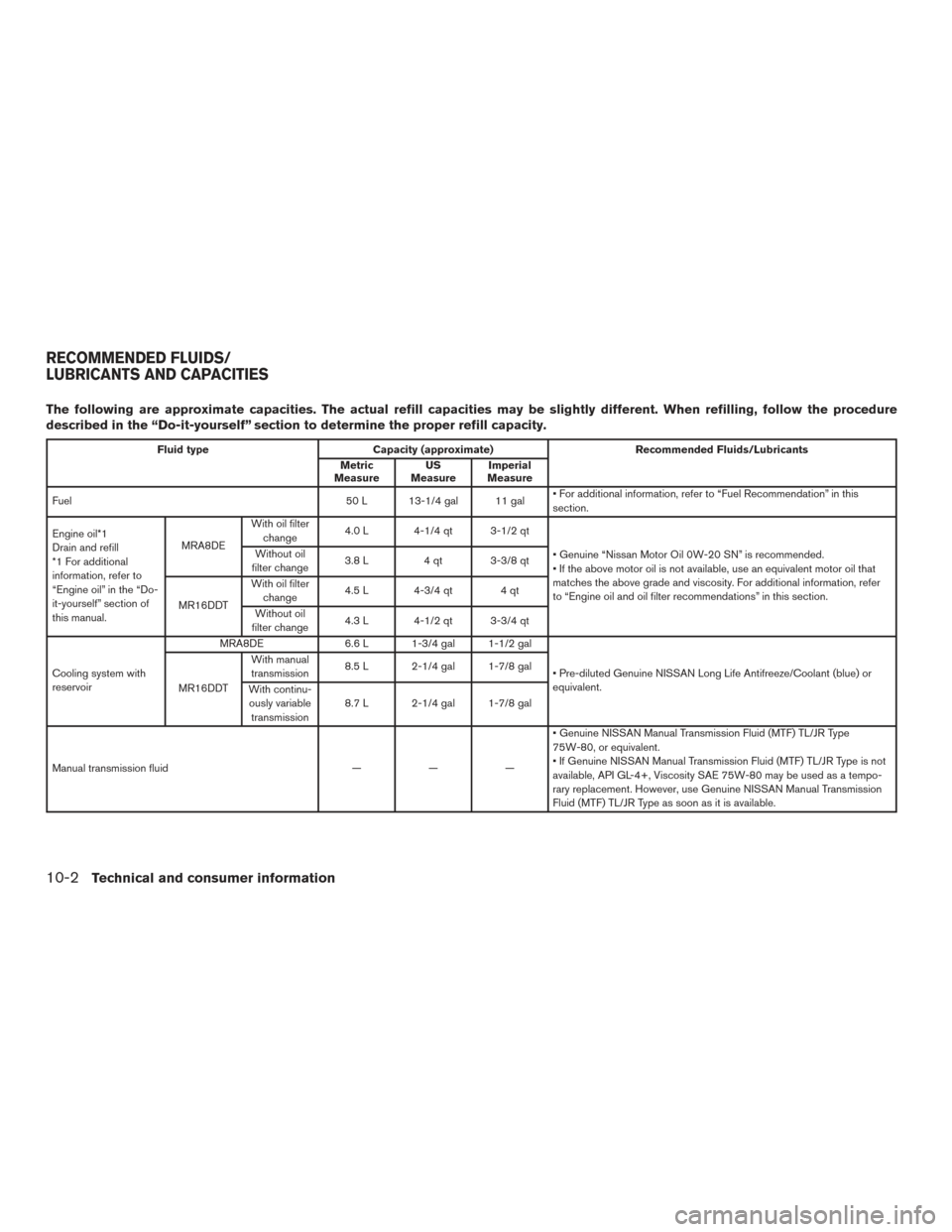
The following are approximate capacities. The actual refill capacities may be slightly different. When refilling, follow the procedure
described in the “Do-it-yourself” section to determine the proper refill capacity.
Fluid typeCapacity (approximate) Recommended Fluids/Lubricants
Metric
Measure US
Measure Imperial
Measure
Fuel 50 L 13-1/4 gal 11 gal• For additional information, refer to “Fuel Recommendation” in this
section.
Engine oil*1
Drain and refill
*1 For additional
information, refer to
“Engine oil” in the “Do-
it-yourself” section of
this manual. MRA8DE
With oil filter
change 4.0 L 4-1/4 qt 3-1/2 qt
• Genuine “Nissan Motor Oil 0W-20 SN” is recommended.
• If the above motor oil is not available, use an equivalent motor oil that
matches the above grade and viscosity. For additional information, refer
to “Engine oil and oil filter recommendations” in this section.
Without oil
filter change 3.8L 4qt 3-3/8qt
MR16DDT With oil filter
change 4.5 L 4-3/4 qt 4 qt
Without oil
filter change 4.3 L 4-1/2 qt 3-3/4 qt
Cooling system with
reservoir MRA8DE
6.6 L 1-3/4 gal 1-1/2 gal
• Pre-diluted Genuine NISSAN Long Life Antifreeze/Coolant (blue) or
equivalent.
MR16DDT With manual
transmission 8.5 L 2-1/4 gal 1-7/8 gal
With continu- ously variable transmission 8.7 L 2-1/4 gal 1-7/8 gal
Manual transmission fluid ———• Genuine NISSAN Manual Transmission Fluid (MTF) TL/JR Type
75W-80, or equivalent.
• If Genuine NISSAN Manual Transmission Fluid (MTF) TL/JR Type is not
available, API GL-4+, Viscosity SAE 75W-80 may be used as a tempo-
rary replacement. However, use Genuine NISSAN Manual Transmission
Fluid (MTF) TL/JR Type as soon as it is available.
RECOMMENDED FLUIDS/
LUBRICANTS AND CAPACITIES
10-2Technical and consumer information
Page 465 of 491
Aftermarket fuel additives
NISSAN does not recommend the use of any
aftermarket fuel additives (for example, fuel injec-
tor cleaner, octane booster, intake valve deposit
removers, etc.) which are sold commercially.
Many of these additives intended for gum, varnish
or deposit removal may contain active solvents or
similar ingredients that can be harmful to the fuel
system and engine.
Octane rating tips
Using unleaded gasoline with an octane
rating lower than recommended can cause
persistent, heavy “spark knock.” (“Spark
knock” is a metallic rapping noise.) If se-
vere, this can lead to engine damage. If you
detect a persistent heavy spark knock even
when using gasoline of the stated octane
rating, or if you hear steady spark knock
while holding a steady speed on level
roads, it is recommended that you have a
NISSAN dealer correct the condition. Fail-
ure to correct the condition is misuse of the
vehicle, for which NISSAN is not respon-
sible.Incorrect ignition timing may result in spark
knock, after-run and/or overheating, which may
cause excessive fuel consumption or engine
damage. If any of the above symptoms are en-
countered, have your vehicle checked. It is rec-
ommended that you visit a NISSAN dealer for
servicing.
However, now and then you may notice
light spark knock for a short time while
accelerating or driving up hills. This is not a
cause for concern, because you get the
greatest fuel benefit when there is light
spark knock for a short time under heavy
engine load.
10-6Technical and consumer information
Page 480 of 491
Due to legal requirements in some states and
Canadian Provinces, your vehicle may be re-
quired to be in what is called the “ready condi-
tion” for an Inspection/Maintenance (I/M) test of
the emission control system.
The vehicle is set to the “ready condition” when it
is driven through certain driving patterns. Usually,
the ready condition can be obtained by ordinary
usage of the vehicle.
If a powertrain system component is repaired or
the battery is disconnected, the vehicle may be
reset to a “not ready” condition. Before taking the
I/M test, check the vehicle’s
inspection/maintenance test readiness condi-
tion. Place the ignition switch in the ON position
without starting the engine. If the Malfunction
Indicator Light (MIL) comes on steady for 20 sec-
onds and then blinks for 10 seconds , the I/M test
condition is “not ready”. If the MIL does not blink
after 20 seconds, the I/M test condition is
“ready”. It is recommended that you visit a
NISSAN dealer to set the “ready condition” or to
prepare the vehicle for testing.This vehicle is equipped with an Event Data Re-
corder (EDR) . The main purpose of an EDR is to
record, in certain crash or near crash-like situa-
tions, such as an air bag deployment or hitting a
road obstacle, data that will assist in understand-
ing how a vehicle’s systems performed. The EDR
is designed to record data related to vehicle
dynamics and safety systems for a short period of
time, typically 30 seconds or less. The EDR in this
vehicle is designed to record such data as:
● How various systems in your vehicle were
operating;
● Whether or not the driver and passenger
safety belts were buckled/fastened;
● How far (if at all) the driver was depressing
the accelerator and/or brake pedal; and,
● How fast the vehicle was traveling.
● Sounds are not recorded. These data can help provide a better understand-
ing of the circumstances in which crashes and
injuries occur. NOTE: EDR data are recorded by
your vehicle only if a nontrivial crash situation
occurs; no data are recorded by the EDR under
normal driving conditions and no personal data
(e.g. name, gender, age and crash location) are
recorded. However, other parties, such as law
enforcement, could combine the EDR data with
the type of personally identifying data routinely
acquired during a crash investigation.
To read data recorded by an EDR, special equip-
ment is required and access to the vehicle or the
EDR is needed. In addition to the vehicle manu-
facturer and NISSAN dealer, other parties, such
as law enforcement, that have the special equip-
ment, can read the information if they have ac-
cess to the vehicle or the EDR. EDR data will only
be accessed with the consent of the vehicle
owner or lessee or as otherwise required or per-
mitted by law.
READINESS FOR INSPECTION/
MAINTENANCE (I/M) TEST
EVENT DATA RECORDERS (EDR)
Technical and consumer information10-21
Page 482 of 491
11 Index
A
Air bag (See supplemental restraint
system) .....................1-41
Air bag system Front (See supplemental front impact air bag
system) ...................1-48
Side and curtain (See supplemental
side air bag and curtain side-impact
air bag system) ...............1-55
Airbagwarninglabels.............1-57
Airbagwarninglight...........1-58,2-20
Air bag warning light, supplemental . .1-58, 2-20
Aircleaner....................8-17
Air cleaner housing filter ............8-17
Air conditioner Air conditioner operation ..........4-26
Air conditioner service ...........4-34
Air conditioner specification label ....10-13
Air conditioner system refrigerant and
oil recommendations ............10-8
Air conditioner system refrigerant
recommendations ..............10-8
Heater and air conditioner (automatic)
(if so equipped) ...............4-31
Heater and air conditioner
controls................4-24,4-32
Heater and air conditioner (manual) ....4-23
Servicing air conditioner ..........4-34
Airflowcharts..............4-20,4-27
Alarm system
(See vehicle security system) .........2-36Anchor point locations
.............1-25
Antenna.....................4-73
Antifreeze ....................5-76
Anti-lock Braking System (ABS) ........5-73
Apps .......................4-74
APPS button ...................4-7
Armrests .....................1-6
Audible reminders ...............2-23
Audio system ..................4-34
AMradioreception.............4-35
Bluetooth®audio..........4-70,4-70
Bluetooth® streaming audio ........4-70
Compact disc (CD) player . .4-46, 4-51, 4-58
FM/AM radio with compact disc (CD)
player ....................4-43
FM/AM/SAT radio with compact disc (CD)
player.................4-48,4-53
FMradioreception..........4-35,4-44
iPod® Player .............4-64,4-66
iPod® player operation .......4-64,4-66
Radio ....................4-34
Steering wheel audio control switch . . .4-72
USB interface ............4-60,4-62
USB (Universal Serial Bus) Connection
Port..................4-60,4-62
Autolight switch .................2-42
Automatic Automatic power window switch .....2-56
Automatic anti-glare inside mirror .......3-30
Automatic door locks ..............3-6
AUXjack.................4-44,4-60 B
Back button ....................4-7
Battery ..................5-76, 8-13
Charge warning light ............2-17
Battery replacement ..............8-24
Keyfob................8-24,8-25
NISSAN Intelligent Key® ..........8-26
Before starting the engine ...........5-14
Belt (See drive belt) ..............8-15
Blind Spot Warning (BSW) ..........5-26
Block heater Engine ....................5-77
Bluetooth® audio ............4-70,4-70
Bluetooth® hands-free phone system ....4-94
Bluetooth® Hands-Free Phone System with
Navigation System ..............4-106
Bluetooth® Hands-Free Phone System without
Navigation System ............4-78,4-94
Bluetooth® streaming audio with Navigation
System .....................4-70
Bluetooth® streaming audio without Navigation
System (if so equipped) ............4-70
Boosterseats..................1-38
Brake Anti-lock Braking System (ABS) ......5-73
Brake fluid ..................8-11
Brakelight(Seestoplight).........8-31
Brake system ................5-72
Brakewarninglight.............2-16
Brakewearindicators........2-23,8-20
Parking brake operation ..........5-23
Page 483 of 491
Self-adjusting brakes............8-20
Brake and clutch fluid ..............8-11
Brake assist ...................5-74
Brake fluid ....................8-11
Brakes ......................8-20
Brake system ...................5-72
Break-in schedule ................5-68
Brightness/contrastbutton............4-9
Brightness control Instrument panel ...............2-44
Bulb check/instrument panel ..........2-16
Bulb replacement ................8-31
C
Capacities and recommended
fuel/lubricants ..................10-2
Cargo (See vehicle loading information) . . .10-14
Car phone or CB radio .............4-78
CD care and cleaning ..............4-71
CD player (See audio system) . .4-46, 4-51, 4-58
Check tire press ..................2-6
Check tire pressure ...............2-34
Child restraints .......1-19,1-19,1-21,1-23
LATCH (Lower Anchors and Tethers for
CHildren) System ..............1-23
Precautions on child
restraints.........1-21,1-28,1-33,1-38
Top tether strap anchor point locations . .1-25
Child safety rear door lock ............3-6
Chimes, audible reminders ...........2-23
Cleaningexteriorandinterior...........7-2
Clock (models without navigation system) ....4-50
Clockset.....................4-50 Clock set/adjustment
...........4-7,4-44
Clock setting
(models with Navigation System) ........4-7
Clock setting (models without Navigation
System) ..................4-49,4-50
Clutch Clutch fluid ..................8-12
C.M.V.S.S. certification label .........10-12
Cold weather driving ...............5-76
Compact disc (CD) player ....4-46,4-51,4-58
Compass .....................2-12
Connect phone .................4-74
Console box ...................2-52
Console light ...................2-60
Continuously Variable Transmission
(CVT) ....................5-9,5-16
Continuously Variable Transmission (CVT)
fluid......................8-11
Driving with Continuously Variable
Transmission (CVT) ..........5-9,5-16
Control panel buttons ...............4-4
Back button ..................4-7
Brightness/contrast button ..........4-9
Enterbutton..................4-4
Setting button .............4-7,4-44
Controls Audio controls (steering wheel) .......4-72
Heater and air conditioner
controls................4-24,4-32
Coolant Capacities and recommended
fuel/lubricants ................10-2
Changingenginecoolant...........8-6
Checking engine coolant level ........8-6
Engine coolant temperature gauge .....2-7
Corrosion protection ...............7-6 Cruisecontrol..................5-45
Cupholders................2-53,2-54
Curtain side-impact air bag system
(See supplemental side air bag and curtain
side-impact air bag system)
...........1-55
D
Daytime Running Light System .....2-43,2-44
Defroster switch Rear window and outside mirror defroster
switch .....................
2-40
Dimensionsandweights............10-10
Dimmer switch for instrument panel ......2-44
Display......................2-24
Display controls (see control panel buttons) . .4-4
Door locks .....................3-5
Door open warning light .............2-17
Drive belt .....................8-15
Driving Cold weather driving .............5-76
Driving with Continuously Variable
Transmission (CVT) ..........5-9,5-16
Driving with manual transmission . . .5-9, 5-21
Precautions when starting and driving ....5-2
Driving the vehicle ................5-16
E
ECO mode switch ................5-24
Economy-fuel..................5-70
Emergency engine shutoff ............5-12
Emission control information label ......10-12
Emission control system warranty .......10-19
11-2
Page 484 of 491
EngineBefore starting the engine ..........5-14
Block heater .................5-77
Capacities and recommended
fuel/lubricants ................10-2
Changing engine coolant ...........8-6
Changing engine oil ..............8-8
Changing engine oil filter ...........8-9
Checking engine coolant level ........8-6
Checking engine oil level ...........8-7
Engine compartment check locations ....8-3
Engine coolant temperature gauge .....2-7
Engine cooling system ............8-5
Engine oil ...................8-7
Engine oil and oil filter recommendation . .10-7
Engine oil pressure warning light ......2-17
Engine oil viscosity ..............10-7
Engine serial number ............10-12
Engine specifications ............10-9
Starting the engine ..........5-14,5-15
Engine coolant temperature gauge .......2-7
Enterbutton....................4-4
Event Data recorders .............10-21
Exhaust gas (Carbon monoxide) .........5-2
Explanation of maintenance items ........9-2
Explanation of scheduled maintenance items . .9-5
Extendedstorageswitch ............8-24
Eyeglass case ..................2-53
F
Flashers (See hazard warning flasher switch) . .6-2
Flat tire ....................6-3,6-3
Floor mat positioning aid .............7-5 Fluid
Brake fluid ..................8-11
Capacities and recommended
fuel/lubricants ................10-2
Clutch fluid ..................8-12
Continuously Variable Transmission (CVT)
fluid......................8-11
Engine coolant .................8-5
Engine oil ...................8-7
F.M.V.S.S. certification label ..........10-12
Foglightswitch .................2-45
Forward Emergency Braking (FEB) .......2-17
Front air bag system
(See supplemental restraint system) ......1-48
Front power seat adjustment ...........1-4
Frontseats.....................1-2
Fuel Capacities and recommended
fuel/lubricants ................10-2
Fuel economy ................5-70
Fuel-filler cap .................3-26
Fuel-filler door lock opener lever ......3-26
Fuel-filler lid .................3-26
Fuel gauge ...................2-8
Fuel octane rating ..............10-6
Fuel recommendation ............10-4
Loose fuel cap warning ........2-6,2-34
Fuel efficient driving tips .............5-68
Fuel-filler door ..................3-26
Fuelgauge.....................2-8
Fuses.......................8-20
Fusiblelinks ...................8-22 G
Garage door opener, HomeLink® Universal
Transceiver .........2-62,2-64,2-64,2-65
Gascap .....................3-26
Gauge Engine coolant temperature gauge .....2-7
Fuelgauge...................2-8
Odometer ...................
2-5
Speedometer ...............2-4,2-5
Tachometer ..................2-7
Trip computer .................2-9
Trip odometer ..............2-4,2-5
General maintenance ...............9-2
Glovebox.....................2-52
H
Hands-free phone system, Bluetooth® ....4-94
Hazard warning flasher switch ..........6-2
Headlightandturnsignalswitch........2-41
Headlightcontrolswitch ............2-41
Headlights....................8-28
Head restraints ..................1-7
Heated seats ...................2-46
Heated seat switches ..........2-46,4-75
Heater Heater and air conditioner (automatic)
(if so equipped) ...............4-31
Heater and air conditioner
controls ................4-24,4-32
Heater and air conditioner (manual) ....4-23
Heater operation ....4-17,4-19,4-25,4-33
Heater and air conditioner (automatic) .....4-31
11-3