Fuel system NISSAN SENTRA 2017 B17 / 7.G Owner's Manual
[x] Cancel search | Manufacturer: NISSAN, Model Year: 2017, Model line: SENTRA, Model: NISSAN SENTRA 2017 B17 / 7.GPages: 491
Page 324 of 491
The ECO mode cannot be turned off while the
accelerator pedal is depressed, even if the ECO
mode switch is pushed to OFF. Release the
accelerator pedal to turn off the ECO mode.
The ECO mode will turn off automatically if a
malfunction occurs in the system.
Turn off the ECO mode, or depress the accelera-
tor pedal fully when:● Driving with a heavy load of passengers or
cargo in the vehicle
● Driving on a steep uphill slope
● ECO mode may affect air conditioner perfor-
mance
NOTE:
Selecting this drive mode will not necessar-
ily improve fuel economy as many driving
factors influence its effectiveness.
SHIFT LEVER INDICATOR (MRA8DE
engine Manual Transmission models
only)
The shift lever indicator is used to support the
suitable timing of gear change. It operates only
when the ECO mode is in the “ON” state.
The shift indicator icon and recommended gear
position are displayed.
The shift indicator icon indicates when to upshift
or downshift for fuel economy. NOTE:
● The shift indicator is a guide for fuel
economy. Always pay attention to road con-
ditions and other traffic.
● Downshift indicator icon to the “1” (1st) po-
sition is not displayed.
● If the downshifting icon is displayed when
decreasing your vehicle speed, it indicates
that the engine speed is low compared to
the gear position.
LSD2143
Starting and driving5-25
Page 368 of 491
●Above 40 mph (64 km/h), it is more effi-
cient to use A/C to cool the vehicle due to
increased aerodynamic drag
● Recirculating the cool air in the cabin
when the A/C is on reduces cooling load
4. Drive at Economical Speeds and Dis-
tances
● Observing the speed limit and not ex-
ceeding 60 mph (97 km/h) (where legally
allowed) can improve fuel efficiency due
to reduced aerodynamic drag
● Maintaining a safe following distance be-
hind other vehicles reduces unnecessary
braking
● Safely monitoring traffic to anticipate
changes in speed permits reduced brak-
ing and smooth acceleration changes
● Select a gear range suitable to road con-
ditions
5. Use Cruise Control
● Using cruise control during highway driv-
ing helps maintain a steady speed
● Cruise control is particularly effective in
providing fuel savings when driving on flat
terrains 6.
Plan for the Shortest Route
● Utilize a map or navigation system to de-
termine the best route to save time
7. Avoid Idling
● Shutting off your engine when safe for
stops exceeding 30–60 seconds saves
fuel and reduces emissions
8. Buy an Automated Pass for Toll Roads
● Automated passes permit drivers to use
special lanes to maintain cruising speed
through the toll and avoid stopping and
starting
9. Winter Warm Up
● Limit idling time to minimize impact to fuel
economy
● Vehicles typically need no more than
30 seconds of idling at start-up to effec-
tively circulate the engine oil before driv-
ing
● Your vehicle will reach its ideal operating
temperature more quickly while driving
versus idling 10.
Keeping your Vehicle Cool
● Park your vehicle in a covered parking
area or in the shade whenever possible
● When entering a hot vehicle, opening the
windows will help to reduce the inside
temperature faster, resulting in reduced
demand on your A/C system
11. ECO Mode
● The ECO mode helps to enhance the fuel
economy by controlling the engine and
CVT (if so equipped) operation automati-
cally to avoid rapid acceleration.
Starting and driving5-69
Page 398 of 491
Temperature
High temperatures accelerate the rate of corro-
sion to those parts which are not well ventilated.
Air pollution
Industrial pollution, the presence of salt in the air
in coastal areas, or heavy road salt use acceler-
ates the corrosion process. Road salt also accel-
erates the disintegration of paint surfaces.
PROTECT YOUR VEHICLE FROM
CORROSION
●Wash and wax your vehicle often to keep the
vehicle clean.
● Always check for minor damage to the paint
and repair it as soon as possible.
● Keep drain holes at the bottom of the doors
open to avoid water accumulation.
● Check the underbody for accumulation of
sand, dirt or salt. If present, wash with water
as soon as possible.
CAUTION
● NEVER remove dirt, sand or other de-
bris from the passenger compartment
by washing it out with a hose. Remove
dirt with a vacuum cleaner or broom.
● Never allow water or other liquids to
come in contact with electronic compo-
nents inside the vehicle as this may
damage them.
Chemicals used for road surface de-icing are
extremely corrosive. They accelerate corrosion
and deterioration of underbody components
such as the exhaust system, fuel and brake lines,
brake cables, floor pan and fenders.
In winter, the underbody must be cleaned
periodically.
For additional protection against rust and corro-
sion, which may be required in some areas, it is
recommended that you visit a NISSAN dealer.
Appearance and care7-7
Page 447 of 491
Seat belts:Check that all parts of the seat belt
system (for example, buckles, anchors, adjusters
and retractors) operate properly and smoothly,
and are installed securely. Check the belt web-
bing for cuts, fraying, wear or damage.
Steering wheel: Check for changes in the
steering system, such as excessive free play,
hard steering or strange noises.
Warning lights and chimes: Make sure all
warning lights and chimes are operating properly.
Windshield defroster: Check that the air
comes out of the defroster outlets properly and in
sufficient quantity when operating the heater or
air conditioner.
Windshield wiper and washer*: Check that
the wipers and washer operate properly and that
the wipers do not streak.
Under the hood and vehicle
The maintenance items listed here should be
checked periodically (for example, each time you
check the engine oil or refuel) .
Battery* (for serviceable batteries): Check
the fluid level in each cell. It should be between
the MAX and MIN lines. Vehicles operated in high
temperatures or under severe conditions require
frequent checks of the battery fluid level. NOTE:
Care should be taken to avoid situations
that can lead to potential battery discharge
and potential no-start conditions such as:
1. Installation or extended use of electronic accessories that consume battery power
when the engine is not running (Phone char-
gers, GPS, DVD players, etc.) .
2. Vehicle is not driven regularly and/or only driven short distances.
In these cases, the battery may need to be
charged to maintain battery health.
Brake and clutch (if so equipped) fluid
level*: Make sure that the brake and clutch fluid
levels are between the MIN and MAX lines on the
reservoir.
Engine coolant level*: Check the coolant level
when the engine is cold.
Engine drive belts*: Make sure the drive belts
are not frayed, worn, cracked or oily.
Engine oil level*: Check the level after parking
the vehicle on a level surface with the engine off.
Wait more than 15 minutes for the oil to drain
back into the oil pan. Exhaust system:
Make sure there are no loose
supports, cracks or holes. If the sound of the
exhaust seems unusual or there is a smell of
exhaust fumes, immediately have the exhaust
system inspected. It is recommended that you
visit a NISSAN dealer for this service. For addi-
tional information, refer to “Exhaust gas (carbon
monoxide)” in the “Starting and driving” section of
this manual.
Fluid leaks: Check under the vehicle for fuel, oil,
water or other fluid leaks after the vehicle has
been parked for a while. Water dripping from the
air conditioner after use is normal. If you should
notice any leaks or if fuel fumes are evident,
check for the cause and have it corrected imme-
diately.
Radiator and hoses: Check the front of the
radiator and clean off any dirt, insects, leaves,
etc., that may have accumulated. Make sure the
hoses have no cracks, deformation, rot or loose
connections.
9-4Maintenance and schedules
Page 448 of 491
Underbody:The underbody is frequently ex-
posed to corrosive substances such as those
used on icy roads or to control dust. It is very
important to remove these substances from the
underbody, otherwise rust may form on the floor
pan, frame, fuel lines and exhaust system. At the
end of winter, the underbody should be thor-
oughly flushed with plain water, in those areas
where mud and dirt may have accumulated. For
additional information, refer to the “Appearance
and care” section of this manual.
Windshield-washer fluid*: Check that there is
adequate fluid in the reservoir. The following descriptions are provided to give
you a better understanding of the scheduled
maintenance items that should be regularly
checked or replaced. The maintenance schedule
indicates at which mileage/time intervals each
item requires service.
In addition to scheduled maintenance, your vehicle
requires that some items be checked during normal
day-to-day operation. For additional information,
refer to “General maintenance” in this section.
Items marked with
“*”are recommended by
NISSAN for reliable vehicle operation. You are
not required to perform maintenance on these
items in order to maintain the warranties which
come with your NISSAN. Other maintenance
items and intervals are required.
When applicable, additional information can be
found in the “Do-it-yourself” section of this
manual.
NOTE:
NISSAN does not advocate the use of non-
OEM approved aftermarket flushing sys-
tems and strongly advises against perform-
ing these services on a NISSAN product.
Many of the aftermarket flushing systems
use non-OEM approved chemicals or sol-
vents, the use of which has not been vali-
dated by NISSAN. For recommended fuel, lubricants, fluids,
grease, and refrigerant, refer to “Recom-
mended fluids/lubricants and capacities”
in the “Technical and consumer informa-
tion” section of this manual.
EMISSION CONTROL SYSTEM
MAINTENANCE:
Drive belts*:
Check engine drive belts for wear,
fraying or cracking and for proper tension. Re-
place any damaged drive belts.
Engine air filter: Replace at specified intervals.
When driving for prolonged periods in dusty con-
ditions, check/replace the filter more frequently.
Engine coolant*: Replace coolant at the speci-
fied interval. When adding or replacing coolant,
be sure to use only Genuine NISSAN Long Life
Antifreeze/Coolant (blue) or equivalent with the
proper mixture. (For additional information on the
proper mixture for your area, refer to “Engine
cooling system” in the “Do-it-yourself” section of
this manual.)
NOTE: Mixing any other type of coolant or
the use of non-distilled water may reduce
the recommended service interval of the
coolant.
EXPLANATION OF SCHEDULED
MAINTENANCE ITEMS
Maintenance and schedules9-5
Page 449 of 491
Engine oil and oil filter:Replace engine oil
and oil filter at the specified intervals. For recom-
mended oil grade and viscosity refer to “Recom-
mended fluids/lubricants and capacities” in the
“Technical and consumer information” section of
this manual.
Engine valve clearance*: Inspect only if valve
noise increases. Adjust valve clearance if neces-
sary.
Evaporative emissions control vapor lines*:
Check vapor lines for leaks or looseness. Tighten
connections or replace parts as necessary.
Fuel filter: Periodic maintenance is not re-
quired. (in-tank type filter)
Fuel lines*: Check the fuel hoses, piping and
connections for leaks, looseness, or deteriora-
tion. Tighten connections or replace parts as
necessary.
Spark plugs: Replace at specified intervals. In-
stall new plugs of the type as originally equipped.CHASSIS AND BODY
MAINTENANCE:
Brake lines and cables: Visually inspect for
proper installation. Check for chafing, cracks,
deterioration, and signs of leaking. Replace any
deteriorated or damaged parts immediately.
Brake pads, rotors, drums and linings:
Check for wear, deterioration and fluid leaks.
Replace any deteriorated or damaged parts im-
mediately.
Exhaust system: Visually inspect the exhaust
pipes, muffler and hangers for leaks, cracks, de-
terioration, and damage. Tighten connections or
replace parts as necessary.
In-cabin microfilter: Replace at specified in-
tervals. When driving for prolonged periods in
dusty conditions, replace the filter more fre-
quently.
Steering gear and linkage, axle and sus-
pension parts, drive shaft boots: Check for
damage, looseness, and leakage of oil or grease.
Under severe driving conditions, inspect more
frequently. Tire rotation:
Tires should be rotated every
5,000 miles (8,000 km) according to the instruc-
tions under “General maintenance” in this sec-
tion. When rotating tires, check for damage and
uneven wear. Replace if necessary.
Transmission fluid/oil: Visually inspect for
signs of leakage at specified intervals. If using a
car-top carrier, or driving on rough or muddy
roads:
● Replace the manual transaxle gear oil every
20,000 miles or 24 months.
● Replace the CVT fluid every 60,000 miles
(96,000 km) or request the dealer to inspect
the fluid deterioration data using a CON-
SULT. If the deterioration data is more than
210000, replace the CVT fluid.
9-6Maintenance and schedules
Page 451 of 491
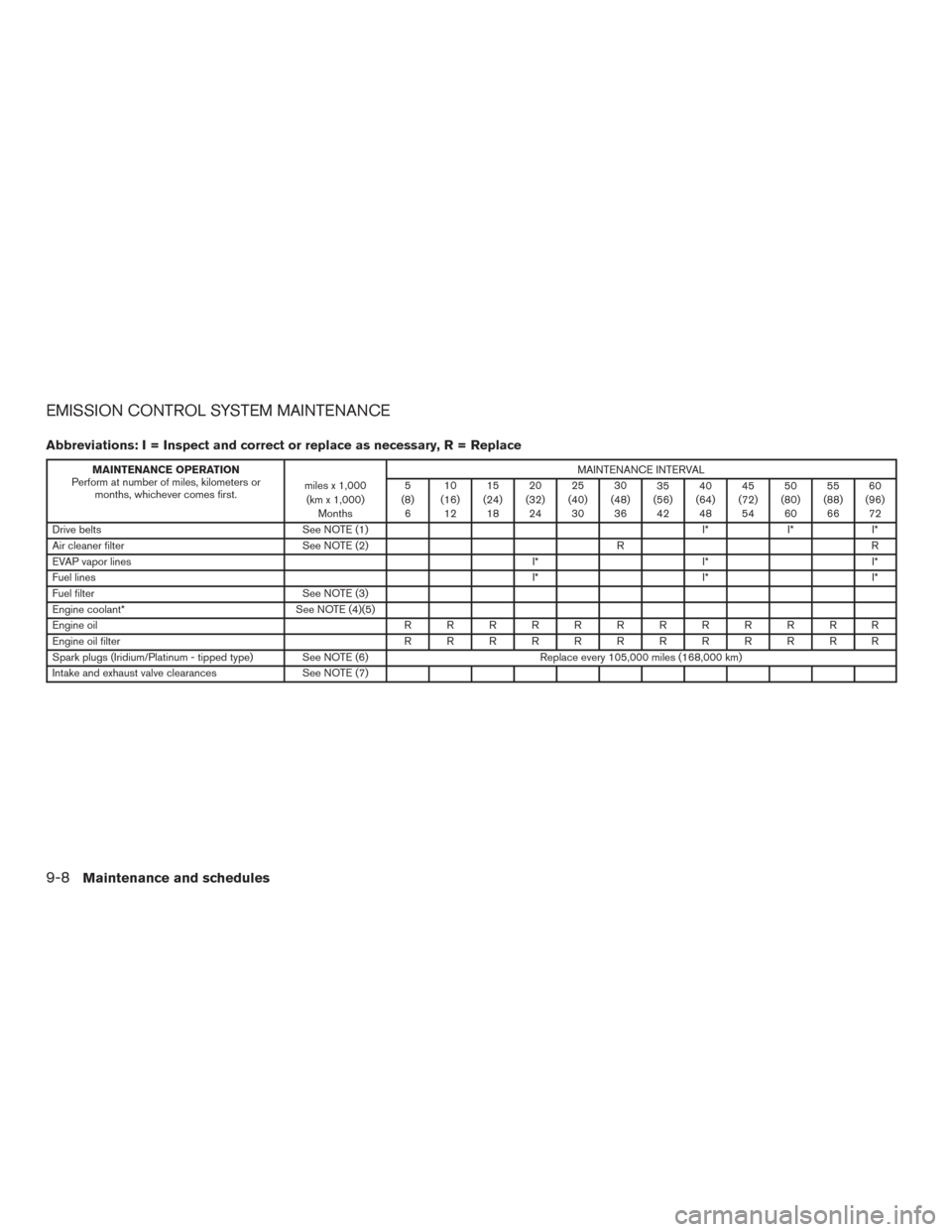
EMISSION CONTROL SYSTEM MAINTENANCE
Abbreviations: I = Inspect and correct or replace as necessary, R = Replace
MAINTENANCE OPERATION
Perform at number of miles, kilometers or months, whichever comes first. miles x 1,000
(km x 1,000) Months MAINTENANCE INTERVAL
5
(8) 6 10
(16) 12 15
(24) 18 20
(32) 24 25
(40) 30 30
(48) 36 35
(56) 42 40
(64) 48 45
(72) 54 50
(80) 60 55
(88) 66 60
(96) 72
Drive belts See NOTE (1) I*I*I*
Air cleaner filter See NOTE (2) RR
EVAP vapor lines I*I*I*
Fuel lines I*I*I*
Fuel filter See NOTE (3)
Engine coolant* See NOTE (4)(5)
Engine oil RRRRRRRRRRRR
Engine oil filter RRRRRRRRRRRR
Spark plugs (Iridium/Platinum - tipped type) See NOTE (6) Replace every 105,000 miles (168,000 km)
Intake and exhaust valve clearances See NOTE (7)
9-8Maintenance and schedules
Page 460 of 491
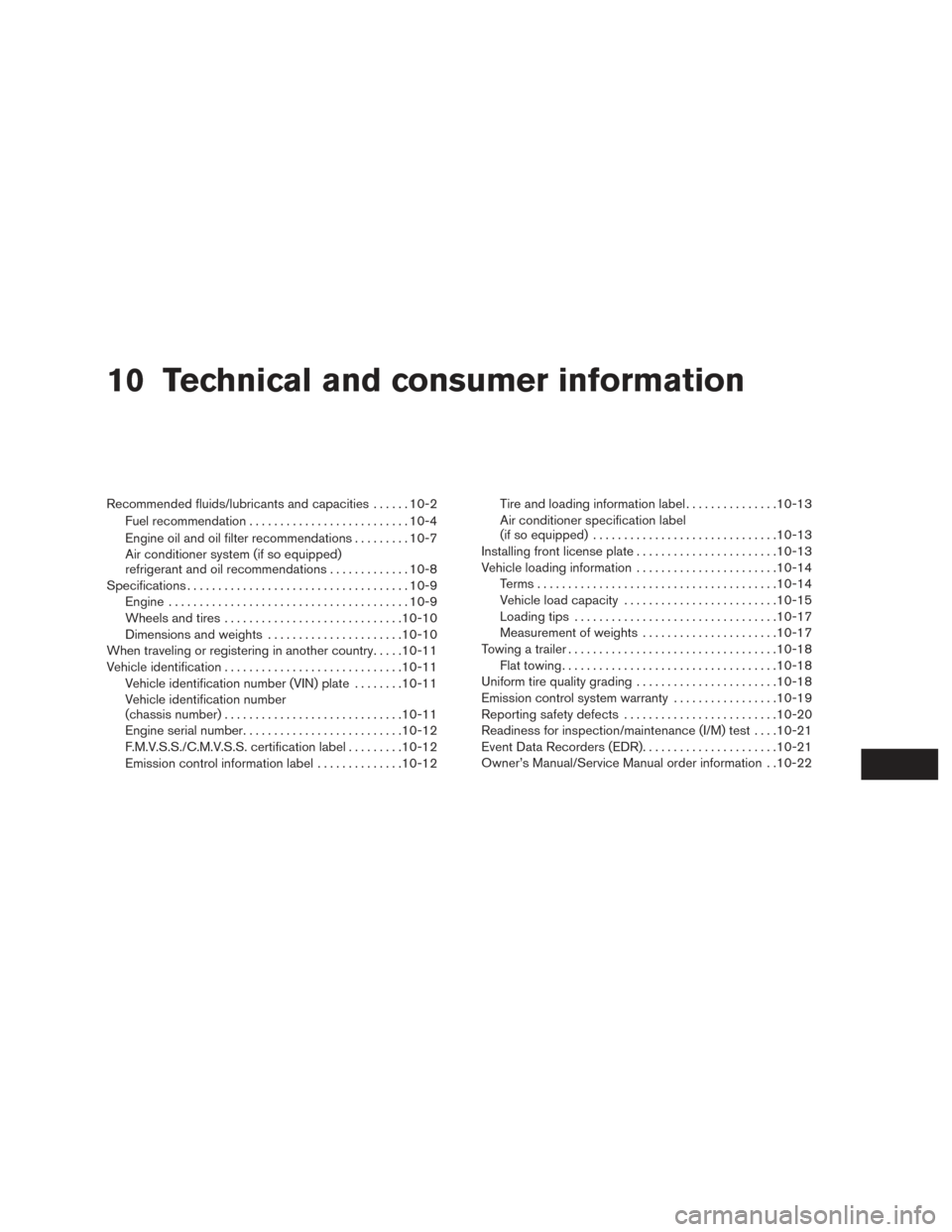
10 Technical and consumer information
Recommended fluids/lubricants and capacities......10-2
Fuel recommendation .......................... 10-4
Engine oil and oil filter recommendations .........10-7
Air conditioner system (if so equipped)
refrigerant and oil recommendations .............10-8
Specifications .................................... 10-9
Engine ....................................... 10-9
Wheels and tires ............................. 10-10
Dimensions and weights ......................10-10
When traveling or registering in another country .....10-11
Vehicle identification ............................. 10-11
Vehicle identification number (VIN) plate ........10-11
Vehicle identification number
(chassis number) ............................. 10-11
Engine serial number .......................... 10-12
F.M.V.S.S./C.M.V.S.S. certification label .........10-12
Emission control information label ..............10-12 Tire and loading information label
...............10-13
Air conditioner specification label
(if so equipped) .............................. 10-13
Installing front license plate .......................10-13
Vehicle loading information .......................10-14
Terms ....................................... 10-14
Vehicle load capacity ......................... 10-15
Loading tips ................................. 10-17
Measurement of weights ......................10-17
Towing a trailer .................................. 10-18
Flat towing ................................... 10-18
Uniform tire quality grading .......................10-18
Emission control system warranty .................10-19
Reporting safety defects ......................... 10-20
Readiness for inspection/maintenance (I/M) test ....10-21
Event Data Recorders (EDR) ......................10-21
Owner’s Manual/Service Manual order information . .10-22
Page 461 of 491
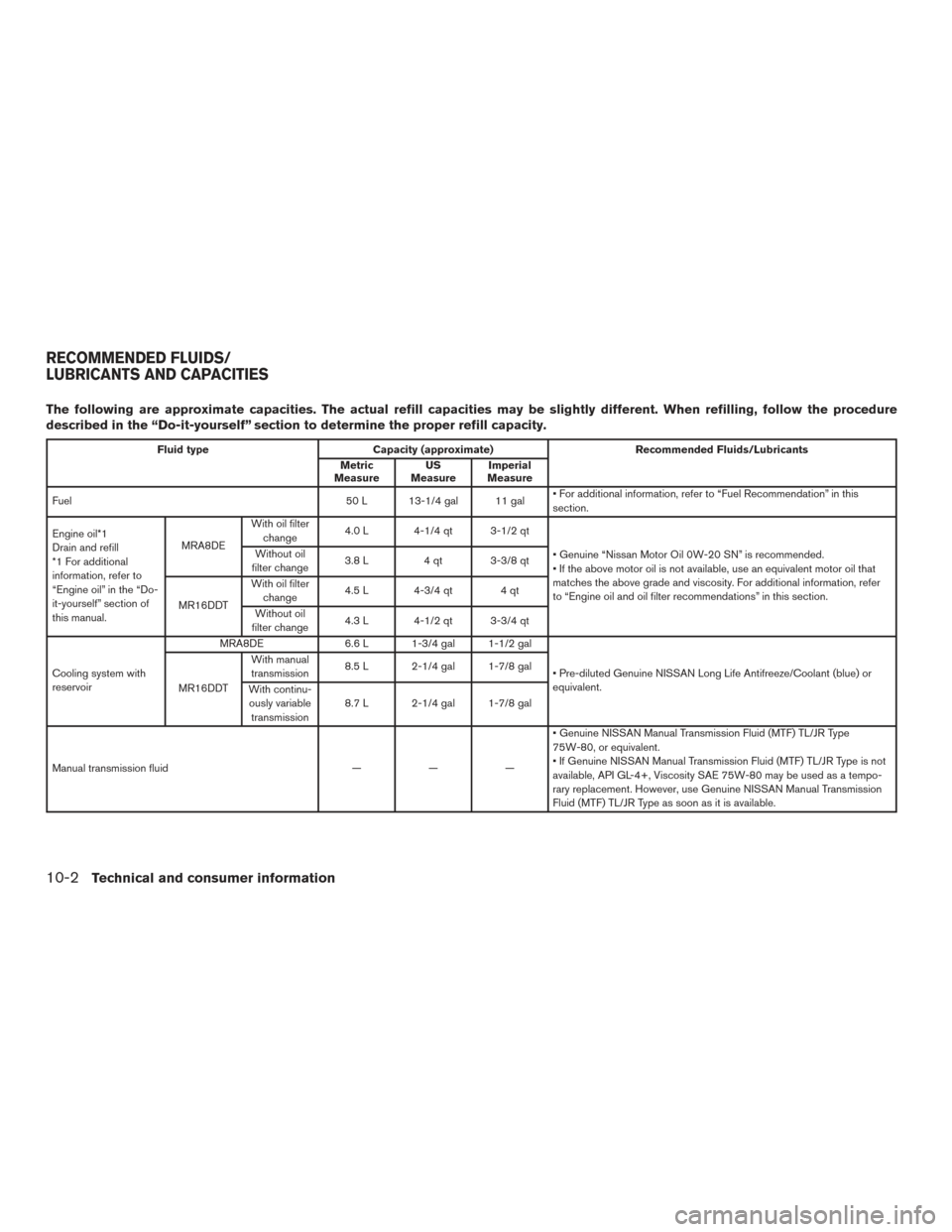
The following are approximate capacities. The actual refill capacities may be slightly different. When refilling, follow the procedure
described in the “Do-it-yourself” section to determine the proper refill capacity.
Fluid typeCapacity (approximate) Recommended Fluids/Lubricants
Metric
Measure US
Measure Imperial
Measure
Fuel 50 L 13-1/4 gal 11 gal• For additional information, refer to “Fuel Recommendation” in this
section.
Engine oil*1
Drain and refill
*1 For additional
information, refer to
“Engine oil” in the “Do-
it-yourself” section of
this manual. MRA8DE
With oil filter
change 4.0 L 4-1/4 qt 3-1/2 qt
• Genuine “Nissan Motor Oil 0W-20 SN” is recommended.
• If the above motor oil is not available, use an equivalent motor oil that
matches the above grade and viscosity. For additional information, refer
to “Engine oil and oil filter recommendations” in this section.
Without oil
filter change 3.8L 4qt 3-3/8qt
MR16DDT With oil filter
change 4.5 L 4-3/4 qt 4 qt
Without oil
filter change 4.3 L 4-1/2 qt 3-3/4 qt
Cooling system with
reservoir MRA8DE
6.6 L 1-3/4 gal 1-1/2 gal
• Pre-diluted Genuine NISSAN Long Life Antifreeze/Coolant (blue) or
equivalent.
MR16DDT With manual
transmission 8.5 L 2-1/4 gal 1-7/8 gal
With continu- ously variable transmission 8.7 L 2-1/4 gal 1-7/8 gal
Manual transmission fluid ———• Genuine NISSAN Manual Transmission Fluid (MTF) TL/JR Type
75W-80, or equivalent.
• If Genuine NISSAN Manual Transmission Fluid (MTF) TL/JR Type is not
available, API GL-4+, Viscosity SAE 75W-80 may be used as a tempo-
rary replacement. However, use Genuine NISSAN Manual Transmission
Fluid (MTF) TL/JR Type as soon as it is available.
RECOMMENDED FLUIDS/
LUBRICANTS AND CAPACITIES
10-2Technical and consumer information
Page 463 of 491
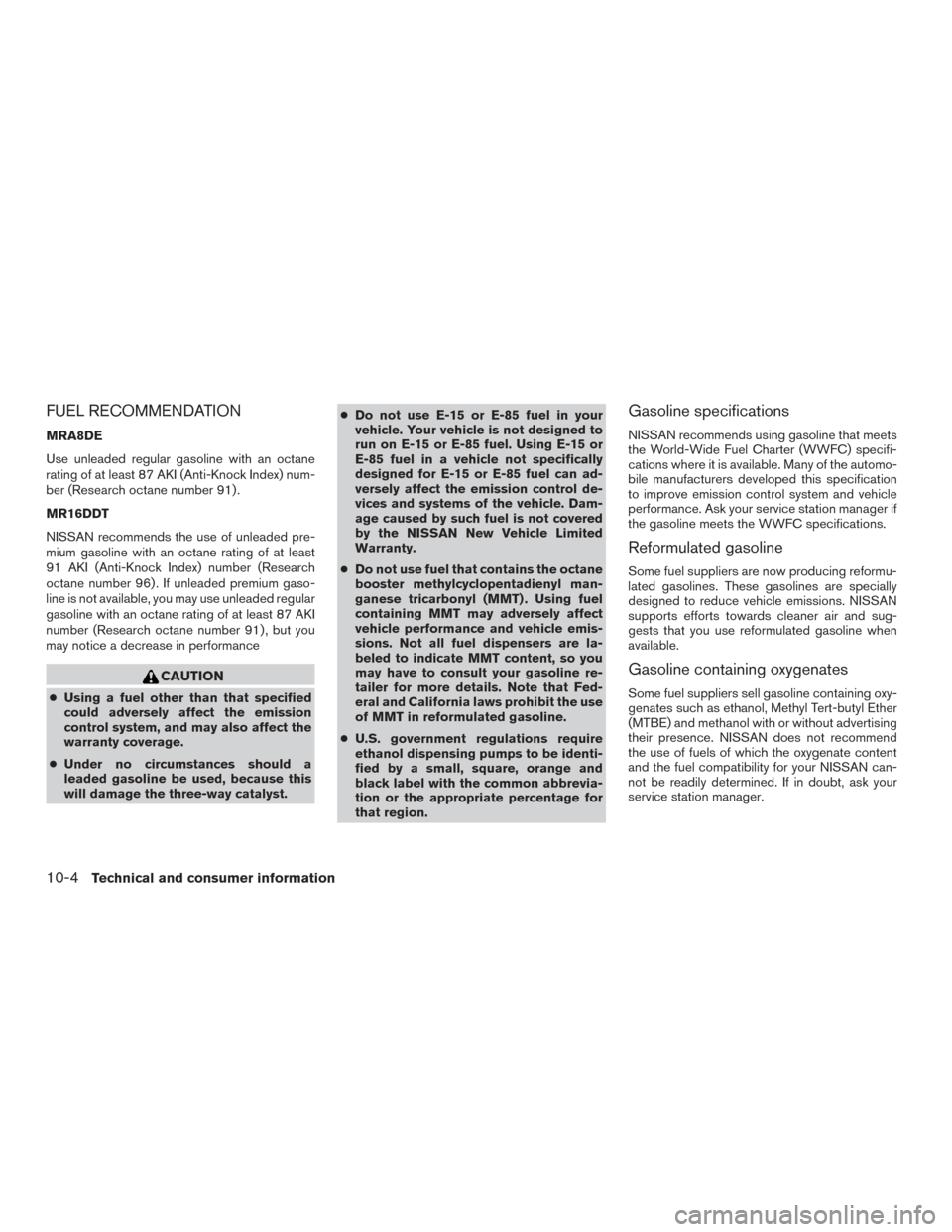
FUEL RECOMMENDATION
MRA8DE
Use unleaded regular gasoline with an octane
rating of at least 87 AKI (Anti-Knock Index) num-
ber (Research octane number 91) .
MR16DDT
NISSAN recommends the use of unleaded pre-
mium gasoline with an octane rating of at least
91 AKI (Anti-Knock Index) number (Research
octane number 96) . If unleaded premium gaso-
line is not available, you may use unleaded regular
gasoline with an octane rating of at least 87 AKI
number (Research octane number 91) , but you
may notice a decrease in performance
CAUTION
●Using a fuel other than that specified
could adversely affect the emission
control system, and may also affect the
warranty coverage.
● Under no circumstances should a
leaded gasoline be used, because this
will damage the three-way catalyst. ●
Do not use E-15 or E-85 fuel in your
vehicle. Your vehicle is not designed to
run on E-15 or E-85 fuel. Using E-15 or
E-85 fuel in a vehicle not specifically
designed for E-15 or E-85 fuel can ad-
versely affect the emission control de-
vices and systems of the vehicle. Dam-
age caused by such fuel is not covered
by the NISSAN New Vehicle Limited
Warranty.
● Do not use fuel that contains the octane
booster methylcyclopentadienyl man-
ganese tricarbonyl (MMT) . Using fuel
containing MMT may adversely affect
vehicle performance and vehicle emis-
sions. Not all fuel dispensers are la-
beled to indicate MMT content, so you
may have to consult your gasoline re-
tailer for more details. Note that Fed-
eral and California laws prohibit the use
of MMT in reformulated gasoline.
● U.S. government regulations require
ethanol dispensing pumps to be identi-
fied by a small, square, orange and
black label with the common abbrevia-
tion or the appropriate percentage for
that region.
Gasoline specifications
NISSAN recommends using gasoline that meets
the World-Wide Fuel Charter (WWFC) specifi-
cations where it is available. Many of the automo-
bile manufacturers developed this specification
to improve emission control system and vehicle
performance. Ask your service station manager if
the gasoline meets the WWFC specifications.
Reformulated gasoline
Some fuel suppliers are now producing reformu-
lated gasolines. These gasolines are specially
designed to reduce vehicle emissions. NISSAN
supports efforts towards cleaner air and sug-
gests that you use reformulated gasoline when
available.
Gasoline containing oxygenates
Some fuel suppliers sell gasoline containing oxy-
genates such as ethanol, Methyl Tert-butyl Ether
(MTBE) and methanol with or without advertising
their presence. NISSAN does not recommend
the use of fuels of which the oxygenate content
and the fuel compatibility for your NISSAN can-
not be readily determined. If in doubt, ask your
service station manager.
10-4Technical and consumer information