trunk NISSAN TEANA 2003 Manual Online
[x] Cancel search | Manufacturer: NISSAN, Model Year: 2003, Model line: TEANA, Model: NISSAN TEANA 2003Pages: 3502, PDF Size: 74.56 MB
Page 2984 of 3502
MA-6
GENERAL MAINTENANCE
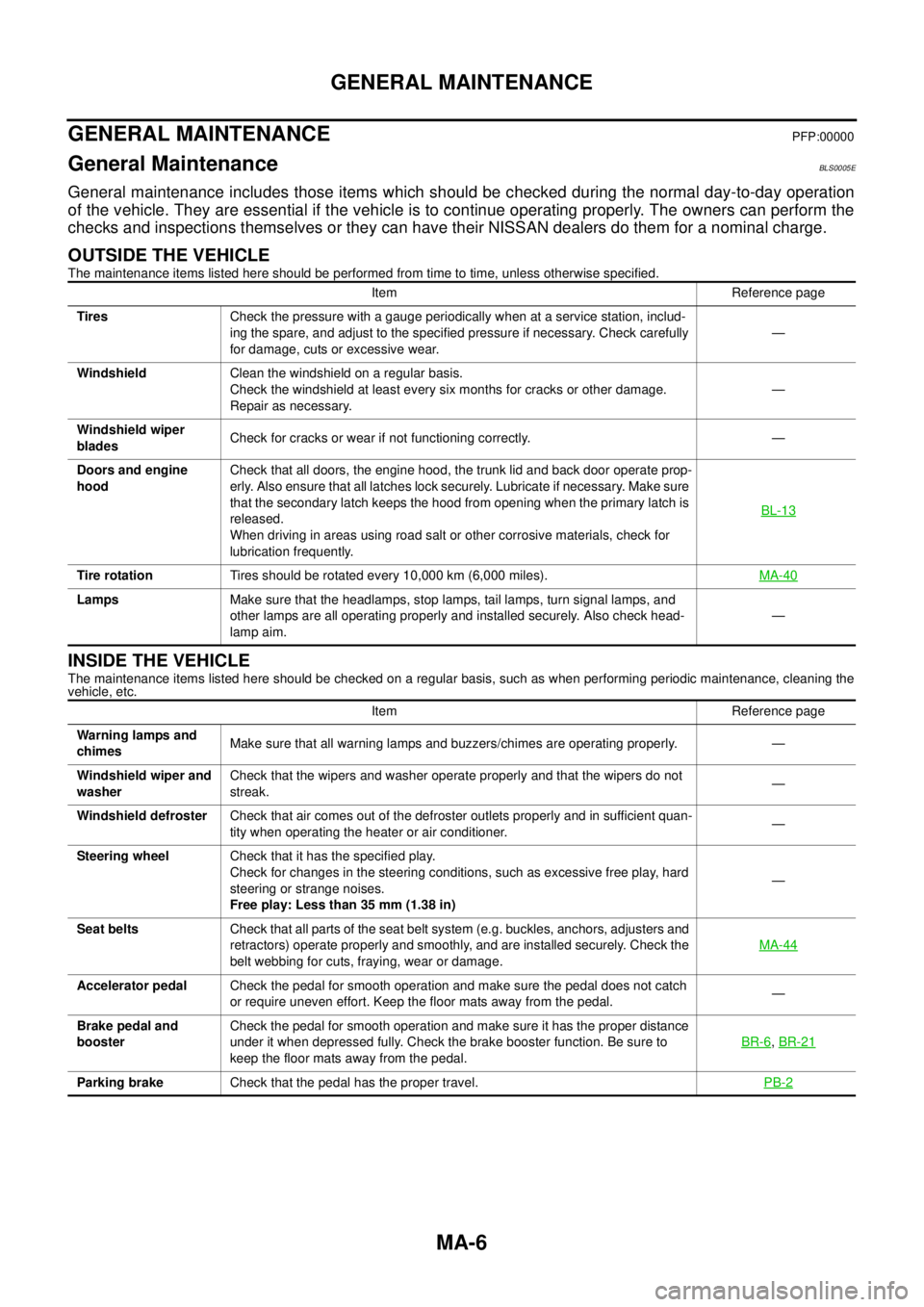
GENERAL MAINTENANCEPFP:00000
General MaintenanceBLS0005E
General maintenance includes those items which should be checked during the normal day-to-day operation
of the vehicle. They are essential if the vehicle is to continue operating properly. The owners can perform the
checks and inspections themselves or they can have their NISSAN dealers do them for a nominal charge.
OUTSIDE THE VEHICLE
The maintenance items listed here should be performed from time to time, unless otherwise specified.
INSIDE THE VEHICLE
The maintenance items listed here should be checked on a regular basis, such as when performing periodic maintenance, cleaning the
vehicle, etc.Item Reference page
TiresCheck the pressure with a gauge periodically when at a service station, includ-
ing the spare, and adjust to the specified pressure if necessary. Check carefully
for damage, cuts or excessive wear.—
WindshieldClean the windshield on a regular basis.
Check the windshield at least every six months for cracks or other damage.
Repair as necessary.—
Windshield wiper
bladesCheck for cracks or wear if not functioning correctly. —
Doors and engine
hoodCheck that all doors, the engine hood, the trunk lid and back door operate prop-
erly. Also ensure that all latches lock securely. Lubricate if necessary. Make sure
that the secondary latch keeps the hood from opening when the primary latch is
released.
When driving in areas using road salt or other corrosive materials, check for
lubrication frequently.BL-13
Tire rotationTires should be rotated every 10,000 km (6,000 miles).MA-40
LampsMake sure that the headlamps, stop lamps, tail lamps, turn signal lamps, and
other lamps are all operating properly and installed securely. Also check head-
lamp aim.—
Item Reference page
Warning lamps and
chimesMake sure that all warning lamps and buzzers/chimes are operating properly. —
Windshield wiper and
washerCheck that the wipers and washer operate properly and that the wipers do not
streak.—
Windshield defrosterCheck that air comes out of the defroster outlets properly and in sufficient quan-
tity when operating the heater or air conditioner.—
Steering wheelCheck that it has the specified play.
Check for changes in the steering conditions, such as excessive free play, hard
steering or strange noises.
Free play: Less than 35 mm (1.38 in)—
Seat beltsCheck that all parts of the seat belt system (e.g. buckles, anchors, adjusters and
retractors) operate properly and smoothly, and are installed securely. Check the
belt webbing for cuts, fraying, wear or damage.MA-44
Accelerator pedalCheck the pedal for smooth operation and make sure the pedal does not catch
or require uneven effort. Keep the floor mats away from the pedal.—
Brake pedal and
boosterCheck the pedal for smooth operation and make sure it has the proper distance
under it when depressed fully. Check the brake booster function. Be sure to
keep the floor mats away from the pedal.BR-6
, BR-21
Parking brakeCheck that the pedal has the proper travel.PB-2
Page 3023 of 3502

CHASSIS AND BODY MAINTENANCE
MA-45
C
D
E
F
G
H
I
J
K
MA
B
MA
Checking Body CorrosionBLS0009J
Visually check body panels for collision damage (scratches, chipping, rubbing, etc.) or damage to the anti-cor-
rosion materials. In particular, check the following locations.
HEMMED PANELS
Hood front end, door lower end, trunk lid rear end, etc.
PA N E L J O I N T
Side sill of rear fender and center pillar, rear wheel housing of rear fender, around strut tower in engine com-
partment, etc.
PA N E L E D G E
Trunk lid opening, sunroof opening, fender wheel-arch flange, fuel filler lid flange, around holes in panel, etc.
PARTS CONTACT
Waist moulding, windshield moulding, bumper, etc.
PROTECTORS
Damage or condition of mudguard, fender protector, chipping protector, etc.
ANTI-CORROSION MATERIALS
Damage or separation of anti-corrosion materials under the body.
DRAIN HOLES
Condition of drain holes at door and side sill. When repairing corroded areas, refer to the Corrosion Repair
Manual.
Page 3099 of 3502

HARNESS
PG-65
C
D
E
F
G
H
I
J
L
MA
B
PG
POWER CVT Transmission Control Module (Power Supply)
POWER PG Power Supply Routing
PRGVLV EC EVAP Canister Purge Volume Control Solenoid Valve
PRIPS CVT Primary Pressure Sensor
PRSCVT CVT Primary Speed Sensor CVT (Revolution Sensor)
PS/SEN EC Power Steering Pressure Sensor
PT/SEN AT Power Train Sensor
R/FOG LT Rear Fog Lamp
ROOM/L LT Interior Room Lamp
RP/SEN EC Refrigerant Pressure Sensor
RRO2 EC Heated Oxygen Sensor 2 Heater
RRO2 EC Heated Oxygen Sensor 2 Heater Bank 1
RRO2 EC Heated Oxygen Sensor 2 Heater Bank 2
SEAT SE Power Seat
SECPS CVT Secondary Pressure Sensor
SECPSV CVT Secondary Pressure Solenoid Valve
SEN/PW EC Sensor Power Supply
SESCVT CVT Secondary Speed Sensor CVT (Revolution Sensor)
SHADE EI Rear Sunshade
SHIFT AT A/T Shift Lock System
SHIFT CVT CVT Shift Lock System
SROOF RF Sunroof
SRS SRS Supplemental Restraint System
SSV/A AT Shift Solenoid Valve A
SSV/B AT Shift Solenoid Valve B
START SC Starting System
STM CVT Step Motor
STOP/L LT Stop Lamp
STSIG CVT Start Signal Circuit
TAIL/L LT Parking, License and Tail Lamps
TCV AT Torque Converter Clutch Solenoid Valve
TCV CVT Torque Converter Clutch Solenoid Valve
TLID BL Trunk Lid Opener
TPS1 EC Throttle Position Sensor (Sensor 1)
TPS2 EC Throttle Position Sensor (Sensor 2)
TPS3 EC Throttle Position Sensor
TURN LT Turn Signal and Hazard Warning Lamp
VDC BRC Vehicle Dynamics Control System
VIAS/V EC VIAS Control Solenoid Valve
VSSA/T AT Vehicle Speed Sensor A/T (Revolution Sensor)
VSSMTR AT Vehicle Speed Sensor MTR
W/ANT AV Audio Antenna
WARN DI Warning Lamps Code Section Wiring Diagram Name
Page 3165 of 3502

RF-1
ROOF
I BODY
CONTENTS
C
D
E
F
G
H
J
K
L
M
SECTION RF
A
B
RF
ROOF
PRECAUTIONS .......................................................... 2
Precautions for Supplemental Restraint System
(SRS) “AIR BAG” and “SEAT BELT PRE-TEN-
SIONER” .................................................................. 2
Precautions .............................................................. 2
PREPARATION ........................................................... 3
Commercial Service Tools ........................................ 3
SQUEAK AND RATTLE TROUBLE DIAGNOSES ..... 4
Work Flow ................................................................ 4
CUSTOMER INTERVIEW ..................................... 4
DUPLICATE THE NOISE AND TEST DRIVE ....... 5
CHECK RELATED SERVICE BULLETINS ........... 5
LOCATE THE NOISE AND IDENTIFY THE
ROOT CAUSE ...................................................... 5
REPAIR THE CAUSE ........................................... 5
CONFIRM THE REPAIR ....................................... 6
Generic Squeak and Rattle Troubleshooting ........... 6
INSTRUMENT PANEL .......................................... 6
CENTER CONSOLE ............................................. 6
DOORS ................................................................. 6
TRUNK .................................................................. 7
SUNROOF/HEADLINING ..................................... 7
SEATS ................................................................... 7
UNDERHOOD ....................................................... 7
Diagnostic Worksheet .............................................. 8
SUNROOF ................................................................ 10
Component Parts and Harness Connector Location ... 10
System Description ................................................. 11
TILT UP / SLIDE CLOSE OPERATION ................ 11
TILT DOWN / SLIDE OPEN OPERATION ........... 11AUTO OPERATION ............................................. 11
TIMER FUNCTION .............................................. 11
ANTI-PINCH FUNCTION .................................... 11
MEMORY RESET PROCEDURE ....................... 12
INITIALIZATION PROCEDURE .......................... 12
Wiring Diagram — SROOF — ................................ 13
Terminals and Reference Value for BCM ............... 14
Terminals and Reference Value for Sunroof Motor
Assembly ................................................................ 14
Work Flow ............................................................... 15
Trouble Diagnosis Chart by Symptom .................... 15
Check BCM Power Supply and Ground Circuit ...... 15
Check Sunroof Motor Assembly Power Supply and
Ground Circuit ........................................................ 16
Check Sunroof Switch System ............................... 17
Check Driver Side Door Switch .............................. 19
Wind Deflector Inspection ....................................... 21
Link and Wire Assembly ......................................... 21
Fitting Adjustment ................................................... 21
LID WEATHERSTRIP OVERLAP ADJUST-
MENT AND SURFACE FLASHNESS ADJUST-
MENT .................................................................. 22
Removal and Installation ........................................ 22
SUNROOF UNIT ASSEMBLY ............................. 24
GLASS LID .......................................................... 25
WEATHERSTRIP OF GLASS LID ....................... 26
SUNSHADE ........................................................ 26
WIND DEFLECTOR ............................................ 26
SUNROOF MOTOR ASSEMBLY ........................ 27
LINK ASSEMBLY AND WIRE ASSEMBLY ......... 27
Page 3171 of 3502

SQUEAK AND RATTLE TROUBLE DIAGNOSES
RF-7
C
D
E
F
G
H
J
K
L
MA
B
RF
TRUNK
Trunk noises are often caused by a loose jack or loose items put into the trunk by the owner.
In addition look for:
1. Trunk lid dumpers out of adjustment
2. Trunk lid striker out of adjustment
3. Trunk lid torsion bars knocking together
4. A loose license plate or bracket
Most of these incidents can be repaired by adjusting, securing or insulating the item(s) or component(s) caus-
ing the noise.
SUNROOF/HEADLINING
Noises in the sunroof/headlining area can often be traced to one of the following:
1. Sunroof lid, rail, linkage or seals making a rattle or light knocking noise
2. Sunvisor shaft shaking in the holder
3. Front or rear windshield touching headlining and squeaking
Again, pressing on the components to stop the noise while duplicating the conditions can isolate most of these
incidents. Repairs usually consist of insulating with felt cloth tape.
SEATS
When isolating seat noise it's important to note the position the seat is in and the load placed on the seat when
the noise is present. These conditions should be duplicated when verifying and isolating the cause of the
noise.
Cause of seat noise include:
1. Headrest rods and holder
2. A squeak between the seat pad cushion and frame
3. Rear seatback lock and bracket
These noises can be isolated by moving or pressing on the suspected components while duplicating the con-
ditions under which the noise occurs. Most of these incidents can be repaired by repositioning the component
or applying urethane tape to the contact area.
UNDERHOOD
Some interior noise may be caused by components under the hood or on the engine wall. The noise is then
transmitted into the passenger compartment.
Causes of transmitted underhood noise include:
1. Any component mounted to the engine wall
2. Components that pass through the engine wall
3. Engine wall mounts and connectors
4. Loose radiator mounting pins
5. Hood bumpers out of adjustment
6. Hood striker out of adjustment
These noises can be difficult to isolate since they cannot be reached from the interior of the vehicle. The best
method is to secure, move or insulate one component at a time and test drive the vehicle. Also, engine RPM
or load can be changed to isolate the noise. Repairs can usually be made by moving, adjusting, securing, or
insulating the component causing the noise.
Page 3257 of 3502

SE-1
SEAT
I BODY
CONTENTS
C
D
E
F
G
H
J
K
L
M
SECTION SE
A
B
SE
SEAT
INDEX FOR DTC ........................................................ 3
DTC No. Index (AUTO DRIVE POS.) ....................... 3
PRECAUTIONS .......................................................... 4
Precautions for Supplemental Restraint System
(SRS) “AIR BAG” and “SEAT BELT PRE-TEN-
SIONER” .................................................................. 4
Service Notice .......................................................... 4
Precautions .............................................................. 4
PREPARATION ........................................................... 5
Commercial Service Tools ........................................ 5
SQUEAK AND RATTLE TROUBLE DIAGNOSES ..... 6
Work Flow ................................................................ 6
CUSTOMER INTERVIEW ..................................... 6
DUPLICATE THE NOISE AND TEST DRIVE ....... 7
CHECK RELATED SERVICE BULLETINS ........... 7
LOCATE THE NOISE AND IDENTIFY THE
ROOT CAUSE ...................................................... 7
REPAIR THE CAUSE ........................................... 7
CONFIRM THE REPAIR ....................................... 8
Generic Squeak and Rattle Troubleshooting ........... 8
INSTRUMENT PANEL .......................................... 8
CENTER CONSOLE ............................................. 8
DOORS ................................................................. 8
TRUNK .................................................................. 9
SUNROOF/HEADLINING ..................................... 9
SEATS ................................................................... 9
UNDERHOOD ....................................................... 9
Diagnostic Worksheet ............................................ 10
AUTOMATIC DRIVE POSITIONER .......................... 12
System Description ................................................ 12
MANUAL OPERATION ....................................... 12
AUTOMATIC OPERATION ................................. 12
MEMORY STORING AND KEYFOB INTER-
LOCK STORING ................................................. 13
MEMORY SWITCH OPERATION ....................... 14
ENTRY OPERATION .......................................... 14
EXITING OPERATION ........................................ 14
KEYFOB INTERLOCK OPERATION .................. 15
FAIL- SAFE MODE ............................................. 15
CANCEL OF FAIL-SAFE MODE ......................... 15Component Parts and Harness Connector Location ... 16
CAN Communication System Description .............. 16
CAN Communication Unit ....................................... 16
Schematic ............................................................... 17
Wiring Diagram — AUT/DP — ............................... 19
Terminals and Reference Values for BCM .............. 28
Terminals and Reference Values for Driver Seat
Control Unit ............................................................. 28
Work Flow ............................................................... 30
Preliminary Check .................................................. 31
SETTING CHANGE FUNCTION ......................... 31
CHECK POWER SUPPLY AND GROUND ......... 31
CONSULT-II Function (AUTO DRIVE POS.) .......... 33
CONSULT-II OPERATION ................................... 33
SELF-DIAGNOSIS RESULTS ............................. 33
DATA MONITOR ................................................. 34
ACTIVE TEST ..................................................... 34
Check CAN Communication System ...................... 35
Symptom Chart ....................................................... 35
Check Sliding Motor Circuit .................................... 36
Check Reclining Motor Circuit ................................ 37
Check Front Lifting Motor Circuit ............................ 39
Check Rear Lifting Motor Circuit ............................. 40
Check Sliding Sensor Circuit .................................. 42
Check Reclining Sensor Circuit .............................. 43
Check Front Lifting Sensor Circuit .......................... 44
Check Rear Lifting Sensor Circuit .......................... 45
Check Front Door Switch (Driver Side) Circuit ....... 46
Check Sliding Switch Circuit ................................... 47
Check Reclining Switch Circuit ............................... 48
Check Front Lifting Switch Circuit ........................... 50
Check Rear Lifting Switch Circuit ........................... 51
Check Power Seat Switch Ground Circuit .............. 52
Check Detention Key Switch (P Range Switch) Cir-
cuit .......................................................................... 53
Check Key Switch Circuit ....................................... 54
Check Seat Memory Switch Circuit ........................ 56
Check Memory Indicator Lamp Circuit ................... 57
POWER SEAT ........................................................... 59
Wiring Diagram — SEAT — ................................... 59
Page 3265 of 3502

SQUEAK AND RATTLE TROUBLE DIAGNOSES
SE-9
C
D
E
F
G
H
J
K
L
MA
B
SE
TRUNK
Trunk noises are often caused by a loose jack or loose items put into the trunk by the owner.
In addition look for:
1. Trunk lid dumpers out of adjustment
2. Trunk lid striker out of adjustment
3. Trunk lid torsion bars knocking together
4. A loose license plate or bracket
Most of these incidents can be repaired by adjusting, securing or insulating the item(s) or component(s) caus-
ing the noise.
SUNROOF/HEADLINING
Noises in the sunroof/headlining area can often be traced to one of the following:
1. Sunroof lid, rail, linkage or seals making a rattle or light knocking noise
2. Sunvisor shaft shaking in the holder
3. Front or rear windshield touching headlining and squeaking
Again, pressing on the components to stop the noise while duplicating the conditions can isolate most of these
incidents. Repairs usually consist of insulating with felt cloth tape.
SEATS
When isolating seat noise it's important to note the position the seat is in and the load placed on the seat when
the noise is present. These conditions should be duplicated when verifying and isolating the cause of the
noise.
Cause of seat noise include:
1. Headrest rods and holder
2. A squeak between the seat pad cushion and frame
3. Rear seatback lock and bracket
These noises can be isolated by moving or pressing on the suspected components while duplicating the con-
ditions under which the noise occurs. Most of these incidents can be repaired by repositioning the component
or applying urethane tape to the contact area.
UNDERHOOD
Some interior noise may be caused by components under the hood or on the engine wall. The noise is then
transmitted into the passenger compartment.
Causes of transmitted underhood noise include:
1. Any component mounted to the engine wall
2. Components that pass through the engine wall
3. Engine wall mounts and connectors
4. Loose radiator mounting pins
5. Hood bumpers out of adjustment
6. Hood striker out of adjustment
These noises can be difficult to isolate since they cannot be reached from the interior of the vehicle. The best
method is to secure, move or insulate one component at a time and test drive the vehicle. Also, engine RPM
or load can be changed to isolate the noise. Repairs can usually be made by moving, adjusting, securing, or
insulating the component causing the noise.