lock NISSAN TEANA 2008 Service Manual
[x] Cancel search | Manufacturer: NISSAN, Model Year: 2008, Model line: TEANA, Model: NISSAN TEANA 2008Pages: 5121, PDF Size: 69.03 MB
Page 3000 of 5121
SQUEAK AND RATTLE TROUBLE DIAGNOSES
INT-23
< SYMPTOM DIAGNOSIS >
C
D
E
F
G
H
I
K
L
MA
B
INT
N
O
P
Inspection ProcedureINFOID:0000000003887244
Refer to Table of Contents for specific component removal and installation information.
INSTRUMENT PANEL
Most incidents are caused by contact and movement between:
1. Cluster lid A and instrument panel
2. Acrylic lens and combination meter housing
3. Instrument panel to front pillar garnish
4. Instrument panel to windshield
5. Instrument panel mounting pins
6. Wiring harnesses behind the combination meter
7. A/C defroster duct and duct joint
These incidents can usually be located by tapping or moving the components to duplicate the noise or by
pressing on the components while driving to stop the noise. Most of these incidents can be repaired by apply-
ing felt cloth tape or silicon spray (in hard to reach areas). Urethane pads can be used to insulate wiring har-
ness.
CAUTION:
Never use silicone spray to isolate a squeak or rattle. If the area is saturated with silicone, the recheck
of repair becomes impossible.
CENTER CONSOLE
Components to pay attention to include:
1. Shifter assembly cover to finisher
2. A/C control unit and cluster lid C
3. Wiring harnesses behind audio and A/C control unit
The instrument panel repair and isolation procedures also apply to the center console.
DOORS
Pay attention to the following:
1. Finisher and inner panel making a slapping noise
2. Inside handle escutcheon to door finisher
3. Wiring harnesses tapping
4. Door striker out of alignment causing a popping noise on starts and stops
Tapping or moving the components or pressing on them while driving to duplicate the conditions can isolate
many of these incidents. The areas can usually be insulated with felt cloth tape or insulator foam blocks to
repair the noise.
TRUNK
Trunk noises are often caused by a loose jack or loose items put into the trunk by the customer.
In addition look for the following:
1. Trunk lid dumpers out of adjustment
2. Trunk lid striker out of adjustment
3. Trunk lid torsion bars knocking together
4. A loose license plate or bracket
Most of these incidents can be repaired by adjusting, securing or insulating the item(s) or component(s) caus-
ing the noise.
SUNROOF/HEADLINING
Noises in the sunroof/headlining area can often be traced to one of the following:
1. Sunroof lid, rail, linkage or seals making a rattle or light knocking noise
2. Sunvisor shaft shaking in the holder
3. Front or rear windshield touching headlining and squeaking
Again, pressing on the components to stop the noise while duplicating the conditions can isolate most of these
incidents. Repairs usually consist of insulating with felt cloth tape.
Page 3001 of 5121

INT-24
< SYMPTOM DIAGNOSIS >
SQUEAK AND RATTLE TROUBLE DIAGNOSES
SEATS
When isolating seat noise it is important to note the position the seat is in and the load placed on the seat
when the noise occurs. These conditions should be duplicated when verifying and isolating the cause of the
noise.
Cause of seat noise include:
1. Headrest rods and holder
2. A squeak between the seat pad cushion and frame
3. Rear seatback lock and bracket
These noises can be isolated by moving or pressing on the suspected components while duplicating the con-
ditions under which the noise occurs. Most of these incidents can be repaired by repositioning the component
or applying urethane tape to the contact area.
UNDERHOOD
Some interior noise may be caused by components under the hood or on the engine wall. The noise is then
transmitted into the passenger compartment.
Causes of transmitted underhood noise include:
1. Any component mounted to the engine wall
2. Components that pass through the engine wall
3. Engine wall mounts and connectors
4. Loose radiator mounting pins
5. Hood bumpers out of adjustment
6. Hood striker out of adjustment
These noises can be difficult to isolate since they cannot be reached from the interior of the vehicle. The best
method is to secure, move or insulate one component at a time and test drive the vehicle. Also, engine RPM
or load can be changed to isolate the noise. Repairs can usually be made by moving, adjusting, securing, or
insulating the component causing the noise.
Page 3004 of 5121
PRECAUTIONS
INT-27
< PRECAUTION >
C
D
E
F
G
H
I
K
L
MA
B
INT
N
O
P
PRECAUTION
PRECAUTIONS
Precaution for Supplemental Restraint System (SRS) "AIR BAG" and "SEAT BELT
PRE-TENSIONER"
INFOID:0000000003819210
The Supplemental Restraint System such as “AIR BAG” and “SEAT BELT PRE-TENSIONER”, used along
with a front seat belt, helps to reduce the risk or severity of injury to the driver and front passenger for certain
types of collision. This system includes seat belt switch inputs and dual stage front air bag modules. The SRS
system uses the seat belt switches to determine the front air bag deployment, and may only deploy one front
air bag, depending on the severity of a collision and whether the front occupants are belted or unbelted.
Information necessary to service the system safely is included in the “SRS AIRBAG” and “SEAT BELT” of this
Service Manual.
WARNING:
• To avoid rendering the SRS inoperative, which could increase the risk of personal injury or death in
the event of a collision which would result in air bag inflation, all maintenance must be performed by
an authorized NISSAN/INFINITI dealer.
Improper maintenance, including incorrect removal and installation of the SRS, can lead to personal
injury caused by unintentional activation of the system. For removal of Spiral Cable and Air Bag
Module, see the “SRS AIRBAG”.
Never use electrical test equipment on any circuit related to the SRS unless instructed to in this Ser-
vice Manual. SRS wiring harnesses can be identified by yellow and/or orange harnesses or harness
connectors.
Precaution Necessary for Steering Wheel Rotation after Battery Disconnect
INFOID:0000000003819211
NOTE:
Before removing and installing any control units, first turn the push-button ignition switch to the LOCK posi-
tion, then disconnect both battery cables.
After finishing work, confirm that all control unit connectors are connected properly, then re-connect both
battery cables.
Always use CONSULT-III to perform self-diagnosis as a part of each function inspection after finishing work.
If a DTC is detected, perform trouble diagnosis according to self-diagnosis results.
This vehicle is equipped with a push-button ignition switch and a steering lock unit.
If the battery is disconnected or discharged, the steering wheel will lock and cannot be turned.
If turning the steering wheel is required with the battery disconnected or discharged, follow the procedure
below before starting the repair operation.
OPERATION PROCEDURE
1. Connect both battery cables.
NOTE:
Supply power using jumper cables if battery is discharged.
2. Turn the push-button ignition switch to ACC position.
(At this time, the steering lock will be released.)
3. Disconnect both battery cables. The steering lock will remain released with both battery cables discon-
nected and the steering wheel can be turned.
4. Perform the necessary repair operation.
5. When the repair work is completed, re-connect both battery cables. With the brake pedal released, turn
the push-button ignition switch from ACC position to ON position, then to LOCK position. (The steering
wheel will lock when the push-button ignition switch is turned to LOCK position.)
6. Perform self-diagnosis check of all control units using CONSULT-III.
Page 3009 of 5121
INT-32
< ON-VEHICLE REPAIR >
FRONT DOOR FINISHER
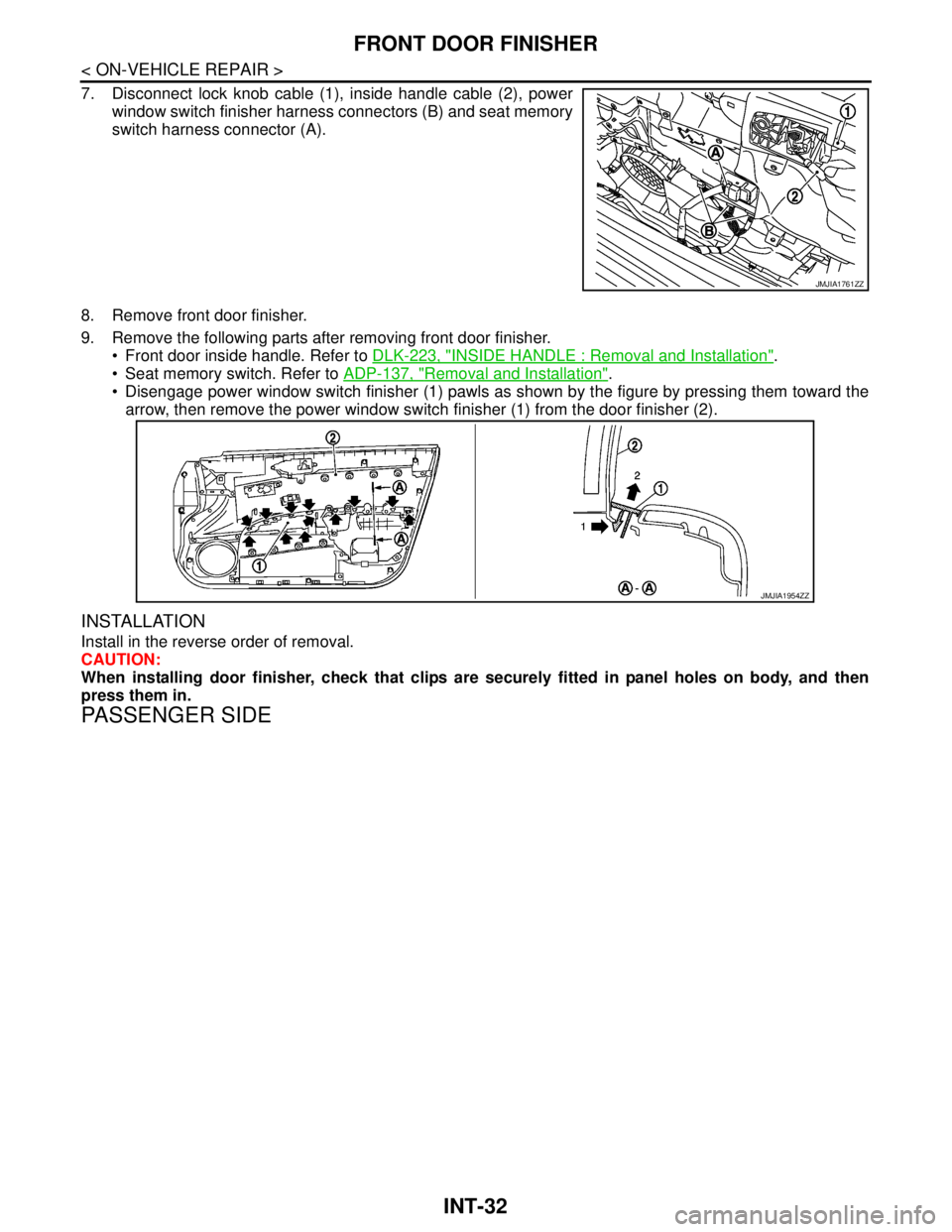
7. Disconnect lock knob cable (1), inside handle cable (2), power
window switch finisher harness connectors (B) and seat memory
switch harness connector (A).
8. Remove front door finisher.
9. Remove the following parts after removing front door finisher.
Front door inside handle. Refer to DLK-223, "
INSIDE HANDLE : Removal and Installation".
Seat memory switch. Refer to ADP-137, "
Removal and Installation".
Disengage power window switch finisher (1) pawls as shown by the figure by pressing them toward the
arrow, then remove the power window switch finisher (1) from the door finisher (2).
INSTALLATION
Install in the reverse order of removal.
CAUTION:
When installing door finisher, check that clips are securely fitted in panel holes on body, and then
press them in.
PASSENGER SIDE
JMJIA1761ZZ
JMJIA1954ZZ
Page 3012 of 5121
FRONT DOOR FINISHER
INT-35
< ON-VEHICLE REPAIR >
C
D
E
F
G
H
I
K
L
MA
B
INT
N
O
P
7. Remove step lamp and then disconnect the harness connector. Refer to INL-96, "Removal and Installa-
tion".
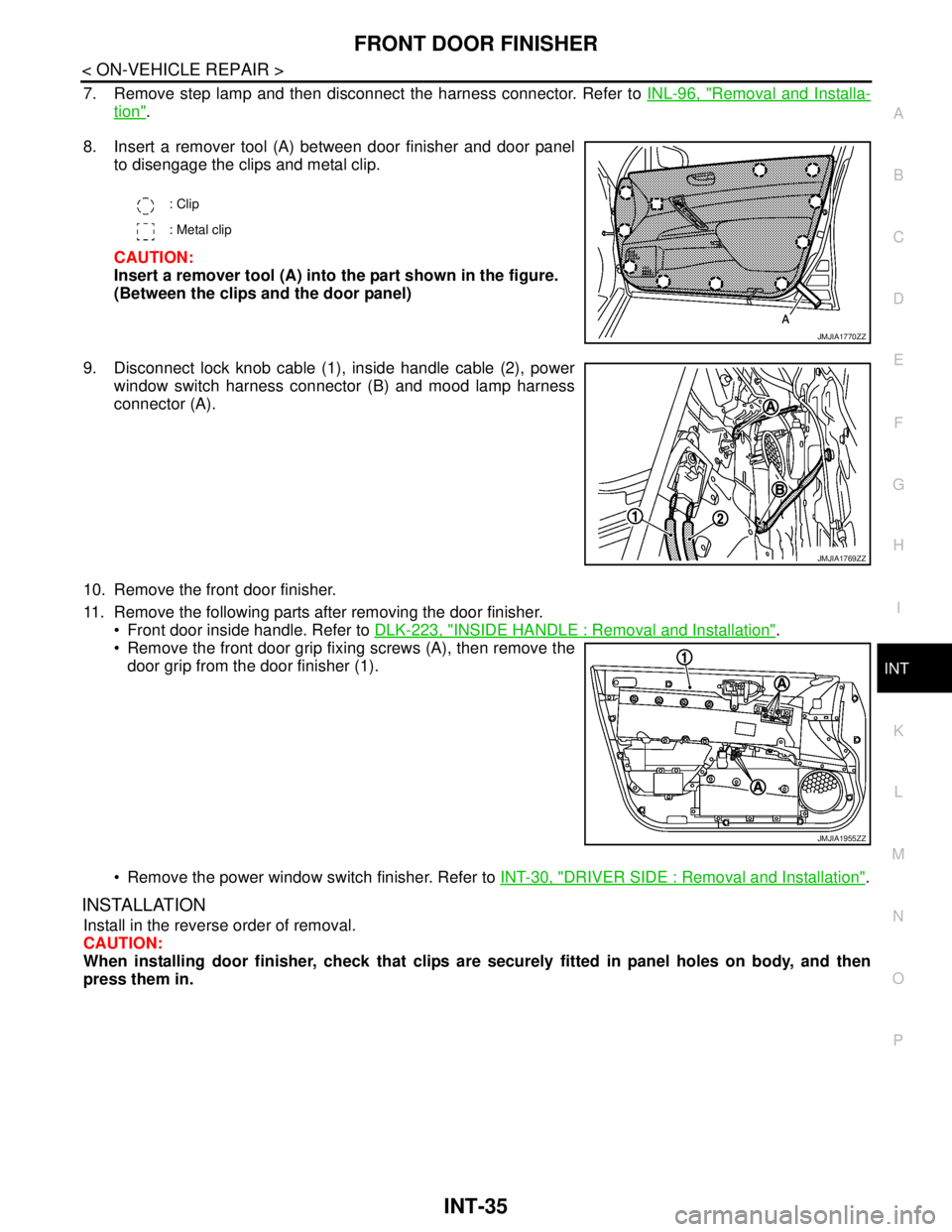
8. Insert a remover tool (A) between door finisher and door panel
to disengage the clips and metal clip.
CAUTION:
Insert a remover tool (A) into the part shown in the figure.
(Between the clips and the door panel)
9. Disconnect lock knob cable (1), inside handle cable (2), power
window switch harness connector (B) and mood lamp harness
connector (A).
10. Remove the front door finisher.
11. Remove the following parts after removing the door finisher.
Front door inside handle. Refer to DLK-223, "
INSIDE HANDLE : Removal and Installation".
Remove the front door grip fixing screws (A), then remove the
door grip from the door finisher (1).
Remove the power window switch finisher. Refer to INT-30, "
DRIVER SIDE : Removal and Installation".
INSTALLATION
Install in the reverse order of removal.
CAUTION:
When installing door finisher, check that clips are securely fitted in panel holes on body, and then
press them in.
: Clip
: Metal clip
JMJIA1770ZZ
JMJIA1769ZZ
JMJIA1955ZZ
Page 3015 of 5121
INT-38
< ON-VEHICLE REPAIR >
REAR DOOR FINISHER
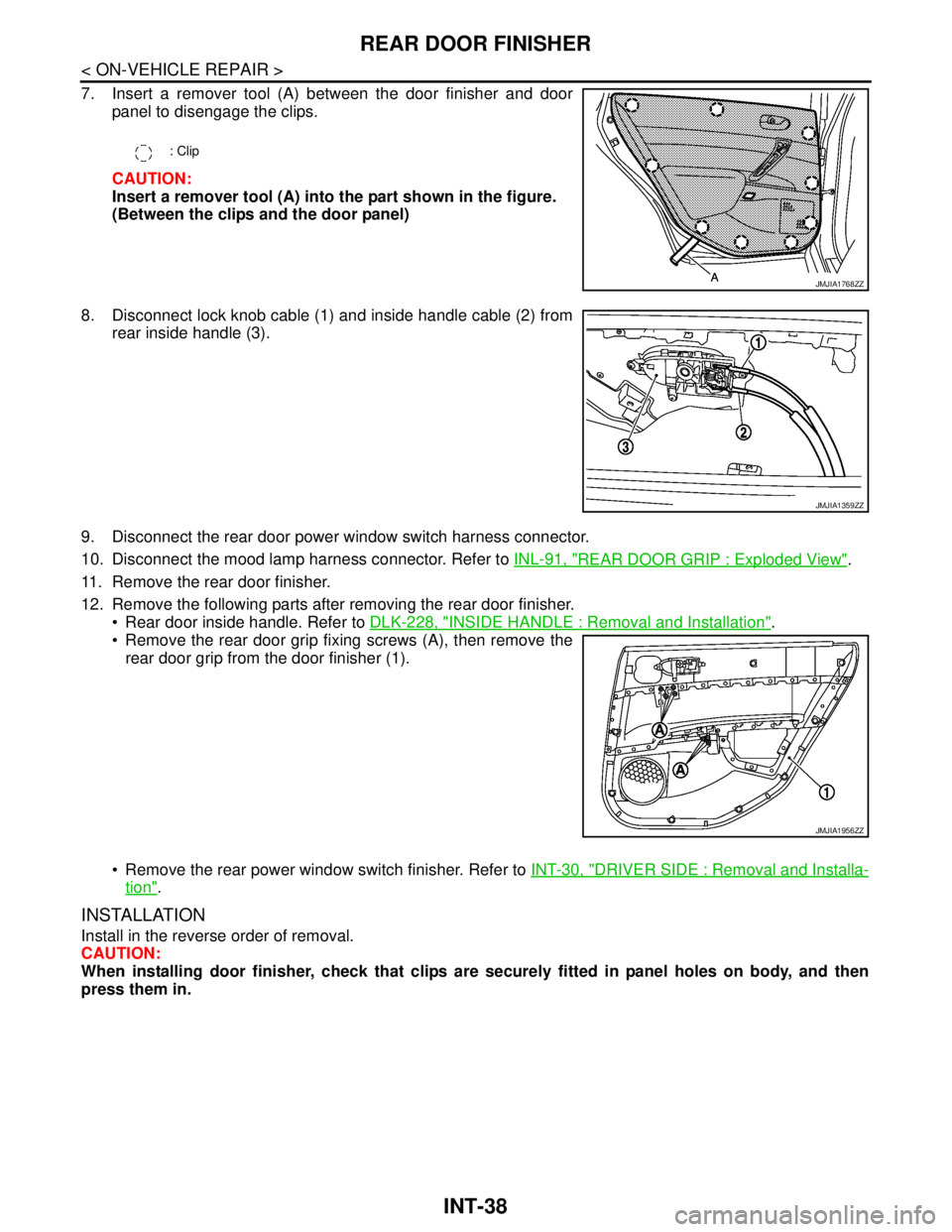
7. Insert a remover tool (A) between the door finisher and door
panel to disengage the clips.
CAUTION:
Insert a remover tool (A) into the part shown in the figure.
(Between the clips and the door panel)
8. Disconnect lock knob cable (1) and inside handle cable (2) from
rear inside handle (3).
9. Disconnect the rear door power window switch harness connector.
10. Disconnect the mood lamp harness connector. Refer to INL-91, "
REAR DOOR GRIP : Exploded View".
11. Remove the rear door finisher.
12. Remove the following parts after removing the rear door finisher.
Rear door inside handle. Refer to DLK-228, "
INSIDE HANDLE : Removal and Installation".
Remove the rear door grip fixing screws (A), then remove the
rear door grip from the door finisher (1).
Remove the rear power window switch finisher. Refer to INT-30, "
DRIVER SIDE : Removal and Installa-
tion".
INSTALLATION
Install in the reverse order of removal.
CAUTION:
When installing door finisher, check that clips are securely fitted in panel holes on body, and then
press them in.
: Clip
JMJIA1768ZZ
JMJIA1359ZZ
JMJIA1956ZZ
Page 3026 of 5121
HEADLINING
INT-49
< ON-VEHICLE REPAIR >
C
D
E
F
G
H
I
K
L
MA
B
INT
N
O
P
HEADLINING
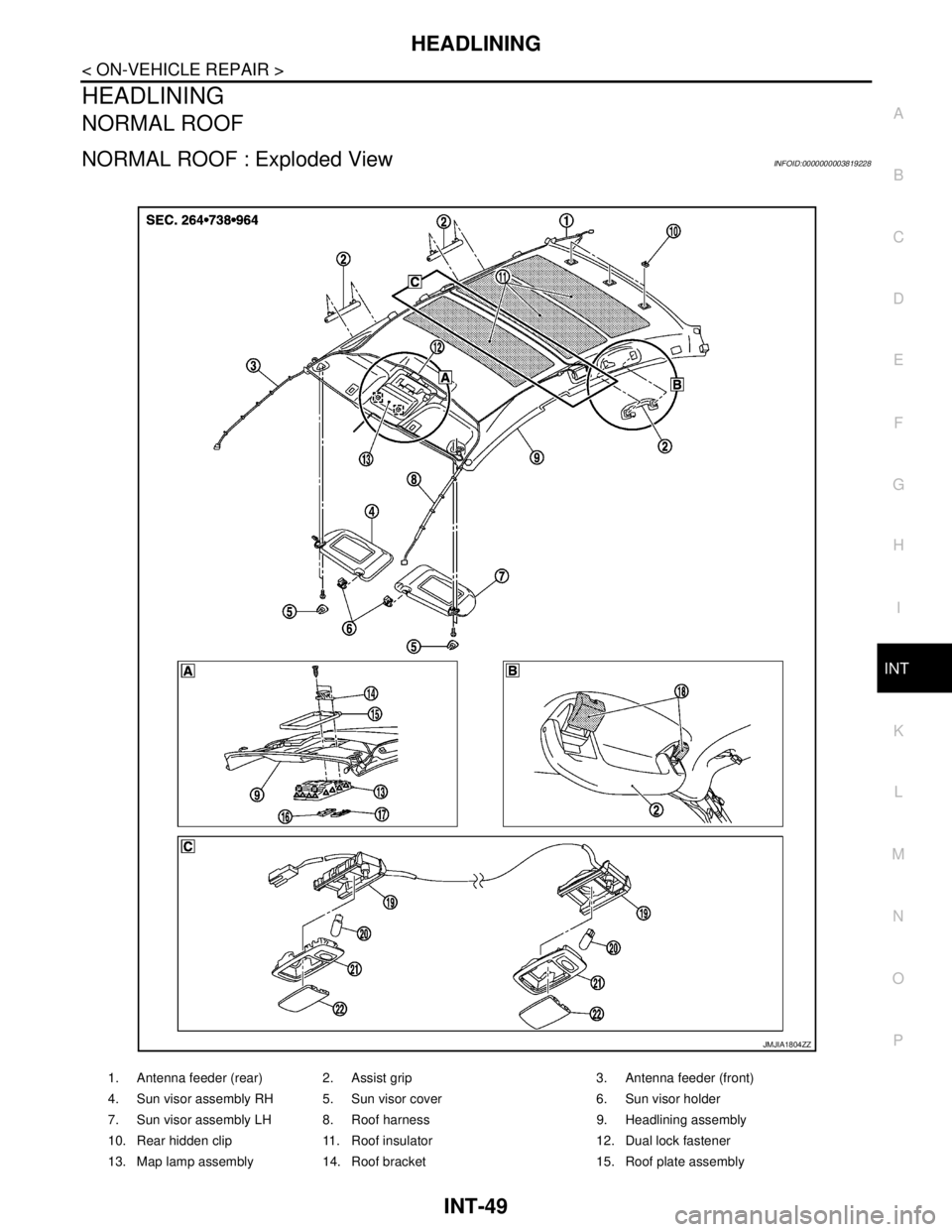
NORMAL ROOF
NORMAL ROOF : Exploded ViewINFOID:0000000003819228
1. Antenna feeder (rear) 2. Assist grip 3. Antenna feeder (front)
4. Sun visor assembly RH 5. Sun visor cover 6. Sun visor holder
7. Sun visor assembly LH 8. Roof harness 9. Headlining assembly
10. Rear hidden clip 11. Roof insulator 12. Dual lock fastener
13. Map lamp assembly 14. Roof bracket 15. Roof plate assembly
JMJIA1804ZZ
Page 3028 of 5121
HEADLINING
INT-51
< ON-VEHICLE REPAIR >
C
D
E
F
G
H
I
K
L
MA
B
INT
N
O
P
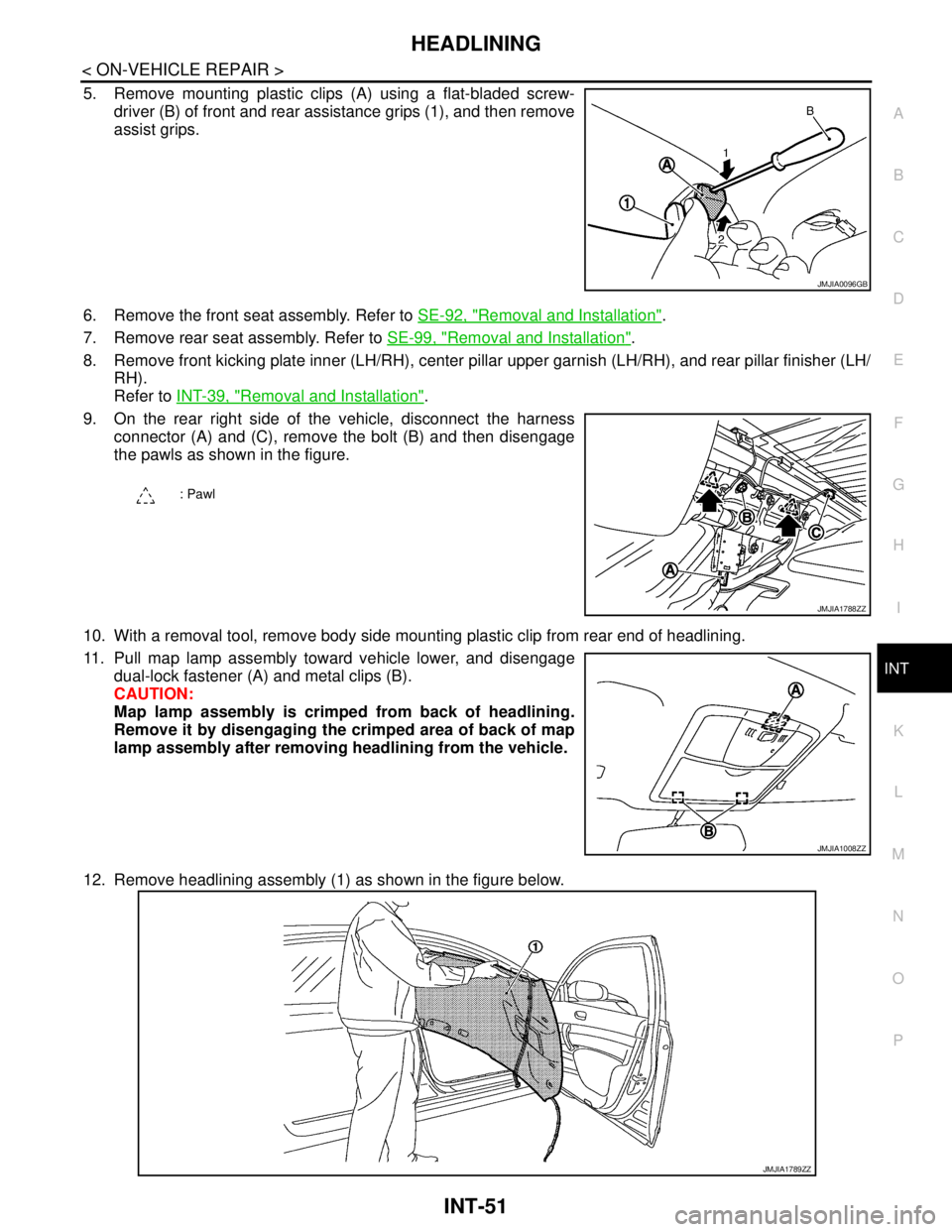
5. Remove mounting plastic clips (A) using a flat-bladed screw-
driver (B) of front and rear assistance grips (1), and then remove
assist grips.
6. Remove the front seat assembly. Refer to SE-92, "
Removal and Installation".
7. Remove rear seat assembly. Refer to SE-99, "
Removal and Installation".
8. Remove front kicking plate inner (LH/RH), center pillar upper garnish (LH/RH), and rear pillar finisher (LH/
RH).
Refer to INT-39, "
Removal and Installation".
9. On the rear right side of the vehicle, disconnect the harness
connector (A) and (C), remove the bolt (B) and then disengage
the pawls as shown in the figure.
10. With a removal tool, remove body side mounting plastic clip from rear end of headlining.
11. Pull map lamp assembly toward vehicle lower, and disengage
dual-lock fastener (A) and metal clips (B).
CAUTION:
Map lamp assembly is crimped from back of headlining.
Remove it by disengaging the crimped area of back of map
lamp assembly after removing headlining from the vehicle.
12. Remove headlining assembly (1) as shown in the figure below.
JMJIA0096GB
: Pawl
JMJIA1788ZZ
JMJIA1008ZZ
JMJIA1789ZZ
Page 3030 of 5121
HEADLINING
INT-53
< ON-VEHICLE REPAIR >
C
D
E
F
G
H
I
K
L
MA
B
INT
N
O
P
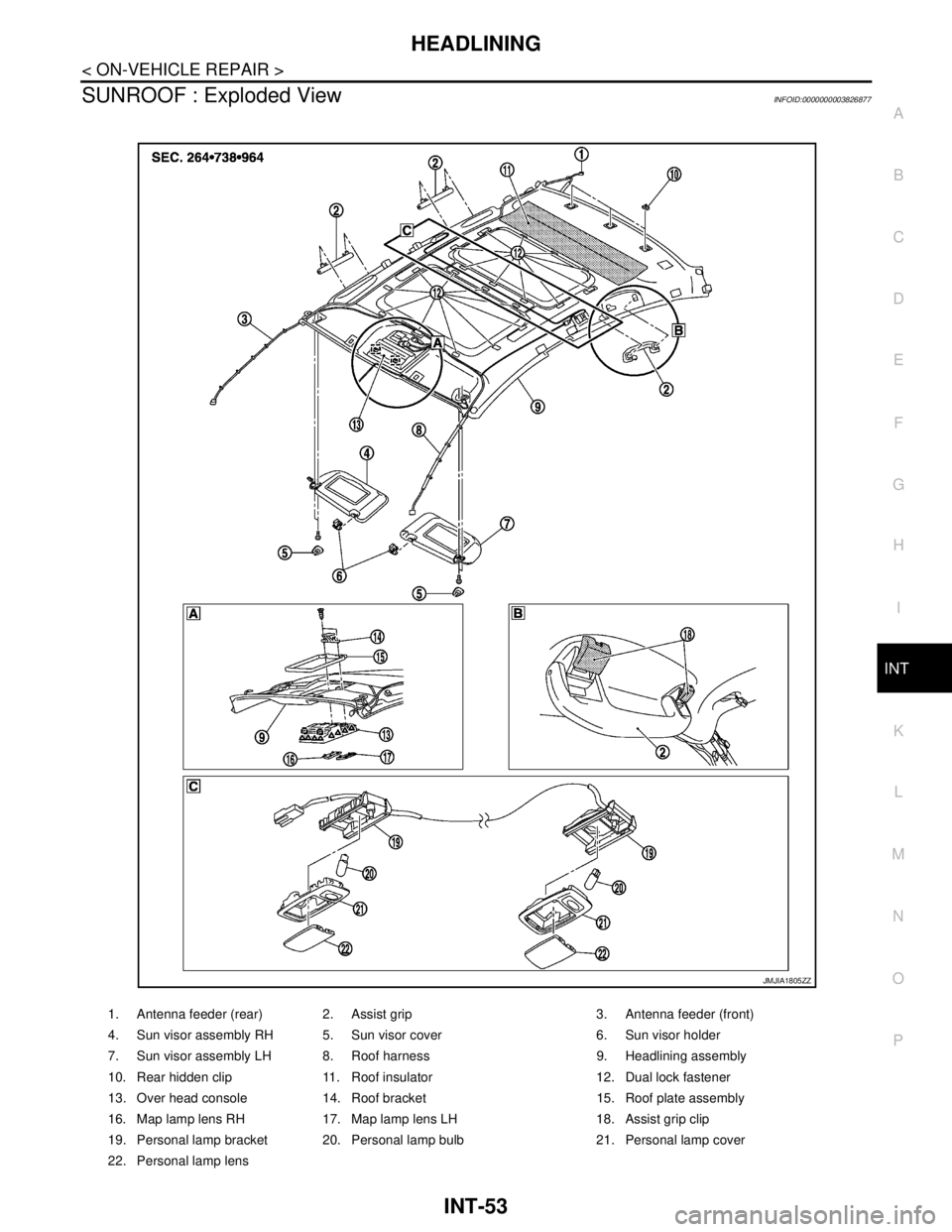
SUNROOF : Exploded ViewINFOID:0000000003826877
1. Antenna feeder (rear) 2. Assist grip 3. Antenna feeder (front)
4. Sun visor assembly RH 5. Sun visor cover 6. Sun visor holder
7. Sun visor assembly LH 8. Roof harness 9. Headlining assembly
10. Rear hidden clip 11. Roof insulator 12. Dual lock fastener
13. Over head console 14. Roof bracket 15. Roof plate assembly
16. Map lamp lens RH 17. Map lamp lens LH 18. Assist grip clip
19. Personal lamp bracket 20. Personal lamp bulb 21. Personal lamp cover
22. Personal lamp lens
JMJIA1805ZZ
Page 3032 of 5121
HEADLINING
INT-55
< ON-VEHICLE REPAIR >
C
D
E
F
G
H
I
K
L
MA
B
INT
N
O
P
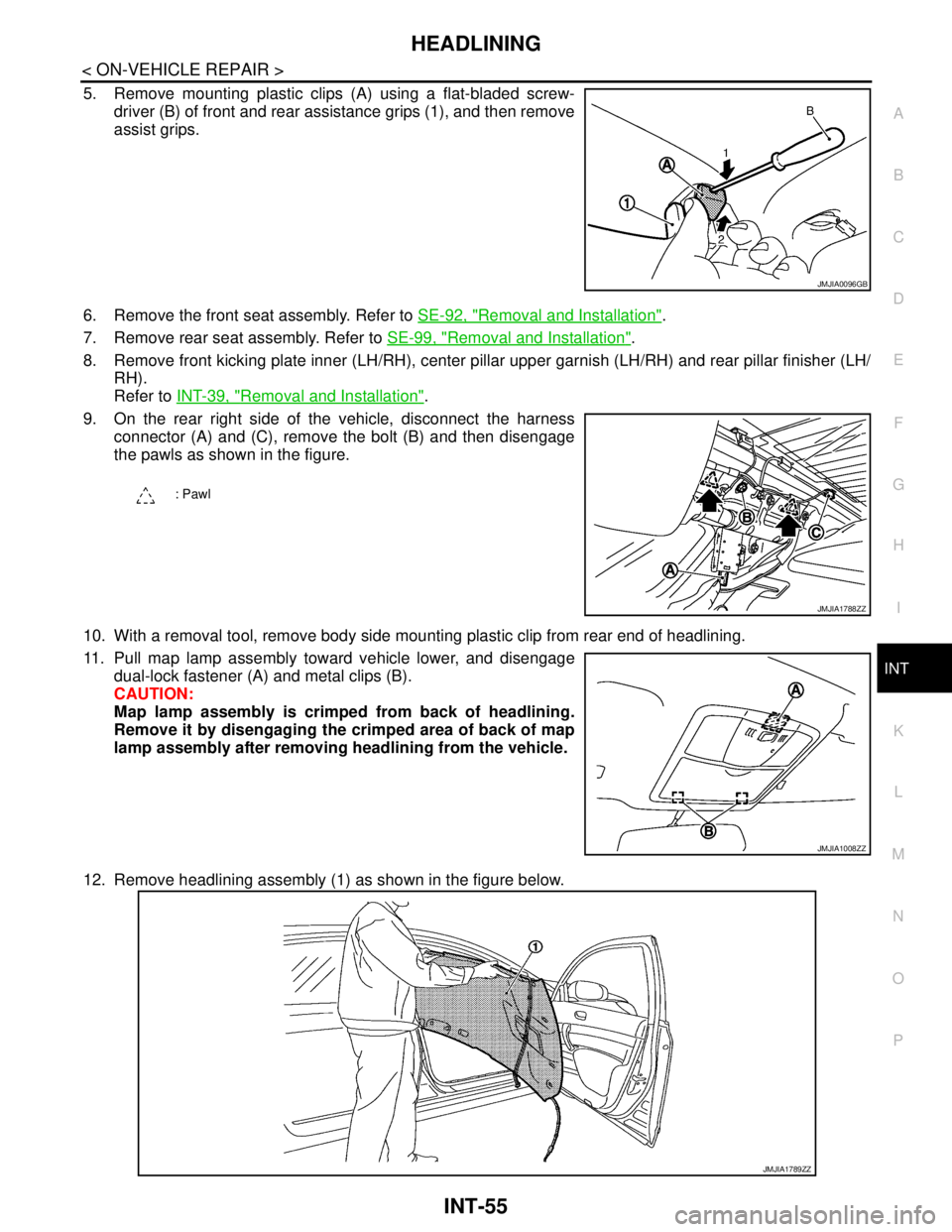
5. Remove mounting plastic clips (A) using a flat-bladed screw-
driver (B) of front and rear assistance grips (1), and then remove
assist grips.
6. Remove the front seat assembly. Refer to SE-92, "
Removal and Installation".
7. Remove rear seat assembly. Refer to SE-99, "
Removal and Installation".
8. Remove front kicking plate inner (LH/RH), center pillar upper garnish (LH/RH) and rear pillar finisher (LH/
RH).
Refer to INT-39, "
Removal and Installation".
9. On the rear right side of the vehicle, disconnect the harness
connector (A) and (C), remove the bolt (B) and then disengage
the pawls as shown in the figure.
10. With a removal tool, remove body side mounting plastic clip from rear end of headlining.
11. Pull map lamp assembly toward vehicle lower, and disengage
dual-lock fastener (A) and metal clips (B).
CAUTION:
Map lamp assembly is crimped from back of headlining.
Remove it by disengaging the crimped area of back of map
lamp assembly after removing headlining from the vehicle.
12. Remove headlining assembly (1) as shown in the figure below.
JMJIA0096GB
: Pawl
JMJIA1788ZZ
JMJIA1008ZZ
JMJIA1789ZZ