light NISSAN TEANA 2008 Workshop Manual
[x] Cancel search | Manufacturer: NISSAN, Model Year: 2008, Model line: TEANA, Model: NISSAN TEANA 2008Pages: 5121, PDF Size: 69.03 MB
Page 876 of 5121
BCS
BCM (BODY CONTROL MODULE)
BCS-59
< ECU DIAGNOSIS >
C
D
E
F
G
H
I
J
K
L B A
O
P N
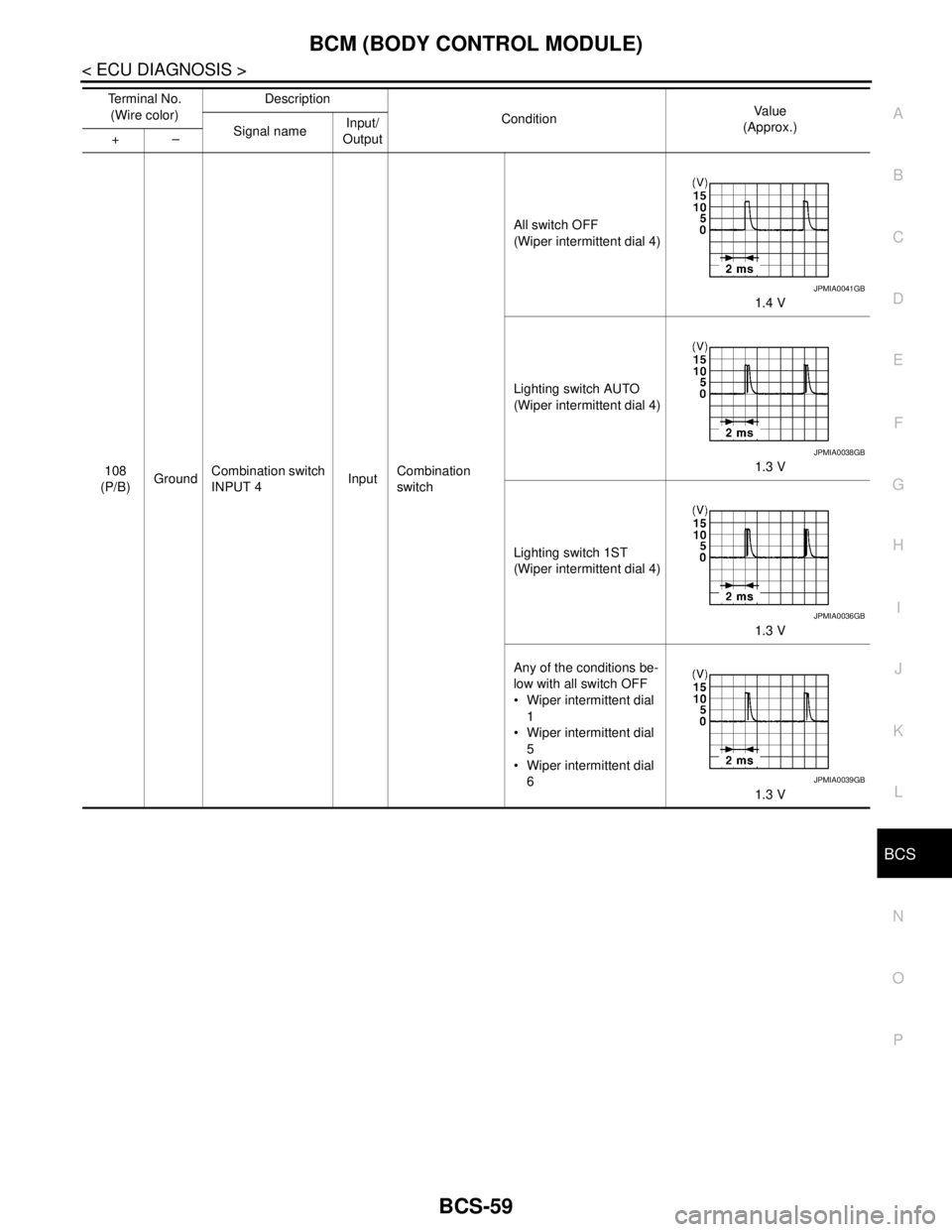
108
(P/B)GroundCombination switch
INPUT 4InputCombination
switchAll switch OFF
(Wiper intermittent dial 4)
1.4 V
Lighting switch AUTO
(Wiper intermittent dial 4)
1.3 V
Lighting switch 1ST
(Wiper intermittent dial 4)
1.3 V
Any of the conditions be-
low with all switch OFF
Wiper intermittent dial
1
Wiper intermittent dial
5
Wiper intermittent dial
6
1.3 V Te r m i n a l N o .
(Wire color)Description
ConditionVa l u e
(Approx.)
Signal nameInput/
Output +–
JPMIA0041GB
JPMIA0038GB
JPMIA0036GB
JPMIA0039GB
Page 877 of 5121
BCS-60
< ECU DIAGNOSIS >
BCM (BODY CONTROL MODULE)
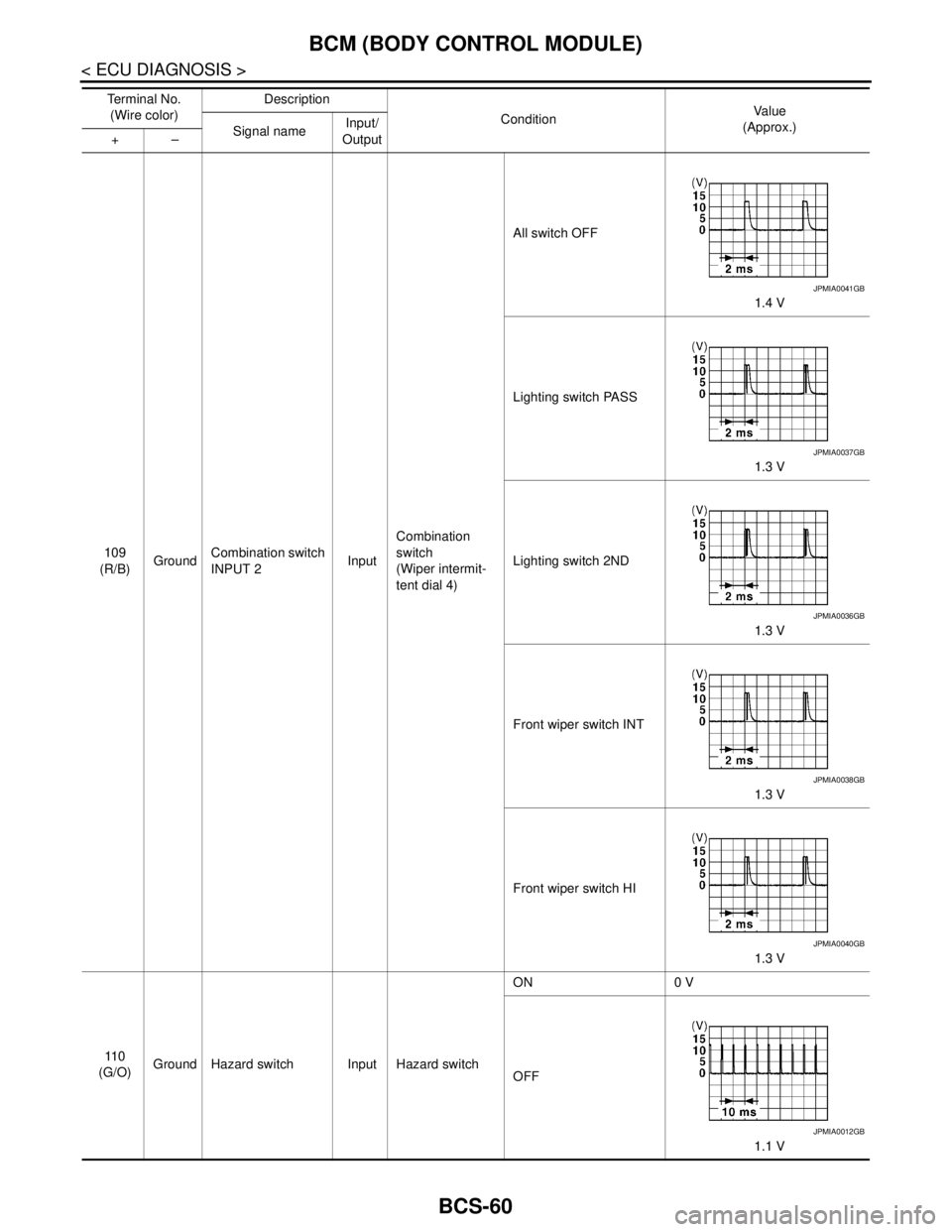
109
(R/B)GroundCombination switch
INPUT 2InputCombination
switch
(Wiper intermit-
tent dial 4)All switch OFF
1.4 V
Lighting switch PASS
1.3 V
Lighting switch 2ND
1.3 V
Front wiper switch INT
1.3 V
Front wiper switch HI
1.3 V
11 0
(G/O)Ground Hazard switch Input Hazard switchON 0 V
OFF
1.1 V Te r m i n a l N o .
(Wire color)Description
ConditionVa l u e
(Approx.)
Signal nameInput/
Output +–
JPMIA0041GB
JPMIA0037GB
JPMIA0036GB
JPMIA0038GB
JPMIA0040GB
JPMIA0012GB
Page 880 of 5121
BCS
BCM (BODY CONTROL MODULE)
BCS-63
< ECU DIAGNOSIS >
C
D
E
F
G
H
I
J
K
L B A
O
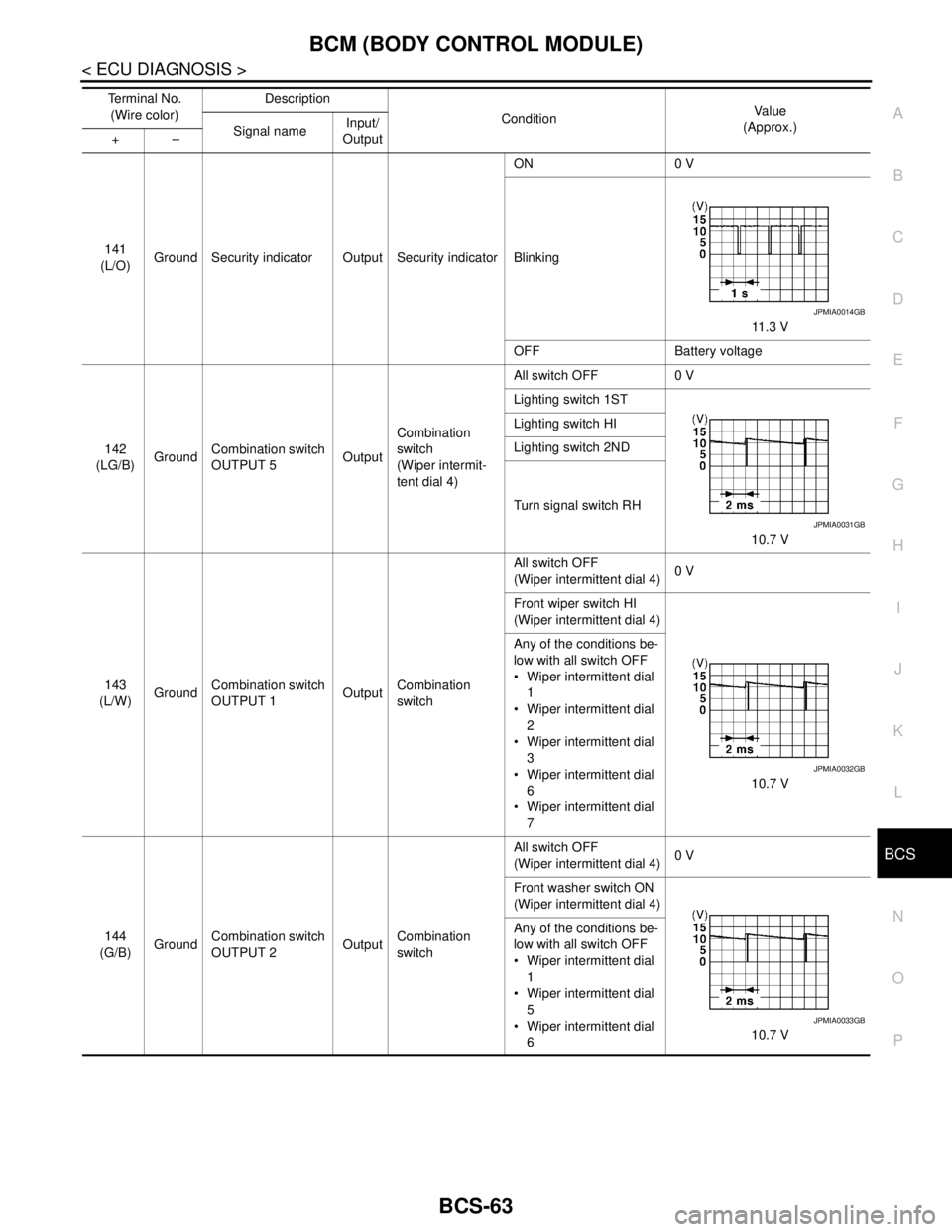
P N141
(L/O)Ground Security indicator Output Security indicatorON 0 V
Blinking
11.3 V
OFF Battery voltage
142
(LG/B)GroundCombination switch
OUTPUT 5OutputCombination
switch
(Wiper intermit-
tent dial 4)All switch OFF 0 V
Lighting switch 1ST
10.7 V Lighting switch HI
Lighting switch 2ND
Turn signal switch RH
143
(L/W)GroundCombination switch
OUTPUT 1OutputCombination
switchAll switch OFF
(Wiper intermittent dial 4)0 V
Front wiper switch HI
(Wiper intermittent dial 4)
10.7 V Any of the conditions be-
low with all switch OFF
Wiper intermittent dial
1
Wiper intermittent dial
2
Wiper intermittent dial
3
Wiper intermittent dial
6
Wiper intermittent dial
7
144
(G/B)GroundCombination switch
OUTPUT 2OutputCombination
switchAll switch OFF
(Wiper intermittent dial 4)0 V
Front washer switch ON
(Wiper intermittent dial 4)
10.7 V Any of the conditions be-
low with all switch OFF
Wiper intermittent dial
1
Wiper intermittent dial
5
Wiper intermittent dial
6 Te r m i n a l N o .
(Wire color)Description
ConditionVa l u e
(Approx.)
Signal nameInput/
Output +–
JPMIA0014GB
JPMIA0031GB
JPMIA0032GB
JPMIA0033GB
Page 881 of 5121
BCS-64
< ECU DIAGNOSIS >
BCM (BODY CONTROL MODULE)
NOTE:
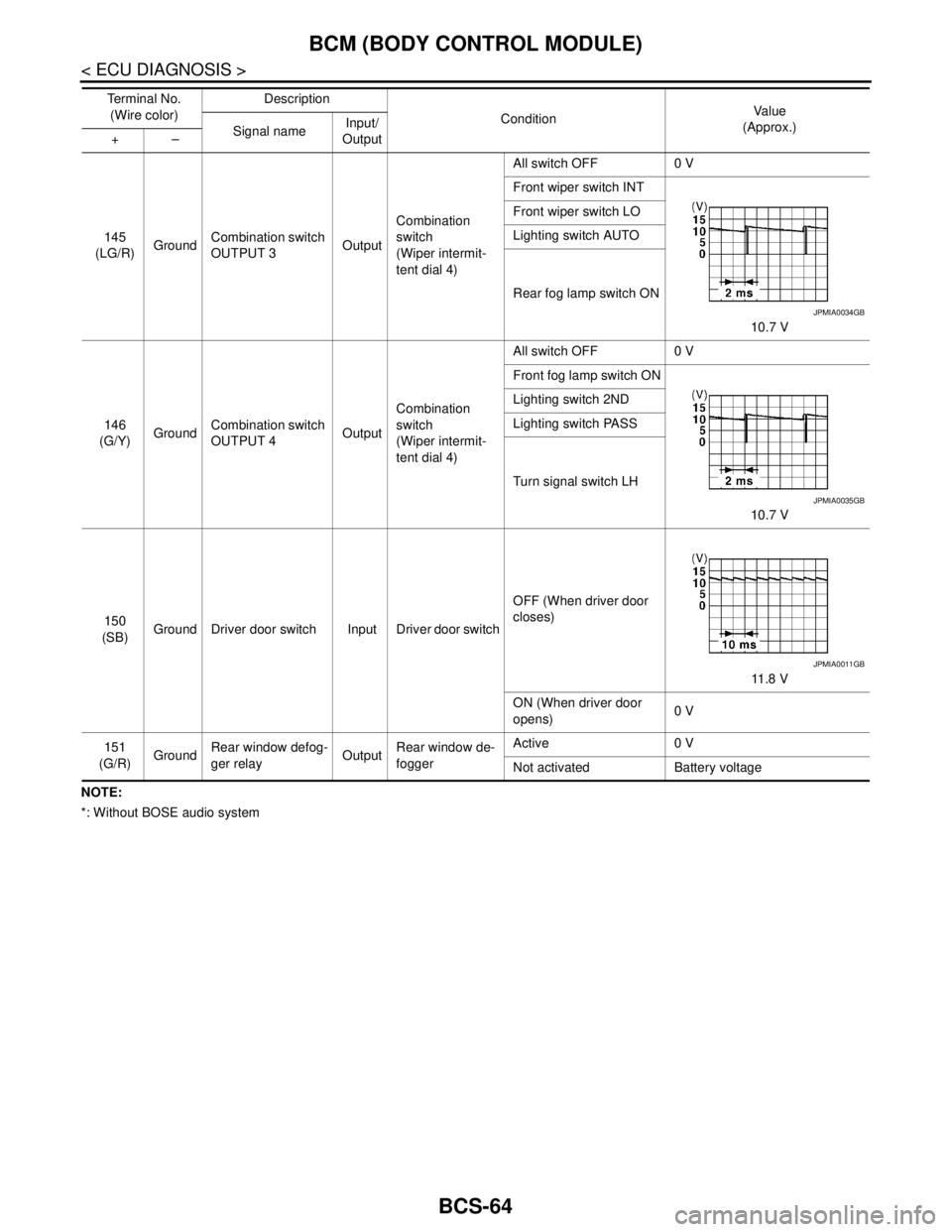
*: Without BOSE audio system145
(LG/R)GroundCombination switch
OUTPUT 3OutputCombination
switch
(Wiper intermit-
tent dial 4)All switch OFF 0 V
Front wiper switch INT
10.7 V Front wiper switch LO
Lighting switch AUTO
Rear fog lamp switch ON
146
(G/Y)GroundCombination switch
OUTPUT 4OutputCombination
switch
(Wiper intermit-
tent dial 4)All switch OFF 0 V
Front fog lamp switch ON
10.7 V Lighting switch 2ND
Lighting switch PASS
Turn signal switch LH
150
(SB)Ground Driver door switch Input Driver door switchOFF (When driver door
closes)
11 . 8 V
ON (When driver door
opens)0 V
151
(G/R)GroundRear window defog-
ger relayOutputRear window de-
foggerActive 0 V
Not activated Battery voltage Te r m i n a l N o .
(Wire color)Description
ConditionVa l u e
(Approx.)
Signal nameInput/
Output +–
JPMIA0034GB
JPMIA0035GB
JPMIA0011GB
Page 893 of 5121
BCS-76
< SYMPTOM DIAGNOSIS >
COMBINATION SWITCH SYSTEM SYMPTOMS
SYMPTOM DIAGNOSIS
COMBINATION SWITCH SYSTEM SYMPTOMS
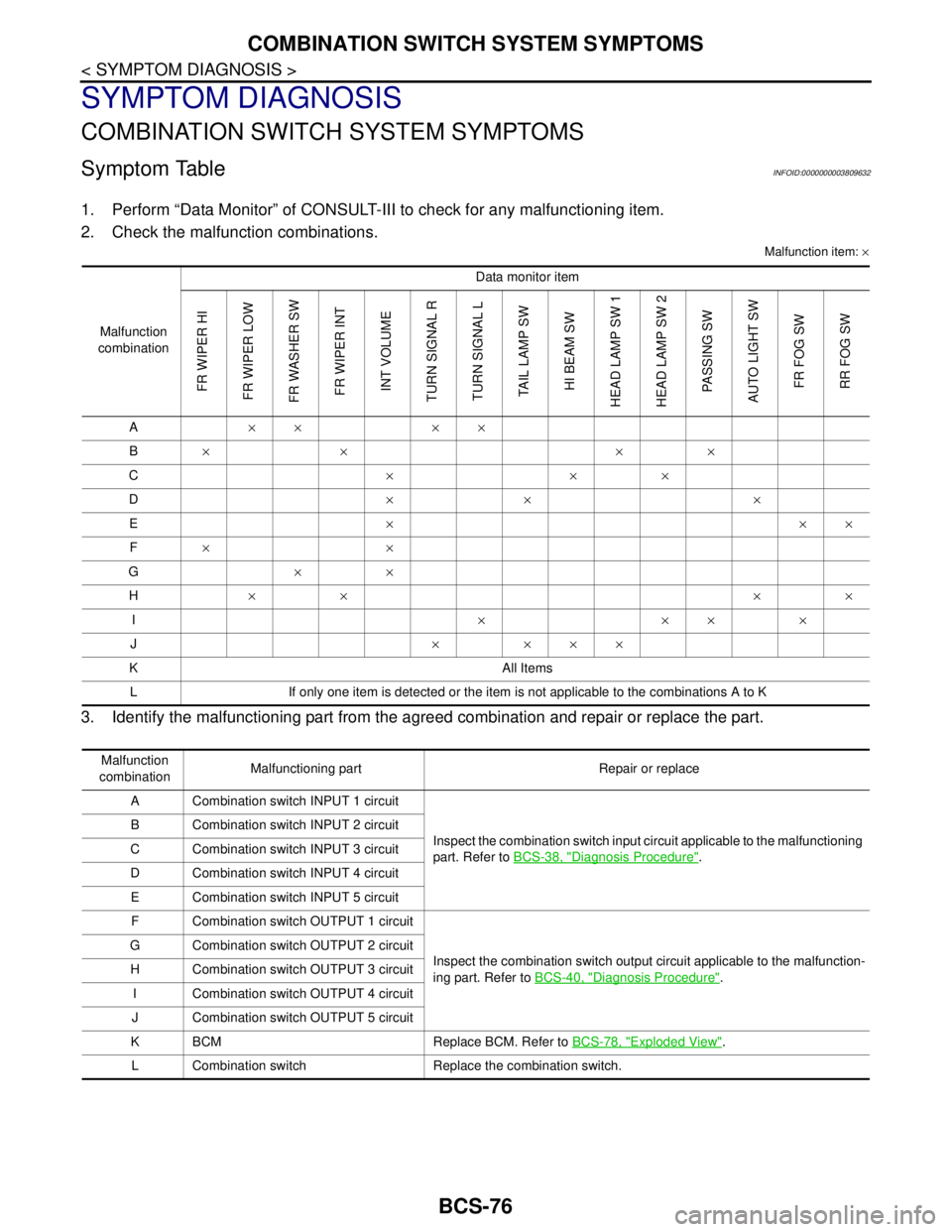
Symptom TableINFOID:0000000003809632
1. Perform “Data Monitor” of CONSULT-III to check for any malfunctioning item.
2. Check the malfunction combinations.
Malfunction item: ×
3. Identify the malfunctioning part from the agreed combination and repair or replace the part.
Malfunction
combinationData monitor item
FR WIPER HI
FR WIPER LOW
FR WASHER SW
FR WIPER INT
INT VOLUME
TURN SIGNAL R
TURN SIGNAL L
TAIL LAMP SW
HI BEAM SW
HEAD LAMP SW 1
HEAD LAMP SW 2
PASSING SW
AUTO LIGHT SW
FR FOG SW
RR FOG SW
A×× ××
B×× ××
C×××
D×× ×
E×××
F××
G××
H×× ××
I××××
J× ×××
K All Items
L If only one item is detected or the item is not applicable to the combinations A to K
Malfunction
combinationMalfunctioning part Repair or replace
A Combination switch INPUT 1 circuit
Inspect the combination switch input circuit applicable to the malfunctioning
part. Refer to BCS-38, "
Diagnosis Procedure". B Combination switch INPUT 2 circuit
C Combination switch INPUT 3 circuit
D Combination switch INPUT 4 circuit
E Combination switch INPUT 5 circuit
F Combination switch OUTPUT 1 circuit
Inspect the combination switch output circuit applicable to the malfunction-
ing part. Refer to BCS-40, "
Diagnosis Procedure". G Combination switch OUTPUT 2 circuit
H Combination switch OUTPUT 3 circuit
I Combination switch OUTPUT 4 circuit
J Combination switch OUTPUT 5 circuit
K BCM Replace BCM. Refer to BCS-78, "
Exploded View".
L Combination switch Replace the combination switch.
Page 901 of 5121
PRECAUTIONS
BR-5
< PRECAUTION >
C
D
E
G
H
I
J
K
L
MA
B
BR
N
O
P
Precaution for Procedure without Cowl Top CoverINFOID:0000000003890162
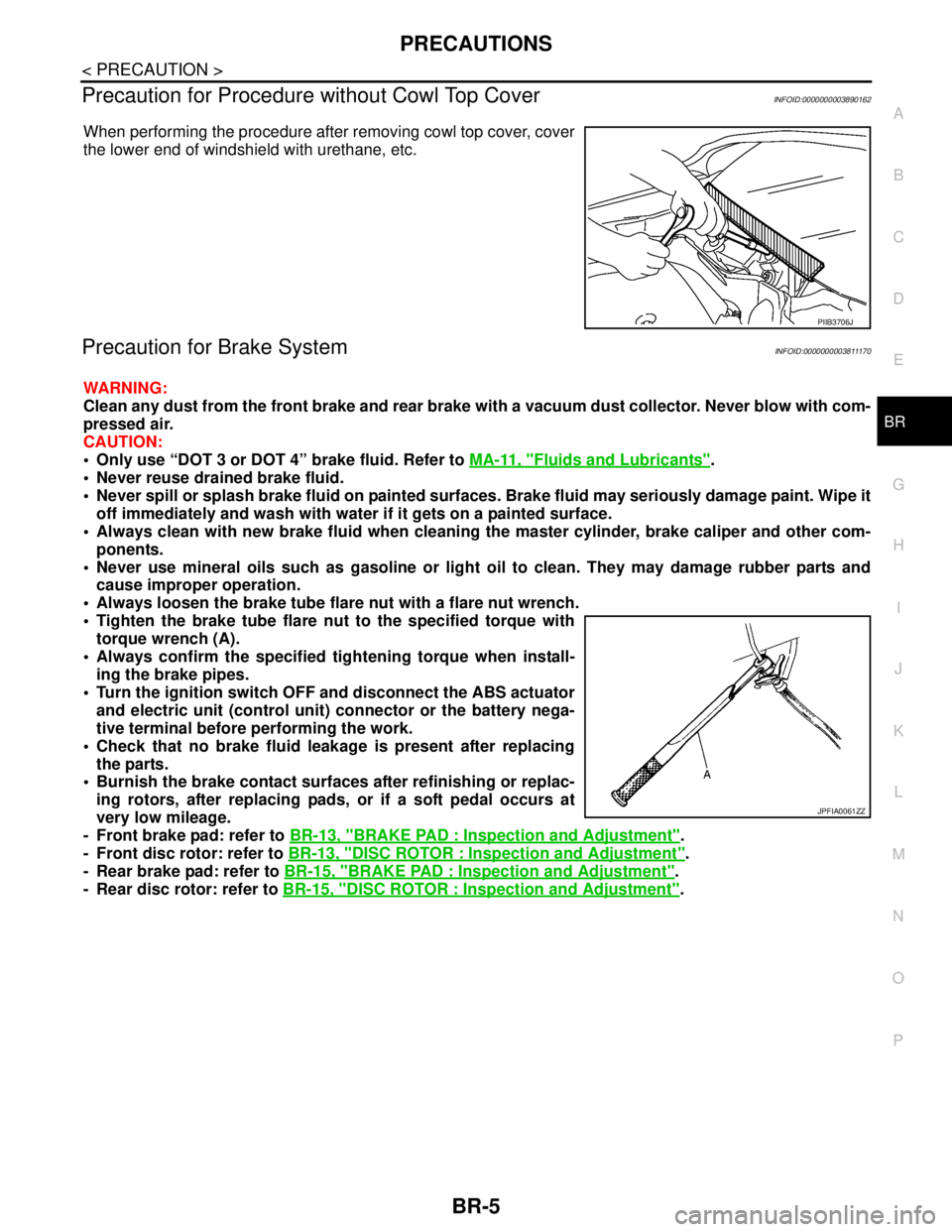
When performing the procedure after removing cowl top cover, cover
the lower end of windshield with urethane, etc.
Precaution for Brake SystemINFOID:0000000003811170
WARNING:
Clean any dust from the front brake and rear brake with a vacuum dust collector. Never blow with com-
pressed air.
CAUTION:
Only use “DOT 3 or DOT 4” brake fluid. Refer to MA-11, "
Fluids and Lubricants".
Never reuse drained brake fluid.
Never spill or splash brake fluid on painted surfaces. Brake fluid may seriously damage paint. Wipe it
off immediately and wash with water if it gets on a painted surface.
Always clean with new brake fluid when cleaning the master cylinder, brake caliper and other com-
ponents.
Never use mineral oils such as gasoline or light oil to clean. They may damage rubber parts and
cause improper operation.
Always loosen the brake tube flare nut with a flare nut wrench.
Tighten the brake tube flare nut to the specified torque with
torque wrench (A).
Always confirm the specified tightening torque when install-
ing the brake pipes.
Turn the ignition switch OFF and disconnect the ABS actuator
and electric unit (control unit) connector or the battery nega-
tive terminal before performing the work.
Check that no brake fluid leakage is present after replacing
the parts.
Burnish the brake contact surfaces after refinishing or replac-
ing rotors, after replacing pads, or if a soft pedal occurs at
very low mileage.
- Front brake pad: refer to BR-13, "
BRAKE PAD : Inspection and Adjustment".
- Front disc rotor: refer to BR-13, "
DISC ROTOR : Inspection and Adjustment".
- Rear brake pad: refer to BR-15, "
BRAKE PAD : Inspection and Adjustment".
- Rear disc rotor: refer to BR-15, "
DISC ROTOR : Inspection and Adjustment".
PIIB3706J
JPFIA0061ZZ
Page 908 of 5121

BR-12
< ON-VEHICLE MAINTENANCE >
BRAKE BOOSTER
BRAKE BOOSTER
InspectionINFOID:0000000003811178
OPERATION
Depress the brake pedal several times at 5-second intervals with the
engine stopped. Start the engine with the brake pedal fully
depressed. Check that the clearance between brake pedal and dash
lower panel decreases.
NOTE:
A slight impact with a small click may be felt on the pedal when the
brake pedal is fully depressed. This is a normal phenomenon due to
the brake system operation.
AIR TIGHT
Idle the engine for 1 minute to apply vacuum to the brake booster,
and stop the engine. Then depress the brake pedal several times
at 5-second intervals until the accumulated vacuum is released to
atmospheric pressure. Check that the clearance between brake
pedal and dash lower panel gradually increases (A → B → C) each
time the brake pedal is depressed during this operation.
Depress the brake pedal with the engine running. Then stop the
engine while holding down the brake pedal. Check that the brake
pedal stroke does not change after holding down the brake pedal
for 30 seconds or more.
NOTE:
A slight impact with a small click may be felt on the pedal when the
brake pedal is fully depressed. This is a normal phenomenon due
to the brake system operation.
BRA0037D
JPFIA0043ZZ
JPFIA0044ZZ
Page 922 of 5121
BR-26
< ON-VEHICLE REPAIR >
BRAKE MASTER CYLINDER
The piston may drop off when pulled out strongly. Never hold the piston. Hold the cylinder body
when handling the master cylinder assembly.
INSTALLATION
CAUTION:
Never spill or splash brake fluid on painted surfaces. Brake fluid may seriously damage paint. Wipe it
off immediately and wash with water if it gets on a painted surface.
Note the following, and install the reverse order of removal.
Never depress the brake pedal after the master cylinder assembly is removed.
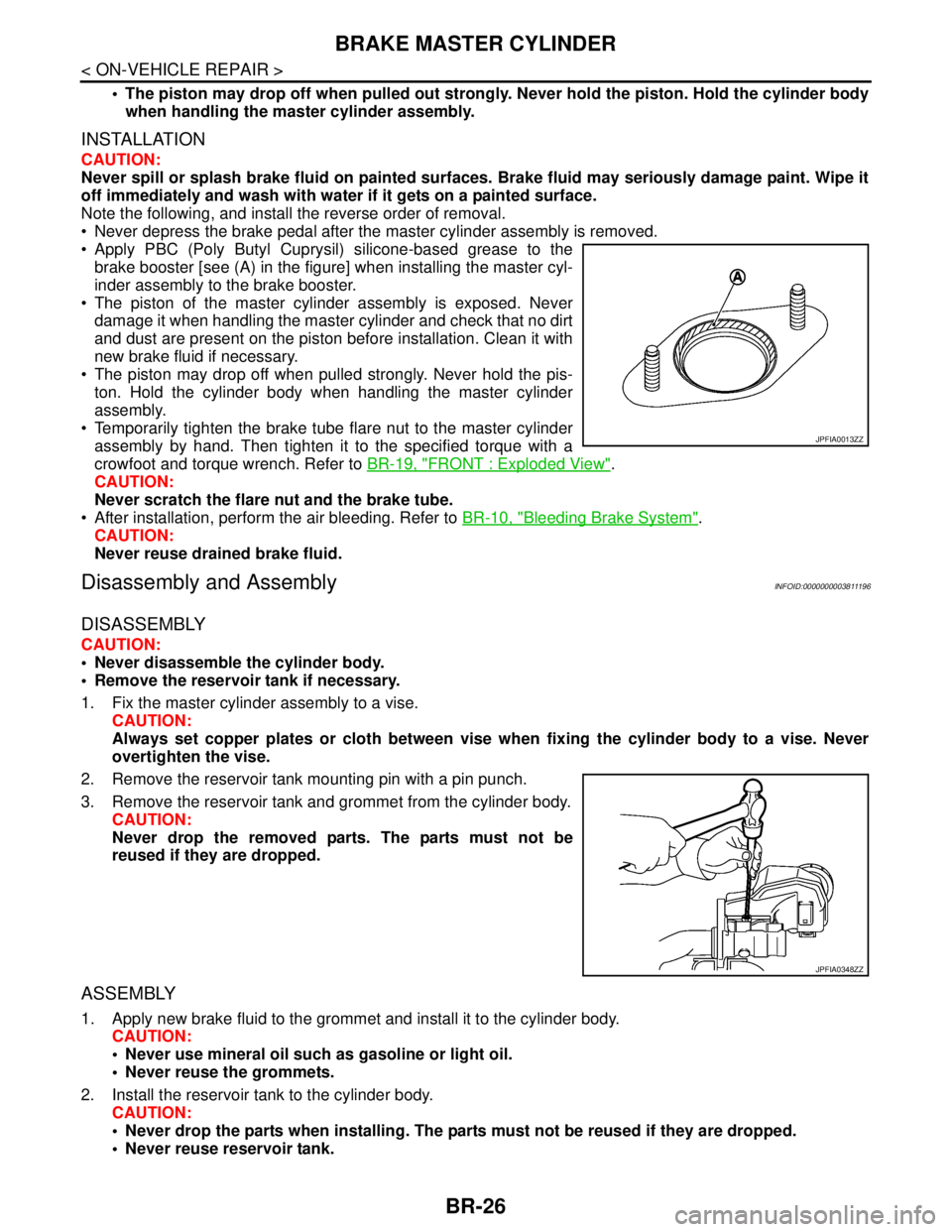
Apply PBC (Poly Butyl Cuprysil) silicone-based grease to the
brake booster [see (A) in the figure] when installing the master cyl-
inder assembly to the brake booster.
The piston of the master cylinder assembly is exposed. Never
damage it when handling the master cylinder and check that no dirt
and dust are present on the piston before installation. Clean it with
new brake fluid if necessary.
The piston may drop off when pulled strongly. Never hold the pis-
ton. Hold the cylinder body when handling the master cylinder
assembly.
Temporarily tighten the brake tube flare nut to the master cylinder
assembly by hand. Then tighten it to the specified torque with a
crowfoot and torque wrench. Refer to BR-19, "
FRONT : Exploded View".
CAUTION:
Never scratch the flare nut and the brake tube.
After installation, perform the air bleeding. Refer to BR-10, "
Bleeding Brake System".
CAUTION:
Never reuse drained brake fluid.
Disassembly and AssemblyINFOID:0000000003811196
DISASSEMBLY
CAUTION:
Never disassemble the cylinder body.
Remove the reservoir tank if necessary.
1. Fix the master cylinder assembly to a vise.
CAUTION:
Always set copper plates or cloth between vise when fixing the cylinder body to a vise. Never
overtighten the vise.
2. Remove the reservoir tank mounting pin with a pin punch.
3. Remove the reservoir tank and grommet from the cylinder body.
CAUTION:
Never drop the removed parts. The parts must not be
reused if they are dropped.
ASSEMBLY
1. Apply new brake fluid to the grommet and install it to the cylinder body.
CAUTION:
Never use mineral oil such as gasoline or light oil.
Never reuse the grommets.
2. Install the reservoir tank to the cylinder body.
CAUTION:
Never drop the parts when installing. The parts must not be reused if they are dropped.
Never reuse reservoir tank.
JPFIA0013ZZ
JPFIA0348ZZ
Page 925 of 5121

BRAKE BOOSTER
BR-29
< ON-VEHICLE REPAIR >
C
D
E
G
H
I
J
K
L
MA
B
BR
N
O
P
Replace the clevis pin if it is damaged. Refer to BR-18, "Inspection and Adjustment".
After installation, perform the air bleeding. Refer to BR-10, "
Bleeding Brake System".
CAUTION:
Never reuse drained brake fluid.
Inspection and AdjustmentINFOID:0000000003811200
INSPECTION AFTER REMOVAL
Output Rod Length Inspection
1. With a handy vacuum pump, apply vacuum pressure of −66.7
kPa (−500 mmHg, −19.70 inHg, –0.667 bar) to the brake
booster.
2. Check the output rod length (A).
Input Rod Length Inspection
1. Loosen the lock nut (1) and adjust the input rod (2) to the speci-
fied length (B).
2. Tighten the lock nut to the specified torque.
INSPECTION AFTER INSTALLATION
Operation
Depress the brake pedal several times at 5-second intervals with the
engine stopped. Start the engine with the brake pedal fully
depressed. Check that the clearance between brake pedal and dash
lower pane decreases.
NOTE:
A slight impact with a small click may be felt on the pedal when the
brake pedal is fully depressed. This is a normal phenomenon due to
the brake system operation.
Air Tight
Standard
A: Refer to BR-45, "
Brake Booster".
JPFIA0021ZZ
Standard
B: Refer to BR-45, "
Brake Booster".
JPFIA0020ZZ
BRA0037D
Page 926 of 5121

BR-30
< ON-VEHICLE REPAIR >
BRAKE BOOSTER
Idle the engine for 1 minute to apply vacuum to the brake booster,
and stop the engine. Then depress the brake pedal several times
at 5-second intervals until the accumulated vacuum is released to
atmospheric pressure. Check that the clearance between brake
pedal and dash lower panel gradually increases (A → B → C) each
time the brake pedal is depressed during this operation.
Depress the brake pedal with the engine running. Then stop the
engine while holding down the brake pedal. Check that the brake
pedal stroke does not change after holding down the brake pedal
for 30 seconds or more.
NOTE:
A slight impact with a small click may be felt on the pedal when the
brake pedal is fully depressed. This is a normal phenomenon due
to the brake system operation.
ADJUSTMENT AFTER INSTALLATION
Perform the brake pedal adjustment after installing the brake pedal assembly. Refer to BR-6, "Inspection and
Adjustment".
JPFIA0043ZZ
JPFIA0044ZZ