roof NISSAN TEANA 2008 Manual PDF
[x] Cancel search | Manufacturer: NISSAN, Model Year: 2008, Model line: TEANA, Model: NISSAN TEANA 2008Pages: 5121, PDF Size: 69.03 MB
Page 3824 of 5121
FRONT SUNROOF GLASS
RF-93
< ON-VEHICLE REPAIR >
C
D
E
F
G
H
I
J
L
MA
B
RF
N
O
P
5. Apply paint primer on areas where adhesive contacts on the side of sunroof frame.
CAUTION:
If paint primer adheres to a painted surface other than bonding area, or if it overflows, quickly
remove it with white gasoline.
6. After applying primers, apply the adhesive along the entire circumference of the glass as shown in the fig-
ure, and within the time specified in the instructions for the adhesive.
Open adhesive by cutting off the nozzle tip and set it in a sealant gun.
7. After setting suction lifter to glass, align matching marks on sunroof frame and glass. Install glass to the
sunroof frame.
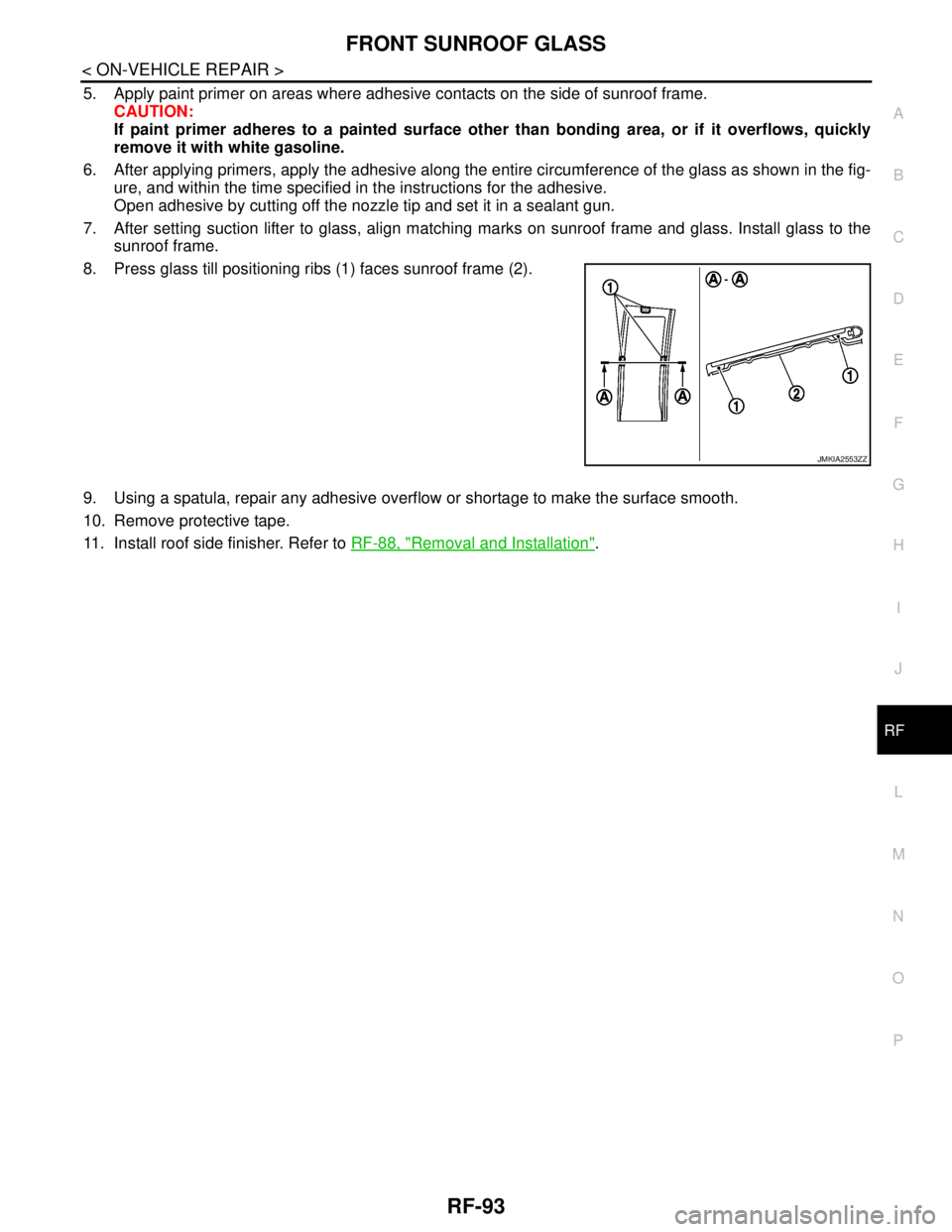
8. Press glass till positioning ribs (1) faces sunroof frame (2).
9. Using a spatula, repair any adhesive overflow or shortage to make the surface smooth.
10. Remove protective tape.
11. Install roof side finisher. Refer to RF-88, "
Removal and Installation".
JMKIA2553ZZ
Page 3825 of 5121
RF-94
< ON-VEHICLE REPAIR >
REAR SUNROOF GLASS
REAR SUNROOF GLASS
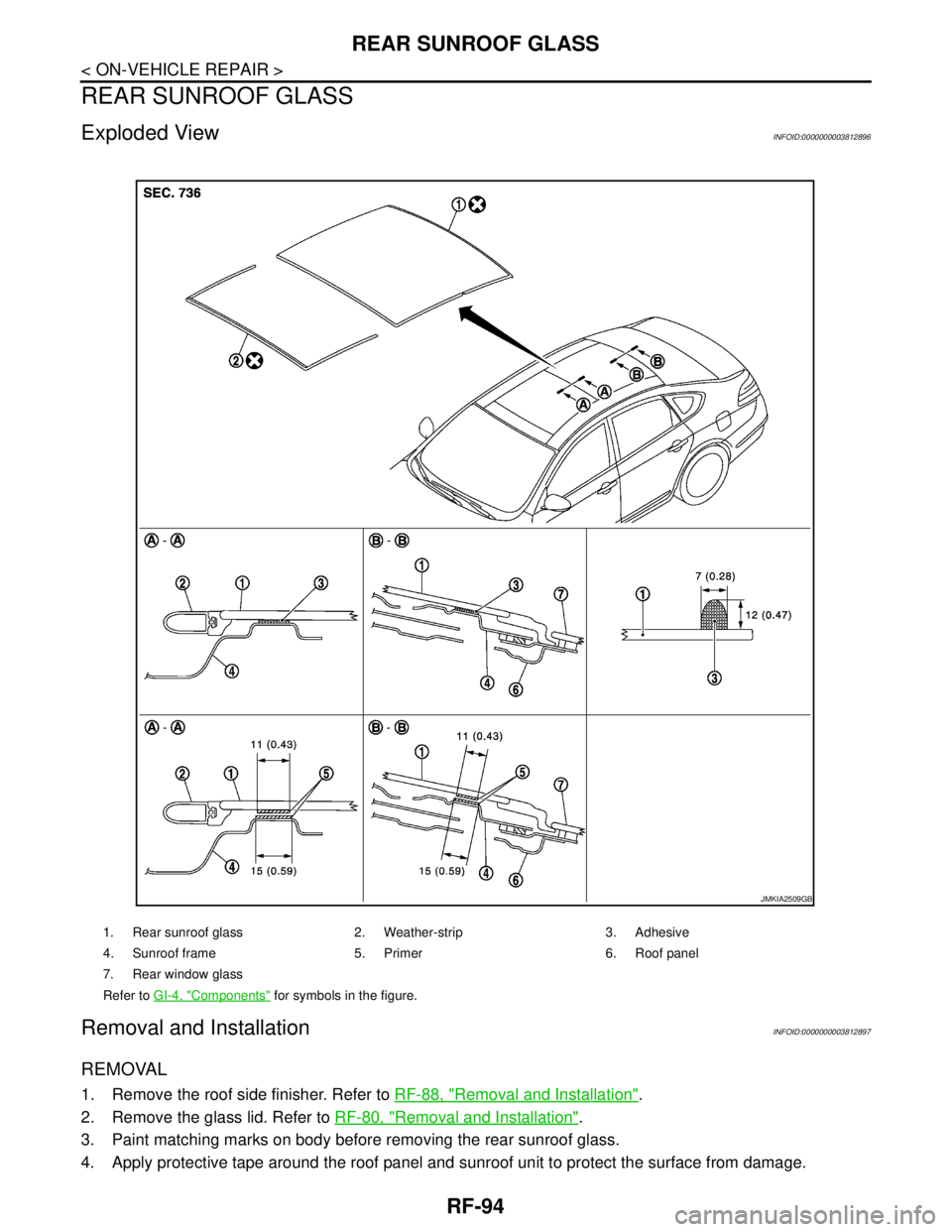
Exploded ViewINFOID:0000000003812896
Removal and InstallationINFOID:0000000003812897
REMOVAL
1. Remove the roof side finisher. Refer to RF-88, "Removal and Installation".
2. Remove the glass lid. Refer to RF-80, "
Removal and Installation".
3. Paint matching marks on body before removing the rear sunroof glass.
4. Apply protective tape around the roof panel and sunroof unit to protect the surface from damage.
1. Rear sunroof glass 2. Weather-strip 3. Adhesive
4. Sunroof frame 5. Primer 6. Roof panel
7. Rear window glass
Refer to GI-4, "
Components" for symbols in the figure.
JMKIA2509GB
Page 3826 of 5121
REAR SUNROOF GLASS
RF-95
< ON-VEHICLE REPAIR >
C
D
E
F
G
H
I
J
L
MA
B
RF
N
O
P
5. Remove weather-strip.
6. Cut adhesive.
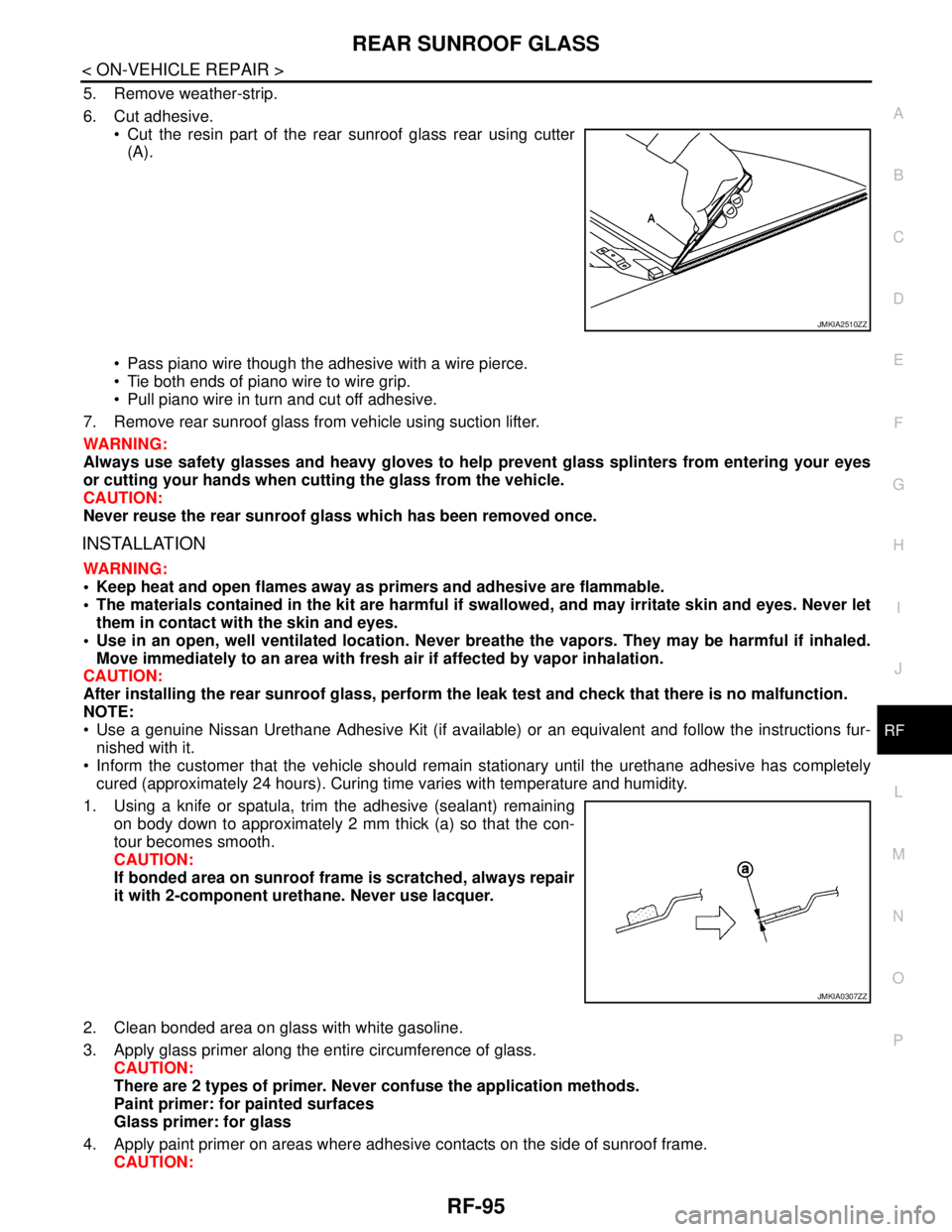
Cut the resin part of the rear sunroof glass rear using cutter
(A).
Pass piano wire though the adhesive with a wire pierce.
Tie both ends of piano wire to wire grip.
Pull piano wire in turn and cut off adhesive.
7. Remove rear sunroof glass from vehicle using suction lifter.
WARNING:
Always use safety glasses and heavy gloves to help prevent glass splinters from entering your eyes
or cutting your hands when cutting the glass from the vehicle.
CAUTION:
Never reuse the rear sunroof glass which has been removed once.
INSTALLATION
WARNING:
Keep heat and open flames away as primers and adhesive are flammable.
The materials contained in the kit are harmful if swallowed, and may irritate skin and eyes. Never let
them in contact with the skin and eyes.
Use in an open, well ventilated location. Never breathe the vapors. They may be harmful if inhaled.
Move immediately to an area with fresh air if affected by vapor inhalation.
CAUTION:
After installing the rear sunroof glass, perform the leak test and check that there is no malfunction.
NOTE:
Use a genuine Nissan Urethane Adhesive Kit (if available) or an equivalent and follow the instructions fur-
nished with it.
Inform the customer that the vehicle should remain stationary until the urethane adhesive has completely
cured (approximately 24 hours). Curing time varies with temperature and humidity.
1. Using a knife or spatula, trim the adhesive (sealant) remaining
on body down to approximately 2 mm thick (a) so that the con-
tour becomes smooth.
CAUTION:
If bonded area on sunroof frame is scratched, always repair
it with 2-component urethane. Never use lacquer.
2. Clean bonded area on glass with white gasoline.
3. Apply glass primer along the entire circumference of glass.
CAUTION:
There are 2 types of primer. Never confuse the application methods.
Paint primer: for painted surfaces
Glass primer: for glass
4. Apply paint primer on areas where adhesive contacts on the side of sunroof frame.
CAUTION:
JMKIA2510ZZ
JMKIA0307ZZ
Page 3827 of 5121
RF-96
< ON-VEHICLE REPAIR >
REAR SUNROOF GLASS
If paint primer adheres to a painted surface other than bonding area, or if it overflows, quickly
remove it with white gasoline.
5. After applying primers, apply the adhesive along the entire circumference of the glass as shown in the fig-
ure, and within the time specified in the instructions for the adhesive.
Open adhesive by cutting off the nozzle tip and set it in a sealant gun.
6. After setting suction lifter to glass, align matching marks on sunroof frame and glass. Install glass to the
sunroof frame.
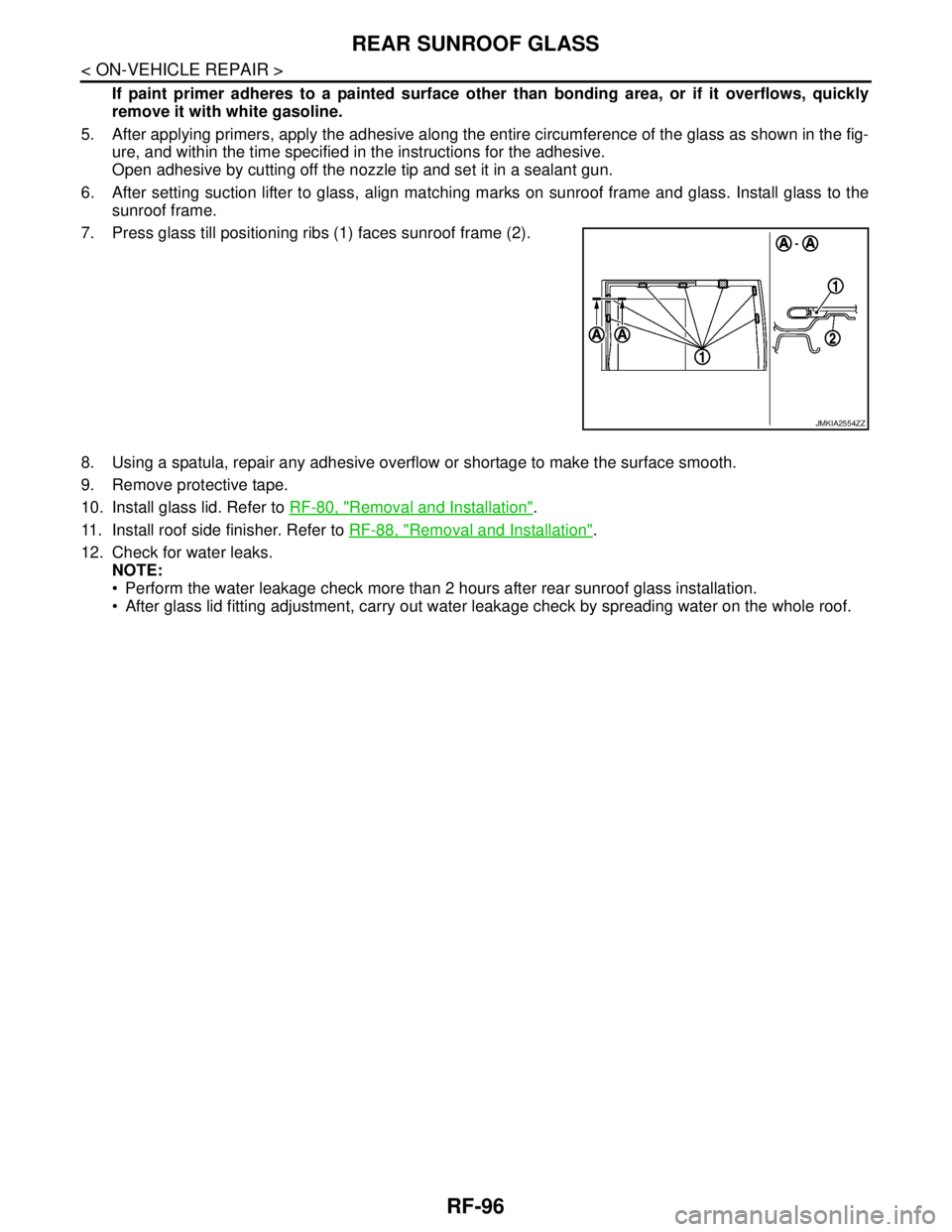
7. Press glass till positioning ribs (1) faces sunroof frame (2).
8. Using a spatula, repair any adhesive overflow or shortage to make the surface smooth.
9. Remove protective tape.
10. Install glass lid. Refer to RF-80, "
Removal and Installation".
11. Install roof side finisher. Refer to RF-88, "
Removal and Installation".
12. Check for water leaks.
NOTE:
Perform the water leakage check more than 2 hours after rear sunroof glass installation.
After glass lid fitting adjustment, carry out water leakage check by spreading water on the whole roof.
JMKIA2554ZZ
Page 3828 of 5121
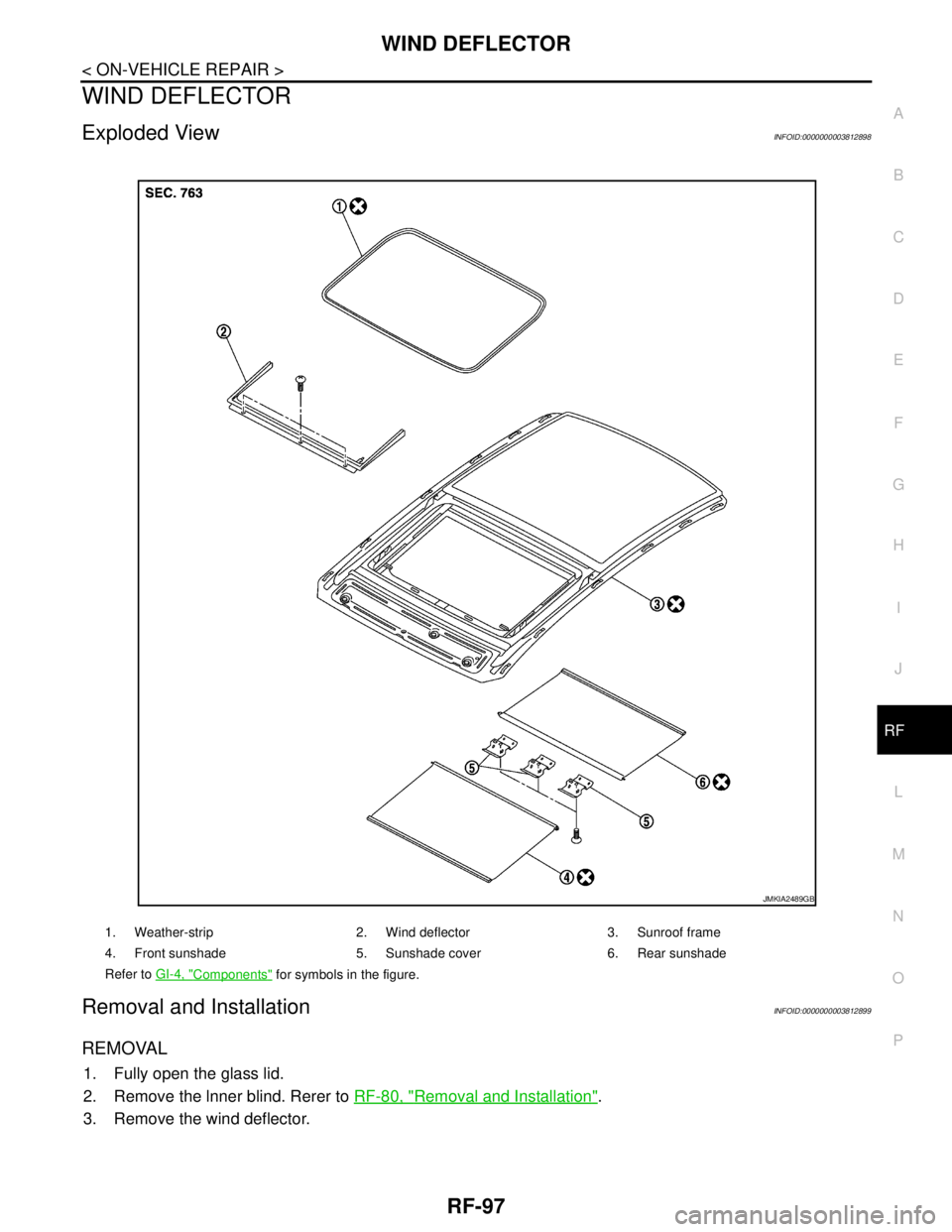
WIND DEFLECTOR
RF-97
< ON-VEHICLE REPAIR >
C
D
E
F
G
H
I
J
L
MA
B
RF
N
O
P
WIND DEFLECTOR
Exploded ViewINFOID:0000000003812898
Removal and InstallationINFOID:0000000003812899
REMOVAL
1. Fully open the glass lid.
2. Remove the lnner blind. Rerer to RF-80, "
Removal and Installation".
3. Remove the wind deflector.
1. Weather-strip 2. Wind deflector 3. Sunroof frame
4. Front sunshade 5. Sunshade cover 6. Rear sunshade
Refer to GI-4, "
Components" for symbols in the figure.
JMKIA2489GB
Page 3830 of 5121
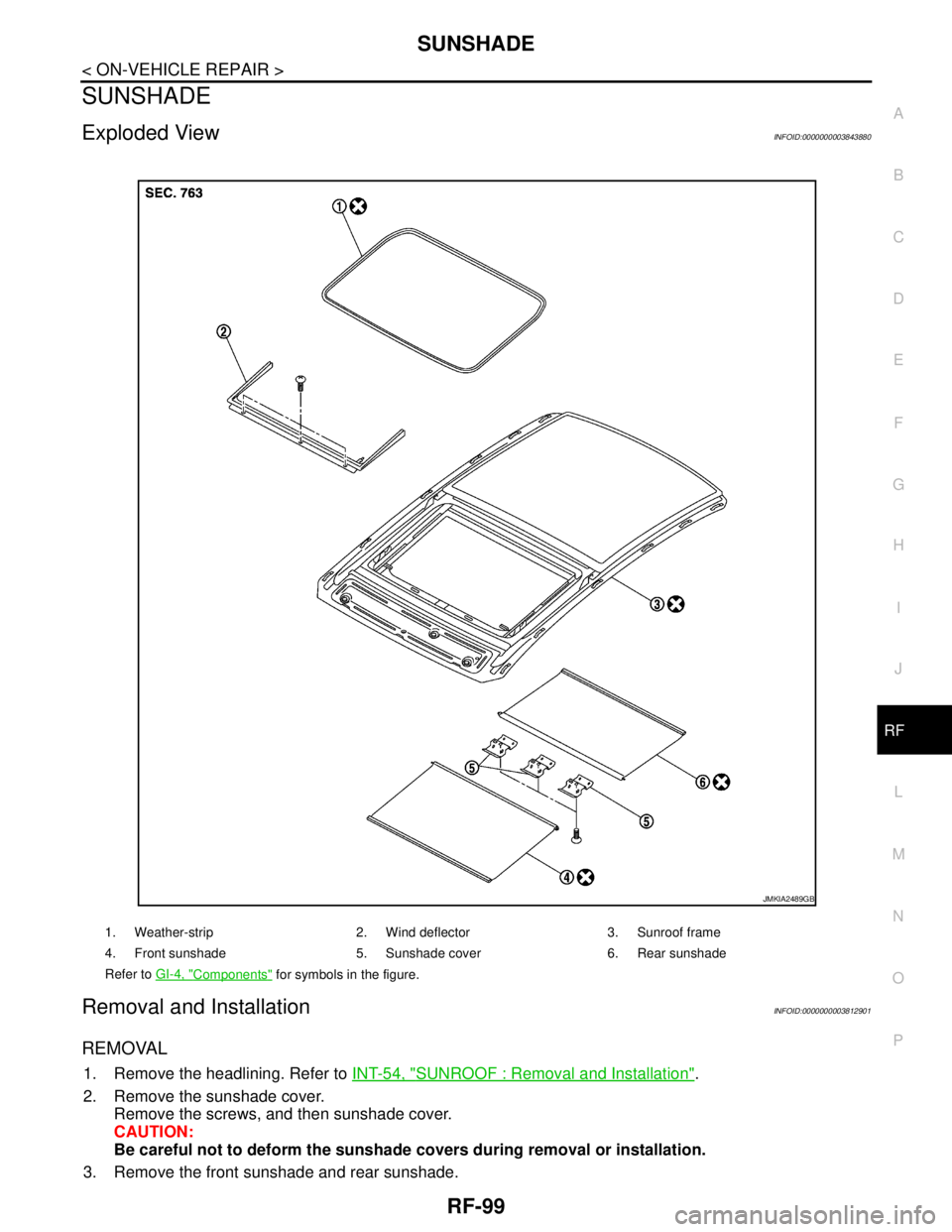
SUNSHADE
RF-99
< ON-VEHICLE REPAIR >
C
D
E
F
G
H
I
J
L
MA
B
RF
N
O
P
SUNSHADE
Exploded ViewINFOID:0000000003843880
Removal and InstallationINFOID:0000000003812901
REMOVAL
1. Remove the headlining. Refer to INT-54, "SUNROOF : Removal and Installation".
2. Remove the sunshade cover.
Remove the screws, and then sunshade cover.
CAUTION:
Be careful not to deform the sunshade covers during removal or installation.
3. Remove the front sunshade and rear sunshade.
1. Weather-strip 2. Wind deflector 3. Sunroof frame
4. Front sunshade 5. Sunshade cover 6. Rear sunshade
Refer to GI-4, "
Components" for symbols in the figure.
JMKIA2489GB
Page 3832 of 5121
SUNROOF SWITCH
RF-101
< ON-VEHICLE REPAIR >
C
D
E
F
G
H
I
J
L
MA
B
RF
N
O
P
SUNROOF SWITCH
Exploded ViewINFOID:0000000003812902
Refer to INT-53, "SUNROOF : Exploded View".
Removal and InstallationINFOID:0000000003812903
Removal
Remove the sunroof switch. Refer to INT-54, "SUNROOF : Removal and Installation".
Installation
Install in the reverse order of removal.
Page 3946 of 5121
![NISSAN TEANA 2008 Manual PDF SE-82
< SYMPTOM DIAGNOSIS >[WITH VENTILATION SEAT]
SQUEAK AND RATTLE TROUBLE DIAGNOSES
Inspection Procedure
INFOID:0000000003940144
Refer to Table of Contents for specific component removal and instal](/img/5/57391/w960_57391-3945.png "NISSAN TEANA 2008 Manual PDF SE-82
< SYMPTOM DIAGNOSIS >[WITH VENTILATION SEAT]
SQUEAK AND RATTLE TROUBLE DIAGNOSES
Inspection Procedure
INFOID:0000000003940144
Refer to Table of Contents for specific component removal and instal")
SE-82
< SYMPTOM DIAGNOSIS >[WITH VENTILATION SEAT]
SQUEAK AND RATTLE TROUBLE DIAGNOSES
Inspection Procedure
INFOID:0000000003940144
Refer to Table of Contents for specific component removal and installation information.
INSTRUMENT PANEL
Most incidents are caused by contact and movement between:
1. Cluster lid A and instrument panel
2. Acrylic lens and combination meter housing
3. Instrument panel to front pillar garnish
4. Instrument panel to windshield
5. Instrument panel mounting pins
6. Wiring harnesses behind the combination meter
7. A/C defroster duct and duct joint
These incidents can usually be located by tapping or moving the components to duplicate the noise or by
pressing on the components while driving to stop the noise. Most of these incidents can be repaired by apply-
ing felt cloth tape or silicon spray (in hard to reach areas). Urethane pads can be used to insulate wiring har-
ness.
CAUTION:
Never use silicone spray to isolate a squeak or rattle. If the area is saturated with silicone, the recheck
of repair becomes impossible.
CENTER CONSOLE
Components to pay attention to include:
1. Shifter assembly cover to finisher
2. A/C control unit and cluster lid C
3. Wiring harnesses behind audio and A/C control unit
The instrument panel repair and isolation procedures also apply to the center console.
DOORS
Pay attention to the following:
1. Finisher and inner panel making a slapping noise
2. Inside handle escutcheon to door finisher
3. Wiring harnesses tapping
4. Door striker out of alignment causing a popping noise on starts and stops
Tapping or moving the components or pressing on them while driving to duplicate the conditions can isolate
many of these incidents. The areas can usually be insulated with felt cloth tape or insulator foam blocks to
repair the noise.
TRUNK
Trunk noises are often caused by a loose jack or loose items put into the trunk by the customer.
In addition look for the following:
1. Trunk lid dumpers out of adjustment
2. Trunk lid striker out of adjustment
3. Trunk lid torsion bars knocking together
4. A loose license plate or bracket
Most of these incidents can be repaired by adjusting, securing or insulating the item(s) or component(s) caus-
ing the noise.
SUNROOF/HEADLINING
Noises in the sunroof/headlining area can often be traced to one of the following:
1. Sunroof lid, rail, linkage or seals making a rattle or light knocking noise
2. Sunvisor shaft shaking in the holder
3. Front or rear windshield touching headlining and squeaking
Again, pressing on the components to stop the noise while duplicating the conditions can isolate most of these
incidents. Repairs usually consist of insulating with felt cloth tape.
Page 3987 of 5121
![NISSAN TEANA 2008 Manual PDF SQUEAK AND RATTLE TROUBLE DIAGNOSES
SE-123
< SYMPTOM DIAGNOSIS >[WITHOUT VENTILATION SEAT]
C
D
E
F
G
H
I
K
L
MA
B
SE
N
O
P
Confirm that the cause of a noise is repaired by test driving the vehicle. Op](/img/5/57391/w960_57391-3986.png "NISSAN TEANA 2008 Manual PDF SQUEAK AND RATTLE TROUBLE DIAGNOSES
SE-123
< SYMPTOM DIAGNOSIS >[WITHOUT VENTILATION SEAT]
C
D
E
F
G
H
I
K
L
MA
B
SE
N
O
P
Confirm that the cause of a noise is repaired by test driving the vehicle. Op")
SQUEAK AND RATTLE TROUBLE DIAGNOSES
SE-123
< SYMPTOM DIAGNOSIS >[WITHOUT VENTILATION SEAT]
C
D
E
F
G
H
I
K
L
MA
B
SE
N
O
P
Confirm that the cause of a noise is repaired by test driving the vehicle. Operate the vehicle under the same
conditions as when the noise originally occurred. Refer to the notes on the Diagnostic Worksheet.
Inspection ProcedureINFOID:0000000003940141
Refer to Table of Contents for specific component removal and installation information.
INSTRUMENT PANEL
Most incidents are caused by contact and movement between:
1. Cluster lid A and instrument panel
2. Acrylic lens and combination meter housing
3. Instrument panel to front pillar garnish
4. Instrument panel to windshield
5. Instrument panel mounting pins
6. Wiring harnesses behind the combination meter
7. A/C defroster duct and duct joint
These incidents can usually be located by tapping or moving the components to duplicate the noise or by
pressing on the components while driving to stop the noise. Most of these incidents can be repaired by apply-
ing felt cloth tape or silicon spray (in hard to reach areas). Urethane pads can be used to insulate wiring har-
ness.
CAUTION:
Never use silicone spray to isolate a squeak or rattle. If the area is saturated with silicone, the recheck
of repair becomes impossible.
CENTER CONSOLE
Components to pay attention to include:
1. Shifter assembly cover to finisher
2. A/C control unit and cluster lid C
3. Wiring harnesses behind audio and A/C control unit
The instrument panel repair and isolation procedures also apply to the center console.
DOORS
Pay attention to the following:
1. Finisher and inner panel making a slapping noise
2. Inside handle escutcheon to door finisher
3. Wiring harnesses tapping
4. Door striker out of alignment causing a popping noise on starts and stops
Tapping or moving the components or pressing on them while driving to duplicate the conditions can isolate
many of these incidents. The areas can usually be insulated with felt cloth tape or insulator foam blocks to
repair the noise.
TRUNK
Trunk noises are often caused by a loose jack or loose items put into the trunk by the customer.
In addition look for the following:
1. Trunk lid dumpers out of adjustment
2. Trunk lid striker out of adjustment
3. Trunk lid torsion bars knocking together
4. A loose license plate or bracket
Most of these incidents can be repaired by adjusting, securing or insulating the item(s) or component(s) caus-
ing the noise.
SUNROOF/HEADLINING
Noises in the sunroof/headlining area can often be traced to one of the following:
1. Sunroof lid, rail, linkage or seals making a rattle or light knocking noise
2. Sunvisor shaft shaking in the holder
3. Front or rear windshield touching headlining and squeaking
Page 4010 of 5121

SEC-1
BODY EXTERIOR, DOORS, ROOF & VEHICLE SECURITY
C
D
E
F
G H
I
J
L
M
SECTION SEC
A
B
SEC
N
O P
CONTENTS
SECURITY CONTROL SYSTEM
INTELLIGENT KEY SYSTEM
BASIC INSPECTION ....... .............................
5
DIAGNOSIS AND REPAIR WORKFLOW ..... .....5
Work Flow ........................................................... ......5
INSPECTION AND ADJUSTMENT .....................8
ECM RE-COMMUNICATING FUNCTION ............. ......8
ECM RE-COMMUNICATING FUNCTION : De-
scription .....................................................................
8
ECM RE-COMMUNICATING FUNCTION : Spe-
cial Repair Requirement ............................................
8
FUNCTION DIAGNOSIS ...............................9
INTELLIGENT KEY SYSTEM/ENGINE
START FUNCTIO N ........................................ .....
9
System Diagram .................................................. ......9
System Description ...................................................9
Component Parts Location ......................................12
Component Description ...........................................13
NISSAN VEHICLE IMMOBILIZER SYSTEM-
NATS ..................................................................
14
System Diagram .................................................. ....14
System Description .................................................14
Component Parts Location ......................................15
Component Description ..........................................16
VEHICLE SECURITY SYSTEM .........................17
System Diagram .................................................. ....17
System Description .................................................17
Component Parts Location ......................................18
Component Description ...........................................19
DIAGNOSIS SYSTEM (BCM) ............................21
COMMON ITEM ..................................................... ....21
COMMON ITEM : CONSULT-III Function (BCM -
COMMON ITEM) .....................................................
21
INTELLIGENT KEY ................................................ ....22
INTELLIGENT KEY : CONSULT-III Function
(BCM - INTELLIGENT KEY) ....................................
22
THEFT ALM ........................................................... ....25
THEFT ALM : CONSULT-III Function (BCM -
THEFT) ................................................................ ....
25
IMMU ...................................................................... ....27
IMMU : CONSULT-III Function (BCM - IMMU) ........27
COMPONENT DIAGNOSIS .........................28
U1000 CAN COMM CIRCUIT ...........................28
BCM ....................................................................... ....28
BCM : Description ....................................................28
BCM : DTC Logic .....................................................28
BCM : Diagnosis Procedure ....................................28
IPDM E/R ................................................................ ....28
IPDM E/R : Description ............................................28
IPDM E/R : DTC Logic .............................................28
IPDM E/R : Diagnosis Procedure ............................28
U1010 CONTROL UNIT (CAN) .........................30
BCM ....................................................................... ....30
BCM : DTC Logic .....................................................30
BCM : Diagnosis Procedure ....................................30
BCM : Special Repair Requirement .........................30
P1610 LOCK MODE .........................................31
Description ...............................................................31
DTC Logic ................................................................31
Diagnosis Procedure ...............................................31
P1611 ID DISCORD, IMMU-ECM .....................32
Description ...............................................................32
DTC Logic ................................................................32
Diagnosis Procedure ...............................................32
P1612 CHAIN OF ECM-IMMU ..........................34