Key NISSAN TEANA 2014 Service Manual
[x] Cancel search | Manufacturer: NISSAN, Model Year: 2014, Model line: TEANA, Model: NISSAN TEANA 2014Pages: 4801, PDF Size: 51.2 MB
Page 993 of 4801
INTELLIGENT KEY BATTERYDLK-225
< REMOVAL AND INSTALLATION >
C
D E
F
G H
I
J
L
M A
B
DLK
N
O P
INTELLIGENT KEY BATTERY
Removal and InstallationINFOID:0000000009461977
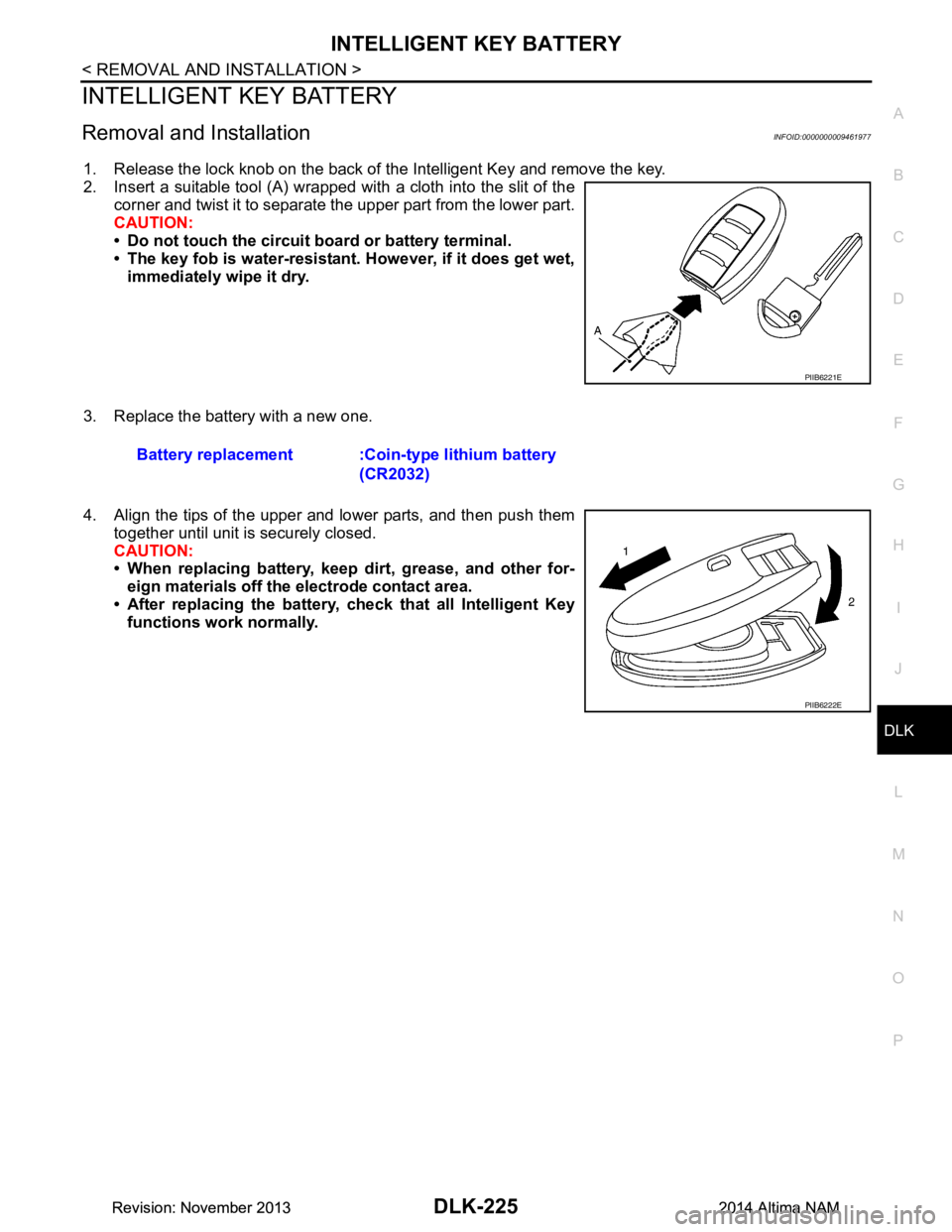
1. Release the lock knob on the back of the Intelligent Key and remove the key.
2. Insert a suitable tool (A) wrapped with a cloth into the slit of the corner and twist it to separate the upper part from the lower part.
CAUTION:
• Do not touch the circuit board or battery terminal.
• The key fob is water-resistant. However, if it does get wet,
immediately wipe it dry.
3. Replace the battery with a new one.
4. Align the tips of the upper and lower parts, and then push them together until unit is securely closed.
CAUTION:
• When replacing battery, keep dirt, grease, and other for-
eign materials off the electrode contact area.
• After replacing the battery, check that all Intelligent Key
functions work normally.
PIIB6221E
Battery replacement :Coin-type lithium battery
(CR2032)
PIIB6222E
Revision: November 20132014 Altima NAMRevision: November 20132014 Altima NAM
Page 1030 of 4801
![NISSAN TEANA 2014 Service Manual
EC-30
< SYSTEM DESCRIPTION >[QR25DE]
COMPONENT PARTS
ECM receives the signals as shown in the figure.
Intake Valve Timing Control Solenoid ValveINFOID:0000000009462066
Intake valve timing control sol](/img/5/57390/w960_57390-1029.png "NISSAN TEANA 2014 Service Manual
EC-30
< SYSTEM DESCRIPTION >[QR25DE]
COMPONENT PARTS
ECM receives the signals as shown in the figure.
Intake Valve Timing Control Solenoid ValveINFOID:0000000009462066
Intake valve timing control sol")
EC-30
< SYSTEM DESCRIPTION >[QR25DE]
COMPONENT PARTS
ECM receives the signals as shown in the figure.
Intake Valve Timing Control Solenoid ValveINFOID:0000000009462066
Intake valve timing control solenoid valve is activated by ON/OFF
pulse duty (ratio) signals from the ECM.
The intake valve timing control solenoid valve changes the oil
amount and direction of flow through intake valve timing control unit
or stops oil flow.
The longer pulse width advances valve angle.
The shorter pulse width retards valve angle.
When ON and OFF pulse widths become equal, the solenoid valve
stops oil pressure flow to fix the intake valve angle at the control
position.
Intake Valve Timing Intermediate Lock Control Solenoid ValveINFOID:0000000009462067
Intake valve timing intermediate lock control solenoid valve is acti-
vated by ON/OFF signals from the ECM.
The intake valve timing intermediate lock control solenoid valve
opens/closes the path of oil pressure acting on the lock key in the
camshaft sprocket (INT).
• When the solenoid valve becomes ON, oil pressure to the lock key
is trained to perform intermediate lock.
• When the solenoid valve becomes OFF, oil pressure is acted on the lock key to release the intermediate lock.
Exhaust Valve Timing Control Position SensorINFOID:0000000009462068
Exhaust valve timing control position sensor detects the protrusion of
the signal plate installed to the exhaust camshaft front end.
This sensor signal is used for sensing a position of the exhaust cam-
shaft.
The sensor consists of a permanent magnet and Hall IC.
When engine is running, the high and low parts of the teeth cause
the gap with the sensor to change.
The changing gap causes the magnetic field near the sensor to
change.
Due to the changing magnetic field, the voltage from the sensor
changes.
JMBIA0714GB
PBIB1842E
PBIB1842E
JPBIA5847ZZ
Revision: November 20132014 Altima NAMRevision: November 20132014 Altima NAM
Page 1051 of 4801
![NISSAN TEANA 2014 Service Manual
SYSTEMEC-51
< SYSTEM DESCRIPTION > [QR25DE]
C
D E
F
G H
I
J
K L
M A
EC
NP
O
The intake valve timing intermediate lock control improv
es the cleaning ability of exhaust gas at cold starting
by fixing](/img/5/57390/w960_57390-1050.png "NISSAN TEANA 2014 Service Manual
SYSTEMEC-51
< SYSTEM DESCRIPTION > [QR25DE]
C
D E
F
G H
I
J
K L
M A
EC
NP
O
The intake valve timing intermediate lock control improv
es the cleaning ability of exhaust gas at cold starting
by fixing")
SYSTEMEC-51
< SYSTEM DESCRIPTION > [QR25DE]
C
D E
F
G H
I
J
K L
M A
EC
NP
O
The intake valve timing intermediate lock control improv
es the cleaning ability of exhaust gas at cold starting
by fixing the camshaft sprocket (INT) with two lock keys and bringing the cam phase into intermediate phase.
Cam phase is fixed at the intermediate phase by two lock keys in the camshaft sprocket (INT). Lock key 1 con-
trols retard position and lock key 2 controls advance position.
ECM controls the intermediate phase lock by opening/clos ing the intake valve timing intermediate lock control
solenoid valve to control oil pressure acti ng on the lock key and locking/unlocking the lock key.
Lock/Unlock Activation
When ECM activates the intake valve timing intermediate lock control solenoid valve, oil pressure generated in
the oil pump is drained through the oil pressure path in t he control valve. Since oil pressure is not acted on the
lock key, the lock key position is fixed by the spri ng tension and the cam phase is fixed at the intermediate
phase.
When ECM deactivates the intake valve timing intermediate lock control solenoid valve, unlocking oil pressure
acts on each lock key. Lock key 1 is not released because it is under load due to sprocket rotational force. For
this reason, lock key 2 is released first by being pushed up by unlocking oil pressure. When lock key 2 is
released, some clearance is formed between lock key 1 and the rotor due to sprocket rotational force and
return spring force. Accordingly, lock key 1 is pushed up by unlocking oil pressure and the intermediated
phase lock is released.
When stopping the engine
When the ignition switch is turned from idle state to OFF, ECM receives an ignition switch signal from BCM via
CAN communication and activates the intake valve timing intermediate lock control solenoid valve and drains
oil pressure acting on the lock key before activating the intake valve timing control solenoid valve and operat-
ing the cam phase toward the advance position.
The cam phase is fixed by the lock key when shifting to the intermediated phase and ECM performs Lock
judgment to stop the engine.
When starting the engine
JPBIA6317GB
JPBIA5970GB
Revision: November 20132014 Altima NAMRevision: November 20132014 Altima NAM
Page 1052 of 4801
![NISSAN TEANA 2014 Service Manual
EC-52
< SYSTEM DESCRIPTION >[QR25DE]
SYSTEM
When starting the engine by cold start, ECM judges the
locked/unlocked state when ignition switch is turned
ON. When judged as locked state (fixed at the](/img/5/57390/w960_57390-1051.png "NISSAN TEANA 2014 Service Manual
EC-52
< SYSTEM DESCRIPTION >[QR25DE]
SYSTEM
When starting the engine by cold start, ECM judges the
locked/unlocked state when ignition switch is turned
ON. When judged as locked state (fixed at the")
EC-52
< SYSTEM DESCRIPTION >[QR25DE]
SYSTEM
When starting the engine by cold start, ECM judges the
locked/unlocked state when ignition switch is turned
ON. When judged as locked state (fixed at the intermedi ate phase), the intake valve timing intermediate lock
control solenoid valve is activated. Since oil pre ssure does not act on the lock key even when the engine is
started, the cam phase is fixed at the intermediate phas e and the intake valve timing control is not performed.
When the engine stops without locking the cam phase at the intermediate phase due to an engine stall and the
state is not judged as locked, the intake valve timing intermediate lock control solenoid valve and the intake
valve timing control solenoid valve are activated and the cam phase shifts to the advanced position to be
locked at the intermediate phase. Even when not locked in the intermediate lock phase due to no oil pressure
or low oil pressure, a ratchet structure of the camshaft sprocket (INT) rotor allows the conversion to the inter-
mediate phase in stages by engine vibration.
When engine coolant temperature is more than 60 °C, the intake valve timing is controlled by deactivating the
intake valve timing intermediate lock control so lenoid valve and releasing the intermediate phase lock.
When the engine is started after warming up, ECM releas es the intermediate phase lock immediately after the
engine start and controls the intake valve timing.
EXHAUST VALVE TIMING CONTROL
EXHAUST VALVE TIMING CONT ROL : System DescriptionINFOID:0000000009462097
SYSTEM DIAGRAM
INPUT/OUTPUT SIGNAL CHART
JPBIA4761GB
Sensor Input signal to ECM ECM function Actuator
Crankshaft position sensor (POS) Engine speed and piston position
Exhaust valve
timing control Exhaust valve timing control
solenoid valve
Camshaft position sensor (PHASE)
Engine oil temperature sensor Engine oil temperature
Exhaust valve timing control position
sensor Exhaust valve timing signal
Combination meter CAN commu-
nication Vehicle speed signal
Revision: November 20132014 Altima NAMRevision: November 20132014 Altima NAM
Page 1171 of 4801
![NISSAN TEANA 2014 Service Manual
BASIC INSPECTIONEC-171
< BASIC INSPECTION > [QR25DE]
C
D E
F
G H
I
J
K L
M A
EC
NP
O
2. Rev engine (2,000 to 3,000 rpm) two or three times under no
load, then run engine at idle speed for about 1 mi](/img/5/57390/w960_57390-1170.png "NISSAN TEANA 2014 Service Manual
BASIC INSPECTIONEC-171
< BASIC INSPECTION > [QR25DE]
C
D E
F
G H
I
J
K L
M A
EC
NP
O
2. Rev engine (2,000 to 3,000 rpm) two or three times under no
load, then run engine at idle speed for about 1 mi")
BASIC INSPECTIONEC-171
< BASIC INSPECTION > [QR25DE]
C
D E
F
G H
I
J
K L
M A
EC
NP
O
2. Rev engine (2,000 to 3,000 rpm) two or three times under no
load, then run engine at idle speed for about 1 minute.
3. Check idle speed.
For procedure, refer to EC-534, "Inspection"
.
For specification, refer to EC-541, "Idle Speed"
.
Is the inspection result normal?
YES >> GO TO 10.
NO >> GO TO 4.
4.PERFORM ACCELERATOR PEDAL RE LEASED POSITION LEARNING
1. Stop engine.
2. Perform EC-177, "Work Procedure"
.
>> GO TO 5.
5.PERFORM THROTTLE VALVE CL OSED POSITION LEARNING
Perform EC-178, "Work Procedure"
.
>> GO TO 6.
6.PERFORM IDLE AIR VOLUME LEARNING
Perform EC-179, "Work Procedure"
.
Is Idle Air Volume Learning carried out successfully?
YES >> GO TO 7.
NO >> Follow the instruction of Idle Air Volume Learning. Then GO TO 4.
7.CHECK TARGET IDLE SPEED AGAIN
1. Start engine and warm it up to normal operating temperature.
2. Check idle speed.
For procedure, refer to EC-534, "Inspection"
.
For specification, refer to EC-541, "Idle Speed"
.
Is the inspection result normal?
YES >> GO TO 10.
NO >> GO TO 8.
8.DETECT MALFUNCTIONING PART
Check the Following.
• Check camshaft position sensor (PHASE) and circuit. Refer to EC-329, "DTC Logic"
.
• Check crankshaft position sensor (POS) and circuit. Refer to EC-326, "DTC Logic"
.
Is the inspection result normal?
YES >> GO TO 9.
NO >> Repair or replace. Then GO TO 4
9.CHECK ECM FUNCTION
1. Substitute another known-good ECM to check ECM f unction. (ECM may be the cause of an incident, but
this is a rare case.)
2. Perform initialization of NVIS (NATS) system and regi stration of all NVIS (NATS) ignition key IDs. Refer to
SEC-66, "ECM : Work Procedure"
.
>> GO TO 4.
10.CHECK IGNITION TIMING
1. Run engine at idle.
PBIA8513J
Revision: November 20132014 Altima NAMRevision: November 20132014 Altima NAM
Page 1173 of 4801
![NISSAN TEANA 2014 Service Manual
BASIC INSPECTIONEC-173
< BASIC INSPECTION > [QR25DE]
C
D E
F
G H
I
J
K L
M A
EC
NP
O
17.DETECT MALFUNCTIONING PART
Check the following.
• Check camshaft position sensor (PHASE) and circuit. Refe](/img/5/57390/w960_57390-1172.png "NISSAN TEANA 2014 Service Manual
BASIC INSPECTIONEC-173
< BASIC INSPECTION > [QR25DE]
C
D E
F
G H
I
J
K L
M A
EC
NP
O
17.DETECT MALFUNCTIONING PART
Check the following.
• Check camshaft position sensor (PHASE) and circuit. Refe")
BASIC INSPECTIONEC-173
< BASIC INSPECTION > [QR25DE]
C
D E
F
G H
I
J
K L
M A
EC
NP
O
17.DETECT MALFUNCTIONING PART
Check the following.
• Check camshaft position sensor (PHASE) and circuit. Refer to EC-329, "DTC Logic"
.
• Check crankshaft position sensor (POS) and circuit. Refer to EC-326, "DTC Logic"
.
Is the inspection result normal?
YES >> GO TO 18.
NO >> Repair or replace. Then GO TO 4
18.CHECK ECM FUNCTION
1. Substitute another known-good ECM to check ECM f unction. (ECM may be the cause of an incident, but
this is a rare case.)
2. Perform initialization of NVIS (NATS) system and regi stration of all NVIS (NATS) ignition key IDs. Refer to
SEC-66, "ECM : Work Procedure"
.
>> GO TO 4.
Revision: November 20132014 Altima NAMRevision: November 20132014 Altima NAM
Page 1175 of 4801
![NISSAN TEANA 2014 Service Manual
ADDITIONAL SERVICE WHEN REPLACING ECMEC-175
< BASIC INSPECTION > [QR25DE]
C
D E
F
G H
I
J
K L
M A
EC
NP
O
• During programming, maintain the following conditions:
- Ignition switch: ON
- Electri](/img/5/57390/w960_57390-1174.png "NISSAN TEANA 2014 Service Manual
ADDITIONAL SERVICE WHEN REPLACING ECMEC-175
< BASIC INSPECTION > [QR25DE]
C
D E
F
G H
I
J
K L
M A
EC
NP
O
• During programming, maintain the following conditions:
- Ignition switch: ON
- Electri")
ADDITIONAL SERVICE WHEN REPLACING ECMEC-175
< BASIC INSPECTION > [QR25DE]
C
D E
F
G H
I
J
K L
M A
EC
NP
O
• During programming, maintain the following conditions:
- Ignition switch: ON
- Electric load: OFF
- Brake pedal: Not depressed
- Battery voltage: 12 – 13.5 V (Be sure to check the va lue of battery voltage by selecting “BATTERY VOLT” in
“Data monitor” of CONSULT.)
>> GO TO 6.
5.REPLACE ECM
Replace ECM. Refer to EC-540, "Removal and Installation"
.
>> GO TO 6.
6.PERFORM INITIALIZATION OF NATS SYSTEM AND REGISTRATION OF ALL NATS IGNITION KEY IDS
Refer to SEC-66, "ECM : Work Procedure"
.
>> GO TO 7.
7.CHECK ECM DATA STATUS
Check if the data is successfully copied from the EC M at Step 1 (before replacement) and saved in CONSULT.
Is the data saved successfully?
YES >> GO TO 8.
NO >> GO TO 9.
8.WRITE ECM DATA
With CONSULT
1. Select “WRITING DATA FOR REPLC CPU” in “W ORK SUPPORT” mode of “ENGINE” using CONSULT.
2. Follow the instruction of CONSULT display.
NOTE:
The data saved by “SAVING DATA FOR REPLC CPU” is written to ECM.
>> GO TO 10.
9.PERFORM VIN REGISTRATION
Refer to EC-176, "Work Procedure"
.
>> GO TO 10.
10.PERFORM ACCELERATOR PEDAL RE LEASED POSITION LEARNING
Refer to EC-177, "Work Procedure"
.
>> GO TO 11.
11 .PERFORM THROTTLE VALVE CLOSED POSITION LEARNING
Refer to EC-178, "Work Procedure"
.
>> GO TO 12.
12.PERFORM IDLE AIR VOLUME LEARNING
Refer to EC-179, "Work Procedure"
.
>> END
Revision: November 20132014 Altima NAMRevision: November 20132014 Altima NAM
Page 1633 of 4801
![NISSAN TEANA 2014 Service Manual
ECM
EC-633
< ECU DIAGNOSIS INFORMATION > [VQ35DE]
C
D E
F
G H
I
J
K L
M A
EC
NP
OP0463 0463 FUEL LEVL SEN/CIRC — 2
×BEC-866
P0500 0500
VEH SPEED SEN/CIRC*8—2×BEC-867
P0506 0506 ISC SYSTEM —](/img/5/57390/w960_57390-1632.png "NISSAN TEANA 2014 Service Manual
ECM
EC-633
< ECU DIAGNOSIS INFORMATION > [VQ35DE]
C
D E
F
G H
I
J
K L
M A
EC
NP
OP0463 0463 FUEL LEVL SEN/CIRC — 2
×BEC-866
P0500 0500
VEH SPEED SEN/CIRC*8—2×BEC-867
P0506 0506 ISC SYSTEM —")
ECM
EC-633
< ECU DIAGNOSIS INFORMATION > [VQ35DE]
C
D E
F
G H
I
J
K L
M A
EC
NP
OP0463 0463 FUEL LEVL SEN/CIRC — 2
×BEC-866
P0500 0500
VEH SPEED SEN/CIRC*8—2×BEC-867
P0506 0506 ISC SYSTEM — 2 ×BEC-869
P0507 0507 ISC SYSTEM — 2 ×BEC-871
P050A 050A COLD START CONTROL — 2 ×AEC-873
P050E 050E COLD START CONTROL — 2 ×AEC-873
P0520 0520 EOP SENSOR/SWITCH — 2 — — EC-875
P0524 0524 ENGINE OIL PRESSURE — 1 — —EC-878
P0603 0603 ECM BACK UP/CIRCUIT — 2×BEC-881
P0605 0605 ECM — 1 or 2 × or — B EC-883
P0607 0607 ECM — 1 ×BEC-884
P0643 0643 SENSOR POWER/CIRC — 1 ×BEC-885
P0850 0850 P-N POS SW/CIRCUIT — 2 ×BEC-887
P1148 1148 CLOSED LOOP-B1 — 1 ×AEC-890
P1168 1168 CLOSED LOOP-B2 — 1 ×AEC-890
P1212 1212 TCS/CIRC — 2 — — EC-891
P1217 1217 ENG OVER TEMP — 1×BEC-892
P1225 1225 CTP LEARNING-B1 — 2 — — EC-895
P1226 1226 CTP LEARNING-B1 — 2 — —EC-896
P1550 1550 BAT CURRENT SENSOR — 2 — —EC-897
P1551 1551 BAT CURRENT SENSOR — 2 — —EC-899
P1552 1552 BAT CURRENT SENSOR — 2 — —EC-899
P1553 1553 BAT CURRENT SENSOR — 2 — —EC-901
P1554 1554 BAT CURRENT SENSOR — 2 — —EC-903
P1556 1556 BAT TMP SEN/CIRC — 2 — —EC-906
P1557 1557 BAT TMP SEN/CIRC — 2 — —EC-906
P1564 1564 ASCD SW — 1 — —EC-908
P1572 1572 ASCD BRAKE SW — 1 — — EC-911
P1574 1574 ASCD VHL SPD SEN — 1 — —EC-918
P1610 1610 LOCK MODE — 2 — —SEC-68
P1611 1611 ID DISCORD, IMM-ECM — 2 — —SEC-69
P1612 1612 CHAIN OF ECM-IMMU — 2 — — SEC-70
P1614 1614 CHAIN OF IMMU-KEY — 2 — —SEC-71
P1800 1800 VIAS S/V-1 — 2 — — EC-920
P1801 1801 VIAS S/V-2 — 2 — —EC-922
P1805 1805 BRAKE SW/CIRCUIT — 2 — —EC-924
P2096 2096 A/F SENSOR1 (B1) — 2×AEC-927
P2097 2097 A/F SENSOR1 (B1) — 2 ×AEC-927
P2098 2098 A/F SENSOR1 (B2) — 2 ×AEC-927
P2099 2099 A/F SENSOR1 (B2) — 2 ×AEC-927
P2100 2100 ETC MOT PWR-B1 — 1 ×BEC-931
P2101 2101 ETC FNCTN/CIRC-B1 — 1 ×BEC-933
DTC*1
Items
(CONSULT screen terms) SRT
code Trip MIL Permanent
DTC group*4Refer-
ence page
CONSULT
GST
*2ECM*3
Revision: November 20132014 Altima NAMRevision: November 20132014 Altima NAM
Page 1676 of 4801
![NISSAN TEANA 2014 Service Manual
EC-676
< BASIC INSPECTION >[VQ35DE]
BASIC INSPECTION
2. Rev engine (2,000 to 3,000 rpm) 2 or 3 times under no load,
then run engine at idle speed for approximately 1 minute.
3. Check idle speed.
For](/img/5/57390/w960_57390-1675.png "NISSAN TEANA 2014 Service Manual
EC-676
< BASIC INSPECTION >[VQ35DE]
BASIC INSPECTION
2. Rev engine (2,000 to 3,000 rpm) 2 or 3 times under no load,
then run engine at idle speed for approximately 1 minute.
3. Check idle speed.
For")
EC-676
< BASIC INSPECTION >[VQ35DE]
BASIC INSPECTION
2. Rev engine (2,000 to 3,000 rpm) 2 or 3 times under no load,
then run engine at idle speed for approximately 1 minute.
3. Check idle speed.
For procedure, refer to EC-992, "Work Procedure"
.
For specification, refer to EC-998, "Idle Speed"
.
Is the inspection result normal?
YES >> GO TO 10.
NO >> GO TO 4.
4.PERFORM ACCELERATOR PEDAL RE LEASED POSITION LEARNING
1. Stop engine.
2. Perform EC-681, "Work Procedure"
.
>> GO TO 5.
5.PERFORM THROTTLE VALVE CL OSED POSITION LEARNING
Perform EC-682, "Work Procedure"
.
>> GO TO 6.
6.PERFORM IDLE AIR VOLUME LEARNING
Perform EC-683, "Work Procedure"
.
Is Idle Air Volume Learning carried out successfully?
YES >> GO TO 7.
NO >> Follow the instruction of Idle Air Volume Learning. Then GO TO 4.
7.CHECK IDLE SPEED AGAIN
1. Start engine and warm it up to normal operating temperature.
2. Check idle speed.
For procedure, refer to EC-992, "Work Procedure"
.
For specification, refer to EC-998, "Idle Speed"
.
Is the inspection result normal?
YES >> GO TO 10.
NO >> GO TO 8.
8.DETECT MALFUNCTIONING PART
Check the Following.
• Check camshaft position sensor (PHASE) and circuit. Refer to EC-820, "Diagnosis Procedure"
.
• Check crankshaft position sensor (POS) and circuit. Refer to EC-817, "Diagnosis Procedure"
.
Is the inspection result normal?
YES >> GO TO 9.
NO >> Repair or replace malfunctioning part. Then GO TO 4.
9.CHECK ECM FUNCTION
1. Substitute with a non-malfunctioning ECM to check EC M function. (ECM may be the cause of the incident,
although this is rare.)
2. Perform initialization of NVIS (NAT S) system and registration of all NVIS (NATS) ignition key IDs. Refer to
SEC-66, "ECM : Work Procedure"
.
>> GO TO 4.
10.CHECK IGNITION TIMING
1. Run engine at idle.
2. Check ignition timing with a timing light.
For procedure, refer to EC-993, "Work Procedure"
.
PBIA8513J
Revision: November 20132014 Altima NAMRevision: November 20132014 Altima NAM
Page 1678 of 4801
![NISSAN TEANA 2014 Service Manual
EC-678
< BASIC INSPECTION >[VQ35DE]
BASIC INSPECTION
2. Perform initialization of NVIS (NAT
S) system and registration of all NVIS (NATS) ignition key IDs. Refer to
SEC-66, "ECM : Work Procedure"
.
>](/img/5/57390/w960_57390-1677.png "NISSAN TEANA 2014 Service Manual
EC-678
< BASIC INSPECTION >[VQ35DE]
BASIC INSPECTION
2. Perform initialization of NVIS (NAT
S) system and registration of all NVIS (NATS) ignition key IDs. Refer to
SEC-66, \"ECM : Work Procedure\"
.
>")
EC-678
< BASIC INSPECTION >[VQ35DE]
BASIC INSPECTION
2. Perform initialization of NVIS (NAT
S) system and registration of all NVIS (NATS) ignition key IDs. Refer to
SEC-66, "ECM : Work Procedure"
.
>> GO TO 4.
19.INSPECTION END
If ECM is replaced during this BASIC INSPECTION procedure, perform EC-679, "Work Procedure"
.
>> INSPECTION END
Revision: November 20132014 Altima NAMRevision: November 20132014 Altima NAM