Sec pressure NISSAN TEANA 2014 User Guide
[x] Cancel search | Manufacturer: NISSAN, Model Year: 2014, Model line: TEANA, Model: NISSAN TEANA 2014Pages: 4801, PDF Size: 51.2 MB
Page 181 of 4801
![NISSAN TEANA 2014 User Guide
DIAGNOSIS SYSTEM [ABS ACTUATOR AND ELECTRIC UNIT (CONTROL
UNIT)]
BRC-35
< SYSTEM DESCRIPTION > [VDC/TCS/ABS]
C
D E
G H
I
J
K L
M A
B
BRC
N
O P
× : Applicable
–: Not applicable N POSI SIG
(On/O](/img/5/57390/w960_57390-180.png "NISSAN TEANA 2014 User Guide
DIAGNOSIS SYSTEM [ABS ACTUATOR AND ELECTRIC UNIT (CONTROL
UNIT)]
BRC-35
< SYSTEM DESCRIPTION > [VDC/TCS/ABS]
C
D E
G H
I
J
K L
M A
B
BRC
N
O P
× : Applicable
–: Not applicable N POSI SIG
(On/O")
DIAGNOSIS SYSTEM [ABS ACTUATOR AND ELECTRIC UNIT (CONTROL
UNIT)]
BRC-35
< SYSTEM DESCRIPTION > [VDC/TCS/ABS]
C
D E
G H
I
J
K L
M A
B
BRC
N
O P
× : Applicable
–: Not applicable N POSI SIG
(On/Off) ––
×Neutral position (On/Off) judged by transmission
range switch signal.
P POSI SIG
(On/Off) ––
×Park position (On/Off) judged by transmission range
switch signal.
ACCEL POS SIG
(%) ×
– ×Throttle valve open/close status judged by CAN com-
munication signal is displayed.
SIDE G-SENSOR
(m/s
2) ×
– ×Transverse acceleration detected by side G-sensor is
displayed.
STR ANGLE SIG
(deg) ×
– ×Steering angle detected by steering angle sensor is
displayed.
PRESS SENSOR
(bar) ×
– ×Brake pressure detected by pressure sensor is dis-
played.
EBD SIGNAL
(On/Off) ––
×EBD operation (On/Off) status is displayed.
ABS SIGNAL
(On/Off) ––
×ABS operation (On/Off) status is displayed.
TCS SIGNAL
(On/Off) ––
×TCS operation (On/Off) status is displayed.
VDC SIGNAL
(On/Off) ––
×VDC operation (On/Off) status is displayed.
EBD FAIL SIG
(On/Off) ––
×EBD fail signal (On/Off) status is displayed.
ABS FAIL SIG
(On/Off) ––
×ABS fail signal (On/Off) status is displayed.
TCS FAIL SIG
(On/Off) ––
×TCS fail signal (On/Off) status is displayed.
VDC FAIL SIG
(On/Off) ––
×VDC fail signal (On/Off) status is displayed.
CRANKING SIG
(On/Off) ––
×The input state of the key SW START position signal
is displayed.
FLUID LEV SW
(On/Off) ×
– ×Brake fluid level switch (On/Off) status is displayed.
PARK BRAKE SW
(On/Off) ×
– ×Park brake switch (On/Off) status is displayed.
USV[FL-RR]
(On/Off) ——
×Primary side USV solenoid valve (On/Off) status is
displayed.
USV[FR-RL]
(On/Off) ——
×Secondary side USV solenoid valve (On/Off) status is
displayed.
HSV[FL-RR]
(On/Off) ——
×Primary side HSV solenoid valve (On/Off) status is
displayed.
HSV[FR-RL]
(On/Off) ——
×Secondary side HSV solenoid valve (On/Off) status is
displayed.
V/R OUTPUT
(On/Off) ——
×Valve relay operation signal (On/Off) status is dis-
played.
M/R OUTPUT
(On/Off) ——
×Motor relay operation signal (On/Off) status is dis-
played.
ENGINE RPM
(tr/min) ×
– ×Engine speed judged by CAN communication signal
is displayed.
Item
(Unit) Data monitor item selection
Remarks
ECU INPUT
SIGNALS MAIN
SIGNALS SELECTION
FROM MENU
Revision: November 20132014 Altima NAMRevision: November 20132014 Altima NAM
Page 392 of 4801
![NISSAN TEANA 2014 User Guide
CO-12
< PERIODIC MAINTENANCE >[QR25DE]
ENGINE COOLANT
2. Pull the negative-pressure valve to open it and check that it
closes completely when released.
• Check that there is no dirt or damage on](/img/5/57390/w960_57390-391.png "NISSAN TEANA 2014 User Guide
CO-12
< PERIODIC MAINTENANCE >[QR25DE]
ENGINE COOLANT
2. Pull the negative-pressure valve to open it and check that it
closes completely when released.
• Check that there is no dirt or damage on")
CO-12
< PERIODIC MAINTENANCE >[QR25DE]
ENGINE COOLANT
2. Pull the negative-pressure valve to open it and check that it
closes completely when released.
• Check that there is no dirt or damage on the valve seat of the
radiator cap negative-pressure valve.
• Check that there are no abnormalities in the opening and clos- ing conditions of the negative-pressure valve.
3. Check radiator cap relief pressure using suitable tool and Tool. • When connecting the radiator cap to the tester, apply water orcoolant to the cap seal surface.
• Replace the radiator cap if there is an abnormality in the nega-
tive-pressure valve, or if the open-valve pressure is outside of
the standard values.
CHECKING RADIATOR
Check radiator for mud or clogging. If necessary, clean radiator as follows.
CAUTION:
• Be careful not to bend or damage the radiator fins.
• When radiator is cleaned on-vehicle, remove surr ounding parts in order to access the radiator core.
Tape the harness and electrical connectors to prevent water from entering.
1. Spray water to the back side of the radiator co re using a side to side motion from the top down.
2. Stop spraying when debris no longer flows from radiator core.
3. Blow air into the back side of radiator core using a side to side motion from the top down.
• Use compressed air lower than 490 kPa (5 kg/cm
2, 71 psi) and keep distance more than 30 cm (11.8 in).
4. Continue to blow air until no water sprays out.
5. Check for coolant leaks. Repair as necessary.
Changing Engine CoolantINFOID:0000000009460391
WARNING:
Do not remove the radiator cap when the engine is hot. Serious burns could occur from high-pressure
engine coolant escaping from the radiator. Wrap a th ick cloth around the cap. Slowly push down and
turn it a quarter turn to allow built-up pressure to escape. Carefully remove the cap by pushing it down
and turning it all the way.
DRAINING ENGINE COOLANT
1. Remove the engine under cover. Refer to EXT-17, "Removal and Installation".
2. Open the radiator drain plug at the bottom of the radi ator and remove the radiator filler cap. This is the
only step required when partially draining the cooling system (radiator only).
CAUTION:
• Do not allow the coolant to contact the drive belt.
• Perform this step when engine is cold.
3. Follow this step for heater core removal/replac ement only. Disconnect the upper heater hose at the
engine side and apply moderate air pressure [103.46 kPa (1.055 kg/cm
2, 15 psi) maximum air pressure]
into the hose for 30 seconds to blow t he excess coolant out of the heater core.
4. When draining all of the coolant in the system, re move the reservoir tank and drain the coolant, then clean
the reservoir tank before installation.
SMA967B
Tool number : EG17650301 (J-33984-A)
Standard: Refer to CO-26, "Radiator"
.
WBIA0570E
Revision: November 20132014 Altima NAM
Page 394 of 4801
![NISSAN TEANA 2014 User Guide
CO-14
< PERIODIC MAINTENANCE >[QR25DE]
ENGINE COOLANT
4. Install the Tool by installing the radiator cap adapter onto the
radiator neck opening. Then attach the gauge body assembly
with the refill t](/img/5/57390/w960_57390-393.png "NISSAN TEANA 2014 User Guide
CO-14
< PERIODIC MAINTENANCE >[QR25DE]
ENGINE COOLANT
4. Install the Tool by installing the radiator cap adapter onto the
radiator neck opening. Then attach the gauge body assembly
with the refill t")
CO-14
< PERIODIC MAINTENANCE >[QR25DE]
ENGINE COOLANT
4. Install the Tool by installing the radiator cap adapter onto the
radiator neck opening. Then attach the gauge body assembly
with the refill tube and the venturi assembly to the radiator cap
adapter.
5. Insert the refill hose into the coolant mixture container that is placed at floor level. Make sure the ball valve is in the closed
position.
• Use recommended coolant or equivalent.
Refer to MA-11, "FOR USA AND CANADA : Fluids and Lubri-
cants".
CAUTION:
Do not use any cooling system additives such as radiator
sealer. Additives may clog th e cooling system and cause
damage to the engine, transm ission and/or cooling system.
6. Install an air hose to the venturi assembly, the air pressure must be within specification.
CAUTION:
The compressed air supply must be equipped with an air dryer.
7. The vacuum gauge will begin to rise and there will be an audible hissing noise. During this process open the ball valve on the refill hose slightly. Coolant will be vi sible rising in the refill hose. Once the refill hose is
full of coolant, close the ball valve. This will purge any air trapped in the refill hose.
8. Continue to draw the vacuum until the gauge reaches 28 inches of vacuum. The gauge may not reach 28 inches in high altitude
locations, use the vacuum specifications based on the altitude
above sea level.
9. When the vacuum gauge has reached the specifi ed amount, disconnect the air hose and wait 20 seconds
to see if the system loses any vacuum. If the vacuum level drops, perform any necessary repairs to the
system and repeat steps 6 - 8 to bring the vacuum to the specified amount. Recheck for any leaks.
10. Place the coolant container (with the refill hose insert ed) at the same level as the top of the radiator. Then
open the ball valve on the refill hose so the coolant will be drawn up to fill the cooling system. The cooling
system is full when the vacuum gauge reads zero.
CAUTION:
Do not allow the coolant container to get too low when filling, to avoid air from being drawn into
the cooling system.
11. Remove the Tool from the radiator neck opening.
12. Fill the cooling system reservoir tank to the specif ied level and install the radiator cap. Run the engine to
warm up the cooling system and t op up the system as necessary.
13. Install the engine under cover. Refer to EXT-17, "Removal and Installation"
.
FLUSHING COOLING SYSTEM
Tool number : KV991J0070 (J-45695)
Engine coolant capacity
(with reservoir tank) : Refer to
CO-26, "Capacity"
.
Compressed air
supply pressure : 549 - 824 kPa (5.6 - 8.4 kg/cm
2,
80 - 119 psi)
LLIA0058E
Altitude above sea level Vacuum gauge reading
0 - 100 m (328 ft) : 28 inches of vacuum
300 m (984 ft) : 27 inches of vacuum
500 m (1,641 ft) : 26 inches of vacuum
1,000 m (3,281 ft) : 24 - 25 inches of vacuum
LLIA0057E
Revision: November 20132014 Altima NAM
Page 400 of 4801
![NISSAN TEANA 2014 User Guide
CO-20
< REMOVAL AND INSTALLATION >[QR25DE]
WATER PUMP
WATER PUMP
Exploded ViewINFOID:0000000009460397
WARNING:
Do not remove the radiator cap when the engine is hot. Serious burns could occur from](/img/5/57390/w960_57390-399.png "NISSAN TEANA 2014 User Guide
CO-20
< REMOVAL AND INSTALLATION >[QR25DE]
WATER PUMP
WATER PUMP
Exploded ViewINFOID:0000000009460397
WARNING:
Do not remove the radiator cap when the engine is hot. Serious burns could occur from")
CO-20
< REMOVAL AND INSTALLATION >[QR25DE]
WATER PUMP
WATER PUMP
Exploded ViewINFOID:0000000009460397
WARNING:
Do not remove the radiator cap when the engine is hot. Serious burns could occur from high-pressure
engine coolant escaping from the radiator. Wrap a th ick cloth around the cap. Slowly push down and
turn it a quarter turn to allow built-up pressure to escape. Carefully remove the cap by pushing it down
and turning it all the way.
CAUTION:
• When removing water pump assembly, be car eful not to get coolant on drive belt.
• Water pump cannot be disassembled and should be replaced as a unit.
• After installing water pump, connect hose and clamp securely, then check for leaks using radiator
cap tester.
NOTE:
When removing components such as hoses, tubes/lines, etc. , cap or plug openings to prevent fluid from spill-
ing.
Removal and InstallationINFOID:0000000009460398
REMOVAL
1. Drain engine coolant from the radiator. Refer to CO-12, "Changing Engine Coolant".
CAUTION:
Perform when the engine is cold.
2. Remove the core support cover clips (A), then remove the core support cover (1).
ALBIA0823GB
1. Water pump 2-5. Tightening order 6. Gasket
7. Water pump housing 8-11. Tightening order 12. Water pipe
13. Gasket 14. O-ring
ALKIA2602ZZ
Revision: November 20132014 Altima NAM
Page 416 of 4801
![NISSAN TEANA 2014 User Guide
CO-36
< PERIODIC MAINTENANCE >[VQ35DE]
ENGINE COOLANT
2. Pull the negative-pressure valve to open it and check that it
closes completely when released.
• Check that there is no dirt or damage on](/img/5/57390/w960_57390-415.png "NISSAN TEANA 2014 User Guide
CO-36
< PERIODIC MAINTENANCE >[VQ35DE]
ENGINE COOLANT
2. Pull the negative-pressure valve to open it and check that it
closes completely when released.
• Check that there is no dirt or damage on")
CO-36
< PERIODIC MAINTENANCE >[VQ35DE]
ENGINE COOLANT
2. Pull the negative-pressure valve to open it and check that it
closes completely when released.
• Check that there is no dirt or damage on the valve seat of the
radiator cap negative-pressure valve.
• Check that there are no abnormalities in the opening and clos- ing conditions of the negative-pressure valve.
3. Check radiator cap relief pressure using suitable tool and Tool. • When connecting the radiator cap to the tester, apply water orcoolant to the cap seal surface.
• Replace the radiator cap if there is an abnormality in the nega-
tive-pressure valve, or if the open-valve pressure is outside of
the standard values.
CHECKING RADIATOR
Check radiator for mud or clogging. If necessary, clean radiator as follows.
CAUTION:
• Be careful not to bend or damage the radiator fins.
• When radiator is cleaned on-vehicle, remove surr ounding parts in order to access the radiator core.
Tape the harness and electrical connectors to prevent water from entering.
1. Spray water to the back side of the radiator co re using a side to side motion from the top down.
2. Stop spraying when debris no longer flows from radiator core.
3. Blow air into the back side of radiator core using a side to side motion from the top down.
• Use compressed air lower than 490 kPa (5 kg/cm
2, 71 psi) and keep distance more than 30 cm (11.8 in).
4. Continue to blow air until no water sprays out.
5. Check for coolant leaks. Repair as necessary.
Changing Engine CoolantINFOID:0000000009460414
WARNING:
Do not remove the radiator cap when the engine is hot. Serious burns could occur from high-pressure
engine coolant escaping from the radiator. Wrap a th ick cloth around the cap. Slowly push down and
turn it a quarter turn to allow built-up pressure to escape. Carefully remove the cap by pushing it down
and turning it all the way.
DRAINING ENGINE COOLANT
1. Remove the engine under cover. Refer to EXT-17, "Removal and Installation".
2. Open the radiator drain plug at the bottom of the radi ator and remove the radiator filler cap. This is the
only step required when partially draining the cooling system (radiator only).
CAUTION:
• Do not allow the coolant to contact the drive belts.
• Perform this step when engine is cold.
3. Follow this step for heater core removal/replac ement only. Disconnect the upper heater hose at the
engine side and apply moderate air pressure [103.46 kPa (1.055 kg/cm
2, 15 psi) maximum air pressure]
into the hose for 30 seconds to blow t he excess coolant out of the heater core.
4. When draining all of the coolant in the system, re move the reservoir tank and drain the coolant, then clean
the reservoir tank before installation.
CAUTION:
SMA967B
Tool number : EG17650301 (J-33984-A)
Standard : Refer to CO-53, "Radiator"
.
WBIA0570E
Revision: November 20132014 Altima NAM
Page 418 of 4801
![NISSAN TEANA 2014 User Guide
CO-38
< PERIODIC MAINTENANCE >[VQ35DE]
ENGINE COOLANT
4. Install the Tool by installing the radiator cap adapter onto the
radiator neck opening. Then attach the gauge body assembly
with the refill t](/img/5/57390/w960_57390-417.png "NISSAN TEANA 2014 User Guide
CO-38
< PERIODIC MAINTENANCE >[VQ35DE]
ENGINE COOLANT
4. Install the Tool by installing the radiator cap adapter onto the
radiator neck opening. Then attach the gauge body assembly
with the refill t")
CO-38
< PERIODIC MAINTENANCE >[VQ35DE]
ENGINE COOLANT
4. Install the Tool by installing the radiator cap adapter onto the
radiator neck opening. Then attach the gauge body assembly
with the refill tube and the venturi assembly to the radiator cap
adapter.
5. Insert the refill hose into the coolant mixture container that is placed at floor level. Make sure the ball valve is in the closed
position.
• Use recommended coolant or equivalent.
Refer to MA-11, "FOR USA AND CANADA : Fluids and Lubri-
cants".
CAUTION:
Do not use any cooling system additives such as radiator
sealer. Additives may clog th e cooling system and cause
damage to the engine, transm ission and/or cooling system.
6. Install an air hose to the venturi assembly, the air pressure must be within specification.
CAUTION:
The compressed air supply must be equipped with an air dryer.
7. The vacuum gauge will begin to rise and there will be an audible hissing noise. During this process open the ball valve on the refill hose slightly. Coolant will be vi sible rising in the refill hose. Once the refill hose is
full of coolant, close the ball valve. This will purge any air trapped in the refill hose.
8. Continue to draw the vacuum until the gauge reaches 28 inches of vacuum. The gauge may not reach 28 inches in high altitude
locations, use the vacuum specifications based on the altitude
above sea level.
9. When the vacuum gauge has reached the specifi ed amount, disconnect the air hose and wait 20 seconds
to see if the system loses any vacuum. If the vacuum level drops, perform any necessary repairs to the
system and repeat steps 6 - 8 to bring the vacuum to the specified amount. Recheck for any leaks.
10. Place the coolant container (with the refill hose insert ed) at the same level as the top of the radiator. Then
open the ball valve on the refill hose so the coolant will be drawn up to fill the cooling system. The cooling
system is full when the vacuum gauge reads zero.
CAUTION:
Do not allow the coolant container to get too low when filling, to avoid air from being drawn into
the cooling system.
11. Remove the Tool from the radiator neck opening.
12. Fill the cooling system reservoir tank to the specif ied level and install the radiator cap. Run the engine to
warm up the cooling system and t op up the system as necessary.
13. Install the engine under cover. Refer to EXT-17, "Removal and Installation"
.
FLUSHING COOLING SYSTEM
Tool number : KV991J0070 (J-45695)
Engine coolant capacity
(with reservoir tank) : Refer to
CO-53, "Capacity"
.
Compressed air
supply pressure : 549 - 824 kPa (5.6 - 8.4 kg/cm
2,
80 - 119 psi)
LLIA0058E
Altitude above sea level Vacuum gauge reading
0 - 100 m (328 ft) : 28 inches of vacuum
300 m (984 ft) : 27 inches of vacuum
500 m (1,641 ft) : 26 inches of vacuum
1,000 m (3,281 ft) : 24 - 25 inches of vacuum
LLIA0057E
Revision: November 20132014 Altima NAM
Page 424 of 4801
![NISSAN TEANA 2014 User Guide
CO-44
< REMOVAL AND INSTALLATION >[VQ35DE]
WATER PUMP
WATER PUMP
Exploded ViewINFOID:0000000009460420
Removal and InstallationINFOID:0000000009460421
WARNING:
Do not remove the radiator cap when the](/img/5/57390/w960_57390-423.png "NISSAN TEANA 2014 User Guide
CO-44
< REMOVAL AND INSTALLATION >[VQ35DE]
WATER PUMP
WATER PUMP
Exploded ViewINFOID:0000000009460420
Removal and InstallationINFOID:0000000009460421
WARNING:
Do not remove the radiator cap when the")
CO-44
< REMOVAL AND INSTALLATION >[VQ35DE]
WATER PUMP
WATER PUMP
Exploded ViewINFOID:0000000009460420
Removal and InstallationINFOID:0000000009460421
WARNING:
Do not remove the radiator cap when the engine is hot. Serious burns could occur from high-pressure
engine coolant escaping from the radiator. Wrap a th ick cloth around the cap. Slowly push down and
turn it a quarter turn to allow built-up pressure to escape. Carefully remove the cap by pushing it down
and turning it all the way.
CAUTION:
• When removing water pump assembly, be car eful not to get coolant on drive belt.
• Water pump cannot be disassembled and must be replaced as a unit.
• After installing the water pump, connect hose and clamp securely, then check for leaks. Repair as
necessary.
NOTE:
When removing components such as hoses, tubes/lines, etc. , cap or plug openings to prevent fluid from spill-
ing.
REMOVAL
1. Disconnect the negative battery terminal. Refer to PG-73, "Removal and Installation (Battery)".
2. Remove the core support cover clips (A), then remove the core support cover (1).
3. Remove front air duct. Refer to EM-84, "Removal and Installation"
.
1. Timing chain tensioner (primary) 2. Valve timing control cover gasket
(bank 1)3. Valve timing cont
rol cover (bank 1)
4. Water pump cover 5. O-ring 6. O-ring
7. Water pump A. Engine oil B. Identify with white mark
AWBIA1291GB
ALKIA2602ZZ
Revision: November 20132014 Altima NAM
Page 734 of 4801
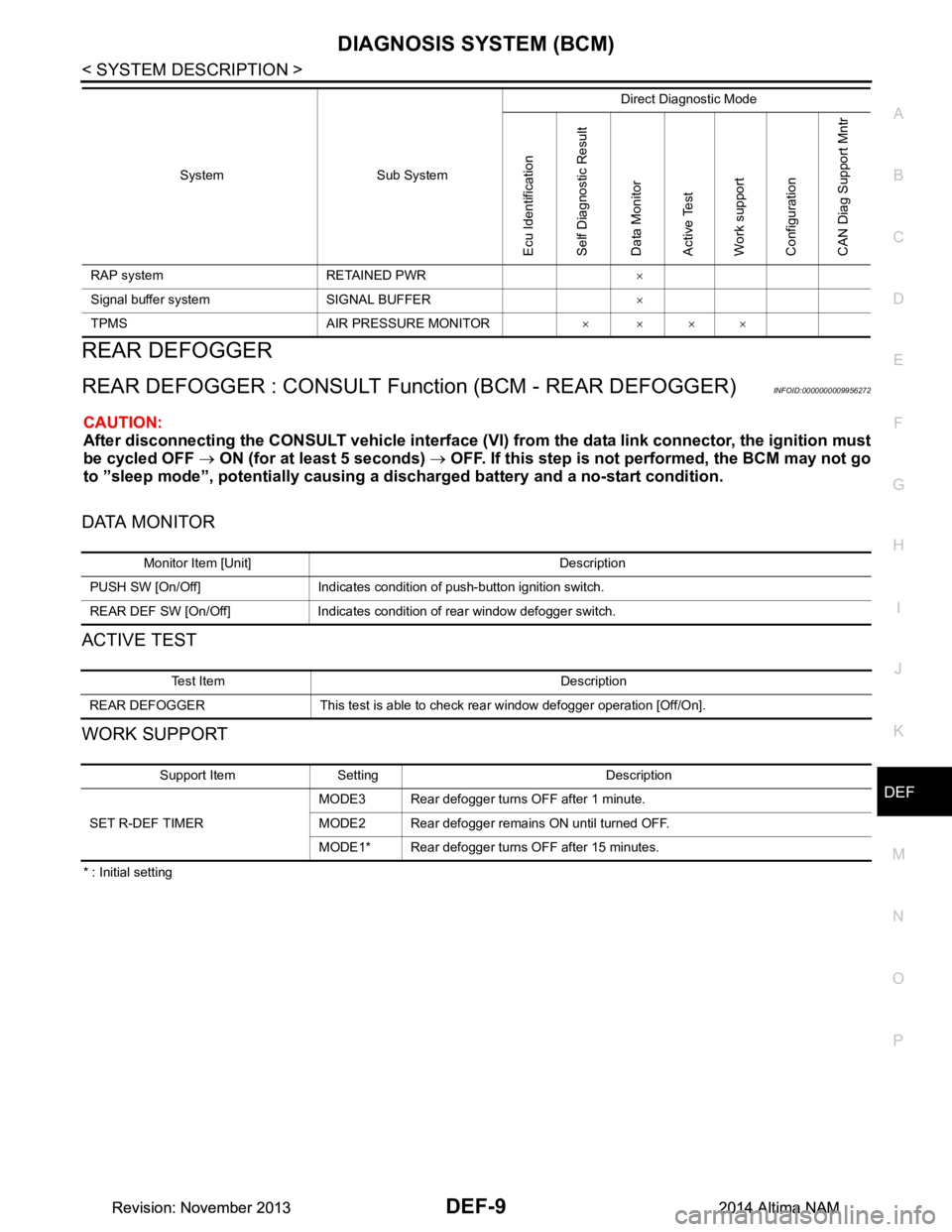
DIAGNOSIS SYSTEM (BCM)DEF-9
< SYSTEM DESCRIPTION >
C
D E
F
G H
I
J
K
M A
B
DEF
N
O P
REAR DEFOGGER
REAR DEFOGGER : CONSULT Func tion (BCM - REAR DEFOGGER)INFOID:0000000009956272
CAUTION:
After disconnecting the CONSULT vehicle interface (VI) from the data link connector, the ignition must
be cycled OFF → ON (for at least 5 seconds) → OFF. If this step is not performed, the BCM may not go
to ”sleep mode”, potentiall y causing a discharged battery and a no-start condition.
DATA MONITOR
ACTIVE TEST
WORK SUPPORT
* : Initial setting RAP system RETAINED PWR
×
Signal buffer system SIGNAL BUFFER ×
TPMS AIR PRESSURE MONITOR ××××
System Sub System
Direct Diagnostic Mode
Ecu Identification
Self Diagnostic Result
Data Monitor
Active Test
Work support
Configuration
CAN Diag Support Mntr
Monitor Item [Unit] Description
PUSH SW [On/Off] Indicates condition of push-button ignition switch.
REAR DEF SW [On/Off] Indicates condition of rear window defogger switch.
Test Item Description
REAR DEFOGGER This test is able to check rear window defogger operation [Off/On].
Support Item Setting Description
SET R-DEF TIMER MODE3 Rear defogger turns OFF after 1 minute.
MODE2 Rear defogger remains ON until turned OFF.
MODE1* Rear defogger turns OFF after 15 minutes.
Revision: November 20132014 Altima NAMRevision: November 20132014 Altima NAM
Page 811 of 4801
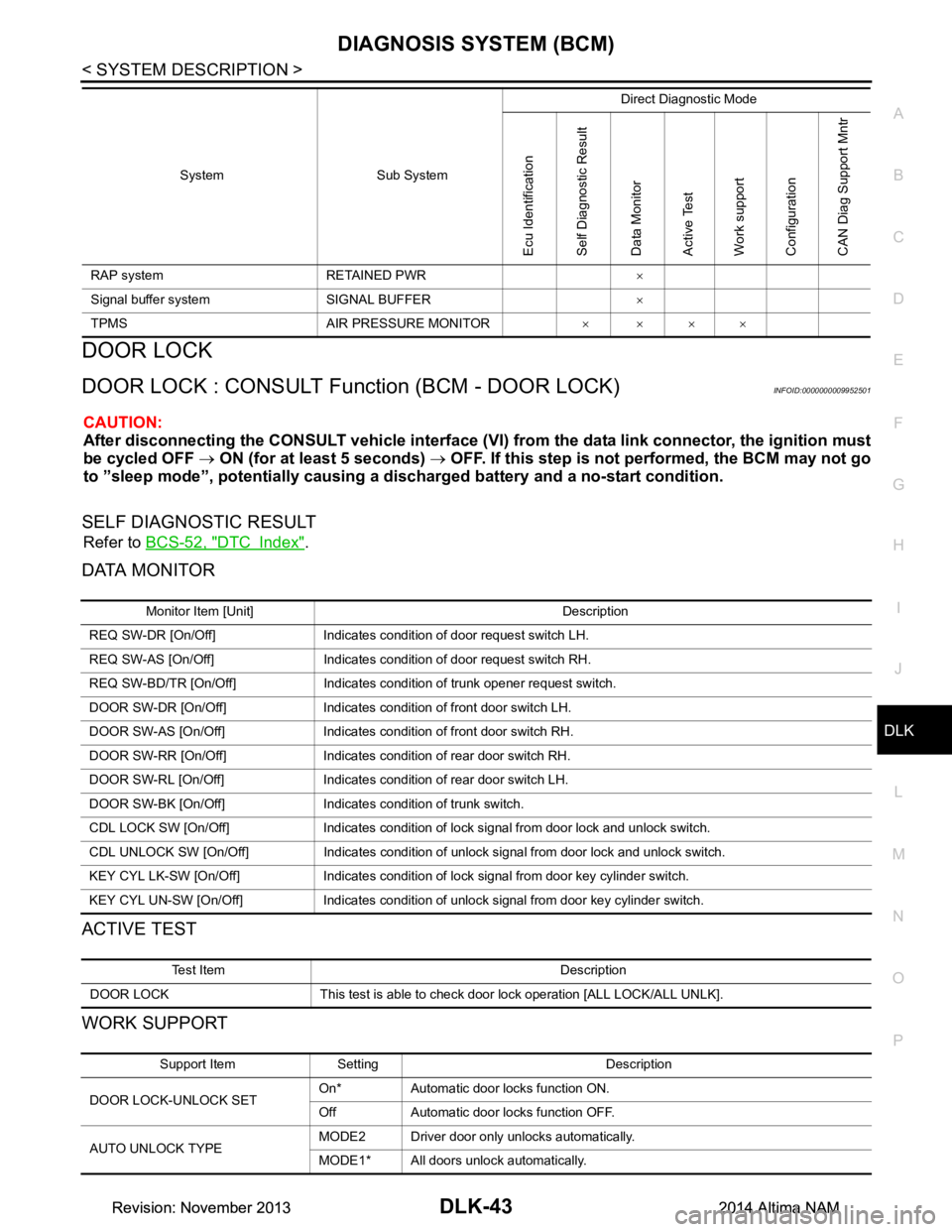
DIAGNOSIS SYSTEM (BCM)DLK-43
< SYSTEM DESCRIPTION >
C
D E
F
G H
I
J
L
M A
B
DLK
N
O P
DOOR LOCK
DOOR LOCK : CONSULT Func tion (BCM - DOOR LOCK)INFOID:0000000009952501
CAUTION:
After disconnecting the CONSULT vehicle interface (VI) from the data link connector, the ignition must
be cycled OFF → ON (for at least 5 seconds) → OFF. If this step is not performed, the BCM may not go
to ”sleep mode”, potentiall y causing a discharged battery and a no-start condition.
SELF DIAGNOSTIC RESULT
Refer to BCS-52, "DTC Index".
DATA MONITOR
ACTIVE TEST
WORK SUPPORT
RAP system RETAINED PWR ×
Signal buffer system SIGNAL BUFFER ×
TPMS AIR PRESSURE MONITOR ××××
System Sub System
Direct Diagnostic Mode
Ecu Identification
Self Diagnostic Result
Data Monitor
Active Test
Work support
Configuration
CAN Diag Support Mntr
Monitor Item [Unit] Description
REQ SW-DR [On/Off] Indicates condition of door request switch LH.
REQ SW-AS [On/Off] Indicates condition of door request switch RH.
REQ SW-BD/TR [On/Off] Indicates condition of trunk opener request switch.
DOOR SW-DR [On/Off] Indicates condition of front door switch LH.
DOOR SW-AS [On/Off] Indicates condition of front door switch RH.
DOOR SW-RR [On/Off] In dicates condition of rear door switch RH.
DOOR SW-RL [On/Off] Indicates condition of rear door switch LH.
DOOR SW-BK [On/Off] Indicates condition of trunk switch.
CDL LOCK SW [On/Off] Indicates condition of lock signal from door lock and unlock switch.
CDL UNLOCK SW [On/Off] Indicates condition of unlock signal from door lock and unlock switch.
KEY CYL LK-SW [On/Off] Indicates condition of lo ck signal from door key cylinder switch.
KEY CYL UN-SW [On/Off] Indicates condition of unlo ck signal from door key cylinder switch.
Test Item Description
DOOR LOCK This test is able to check door lock operation [ALL LOCK/ALL UNLK].
Support Item Setting Description
DOOR LOCK-UNLOCK SET On* Automatic door locks function ON.
Off Automatic door locks function OFF.
AUTO UNLOCK TYPE MODE2 Driver door only unlocks automatically.
MODE1* All doors unlock automatically.
Revision: November 20132014 Altima NAMRevision: November 20132014 Altima NAM
Page 1001 of 4801

EC-1
ENGINE
C
D E
F
G H
I
J
K L
M
SECTION EC
A
EC
N
O P
CONTENTS
ENGINE CONTROL SYSTEM
QR25DE
PRECAUTION ................ ..............................
15
PRECAUTIONS .............................................. ....15
Precaution for Supplemental Restraint System
(SRS) "AIR BAG" and "SEAT BELT PRE-TEN-
SIONER" ............................................................. ....
15
Precaution for Procedure without Cowl Top Cover ....15
On Board Diagnostic (OBD) System of Engine
and CVT .............................................................. ....
15
General Precautions ...............................................16
PREPARATION ...........................................19
PREPARATION .............................................. ....19
Special Service Tools .......................................... ....19
Commercial Service Tools ......................................19
SYSTEM DESCRIPTION .............................21
COMPONENT PARTS ................................... ....21
Component Parts Location ................................ ....21
ECM ........................................................................25
Accelerator Pedal Position Sensor ...................... ....25
Electric Throttle Control Actuator ........................ ....25
Ignition Coil With Power Transistor .........................26
Fuel Injector ........................................................ ....26
Fuel Level Sensor Unit and Fuel Pump .............. ....26
Fuel Tank Temperature Sensor .......................... ....27
Mass Air Flow Sensor (With Intake Air Tempera-
ture Sensor) ........................................................ ....
27
Manifold Absolute Pressure Sensor ........................28
Engine Coolant Temperature Sensor .................. ....28
Crankshaft Position Sensor (POS) ..........................29
Camshaft Position Sens or (PHASE) .......................29
Intake Valve Timing Cont rol Solenoid Valve ...........30
Intake Valve Timing Intermediate Lock Control
Solenoid Valve .................................................... ....
30
Exhaust Valve Timing Control Position Sensor .......30
Exhaust Valve Timing Control Solenoid Valve ........31
Intake Manifold Runner Control Valve ................. ....31
Intake Manifold Tuning Valve ..................................31
Air Fuel Ratio (A/F) Sensor 1 ..................................32
Heated Oxygen Sensor 2 ........................................32
Knock Sensor ..........................................................33
Engine Oil Pressure Sensor ....................................33
Engine Oil Temperature Sensor .......................... ....33
Cooling Fan .............................................................34
EVAP Canister .........................................................34
EVAP Canister Purge Volu me Control Solenoid
Valve .................................................................... ....
34
EVAP Canister Vent Control Valve ..........................35
EVAP Control System Pres sure Sensor ..................35
Battery Current Sensor (With Battery Tempera-
ture Sensor) ......................................................... ....
35
Malfunction Indicator lamp (MIL) .............................36
Oil Pressure Warning Lamp ....................................36
Refrigerant Pressure Sensor ............................... ....36
Stop Lamp Switch & Brake Pedal Position Switch ....36
ASCD Steering Switch .............................................37
Information Display ..................................................37
STRUCTURE AND OPERATION .....................38
Positive Crankcase Ventilation ................................38
On Board Refueling Vapor Recovery (ORVR) ........39
SYSTEM ............................................................40
ENGINE CONTROL SYSTEM ........................ ...........40
ENGINE CONTROL SYSTEM : System Descrip-
tion ....................................................................... ....
40
ENGINE CONTROL SYSTEM : Fail Safe ..............41
MULTIPORT FUEL INJECTION SYSTEM ................43
MULTIPORT FUEL INJECTION SYSTEM : Sys-
tem Description (with auto matic air conditioner) ......
43
MULTIPORT FUEL INJECTION SYSTEM : Sys-
tem Description (with manual air conditioner) .........
46
ELECTRIC IGNITION SYSTEM .................................48
ELECTRIC IGNITION SYSTEM : System De-
scription ............................................................... ....
48
Revision: November 20132014 Altima NAMRevision: November 20132014 Altima NAM