esp NISSAN TEANA 2014 User Guide
[x] Cancel search | Manufacturer: NISSAN, Model Year: 2014, Model line: TEANA, Model: NISSAN TEANA 2014Pages: 4801, PDF Size: 51.2 MB
Page 687 of 4801
![NISSAN TEANA 2014 User Guide
DAS-254
< BASIC INSPECTION >[MOD]
ACTION TEST
ACTION TEST
DescriptionINFOID:0000000009464902
• Perform action test to verify the customers concern.
• Perform action test and check the syst em o](/img/5/57390/w960_57390-686.png "NISSAN TEANA 2014 User Guide
DAS-254
< BASIC INSPECTION >[MOD]
ACTION TEST
ACTION TEST
DescriptionINFOID:0000000009464902
• Perform action test to verify the customers concern.
• Perform action test and check the syst em o")
DAS-254
< BASIC INSPECTION >[MOD]
ACTION TEST
ACTION TEST
DescriptionINFOID:0000000009464902
• Perform action test to verify the customer's concern.
• Perform action test and check the syst em operation after system diagnosis.
WARNING:
Be careful of traffic conditions and safety ar ound the vehicle when performing road test.
CAUTION:
• Fully understand the following it ems well before the road test;
- Precautions: Refer to DAS-73, "Precaution for LDW System Service"
.
- System description for LDW: Refer to DAS-77, "System Description"
.
- System description for BSW: Refer to DAS-152, "System Description"
.
- System description for MOD: Refer to DAS-228, "System Description"
.
- Handling precaution: Refer to DAS-82, "Precautions for Lane Departure Warning"
.
Inspection ProcedureINFOID:0000000009464903
WARNING:
Be careful of traffic conditions and safety ar ound the vehicle when performing road test.
CAUTION:
• Fully understand the following it ems well before the road test;
- Precautions: Refer to DAS-73, "Precaution for LDW System Service"
.
- System description for LDW: Refer to DAS-77, "System Description"
.
- System description for BSW: Refer to DAS-152, "System Description"
.
- System description for MOD: Refer to DAS-228, "System Description"
.
- Handling precaution: Refer to DAS-232, "Precautions for Moving Objects Detection"
.
1.CHECK MOD SYSTEM SETTING
1. Start the engine.
2. Check that the MOD system setting can be enabl ed/disabled on the vehicle information display.
3. Turn OFF the ignition switch and wait for 30 seconds or more.
4. Check that the previous setting is saved when the engine starts again.
>> GO TO 2.
2.ACTION TEST FOR MOD
1. Enable the setting of the MOD system on the vehicle information display.
2. Turn warning systems switch ON (w arning systems ON indicator is ON).
3. Check the MOD operation according to the following table.
NOTE:
After the operating conditions of warning are satisfi ed, the warning continues until the vehicle reaches a
higher speed. Refer to DAS-228, "System Description"
.
>> Inspection End.
Vehicle condition/ Driver's operation Vehicle response
Moving Object De-
tection ON indicator Vehicle speed
(Approx.)
[km/h (MPH)] Status of vehicle detection
within detection area Indication on the Moving Object Detection
indicator Buzzer
OFF — — OFF OFF
Blue Less than approx.
8 km/h (5 MPH) Vehicle is detected ON ON
Approx. 8 km/h (5
MPH) or more Vehicle is absent ON OFF
Vehicle is detected ON OFF
Vehicle is not detected ON OFF
Revision: November 20132014 Altima NAMRevision: November 20132014 Altima NAM
Page 793 of 4801
SYSTEM (INTELLIGENT KEY SYSTEM)DLK-25
< SYSTEM DESCRIPTION >
C
D E
F
G H
I
J
L
M A
B
DLK
N
O P
OPERATION DESCRIPTION
• When the BCM detects that each door request switch (if equipped) is pressed, it activates the outside key
antenna and inside key antenna corresponding to the pres sed door request switch (if equipped) and trans-
mits the request signal to the Intelligent Key. T hen check that the Intelligent Key is near the door.
• If the Intelligent Key is within the outside key ant enna detection area, it receives the request signal and
transmits the key ID signal to the BCM via remote keyless entry receiver.
• BCM receives the key ID signal and compares it with the registered key ID.
• BCM locks/unlocks each door.
• BCM sounds Intelligent Key warning buzzer (lock: 2 ti mes, unlock: 1 time) and blinks hazard warning lamps
(lock: 2 times, unlock: 1 time) at the same time as a reminder.
OPERATION CONDITION
If the following conditions are satisfied, door lock/unl ock operation is performed if the door request switch (if
equipped) is operated.
*: Even with a registered Intelligent Key remaining inside the vehicle, door locks can be locked/unlocked from outside of the v ehicle with
a spare Intelligent Key as long as key IDs are different.
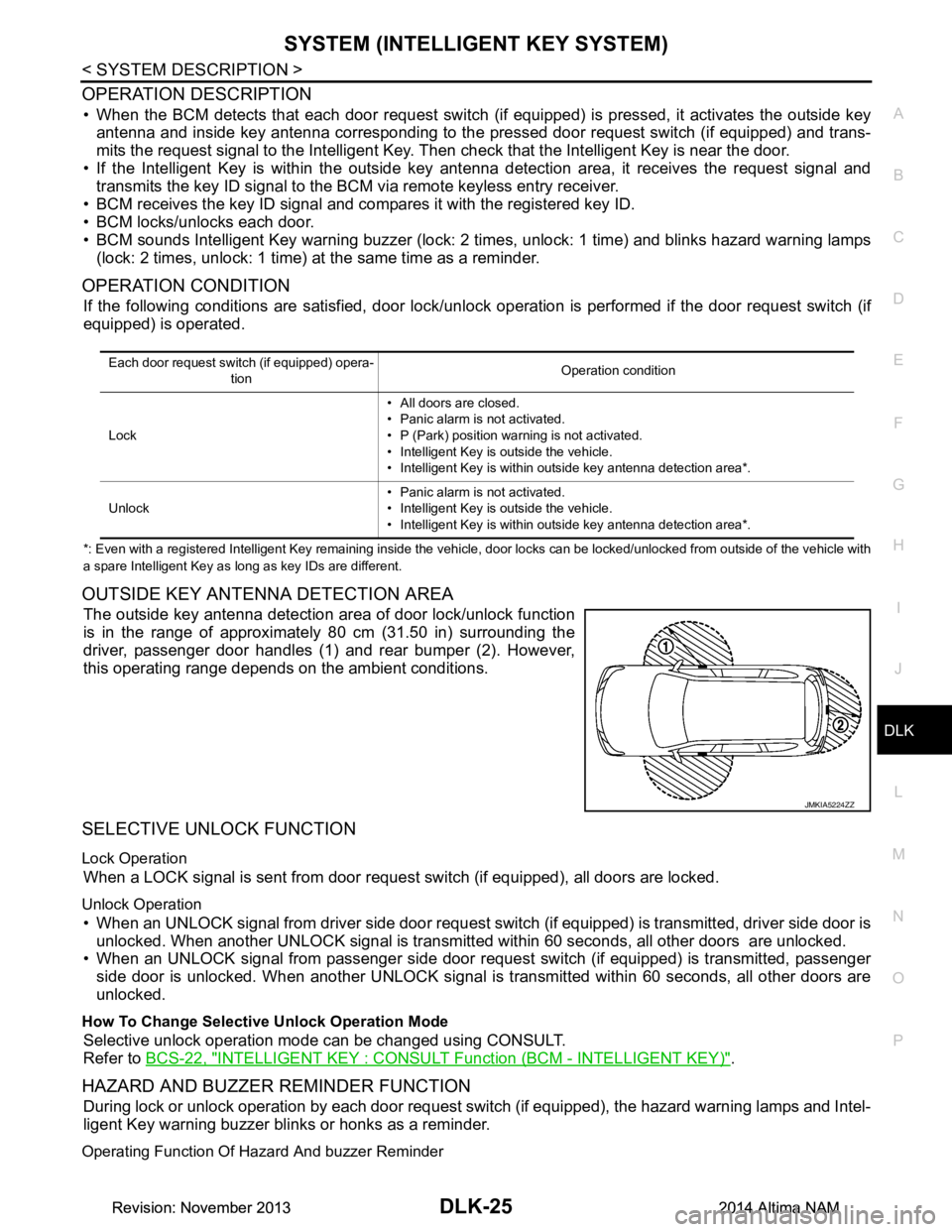
OUTSIDE KEY ANTENNA DETECTION AREA
The outside key antenna detection area of door lock/unlock function
is in the range of approximately 80 cm (31.50 in) surrounding the
driver, passenger door handles (1) and rear bumper (2). However,
this operating range depends on the ambient conditions.
SELECTIVE UNLOCK FUNCTION
Lock Operation
When a LOCK signal is sent from door r equest switch (if equipped), all doors are locked.
Unlock Operation
• When an UNLOCK signal from driver side door request swit ch (if equipped) is transmitted, driver side door is
unlocked. When another UNLOCK signal is transmitted within 60 seconds, all other doors are unlocked.
• When an UNLOCK signal from passenger side door reques t switch (if equipped) is transmitted, passenger
side door is unlocked. When another UNLOCK signal is transmitted within 60 seconds, all other doors are
unlocked.
How To Change Selective Unlock Operation Mode
Selective unlock operation mode can be changed using CONSULT.
Refer to BCS-22, "INTELLIGENT KEY : CONSUL T Function (BCM - INTELLIGENT KEY)"
.
HAZARD AND BUZZER REMINDER FUNCTION
During lock or unlock operation by each door request switch (if equipped), the hazard warning lamps and Intel-
ligent Key warning buzzer blinks or honks as a reminder.
Operating Function Of Hazard And buzzer Reminder
Each door request switch (if equipped) opera-
tion Operation condition
Lock • All doors are closed.
• Panic alarm is not activated.
• P (Park) position warning is not activated.
• Intelligent Key is outside the vehicle.
• Intelligent Key is within outside key antenna detection area*.
Unlock • Panic alarm is not activated.
• Intelligent Key is outside the vehicle.
• Intelligent Key is within outside key antenna detection area*.
JMKIA5224ZZ
Revision: November 20132014 Altima NAMRevision: November 20132014 Altima NAM
Page 805 of 4801
SYSTEM (INTELLIGENT KEY SYSTEM)DLK-37
< SYSTEM DESCRIPTION >
C
D E
F
G H
I
J
L
M A
B
DLK
N
O P
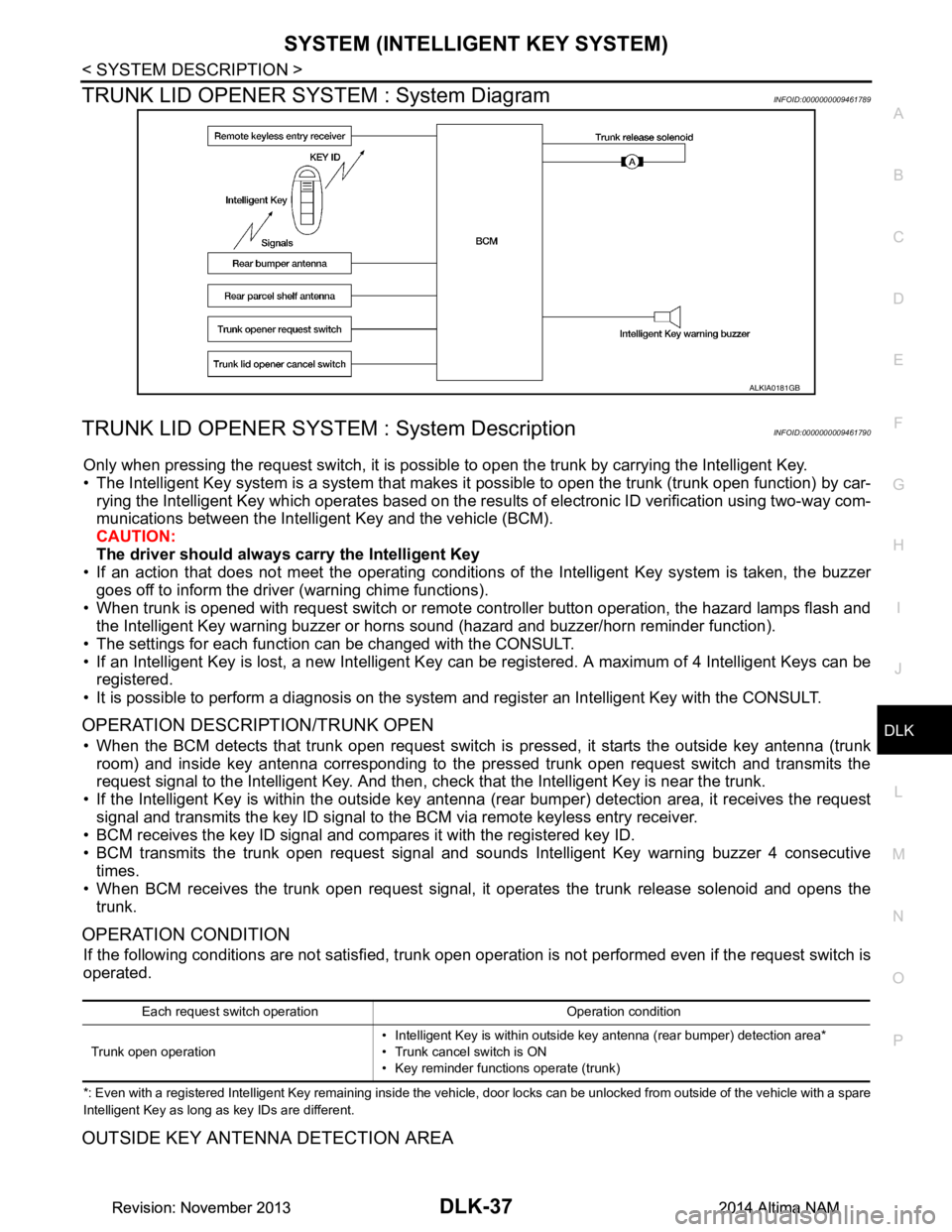
TRUNK LID OPENER SYSTEM : System DiagramINFOID:0000000009461789
TRUNK LID OPENER SYSTEM : System DescriptionINFOID:0000000009461790
Only when pressing the request switch, it is possibl e to open the trunk by carrying the Intelligent Key.
• The Intelligent Key system is a system that makes it possible to open the trunk (trunk open function) by car-
rying the Intelligent Key which operates based on the resu lts of electronic ID verification using two-way com-
munications between the Intelli gent Key and the vehicle (BCM).
CAUTION:
The driver should always carry the Intelligent Key
• If an action that does not meet the operating conditions of the Intelligent Key system is taken, the buzzer
goes off to inform the driver (warning chime functions).
• When trunk is opened with request switch or remote controller button operation, the hazard lamps flash and the Intelligent Key warning buzzer or horns sound (hazard and buzzer/horn reminder function).
• The settings for each functi on can be changed with the CONSULT.
• If an Intelligent Key is lost, a new Intelligent Key can be registered. A maximum of 4 Intelligent Keys can be registered.
• It is possible to perform a diagnosis on the system and register an Intelligent Key with the CONSULT.
OPERATION DESCRIPTION/TRUNK OPEN
• When the BCM detects that trunk open request switch is pressed, it starts the outside key antenna (trunk
room) and inside key antenna corresponding to the pressed trunk open request switch and transmits the
request signal to the Intelligent Key. And then, c heck that the Intelligent Key is near the trunk.
• If the Intelligent Key is within the outside key ant enna (rear bumper) detection area, it receives the request
signal and transmits the key ID signal to the BCM via remote keyless entry receiver.
• BCM receives the key ID signal and compares it with the registered key ID.
• BCM transmits the trunk open request signal and sounds Intelligent Key warning buzzer 4 consecutive
times.
• When BCM receives the trunk open request signal, it operates the trunk release solenoid and opens the trunk.
OPERATION CONDITION
If the following conditions are not satisfied, trunk open operation is not performed even if the request switch is
operated.
*: Even with a registered Intelligent Key remaining inside the vehicle, door locks can be unlocked from outside of the vehicle with a spare
Intelligent Key as long as key IDs are different.
OUTSIDE KEY ANTENNA DETECTION AREA
ALKIA0181GB
Each request switch operation Operation condition
Trunk open operation • Intelligent Key is within outside key antenna (rear bumper) detection area*
• Trunk cancel switch is ON
• Key reminder functions operate (trunk)
Revision: November 20132014 Altima NAMRevision: November 20132014 Altima NAM
Page 932 of 4801
DLK-164
< SYMPTOM DIAGNOSIS >
SQUEAK AND RATTLE TROUBLE DIAGNOSES
SQUEAK AND RATTLE TROUBLE DIAGNOSES
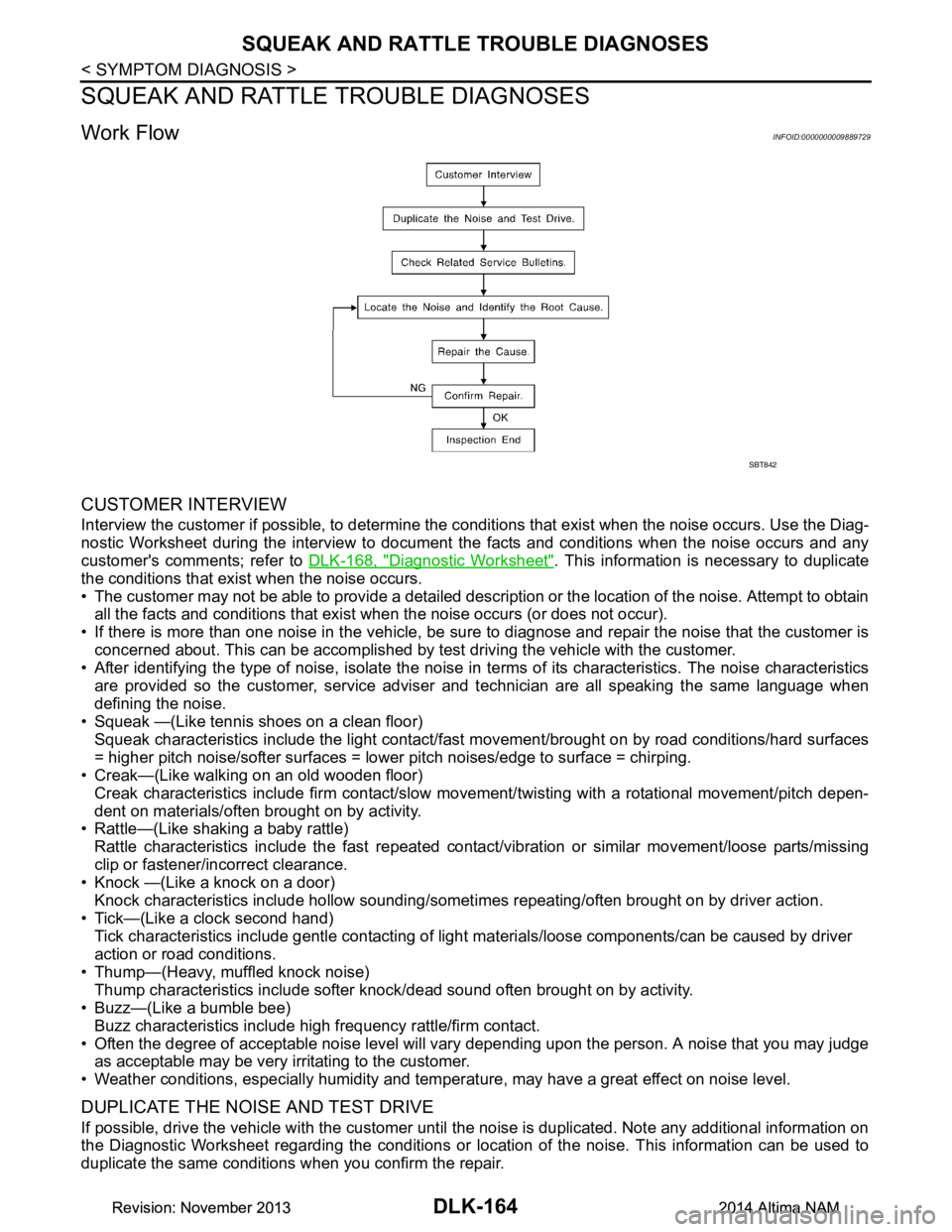
Work FlowINFOID:0000000009889729
CUSTOMER INTERVIEW
Interview the customer if possible, to determine the conditions that exist when the noise occurs. Use the Diag-
nostic Worksheet during the interview to document the facts and conditions when the noise occurs and any
customer's comments; refer to DLK-168, "Diagnostic Worksheet"
. This information is necessary to duplicate
the conditions that exist when the noise occurs.
• The customer may not be able to provide a detailed description or the location of the noise. Attempt to obtain all the facts and conditions that exist w hen the noise occurs (or does not occur).
• If there is more than one noise in the vehicle, be sure to diagnose and repair the noise that the customer is
concerned about. This can be accomplished by test driving the vehicle with the customer.
• After identifying the type of noise, isolate the noise in terms of its characteristics. The noise characteristics
are provided so the customer, service adviser and technician are all speaking the same language when
defining the noise.
• Squeak —(Like tennis shoes on a clean floor)
Squeak characteristics include the light contact/fast movement/brought on by road conditions/hard surfaces
= higher pitch noise/softer surfaces = lower pitch noises/edge to surface = chirping.
• Creak—(Like walking on an old wooden floor)
Creak characteristics include firm contact/slow mo vement/twisting with a rotational movement/pitch depen-
dent on materials/often brought on by activity.
• Rattle—(Like shaking a baby rattle)
Rattle characteristics include the fast repeated contac t/vibration or similar movement/loose parts/missing
clip or fastener/incorrect clearance.
• Knock —(Like a knock on a door)
Knock characteristics include hollow sounding/someti mes repeating/often brought on by driver action.
• Tick—(Like a clock second hand) Tick characteristics include gentle contacting of light materials/loose components/can be caused by driver
action or road conditions.
• Thump—(Heavy, muffled knock noise) Thump characteristics include softer k nock/dead sound often brought on by activity.
• Buzz—(Like a bumble bee)
Buzz characteristics include hi gh frequency rattle/firm contact.
• Often the degree of acceptable noise level will vary depending upon the person. A noise that you may judge as acceptable may be very irritating to the customer.
• Weather conditions, especially humidity and temperat ure, may have a great effect on noise level.
DUPLICATE THE NOISE AND TEST DRIVE
If possible, drive the vehicle with the customer until the noise is duplicated. Note any additional information on
the Diagnostic Worksheet regarding the conditions or lo cation of the noise. This information can be used to
duplicate the same conditions when you confirm the repair.
SBT842
Revision: November 20132014 Altima NAMRevision: November 20132014 Altima NAM
Page 1015 of 4801
![NISSAN TEANA 2014 User Guide
PRECAUTIONSEC-15
< PRECAUTION > [QR25DE]
C
D E
F
G H
I
J
K L
M A
EC
NP
O
PRECAUTION
PRECAUTIONS
Precaution for Supplemental
Restraint System (SRS) "AIR BAG" and "SEAT BELT
PRE-TENSIONER"
INFOID:00](/img/5/57390/w960_57390-1014.png "NISSAN TEANA 2014 User Guide
PRECAUTIONSEC-15
< PRECAUTION > [QR25DE]
C
D E
F
G H
I
J
K L
M A
EC
NP
O
PRECAUTION
PRECAUTIONS
Precaution for Supplemental
Restraint System (SRS) \"AIR BAG\" and \"SEAT BELT
PRE-TENSIONER\"
INFOID:00")
PRECAUTIONSEC-15
< PRECAUTION > [QR25DE]
C
D E
F
G H
I
J
K L
M A
EC
NP
O
PRECAUTION
PRECAUTIONS
Precaution for Supplemental
Restraint System (SRS) "AIR BAG" and "SEAT BELT
PRE-TENSIONER"
INFOID:0000000009951805
The Supplemental Restraint System such as “A IR BAG” and “SEAT BELT PRE-TENSIONER”, used along
with a front seat belt, helps to reduce the risk or severi ty of injury to the driver and front passenger for certain
types of collision. Information necessary to service t he system safely is included in the SR and SB section of
this Service Manual.
WARNING:
• To avoid rendering the SRS inoper ative, which could increase the risk of personal injury or death in
the event of a collision which would result in air bag inflation, all maintenance must be performed by
an authorized NISSAN/INFINITI dealer.
• Improper maintenance, including in correct removal and installation of the SRS, can lead to personal
injury caused by unintentional act ivation of the system. For removal of Spiral Cable and Air Bag
Module, see the SR section.
• Do not use electrical test equipm ent on any circuit related to the SRS unless instructed to in this
Service Manual. SRS wiring harnesses can be identi fied by yellow and/or orange harnesses or har-
ness connectors.
PRECAUTIONS WHEN USING POWER TOOLS (AIR OR ELECTRIC) AND HAMMERS
WARNING:
• When working near the Airbag Diagnosis Sensor Un it or other Airbag System sensors with the Igni-
tion ON or engine running, DO NOT use air or el ectric power tools or strike near the sensor(s) with a
hammer. Heavy vibration could activate the sensor( s) and deploy the air bag(s), possibly causing
serious injury.
• When using air or electric power tools or hammers , always switch the Ignition OFF, disconnect the
battery and wait at least three mi nutes before performing any service.
Precaution for Procedure without Cowl Top CoverINFOID:0000000009462048
When performing the procedure after removing cowl top cover, cover
the lower end of windshield with urethane, etc to prevent damage to
windshield.
On Board Diagnostic (OBD) S ystem of Engine and CVTINFOID:0000000009462049
The ECM has an on board diagnostic system . It will light up the malfunction indicator lamp (MIL) to warn the
driver of a malfunction causing emission deterioration.
CAUTION:
• Be sure to turn the ignition switch OFF and di sconnect the negative battery cable before any repair
or inspection work. The open/short circuit of re lated switches, sensors, solenoid valves, etc. will
cause the MIL to light up.
• Be sure to connect and lock the connectors secure ly after work. A loose (unlocked) connector will
cause the MIL to light up due to the open circuit. (Be sure the connector is free from water, grease,
dirt, bent terminals, etc.)
• Certain systems and components, especially those related to OBD, may use a new style slide-lock-
ing type harness connector. For descripti on and how to disconnect, refer to PG-65, "Description"
.
• Be sure to route and secure the harnesses properly after work. The interference of the harness with
a bracket, etc. may cause the MIL to li ght up due to the short circuit.
PIIB3706J
Revision: November 20132014 Altima NAMRevision: November 20132014 Altima NAM
Page 1026 of 4801
![NISSAN TEANA 2014 User Guide
EC-26
< SYSTEM DESCRIPTION >[QR25DE]
COMPONENT PARTS
THROTTLE CONTROL MOTOR RELAY
Power supply for the throttle control motor is provided to
the ECM via throttle control motor relay. The throttle
co](/img/5/57390/w960_57390-1025.png "NISSAN TEANA 2014 User Guide
EC-26
< SYSTEM DESCRIPTION >[QR25DE]
COMPONENT PARTS
THROTTLE CONTROL MOTOR RELAY
Power supply for the throttle control motor is provided to
the ECM via throttle control motor relay. The throttle
co")
EC-26
< SYSTEM DESCRIPTION >[QR25DE]
COMPONENT PARTS
THROTTLE CONTROL MOTOR RELAY
Power supply for the throttle control motor is provided to
the ECM via throttle control motor relay. The throttle
control motor relay is ON/OFF controlled by the ECM. When the ignition switch is turned ON, the ECM sends
an ON signal to throttle control motor relay and battery voltage is provided to the ECM. When the ignition
switch is turned OFF, the ECM sends an OFF signal to throttle control motor relay and battery voltage is not
provided to the ECM.
THROTTLE CONTROL MOTOR
The throttle control motor is operated by the ECM and it opens and closes the throttle valve.
The current opening angle of the throttle valve is detected by the throttle position sensor and it provides feed-
back to the ECM to control the throttle control mo tor to make the throttle valve opening angle properly in
response to driving condition.
THROTTLE POSITION SENSOR
The throttle position sensor responds to the throttle valve movement.
The throttle position sensor has two sensors. These sensors are a
kind of potentiometers which transform the throttle valve position into
output voltage, and emit the voltage signal to the ECM. In addition,
these sensors detect the opening and closing speed of the throttle
valve and feed the voltage signals to the ECM. The ECM judges the
current opening angle of the throttle valve from these signals and the
ECM controls the throttle control motor to make the throttle valve
opening angle properly in response to driving condition.
Ignition Coil With Power TransistorINFOID:0000000009462057
The ignition signal from the ECM is sent to and amplified by the
power transistor. The power transistor turns ON and OFF the ignition
coil primary circuit. This ON/OFF operation induces the proper high
voltage in the coil secondary circuit.
Fuel InjectorINFOID:0000000009462058
The fuel injector is a small, precise solenoid valve. When the ECM
supplies a ground to the fuel injector circuit, the coil in the fuel injec-
tor is energized. The energized coil pulls the ball valve back and
allows fuel to flow through the fuel injector into the intake manifold.
The amount of fuel injected depends upon the injection pulse dura-
tion. Pulse duration is the length of time the fuel injector remains
open. The ECM controls the injection pulse duration based on
engine fuel needs.
Fuel Level Sensor Unit and Fuel PumpINFOID:0000000009462059
FUEL PUMP
PBIB0145E
JPBIA4613ZZ
JPBIA5845ZZ
Revision: November 20132014 Altima NAMRevision: November 20132014 Altima NAM
Page 1032 of 4801
![NISSAN TEANA 2014 User Guide
EC-32
< SYSTEM DESCRIPTION >[QR25DE]
COMPONENT PARTS
Air Fuel Ratio (A/F) Sensor 1
INFOID:0000000009462072
The sensor element of the A/F sensor 1 is composed an electrode
layer, which transports ion](/img/5/57390/w960_57390-1031.png "NISSAN TEANA 2014 User Guide
EC-32
< SYSTEM DESCRIPTION >[QR25DE]
COMPONENT PARTS
Air Fuel Ratio (A/F) Sensor 1
INFOID:0000000009462072
The sensor element of the A/F sensor 1 is composed an electrode
layer, which transports ion")
EC-32
< SYSTEM DESCRIPTION >[QR25DE]
COMPONENT PARTS
Air Fuel Ratio (A/F) Sensor 1
INFOID:0000000009462072
The sensor element of the A/F sensor 1 is composed an electrode
layer, which transports ions. It has a heater in the element.
The sensor is capable of precise measurement = 1, but also in the lean and rich range. Together with its
control electronics, the sensor outputs a cl ear, continuous signal throughout a wide range.
The exhaust gas components diffuse through the diffusi on layer at the sensor cell. An electrode layer is
applied voltage, and this current relati ve oxygen density in lean. Also this current relative hydrocarbon density
in rich.
Therefore, the A/F sensor 1 is able to indicate air fuel ratio by this
electrode layer of current. In additi on, a heater is integrated in the
sensor to ensure the required operating temperature of approxi-
mately 760 °C (1,400 °F).
A/F SENSOR 1 HEATER
A/F sensor 1 heater is integrated in the sensor.
The ECM performs ON/OFF duty control of the A/F sensor 1 heater corresponding to the engine operating
condition to keep the temperature of A/F s ensor 1 element within the specified range.
Heated Oxygen Sensor 2INFOID:0000000009462073
The heated oxygen sensor 2, after three way catalyst (manifold),
monitors the oxygen level in the exhaust gas.
Even if switching characteristics of the air fuel ratio (A/F) sensor 1
are shifted, the air fuel ratio is controlled to stoichiometric, by the sig-
nal from the heated oxygen sensor 2.
This sensor is made of ceramic zirconia. The zirconia generates volt-
age from approximately 1 V in richer conditions to 0 V in leaner con-
ditions.
Under normal conditions the heated ox ygen sensor 2 is not used for
engine control operation.
HEATED OXYGEN SENSOR 2 HEATER
Heated oxygen sensor 2 heater is integrated in the sensor.
The ECM performs ON/OFF control of the heated oxy gen sensor 2 heater corresponding to the engine speed,
amount of intake air and engine coolant temperature.
JPBIA4038GB
JPBIA5446GB
SEF327R
Revision: November 20132014 Altima NAMRevision: November 20132014 Altima NAM
Page 1034 of 4801
![NISSAN TEANA 2014 User Guide
EC-34
< SYSTEM DESCRIPTION >[QR25DE]
COMPONENT PARTS
<Reference data>
*: These data are reference values and are measured between ECM terminals.
Cooling FanINFOID:0000000009462077
The ECM controls th](/img/5/57390/w960_57390-1033.png "NISSAN TEANA 2014 User Guide
EC-34
< SYSTEM DESCRIPTION >[QR25DE]
COMPONENT PARTS
<Reference data>
*: These data are reference values and are measured between ECM terminals.
Cooling FanINFOID:0000000009462077
The ECM controls th")
EC-34
< SYSTEM DESCRIPTION >[QR25DE]
COMPONENT PARTS
*: These data are reference values and are measured between ECM terminals.
Cooling FanINFOID:0000000009462077
The ECM controls the cooling fan corresponding to the
vehicle speed, engine coolant temperature, refrigerant
pressure, and air conditioner ON signal. The control system has 4-step control [HIGH/MIDDLE/LOW/OFF].
Cooling fan operates at each speed when the current flows in the cooling fan motor.
Refer to EC-59, "COOLING FAN CONTROL : System De scription (with automatic air conditioner)"
for cooling
fan operation.
EVAP CanisterINFOID:0000000009462078
EVAP canister stores the generat ed fuel vapors in the sealed fuel
tank to activated charcoals of EVAP canister when the engine is not
operating or when refueling to the fuel tank.
EVAP Canister Purge Volume Control Solenoid ValveINFOID:0000000009462079
The EVAP canister purge volume control solenoid valve uses a ON/
OFF duty to control the flow rate of fuel vapor from the EVAP canis-
ter. The EVAP canister purge volume control solenoid valve is
moved by ON/OFF pulses from the ECM. The longer the ON pulse,
the greater the amount of fuel vapor that will flow through the valve.
Engine oil temperature
[° C ( °F)] Vol tag e* (V)
Resistance (k
Ω)
–10 (14) 4.4 7.0 - 11.4 20 (68) 3.5 2.37 - 2.63
50 (122) 2.2 0.68 - 1.00
90 (194) 1.0 0.236 - 0.260
110 (230) 0.6 0.143 - 0.153
SEF012P
JPBIA5851ZZ
JMBIA0069ZZ
Revision: November 20132014 Altima NAMRevision: November 20132014 Altima NAM
Page 1035 of 4801
![NISSAN TEANA 2014 User Guide
COMPONENT PARTSEC-35
< SYSTEM DESCRIPTION > [QR25DE]
C
D E
F
G H
I
J
K L
M A
EC
NP
O
EVAP Canister Vent Control ValveINFOID:0000000009462080
The EVAP canister vent control valve is located on the EV](/img/5/57390/w960_57390-1034.png "NISSAN TEANA 2014 User Guide
COMPONENT PARTSEC-35
< SYSTEM DESCRIPTION > [QR25DE]
C
D E
F
G H
I
J
K L
M A
EC
NP
O
EVAP Canister Vent Control ValveINFOID:0000000009462080
The EVAP canister vent control valve is located on the EV")
COMPONENT PARTSEC-35
< SYSTEM DESCRIPTION > [QR25DE]
C
D E
F
G H
I
J
K L
M A
EC
NP
O
EVAP Canister Vent Control ValveINFOID:0000000009462080
The EVAP canister vent control valve is located on the EVAP canis-
ter and is used to seal the canister vent.
This solenoid valve responds to signals from the ECM. When the
ECM sends an ON signal, the coil in the solenoid valve is energized.
A plunger will then move to seal the canister vent. The ability to seal
the vent is necessary for the on board diagnosis of other evaporative
emission control system components.
This solenoid valve is used only for diagnosis, and usually remains
opened.
When the vent is closed, under normal purge conditions, the evapo-
rative emission control system is depressurized and allows “EVAP
Control System” diagnosis.
EVAP Control System Pressure SensorINFOID:0000000009462081
The EVAP control system pressure sensor detects pressure in the
purge line. The sensor output voltage to the ECM increases as pres-
sure increases.
Battery Current Sensor (With Battery Temperature Sensor)INFOID:0000000009462082
OUTLINE
The power generation voltage variable control enables fuel con-
sumption to be decreased by reducing the engine load which is
caused by the power generation of the generator.
Based on sensor signals, ECM judges whether or not the power
generation voltage variable contro l is performed. When performing
the power generation voltage variable control, ECM calculates the
target power generation voltage based on the sensor signal. And
ECM sends the calculated value as the power generation command
value to IPDM E/R. For the details of the power generation voltage
variable control, refer to CHG-10, "System Description"
.
CAUTION:
Never connect the electrical co mponent or the ground wire
directly to the battery terminal. The connection cau ses the malfunction of the power generation volt-
age variable control, and then the battery discharge may occur.
BATTERY CURRENT SENSOR
The battery current sensor is installed to the battery negative cable. The sensor measures the charging/dis-
charging current of the battery.
BATTERY TEMPERATURE SENSOR
PBIB1263E
PBIB3370E
JPBIA3262ZZ
Revision: November 20132014 Altima NAMRevision: November 20132014 Altima NAM
Page 1059 of 4801
![NISSAN TEANA 2014 User Guide
SYSTEMEC-59
< SYSTEM DESCRIPTION > [QR25DE]
C
D E
F
G H
I
J
K L
M A
EC
NP
O
COOLING FAN CONTROL : System Descripti
on (with automatic air conditioner)
INFOID:0000000009462104
SYSTEM DIAGRAM
SYSTEM](/img/5/57390/w960_57390-1058.png "NISSAN TEANA 2014 User Guide
SYSTEMEC-59
< SYSTEM DESCRIPTION > [QR25DE]
C
D E
F
G H
I
J
K L
M A
EC
NP
O
COOLING FAN CONTROL : System Descripti
on (with automatic air conditioner)
INFOID:0000000009462104
SYSTEM DIAGRAM
SYSTEM")
SYSTEMEC-59
< SYSTEM DESCRIPTION > [QR25DE]
C
D E
F
G H
I
J
K L
M A
EC
NP
O
COOLING FAN CONTROL : System Descripti
on (with automatic air conditioner)
INFOID:0000000009462104
SYSTEM DIAGRAM
SYSTEM DESCRIPTION
ECM controls cooling fan speed corresponding to vehicle speed, engine coolant temperature, refrigerant pres-
sure, air conditioner ON signal. Then control syst em has 4-step control [HIGH/MIDDLE/LOW/OFF].
Cooling Fan Operation
Cooling Fan Relay Operation
The ECM controls cooling fan relays through CAN communication line.
JPBIA3233GB
JMBIA0179GB
Revision: November 20132014 Altima NAMRevision: November 20132014 Altima NAM