ESP NISSAN TERRANO 2002 Service Owner's Guide
[x] Cancel search | Manufacturer: NISSAN, Model Year: 2002, Model line: TERRANO, Model: NISSAN TERRANO 2002Pages: 1767, PDF Size: 41.51 MB
Page 696 of 1767
Introduction
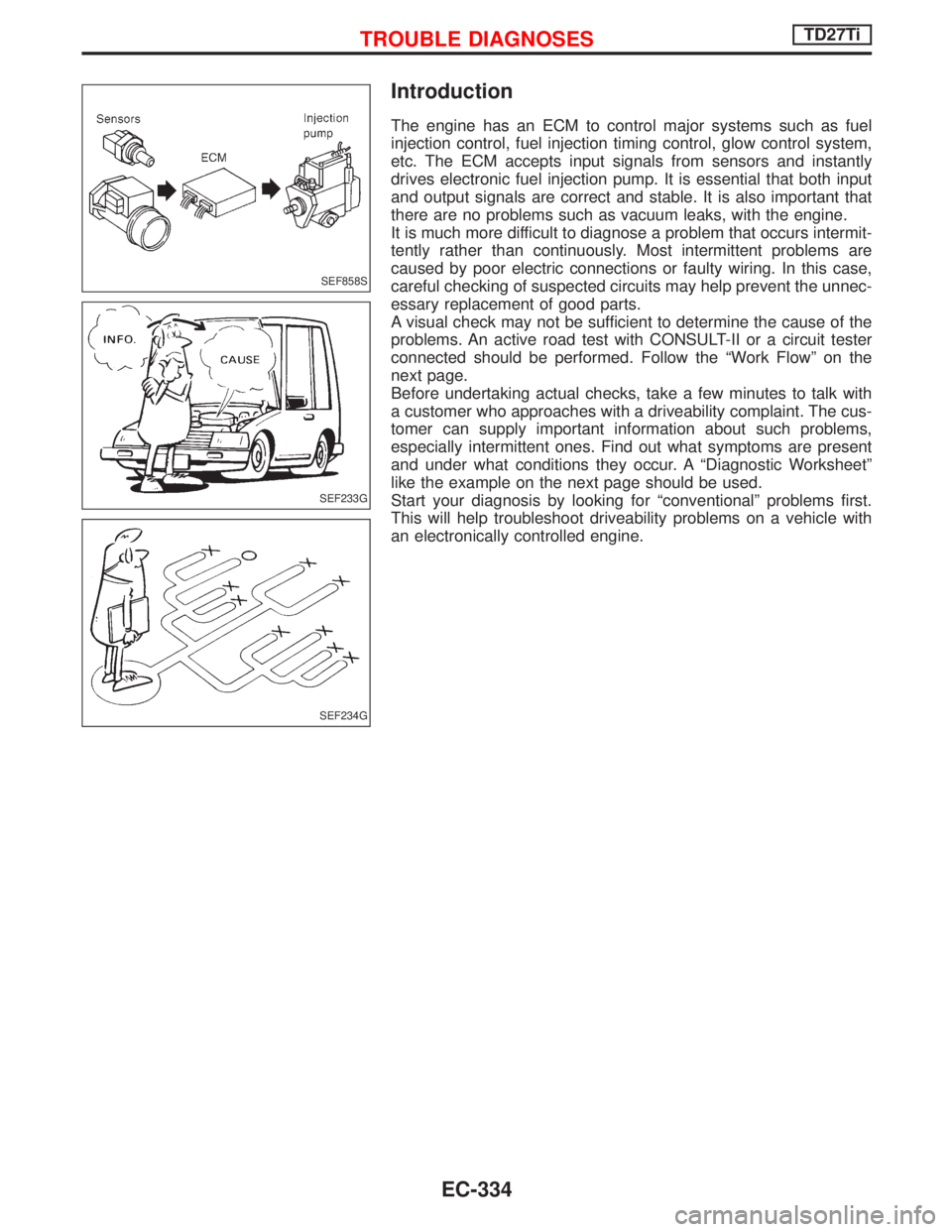
The engine has an ECM to control major systems such as fuel
injection control, fuel injection timing control, glow control system,
etc. The ECM accepts input signals from sensors and instantly
drives electronic fuel injection pump. It is essential that both input
and output signals are correct and stable. It is also important that
there are no problems such as vacuum leaks, with the engine.
It is much more difficult to diagnose a problem that occurs intermit-
tently rather than continuously. Most intermittent problems are
caused by poor electric connections or faulty wiring. In this case,
careful checking of suspected circuits may help prevent the unnec-
essary replacement of good parts.
A visual check may not be sufficient to determine the cause of the
problems. An active road test with CONSULT-II or a circuit tester
connected should be performed. Follow the ªWork Flowº on the
next page.
Before undertaking actual checks, take a few minutes to talk with
a customer who approaches with a driveability complaint. The cus-
tomer can supply important information about such problems,
especially intermittent ones. Find out what symptoms are present
and under what conditions they occur. A ªDiagnostic Worksheetº
like the example on the next page should be used.
Start your diagnosis by looking for ªconventionalº problems first.
This will help troubleshoot driveability problems on a vehicle with
an electronically controlled engine.
SEF858S
SEF233G
SEF234G
TROUBLE DIAGNOSESTD27Ti
EC-334
Page 718 of 1767
Component Description
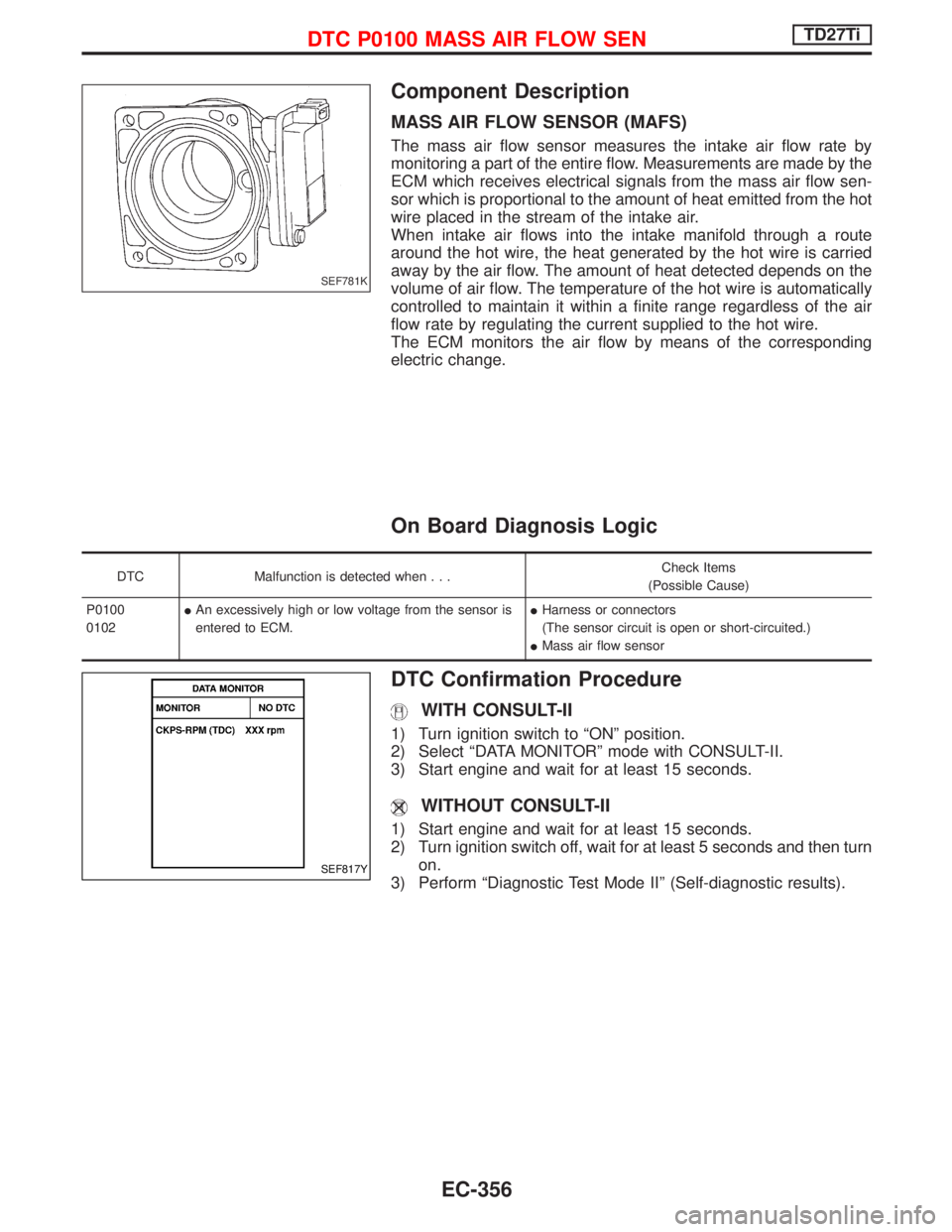
MASS AIR FLOW SENSOR (MAFS)
The mass air flow sensor measures the intake air flow rate by
monitoring a part of the entire flow. Measurements are made by the
ECM which receives electrical signals from the mass air flow sen-
sor which is proportional to the amount of heat emitted from the hot
wire placed in the stream of the intake air.
When intake air flows into the intake manifold through a route
around the hot wire, the heat generated by the hot wire is carried
away by the air flow. The amount of heat detected depends on the
volume of air flow. The temperature of the hot wire is automatically
controlled to maintain it within a finite range regardless of the air
flow rate by regulating the current supplied to the hot wire.
The ECM monitors the air flow by means of the corresponding
electric change.
On Board Diagnosis Logic
DTC Malfunction is detected when...Check Items
(Possible Cause)
P0100
0102IAn excessively high or low voltage from the sensor is
entered to ECM.IHarness or connectors
(The sensor circuit is open or short-circuited.)
IMass air flow sensor
DTC Confirmation Procedure
WITH CONSULT-II
1) Turn ignition switch to ªONº position.
2) Select ªDATA MONITORº mode with CONSULT-II.
3) Start engine and wait for at least 15 seconds.
WITHOUT CONSULT-II
1) Start engine and wait for at least 15 seconds.
2) Turn ignition switch off, wait for at least 5 seconds and then turn
on.
3) Perform ªDiagnostic Test Mode IIº (Self-diagnostic results).
SEF781K
SEF817Y
DTC P0100 MASS AIR FLOW SENTD27Ti
EC-356
Page 752 of 1767
Component Description
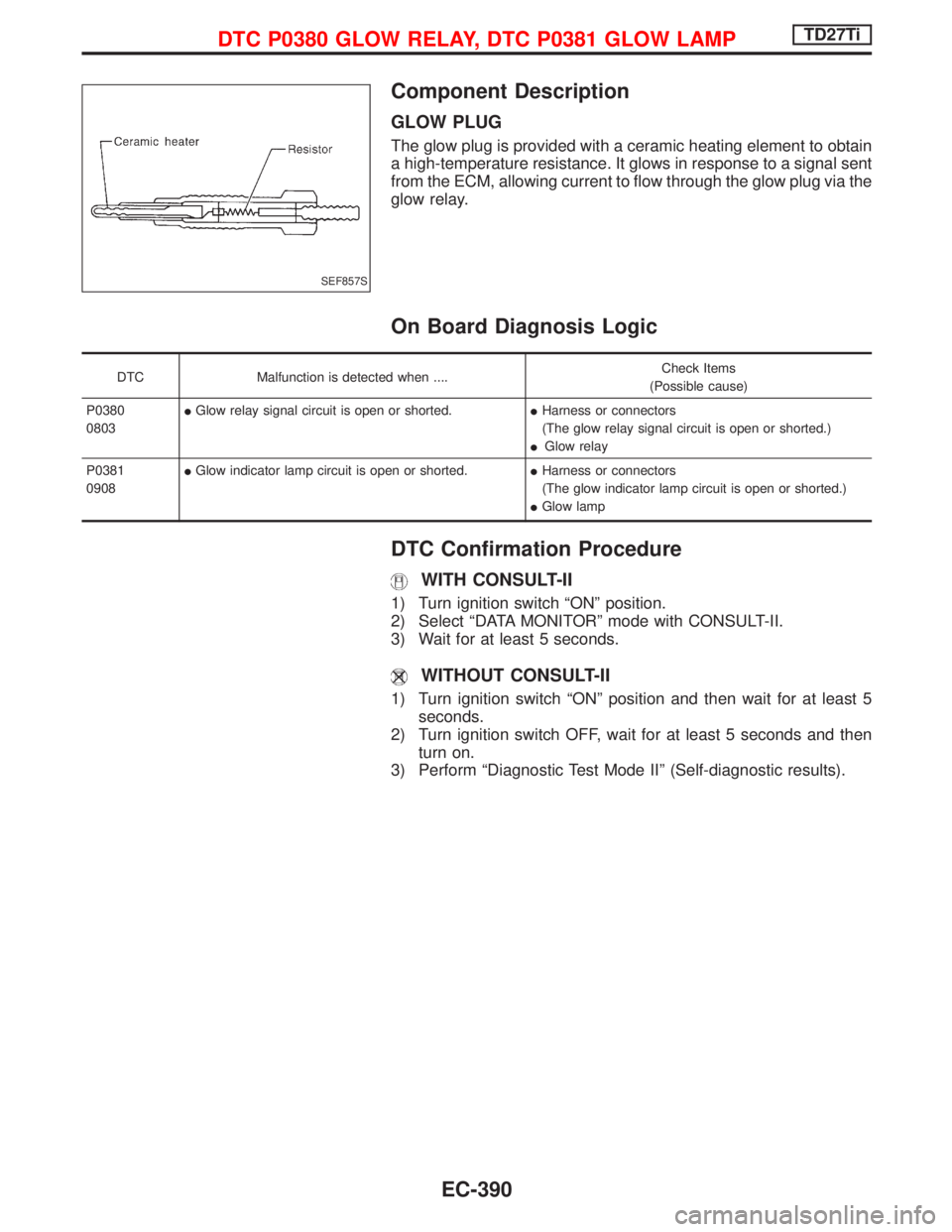
GLOW PLUG
The glow plug is provided with a ceramic heating element to obtain
a high-temperature resistance. It glows in response to a signal sent
from the ECM, allowing current to flow through the glow plug via the
glow relay.
On Board Diagnosis Logic
DTC Malfunction is detected when ....Check Items
(Possible cause)
P0380
0803IGlow relay signal circuit is open or shorted.IHarness or connectors
(The glow relay signal circuit is open or shorted.)
IGlow relay
P0381
0908IGlow indicator lamp circuit is open or shorted.IHarness or connectors
(The glow indicator lamp circuit is open or shorted.)
IGlow lamp
DTC Confirmation Procedure
WITH CONSULT-II
1) Turn ignition switch ªONº position.
2) Select ªDATA MONITORº mode with CONSULT-II.
3) Wait for at least 5 seconds.
WITHOUT CONSULT-II
1) Turn ignition switch ªONº position and then wait for at least 5
seconds.
2) Turn ignition switch OFF, wait for at least 5 seconds and then
turn on.
3) Perform ªDiagnostic Test Mode IIº (Self-diagnostic results).
SEF857S
DTC P0380 GLOW RELAY, DTC P0381 GLOW LAMPTD27Ti
EC-390
Page 780 of 1767
Description
SYSTEM DESCRIPTION
Sensor Input signal to ECM ECM function Actuator
Engine coolant temperature
sensorEngine coolant temperature
Cooling fan control Cooling fan relay
Air conditioner switch Air conditioner ªONº signal
The ECM controls the cooling fan corresponding to the vehicle speed, engine coolant temperature, air condi-
tioner ON signal.
On Board Diagnosis Logic
This diagnosis continuously monitors the engine coolant temperature.
If the cooling fan or another component in the cooling system malfunctions, engine coolant temperature will
rise.
When the engine coolant temperature reaches an abnormally high temperature condition, a malfunction is
indicated.
DTC Malfunction is detected when ... Check Items (Possible Cause)
P1217
0208ICooling fan does not operate properly (Overheat).
ICooling fan system does not operate properly (Over-
heat).
IEngine coolant was not added to the system using
the proper filling method.IHarness or connectors
(The cooling fan circuit is open or shorted.)
ICooling fan
IRadiator hose
IRadiator
IRadiator cap
IWater pump
IThermostat
IEngine coolant temperature sensor
For more information, refer to ªMAIN 12 CAUSES OF
OVERHEATINGº, EC-425.
CAUTION:
When a malfunction is indicated, be sure to replace the coolant following the procedure in the LC
section, ªChanging Engine Coolantº. Also, replace the engine oil.
1) Fill radiator with coolant up to specified level with a filling speed of 2 liters per minute. Be sure to
use coolant with the proper mixture ratio. Refer to MA section, ªEngine Coolant Mixture Ratioº.
2) After refilling coolant, run engine to ensure that no water-flow noise is emitted.
DTC P1217 OVER HEATTD27Ti
EC-418
Page 833 of 1767
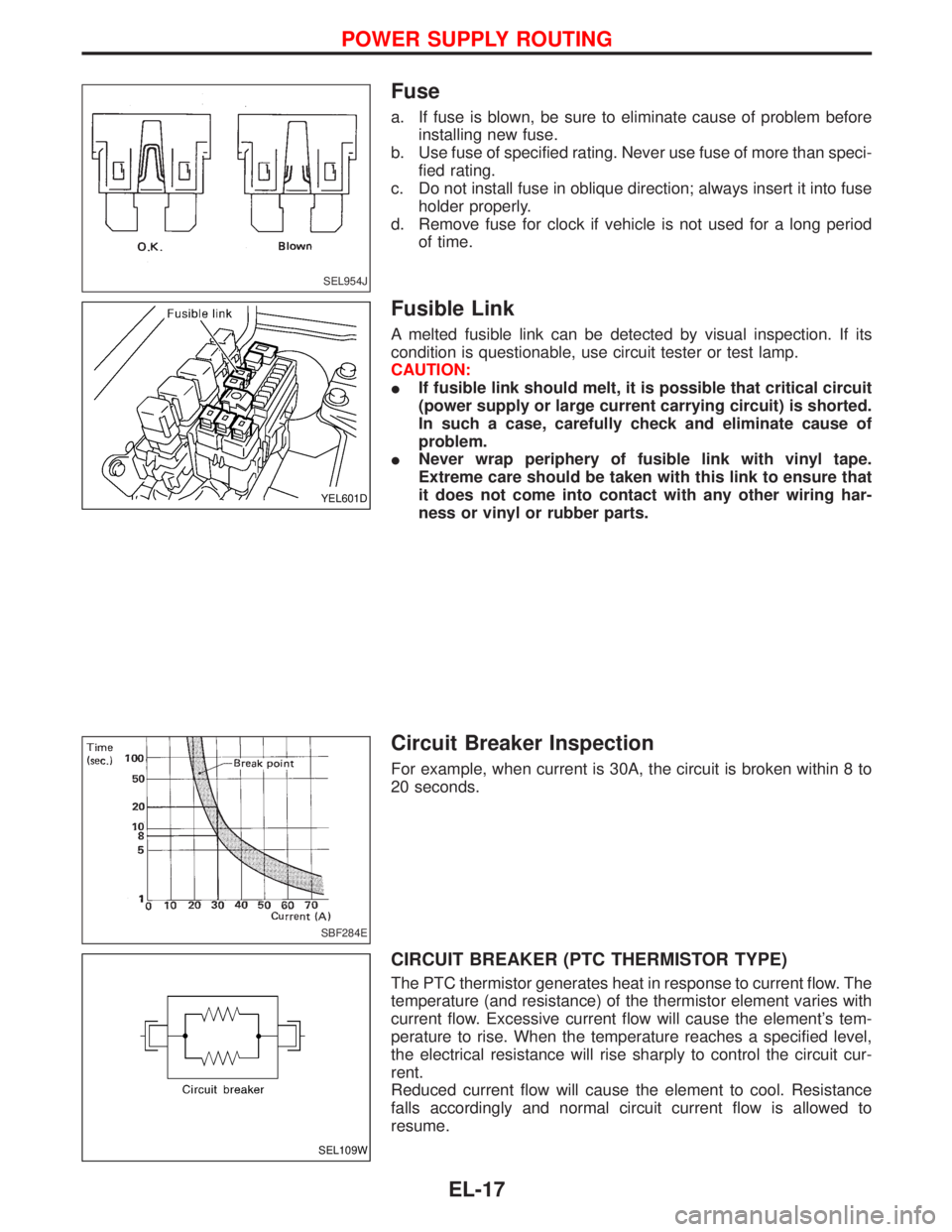
Fuse
a. If fuse is blown, be sure to eliminate cause of problem before
installing new fuse.
b. Use fuse of specified rating. Never use fuse of more than speci-
fied rating.
c. Do not install fuse in oblique direction; always insert it into fuse
holder properly.
d. Remove fuse for clock if vehicle is not used for a long period
of time.
Fusible Link
A melted fusible link can be detected by visual inspection. If its
condition is questionable, use circuit tester or test lamp.
CAUTION:
IIf fusible link should melt, it is possible that critical circuit
(power supply or large current carrying circuit) is shorted.
In such a case, carefully check and eliminate cause of
problem.
INever wrap periphery of fusible link with vinyl tape.
Extreme care should be taken with this link to ensure that
it does not come into contact with any other wiring har-
ness or vinyl or rubber parts.
Circuit Breaker Inspection
For example, when current is 30A, the circuit is broken within 8 to
20 seconds.
CIRCUIT BREAKER (PTC THERMISTOR TYPE)
The PTC thermistor generates heat in response to current flow. The
temperature (and resistance) of the thermistor element varies with
current flow. Excessive current flow will cause the element's tem-
perature to rise. When the temperature reaches a specified level,
the electrical resistance will rise sharply to control the circuit cur-
rent.
Reduced current flow will cause the element to cool. Resistance
falls accordingly and normal circuit current flow is allowed to
resume.
SEL954J
YEL601D
SBF284E
SEL109W
POWER SUPPLY ROUTING
EL-17
Page 859 of 1767
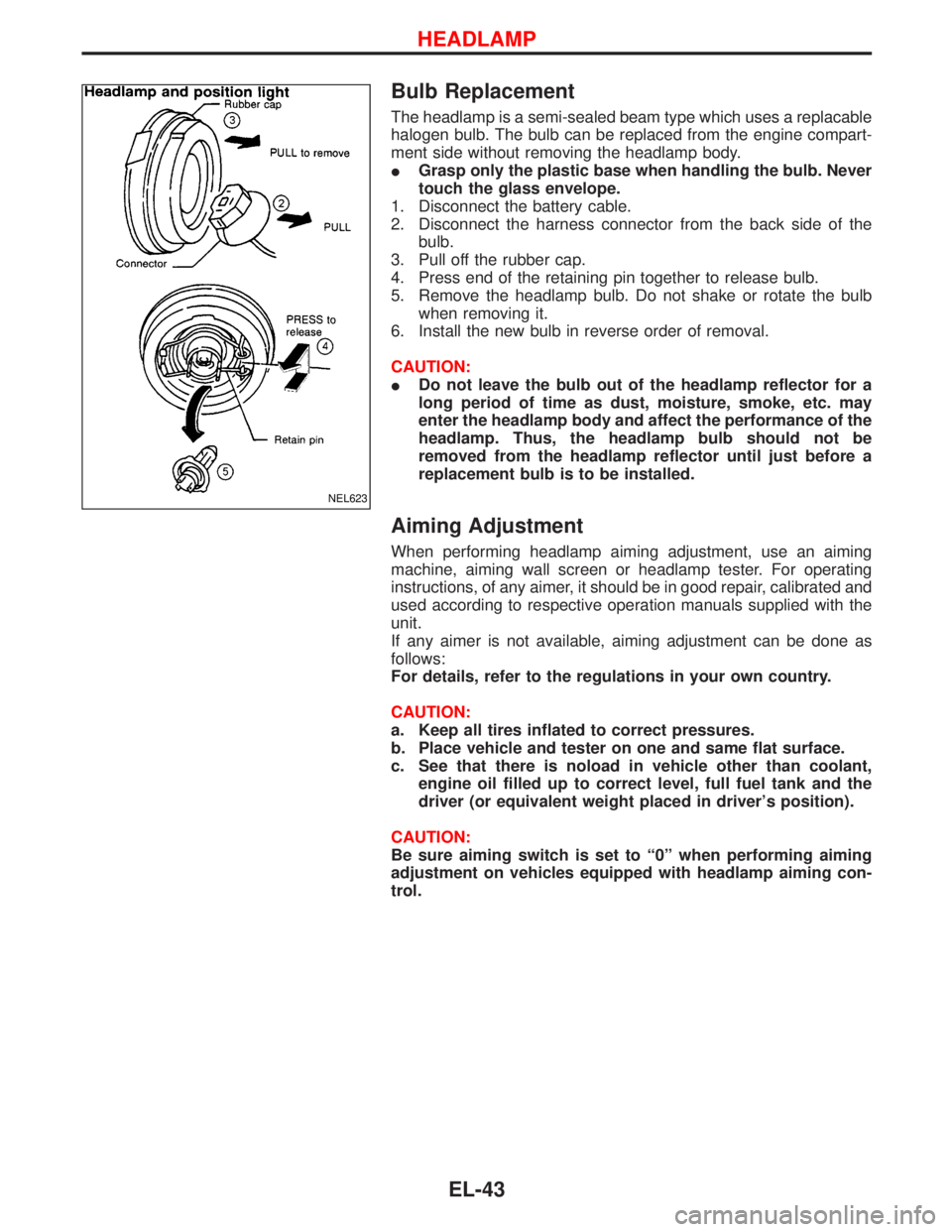
Bulb Replacement
The headlamp is a semi-sealed beam type which uses a replacable
halogen bulb. The bulb can be replaced from the engine compart-
ment side without removing the headlamp body.
IGrasp only the plastic base when handling the bulb. Never
touch the glass envelope.
1. Disconnect the battery cable.
2. Disconnect the harness connector from the back side of the
bulb.
3. Pull off the rubber cap.
4. Press end of the retaining pin together to release bulb.
5. Remove the headlamp bulb. Do not shake or rotate the bulb
when removing it.
6. Install the new bulb in reverse order of removal.
CAUTION:
IDo not leave the bulb out of the headlamp reflector for a
long period of time as dust, moisture, smoke, etc. may
enter the headlamp body and affect the performance of the
headlamp. Thus, the headlamp bulb should not be
removed from the headlamp reflector until just before a
replacement bulb is to be installed.
Aiming Adjustment
When performing headlamp aiming adjustment, use an aiming
machine, aiming wall screen or headlamp tester. For operating
instructions, of any aimer, it should be in good repair, calibrated and
used according to respective operation manuals supplied with the
unit.
If any aimer is not available, aiming adjustment can be done as
follows:
For details, refer to the regulations in your own country.
CAUTION:
a. Keep all tires inflated to correct pressures.
b. Place vehicle and tester on one and same flat surface.
c. See that there is noload in vehicle other than coolant,
engine oil filled up to correct level, full fuel tank and the
driver (or equivalent weight placed in driver's position).
CAUTION:
Be sure aiming switch is set to ª0º when performing aiming
adjustment on vehicles equipped with headlamp aiming con-
trol.
NEL623
HEADLAMP
EL-43
Page 975 of 1767
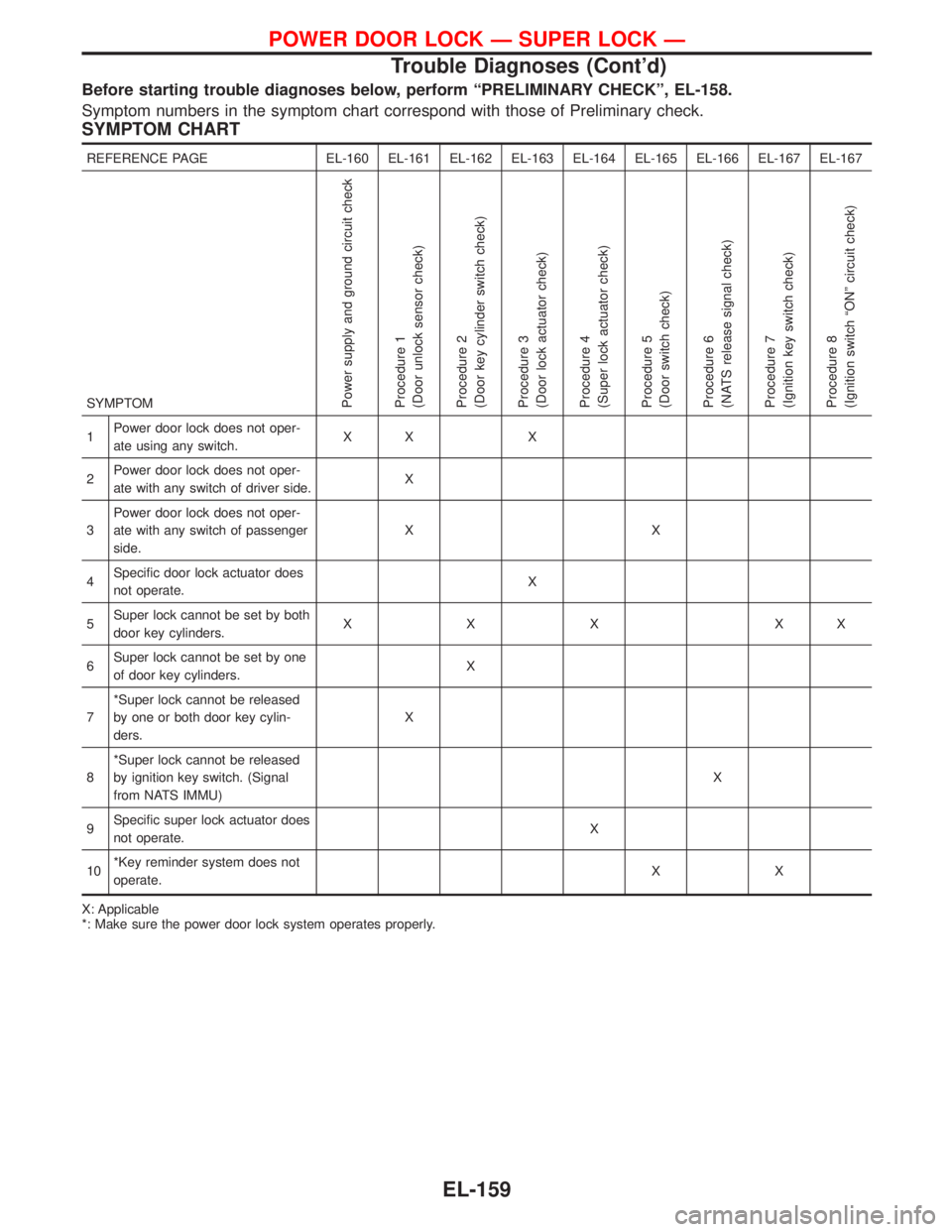
Before starting trouble diagnoses below, perform ªPRELIMINARY CHECKº, EL-158.
Symptom numbers in the symptom chart correspond with those of Preliminary check.
SYMPTOM CHART
REFERENCE PAGE EL-160 EL-161 EL-162 EL-163 EL-164 EL-165 EL-166 EL-167 EL-167
SYMPTOM
Power supply and ground circuit check
Procedure 1
(Door unlock sensor check)
Procedure 2
(Door key cylinder switch check)
Procedure 3
(Door lock actuator check)
Procedure 4
(Super lock actuator check)
Procedure 5
(Door switch check)
Procedure 6
(NATS release signal check)
Procedure 7
(Ignition key switch check)
Procedure 8
(Ignition switch ªONº circuit check)
1Power door lock does not oper-
ate using any switch.XX X
2Power door lock does not oper-
ate with any switch of driver side.X
3Power door lock does not oper-
ate with any switch of passenger
side.XX
4Specific door lock actuator does
not operate.X
5Super lock cannot be set by both
door key cylinders.XXX XX
6Super lock cannot be set by one
of door key cylinders.X
7*Super lock cannot be released
by one or both door key cylin-
ders.X
8*Super lock cannot be released
by ignition key switch. (Signal
from NATS IMMU)X
9Specific super lock actuator does
not operate.X
10*Key reminder system does not
operate.XX
X: Applicable
*: Make sure the power door lock system operates properly.
POWER DOOR LOCK Ð SUPER LOCK Ð
Trouble Diagnoses (Cont'd)
EL-159
Page 1048 of 1767
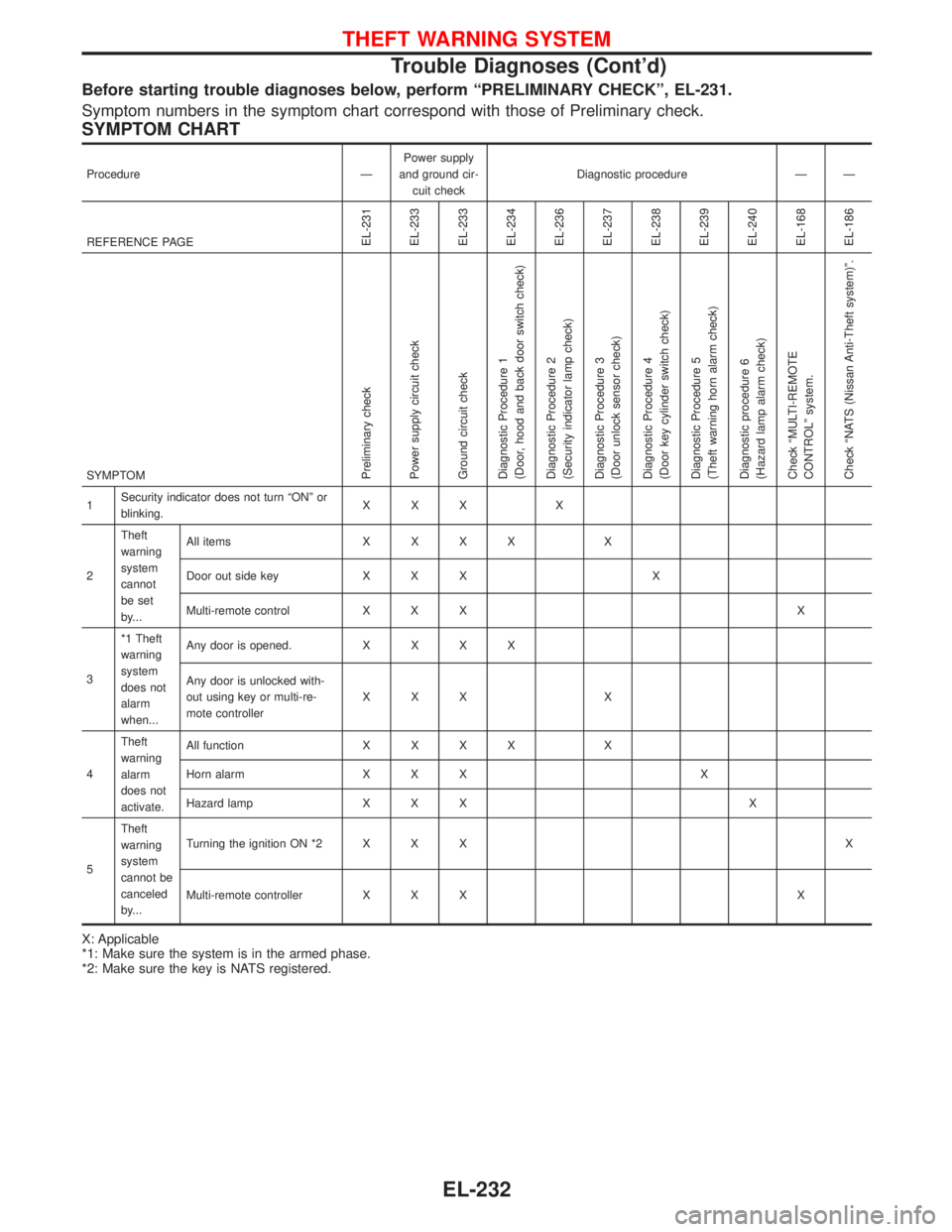
Before starting trouble diagnoses below, perform ªPRELIMINARY CHECKº, EL-231.
Symptom numbers in the symptom chart correspond with those of Preliminary check.
SYMPTOM CHART
Procedure ÐPower supply
and ground cir-
cuit checkDiagnostic procedure Ð Ð
REFERENCE PAGE
EL-231
EL-233
EL-233
EL-234
EL-236
EL-237
EL-238
EL-239
EL-240
EL-168
EL-186
SYMPTOMPreliminary check
Power supply circuit check
Ground circuit check
Diagnostic Procedure 1
(Door, hood and back door switch check)
Diagnostic Procedure 2
(Security indicator lamp check)
Diagnostic Procedure 3
(Door unlock sensor check)
Diagnostic Procedure 4
(Door key cylinder switch check)
Diagnostic Procedure 5
(Theft warning horn alarm check)
Diagnostic procedure 6
(Hazard lamp alarm check)
Check ªMULTI-REMOTE
CONTROLº system.
Check ªNATS (Nissan Anti-Theft system)º.
1Security indicator does not turn ªONº or
blinking.XXX X
2Theft
warning
system
cannot
be set
by...All itemsXXXX X
Door out side key X X X X
Multi-remote control X X X X
3*1 Theft
warning
system
does not
alarm
when...Any door is opened.XXXX
Any door is unlocked with-
out using key or multi-re-
mote controllerXXX X
4Theft
warning
alarm
does not
activate.All functionXXXX X
Horn alarm X X X X
Hazard lamp X X X X
5Theft
warning
system
cannot be
canceled
by...Turning the ignition ON *2 X X XX
Multi-remote controller X X X X
X: Applicable
*1: Make sure the system is in the armed phase.
*2: Make sure the key is NATS registered.
THEFT WARNING SYSTEM
Trouble Diagnoses (Cont'd)
EL-232
Page 1158 of 1767
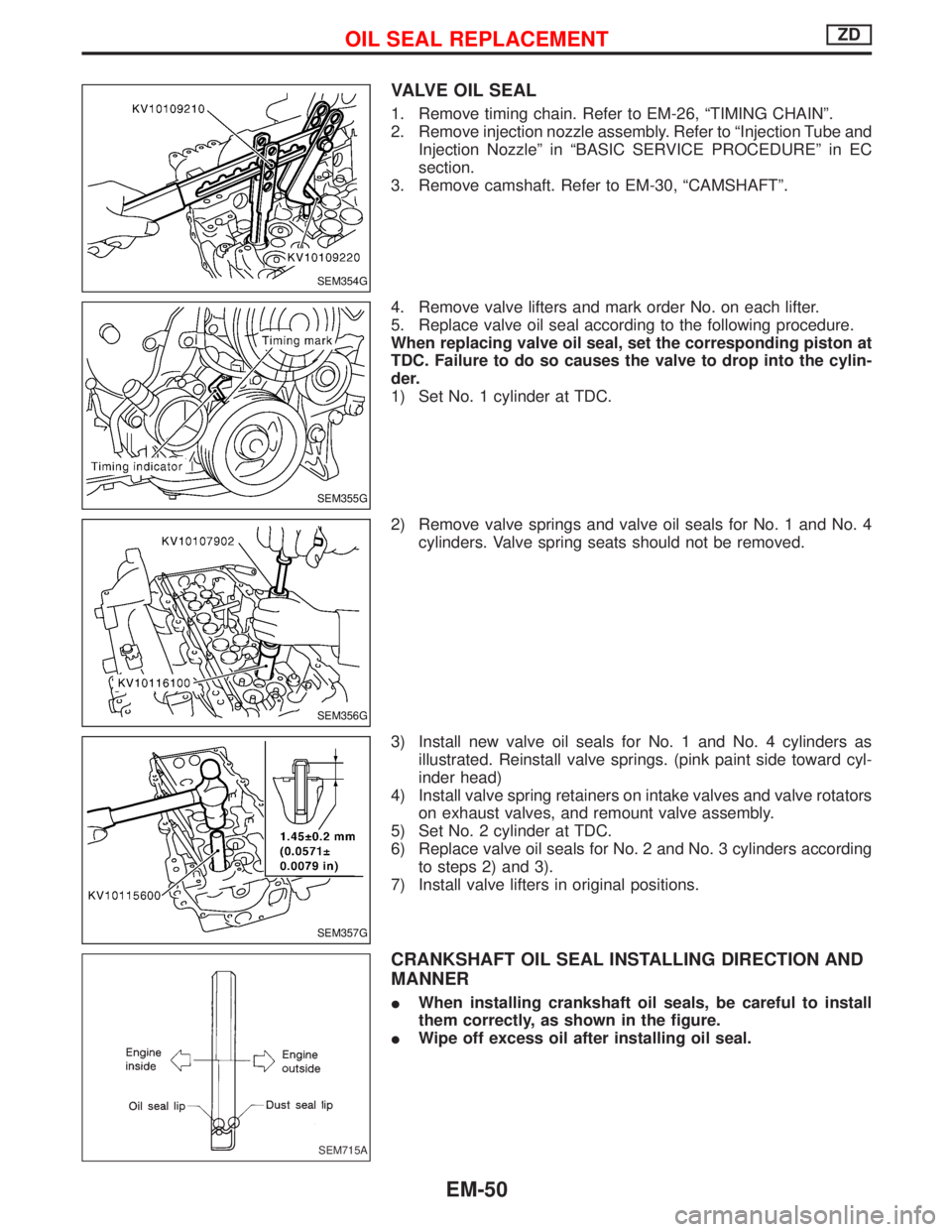
VALVE OIL SEAL
1. Remove timing chain. Refer to EM-26, ªTIMING CHAINº.
2. Remove injection nozzle assembly. Refer to ªInjection Tube and
Injection Nozzleº in ªBASIC SERVICE PROCEDUREº in EC
section.
3. Remove camshaft. Refer to EM-30, ªCAMSHAFTº.
4. Remove valve lifters and mark order No. on each lifter.
5. Replace valve oil seal according to the following procedure.
When replacing valve oil seal, set the corresponding piston at
TDC. Failure to do so causes the valve to drop into the cylin-
der.
1) Set No. 1 cylinder at TDC.
2) Remove valve springs and valve oil seals for No. 1 and No. 4
cylinders. Valve spring seats should not be removed.
3) Install new valve oil seals for No. 1 and No. 4 cylinders as
illustrated. Reinstall valve springs. (pink paint side toward cyl-
inder head)
4) Install valve spring retainers on intake valves and valve rotators
on exhaust valves, and remount valve assembly.
5) Set No. 2 cylinder at TDC.
6) Replace valve oil seals for No. 2 and No. 3 cylinders according
to steps 2) and 3).
7) Install valve lifters in original positions.
CRANKSHAFT OIL SEAL INSTALLING DIRECTION AND
MANNER
IWhen installing crankshaft oil seals, be careful to install
them correctly, as shown in the figure.
IWipe off excess oil after installing oil seal.
SEM354G
SEM355G
SEM356G
SEM357G
SEM715A
OIL SEAL REPLACEMENTZD
EM-50
Page 1160 of 1767
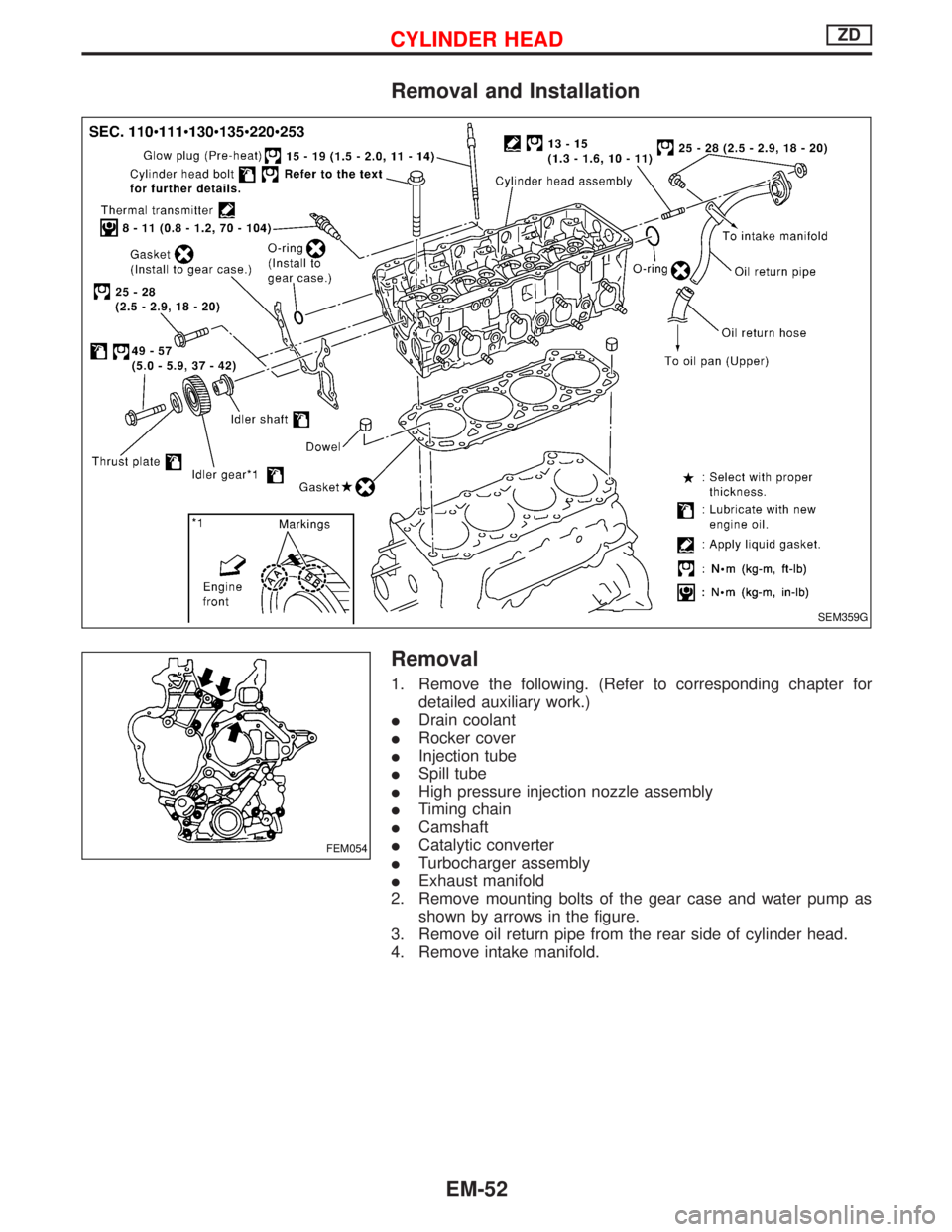
Removal and Installation
Removal
1. Remove the following. (Refer to corresponding chapter for
detailed auxiliary work.)
IDrain coolant
IRocker cover
IInjection tube
ISpill tube
IHigh pressure injection nozzle assembly
ITiming chain
ICamshaft
ICatalytic converter
ITurbocharger assembly
IExhaust manifold
2. Remove mounting bolts of the gear case and water pump as
shown by arrows in the figure.
3. Remove oil return pipe from the rear side of cylinder head.
4. Remove intake manifold.
SEM359G
FEM054
CYLINDER HEADZD
EM-52