engine NISSAN TERRANO 2002 Service Repair Manual
[x] Cancel search | Manufacturer: NISSAN, Model Year: 2002, Model line: TERRANO, Model: NISSAN TERRANO 2002Pages: 1767, PDF Size: 41.51 MB
Page 1547 of 1767
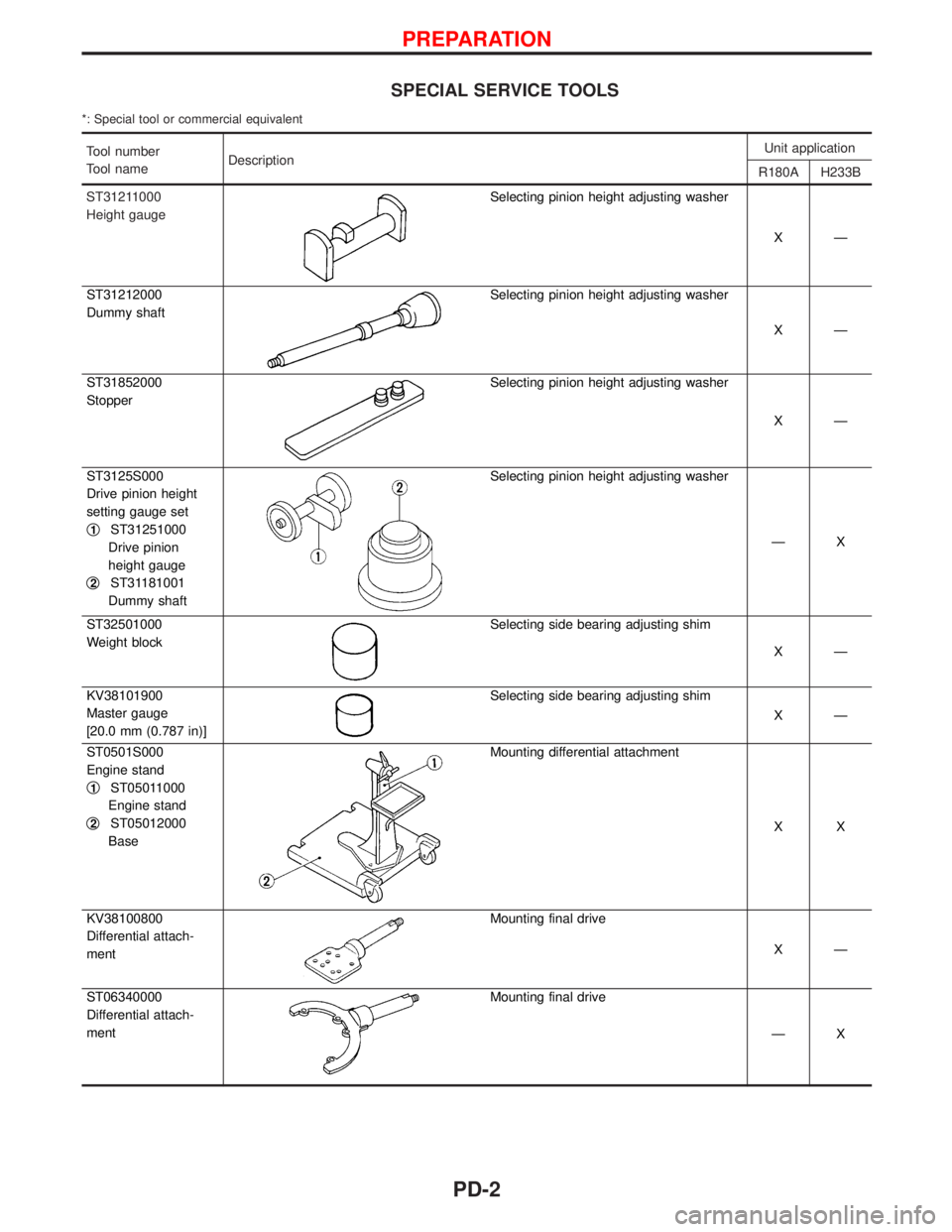
SPECIAL SERVICE TOOLS
*: Special tool or commercial equivalent
Tool number
Tool nameDescriptionUnit application
R180A H233B
ST31211000
Height gauge
Selecting pinion height adjusting washer
XÐ
ST31212000
Dummy shaft
Selecting pinion height adjusting washer
XÐ
ST31852000
Stopper
Selecting pinion height adjusting washer
XÐ
ST3125S000
Drive pinion height
setting gauge set
q
1ST31251000
Drive pinion
height gauge
q
2ST31181001
Dummy shaft
Selecting pinion height adjusting washer
ÐX
ST32501000
Weight block
Selecting side bearing adjusting shim
XÐ
KV38101900
Master gauge
[20.0 mm (0.787 in)]
Selecting side bearing adjusting shim
XÐ
ST0501S000
Engine stand
q
1ST05011000
Engine stand
q
2ST05012000
Base
Mounting differential attachment
XX
KV38100800
Differential attach-
ment
Mounting final drive
XÐ
ST06340000
Differential attach-
ment
Mounting final drive
ÐX
PREPARATION
PD-2
Page 1557 of 1767
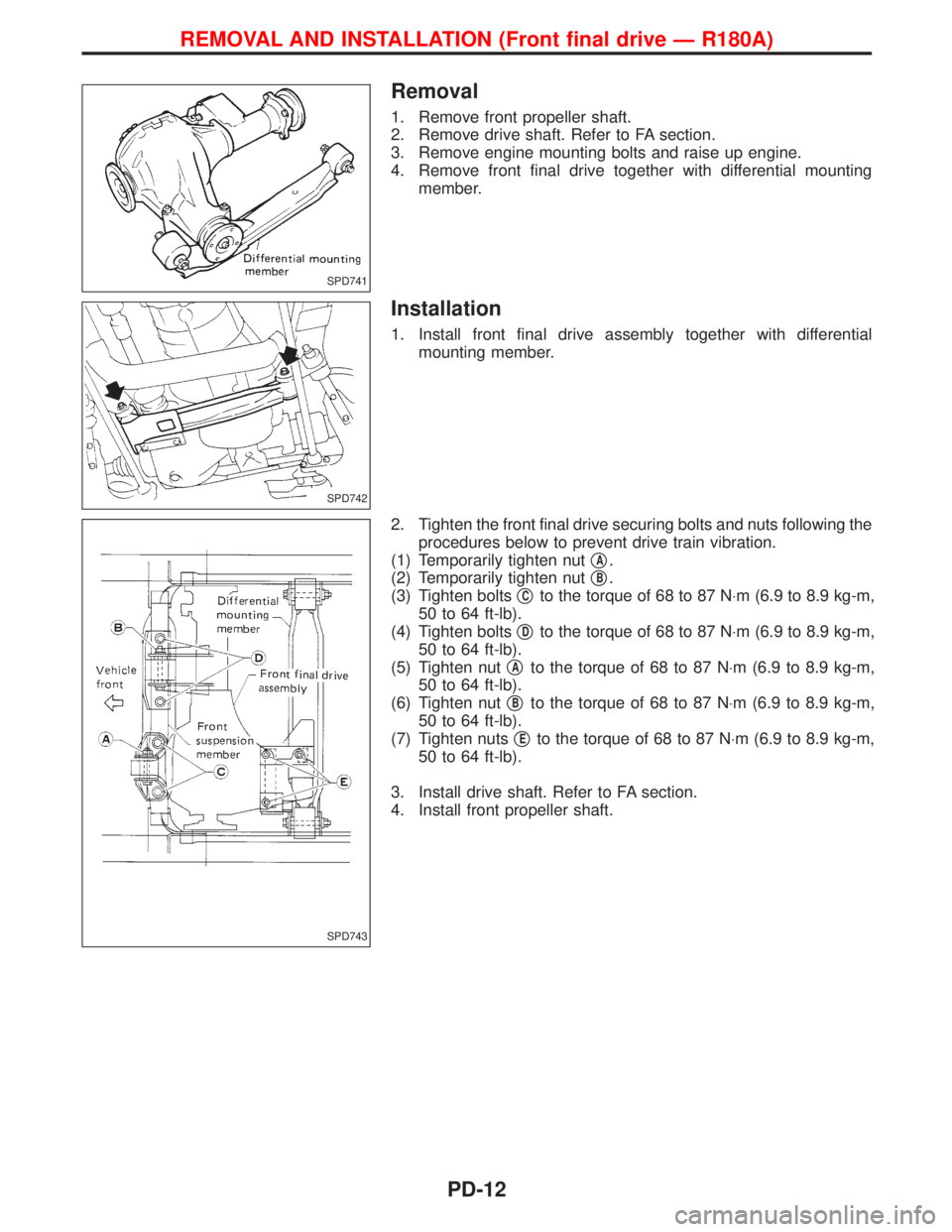
Removal
1. Remove front propeller shaft.
2. Remove drive shaft. Refer to FA section.
3. Remove engine mounting bolts and raise up engine.
4. Remove front final drive together with differential mounting
member.
Installation
1. Install front final drive assembly together with differential
mounting member.
2. Tighten the front final drive securing bolts and nuts following the
procedures below to prevent drive train vibration.
(1) Temporarily tighten nutq
A.
(2) Temporarily tighten nutq
B.
(3) Tighten boltsq
Cto the torque of 68 to 87 N×m (6.9 to 8.9 kg-m,
50 to 64 ft-lb).
(4) Tighten boltsq
Dto the torque of 68 to 87 N×m (6.9 to 8.9 kg-m,
50 to 64 ft-lb).
(5) Tighten nutq
Ato the torque of 68 to 87 N×m (6.9 to 8.9 kg-m,
50 to 64 ft-lb).
(6) Tighten nutq
Bto the torque of 68 to 87 N×m (6.9 to 8.9 kg-m,
50 to 64 ft-lb).
(7) Tighten nutsq
Eto the torque of 68 to 87 N×m (6.9 to 8.9 kg-m,
50 to 64 ft-lb).
3. Install drive shaft. Refer to FA section.
4. Install front propeller shaft.
SPD741
SPD742
SPD743
REMOVAL AND INSTALLATION (Front final drive Ð R180A)
PD-12
Page 1588 of 1767
CAUTION:
Do not run engine when one rear wheel is off the ground.
Preparation for Disassembly
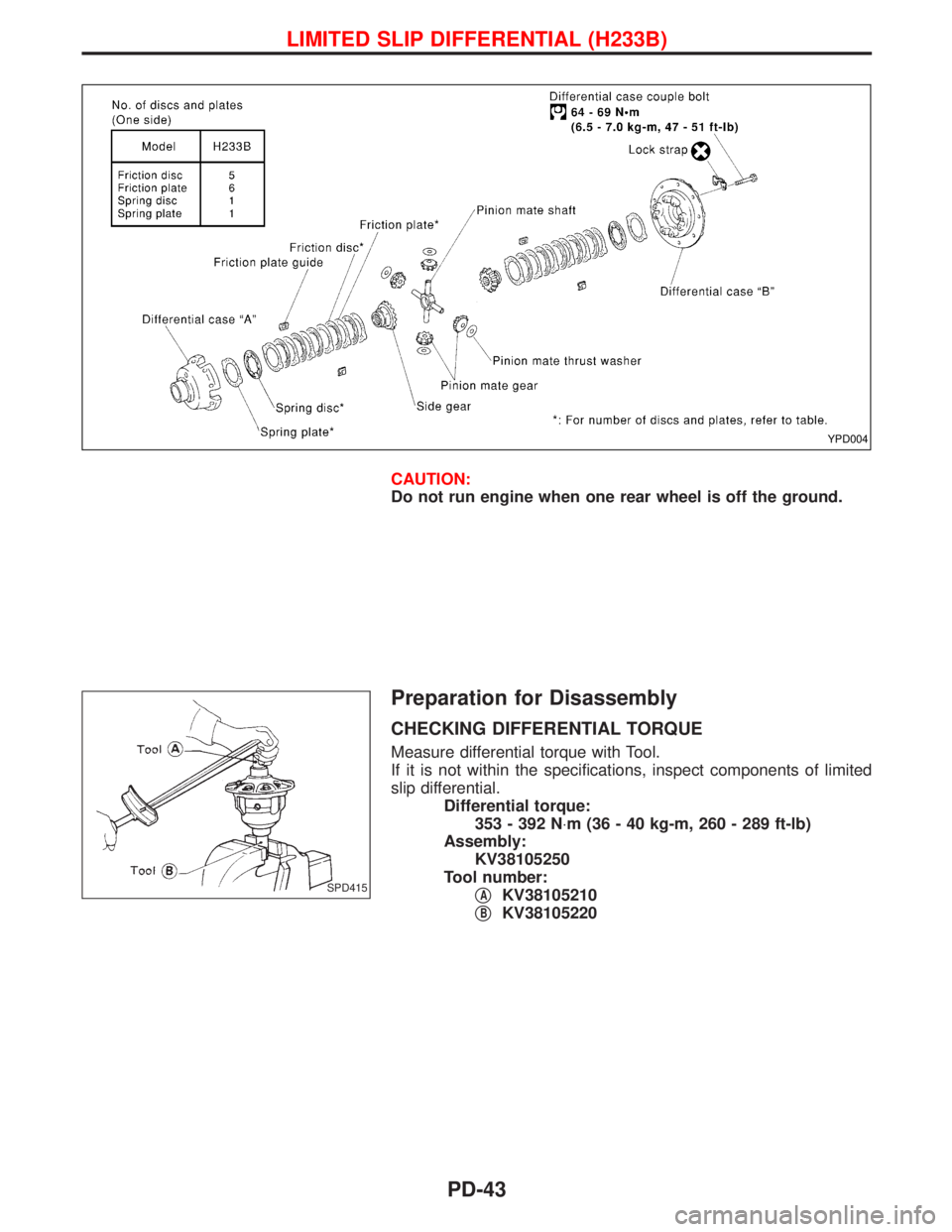
CHECKING DIFFERENTIAL TORQUE
Measure differential torque with Tool.
If it is not within the specifications, inspect components of limited
slip differential.
Differential torque:
353 - 392 N×m (36 - 40 kg-m, 260 - 289 ft-lb)
Assembly:
KV38105250
Tool number:
q
AKV38105210
q
BKV38105220
YPD004
SPD415
LIMITED SLIP DIFFERENTIAL (H233B)
PD-43
Page 1607 of 1767
Precautions
IWhen installing each rubber part, final tightening must be car-
ried out under unladen condition* with tires on ground.
* Fuel, radiator coolant and engine oil full. Spare tire, jack,
hand tools and mats in designated positions.
IUse Tool when removing or installing brake tubes.
IIf suspension or suspension parts are dismounted, check wheel
alignment and adjust if necessary.
IDo not jack up vehicle at lower link.
Preparation
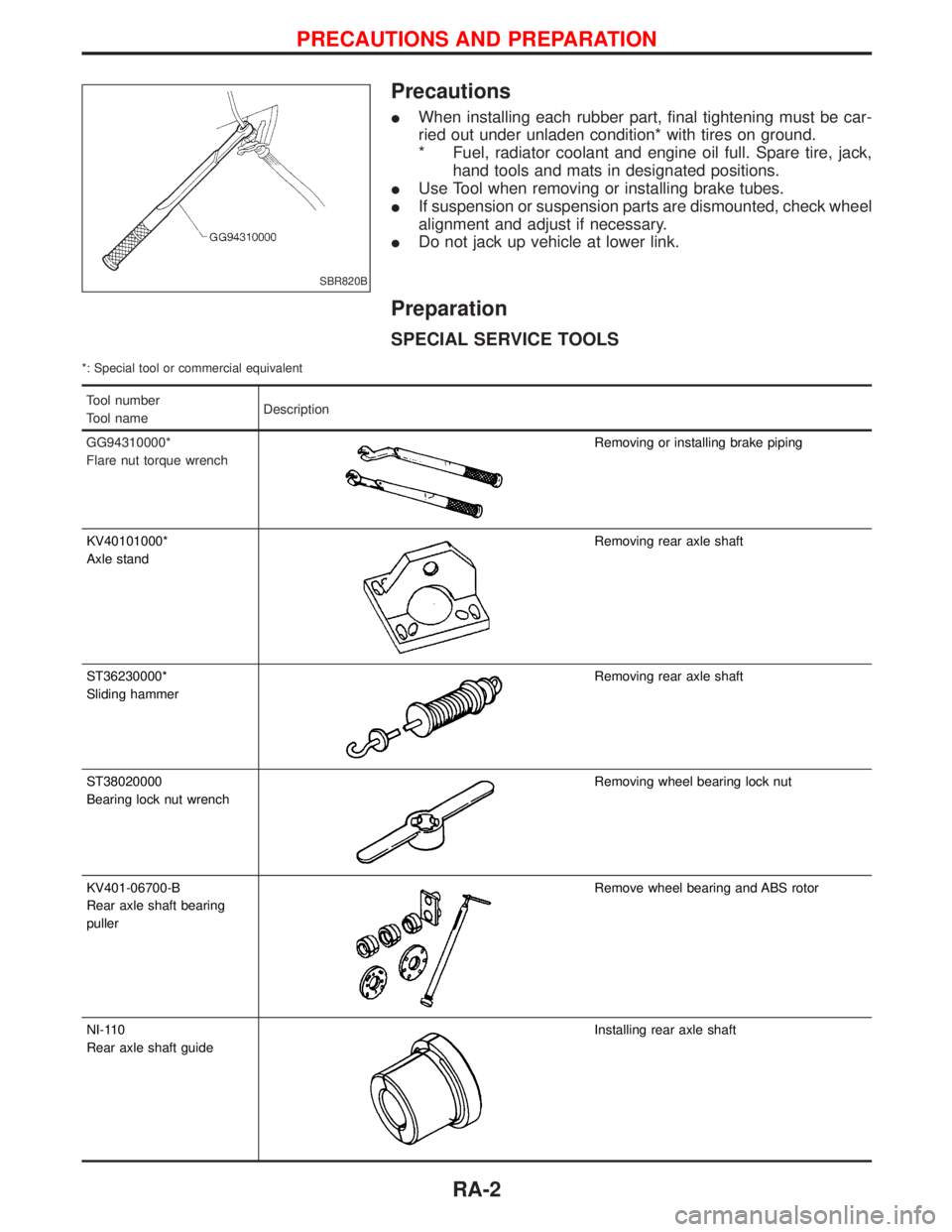
SPECIAL SERVICE TOOLS
*: Special tool or commercial equivalent
Tool number
Tool nameDescription
GG94310000*
Flare nut torque wrench
Removing or installing brake piping
KV40101000*
Axle stand
Removing rear axle shaft
ST36230000*
Sliding hammer
Removing rear axle shaft
ST38020000
Bearing lock nut wrench
Removing wheel bearing lock nut
KV401-06700-B
Rear axle shaft bearing
puller
Remove wheel bearing and ABS rotor
NI-110
Rear axle shaft guide
Installing rear axle shaft
SBR820B
PRECAUTIONS AND PREPARATION
RA-2
Page 1684 of 1767
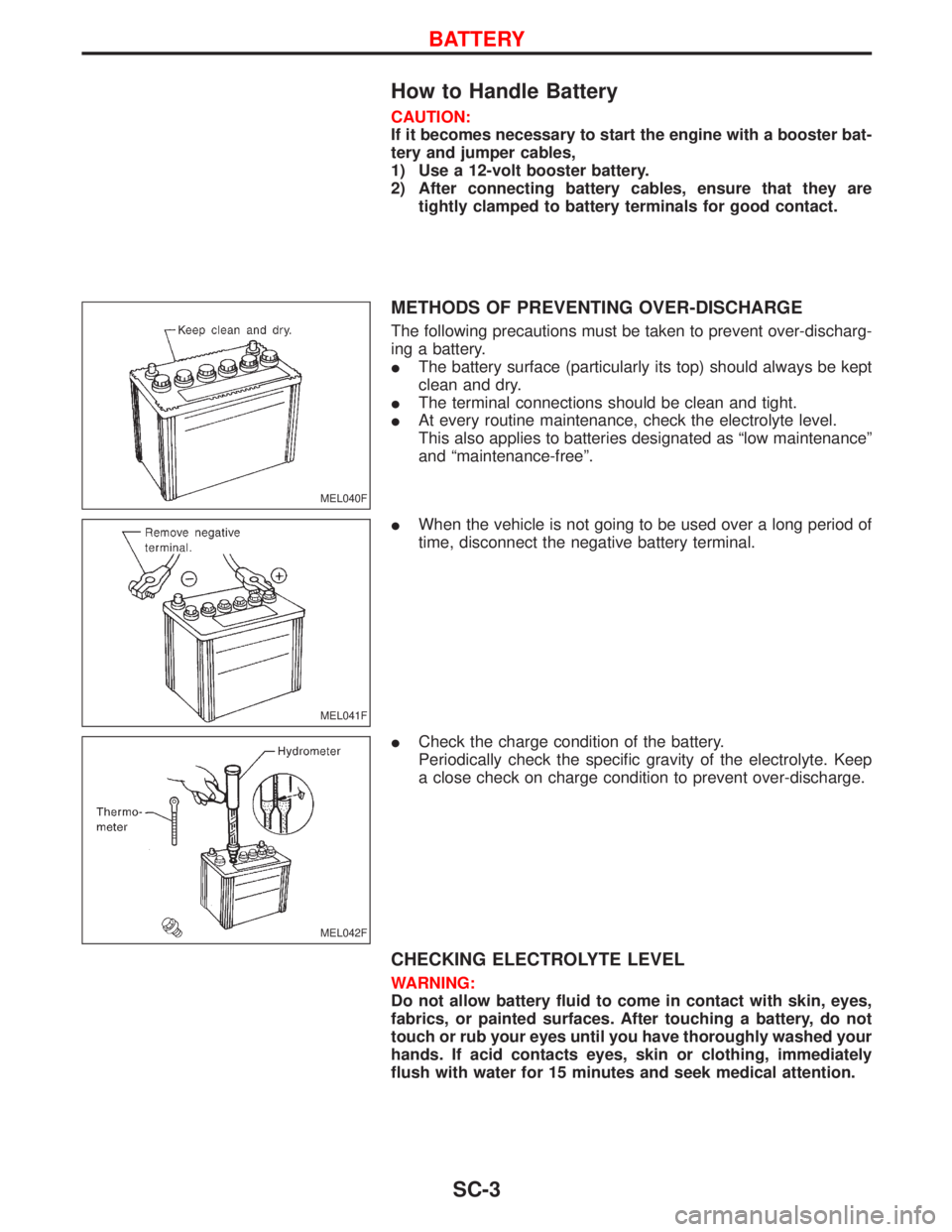
How to Handle Battery
CAUTION:
If it becomes necessary to start the engine with a booster bat-
tery and jumper cables,
1) Use a 12-volt booster battery.
2) After connecting battery cables, ensure that they are
tightly clamped to battery terminals for good contact.
METHODS OF PREVENTING OVER-DISCHARGE
The following precautions must be taken to prevent over-discharg-
ing a battery.
IThe battery surface (particularly its top) should always be kept
clean and dry.
IThe terminal connections should be clean and tight.
IAt every routine maintenance, check the electrolyte level.
This also applies to batteries designated as ªlow maintenanceº
and ªmaintenance-freeº.
IWhen the vehicle is not going to be used over a long period of
time, disconnect the negative battery terminal.
ICheck the charge condition of the battery.
Periodically check the specific gravity of the electrolyte. Keep
a close check on charge condition to prevent over-discharge.
CHECKING ELECTROLYTE LEVEL
WARNING:
Do not allow battery fluid to come in contact with skin, eyes,
fabrics, or painted surfaces. After touching a battery, do not
touch or rub your eyes until you have thoroughly washed your
hands. If acid contacts eyes, skin or clothing, immediately
flush with water for 15 minutes and seek medical attention.
MEL040F
MEL041F
MEL042F
BATTERY
SC-3
Page 1694 of 1767
System Description
M/T MODELS
Power is supplied at all times
Ithrough 40A fusible link (letterC, located in the fuse and fusible link box)
Ito ignition switch terminal 1.
With the ignition switch in START position, power is supplied
Ifrom ignition switch terminal 1
Ito starter motor harness connector terminal 4.
The starter motor plunger closes and provides a closed circuit between the battery and starter motor. The
starter motor is grounded to the engine block. With power and ground supplied, cranking occurs and the engine
starts.
A/T MODELS
Power is supplied at all times
Ithrough 40A fusible link (letterC, located in the fuse and fusible link box)
Ito ignition switch terminal 1.
With the ignition switch in the START position, power is supplied
Ifrom ignition switch terminal 1
Ito park/neutral position relay terminal 4.
With the ignition switch ON or START position, power is supplied
Ithrough 10A fuse [No. 8, located in the fuse block (J/B)]
Ito park/neutral position (PNP) relay terminal 1.
With the selector lever in the P or N position, ground is supplied
Ito park/neutral position relay terminal 2 through the park/neutral position switch
Ifrom body grounds, M754 and M33.
Then park/neutral position relay is energized and power is supplied
Ifrom park/neutral position relay terminal 3
Ito starter motor harness connector terminal 1.
The starter motor plunger closes and provides a closed circuit between the battery and starter motor. The
starter motor is grounded to the engine block. With power and ground supplied, cranking occurs and the engine
starts.
STARTING SYSTEM
SC-13
Page 1695 of 1767
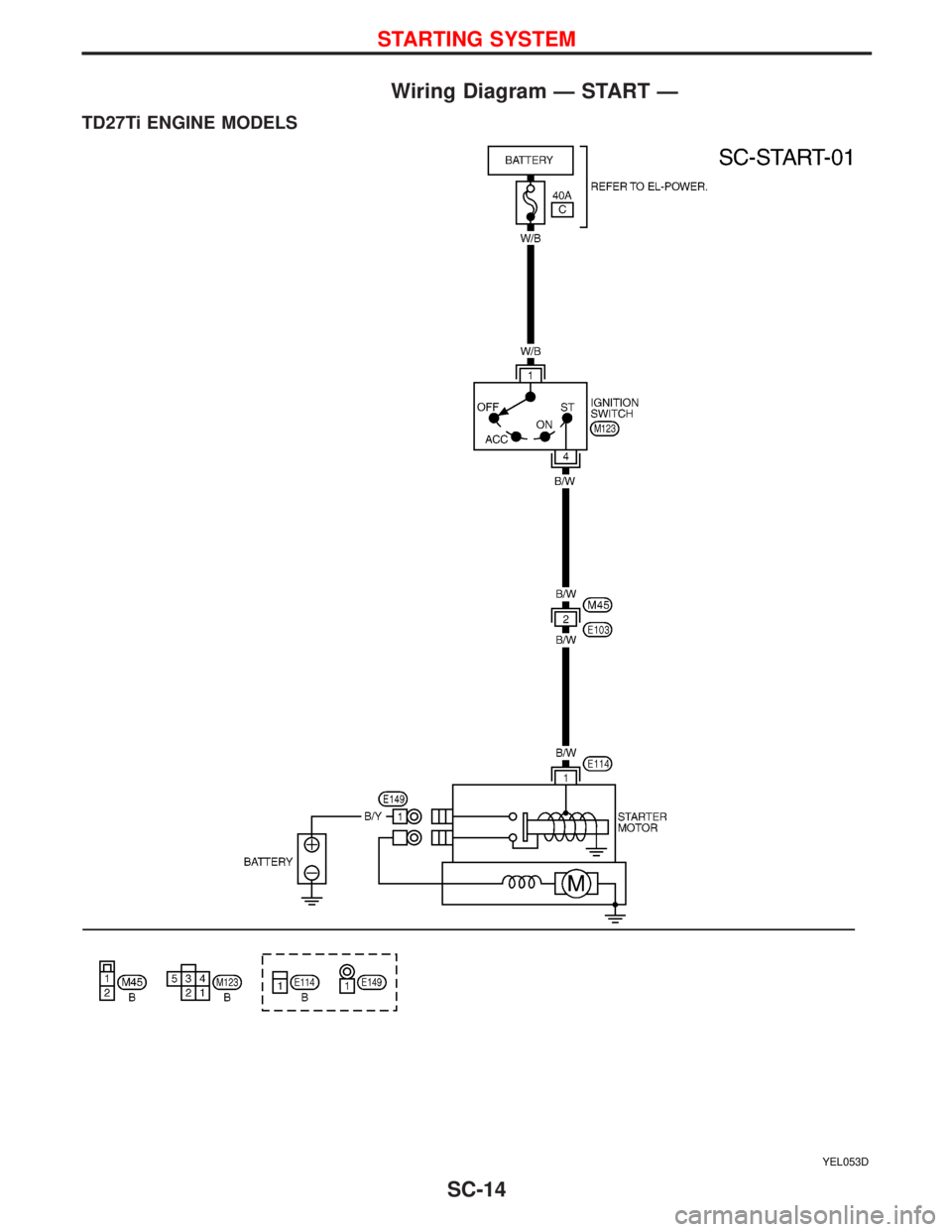
Wiring Diagram Ð START Ð
TD27Ti ENGINE MODELS
YEL053D
STARTING SYSTEM
SC-14
Page 1696 of 1767

ZD30DDTi ENGINE MODELS
YEL054D
STARTING SYSTEM
Wiring Diagram Ð START Ð (Cont'd)
SC-15
Page 1704 of 1767
System Description
The alternator provides DC voltage to operate the vehicle's electrical system and to keep the battery charged.
The voltage output is controlled by the IC regulator.
Power is supplied at all times to alternator terminal 4 (S) through:
I10A fuse (No. 31, located in the fuse and fusible link box).
Terminal B supplies power to charge the battery and operate the vehicle's electrical system. Output voltage
is controlled by the IC regulator at terminal 4 (S) detecting the input voltage (ZD30DDTi engine models). The
charging circuit is protected by the 100A (A/T models) fusible link.
The alternator is grounded to the engine block.
With the ignition switch in the ON or START position, power is supplied
Ithrough 10A fuse [No. 12, located in the fuse block (J/B)]
Ito combination meter terminal 28 for the charge warning lamp.
Ground is supplied to terminal 2 of the combination meter through terminal 1(L) (TD27Ti engine models) or
3(L) (ZD30DDTi engine model) of the alternator. With power and ground supplied, the charge warning lamp
will illuminate. When the alternator is providing sufficient voltage with the engine running, the ground is opened
and the charge warning lamp will go off.
If the charge warning lamp illuminates with the engine running, a malfunction is indicated.
CHARGING SYSTEM
SC-23
Page 1705 of 1767
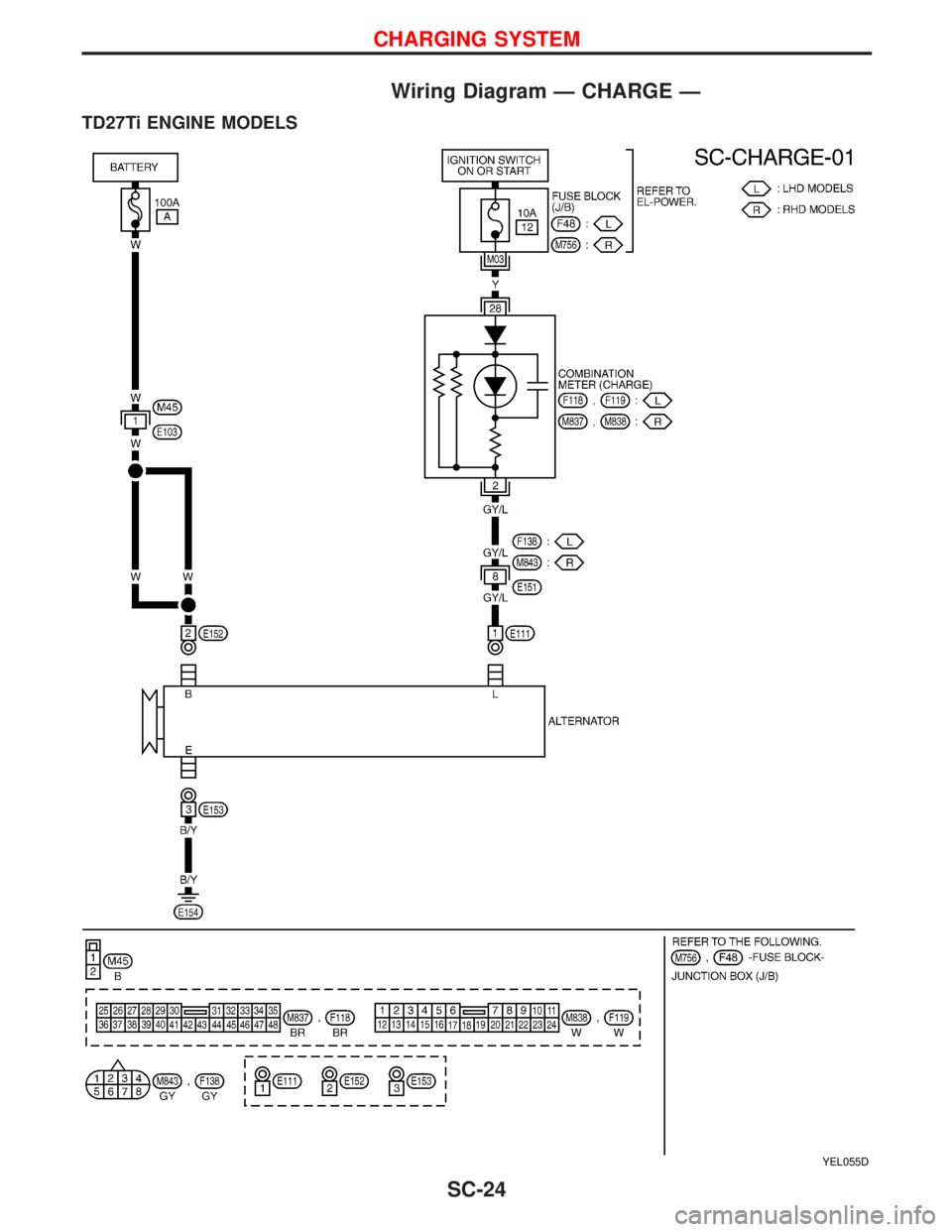
Wiring Diagram Ð CHARGE Ð
TD27Ti ENGINE MODELS
YEL055D
CHARGING SYSTEM
SC-24